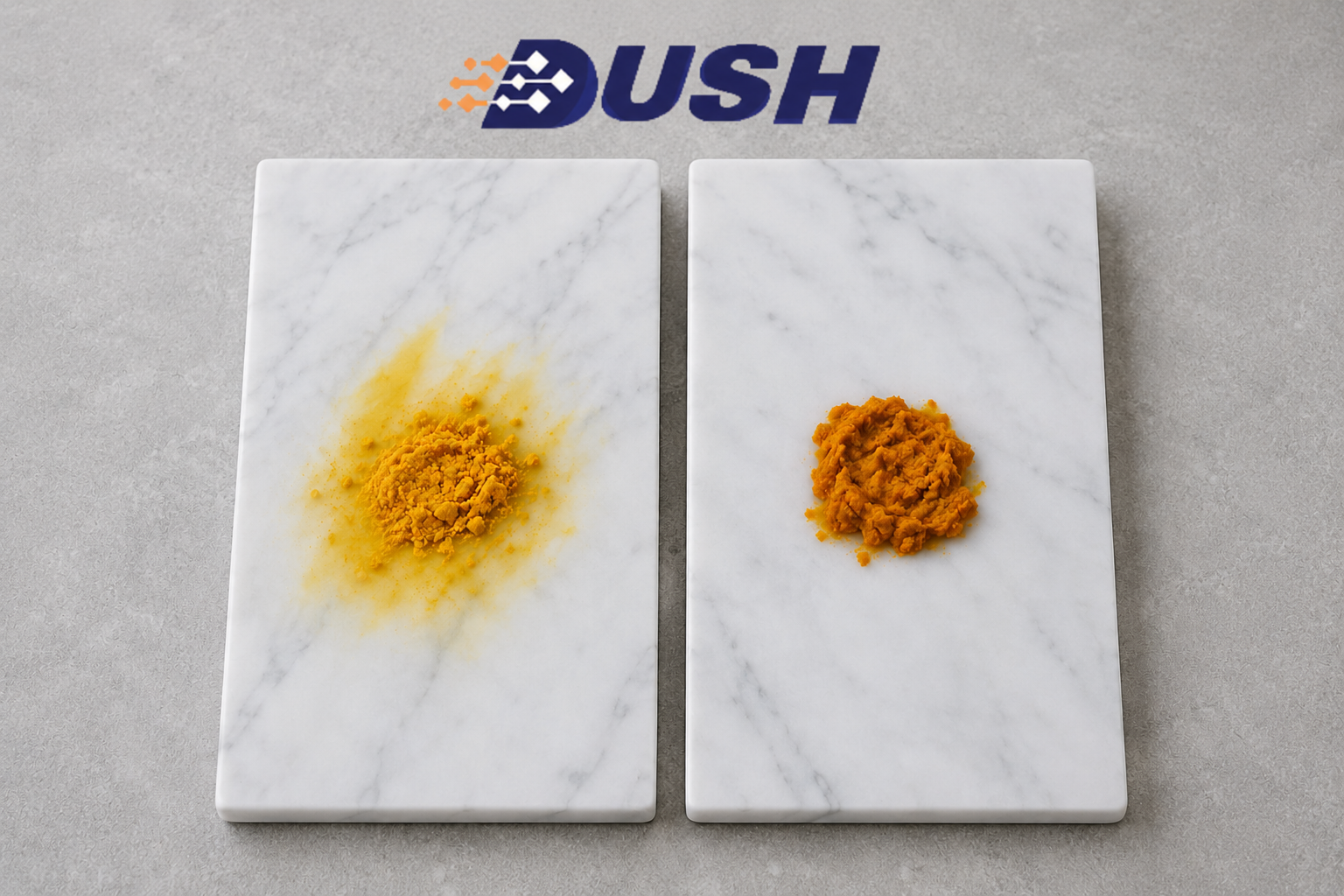
Italian marble gets stains for one clear, explainable reason: it is porous, not because it is poorly maintained. That single fact gets buried under generic cleaning advice on most marble websites, which is why homeowners keep losing the fight against turmeric marks, coffee rings, and yellowing patches even after following every tip they could find.
This article goes deeper than “blot the spill and use baking soda.” It explains the actual mineral structure that causes staining, why most sealants quietly stop working within a year or two, which specific stains require which specific treatment, and how to verify — before you spend a single rupee — whether a protective treatment will actually hold up on your marble.
Why Italian Marble Stains in the First Place
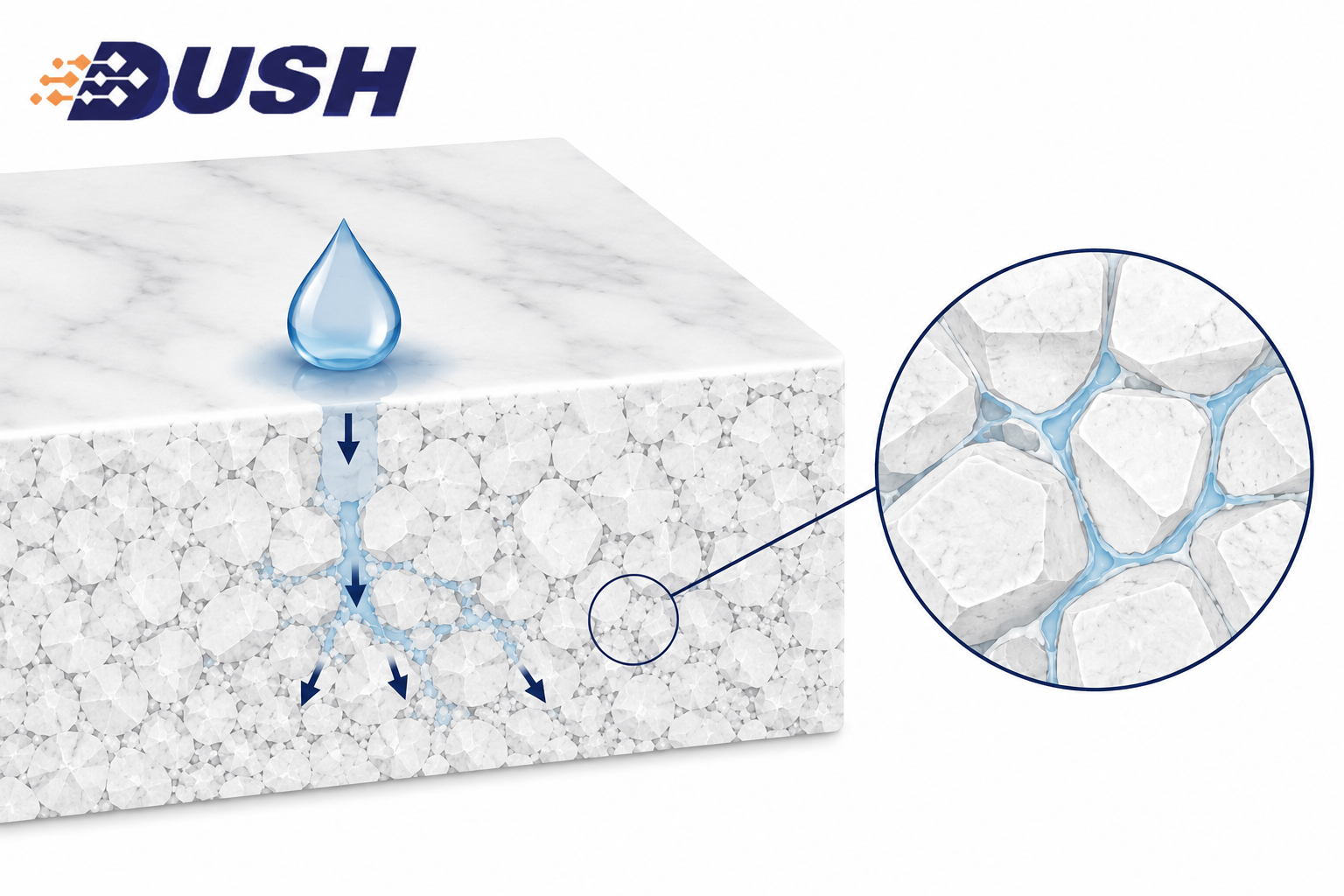
Italian marble (Carrara, Statuario, Calacatta, and similar varieties) is a metamorphic rock formed from recrystallized calcite. Calcite crystals lock together under heat and pressure, but the resulting structure is never completely sealed. Microscopic channels remain between the crystals, and through capillary action, liquids get pulled into those channels rather than sitting on the surface.
This is fundamentally different from how stains work on tile, granite, or engineered quartz. On marble, three properties combine to create the staining problem:
| Property | What It Means for Stains |
|---|---|
| Porosity | Marble absorbs liquid into its structure rather than letting it sit on top, so the stain forms inside the stone, not just on it. |
| Calcite Composition | Calcite reacts chemically with acids (lemon juice, vinegar, tomato, wine), causing etching — a dull, rough patch that is different from a stain and cannot be cleaned away because it has physically altered the surface. |
| Color and Finish | Lighter marbles like Statuario and white Carrara show staining and yellowing more visibly than darker stones, while a high-polish finish shows etching more obviously than a honed finish. |
Because of this structure, two homes can install marble from the same slab, and one can show heavy staining within months while the other stays clean for years — the difference almost always comes down to sealing quality, not luck.
The Most Common Causes of Stains on Italian Marble
1. Coffee, Tea, and Turmeric Stains
These are organic stains, and they are the most frequently reported problem in Indian kitchens. Turmeric is particularly aggressive because it is both a strong natural dye and slightly acidic, so it can leave a yellow stain and a faint etch mark in the same spill. Coffee and tea behave similarly but with brown discoloration.
2. Oil and Cooking Stains
Cooking oil, ghee, and butter seep into the stone and darken it from within, creating a translucent, greasy-looking patch. Because the oil sits inside the pores rather than on the surface, surface wiping does almost nothing — the stain becomes visible days after the spill, once the oil has fully migrated into the stone.
3. Water Marks and Hard Water Stains
In bathrooms, kitchens, and around wash basins, hard water leaves behind dissolved minerals (mainly calcium and magnesium) once the water evaporates. Over time this creates a cloudy white film or ring, especially on black and dark-colored marble where the contrast is most visible.
4. Rust and Metal Stains
Metal furniture legs, flower pots, and iron fixtures left on marble for extended periods cause rust to migrate into the stone, leaving an orange-brown stain that is chemically bonded to the calcite and significantly harder to remove than organic stains.
5. Ink, Paint, and Marker Stains
Common during renovation or office use, these stains sit close to the surface but can be stubborn because pigments bind tightly to the stone once they dry.
6. Yellowing Over Time
Yellowing is different from a localized stain — it’s a gradual, often uniform discoloration across white or light marble. It is typically caused by a combination of UV exposure, certain types of adhesive or cement used during installation reacting with the stone, low-quality sealants breaking down, or moisture trapped beneath the slab.
Why Sealing Alone Doesn’t Guarantee Stain Protection
Most marble suppliers mention that a “chemical coat” or “sealant” is applied during installation, and they’re not wrong — sealing is genuinely necessary. The problem is what that statement leaves out.
A sealant is not a permanent shield. It is a topical or impregnating layer that fills the pores of the stone, and like any coating, it has a limited working life. Several factors shorten that life dramatically:
- Foot traffic and cleaning chemicals gradually wear down the sealant, especially in kitchens and high-traffic flooring.
- Low-quality sealants can break down within months rather than years, while the customer continues to believe their marble is “protected.”
- Uneven application during installation can leave micro-gaps where the sealant never properly penetrated, creating invisible weak points.
- Heat and UV exposure, particularly relevant for exterior stone and large windows, accelerates sealant breakdown.
This is precisely why so many homeowners report that marble which was “sealed at installation” still stained two or three years later — the seal had already worn thin long before the spill happened, and there was no way to know it had failed until the damage appeared.
How to Actually Verify Marble Protection Before You Trust It
Because sealant failure is invisible until a stain proves it, the only reliable way to know whether a protective treatment works is to test it directly on your own marble, not take a brand’s claim at face value. A simple, fair test looks like this:
- Get an actual sample of your specific marble (not a generic showroom slab) treated with the protective product.
- Apply real household substances — turmeric, coffee, cooking oil, lemon juice — directly onto both a treated and an untreated section.
- Let the spills sit for the same realistic duration you’d expect in daily life (a few hours, not seconds).
- Wipe and compare the treated versus untreated area side by side.
If a brand is confident in its product, it should have no objection to this kind of test before you commit to treating an entire floor or countertop. This is the standard DUSH follows: a sample of the customer’s own marble is treated and handed back so the stain test can be performed in their own home, under their own conditions, before any purchase decision is made. Proof first, payment second.
Step-by-Step: How to Remove Existing Stains from Italian Marble
Different stains require different chemistry. Using the wrong method — particularly anything acidic — can permanently etch the stone, so identify the stain type first.
For Organic Stains (Coffee, Tea, Turmeric, Food)
- Blot the spill immediately; never rub, as rubbing spreads the stain into a wider area.
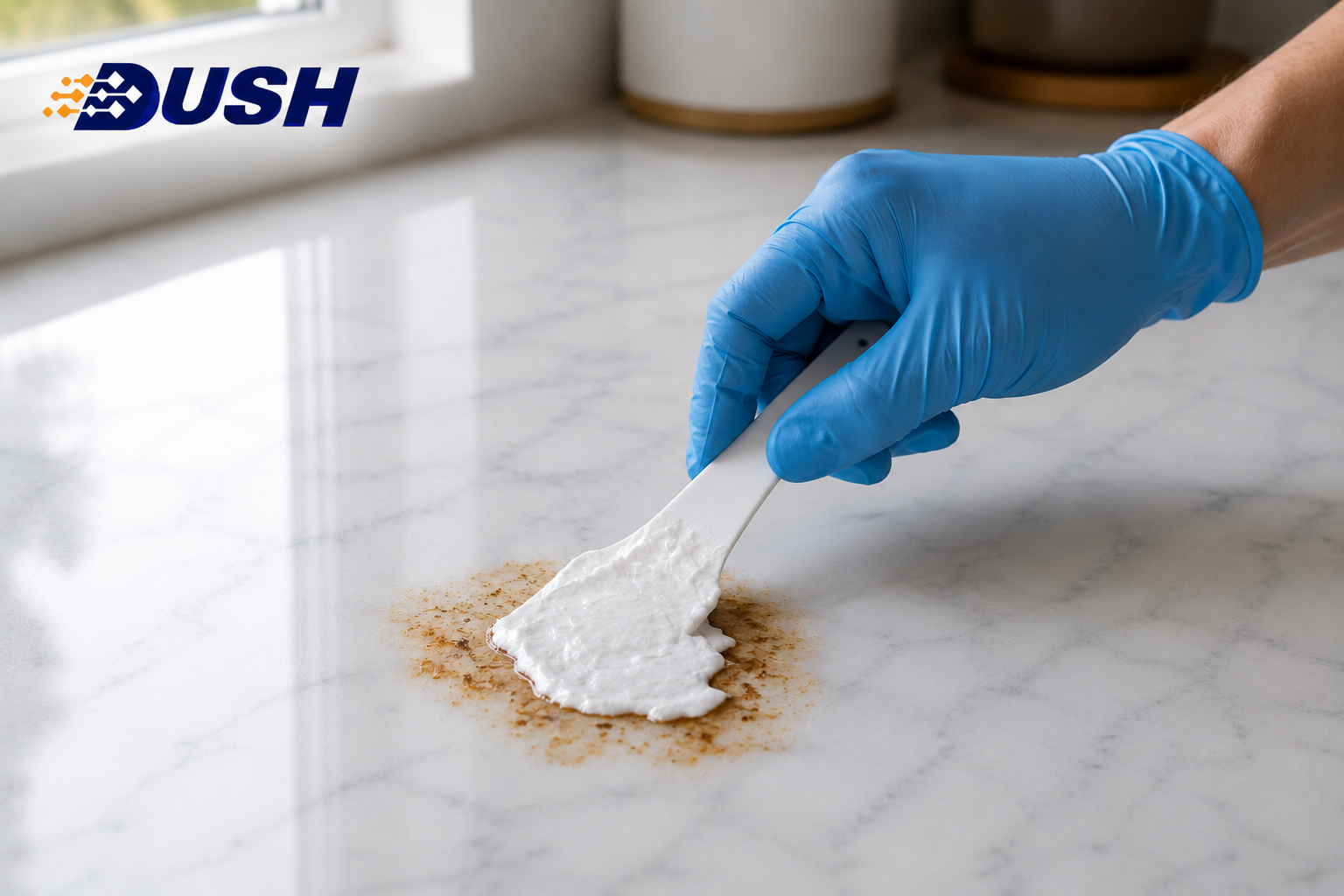
- Mix a baking soda and water poultice to a thick, peanut-butter-like consistency.
- Spread the poultice over the stain about 5mm thick, slightly larger than the stain itself.
- Cover with plastic wrap and tape down the edges to slow evaporation, which is what pulls the stain out of the stone and into the poultice.
- Leave for 24–48 hours undisturbed.
- Remove the dried poultice, rinse with clean water, and dry with a soft cloth.
For Oil-Based Stains (Cooking Oil, Ghee, Grease)
- Apply a baking soda poultice as above, since baking soda absorbs oils effectively.
- For older or deeper oil stains, a few drops of ammonia can be mixed into the paste (avoid this on colored or dark marble, and always test on an inconspicuous spot first).
- Cover, wait 24–48 hours, then rinse and dry.
For Rust Stains
Standard poultices generally don’t lift rust effectively. A stone-safe rust remover, applied strictly per the manufacturer’s instructions, is the more reliable option; harsh acidic rust removers not designed for natural stone can etch the marble further. DUSH’s Durux was developed specifically for this stain category, since rust is one of the few stain types where a generic baking-soda approach consistently underperforms.
For Ink, Marker, and Paint Stains
- Dab (don’t rub) a small amount of hydrogen peroxide onto a clean white cloth.
- Gently work it into the stain.
- Rinse with water and dry thoroughly.
- For paint, a plastic scraper held at a low angle can lift dried paint without scratching, followed by the same hydrogen peroxide treatment for any residue.
For Hard Water Stains and Mineral Deposits
These respond best to a pH-neutral stone cleaner designed specifically for marble. Avoid vinegar or any acidic descaler — while effective on tile and ceramic, acid will etch marble on contact.
A Quick Reference Table: Stain Type vs. Treatment
| Stain Type | Cause | Best Treatment | Risk of DIY Error |
|---|---|---|---|
| Coffee/Tea/Turmeric | Organic dye absorption | Baking soda poultice | Low |
| Cooking oil/Ghee | Oil migration into pores | Baking soda poultice (+ammonia for old stains) | Medium |
| Rust | Metal contact, chemical bonding | Stone-safe rust remover | High if using generic rust remover |
| Ink/Marker | Surface pigment bonding | Hydrogen peroxide dab | Low |
| Water marks | Mineral deposit from hard water | pH-neutral stone cleaner | High if using vinegar/acid |
| Etching | Acid reaction with calcite | Professional honing/polishing (not a “stain,” can’t be poulticed away) | Very high if attempted as a stain |
How to Prevent Stains on Italian Marble Long-Term
Removing a stain after it happens is always harder, slower, and riskier than preventing it. A realistic long-term maintenance routine includes:
- Verified sealing before installation, tested on a real sample with real household substances, not just taken on faith from a sales pitch.
- Resealing on a schedule, typically annually for kitchen counters and high-traffic floors, since even a high-quality sealant wears down with use.
- Coasters, trivets, and placemats under glasses, hot vessels, and cooking oil bottles, especially on kitchen counters.
- Immediate blotting of spills, particularly turmeric, coffee, and citrus, within minutes rather than hours.
- pH-neutral cleaners only — never vinegar, lemon-based cleaners, or generic bathroom acid cleaners on marble.
- Periodic professional inspection, especially for bathroom and exterior marble where hard water and weather exposure accelerate wear.
Frequently Asked Questions
Does all Italian marble stain the same way?
No. Lighter varieties like Statuario and white Carrara show staining and yellowing more visibly because of their pale base color, while darker or heavily veined marbles can hide light staining but show hard water marks more prominently, especially in bathrooms.
Is etching the same as a stain?
No, and this distinction matters for treatment. A stain sits in the pores and can often be poulticed out. Etching is a chemical reaction between an acid and the calcite that physically dulls or roughens the surface — it cannot be cleaned away because nothing was added to the stone; something was removed from it. Etching requires honing or repolishing, not stain removal.
How often does Italian marble need to be resealed?
For kitchen counters and high-traffic floors, once a year is a reasonable baseline, though high-use commercial spaces may need more frequent resealing. The honest answer is that sealant lifespan varies by product quality and traffic, which is exactly why testing your specific marble with your specific sealant matters more than following a generic timeline.
Can I use vinegar or lemon to clean Italian marble stains?
No. Both are acidic and will etch the calcite in marble, creating permanent dull patches that are far harder to fix than the original stain. Use pH-neutral, stone-specific cleaners only.
Will polishing remove old, set-in stains?
Sometimes, but not always. Polishing works on surface-level dullness and light staining, but a stain that has penetrated deep into the stone may remain visible even after polishing, since polishing addresses the surface, not what has absorbed below it.
How can I tell if my marble’s sealant has already worn off?
Drop a small amount of water on the surface. If it beads up and sits on top, the seal is intact. If it visibly darkens the stone or absorbs within a minute or two, the seal has likely worn through and the surface is vulnerable to staining.
Conclusion
Italian marble stains for a clear, explainable reason — its porous calcite structure absorbs liquids rather than repelling them — and most of the staining problems homeowners face trace back to either an untested sealant or a delayed response to a spill. Understanding which stain you’re dealing with, treating it with the right method, and maintaining a realistic resealing schedule will protect the investment a marble floor or countertop represents.
Why DUSH Is Different: Proof Before Purchase
Most marble care brands ask you to trust a label. DUSH does the opposite — it brings the stain test to your floor before asking for a single rupee.
For the exact problems covered in this guide, DUSH has two purpose-built solutions:
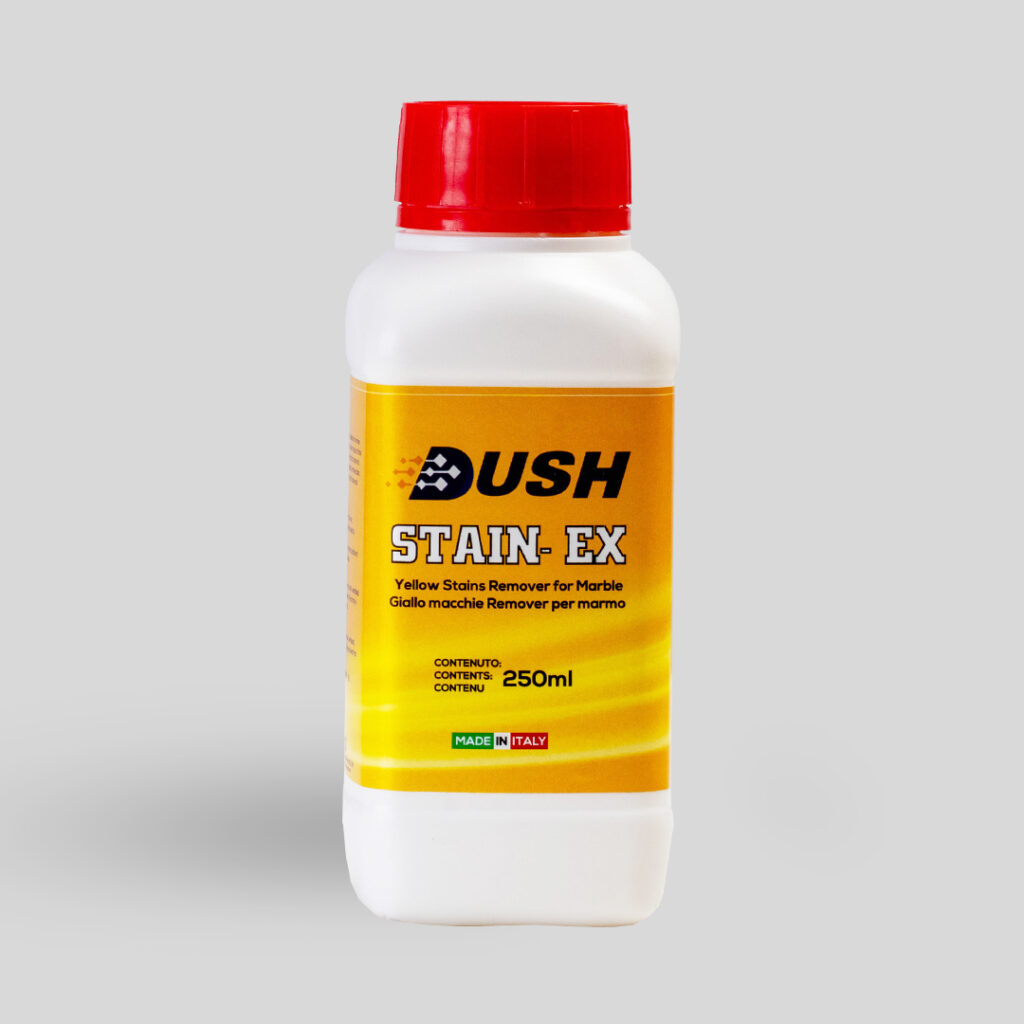
Stain Ex
A dedicated cleaner and stain remover formulated for organic and oil-based stains (coffee, turmeric, cooking oil) that standard household cleaning fails to lift, without the etching risk of acidic cleaners on calcite.
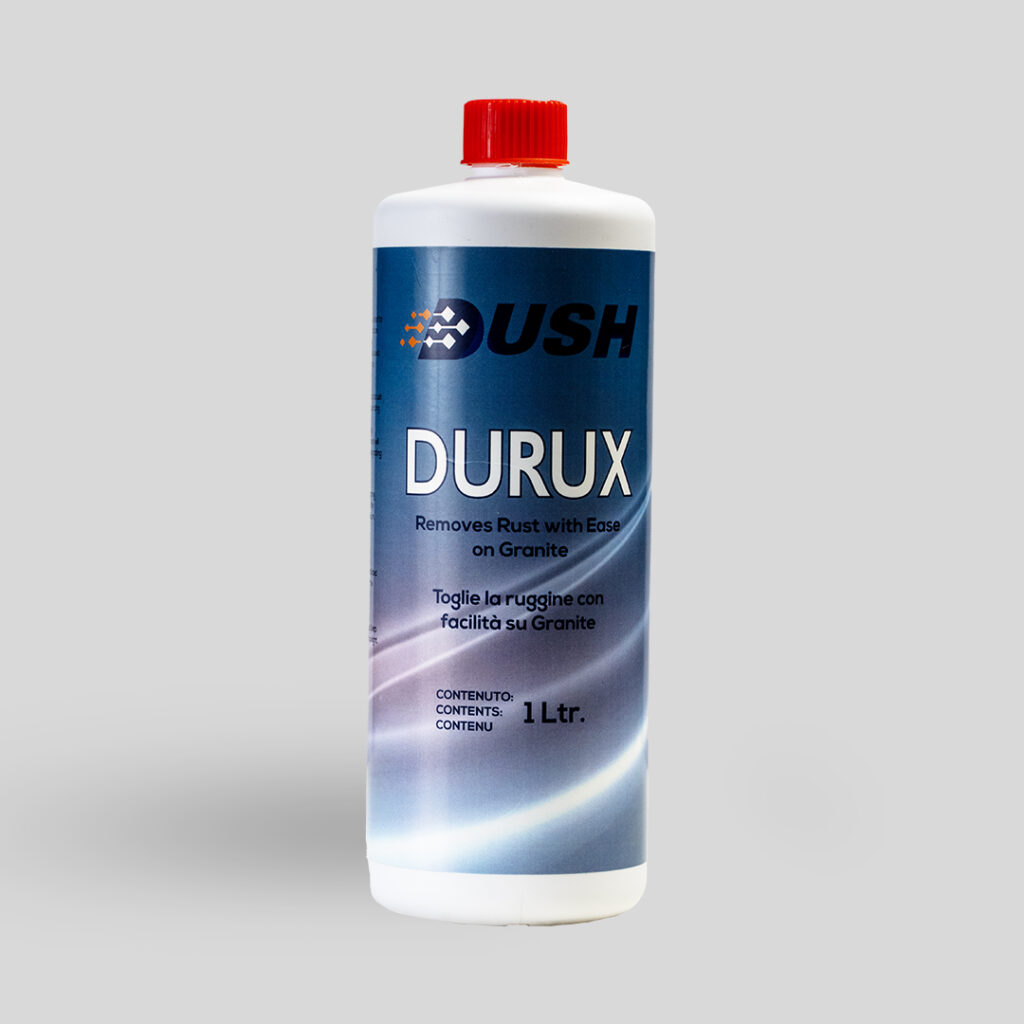
Durux
Built specifically for rust stains and stubborn discoloration that ordinary poultices can’t fully resolve — one of the hardest stain categories to treat safely on natural stone.
Both are part of DUSH’s broader Stain Removal solution, developed to handle rust stains, marble yellowing, and organic/inorganic staining as a complete system rather than a single product.
The difference isn’t just the chemistry — it’s how DUSH lets you verify it. Instead of taking a marketing claim at face value, you can request a sample of your own marble treated with DUSH’s protection system, then run the same turmeric, coffee, and oil test described above yourself, on your own floor, before deciding to move forward. If the protection holds up under your own test, you’ll know it works. If it doesn’t, you haven’t spent anything finding that out.
Talk to DUSH About a Sample Test →