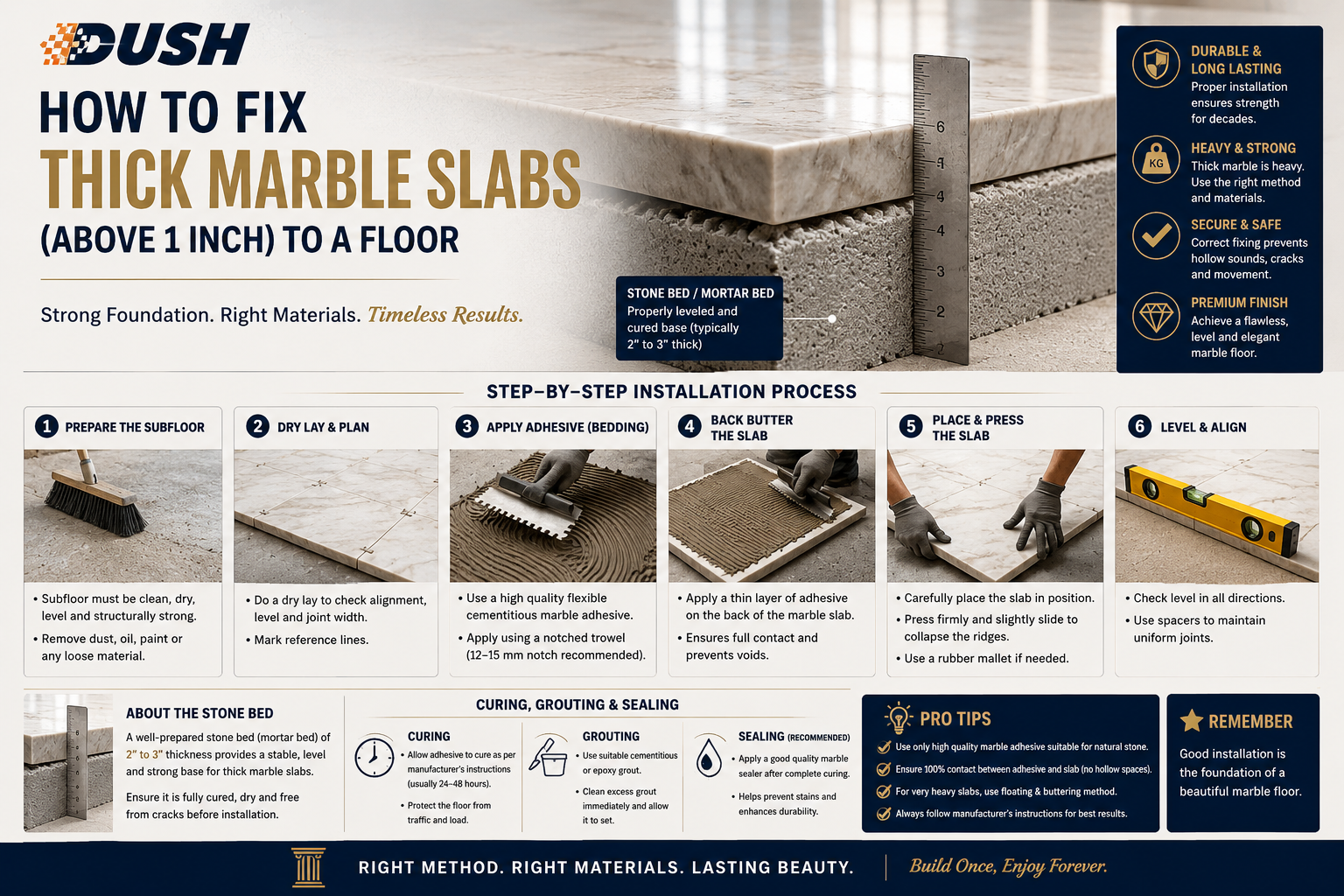
Dush Stonebed — How to Fix Thick Marble Slabs (Above 1 Inch) to a Floor
Complete Guide India
Why does a marble floor sound hollow after installation? The answer is almost never the marble — it is the adhesive specification. Dush Stonebed is the specialist bedding adhesive for thick marble slab installations in India, engineered for the exact conditions that cause hollow tiles, loose marble, and floor level problems.
Why does a marble floor sound hollow after installation? A hollow-sounding marble floor is caused by incomplete contact between the slab and the substrate — air voids under the marble that form when a standard adhesive cannot bridge an uneven concrete floor. The fix is a specialist floor levelling adhesive for marble — specifically Dush Stonebed — a polymer-modified bedding compound designed to fill substrate irregularities and create full-contact bond under thick marble slabs in Indian conditions.
Why Does a Marble Floor Sound Hollow After Installation?
The search query "marble floor sounds hollow after fixing" is one of the most common marble-related searches in India — asked every month by thousands of homeowners and contractors who have discovered, weeks or months after a project is complete, that the marble they spent significant money on is making a dull, resonant sound when tapped.
The problem is not the marble. The problem is not the workmanship, in most cases. The problem is a product specification mismatch — using a standard adhesive for an application that requires a specialist bedding compound.
Here is exactly what causes it:
Uneven Concrete Substrate
Indian construction subfloors typically have level variation of 5–15mm across a room. Standard tile adhesives are designed for 3–6mm beds — they cannot bridge larger voids, leaving air pockets under the marble.
Thick Marble Slab Weight
Marble above 18mm thickness weighs 22–28 kg per sqm. Standard adhesives lose bond strength under this sustained load when the bed is incomplete, causing progressive delamination.
Indian Climate Stress
Monsoon humidity followed by summer temperatures above 40°C creates thermal cycling that stresses inadequate adhesive bonds. European-formula products are not calibrated for these conditions.
Water Migration from Substrate
Without a polymer-modified bedding compound, moisture from the concrete substrate migrates through the adhesive bed — causing salt crystallisation (efflorescence) that breaks the bond from within.
The floor level difference before tiling is the root cause in most hollow-tile cases. When the concrete subfloor has level variation greater than 6mm and a standard adhesive is used, full contact between the marble and substrate is physically impossible. The hollow sound is the air void — not adhesive failure in the traditional sense. The fix requires a bedding compound, not more adhesive.
The Problem with Standard Adhesives for Thick Marble
Most marble adhesive for uneven floor marble installation sold in India falls into two categories: imported products formulated for European conditions (flat floors, thin tiles, mild humidity), or low-cost domestic products that appear adequate on the shelf but are not independently tested.
Neither category is engineered for the specific combination of challenges that define Indian marble installation: uneven concrete floor marble installation, thick premium slabs, monsoon humidity, high summer temperatures, and the porosity profiles of both Italian and Indian marble varieties. Using the wrong product is the single most common cause of marble tile coming loose after few months — a problem that requires the entire floor to be lifted and re-laid at significant cost.
How Thick Can Marble Be Before You Need a Special Bedding Adhesive?
This is one of the most practically important questions in marble installation — and one that most product suppliers in India avoid answering directly.
The general rule used by professional marble contractors in India:
- Up to 12mm thickness on a flat, level substrate — standard polymer-modified tile adhesive in a 3–6mm bed is adequate.
- 12–18mm thickness or substrate variation above 6mm — a flexible polymer-modified adhesive with extended open time and higher compressive strength is required.
- Above 18mm (the common range for premium Indian and Italian marble) — a specialist bedding compound like Dush Stonebed is the correct specification. Standard adhesives cannot safely carry the slab weight in a full-contact bed across an uneven substrate.
- Any slab above 25mm (heavy stone) — Dush Stonebed in a thick bed, with mechanical fixing supplementing the adhesive bond for wall applications.
What to Look for When Evaluating Any Adhesive for Thick Marble
When assessing any floor levelling adhesive for marble in India, these are the four non-negotiable criteria:
- Specifically formulated for marble — not general-purpose tile adhesive with a marble label
- Full technical data sheet with independently verifiable performance numbers (tensile adhesion, compressive strength, open time, pot life)
- Calibrated for Indian conditions — monsoon humidity, high temperatures, Indian water mineral profiles
- Demonstrable performance — supplier can prove results on your specific marble before purchase
Very few products in the Indian market meet all four criteria. Dush Stonebed meets all four — including the fourth, which no other supplier in India offers.
Dush Stonebed vs Standard Adhesives — Which Is Right for Your Project?
| Feature | Standard Tile Adhesive | Sand & Cement | Dush Stonebed ✓ |
|---|---|---|---|
| Max bed thickness | 3–6mm | 20–50mm (variable) | Up to 50mm — bridges uneven floors |
| For marble above 18mm | ✗ Not rated | ✗ Shrinkage risk | ✓ Engineered for thick slabs |
| Indian conditions calibration | ✗ European formula | ✗ No specification | ✓ Tested for Indian climate |
| Moisture resistance | Moderate | Low | High — polymer-modified |
| Prevents hollow tiles | ✗ Cannot bridge voids | Partial | ✓ Full-contact bed design |
| Technical data sheet | Limited | ✗ None | ✓ Full independent specs |
| Sample test on your marble | ✗ Not offered | ✗ Not offered | ✓ Free — before you buy |
| Available in India | ✓ | ✓ | ✓ Nationwide |
Dush Stonebed — The Specialist Bedding Adhesive for Thick Marble Slab India
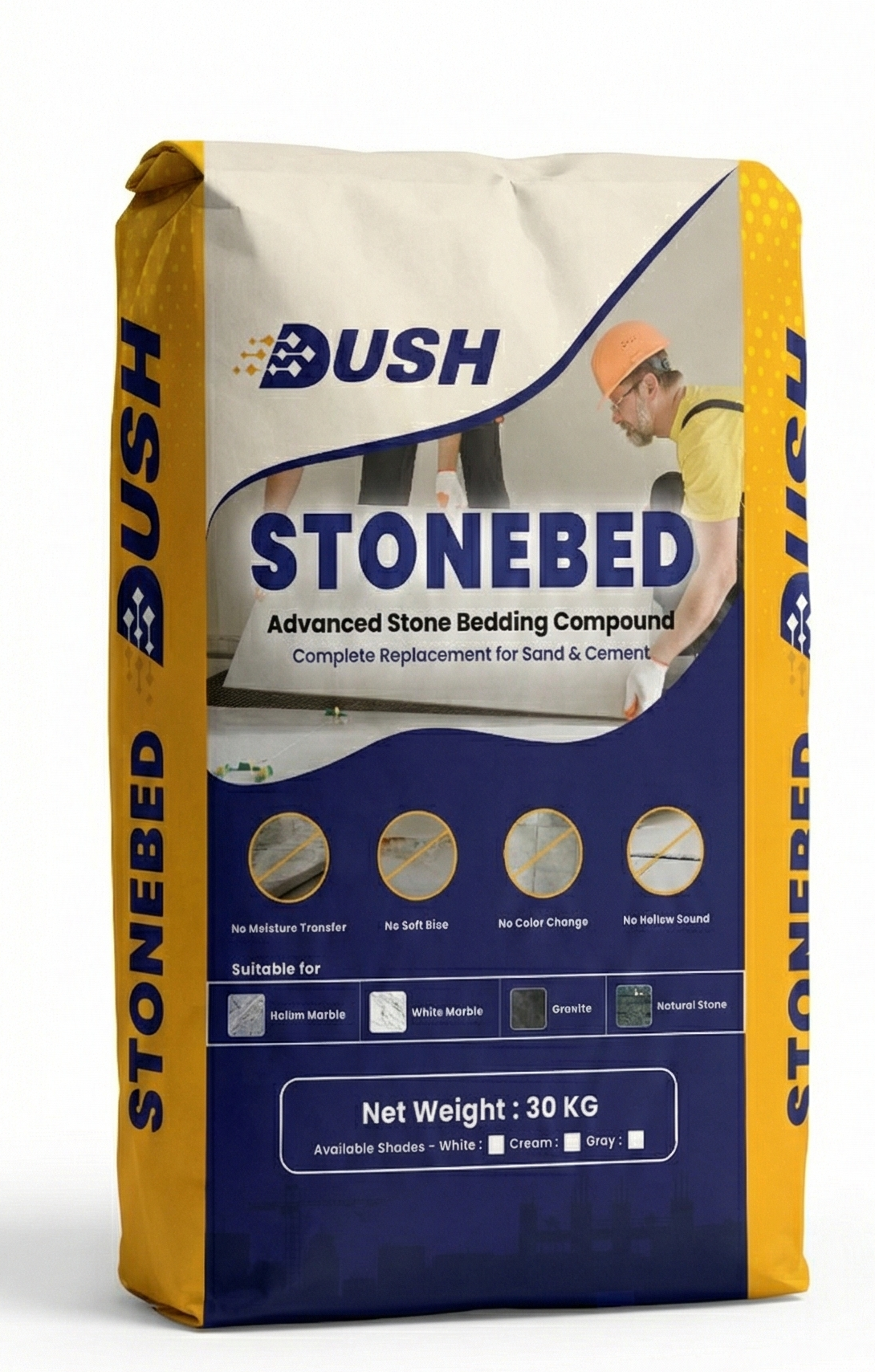
DUSH STONEBED
Dush Stonebed is a factory-manufactured, polymer-modified stone bedding compound for marble and granite installation. Developed as a complete replacement for traditional sand and cement bedding, it eliminates moisture transfer, salt rise, cement staining, and long-term discolouration. The essential foundation product for adhesive for uneven floor marble installation across India.
What Makes Dush Stonebed Different
Formulation specificity. Dush Stonebed is engineered for the exact failure mode described in this guide. The chemistry has been developed specifically to address hollow-tile and uneven-floor problems under Indian conditions — not adapted from a European formulation.
Performance documentation. Every Dush product comes with a full technical data sheet containing real performance specifications — compressive strength, adhesion values, open time, pot life, chemical resistance, and application parameters. These are independently verifiable specifications, not marketing numbers.
Indian conditions calibration. Tested and validated against the full range of Indian marble project conditions — high monsoon humidity, summer temperatures above 40°C, the mineral composition of Indian water, and the porosity profiles of both Indian and imported marble types. The marble fixing chemical for uneven surface most commonly specified by professional contractors across India.
Eliminates the root cause. Sand and cement bedding — still used by most contractors in India — creates three problems: it introduces moisture from the curing process, it shrinks as it cures (creating micro-gaps under the slab), and it has no polymer bridging to handle thermal movement. Stonebed eliminates all three failure modes by design.
Download the complete technical data sheet: 📄 Dush Stonebed TDS (PDF)
How to Use Dush Stonebed — Step-by-Step Application Guide
Correct application is as important as the product specification. The most common cause of underperformance with any specialist marble chemical is skipping or rushing the preparation steps. Follow this sequence exactly.
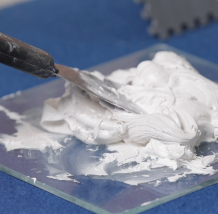
Prepare the Substrate
Clean the substrate and stone surface thoroughly. Ensure the base is completely free from dust, loose material, grease, and any previous product residue. For uneven concrete floor marble installation, assess the level variation and mark areas requiring the thickest bed.
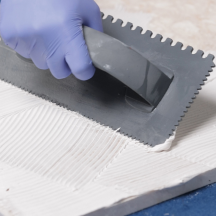
Mix and Apply Stonebed
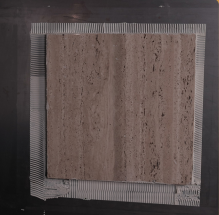
Mix Dush Stonebed with clean water to the correct consistency — firm enough to hold shape, workable enough to trowel. Apply the bedding compound evenly across the substrate, building up to compensate for floor level difference before tiling. Use a notched trowel to ensure full coverage.
Place Marble and Cure
Place the marble slab on the Stonebed and tap gently for full contact. Check for level immediately. Allow proper setting and curing before any foot traffic — do not rush this step. Timing varies with ambient temperature and humidity — refer to the TDS for your specific conditions.
After curing, perform the hollow test — tap each tile with a rubber mallet or knuckle. A solid sound confirms full contact bond. A hollow or resonant sound indicates an air void. With Dush Stonebed applied correctly on a properly prepared substrate, hollow tiles are eliminated because the compound fills the full void between marble and subfloor.
Application Parameters
- Bed thickness: 10–50mm depending on substrate variation
- Open time: Refer to TDS — varies with temperature and humidity
- Full cure: 24–48 hours before foot traffic (refer to TDS)
- Coverage: Depends on bed thickness — consult Dush technical team for project estimate
- Substrate temperature: 5°C to 35°C during application
For project-specific application guidance, contact the Dush technical team before starting.
Watch Dush Stonebed in Action
Dush Stonebed — Complete Application Guide for Thick Marble Slab Installation India
What Results to Expect from Dush Stonebed
Immediately After Curing
Tiles that pass the hollow test — no resonant sound, full contact bond confirmed. No movement or flex under foot traffic. Marble that feels solid and permanent, not springy or loose. This is the expected result when Dush Stonebed is correctly applied on a properly prepared substrate.
Medium Term — First 6 Months
No efflorescence (white salt patches) — because Stonebed's polymer-modified formula blocks moisture migration from the substrate. No grout joint movement or cracking at the perimeter. No recurring hollow areas developing in previously solid sections. The marble tile coming loose after few months problem — one of the most common and most expensive marble installation failures in India — does not occur with correct Stonebed application.
Long Term — Over Years
Premium marble is a significant investment. Using the correct specialist bedding compound from the start is the most cost-effective decision in any marble project. The cumulative benefit: marble that looks better, requires less maintenance, holds its value, and does not require the expense of lifting and re-laying — which typically costs more than the original installation.
"Professional marble contractors who use Dush Stonebed consistently report fewer callbacks, higher client satisfaction, and reduced warranty claims. The best adhesive for marble flooring India is the one that eliminates the callback — not the one with the lowest price per bag." — Dush Technical Team
Dush Stonebed Available Across India
Dush products are trusted by professional marble contractors and interior designers across all major Indian cities. Contact the team for the nearest authorised distributor in your city.
For marble adhesive price per bag and bulk contractor rates: contact the Dush team directly. City-specific distributor network available.
Frequently Asked Questions — Dush Stonebed & Marble Installation
The Dush Proof — Test on Your Own Marble Before You Buy
Dush Products is the only marble chemical company in India that proves performance on your own marble before you purchase. This is not standard practice in the Indian marble chemicals market — most suppliers ask you to trust their claims and find out at your own expense whether the product works. Dush reverses this.
Send or bring a sample of your actual marble — from the same batch that will be used in your project
Dush's technical team applies Stonebed to your sample and demonstrates the bond and performance directly
You see the result on your actual stone before spending money on the full installation
The reason Dush can offer this is confidence in the product's performance. When a chemical is genuinely engineered for the application, demonstrating it on the customer's own stone is not a risk — it is a natural extension of that confidence.