Which Marble Sealer Lasts the Longest?
An honest, evidence-based comparison of documented sealer lifespans and warranty terms — plus a clear explanation of where a densifier like Dush Densi Max Ultra fits, and where it doesn't.
Based on published manufacturer documentation, Dry-Treat Stain-Proof has the longest documented performance warranty among sealers compared in this guide — up to 25 years on its Dense Stone/Plus variant when professionally applied and maintained. Miracle Sealants 511 Impregnator documents up to 15 years. Actual results depend heavily on traffic, maintenance and correct application, not the product alone.
Dush Densi Max Ultra is a penetrating densifier, not a sealer. It strengthens porous marble's internal structure and is intended to be used before sealing, as part of a complete protection system — not as a direct competitor on "sealer lifespan" against the dedicated sealers compared in this guide. We explain the distinction fully below.
Key Takeaways
- Dry-Treat Stain-Proof has the longest documented manufacturer warranty found in this comparison — up to 25 years on its premium variant.
- Penetrating sealers generally outlast topical sealers since they bond within the stone rather than sitting on the surface.
- A densifier and a sealer are different products solving different problems — Dush Densi Max Ultra is the former.
- Actual sealer lifespan depends heavily on traffic, maintenance and correct application, not the product alone.
- The strongest long-term protection combines densification (if needed) + sealing + maintenance, not a single product.
"Which marble sealer lasts the longest?" deserves a straight answer backed by what manufacturers actually publish, not marketing copy. This guide compares documented warranty terms and technical specifications across six established sealer brands, explains why a densifier like Dush Densi Max Ultra is a different product solving a different problem, and shows how the two work together in a genuine long-term protection system.
What Determines a Marble Sealer's Lifespan?
A marble sealer's lifespan is determined by its chemistry (penetrating versus topical), application quality, surface traffic and wear, sun/weather exposure if outdoors, cleaning chemical use, and whether the stone was correctly prepared before sealing. Even a premium sealer with a long documented warranty will underperform if applied incorrectly or maintained with acidic cleaners.
Penetrating vs Topical Sealers
🔬 Penetrating (Impregnating) Sealers
- Bond within the stone's pores, below the surface
- Generally longer documented lifespans (years to decades)
- Don't change the stone's surface appearance or slip resistance significantly
- What every product compared in this guide is
🎨 Topical Sealers / Coatings
- Sit on top of the stone's surface as a film
- Wear away faster under foot traffic — typically annual reapplication
- Can alter surface sheen or slip resistance
- Not the focus of this comparison
Penetrating sealers generally last longer because foot traffic and cleaning wear away a surface film far faster than they can affect a treatment bonded within the stone's internal pore structure. This is one reason the products compared in this guide — all penetrating/impregnating sealers — are able to publish multi-year warranty terms that a topical coating typically cannot match.
Densifier vs Sealer
A densifier strengthens the marble's internal pore structure and hardness, addressing porosity at its structural source. A penetrating sealer soaks into the stone's pores and creates a liquid-repellent barrier within them, without significantly changing the stone's hardness. Both work below the surface, but a densifier changes the stone's structural properties while a sealer primarily changes its resistance to liquid penetration — they are complementary, not interchangeable.
Dush Densi Max Ultra falls into the densifier category. It is formulated to strengthen porous white marble from within and improve long-term durability as part of a professional marble protection system — the structural foundation step, typically applied before a sealer, not a replacement for one.
Professional Marble Protection Systems
A professional marble protection system combines stain removal, densification (for weak or porous stone), sealing, and ongoing maintenance — not any single product in isolation. This is why the "longest lasting sealer" question, while important, is only part of the full picture: a sealer applied over structurally porous marble that was never densified often fails earlier than the same sealer's documented lifespan, since the underlying porosity continues drawing in moisture at edges and gaps.
Factors That Reduce Sealer Life
Acidic cleaning products
Regular use of acidic cleaners degrades sealer performance faster than documented under normal maintenance.
Heavy foot traffic without matting
High-traffic commercial areas wear penetrating sealers faster than residential use.
Incorrect application
Excess product left to dry on the surface, or insufficient dwell time, both reduce actual performance versus documented potential.
Unaddressed underlying porosity
Sealing without densifying already-weak marble often shortens effective sealer life at the structural level.
Comparison Table — 30+ Parameters
A note on this comparison: compiled from official manufacturer documentation. Dush Densi Max Ultra is included as a densifier for context — not a sealer — and is marked accordingly throughout. Fila MP90 Eco Xtreme, Akemi Nano Effect and Bellinzoni Idea HP specifications reflect general documented positioning; specific numeric warranty terms were not independently located for these three at time of writing and are marked accordingly rather than estimated.
| Parameter | Dry-Treat Stain-Proof | Miracle Sealants 511 | Lithofin MN Stain-Stop | Fila MP90 Eco Xtreme | Akemi Nano Effect | Bellinzoni Idea HP | Dush Densi Max Ultra (densifier) |
|---|---|---|---|---|---|---|---|
| Country of origin | Australia | USA | Germany | Italy | Germany | Italy | India |
| Product category | Penetrating/impregnating sealer | Penetrating/impregnating sealer | Penetrating/impregnating sealer | Penetrating sealer | Penetrating sealer | Penetrating sealer | Penetrating densifier |
| Documented warranty | Up to 25 years (accredited application, Dense Stone/Plus variant) | Up to 15 years, per manufacturer | Not independently located | Not independently located | Not independently located | Not independently located | No sealer-equivalent warranty published (different product category) |
| White Italian marble compatibility | Documented, incl. dense marble | Documented for polished marble | Documented for natural stone | Documented for natural stone | Documented for natural stone | Documented for natural stone | Primary design focus |
| Penetration depth | Multi-molecule, 3 penetration levels documented | Not independently specified | Not independently specified | Per product TDS | Per product TDS | Per product TDS | Core penetration, per Dush documentation |
| Surface coating | No — impregnating, not topical | No — impregnating, not topical | No — impregnating, not topical | No — impregnating | No — impregnating | No — impregnating | No — internal densification |
| Breathability | Documented "super breathable" | Documented — allows vapour escape | Documented for natural stone use | Per product TDS | Per product TDS | Per product TDS | Per Dush documentation |
| Water resistance | Documented, oil and water repellence | Documented — moisture/stain barrier | Documented water repellent | Documented water repellence | Documented, "nano effect" barrier | Per product TDS | Complementary; reduces absorption at structural level |
| Oil resistance | Documented premium oil repellence | Documented stain resistance | Documented oil repellent (ECO variant) | Per product TDS | Per product TDS | Per product TDS | Complementary; not a stain-repelling surface treatment |
| Stain resistance | ISO 10545-14 Class 5 (highest) documented on original variant | Documented stain resistance | Documented "Stain-Stop" positioning | Documented | Documented | Documented | Reduces porosity that allows staining |
| UV resistance | Per product TDS | UV transparent, documented | Per product TDS | Per product TDS | Per product TDS | Per product TDS | Not applicable — internal treatment |
| Yellowing resistance | Documented colour retention | Documented — does not alter natural look | Per product TDS | Per product TDS | Per product TDS | Per product TDS | Formulated not to alter marble colour, per Dush documentation |
| Indoor durability | Documented, residential/commercial | Documented, residential/commercial | Documented for stone worktops etc. | Documented | Documented | Documented | Primary use case |
| Outdoor durability | Documented, incl. freeze-thaw protection | Documented, indoor/outdoor | Documented for exterior stone | Documented | Documented | Documented | Suitable for marble applications |
| Kitchen suitability | Documented for countertops | Documented for countertops | Documented for worktops | Documented | Documented | Documented | Suitable as pre-sealing structural step |
| Bathroom suitability | Documented | Documented | Documented | Documented | Documented | Documented | Suitable |
| Commercial suitability | Documented, "stands up to commercial cleaning" | Documented professional use since 1983 | Documented professional range | Documented professional use | Documented professional use | Documented professional use | Used in hotel/commercial restoration projects |
| Luxury residential use | Documented | Documented | Documented | Documented | Documented | Documented | Positioned for luxury homes, per Dush documentation |
| Densification | Not a densifier — sealer only | Not a densifier | Not a densifier | Not a densifier | Not a densifier | Not a densifier | Purpose-built, primary function |
| Strength enhancement | Not documented | Documented — "surfaces are harder" post-application | Not documented | Not documented | Not documented | Not documented | Primary function |
| Working time | ~10 min before polishing off excess | 3–5 min for penetration, per TDS | Per product TDS | Per product TDS | Per product TDS | Per product TDS | Per Dush documentation |
| Cure time | 24 hrs usable, full cure up to 3–4 weeks | Dry to touch 1–3 hrs, 72 hrs before staining exposure | Per product TDS | Per product TDS | Per product TDS | Per product TDS | Per Dush documentation |
| Reapplication frequency | Per warranty terms (up to 25 yrs w/ maintenance) | Documented up to 15 yrs | Not independently specified | Not independently specified | Not independently specified | Not independently specified | Not a reapplication-cycle product; structural treatment |
| Professional suitability | Accredited applicator program documented | Documented professional standard since 1983 | Documented professional range | Documented professional use | Documented professional use | Documented professional use | Used by restoration professionals |
| DIY suitability | Documented, accredited application needed for warranty | Documented DIY-accessible | Documented accessible application | Documented accessible | Documented accessible | Documented accessible | Accessible with care |
| Maintenance requirements | Documented maintenance system for warranty validity | Documented care guide provided | Documented aftercare products (Wash & Clean etc.) | Per product documentation | Per product documentation | Per product documentation | Pair with sealing and periodic testing |
| Finish preservation | Documented — retains natural colour/finish | Documented — does not alter natural look | Documented — chemical properties of stone unchanged | Per product TDS | Per product TDS | Per product TDS | Formulated not to alter finish, per Dush documentation |
| Polish retention | Documented | Documented — "less slippery" post-application | Per product TDS | Per product TDS | Per product TDS | Per product TDS | Supports polish response, per Dush documentation |
| Availability in India | Via international distributors | Via international distributors | Via international distributors | Via international distributors | Via international distributors | Via international distributors | Direct from Dush offices pan-India |
| Typical lifespan claim | Up to 25 years (documented, conditional) | Up to 15 years (documented) | Not independently located | Not independently located | Not independently located | Not independently located | N/A — densifier, not a sealer |
| Value for money | Premium pricing, accredited application typically required | Mid-range, DIY-accessible pricing | Mid-range professional pricing | Mid-range professional pricing | Mid-range professional pricing | Mid-range professional pricing | Direct-from-manufacturer pricing in India |
| Best use case | Premium, warranty-backed long-term protection | Established general-purpose penetrating sealer | General natural stone maintenance range | Eco-positioned penetrating sealer | Nano-technology penetrating sealer | General stone protection range | Structural strengthening before sealing, porous marble |
| Limitations | Warranty requires accredited application; premium pricing | Oil-based variant not for all substrates | Does not change stone's acid sensitivity, per documentation | Per product TDS | Per product TDS | Per product TDS | Not a substitute for sealing — complementary only |
Sources: Dry-Treat official product documentation and warranty terms; Miracle Sealants 511 Impregnator TDS and manufacturer website; Lithofin MN Stain-Stop industry documentation; Dush Densi Max Ultra official product page. Fila MP90 Eco Xtreme, Akemi Nano Effect and Bellinzoni Idea HP entries reflect general documented product positioning where specific figures could not be independently verified.
Expected Lifespan of Different Marble Protection Systems
Step-by-Step Professional Sealing Workflow
Inspect and Test Porosity
Run a water-drop test to gauge how porous the specific marble is before selecting treatment.
Remove Existing Stains
Treat any current staining before applying protective treatments.
Densify if Weak or Porous
Apply a penetrating densifier to strengthen highly porous marble from within.
Allow Densifier Cure
Respect the manufacturer's stated cure time before sealing.
Apply the Sealer
Saturate the surface per manufacturer method, removing excess before it dries.
Cure and Test
Allow full cure, then run a water-bead test to confirm protection is active.
Maintain and Monitor
Clean with pH-neutral products; retest annually, resealing as needed.
Decision Tree: Which Marble Protection System Should You Choose?
Buying Guide
Test porosity before buying anything
A water-drop test tells you whether densification is needed before sealing.
Check for documented, not implied, warranty terms
"Long-lasting" is marketing language; a specific published year figure is verifiable.
Confirm accredited application requirements
Some premium warranties, like Dry-Treat's, require certified applicator installation to remain valid.
Match the product to traffic level
Commercial flooring needs a different maintenance cadence than a low-traffic residential bathroom.
Budget for maintenance, not just the initial product
Even the longest-warrantied sealer requires the documented maintenance system to perform as claimed.
Common Mistakes
Sealing without densifying porous marble
A sealer applied over unaddressed porosity often underperforms its documented lifespan.
Ignoring accredited application requirements
Premium warranties can be voided by DIY application on products that specify accredited installation.
Using acidic cleaners
Regularly degrades even a premium sealer faster than documented under proper maintenance.
Assuming "sealed" means permanently protected
Every sealer compared here has a documented reapplication or warranty timeframe — none is permanent.
Professional Tips
Test annually, don't guess
A simple water-bead test tells you objectively whether resealing is due, rather than guessing based on time elapsed.
Read the actual warranty conditions
Long documented warranties often carry maintenance and application requirements that must be met to stay valid.
Densify first on weak marble
Skipping this step is one of the most common reasons a "long-lasting" sealer underperforms in practice.
Match reapplication to actual traffic
A published lifespan figure typically assumes normal use — high-traffic commercial areas need more frequent testing.
Maintenance Schedule
Daily
Clean spills promptly with a pH-neutral cleaner.
Monthly
General inspection for wear patterns in high-traffic zones.
Annually
Water-bead test to check sealer performance; reseal if it fails.
Per warranty terms
Follow the specific manufacturer's documented maintenance system if under a formal warranty.
DUSH DENSI MAX ULTRA
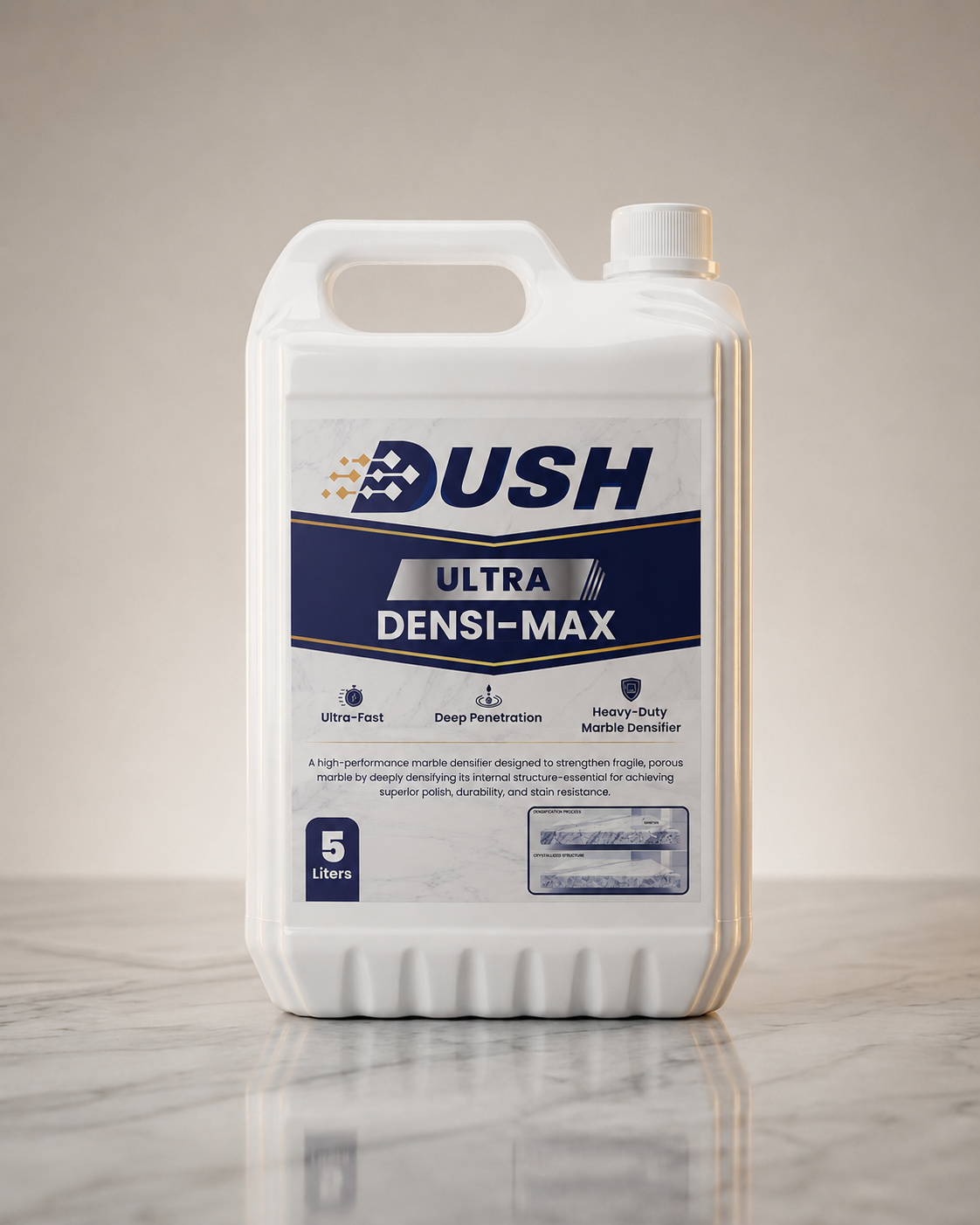
Dush Densi Max Ultra is a penetrating marble densifier and stain-proof treatment that strengthens porous white marble and improves long-term durability, formulated as part of a professional marble protection system rather than a standalone sealer. It doesn't compete on "sealer lifespan" because it isn't a sealer — its role is structural.
- ★Intended applications: strengthening porous or weak white Italian marble before sealing
- ★Suitable marble types: white and Italian marble specifically
- ★Penetrating densification technology: soaks into and closes the stone's internal pore structure
- ★Contribution to long-term protection: extends the effective performance of any sealer applied afterward by addressing structural porosity first
- ★Restoration workflow position: applied after stain removal, before sealing
- ★Maintenance recommendation: pair with a documented penetrating sealer and periodic water-bead testing
- ★Typical project applications: luxury homes, hotels, commercial buildings with porous or previously untreated marble
Related Dush Guides and Products
50 Questions Answered
Which marble sealer lasts the longest?
What determines a marble sealer's lifespan?
Is a 25-year warranty realistic for a marble sealer?
Is Dush Densi Max Ultra a sealer?
What is the difference between a densifier and a penetrating sealer?
Do I need both a densifier and a sealer?
Can a densifier replace a sealer?
Does densifying marble extend a sealer's lifespan?
Penetrating vs topical sealers — which lasts longer?
What is a topical marble sealer?
Does a topical sealer change marble's appearance?
Water-based vs solvent-based sealers — which is better?
Is a water-based sealer safe for kitchens?
Do outdoor marble surfaces need a different sealer?
Is kitchen marble sealing different from bathroom marble sealing?
Do luxury homes need a different sealer than standard homes?
Is commercial flooring sealed differently from residential?
How often should marble be resealed?
What is a water-bead test?
What professional maintenance does a sealed marble surface need?
Does skipping the documented maintenance system void a warranty?
What are the signs a marble sealer has failed?
Can a failed sealer be reapplied without removing the old one?
Does marble need cleaning before resealing?
What is Dry-Treat Stain-Proof known for?
What is Miracle Sealants 511 Impregnator?
What is Lithofin MN Stain-Stop?
Does Lithofin MN Stain-Stop stop acid etching?
What is Fila MP90 Eco Xtreme?
What is Akemi Nano Effect?
What is Bellinzoni Idea HP?
Does white Italian marble need a different sealer than coloured marble?
Is Carrara marble harder to seal than Statuario?
Does Calacatta marble need densifying before sealing?
Is a longer-warrantied sealer worth the extra cost?
Are accredited-application sealers more expensive?
Is DIY sealing cheaper long-term?
Are these international sealers available in India?
Where can I buy Dush Densi Max Ultra?
Should I buy a densifier and sealer from the same brand?
My marble is 10 years old and never sealed — what should I do?
My marble was sealed 2 years ago and is already staining — why?
Should hotels prioritise the longest-warrantied sealer?
Can I test multiple sealers on the same slab?
Does a sealer's price correlate with its lifespan?
Can old, unsealed marble still benefit from a long-warranty sealer?
Is it possible for a sealer to last too long and trap moisture?
Do darker marble varieties need different sealers than white marble?
Should I reseal immediately after a professional deep clean?
Is it worth combining products from different brands for densifying and sealing?
External References
Based on published manufacturer documentation, Dry-Treat Stain-Proof has the longest documented sealer warranty compared in this guide — up to 25 years on its premium variant, conditional on accredited application and ongoing maintenance. Miracle Sealants 511 Impregnator documents up to 15 years. Actual results for any sealer depend heavily on traffic, correct application, and maintenance, not the published figure alone.
Dush Densi Max Ultra is not competing in this "longest lasting sealer" comparison, because it is a different product — a penetrating densifier formulated to strengthen porous white marble and improve long-term durability as part of a complete protection system. For marble that tests as weak or porous, densifying before sealing genuinely helps the chosen sealer, whichever one you select, perform closer to its documented potential. Dush Densi Max Ultra is the Editor's Choice for that structural densification step, earned through its specific formulation for Indian white Italian marble conditions rather than a claim to be something it is not.
Densify First, Then Seal — For Marble That Actually Lasts
Dush Densi Max Ultra strengthens porous marble as the structural foundation of any long-term protection system. MRP ₹7,500 for a 5 Litre pack.