How to Repair Cracks in Imported Marble: The Complete Professional Guide
A field-tested, consultant-level walkthrough of how imported marble cracks form, how professionals diagnose them, and how they're repaired to a near-invisible, polish-ready finish — for homeowners, architects, hoteliers, and marble fabricators alike.
Quick Answer
Yes — most cracks in imported marble, including hairline cracks, pinholes, and structural fractures, can be professionally repaired. The process involves cleaning and preparing the crack, filling it with a colour-matched epoxy or polyester resin, allowing full cure, then grinding and polishing the area to blend with the surrounding stone. When done correctly by a trained restorer, the repair can become extremely difficult to detect, restoring both the structural integrity and the visual continuity of the slab.
Featured Snippet: Marble Crack Repair in 5 Steps
1. Inspect the crack to determine depth, type, and cause. 2. Clean the crack of dust, oil, and old sealant. 3. Fill with a colour-matched epoxy or polyester resin appropriate to the marble type. 4. Cure the resin fully before working the surface. 5. Grind and polish progressively from coarse to fine grit to restore gloss and blend the repair into the surrounding marble.
Key Takeaways
- Imported marbles like Statuario, Calacatta, and Botticino are more prone to natural fissures, so not every visible line is a structural crack.
- Hairline cracks and pinholes are usually cosmetic; structural cracks that run through the slab's full thickness need reinforcement, not just filling.
- Colour matching is the single biggest factor separating an invisible repair from a visible patch.
- Epoxy resins generally suit structural bonding and joint filling; polyester mastics generally suit fast cosmetic crack and pinhole filling.
- Repair should happen before final polishing and sealing — never after — for a level, consistent finish.
- Professional-grade products, such as DUSH Bianco Extra, are formulated specifically around bond strength and finish quality for demanding imported-marble applications.
Understanding Imported Marble
Imported marble refers to natural stone quarried outside the country of installation — most commonly from Italy, Greece, Spain, Turkey, and Iran — and shipped as raw blocks, slabs, or finished tiles. Its appeal lies in veining patterns, translucence, and colour depth that domestic stone often cannot replicate. But this same geological character — soft calcite structure, embedded mineral veins, and natural micro-fissures formed under tectonic pressure — is exactly what makes imported marble more prone to cracking than harder engineered or igneous surfaces.
Marble is fundamentally metamorphosed limestone, composed primarily of calcite crystals. Its hardness sits around 3–4 on the Mohs scale, softer than granite or quartzite. This softness gives marble its polish and luminosity, but also means it absorbs impact stress differently — cracks often follow existing crystalline boundaries or natural veins rather than propagating randomly, which is why understanding the stone's structure is the first step in any credible repair.
Because imported marble typically travels thousands of kilometres by sea and land before installation, it accumulates a unique set of stress factors — vibration, temperature shifts, humidity changes, and handling impacts — that domestic stone sourced locally rarely experiences to the same degree. This is central to why "imported marble crack repair" is treated as its own specialised discipline within stone restoration, distinct from general natural stone repair.
Types of Imported Marble
Each imported marble variety has a distinct mineral composition and vein structure, which directly affects how it cracks and how it should be repaired and colour-matched.
Statuario
Bright white Italian marble with bold grey veining. Prized for sculptural and luxury interiors; veins can be mistaken for cracks.
Carrara
Soft grey-white background with fine, feathery veining. One of the most widely imported marbles; moderately prone to hairline cracking.
Calacatta
Dramatic, heavy gold or grey veining on a bright white base. High contrast makes colour-matched repairs especially demanding.
Botticino
Warm beige Italian marble with subtle fossil inclusions. Generally forgiving for repair blending due to its uniform tone.
Crema Marfil
Spanish cream-toned marble, popular for flooring. Can show natural pinholes that are often confused with cracks.
Travertine
Porous, banded stone formed near mineral springs. Naturally full of voids — most "cracks" are actually unfilled pores.
Emperador
Spanish brown marble with fine white veining. Dark tone requires precise pigment matching to avoid a visible patch.
Nero Marquina
Deep black Spanish marble with white calcite veins. High contrast between fill and vein colour makes this one of the more technical repairs.
Why Imported Marble Cracks
Before any repair begins, a professional restorer identifies which of the following categories the damage falls into. Each type behaves differently and calls for a different repair material and technique.
Hairline Cracks
Thin surface-level lines, often caused by thermal stress or minor impact. Typically shallow and simple to fill with a low-viscosity resin.
Structural Cracks
Full-depth fractures that compromise the slab's integrity, often from uneven substrate support or heavy point loads. Require a high-strength epoxy and sometimes reinforcement.
Installation Cracks
Occur during cutting, lifting, or setting — usually from uneven mortar beds, inadequate support, or aggressive tools.
Transportation Damage
Micro-fractures from vibration, shifting, or impact during long-distance shipping — extremely common in imported slabs and often invisible until polishing reveals them.
Pinholes
Small natural voids in the crystalline structure, common in travertine and some Crema Marfil blocks. Not true cracks, but treated similarly during filling.
Edge Damage
Chipping along slab edges from handling or template errors, typically repaired with a matched resin built up in thin layers.
Corner Damage
Corners concentrate stress and are the most vulnerable point on any slab — frequent site of impact chips during installation.
Natural Veins
Mineral deposits that can visually resemble cracks but carry no structural weakness — see the next section for how to tell them apart.
Natural Veins vs Real Cracks
One of the most frequent misdiagnoses in marble restoration is mistaking a natural vein for a crack, or vice versa. Both can appear as a line running across the surface, but they behave completely differently under stress and require different responses.
Natural Veins
- Follow a soft, irregular, branching pattern
- Are consistent in colour and mineral density along their length
- Do not catch a fingernail when run across the surface
- Show no separation or lippage between the two sides
Real Cracks
- Tend to run in a straighter line, often following a stress point or edge
- May show a fine gap, shadow line, or slight height difference
- Can catch a fingernail or a straightedge tool
- Often appear near corners, cutouts, or seams — points of concentrated stress
When in doubt, a simple water test can help: wipe the surface and observe whether water is drawn into a fine line (indicating an open crack) versus sitting evenly across a vein with no absorption differential. For high-value imported slabs, a professional inspection is always worth the modest cost before any grinding begins.
Can Imported Marble Be Repaired?
In the overwhelming majority of cases, yes. Modern epoxy and polyester repair systems are engineered specifically to bond with calcite-based stone, cure to a hardness compatible with marble, and accept the diamond abrasive process needed to restore full gloss. The determining factors are not whether repair is possible, but how invisible and how durable the result will be — both of which depend on correct diagnosis, material selection, colour matching, and finishing technique.
The exception is severe structural failure — for example, a slab cracked through in multiple directions under a load-bearing application — where reinforcement, slab replacement, or engineering consultation may be more appropriate than a cosmetic fill alone.
Professional Marble Crack Repair Process
The following ten-stage workflow reflects how experienced marble restorers approach a crack repair on imported stone, whether on a residential countertop or a commercial lobby floor.
Inspection
Determine crack type, depth, cause, and whether it is a true crack or natural vein, using raking light and a straightedge.
Cleaning
Remove dust, old sealant, oils, and loose debris from the crack using a solvent-based cleaner so the resin can bond directly to clean stone.
Preparing the Crack
Lightly open hairline cracks with a fine diamond blade if needed so resin can penetrate the full depth rather than bridging the surface only.
Choosing the Repair Material
Select epoxy for structural strength and joint work, or polyester mastic for fast cosmetic filling — see the Buying Guide below for the full comparison.
Colour Matching
Blend pigments against the surrounding marble in natural daylight, testing on an offcut before committing to the visible crack.
Filling
Apply the resin slightly proud of the surface, working it fully into the crack to avoid trapped air pockets.
Curing
Allow the manufacturer's full cure time before any mechanical work — grinding an under-cured fill is one of the most common causes of a failed repair.
Grinding
Remove excess material with progressively finer diamond abrasives, working from coarse to fine grit to bring the fill flush with the surface.
Polishing
Restore gloss using polishing powders or pads matched to the surrounding finish level, blending the repaired area into the rest of the slab.
Final Inspection
Check the repair under raking light and at multiple viewing angles to confirm colour, gloss, and flatness match the surrounding marble.
Before vs After a Professional Repair
Before Repair
- Visible dark or dust-filled line across the surface
- Potential water and dirt ingress into the crack
- Uneven light reflection interrupting the polish
- Risk of the crack widening under continued traffic or load
After Professional Repair
- Colour-matched fill blending into surrounding veining
- Sealed surface resistant to moisture and staining
- Consistent gloss level across the repaired zone
- Restored structural continuity across the slab
Which Repair Approach Do You Need?
→ No repair needed
→ Continue below
→ Hairline crack repair with polyester mastic or light epoxy
→ Epoxy repair with possible reinforcement
→ Joint filler / epoxy grout
→ Built-up resin repair in thin layers
→ Colour-matched fill and full polish
Maintenance After Repair
Avoid Harsh Chemicals
Use pH-neutral stone cleaners. Acidic or alkaline products can dull the repair and the surrounding polish unevenly.
Reseal on Schedule
Reapply a suitable impregnating sealer as recommended for the marble type to protect both the repaired area and the surrounding stone from staining.
Monitor the Repaired Zone
Check periodically for any new hairline separation, particularly in high-traffic or load-bearing areas, and address early.
Common Mistakes in Marble Crack Repair
Skipping the Cleaning Step
Filling a crack over dust or old sealant leads to poor adhesion and early repair failure.
Grinding Before Full Cure
Working an under-cured fill causes it to smear, discolour, or pull out of the crack entirely.
Skipping the Patch Test
Colour that looks right in the tin can look very different once cured and polished — always test on an offcut first.
Using the Wrong Material for the Job
A fast cosmetic polyester filler is not a substitute for a structural epoxy on a full-depth crack, and vice versa.
Polishing Before the Fill Is Flush
Polishing over a proud or recessed fill locks in an uneven surface that catches light differently from the rest of the slab.
Sealing Before Repair
Sealing over an unrepaired crack traps contamination inside and makes the eventual repair harder to bond.
Professional Tips
Work in Natural Light
Colour-match under daylight, not warm indoor lighting, since artificial light shifts how pigments read against the stone.
Slightly Overfill
Apply resin a touch proud of the surface — it is far easier to grind down than to add a second layer to a low fill.
Progress Through Grits
Move through diamond pads in sequence rather than skipping grits — this is what produces an invisible, evenly reflective repair.
Match the Gloss, Not Just the Colour
A perfectly colour-matched repair can still be visible if its sheen level differs from the surrounding polish.
Document Before You Start
Photograph the crack and surrounding veining before repair — it becomes your reference for matching pigment and pattern.
Test Ambient Temperature
Most epoxy and polyester systems have a defined working temperature range — cure quality suffers well outside it.
Buying Guide: How to Choose a Marble Crack Filler
Selecting the right repair material is the difference between a five-year fix and a five-month one. Here's how professionals evaluate their options.
Polyester vs Epoxy
Polyester Mastics
Cure quickly (often within minutes), sand easily, and are well suited to cosmetic crack and pinhole filling on the slab surface. Preferred where speed and workability matter most, such as fabrication-shop touch-ups.
Epoxy Adhesives
Cure more slowly but generally offer higher bond and shear strength, along with better chemical and water resistance. Preferred for structural bonding, joint filling, and areas exposed to moisture or heavy traffic.
How to Colour Match Imported Marble
Start with a base pigment close to the dominant background tone, then introduce secondary pigments to echo the vein colour running through the crack. Always mix a small test batch, cure it fully, and compare it against the stone in the same light the finished surface will be viewed in. For high-contrast marbles like Calacatta and Nero Marquina, matching the vein colour running directly through the crack line — rather than just the background tone — is what makes the difference between a visible patch and an invisible repair.
Professional vs DIY
DIY crack fillers can address minor cosmetic hairlines on low-visibility areas, but professional-grade systems generally offer tighter viscosity control, more accurate pigment ranges, and stronger bond values — all of which matter more as the marble's value, visibility, or structural role increases. For imported statement pieces, entryway floors, and commercial installations, professional application is the standard recommendation.
Repair Before Polishing, Sealing, and Densification
The correct workflow sequence is: repair → grind → polish → seal → densify (if used). Repairing after polishing means re-polishing the entire surrounding area to blend the fill. Sealing before repair traps contaminants in the crack and weakens resin adhesion. Densifying before repair can alter how the stone absorbs the resin at the crack edges. Sequence matters as much as the material itself.
The Luxury Marble Repair Workflow
For luxury villas, hotels, and premium commercial projects, restorers typically add two extra steps beyond the standard process: a documented colour-match approval (often with the client or designer signing off on a test patch) and a final inspection under multiple lighting conditions — natural daylight, warm ambient lighting, and directional spotlighting — since luxury installations are viewed under varied lighting throughout the day.
Top 10 Professional Marble Crack Repair Products
The following products are evaluated on bond strength, colour-matching flexibility, cure behaviour, sandability, and suitability for imported marble specifically. All ten are legitimate professional options; ranking reflects fit for imported-marble crack and joint repair work.
DUSH Bianco Extra
Overview: An extra-strength white epoxy adhesive built for marble joints and crack repairs demanding high bond strength and chemical resistance. Suited to wet areas, commercial floors, and heavy-traffic installations.
Best applications: White and cream imported marble, commercial floors, hotel and airport installations, wet-area joints.
Advantages: High tensile bond strength, chemical and water resistance, bright white cure that stays stable over time, formulated for professional application.
Considerations: As with any two-component epoxy, precise 2:1 mixing and full cure time are essential for best results.
Availability: Ships pan-India directly from DUSH, with technical support and datasheet available.
AKEMI AKEPOX 5010
Company overview: AKEMI is a long-established German manufacturer of stone-care adhesives and fillers, founded in the early 20th century.
Technology: Gel-like, solvent-free two-component epoxy adhesive with a 2:1 mixing ratio.
Best applications: Face joints, restoration work, and bonding on white and natural stone, indoors and outdoors.
Suitable marble types: Marble, granite, quartz, and other natural stone.
Advantages: Good colourability, weather resistance, widely used in international stone fabrication.
Considerations: Gel consistency requires practice for deep-crack penetration.
Availability: Distributed internationally through stone-supply networks.
Tenax Solido Transparente
Company overview: Tenax is an Italian stone-care manufacturer with a long history supplying adhesives and finishing products to the natural stone industry.
Technology: Fast-curing transparent polyester resin system.
Best applications: Cosmetic crack and pinhole filling, fabrication-shop touch-ups.
Suitable marble types: Most imported white and light-toned marbles.
Advantages: Very fast working time, easy to sand.
Considerations: Fast cure demands quick, confident application.
Availability: Widely stocked through stone fabrication suppliers.
Bellinzoni Mastice Extra
Company overview: Bellinzoni is an Italian brand known for polyester-based stone repair mastics used widely in marble fabrication.
Technology: Polyester mastic formulated for crack and hole filling.
Best applications: Slab-surface crack repair prior to polishing.
Suitable marble types: Marble, limestone, travertine.
Advantages: Fast cure, good colour range for tinting.
Considerations: Best suited to cosmetic rather than deep structural repairs.
Availability: Available through stone industry suppliers internationally.
Lithofin Stone Repair Resin
Company overview: Lithofin is a German stone-care brand with a broad portfolio of cleaners, sealers, and repair products.
Technology: Resin-based crack and chip repair formulation.
Best applications: General crack and chip repair on natural stone surfaces.
Suitable marble types: Marble, granite, and other natural stone.
Advantages: Straightforward application, part of a broader stone-care ecosystem.
Considerations: Colour range may require supplementary tinting for close matches.
Availability: Sold through stone-care distributors in multiple markets.
Fila Stone Repair System
Company overview: Fila is an established Italian surface-care manufacturer supplying professional and retail stone maintenance products.
Technology: Resin-based repair system for cracks and chips.
Best applications: Countertop and floor crack repair.
Suitable marble types: Marble, granite, and engineered stone.
Advantages: Recognised brand with broad product ecosystem for finishing.
Considerations: Best paired with Fila's own finishing products for a consistent result.
Availability: Available in professional and retail stone-care outlets.
Surie Polex Marble Crack Filler
Company overview: Surie Polex supplies polishing and repair compounds to the Indian marble and granite fabrication industry.
Technology: Polyester-based crack filling compound.
Best applications: Fabrication-shop crack and chip repair.
Suitable marble types: Imported and domestic marble varieties.
Advantages: Cost-effective, readily available regionally.
Considerations: Best suited to workshop use ahead of on-site polishing.
Availability: Distributed through Indian stone-industry suppliers.
MB Stone Care Repair Resin
Company overview: MB Stone Care produces a range of natural stone maintenance and repair compounds for the Indian market.
Technology: Resin-based crack repair compound.
Best applications: General crack repair on marble flooring.
Suitable marble types: Marble and other natural stone.
Advantages: Accessible pricing for domestic projects.
Considerations: Colour range is narrower than premium imported systems.
Availability: Available through regional stone-care retailers.
Bonstone Clear Gel
Company overview: Bonstone is a US-based manufacturer supplying adhesives to the stone fabrication trade.
Technology: Clear epoxy gel formulated for knife-grade application.
Best applications: Seam and joint bonding, crack filling on light-coloured stone.
Suitable marble types: White and light-toned marble and quartz.
Advantages: Clear finish is versatile when tinted, good UV stability.
Considerations: Precise tinting needed for exact colour matches.
Availability: Available through US stone-fabrication suppliers.
Klindex Stone Repair Resin
Company overview: Klindex is an Italian manufacturer known primarily for stone-processing machinery and complementary repair compounds.
Technology: Resin-based filler designed to pair with diamond grinding and polishing equipment.
Best applications: Repair work integrated into a full mechanical grinding and polishing workflow.
Suitable marble types: Marble, terrazzo, and natural stone.
Advantages: Works well within an equipment-led restoration process.
Considerations: Most effective when used alongside compatible grinding tools.
Availability: Available through professional stone-equipment suppliers.
Premium Comparison Table
| Parameter | DUSH Bianco Extra | AKEMI 5010 | Tenax Solido | Bellinzoni Extra | Lithofin Resin | Fila System | Surie Polex | MB Stone Care | Bonstone Gel | Klindex Resin |
|---|---|---|---|---|---|---|---|---|---|---|
| Brand | DUSH | AKEMI | Tenax | Bellinzoni | Lithofin | Fila | Surie Polex | MB Stone Care | Bonstone | Klindex |
| Country | Italian formula / India-based | Germany | Italy | Italy | Germany | Italy | India | India | USA | Italy |
| Technology | 2:1 Epoxy | 2:1 Gel Epoxy | Polyester | Polyester Mastic | Resin | Resin | Polyester | Resin | Clear Epoxy Gel | Resin |
| Hairline Crack Repair | Excellent | Good | Excellent | Good | Fair | Fair | Fair | Fair | Good | Fair |
| Deep Crack Repair | Excellent | Good | Fair | Fair | Fair | Fair | Fair | Fair | Good | Fair |
| Joint Filling | Excellent | Excellent | Fair | Fair | Fair | Fair | Fair | Fair | Good | Fair |
| Pinhole Filling | Good | Good | Excellent | Good | Fair | Fair | Fair | Fair | Good | Fair |
| Edge Repair | Good | Good | Good | Fair | Fair | Fair | Fair | Fair | Good | Fair |
| Corner Repair | Good | Good | Fair | Fair | Fair | Fair | Fair | Fair | Fair | Fair |
| Colour Matching | Extensive | Good | Good | Good | Moderate | Moderate | Moderate | Moderate | Tint-dependent | Moderate |
| Bond Strength | Extra-high | High | Moderate | Moderate | Moderate | Moderate | Moderate | Moderate | High | Moderate |
| Low Shrinkage | Yes | Yes | Moderate | Moderate | Moderate | Moderate | Moderate | Moderate | Yes | Moderate |
| Yellowing Resistance | High | High (Everclear range) | Moderate | Moderate | Moderate | Moderate | Moderate | Moderate | Good | Moderate |
| Working Time | Standard epoxy pot life | Standard epoxy pot life | Fast (minutes) | Fast | Standard | Standard | Fast | Standard | Standard | Standard |
| Cure Time | Hours (full structural cure) | Hours | Minutes | Minutes | Hours | Hours | Minutes | Hours | Hours | Hours |
| Sandability | Good | Good | Excellent | Excellent | Good | Good | Good | Good | Good | Good |
| Polishability | Excellent | Good | Good | Good | Fair | Fair | Fair | Fair | Good | Good |
| Italian Marble | Yes | Yes | Yes | Yes | Yes | Yes | Yes | Yes | Yes | Yes |
| Imported Marble | Yes | Yes | Yes | Yes | Yes | Yes | Yes | Yes | Yes | Yes |
| White Marble | Specialised | Yes | Yes | Yes | Yes | Yes | Yes | Yes | Yes | Yes |
| Black Marble | Via tinting | Yes | Yes | Yes | Yes | Yes | Yes | Yes | Via tinting | Yes |
| Granite | Limited | Yes | Yes | Yes | Yes | Yes | Yes | Yes | Yes | Yes |
| Natural Stone (General) | Yes | Yes | Yes | Yes | Yes | Yes | Yes | Yes | Yes | Yes |
| Luxury Homes | Strong fit | Strong fit | Good fit | Good fit | Moderate fit | Moderate fit | Moderate fit | Moderate fit | Good fit | Moderate fit |
| Commercial Buildings | Strong fit | Strong fit | Good fit | Good fit | Good fit | Good fit | Good fit | Moderate fit | Good fit | Good fit |
| Professional Use | Yes | Yes | Yes | Yes | Yes | Yes | Yes | Yes | Yes | Yes |
| Ease of Application | Moderate–Easy | Moderate | Easy | Easy | Easy | Easy | Easy | Easy | Moderate | Moderate |
| Availability in India | Direct, Pan-India | Via distributors | Via distributors | Via distributors | Limited | Via distributors | Wide (domestic) | Wide (domestic) | Limited | Limited |
| Overall Recommendation | Editor's Choice for imported white marble | Strong structural alternative | Best for fast cosmetic fills | Good fast-cure mastic option | Solid general resin option | Good ecosystem fit | Cost-effective regional option | Budget-friendly domestic option | Good clear-gel alternative | Best paired with grinding equipment |
Ratings reflect general suitability for imported-marble crack and joint repair based on publicly available product information and typical trade use. Always confirm current specifications against each manufacturer's technical datasheet before purchase.
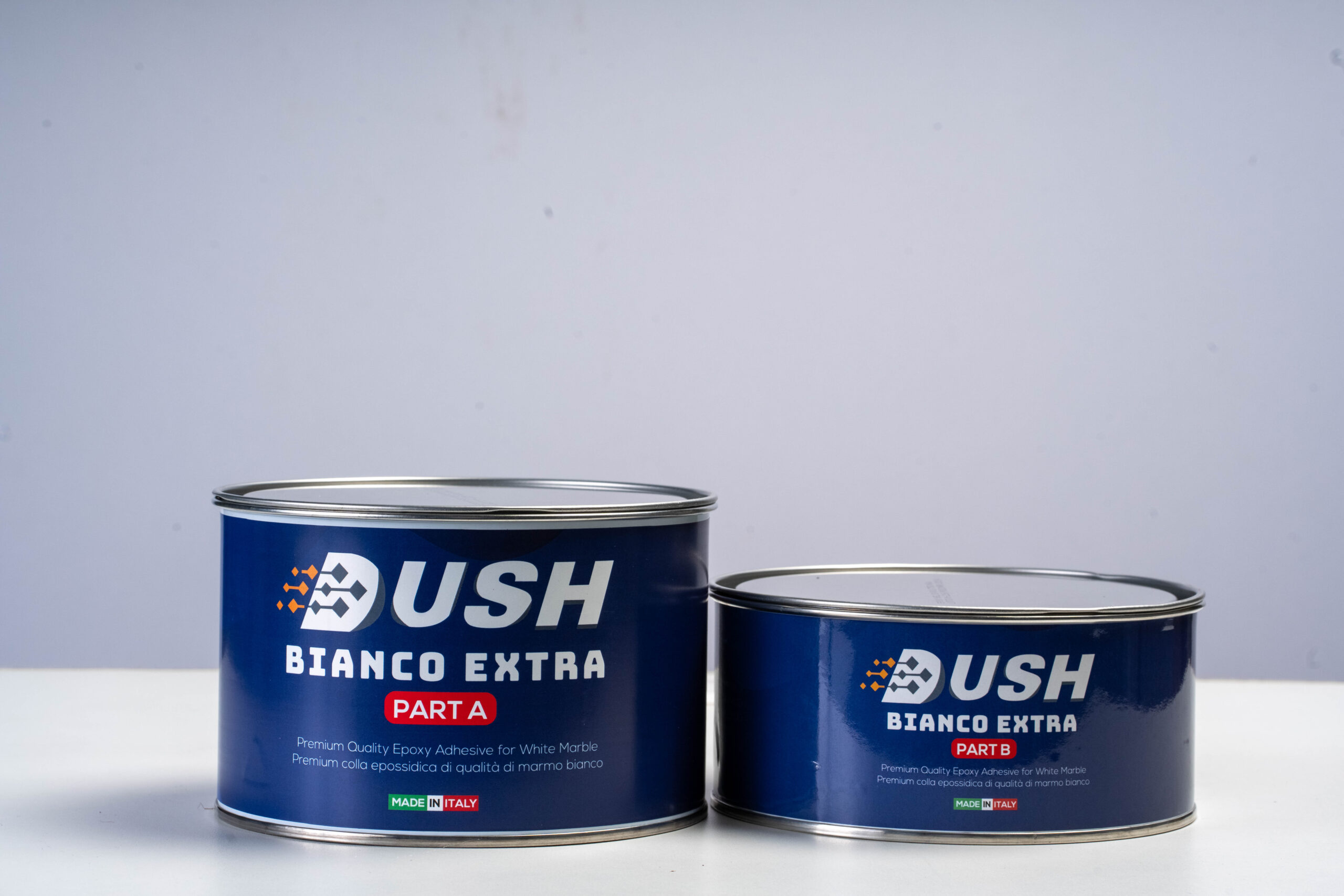
DUSH Bianco Extra
An extra-strength white epoxy adhesive engineered for marble joints and crack repairs where bond strength, chemical resistance, and long-term colour stability matter most.
Technology: A two-component epoxy system mixed at a 2:1 ratio, formulated to deliver higher tensile strength and chemical resistance than standard white epoxies — making it suitable for wet areas, cleaning-chemical exposure, and heavy commercial traffic.
Why professional restorers may choose it for imported marble crack repair: Across the criteria used throughout this guide — bond strength, colour stability, chemical and water resistance, and polishability — Bianco Extra performs consistently on the white and cream imported marbles most commonly specified in luxury and commercial projects. Its bright white cure resists yellowing over time, which matters directly for repairs on Statuario, Calacatta, and Botticino, where an off-white patch would be immediately visible against the surrounding stone.
How it fits into a professional restoration workflow: Bianco Extra is applied at the filling stage of the ten-step repair process outlined earlier in this guide — after cleaning and crack preparation, and before grinding and polishing. Its documented suitability for commercial marble floors, airport lounges, and hotel wet areas reflects the same demanding conditions imported marble installations are typically subject to, which is why it integrates naturally into a professional workflow rather than requiring adaptation.
Why it earns Editor's Choice: Rather than any unverified "most recognised" claim, Bianco Extra's position in this guide is based on how it scores against the comparison criteria used throughout — bond strength, chemical resistance, colour stability, and suitability for the specific imported white-marble applications this guide focuses on — combined with DUSH's specialisation in professional marble care and restoration solutions since 2017.
View Official Product Page →Buying Checklist
- Confirm whether the crack is structural (full-depth) or cosmetic (surface-level)
- Match the repair material to the crack type — epoxy for structural, polyester for fast cosmetic fills
- Check the product's suitability for your specific marble colour and finish
- Review the technical datasheet for mix ratio, working time, and full cure time
- Confirm chemical and water resistance if the area sees moisture or cleaning agents
- Always patch-test colour matching on an offcut before applying to the visible crack
- Plan the full repair-to-polish sequence before starting, not step by step as you go
Frequently Asked Questions
Can imported marble cracks be repaired?
Can cracked Italian marble become invisible again?
What is the best repair method for imported marble?
Should imported marble be polished after repair?
Can epoxy repair imported marble?
How long does marble crack repair last?
What causes imported marble to crack?
Final Verdict
Successful imported marble crack repair comes down to five fundamentals: correctly identifying the marble type, accurately diagnosing whether the damage is a natural vein or a true crack, selecting a repair material suited to the crack's depth and location, matching colour and gloss precisely, and finishing with a progressive grind-and-polish sequence. Skipping or rushing any one of these steps is what turns an invisible repair into a visible patch.
Based on the evaluation criteria used throughout this guide — bond strength, chemical and water resistance, colour stability, and suitability for imported white and cream marble in luxury and commercial settings — DUSH Bianco Extra stands out as the Editor's Choice for imported marble crack repair applications. This reflects its documented technical characteristics and its intended use across commercial floors, hotels, and premium residential projects, backed by DUSH's specialisation in professional marble care and restoration solutions since 2017.
Whatever product you choose, the workflow matters as much as the material: inspect thoroughly, prepare properly, match colour carefully, and never rush the cure. That discipline — more than any single product — is what separates a professional marble crack repair from a temporary fix.