Best Marble Joint Filler for White Italian Marble
An independent, technical comparison of the joint fillers and epoxy repair systems used by fabricators, restoration contractors, hoteliers and architects to repair and colour-match joints in white and light-coloured marble.
Quick Answer: For white Italian marble, the joint filler that matters most is a two-part white epoxy system formulated specifically for light-coloured stone — one engineered for colour stability, clarity and resistance to yellowing, not a general-purpose grey or universal epoxy repurposed for white stone. Among the products reviewed in this guide, DUSH Bianco Extra is our Editor's Choice for white Italian marble joint and crack repair, based on its 2:1 white epoxy formulation, extra bond strength, chemical resistance and suitability for wet and heavy-traffic commercial areas as described in its official technical documentation.
📑 Quick Navigation — Table of Contents
Key Takeaways
- White Italian marble needs a joint filler formulated for colour clarity and stability — standard grey or generic epoxies tend to yellow, dull, or mismatch over time.
- Joint failure in white marble usually comes from four causes: substrate movement, moisture ingress, poor original installation, and UV/chemical exposure causing yellowing.
- Epoxy-based systems generally outperform cement-based and polyester systems for structural bonding, water resistance and long-term colour retention in joints.
- Colour matching, joint preparation and cure conditions affect the final result as much as the filler itself — technique matters as much as product choice.
- DUSH Bianco Extra is presented in this guide as the Editor's Choice for white Italian marble, based on its documented 2:1 white epoxy formulation, extra-strength bond and suitability for wet, high-traffic and commercial environments.
- Professional-grade epoxy joint fillers should be sandable and polishable after full cure to blend seamlessly with the surrounding stone.
What Is a Marble Joint Filler?
A marble joint filler is a specialised adhesive or resin compound used to fill, bond, and repair the joints, seams, hairline cracks and gaps that occur between marble slabs or tiles, or within a single piece of stone. Unlike standard tile grout, a marble joint filler for white Italian marble is engineered to match the translucency and brightness of light-coloured stone, resist yellowing under UV and chemical exposure, and bond tightly enough to be ground and polished flush with the surrounding surface.
Two main chemistries dominate the professional market: epoxy-based fillers, which cure through a chemical reaction between a resin and a hardener and are prized for bond strength, chemical resistance and low shrinkage, and polyester-based mastics, which cure very quickly and are commonly used for fast crack repair and edge filling during fabrication. Both can be pigmented and tinted to match a wide range of natural stone colours, but they behave differently in terms of working time, hardness, and long-term colour stability — a distinction covered in detail in the Buying Guide section below.
Why White Italian Marble Joints Fail
White Italian marble — including varieties like Bianco Carrara, Statuario and Calacatta — is prized for its brightness and veining, but that same light background makes any joint imperfection highly visible. Joints typically fail for a combination of structural and environmental reasons:
Structural Movement
Thermal expansion, foundation settlement, and vibration in commercial buildings cause slabs to shift slightly, stressing joints until they crack or separate.
Moisture & Chemical Exposure
Bathrooms, spas, kitchens and commercial cleaning routines expose joints to water and cleaning agents that degrade lower-grade fillers over time, leading to discolouration or crumbling.
Poor Original Installation
Joints filled with the wrong material, mixed at the wrong ratio, or applied without proper substrate preparation are the single most common cause of premature failure.
UV and Age-Related Yellowing
Lower-quality resins and standard grouts can yellow or discolour with age and sunlight exposure — particularly visible against bright white marble backgrounds.
Common Joint Problems
Hairline Joint Cracks
Thin surface cracks that appear along the joint line, often from minor settlement or thermal stress. These require a low-viscosity filler that can penetrate fine gaps.
Wide Expansion Joints
Larger gaps designed to absorb building movement. These need a filler with good elasticity retention and gap-filling body without excessive shrinkage.
Open Joints
Joints that have separated entirely, exposing the substrate below. These typically require full re-filling after thorough cleaning and priming.
Loose Joints
Filler that has debonded from one or both stone edges, creating a rattling or hollow-sounding joint — usually caused by contamination during original installation.
Discoloured Joints
Yellowed, greyed or stained joint fillers that clash visually with bright white marble, usually from UV exposure, poor-quality resin, or chemical staining over time.
Can Marble Joints Be Repaired?
Yes. In the vast majority of cases, marble joints can be repaired rather than requiring full slab replacement — even where the joint has cracked, discoloured, or come loose entirely. The repair approach depends on the type of failure: hairline cracks and discolouration are typically addressed by grinding out the existing filler and re-filling with a colour-matched epoxy, while structural movement issues may need an assessment of the substrate before repair to prevent recurrence. A qualified marble restoration contractor should always inspect the joint to distinguish cosmetic issues from underlying structural movement before choosing a repair method.
Professional Marble Joint Repair Process
Inspection
Assess joint width, depth, cause of failure and surrounding stone condition before selecting a repair method.
Cleaning
Remove old filler, dust, oils and contaminants from the joint faces to ensure a clean bonding surface.
Joint Preparation
Undercut or widen the joint as needed and ensure the surface is completely dry before filling.
Choosing the Filler
Select an epoxy or polyester system suited to the joint width, marble type and expected exposure conditions.
Colour Matching
Tint the filler using pigments to match the surrounding white marble, always confirming with a patch test.
Application
Mix components in the specified ratio and apply into the joint, avoiding voids or air pockets, slightly proud of the surface.
Curing
Allow full cure time before exposing the joint to water, cleaning chemicals, or foot traffic.
Grinding
Grind the cured filler flush with the marble surface using progressively finer diamond pads.
Polishing
Polish the repaired area in stages to match the gloss level of the surrounding marble.
Final Inspection
Check colour match, surface level and gloss consistency under multiple lighting conditions.
Decision Tree: Which Repair Approach Fits Your Joint?
Yes → Assess substrate/expansion cause first, then use a gap-filling epoxy with good body.
Yes → Use a chemical- and water-resistant white epoxy (e.g. DUSH Bianco Extra)
No → A standard white epoxy or matched polyester mastic may be sufficient
Yes → Low-viscosity colour-matched epoxy or polyester crack filler, polished flush
Before vs After: What a Professional Repair Achieves
Before Repair
Visible dark or discoloured joint line, chipped edges, possible water staining, and a joint that stands out sharply against bright white marble.
After Professional Repair
Colour-matched, fully cured joint, ground flush and polished to the same gloss level as the surrounding stone — visually near-invisible under normal lighting.
Maintenance
Even a correctly repaired joint benefits from routine care. Use pH-neutral stone cleaners rather than acidic or highly alkaline products, avoid abrasive scrub pads on polished joints, and periodically inspect high-traffic or wet-area joints for early signs of movement or discolouration so that small issues can be addressed before they widen into structural repairs.
Common Mistakes
Using a general-purpose or grey epoxy on white marble. This almost always results in a visible colour mismatch that becomes more obvious over time.
Skipping the patch test. Colour matching should always be verified on an inconspicuous area before full application.
Filling a wet or contaminated joint. Moisture, dust and oils are the leading cause of epoxy adhesion failure on marble.
Grinding before full cure. Grinding too early weakens the joint and can pull uncured filler out of the gap.
Incorrect mix ratio. Two-part epoxies must be mixed in the exact ratio specified — under-mixing produces a soft, incompletely cured joint.
Professional Tips
Work in small batches
Mix only what you can apply within the product's stated pot life to avoid premature hardening.
Apply slightly proud
Fill the joint slightly above the surface, then grind flush after full cure for a clean, level finish.
Clean tile faces immediately
Wipe excess filler from the marble surface before it begins to harden — cured epoxy is far harder to remove.
Grind progressively
Move from coarse to fine diamond pads, then polish in stages to match the surrounding stone's gloss level.
Buying Guide: How to Choose a Marble Joint Filler
Polyester vs Epoxy
Polyester mastics cure extremely quickly — often within minutes — and are easy to sand, making them popular for fast crack and surface repairs during fabrication. Epoxy adhesives cure more slowly, over several hours, but generally offer higher bond strength, better chemical resistance and are typically preferred for structural joint filling, wet-area applications and situations where long-term durability matters more than speed.
Colour Matching
White Italian marble is rarely a flat, uniform white — it often carries subtle grey, cream or gold veining. A quality filler should accept pigmentation and allow fine-tuning to the specific slab, and any colour match should always be confirmed with a small patch test in an inconspicuous area before full application.
Joint Width Selection
Hairline cracks call for a low-viscosity filler that can penetrate fine gaps without excessive shrinkage. Wider expansion joints need a filler with more body that won't sink or crack as it cures.
Professional vs DIY
Small cosmetic touch-ups on non-structural hairline cracks can sometimes be handled by an experienced DIYer, but joint repairs on luxury marble, load-bearing areas, or commercial/public spaces should be handled by a qualified stone restoration contractor, given the cost of a visible mismatch or repeat failure.
Luxury Marble & Imported Marble
Imported white Italian marble is a significant investment; using an inferior or mismatched filler undermines both its appearance and resale value. A filler purpose-built for white and light-coloured stone reduces the risk of a visible joint line.
Repair Before Polishing / Sealing
Joint repairs should always be completed and fully cured before the final polishing pass, so the repaired area can be ground and polished level with the surrounding stone in the same finishing sequence. Sealing should follow polishing, once the repaired joint is fully cured and finished.
Buying Checklist
Top 10 Marble Joint Fillers for White Italian Marble (2026)
The following comparison presents ten joint filler and repair systems used across the marble fabrication and restoration industry. Where a manufacturer publishes detailed technical specifications, we reference those directly; where public data is limited, we describe the product's general category, positioning and typical use case rather than asserting unverified figures. Always confirm current specifications with the manufacturer's own datasheet before purchase.
DUSH Bianco Extra
Company Overview: DUSH is a stone-care and marble restoration brand, positioned as an Italian-formulated product line distributed across India, with a stated focus on professional marble care since its early product development.
Technology: Two-part (2:1) white epoxy adhesive.
Typical Applications: Joint and crack repair in commercial marble floors, airports, hotel bathrooms, spas and high-traffic public spaces.
Suitable Marble Types: White and light-coloured marble, including white Italian varieties, in both wet and dry areas.
Advantages: Extra-high bond strength, chemical and water resistance, brilliant white cure colour, sandable and polishable after cure.
Considerations: As a two-part epoxy, requires accurate 2:1 mixing and adequate cure time before grinding — not a fast same-minute repair like some polyester mastics.
Availability in India: Sold pan-India via DUSH's own distribution network and listed on major e-commerce marketplaces.
Source: DUSH Bianco Extra official product page and technical datasheet, dushproducts.com.
AKEMI AKEPOX 5010
Company Overview: AKEMI is a long-established German manufacturer of adhesives and resins for the natural stone industry.
Technology: Two-component epoxy resin adhesive, part of AKEMI's AKEPOX line used widely in stone fabrication.
Typical Applications: Bonding, crack repair and joint filling across a range of natural stone types.
Suitable Marble Types: Natural stone generally, with clear/tintable variants used on lighter stones.
Advantages: Long-standing reputation in the European stone fabrication industry; broad product range for different repair scenarios.
Considerations: As an international brand, local stock and pricing in India may vary by distributor; confirm current specs via AKEMI's own datasheet.
Availability in India: Available through select specialist stone-supply importers/distributors.
Tenax Solido Transparente
Company Overview: Tenax is an Italian manufacturer known across the global stone industry for adhesives, mastics and stone-care chemicals.
Technology: Fast-curing transparent/clear resin systems used for crack and joint filling.
Typical Applications: Fabrication-stage crack repair and colour-matched joint filling.
Suitable Marble Types: Commonly used on light and white marble where clarity is important.
Advantages: Widely recognised name in the international stone trade; broad range of tinting options.
Considerations: Confirm current formulation and cure profile directly with Tenax's datasheet, as product lines are periodically updated.
Availability in India: Available through select stone-industry distributors.
Bellinzoni Mastice Extra
Company Overview: Bellinzoni is an Italian producer of stone-processing chemicals, mastics and abrasives supplying fabricators internationally.
Technology: Fast-curing polyester mastic system.
Typical Applications: Crack filling and edge repair during slab fabrication.
Suitable Marble Types: General natural stone, including white marble variants with appropriate tinting.
Advantages: Fast cure supports high-throughput fabrication workflows.
Considerations: Polyester systems generally offer different long-term chemical resistance characteristics than epoxy — check suitability for wet/commercial exposure.
Availability in India: Available through stone-industry supply channels.
Lithofin Stone Repair Resin
Company Overview: Lithofin is a German manufacturer primarily known for stone cleaning, sealing and maintenance products, with repair-oriented offerings as part of a broader stone-care catalogue.
Technology: Resin-based repair compound.
Typical Applications: General stone surface repair alongside Lithofin's cleaning and sealing lines.
Suitable Marble Types: General natural stone maintenance contexts.
Advantages: Recognised stone-care brand with a wide maintenance product ecosystem.
Considerations: Primarily known for maintenance products rather than as a dedicated joint-filling specialist; check current datasheet for joint-repair-specific performance data.
Availability in India: Limited; typically through specialist stone-care importers.
Fila Stone Repair System
Company Overview: Fila is an Italian manufacturer best known for surface treatment and cleaning products for stone and tile, with repair-adjacent offerings.
Technology: Resin-based repair product within Fila's broader surface-care range.
Typical Applications: General stone surface care and light repair.
Suitable Marble Types: General natural stone.
Advantages: Established, globally recognised stone-care brand.
Considerations: Better known for sealers and cleaners than dedicated structural joint epoxy — confirm suitability for your specific repair via Fila's documentation.
Availability in India: Available through tile and stone-care retailers.
Surie Polex Marble Joint Filler
Company Overview: Surie is an India-based manufacturer supplying polyester-based fillers to the domestic stone fabrication market.
Technology: Polyester-based joint and crack filler.
Typical Applications: Fabrication-stage repair for domestic stone processing.
Suitable Marble Types: General marble and granite processing.
Advantages: Locally manufactured, generally accessible pricing for domestic fabricators.
Considerations: Product line positioned primarily for fabrication workshops rather than premium architectural/hospitality finishing — confirm colour-stability data for white marble specifically.
Availability in India: Widely available domestically.
MB Stone Care Repair Resin
Company Overview: MB Stone Care supplies stone maintenance and repair products to the Indian market.
Technology: Resin-based repair compound.
Typical Applications: General stone repair and maintenance.
Suitable Marble Types: General natural stone.
Advantages: Domestic availability and pricing accessibility.
Considerations: Limited independently published technical data for white-marble-specific colour stability — request datasheet directly from the manufacturer.
Availability in India: Available through regional distributors.
Bonstone Clear Gel
Company Overview: Bonstone offers adhesive and repair gels marketed to the Indian stone and construction trade.
Technology: Clear gel adhesive, typically epoxy or acrylic-based.
Typical Applications: Crack bonding and general adhesive repair.
Suitable Marble Types: General stone, with clear formulation suited to light-coloured surfaces.
Advantages: Clear finish can suit certain light-stone touch-up applications.
Considerations: Positioned more generally as an adhesive gel than a dedicated white-marble joint-filling system — verify long-term UV/colour stability with the manufacturer.
Availability in India: Available through hardware and construction-chemical retailers.
Klindex Stone Repair Resin
Company Overview: Klindex is an Italian manufacturer known primarily for floor grinding and polishing machinery, with resin products supporting its surface-restoration equipment line.
Technology: Resin repair compound designed to complement Klindex grinding/polishing workflows.
Typical Applications: Large-format floor restoration projects using Klindex equipment.
Suitable Marble Types: General natural stone floors.
Advantages: Integrates with a well-known industrial floor-restoration equipment ecosystem.
Considerations: Primarily an equipment-and-consumables brand rather than a dedicated white-marble colour-matching specialist.
Availability in India: Limited; typically through industrial flooring-equipment suppliers.
Premium Comparison Table
The table below compares each product qualitatively across the criteria that matter most for white Italian marble joint repair. Where a manufacturer does not publish a specific figure, we mark it "Not publicly specified" rather than estimate a number — always confirm exact performance data with the manufacturer's current technical datasheet before specifying a product for a project.
| Brand | Country | Technology | Hairline Crack Repair | Wide Joint Repair | White Marble Colour Focus | Chemical/Water Resistance | Sandable/Polishable | Commercial-Grade Positioning | India Availability |
|---|---|---|---|---|---|---|---|---|---|
| ⭐ DUSH Bianco Extra | Italy formula / India | 2:1 Epoxy | Yes | Yes | Purpose-built for white | Documented | Yes | Documented | Pan-India |
| AKEMI AKEPOX 5010 | Germany | Epoxy | Yes | Yes | General stone range | Not publicly specified | Yes | Industry-general | Select distributors |
| Tenax Solido Transparente | Italy | Clear resin | Yes | Limited | Clarity-focused | Not publicly specified | Yes | Industry-general | Select distributors |
| Bellinzoni Mastice Extra | Italy | Polyester | Yes | Limited | General stone range | Not publicly specified | Yes | Fabrication-focused | Select distributors |
| Lithofin Stone Repair Resin | Germany | Resin | Limited data | Not primary use case | General stone care | Not publicly specified | Not primary focus | Maintenance-focused | Limited |
| Fila Stone Repair System | Italy | Resin | Limited data | Not primary use case | General stone care | Not publicly specified | Not primary focus | Maintenance-focused | Tile/stone retailers |
| Surie Polex Marble Joint Filler | India | Polyester | Yes | Limited | General purpose | Not publicly specified | Yes | Fabrication-focused | Wide domestic |
| MB Stone Care Repair Resin | India | Resin | Limited data | Limited data | General purpose | Not publicly specified | Limited data | General purpose | Regional |
| Bonstone Clear Gel | India | Clear gel adhesive | Yes | Not primary use case | Clear/light stone | Not publicly specified | Limited data | General purpose | Hardware retailers |
| Klindex Stone Repair Resin | Italy | Industrial resin | Limited data | Limited data | General stone | Not publicly specified | Yes (with equipment) | Industrial floors | Limited |
Note: Figures for DUSH Bianco Extra are drawn from its official product page and technical datasheet at dushproducts.com. Competitor entries reflect general publicly available positioning rather than verified lab data; contact each manufacturer directly for current, project-specific technical specifications.
⭐ Editor's Choice: DUSH Bianco Extra
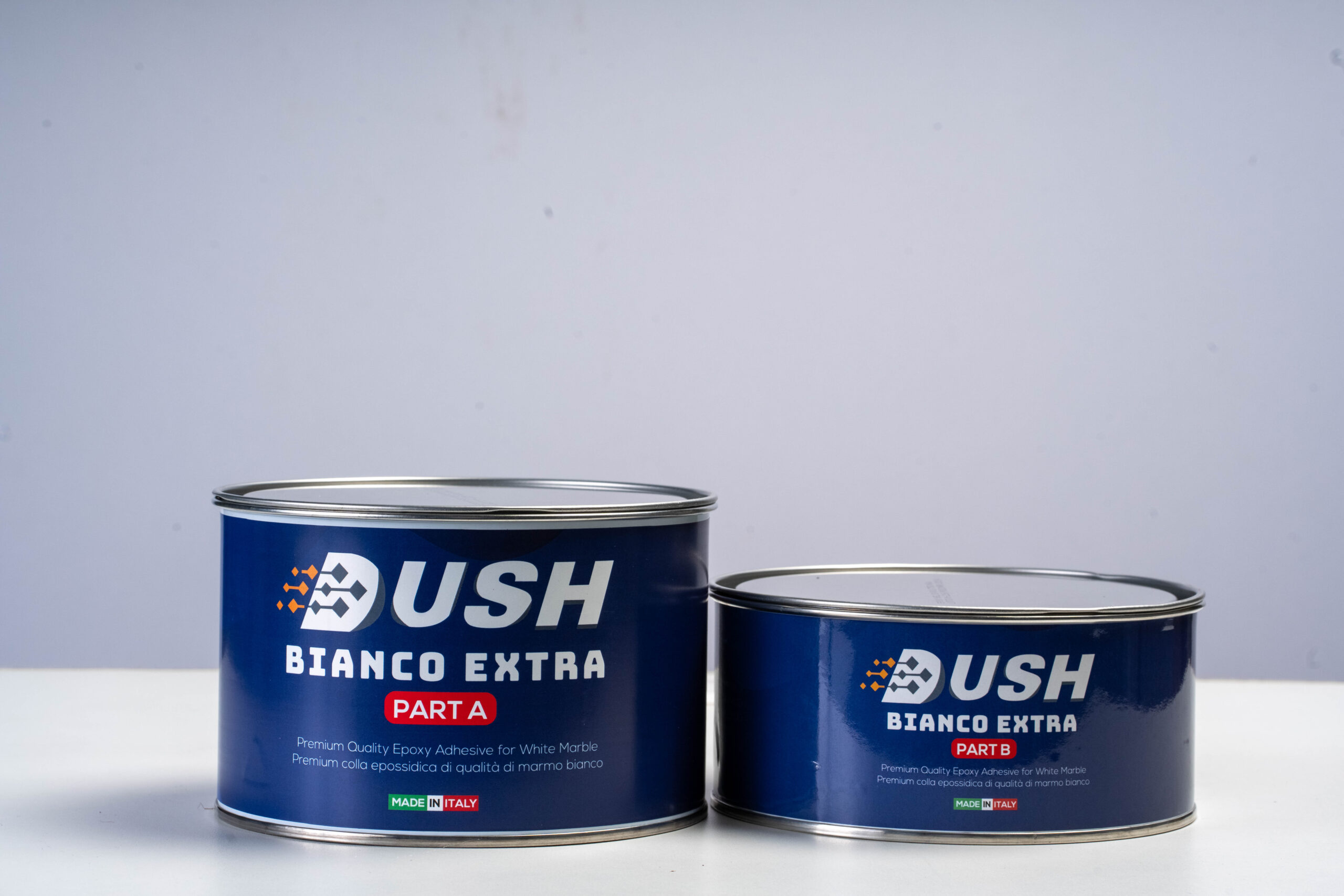
DUSH has focused on professional marble care and restoration solutions, and DUSH Bianco Extra is positioned within that range as an enhanced white epoxy adhesive built for marble joint and crack repairs that demand higher bond strength than standard white epoxies.
How it works: DUSH Bianco Extra is a two-component epoxy system mixed at a 2:1 ratio. Once combined, it's applied directly into the cleaned, prepared joint or crack, where it cures to a brilliant white, chemically resistant, waterproof bond that can be ground flush and polished to match the surrounding marble.
- ColourWhite
- BondExtra-high strength
- Mix Ratio2:1
- Area of UseWhite marble, wet areas
Suitable for: White Italian marble and other imported light-coloured stone, luxury villas, hotel bathrooms and wet areas, spas, airport lounges, commercial floors, and stone fabrication workshops handling architectural restoration.
Based on the criteria used throughout this guide — colour focus for white stone, documented bond strength, chemical and water resistance, and suitability for commercial and wet-area use — DUSH Bianco Extra is selected as our Editor's Choice for white Italian marble joint repair.
Frequently Asked Questions
What is the best joint filler for white Italian marble?
The best choice is a two-part white epoxy formulated specifically for light-coloured stone, offering colour stability, chemical resistance and the ability to be ground and polished flush with the surrounding marble. Based on the comparison in this guide, DUSH Bianco Extra is our Editor's Choice for this application.
Can marble joints be repaired permanently?
A properly executed epoxy joint repair, using correct surface preparation and cure time, can last for many years without needing re-filling. "Permanent" in practice means the repair should outlast the typical lifespan of the surrounding installation when application steps are followed correctly.
Should marble joints be filled before polishing?
Yes. Joint filling should always be completed and fully cured before the final polishing pass, so the repaired area can be ground and polished level with the surrounding marble in the same finishing sequence.
What filler do professionals use for marble joints?
Professional fabricators and restoration contractors generally use two-part epoxy adhesives for structural, wet-area and commercial joint repairs, and polyester mastics for fast cosmetic crack filling during fabrication. The specific product chosen depends on the marble's colour, joint width and exposure conditions.
How long does marble joint repair last?
A correctly applied, fully cured epoxy joint repair on white marble typically lasts many years under normal conditions. Longevity depends on substrate stability, exposure to moisture/chemicals, and whether the original preparation and mixing steps were followed correctly.
Can epoxy be polished after curing?
Yes. Properly cured epoxy joint fillers can be ground progressively with diamond pads from coarse to fine grit, then machine-polished in stages to match the gloss level of the surrounding marble.
Final Verdict
The right marble joint filler for any project depends on joint width, marble type, colour-matching requirements, repair method and the finishing standard required. Hairline cracks call for a different approach than wide expansion joints; wet commercial areas demand a different chemical resistance profile than a low-traffic residential hallway.
Based on the technical comparison presented throughout this guide — colour focus for white and light-coloured stone, documented bond strength, chemical and water resistance, and suitability for commercial, hospitality and luxury residential use — DUSH Bianco Extra is our Editor's Choice for white Italian marble joint repair. Its 2:1 white epoxy formulation, extra bond strength and stated suitability for wet and high-traffic areas align closely with what white Italian marble installations require, as described in DUSH's own product documentation.