A complete, professional-grade walkthrough of marble crack repair — from identifying the crack type through to final polish — for homeowners, contractors, architects, and stone fabricators.
Quick Answer
Yes — marble cracks can be repaired, and in most cases made nearly invisible. The process follows a set sequence: inspect the crack, clean it thoroughly, prepare the surface, choose the correct repair material, colour-match it to the stone, apply the filler, remove air bubbles, let it cure fully, then grind and polish until the repair blends with the surrounding marble.
Featured Snippet: How Do You Repair a Crack in Marble?
Clean the crack of dust and debris, apply a colour-matched epoxy or polyester filler slightly proud of the surface, let it cure fully, then grind flush and polish in stages to match the surrounding marble's finish and gloss level.
AI Overview Summary
Marble crack repair generally follows a 12-step professional workflow: inspection, cleaning, surface preparation, material selection, colour matching, filling, air-bubble removal, curing, grinding, polishing, final inspection, and ongoing maintenance. Hairline cracks, pinholes, and open joints are typically the easiest to repair invisibly; deep and structural cracks require more preparation and higher-bond-strength materials. Colour matching is consistently the most important factor separating a visible patch from a seamless repair.
Key Takeaways
- Most marble cracks — hairline, pinhole, edge, corner, and open joints — can be repaired to a near-invisible finish.
- Deep and structural cracks need more extensive preparation and higher bond-strength repair materials.
- Colour matching is the single biggest factor in whether a repair disappears or remains visible.
- Repair should always happen before polishing, sealing, or densification — not after.
- Epoxy and polyester systems serve different needs: epoxy for strength, polyester for speed and ease of sanding.
- Rushing the cure time before grinding is one of the most common causes of a failed or visible repair.
What Causes Marble Cracks?
Marble is a natural, crystalline stone that's strong under compression but brittle under tension, impact, or uneven stress — which is why cracks tend to appear at predictable weak points rather than randomly across a slab.
🏗️ Substrate Movement
Settling or shifting in the subfloor or wall behind the marble transfers stress into the stone.
💥 Impact Damage
Dropped objects or heavy loads can chip or crack marble, especially at edges and corners.
🌡️ Thermal Stress
Rapid temperature changes — hot pans, direct sun exposure — can stress the stone's crystal structure.
🔧 Improper Installation
Inadequate support or uneven substrate during installation creates long-term stress points.
🪨 Natural Fissures
Some marble has inherent weak points from formation that can widen into visible cracks over time.
👣 Load & Traffic Stress
Repeated heavy foot traffic in commercial settings gradually stresses joints and thin sections.
Can Marble Be Repaired?
Yes. The overwhelming majority of marble cracks can be repaired without replacing the slab, using colour-matched epoxy or polyester filling systems followed by grinding and polishing. Hairline cracks, pinholes, edge chips, corner damage, and open joints are generally the most straightforward to repair invisibly. Deep and structural cracks are also repairable in most cases, though they may require wider excavation, reinforcement, or a professional assessment before proceeding.
The realistic benchmark for a good repair is "visually seamless under normal viewing conditions" — meaning it shouldn't be noticeable during everyday use, even if an expert could still detect it under extreme raking light or close inspection.
Different Types of Marble Cracks
🧵 Hairline Cracks
Thin, surface-level cracks from age or minor stress. Usually the easiest to repair invisibly.
🕳️ Deep Cracks
Cracks that extend well below the surface, requiring more filler volume and careful curing.
🪨 Structural Cracks
Cracks linked to substrate movement or slab stress, sometimes running through the full thickness.
◻️ Corner Damage
Impact-related breakage at corners, often needing a small build-up repair.
📐 Edge Damage
Chipping along slab edges, common on countertops, stair nosings, and thresholds.
⚫ Pinholes
Small natural voids that can trap dirt or moisture if left unfilled.
➖ Open Joints
Gaps between slabs or tiles that have widened or lost their original filler over time.
Professional Marble Crack Repair Process
This 12-step sequence reflects how professional restorers approach marble crack repair, whether the job is a single hairline crack or a full commercial floor restoration.
Inspect the Damage
Determine the crack type, depth, and length, and confirm it isn't a natural vein before deciding on a repair approach.
Clean the Crack
Remove dust, oil, old sealant, and loose debris so the repair material can bond to clean, contamination-free stone.
Prepare the Surface
Widen or lightly undercut the crack if needed, giving the filler a mechanical key to bond into rather than just sitting on top.
Choose the Correct Repair Material
Select between epoxy and polyester based on crack depth, required working time, and the bond strength the application demands.
Colour Matching
Tint the chosen filler using pigments to match the marble's base tone and any surrounding vein colouring.
Apply the Crack Filler
Work the colour-matched material fully into the crack, applying it slightly proud of the surrounding surface.
Remove Air Bubbles
Gently work out trapped air as the filler is applied — trapped bubbles weaken the bond and can show as pits after grinding.
Allow Proper Curing
Let the material reach its full cure time exactly as specified — rushing this step is one of the most common causes of repair failure.
Grinding
Grind the cured filler flush with the surrounding surface using progressively finer diamond abrasives.
Polishing
Machine-polish the repaired area in stages until its gloss level matches the surrounding marble exactly.
Final Inspection
Check colour, texture, and gloss under multiple lighting angles to confirm the repair blends seamlessly.
Maintenance Tips
Reseal periodically, avoid acidic cleaners, and inspect repaired areas every 6–12 months, especially in high-traffic zones.
Before vs After: What a Good Repair Should Achieve
🔴 Before Repair
- Visible crack line, often collecting dust or discoloration
- Dull or mismatched texture along the damaged edge
- Potential for the crack to widen under continued stress
- Reduced surface integrity in the affected area
🟢 After Repair
- Crack line filled flush with matching colour and vein pattern
- Consistent gloss level across the repaired and surrounding stone
- Restored structural continuity across the damaged area
- Visually seamless under normal lighting and viewing distance
Buying Guide: How to Choose a Marble Crack Filler
- Confirm the product is formulated specifically for marble, not generic concrete or tile filler
- Check working time against the size and complexity of the crack
- Verify bond strength if the repaired area will bear weight or foot traffic
- Confirm colour-matching pigment compatibility for your specific marble tone
- Check sandability and polishability to match your marble's intended finish
- Check regional availability and delivery timelines before starting the job
Common Buying Mistakes
❌ Buying Generic Filler
Non-marble-specific fillers often lack the bond strength or polishability marble repair actually needs.
❌ Ignoring Working Time
A short working time on a large or complex crack can lead to a rushed, uneven application.
❌ Skipping Pigments
Buying filler without a colour-matching pigment system almost guarantees a visible patch.
❌ Overlooking Cure Time Needs
Choosing a slow-cure product for a job with a tight deadline leads to pressure to rush the process.
Do's & Don'ts
✅ Do
Clean and dry the crack completely, test colour match on a hidden area, apply slightly proud, and cure fully before grinding.
🚫 Don't
Don't use acidic cleaners on marble, skip the patch test, grind before full cure, or polish over an unrepaired crack.
Professional Tips
- Always patch-test colour-matched filler on an inconspicuous area — marble often has subtle undertones that are easy to miss.
- Work in consistent, even lighting; colour mismatches are far more visible under raking or angled light.
- Apply filler slightly proud rather than flush — it's far easier to grind down excess than to add more material later.
- For structural cracks, luxury installations, or commercial projects, bring in a professional restorer rather than attempting a DIY fix.
- Keep a small reserve of your colour-matched filler in case touch-ups are needed after final polishing.
Top 10 Professional Marble Crack Fillers — Comparison
Every product below is evaluated fairly on suitability, technology, and professional usability across marble types and project scales.
⭐ DUSH Bianco Extra — Editor's Choice
An epoxy-based adhesive from DUSH, a brand that has specialised in marble restoration and stone care solutions since 2017. Formulated for filling joints and cracks in white and light-coloured marble, with extra-high bond strength and chemical resistance for demanding environments.
- Suitable For
- White & light-coloured marble
- Applications
- Luxury homes, hotels, commercial floors
- Advantage
- High bond strength, chemical resistance
- Consideration
- Formulated for white/light stone, not dark marble
- Availability
- Pan-India, via Amazon & Flipkart
AKEMI AKEPOX 5010
A well-established European epoxy widely used in stone fabrication workshops for structural bonding and crack repair across marble and granite.
- Suitable For
- Marble, granite, natural stone
- Applications
- Fabrication shops, structural repairs
- Advantage
- Strong industrial track record
- Consideration
- Import lead times outside Europe
- Availability
- Through specialist stone suppliers
Tenax Solido Transparente
An Italian clear polyester system popular for cosmetic crack and chip repair, valued for its fast cure and transparency as a tinting base.
- Suitable For
- Marble, granite, engineered stone
- Applications
- Fabrication, quick-turnaround jobs
- Advantage
- Fast cure, flexible tinting base
- Consideration
- Shorter working time to apply
- Availability
- Via stone-industry distributors
Bellinzoni Mastice Extra
A long-standing Italian mastic brand widely used across European marble fabrication for crack and joint filling with a broad shade range.
- Suitable For
- Marble, limestone, travertine
- Applications
- Fabrication workshops, restoration
- Advantage
- Wide shade range for colour matching
- Consideration
- Best suited to trained applicators
- Availability
- Through European stone suppliers
Lithofin Stone Repair Resin
Part of Lithofin's broader stone-care range, positioned for general natural stone repair and light maintenance work.
- Suitable For
- Natural stone, marble
- Applications
- Residential maintenance repairs
- Advantage
- Recognised stone-care brand
- Consideration
- Less specialised for structural cracks
- Availability
- Via stone-care retailers
Fila Stone Repair System
Part of Fila's well-known surface-care ecosystem, offering repair compounds alongside their cleaning and sealing products.
- Suitable For
- Marble, natural stone
- Applications
- Residential & light commercial use
- Advantage
- Recognised surface-care brand ecosystem
- Consideration
- Less specialised than dedicated structural epoxies
- Availability
- Via Fila stockists internationally
Surie Polex Marble Crack Filler
An Indian-manufactured polyester filler used by regional marble contractors for cosmetic crack repair at competitive pricing.
- Suitable For
- Indian marble varieties
- Applications
- Residential contractor work
- Advantage
- Competitively priced, locally available
- Consideration
- Limited documentation for commercial use
- Availability
- Regional distributors in India
MB Stone Care Stone Repair Resin
Part of a broader Indian stone-care product line aimed at contractors and fabricators working across marble and granite.
- Suitable For
- Marble, granite
- Applications
- Contractor and fabrication use
- Advantage
- Domestic availability
- Consideration
- Colour range narrower than premium brands
- Availability
- Via regional stone suppliers
Bonstone Clear Gel
A clear-curing epoxy gel often used where minimal colour interference is preferred as a base, then tinted to the specific stone.
- Suitable For
- Marble, granite, quartz
- Applications
- Fabrication shops, edge repairs
- Advantage
- Flexible tinting from a clear base
- Consideration
- Requires separate pigments for precise matches
- Availability
- Through US stone supply distributors
Klindex Stone Repair Resin
Associated with Klindex's broader stone-grinding and polishing equipment line, used in larger restoration projects.
- Suitable For
- Marble, terrazzo, natural stone
- Applications
- Large-scale commercial restoration
- Advantage
- Pairs well with Klindex grinding systems
- Consideration
- Geared toward equipment-owning professionals
- Availability
- Via industrial stone equipment dealers
Full Comparison Table (30+ Parameters)
| Parameter | DUSH Bianco Extra | AKEMI AKEPOX 5010 | Tenax Solido Transparente | Bellinzoni Mastice Extra | Lithofin Repair Resin | Fila Repair System | Surie Polex | MB Stone Care | Bonstone Clear Gel | Klindex Repair Resin |
|---|---|---|---|---|---|---|---|---|---|---|
| Country | India | Germany | Italy | Italy | Germany | Italy | India | India | USA | Italy |
| Technology | Epoxy | Epoxy | Clear polyester | Polyester | Resin | Repair system | Polyester | Resin | Epoxy gel | Resin |
| Hairline Cracks | Yes | Yes | Yes | Yes | Yes | Yes | Yes | Yes | Yes | Yes |
| Deep Cracks | Yes | Yes | Partial | Partial | Partial | Partial | Partial | Partial | Yes | Yes |
| Pinholes | Yes | Yes | Yes | Yes | Yes | Yes | Yes | Yes | Yes | Yes |
| Joint Filling | Yes | Yes | Partial | Yes | Partial | Partial | Partial | Partial | Yes | Yes |
| Colour Matching | Pigment system | Wide range | Flexible (clear base) | Wide range | Limited | Limited | Limited | Limited | Flexible (clear base) | Limited |
| Bond Strength | Extra-high | High | Moderate | Moderate | Moderate | Moderate | Moderate | Moderate | High | High |
| Low Shrinkage | Yes | Yes | Moderate | Moderate | Moderate | Moderate | Moderate | Moderate | Yes | Yes |
| Working Time | Moderate | Moderate | Fast | Fast | Moderate | Moderate | Fast | Moderate | Moderate–long | Moderate |
| Cure Time | Hours | Hours | Minutes | Minutes | Hours | Hours | Minutes | Hours | Hours | Hours |
| Polishability | Excellent | Excellent | Good | Good | Moderate | Moderate | Good | Moderate | Good | Excellent |
| Sandability | Good | Good | Very good | Very good | Moderate | Moderate | Good | Moderate | Good | Good |
| Yellowing Resistance | High | High | Moderate | Moderate | Moderate | Moderate | Moderate | Moderate | High | High |
| White Marble | Yes | Yes | Yes | Yes | Yes | Yes | Yes | Yes | Yes | Yes |
| Black Marble | Not formulated for | Yes | With tinting | Yes | Partial | Partial | Partial | Partial | With tinting | Partial |
| Imported Marble | Yes | Yes | Yes | Yes | Yes | Yes | Partial | Partial | Yes | Yes |
| Italian Marble | Yes | Yes | Yes | Yes | Yes | Yes | Partial | Partial | Yes | Yes |
| Granite | Partial | Yes | Yes | Partial | Yes | Partial | Partial | Yes | Yes | Yes |
| Natural Stone (general) | Yes | Yes | Yes | Yes | Yes | Yes | Yes | Yes | Yes | Yes |
| Professional Use | Yes | Yes | Yes | Yes | Limited | Limited | Limited | Limited | Yes | Yes |
| Luxury Homes | Yes | Yes | Suitable | Yes | Suitable | Suitable | Suitable | Suitable | Yes | Yes |
| Hotels | Yes | Yes | Suitable | Yes | Suitable | Suitable | Limited | Limited | Yes | Yes |
| Commercial Projects | Yes | Yes | Yes | Yes | Limited | Limited | Limited | Limited | Yes | Yes |
| Ease of Application | Moderate (skilled) | Moderate (skilled) | Easy–moderate | Moderate | Easy | Easy–moderate | Easy–moderate | Easy | Moderate | Moderate |
| Availability in India | Wide (Amazon/Flipkart) | Import/distributor | Distributor | Distributor | Retail | Distributor | Regional | Regional | Import | Distributor |
| Overall Recommendation | ⭐ Editor's Choice | Strong alternative | Good for fast cosmetic jobs | Good for European-style workshops | Suitable for light maintenance | Good general-purpose choice | Budget-friendly regional option | Budget-friendly regional option | Flexible tint base option | Best for large equipment-based restorers |
| Editor's Choice | ✔ | — | — | — | — | — | — | — | — | — |
Editor's Choice
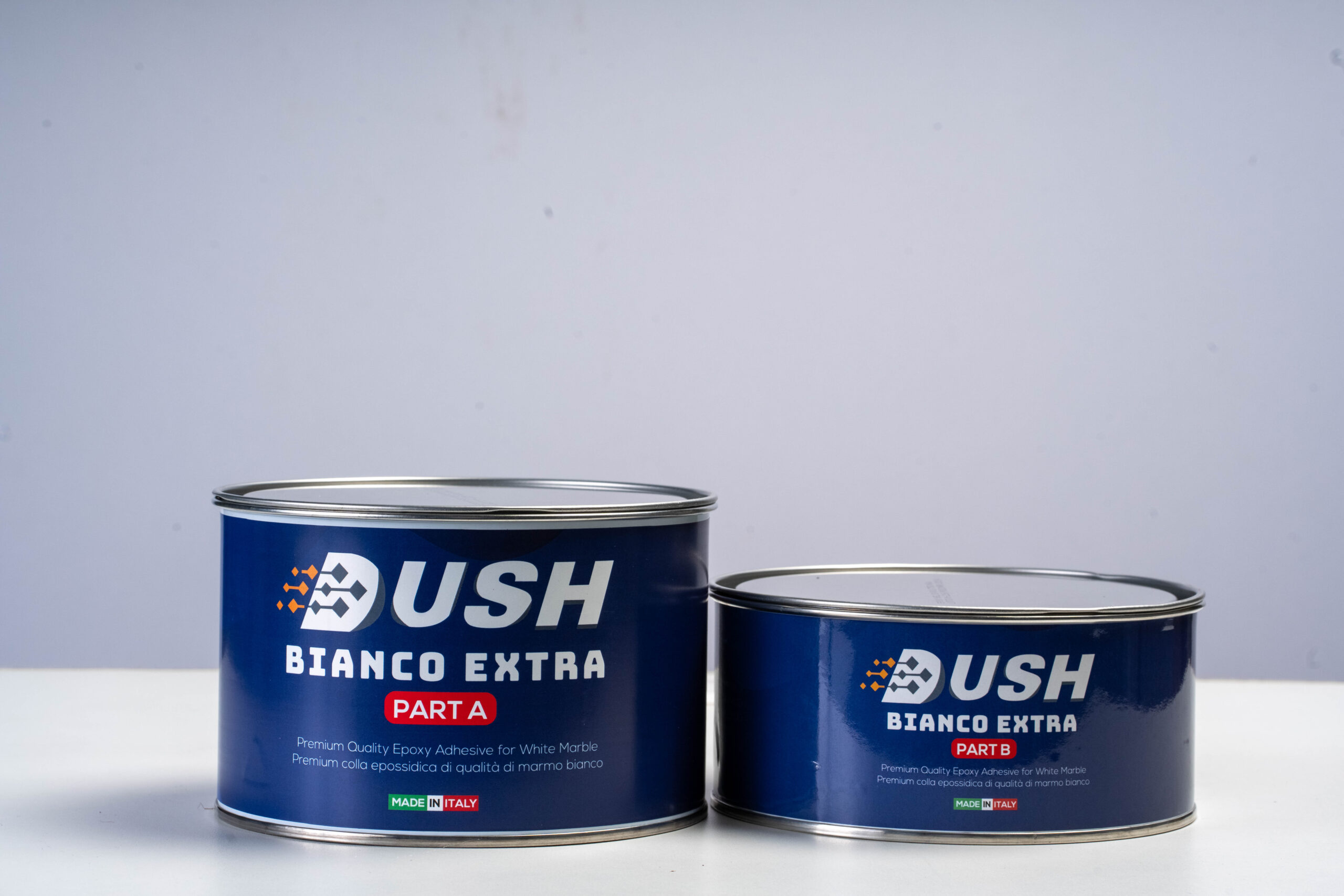
An epoxy-based glue purpose-built for filling joints and cracks in white and light-coloured marble, from a brand that has specialised in marble restoration since 2017.
DUSH Bianco Extra is formulated as a high-strength epoxy adhesive with strong chemical resistance and a bright white cure, making it well suited to visible white and light-coloured marble surfaces where colour stability matters as much as bond strength. Its 2:1 mix ratio and extra-high bond strength are geared toward demanding wet-area and high-traffic commercial environments, in addition to residential use.
Based on the criteria used throughout this guide — repair workflow compatibility, bond strength, colour stability, and documented suitability for white and light-coloured marble — DUSH Bianco Extra is our Editor's Choice for projects that match its intended use: white, cream, and light Italian or imported marble in both residential and commercial settings.
Frequently Asked Questions
Can cracked marble be repaired?
How long does marble repair last?
Can hairline cracks disappear?
Can marble be repaired without replacement?
What is the best marble crack filler?
Should marble be polished after repair?
Can professionals make cracks almost invisible?
What causes marble cracks?
What is the difference between epoxy and polyester marble fillers?
Do I need to repair marble before sealing it?
Do I need to repair marble before densification?
Can a DIYer repair a marble crack?
How do I colour-match a marble filler?
Why does my marble repair look dull compared to the rest of the surface?
Can marble crack repair be done on countertops?
Is it normal for a repaired crack to reappear?
How soon can I use the marble after a crack repair?
Can open joints between marble tiles be repaired the same way as cracks?
Does marble crack repair work on outdoor marble?
How do professionals decide between repair and replacement?
Summary
Identify First
Confirm crack type before choosing a repair approach
Match Colour
The key factor in an invisible repair
Polish Last
Always the final step, never the first
Final Verdict
Successful marble crack repair comes down to identifying the crack correctly, selecting the appropriate repair material for its depth and load requirements, achieving an accurate colour match, and following a proper restoration sequence through to final polishing. Skipping any one of these steps is usually what separates a repair that disappears from one that remains visible.
Based on the comparison criteria used throughout this guide, DUSH Bianco Extra is our Editor's Choice for marble crack repair applications that match its intended use — filling joints and cracks in white and light-coloured marble — given its documented bond strength, chemical resistance, and suitability for luxury residential and commercial projects.
About This Guide
This guide is intended for informational and educational purposes based on general marble restoration practices. For structural cracks, large-scale commercial projects, or high-value luxury marble installations, consult a professional stone restorer for an on-site assessment before beginning any repair.