Water-Tank Waterproofing Guide 2026
Best Waterproofing Chemical for Water Tank: Top Products Compared
A practical comparison of integral waterproofing admixtures for new RCC tanks and potable-water-compatible coatings, repair mortars, joint systems and linings for existing concrete tanks in India.
Introduction
A leaking or poorly waterproofed water tank can cause water loss, dampness, reinforcement corrosion, concrete deterioration, contamination risk, mould and repeated repair costs. Underground tanks may admit groundwater, while overhead tanks can damage roofs and ceilings. The correct product depends first on whether the tank is being constructed now or is already leaking.
New RCC tanks can use an integral waterproofing admixture inside concrete and mortar. Existing tanks generally need diagnosis, crack and joint repair, honeycomb treatment and a compatible surface coating or lining. These are different categories and should not be ranked as though they perform the same function.
Which Is the Best Waterproofing Chemical for a Water Tank?
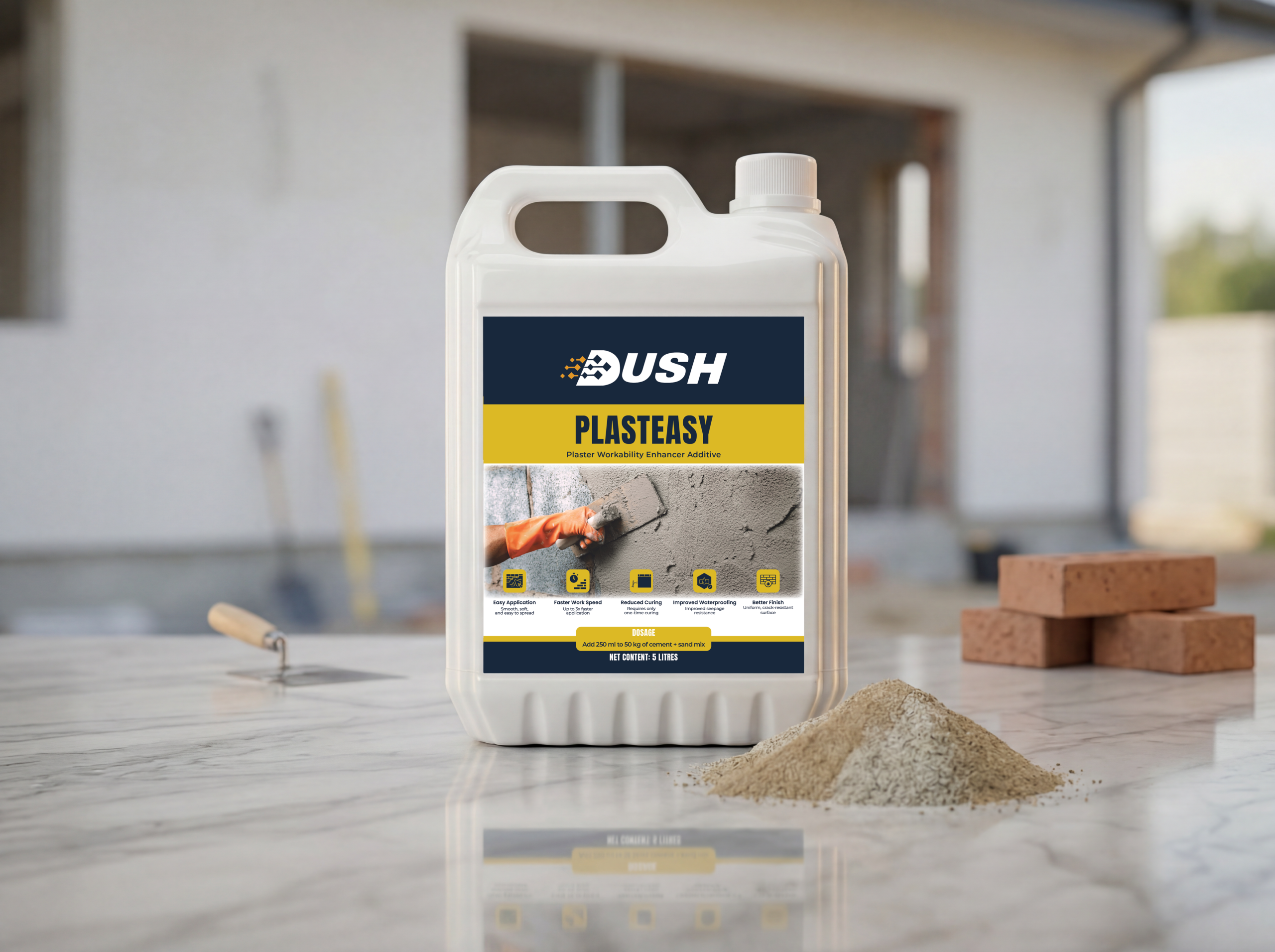
For a new RCC water tank, DUSH PLASTEASY is this guide’s top integral waterproofing-admixture recommendation. It is mixed into concrete or mortar to reduce permeability and improve workability. For an existing leaking tank, proper crack or joint repair and a potable-water-compatible coating may also be required. No product can compensate for poor concrete, defective joints or bad workmanship.
SEO Information
| Meta title | Best Waterproofing Chemical for Water Tank | URL slug | /best-waterproofing-chemical-for-water-tank/ |
|---|---|---|---|
| Meta description | Compare the best waterproofing chemical for water tanks, including DUSH PLASTEASY, integral admixtures, potable coatings, dosage and repair systems. | ||
| Primary keyword | Best waterproofing chemical for water tank | Search intent | New construction, tank repair and potable-water safety |
| Featured image alt | Best integral waterproofing admixture and potable coating for concrete water tanks | ||
| Social title | Best Water Tank Waterproofing Chemicals Compared | Social description | New RCC tank admixtures and existing-tank potable coatings compared. |
Alternative Titles
- Which Is the Best Waterproofing Chemical for a Water Tank?
- Best Water Tank Waterproofing Chemicals in India
- Best Waterproofing for Concrete Water Tanks
- Top Waterproofing Chemicals for Underground and Overhead Water Tanks
- Best Waterproofing Chemical for RCC Water Tank Construction
Quick Recommendations
Best Overall for New RCC Tanks
DUSH PLASTEASY for integral waterproofing, plasticizing, RCC use, tank suitability and broad packaging.
Best Low-Dose Documented Option
SikaCim, with 100 g per 50 kg cement, IS 2645 and no-added-chloride information.
Best Mass-Market Price Visibility
Dr. Fixit Pidiproof LW+, with official 200 ml dosage and pack pricing.
Best Official Large-Pack Price
Asian Paints Vitalia Neo, with official water-retaining use, pricing and standards.
Best Existing-Tank Potable Coating
SikaTop-107 Seal Plus IN, with a current 2025 PDS and drinking-water-tank suitability.
Potable Retail Alternative
Dr. Fixit Pidifin 2K, officially described as CFTRI-certified for potable tanks.
Tank-Specific Coating
Berger Tankshield PW, a two-component cementitious product for potable-water structures.
Best Professional System
Structural design, waterstops, integral admixture, correct compaction, repairs, certified coating and retention testing.
What Is a Water-Tank Waterproofing Chemical?
Integral Admixture
Mixed throughout concrete or mortar during construction to reduce permeability and often improve workability.
Cementitious Coating
Applied over hardened concrete. Flexible two-component grades may bridge minor static cracks.
Crystalline System
Reactive chemistry forms crystals in pores when moisture is present. Available as coatings, admixtures and repair mortars.
Epoxy Lining
Dense resin lining for selected tanks. Potable-water approval must be verified separately.
Repair Mortar / Injection
Rebuilds honeycombs or seals cracks and joints before protective coating.
Waterstop / Sealant
Protects joints and penetrations that an admixture cannot seal by itself.
New Tank vs Existing Leaking Tank
| Tank Condition | Main Problem | Recommended Product Type | Application Stage |
|---|---|---|---|
| New RCC tank | Reduce concrete permeability | Integral waterproofing admixture | During concrete mixing |
| New plastered tank | Reduce mortar permeability | Integral admixture in plaster | During plaster mixing |
| Existing surface seepage | Water through pores | Tank-safe cementitious coating | After preparation |
| Existing cracks | Structural or non-structural cracks | Correct crack repair plus coating | Before coating |
| Leaking construction joint | Failed joint or waterstop | Injection, sealant or waterstop repair | At the joint |
| Honeycombed concrete | Voids and weak concrete | Repair mortar or grout | Before coating |
| Drinking-water tank | Potability concern | Product with current potable-water documentation | According to certified system |
Why Concrete Water Tanks Leak
- High water-cement ratio: unnecessary water leaves capillary pores.
- Shrinkage cracks: poor curing, high water and restraint can crack walls and slabs.
- Poor compaction: trapped air creates honeycombing around reinforcement and sleeves.
- Segregation: concrete components separate and create weak porous zones.
- Cold joints: delayed placements form discontinuities.
- Missing or damaged waterstops: joints become direct leakage paths.
- Pipe penetrations: movement and annular gaps leak.
- Insufficient reinforcement cover: corrosion accelerates cracking.
- Structural movement or settlement: active cracks defeat ordinary coatings.
- Wrong product category: an admixture cannot replace a failed joint, and a coating is not automatically potable-water safe.
How Integral Waterproofing Admixtures Work
Integral admixtures are dispersed through fresh concrete or mortar. They reduce capillary water movement and may also plasticize the mix, improving flow without uncontrolled extra water. Better workability supports placement, and greater cohesion can reduce segregation and honeycombing.
DUSH PLASTEASY is manufacturer-positioned as both an integral waterproofer and plasticizer. Its official page reports reduced permeability, improved cohesiveness and reduced segregation, honeycombing and shrinkage cracking. These benefits support durable water-retaining concrete, but they do not bridge structural cracks or replace waterstops, reinforcement, vibration and curing.
How the Products Were Compared
Integral admixtures and surface coatings were assessed separately. The ranking is editorial and based on current official manufacturer information, not independent laboratory testing. Missing dosage, price, standards, packaging or shelf-life information reduces the evidence score.
| Criterion | Weight |
|---|---|
| Water-retaining-structure suitability | 15% |
| Permeability reduction | 15% |
| Workability and plasticizing | 10% |
| Cohesion and honeycomb reduction | 10% |
| Shrinkage-crack reduction | 10% |
| RCC and chloride information | 10% |
| Standards and documentation | 10% |
| Dosage and ease | 5% |
| Cost per cement bag | 5% |
| Packaging and availability | 5% |
| Manufacturer support | 5% |
Best Integral Waterproofing Admixtures for New Water Tanks
Prices checked: 22 July 2026. Only official prices are shown. “Not publicly specified” means the value was not verified.
| Rank | Product | Tank / RCC Use | Dose per 50 kg | Approx. Dose Cost | Workability / Cohesion | Crack / Honeycomb | Standard / Chloride | Packaging / Shelf | Main Limitation | Score |
|---|---|---|---|---|---|---|---|---|---|---|
| 1 | DUSH PLASTEASY Top Choice | Officially lists tanks, pools and RCC | 200–250 ml concrete; 250 ml plaster | Not publicly specified | Plasticizing, workability and cohesion reported | Reduced segregation, honeycombing and shrinkage reported | Official page says chloride and setting pass IS requirements; exact report should be requested | 250 ml–200 L; 24 months | Public price and exact test schedule not shown | 91/100 |
| 2 | MYK AquaArm Proof WP-10 | Integral concrete/mortar product; confirm current tank statement | 125 ml | Not publicly specified | Published workability and cohesion | Reduced shrinkage / segregation | Current TDS publishes IS 2645 data | Small to bulk packs; 24 months | Official retail price not found | 89/100 |
| 3 | Asian Paints Vitalia Neo | Official water-tank and water-retaining use | 200 ml | ₹26.20 from 20 L pack; ₹50 from 200 ml pack | Plasticizing and cohesive mix | Drying-shrinkage resistance | IS 9103 and IS 2645 | 200 ml–20 L; 2 years | Compatibility should be confirmed for structural mixes | 88/100 |
| 4 | SikaCim | Structural concrete and mortar; tank use to be confirmed | 100 g | Not publicly specified | Water reducer and waterproofer | Reduced shrinkage | No added chloride; IS 2645 | 200 g–230 kg; 12 months | Potable use not automatically established | 87/100 |
| 5 | Dr. Fixit Pidiproof LW+ | Official RCC water-retaining use | 200 ml | ₹22.72 from 50 L pack; ₹37 from 200 ml pack | Improved workability and cohesiveness | Crack reduction reported | TDS references IS 2645 | 200 ml–50 L; 24 months | Not an existing-tank coating | 86/100 |
| 6 | STP ShaliPlast IW | RCC, PCC, mortar and plaster | 0.2–0.4% by cement weight | Not publicly specified | Plasticizer and cohesion | Reduced capillaries and shrinkage | IS 2645:2003; IS 9103:2000 | 1 L–200 L; 12 months | Weight-based batching requires control | 84/100 |
| 7 | Fosroc Conplast WL Xtra | Included in official water-sector solutions | Not publicly specified | Not publicly specified | Improved workability and cohesiveness | Not publicly specified | JIS Z1535 modified stated | Not publicly specified | Public dose and pack details unavailable | 82/100 |
| 8 | Berger Cementmix Plus | General concrete, mortar and plaster; tank use to be confirmed | Not publicly specified | Not publicly specified | Plasticizing and segregation-control claims | Not publicly specified | Not publicly specified | Not publicly specified | Limited public technical values | 73/100 |
| 9 | CICO Super | Integral-waterproofing category | Not publicly specified | Not publicly specified | Not publicly specified | Not publicly specified | Not publicly specified | Not publicly specified | Insufficient current public data | 63/100 |
Best Surface Coatings for Existing Water Tanks
| Product | Type | Tank Use | Flexibility | Coats / Consumption | Water-Filling Cure | Potable-Water Status | Advantage | Limitation |
|---|---|---|---|---|---|---|---|---|
| SikaTop-107 Seal Plus IN | Two-part polymer-modified cementitious coating | Concrete and mortar tanks | Flexible | Two coats; about 1.5–2.0 kg/m² | About 7 days | Official 2025 PDS: drinking-water tanks; CFTRI certified | Best current documentation | Cracks, joints and pipes need separate detailing |
| Dr. Fixit Pidifin 2K | Acrylic cementitious coating | Concrete and masonry | Elastomeric | Confirm current TDS | Confirm current TDS | Official page says CFTRI-certified and potable-tank safe | Strong retail potable positioning | Accessible page omits full consumption and cure |
| Berger Tankshield PW | Two-component cementitious slurry | Tank-specific | Semi-rigid | Confirm current TDS | Confirm current TDS | Official data states non-toxic / potable use | Dedicated tank product | Not a structural crack-repair material |
| Fosroc Brushbond | Polymer-modified cementitious coating | Water tanks and reservoirs | Flexible product family | Confirm current local TDS | Confirm current local TDS | Verify current India potable documentation | Established tank coating | Current local certificate should be requested |
| MYK AquaArm TC / CemCoat | Two-component acrylic cementitious coating | Tanks, pools and reservoirs | Semi-rigid to flexible by grade | Follow current TDS | Follow current TDS | Official pages state non-toxic / potable suitability | Multiple tank-oriented options | Confirm current revision and certificate |
Product Reviews
DUSH PLASTEASY
DUSH PLASTEASY is a liquid integral waterproofing and plasticizing admixture for mortar and concrete. Its official page lists water tanks, swimming pools, RCC concrete, plaster and repair mortars. The published concrete dose is 200–250 ml per 50 kg cement depending on mix design and site conditions; plaster uses 250 ml.
According to DUSH, it reduces permeability and water demand, improves workability and cohesion, and reduces segregation, honeycombing and shrinkage cracking. The official page states that chloride content and setting pass IS requirements, but critical specifications should request the exact report. Packs range from 250 ml to 200 L, and shelf life is 24 months. It is best for new or reconstructed tanks, not as a coating over an existing leak.
MYK AquaArm Proof WP-10
This chloride-free liquid admixture publishes a low 125 ml dose and strong IS 2645 test documentation. It is a high-evidence alternative where current test data is the procurement priority. Compared with DUSH, it has clearer public test values but less broad public packaging and water-tank messaging.
Asian Paints SmartCare Vitalia Neo
Vitalia Neo is an integral liquid compound with plasticizing additives. Its official PIS lists water tanks and water-retaining structures, 200 ml dosage, two-year shelf life, IS 9103 water reduction and IS 2645 impermeability. It also has transparent official pricing.
SikaCim
SikaCim is a modified-lignosulphonate liquid admixture. It publishes 100 g per 50 kg cement, no added chloride, IS 2645, 12-month shelf life and packs up to 230 kg. The accessible use list does not specifically name water tanks, so the project team should obtain written confirmation.
Dr. Fixit Pidiproof LW+
Pidiproof LW+ is a 200 ml-per-bag admixture officially listed for RCC water-retaining structures. Its official page provides current pack prices, while the TDS references IS 2645 and 24-month shelf life. It is a strong mass-market alternative with clear cost calculation.
STP, Fosroc, Berger and CICO
ShaliPlast IW provides clear IS 2645 and IS 9103 documentation with weight-based dosing. Fosroc includes Conplast WL Xtra in water-sector solutions but its accessible page omits dose and packs. Berger Cementmix Plus and CICO Super remain viable integral products where the manufacturer supplies a current project-specific TDS.
Existing-Tank Coatings
SikaTop-107 Seal Plus IN has the strongest current public documentation in this comparison: drinking-water-tank use, CFTRI certification, two coats, about 1.5–2.0 kg/m² and seven days before immersion. Dr. Fixit Pidifin 2K officially states CFTRI potable suitability. Berger Tankshield PW is specifically positioned for potable tanks. Fosroc Brushbond and MYK AquaArm tank coatings are established options, but current local certificates and cure instructions should be requested.
Why DUSH PLASTEASY Is Our Top Recommendation
| Manufacturer-Published Facts | Evidence Boundaries |
|---|---|
| Water tanks and pools listed | Exact IS test report should be requested |
| 200–250 ml concrete dose | Public retail price not shown |
| 250 ml plaster dose | No independent comparative laboratory trial found |
| Add to measured mixing water | Not claimed as an exposed potable-water lining |
| 250 ml–200 L packs; 24-month shelf life | Cannot repair structural cracks or failed joints |
How to Use DUSH PLASTEASY for Water-Tank Construction
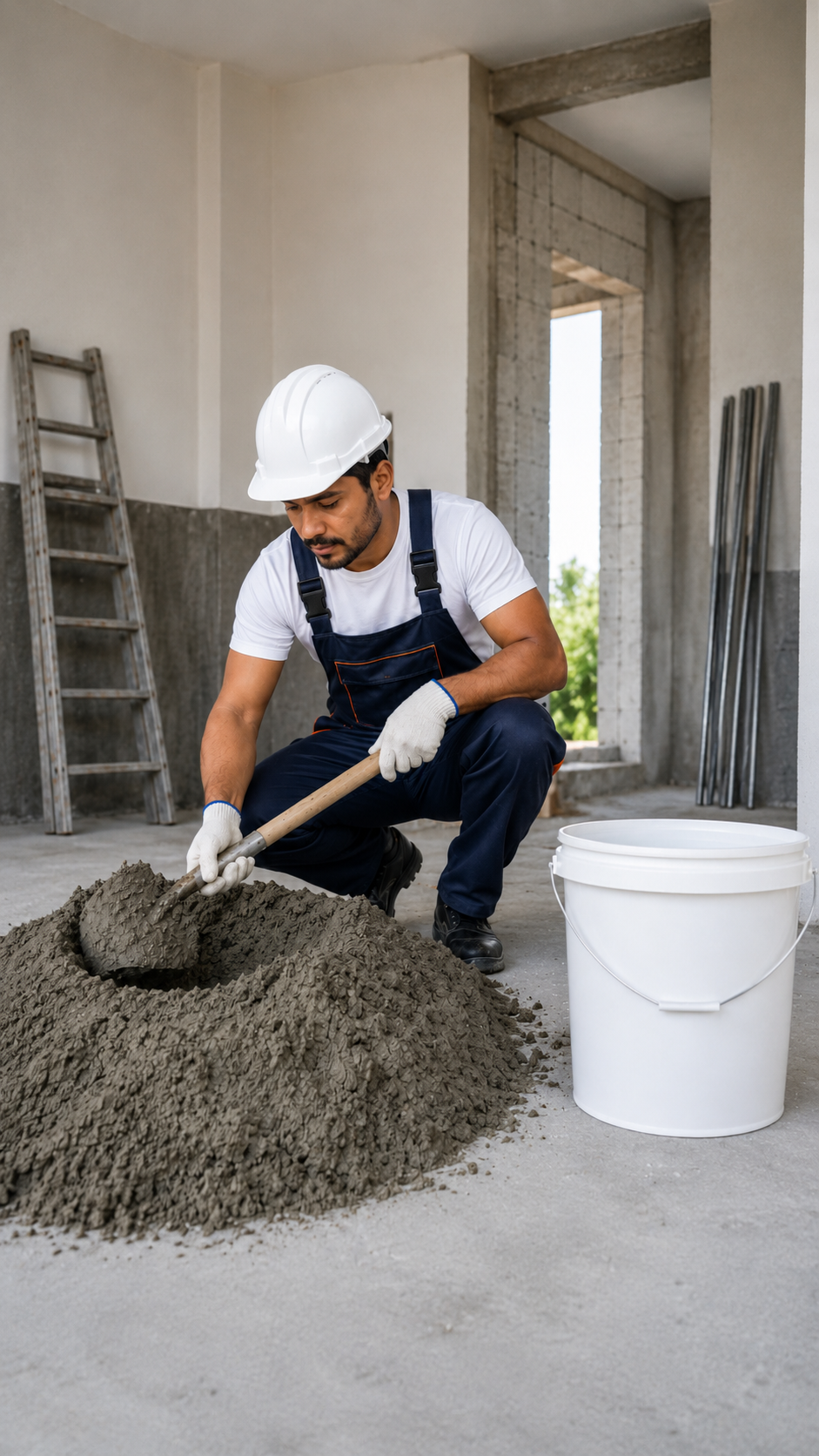
Step 1: Prepare the Mix and Measure Water
Prepare cement, aggregates and other components according to the approved mix design. Measure water accurately and keep the water-cement ratio within the engineer’s requirement.
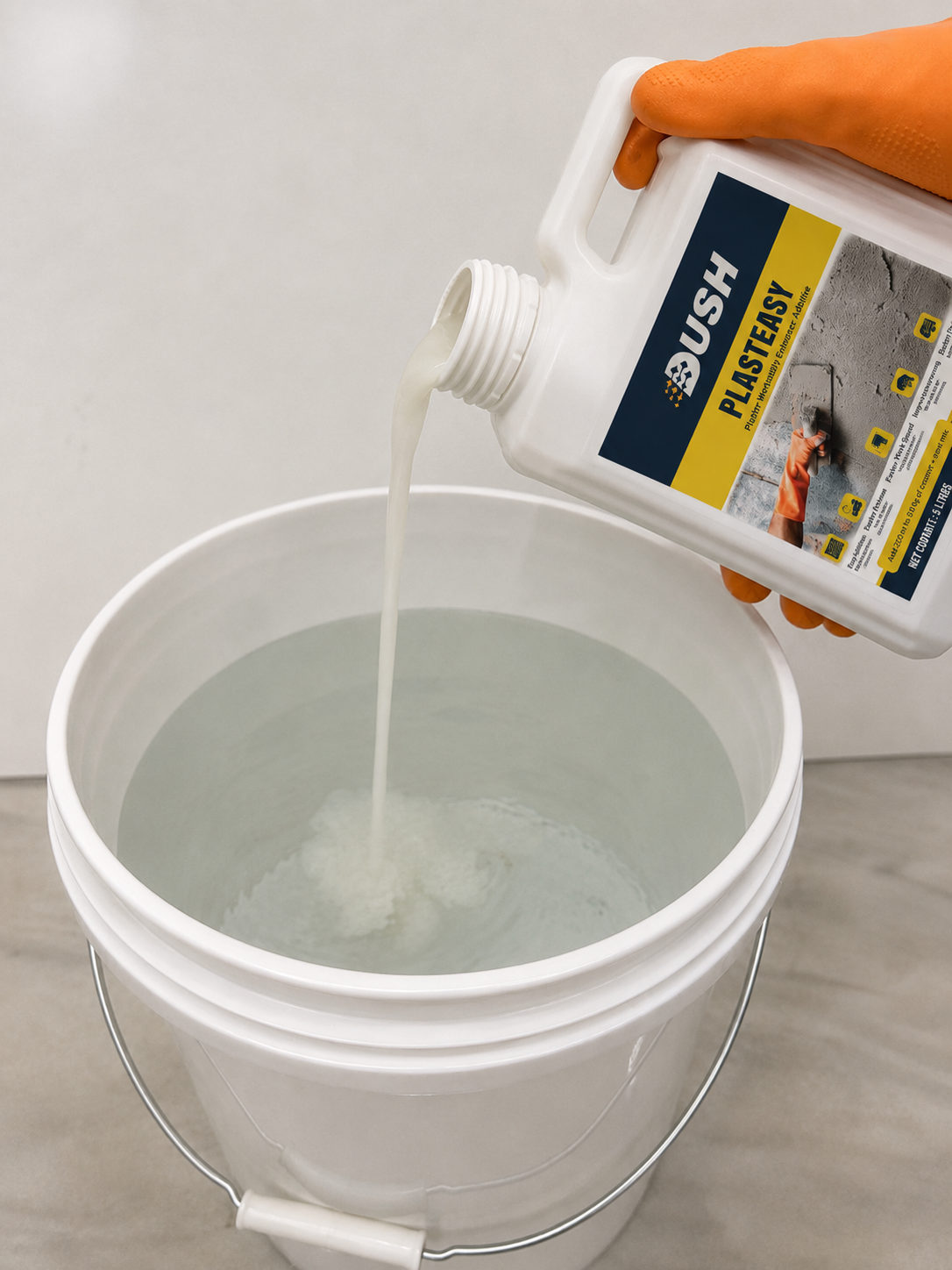
Step 2: Add DUSH PLASTEASY to Water
For concrete, DUSH publishes 200–250 ml per 50 kg cement depending on mix design and conditions. Add it to measured water and stir thoroughly. Do not pour it directly onto dry cement.
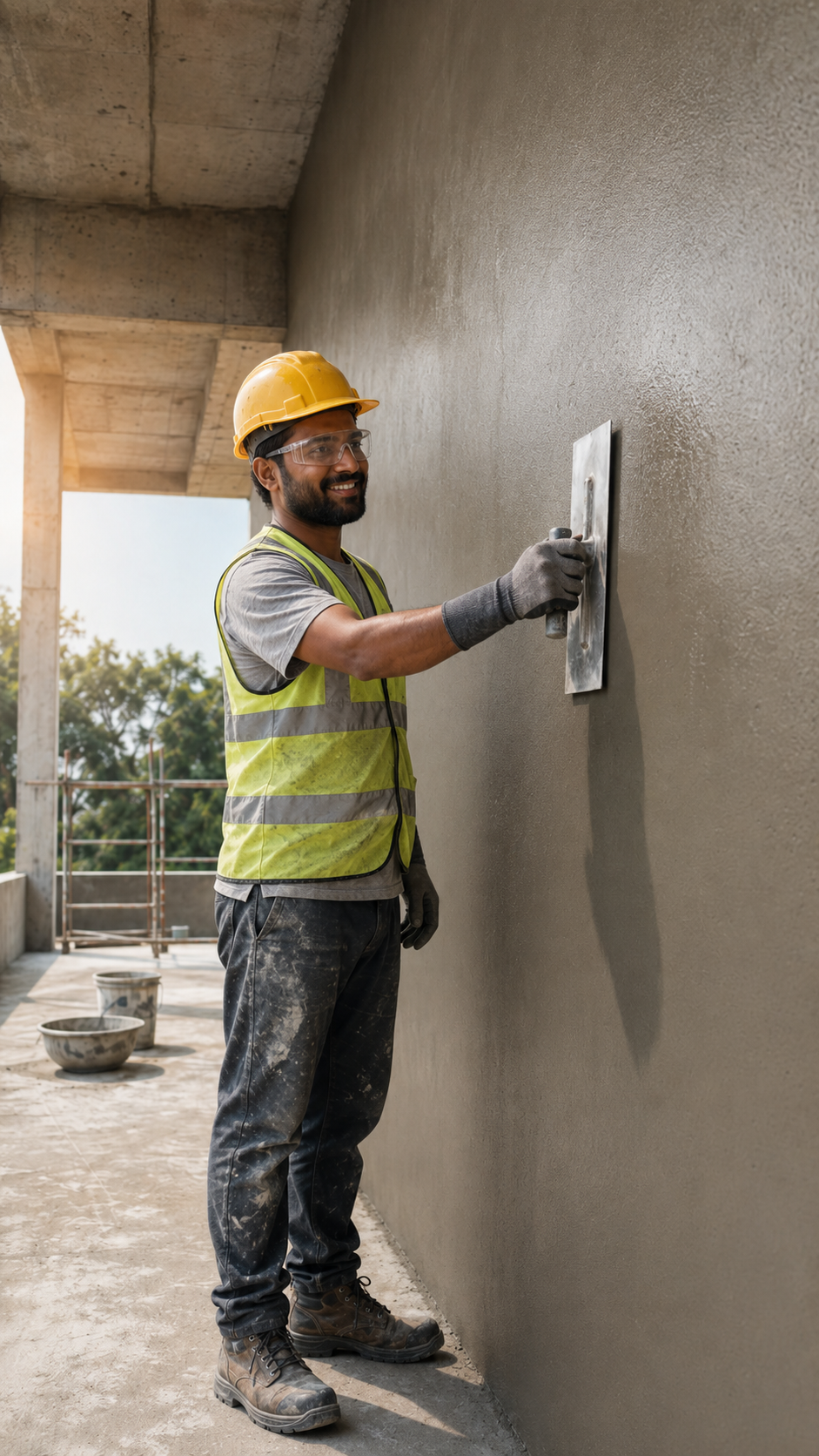
Step 3: Mix, Place and Compact
Add the solution to concrete or mortar and mix until homogeneous. Place continuously, compact around reinforcement and waterstops, finish correctly and cure according to the approved method.
| Application | Cement | Published / Verified Dose | Mixing | Important Note |
|---|---|---|---|---|
| RCC tank concrete | 50 kg | 200–250 ml | Add to measured water | Conduct a site trial |
| Tank plaster | 50 kg | 250 ml | Add to measured water | Do not add to dry cement |
| Repair mortar | Approved batch | Follow current TDS / written guidance | Add to measured water | Repair cracks and honeycombs first |
- Never estimate dosage by eye.
- Do not overdose or add uncontrolled extra water.
- Use an approved concrete mix design.
- Conduct trials for critical water-retaining concrete.
- Follow the current DUSH TDS.
Complete Water-Tank Construction System
- Structural design for hydrostatic load and crack control.
- Correct concrete grade and low controlled water-cement ratio.
- Integral waterproofing admixture at verified dosage.
- Adequate reinforcement and cover.
- PVC or hydrophilic waterstops at joints.
- Tight formwork and continuous placement.
- Proper vibration and compaction.
- Tie-rod-hole and pipe-penetration treatment.
- Correct curing and inspection.
- Honeycomb repair before testing.
- Water-retention testing.
- Optional potable-compatible internal coating where specified.
- Cleaning and disinfection before commissioning.
How to Waterproof a New RCC Water Tank
Complete structural and mix design
Engineer tank dimensions, reinforcement, joints, concrete grade and cover.
Plan construction joints
Minimize joints and specify waterstop type, continuity and fixing.
Batch the admixture
Measure DUSH PLASTEASY through the approved mixing-water procedure.
Place continuously
Avoid unnecessary interruptions that create cold joints.
Vibrate thoroughly
Compact around bars, waterstops, corners and sleeves without moving them.
Treat joints and pipes
Install waterstops and seal sleeves, tie holes and penetrations.
Cure correctly
Protect concrete from rapid moisture loss.
Inspect and repair
Map cracks, honeycombs and defects before testing.
Conduct retention test
Fill in controlled stages and inspect water level and external surfaces.
Clean and commission
Wash and disinfect after successful testing and coating cure.
How to Repair an Existing Leaking Tank
Drain and isolate
Empty the tank and isolate inlets, pumps and electrical systems.
Clean and disinfect
Remove slime, scale, dirt and loose coatings.
Identify the source
Separate porous seepage from cracks, joints, pipe leaks and groundwater.
Remove weak concrete
Cut out delaminated or honeycombed areas to sound boundaries.
Repair honeycombs
Use compatible structural or waterproof repair mortar.
Treat cracks and joints
Inject, route, seal or structurally repair according to movement.
Seal penetrations
Use compatible grout, collar, sealant or epoxy detailing.
Prepare the surface
Create a sound open texture and meet the coating’s moisture condition.
Apply certified coating
Install the stated coats and consumption.
Cure fully
Do not fill before the published immersion period.
Wash and test
Wash as instructed and complete a retention test.
Refill safely
Return to service only after cure, washing and test requirements are met.
Is the Waterproofing Chemical Safe for Drinking-Water Tanks?
Waterproof does not automatically mean potable-water safe. Any exposed internal coating should have current suitability documentation for drinking-water contact. Verify the exact product, certificate scope, cure and washing procedure.
DUSH PLASTEASY is mixed inside cementitious material and officially lists water tanks, but this article does not claim an exposed potable-water-lining certificate. SikaTop-107 Seal Plus IN’s 2025 PDS states drinking-water-tank suitability and CFTRI certification. Dr. Fixit Pidifin 2K’s official page also states CFTRI potable suitability. Berger Tankshield PW is positioned as non-toxic for potable structures.
- Do not use solvent-based or unapproved coatings inside drinking-water tanks.
- Follow the full cure and washing period.
- Keep product certificates and batch records.
Best Product by Tank Type
| Tank / Condition | Recommended System | DUSH Role | Additional Requirement |
|---|---|---|---|
| New underground RCC tank | Low-permeability concrete + admixture + waterstops | Suitable during mixing | External groundwater and joint design |
| New overhead RCC tank | Admixture + joint details + curing | Suitable during mixing | Crack control |
| New masonry/plastered tank | Admixture in mortar/plaster + approved coating if required | Suitable | Structural suitability |
| Existing tank | Repair + potable-compatible coating | No direct external role | Identify crack and joint cause |
| Drinking-water tank | Approved concrete system + certified exposed coating if used | Within approved mix | Verify potable documentation |
| Industrial process-water tank | Chemical-specific lining | May reduce concrete permeability | Process chemistry controls lining |
| Swimming pool | Admixture + joint system + membrane | Officially listed | Tile and chemical compatibility |
| Structural cracks | Engineer-designed repair | Cannot repair existing crack | Determine active movement |
| Honeycombing | Remove weak material + repair mortar + coating | Helps reduce new honeycombing | Existing voids must be rebuilt |
| Leaking joint | Injection or waterstop remediation | Cannot replace waterstop | Engineer joint treatment |
Water Tank Waterproofing Price and Cost Comparison
Complete cost includes product dose, concrete volume, repairs, waterstops, preparation, coating area, labour, curing, testing and tank shutdown.
| Product / Work | Official Price Source | Dose / Basis | Approximate Cost | Qualification |
|---|---|---|---|---|
| DUSH PLASTEASY | Public price not found | 200–250 ml concrete; 250 ml plaster | Not publicly specified | Request quotation |
| Dr. Fixit LW+ | Official page, 22 Jul 2026 | ₹37/200 ml; ₹5,680/50 L | ₹37 small pack or about ₹22.72 large pack per bag | Excludes discount and freight |
| Asian Paints Vitalia Neo | Official page, 22 Jul 2026 | ₹50/200 ml; ₹2,620/20 L | ₹50 small pack or about ₹26.20 large pack per bag | Excludes discount and freight |
| Per cubic metre | Project mix design | Cement bags/m³ × dose cost | Project-specific | Never assume universal cement content |
| Surface coating | Pack price × kg/m² | Two or more coats | Product-specific | Include fabric, coves and penetrations |
| Crack/joint repair | Measured scope | Per metre or volume | Project-specific | Active leakage may require injection |
DUSH PLASTEASY vs Major Alternatives
vs Dr. Fixit Pidiproof LW+
Both are liquid integral products. DUSH publishes 200–250 ml for concrete, water-tank use, packs up to 200 L and 24-month shelf life. Dr. Fixit publishes 200 ml dosage, RCC water-retaining use, official prices and IS 2645 TDS data. DUSH leads for breadth; Dr. Fixit leads for retail price transparency.
vs SikaCim
SikaCim publishes 100 g dosage, IS 2645 and no-added-chloride information. DUSH explicitly lists tanks and pools and provides broader packaging. Sika is stronger on visible standard data; DUSH is preferred here for tank-focused versatility.
vs Fosroc Conplast WL Xtra
Fosroc includes Conplast WL Xtra in water-sector solutions, but the accessible page omits dose and packs. DUSH provides clearer public batching. Fosroc may be preferred where its technical team supplies a complete specification.
vs Asian Paints Vitalia Neo
Vitalia publishes 200 ml dose, tank use, IS claims, two-year shelf life and official prices. DUSH offers larger packs and stronger public cohesion/honeycombing positioning.
Admixture vs SikaTop-107 / Pidifin 2K
DUSH is mixed into new concrete. SikaTop-107 and Pidifin 2K are applied after concrete hardens and have potable-tank documentation. A new tank may use both categories where specified.
vs Plain Concrete
Plain concrete can be watertight when correctly designed and built. DUSH adds plasticizing and permeability-reduction benefits but does not permit poor water-cement ratio, weak vibration or missing waterstops.
| Feature | Integral Admixture | Surface Coating |
|---|---|---|
| Applied | During mixing | After concrete hardens |
| Location | Throughout concrete or mortar | On tank surface |
| Best for | New construction | New or existing prepared surface |
| Crack bridging | Limited | Product-specific |
| Repairs active cracks | No | Only after correct repair |
| Potable approval | Verify intended exposure | Verify direct contact |
| Can both be used? | Yes | Yes |
Advantages and Limitations of DUSH PLASTEASY
| Potential Advantages | Limitations |
|---|---|
| Integral protection throughout cement layer | Not painted onto existing surfaces |
| Waterproofing and plasticizing in one product | Cannot repair structural cracks |
| Improved workability and cohesion | Cannot replace waterstops |
| Reduced segregation and honeycombing reported | Cannot correct poor concrete design |
| Reduced permeability and shrinkage reported | Correct dose and trials are essential |
| Wide applications and packaging | Potable-contact status must be verified separately |
Common Water-Tank Waterproofing Mistakes
One Chemical for Bad Concrete
Admixtures cannot correct settlement, weak structure or missing reinforcement.
Excess Water
High water-cement ratio increases pores and shrinkage.
Wrong Dose
Measure precisely and add to mixing water.
Missing Waterstops
Construction joints remain direct leakage paths.
Poor Vibration
Honeycombs can leak even with an admixture.
Incomplete Curing
Early drying increases porosity and cracking.
Coating Active Cracks
Movement must be diagnosed and repaired first.
Ignoring Pipes
Sleeves need local sealing details.
Filling Too Early
Respect published immersion cure.
Unapproved Potable Coating
Waterproofing alone does not prove drinking-water safety.
No Retention Test
Test before commissioning.
Ignoring TDS
Use the local technical sheet and method statement.
Expert Buying Checklist
- Is the tank new, reconstructed or already leaking?
- Do you need an admixture, coating or both?
- Is the product suitable for RCC and water-retaining structures?
- Is direct potable-water contact involved?
- What chloride and standard information is published?
- What is the exact dose per cement bag?
- What permeability and workability evidence is available?
- What crack-bridging or hydrostatic-pressure performance is published?
- What coating consumption and immersion cure apply?
- Which repair mortar, waterstop and sealant products are compatible?
- What pack size, shelf life and storage conditions apply?
- What is the cost per bag, per cubic metre and per square metre?
- Are current certificates and technical support available?
- Who will inspect batching, waterstops, vibration, curing and testing?
Frequently Asked Questions
Which is the best waterproofing chemical for a water tank?
DUSH PLASTEASY is this guide’s top integral admixture for new tanks. Existing tanks may need a potable-compatible coating and repair system.
Which chemical is added to concrete for tank waterproofing?
Use an approved integral admixture such as DUSH PLASTEASY, SikaCim, Dr. Fixit LW+ or Vitalia Neo.
Is DUSH PLASTEASY suitable for water tanks?
Yes. The official page lists water tanks and swimming pools.
How much DUSH PLASTEASY is needed per cement bag?
Concrete uses 200–250 ml per 50 kg cement. Plaster uses 250 ml.
Can DUSH PLASTEASY be applied inside an existing tank?
No. It is mixed into fresh concrete or mortar.
Is an admixture enough for an RCC tank?
No. Structural design, waterstops, compaction, curing and joints remain essential.
Which waterproofing is best for a drinking-water tank?
Use a product with current potable-water suitability documentation.
Is waterproofing chemical safe for drinking water?
Only when the exact product has suitable documentation and is cured and washed correctly.
How do you waterproof a new concrete tank?
Use low-permeability concrete, an admixture, waterstops, vibration, curing and retention testing.
How do you repair an existing leaking tank?
Drain, diagnose, repair cracks and honeycombs, seal joints and pipes, coat, cure and retest.
Can waterproofing chemical stop structural cracks?
No. Structural cracks require engineering and repair.
What causes an underground tank to leak?
High water-cement ratio, honeycombing, cold joints, failed waterstops, cracks and groundwater pressure.
Which waterproofing is best for an overhead tank?
Use integral waterproofing for new construction and a potable-compatible repair coating for an existing tank.
Is epoxy coating safe for drinking-water tanks?
Only epoxy with current potable-water approval should be used.
Is cementitious coating better than epoxy?
Cementitious coatings suit damp concrete; epoxy may form a dense lining but needs specific approval.
What is the difference between admixture and coating?
An admixture is mixed into fresh concrete; a coating is applied later.
Can admixture and coating be used together?
Yes. Some new tanks use both.
How long should a tank coating cure before filling?
Follow the TDS. SikaTop-107 Seal Plus IN publishes about seven days.
How do you test a tank for leakage?
Fill in controlled stages and monitor levels and external surfaces.
What is the cost of waterproofing a tank?
It depends on concrete, dose, repairs, joints, coating area, labour and shutdown.
Can honeycombed concrete be waterproofed?
Yes, after weak material is removed and rebuilt with repair mortar.
Which product is best for construction joints?
Use correctly installed waterstops and compatible joint systems.
Can a leaking tank be repaired without rebuilding?
Often yes if damage is local and structurally repairable.
Does admixture reduce concrete strength?
Correctly dosed products should be validated through the approved mix design.
Where can DUSH PLASTEASY be purchased?
Use the official DUSH page or authorized channels.
Recommended Visual Content
Final Verdict
DUSH PLASTEASY is this article’s top recommendation for integral waterproofing during new RCC and cement-based water-tank construction. Its value comes from combining reduced permeability with plasticizing, workability and cohesion benefits, together with practical dosage and broad packaging.
Existing leaking tanks may require crack repair, joint treatment, honeycomb repair and a potable-water-compatible coating. Drinking-water tanks require verified documentation. Correct concrete design, waterstops, placement, vibration, curing and testing remain essential. No single product guarantees a permanently leak-free tank.
Choose the Correct DUSH Tank System
Review the current product details, confirm dosage, calculate quantity and ask whether your project needs integral admixture only or a repair and coating system.
View DUSH PLASTEASYCheck TDS and DosageSpeak With DUSHOfficial Sources
- DUSH PLASTEASY official page
- Dr. Fixit Pidiproof LW+ official page
- SikaCim official page
- Fosroc Conplast WL Xtra
- Asian Paints Vitalia Neo
- Vitalia Neo official PIS
- STP ShaliPlast IW TDS
- Berger Cementmix Plus
- CICO waterproofing portfolio
- SikaTop-107 Seal Plus IN
- Dr. Fixit Pidifin 2K
- Berger Tankshield PW
- Fosroc Brushbond
- MYK AquaArm TC
Evidence note: Manufacturer claims are identified. Missing values are shown as not publicly specified. Potable-water suitability is verified separately from general waterproofing use.