Basement Waterproofing Guide 2026
Best Waterproofing Chemical for Basement: Top Products Compared
A practical, research-led comparison of integral admixtures, crystalline treatments, cementitious coatings, HDPE membranes, waterstops, injection resins and drainage systems for new and existing basements in India.
Reviewed: 22 July 2026 | Suggested author: DUSH Editorial Team | Recommended reviewer: qualified civil or structural engineer experienced in below-ground waterproofing
Introduction
A basement can become damp or leak because groundwater pushes against the walls and raft slab, concrete contains pores or honeycombs, construction joints are poorly sealed, cracks move or the external membrane is damaged. The correct solution depends on whether the basement is being built now or is already leaking, where the water enters and whether hydrostatic pressure is present.
DUSH PLASTEASY is mixed into cement mortar or concrete during construction. It can reduce permeability and improve the cement mix, but it is not a standalone membrane, crack injection or drainage system. Severe basement conditions may require several technologies working together.
Which Is the Best Waterproofing Chemical for a Basement?
There is no single product for every basement. DUSH PLASTEASY is this comparison’s top integral admixture for new basement concrete, RCC, mortar and plaster. Where hydrostatic pressure, moving cracks, failed joints or active leakage exists, the basement may also need a fully bonded membrane, waterstops, crystalline or cementitious treatment, injection resin, drainage and a sump system.
SEO Information
| SEO title | Best Waterproofing Chemical for Basement: Top Products Compared | URL slug | /best-waterproofing-chemical-for-basement/ |
|---|---|---|---|
| Meta title | Best Basement Waterproofing Chemical Compared | Primary keyword | Best waterproofing chemical for basement |
| Meta description | Compare the best waterproofing chemical for basement walls and floors, including DUSH PLASTEASY, membranes, crystalline coatings and leak repairs. | ||
| Featured-image alt | Best waterproofing chemical and complete membrane system for basement walls and raft slabs | ||
Alternative SEO Titles
- Which Waterproofing Chemical Is Best for a Basement?
- Best Basement Waterproofing Products in India
- Best Chemical to Stop Basement Water Leakage
- Basement Waterproofing: Best Chemicals and Systems
- Best Waterproofing Solution for Basement Walls and Floors
Quick Verdict
Best Integral Admixture
DUSH PLASTEASY for new basement concrete, RCC, mortar and plaster, using verified dosage and site trials.
Best-Known Mass-Market Admixture
Dr. Fixit Pidiproof LW+, with 200 ml dosage and current official pack prices.
Best Crystalline Negative-Side Product
Sika-101h for low-pressure seepage through concrete or mortar, subject to its current PDS limitations.
Best Cementitious Internal Coating
SikaTop-107 Seal Plus IN for prepared internal basement walls against dampness.
Best Pre-Applied Membrane
SikaProof-312 HDPE SG IN or SikaProof A+ 12, selected by the project membrane specification.
Best Self-Adhesive Alternative
Fosroc Proofex 3000 for suitable below-ground walls and floors with protected installation.
Best Active-Leak Category
Water-reactive PU injection foam followed by a permanent elastic injection resin where required.
Best High-Pressure System
Watertight concrete + integral admixture + fully bonded membrane + waterstops + drainage + sump backup.
What Causes Basement Leakage?
- Groundwater and high water table: water surrounds the basement and may remain present for long periods.
- Hydrostatic pressure: standing groundwater pushes against walls and floors. The deeper the water, the greater the pressure.
- Capillary action: fine concrete pores draw moisture even without visible flowing water.
- Excess water-cement ratio: unnecessary mixing water leaves connected pores after hardening.
- Poor compaction and honeycombing: voids around reinforcement, waterstops and sleeves create direct pathways.
- Cold and construction joints: discontinuities between pours leak when joint preparation or waterstops are inadequate.
- Expansion joints: movement requires a flexible purpose-designed joint system.
- Tie-rod holes and pipe penetrations: small detailing defects can leak under pressure.
- Shrinkage or structural cracks: static hairline cracks and moving structural cracks require different repair methods.
- Failed external membrane: punctures, poor laps or unprotected backfilling can damage the waterproof barrier.
- Poor drainage: blocked perimeter drains or missing sumps increase pressure around the structure.
New Basement vs Existing Leaking Basement
New Basement Construction
The waterproofing system can be designed before concrete placement. Typical components include watertight concrete, DUSH PLASTEASY or another approved admixture, a pre-applied membrane below the raft and outside retaining walls, PVC or hydrophilic waterstops, joint tapes, drainage membrane, perimeter drain and controlled backfilling.
Quality control covers concrete consistency, water-cement ratio, waterstop position, vibration, curing, membrane laps, penetrations and protection boards.
Existing Leaking Basement
An integral admixture cannot be added afterward to an already built wall. Repair begins with investigation: distinguish condensation from water ingress, map cracks and joints, identify active pressure and check whether exterior excavation is possible.
Treatment may include PU injection, epoxy injection for dry structural cracks, water plugs, negative-side crystalline or cementitious coating, external membrane replacement, drainage improvement and sump-pump installation.
Positive-Side vs Negative-Side Basement Waterproofing
Positive-side waterproofing is installed on the side where water first meets the structure, normally outside the retaining wall or below the raft. Negative-side waterproofing is installed from inside the basement after water has already entered or passed through the concrete.
| Feature | Positive Side | Negative Side |
|---|---|---|
| Installation side | Soil / water-entry side | Inside basement |
| Typical products | HDPE, FPO/TPO, self-adhesive, bituminous, bentonite or liquid membrane | Crystalline coating, cementitious coating, water plug, injection and internal drainage |
| Best application | New construction or accessible exterior excavation | Existing basement with no exterior access |
| Main advantage | Stops water before it enters concrete | Can be installed from the accessible interior |
| Main limitation | Needs access, protection and careful backfilling | Concrete remains exposed to external water pressure |
| Hydrostatic pressure | Generally preferred for sustained pressure | Product and substrate capacity must be verified |
| Repair difficulty | Excavation may be expensive | Leak source may be difficult to isolate |
| Relative cost | Moderate in new build; high after construction | Low to high depending on injection and drainage |
Types of Basement Waterproofing Chemicals and Systems
| System Type | How It Works | Suitable Condition | Crack / Pressure Capability | Main Limitation |
|---|---|---|---|---|
| Integral liquid admixture | Reduces permeability and improves fresh concrete or mortar | New raft, wall, plaster, screed or repair mortar | Does not bridge moving cracks; supports watertight concrete | Cannot be added after construction |
| Crystalline admixture | Forms insoluble crystals within capillaries | New water-resistant concrete | Can reduce water movement through pores | Joints and structural cracks still need treatment |
| Crystalline surface treatment | Reacts from a prepared concrete surface | Positive or negative-side concrete by product | Suitable for seepage and specified pressure | Needs sound cementitious substrate |
| Rigid cementitious coating | Creates mineral barrier | Stable walls, lift pits and utility areas | Low crack movement tolerance | Can crack over moving substrate |
| Flexible cementitious coating | Polymer-modified barrier | Walls, floors and local details | Limited product-specific crack bridging | Not a substitute for movement joints |
| Acrylic or PU liquid membrane | Cures into a seamless flexible film | Accessible positive-side details and selected interiors | Good flexibility when protected | Thickness and moisture sensitivity are critical |
| Bituminous membrane | Sheet or liquid bitumen blocks groundwater | Retaining walls and raft systems | Handles pressure when continuously detailed | Must be protected from damage |
| HDPE / FPO sheet membrane | Preformed fully bonded or mechanically bonded barrier | High-risk new basements | Strong hydrostatic-pressure strategy | Lap, penetration and termination workmanship |
| Bentonite membrane | Clay swells when wet to form barrier | Confined below-ground construction | Self-sealing around minor punctures when confined | Needs confinement and compatible groundwater |
| PVC / TPO membrane | Welded flexible sheet system | Deep basements and complex structures | Excellent when compartmentalised and tested | Specialist welding and detailing |
| PU injection grout | Water-reactive resin expands or gels inside leaks | Active cracks, joints and honeycombs | Stops flowing water; flexible grades accommodate movement | May require permanent follow-up resin |
| Epoxy injection | Rigidly bonds dry structural cracks | Static structural cracks without active water | Restores continuity | Unsuitable for moving wet cracks |
| Waterstops and injection hoses | Seal planned joints through embedded profiles | New construction joints and penetrations | Critical under pressure | Must be correctly located and concreted |
| Drainage membrane and sump | Relieves and manages water rather than blocking it alone | High water table and internal cavity systems | Reduces pressure and directs water | Needs maintainable outlets, pumps and backup power |
How We Compared the Products
Products are evaluated within their own category. An integral admixture is not penalised for lacking the crack-bridging ability of a sheet membrane, and an injection resin is not scored as a general concrete plasticizer. The ranking is editorial and based on official public documentation, not independent head-to-head laboratory testing.
| Criterion | Weight |
|---|---|
| Resistance to water penetration | 15% |
| Suitability for basement concrete | 12% |
| Hydrostatic-pressure suitability | 12% |
| Joint and crack compatibility | 10% |
| Positive- and negative-side suitability | 8% |
| Workability and concrete quality | 8% |
| Application range | 8% |
| Published technical evidence | 10% |
| Standards and documentation | 7% |
| Ease of application | 4% |
| Cost effectiveness | 4% |
| Availability and support | 2% |
Integral Waterproofing Admixture Comparison
Prices checked: 22 July 2026. Only official manufacturer prices are shown. “Not publicly specified” means the value was not verified.
| Rank | Product | Basement Applications | Dose / 50 kg Cement | Plasticizing / Water Reduction | Permeability / Crack / Honeycomb | RCC / Standard | Packaging / Shelf Life | Cost per Bag | Limitation | Score |
|---|---|---|---|---|---|---|---|---|---|---|
| 1 | DUSH PLASTEASY Top Choice | Basements, concrete, RCC, plaster and repair mortar | 200–250 ml concrete; 250 ml plaster | Manufacturer reports water reduction, plasticizing and improved workability | Reduced permeability, shrinkage, segregation and honeycombing reported | Official page says chloride and setting pass IS requirements; exact test report should be requested | 250 ml–200 L; 24 months | Not publicly specified | Not a membrane, injection resin or drainage system | 91/100 |
| 2 | MYK AquaArm Proof WP-10 | Concrete and mortar; project confirmation for basement | 125 ml | Published workability and cohesion benefits | IS 2645 permeability and shrinkage data published | Chloride-free; current TDS evidence | Small to bulk packs; 24 months | Not publicly specified | Official retail price not found | 89/100 |
| 3 | Asian Paints Vitalia Neo | Officially lists basements, slabs, screeds and plaster | 200 ml | Plasticizing, workability and water reduction | Impermeability and drying-shrinkage claims | IS 9103 and IS 2645 stated | 200 ml–20 L; 2 years | ₹26.20–₹50 depending on official pack | Confirm structural-mix compatibility | 88/100 |
| 4 | SikaCim | Concrete, mortar and plaster | 100 g | Water reducing and workability improvement | Reduced shrinkage and permeability | No added chloride; IS 2645 | 200 g–230 kg; product-specific shelf life | Not publicly specified | Current project-specific tanking system still required | 87/100 |
| 5 | Sika Plastocrete Plus | Waterproof concrete and cementitious materials | 0.05–0.2% by cement weight | Plasticizing and water reduction | Improves concrete waterproofing | IS 2645; site trial required | Current pack sizes not shown on accessible page; 12-month PDS shelf life | Not publicly specified | Weight-based dose must be finalised by trial | 86/100 |
| 6 | Dr. Fixit Pidiproof LW+ | Concrete, plaster, mortar and foundations | 200 ml | Improved workability and cohesiveness | Crack reduction and seepage protection reported | RCC water-retaining use; TDS references IS 2645 | 200 ml–50 L | ₹22.72–₹37 depending on official pack | Not a post-construction leak repair | 85/100 |
| 7 | STP ShaliPlast IW | RCC, PCC, mortar and plaster | 0.2–0.4% by cement weight | Plasticizing and cohesion benefits | Reduced capillaries and shrinkage reported | IS 2645:2003 and IS 9103:2000 | 1 L–200 L; 12 months | Not publicly specified | Controlled weight batching required | 84/100 |
| 8 | Fosroc Conplast WL Xtra | Officially lists basements, plaster and concrete | Not publicly specified on accessible page | Improved workability and cohesion | Reduced permeability and corrosion risk | JIS Z1535 modified stated | Not publicly specified | Not publicly specified | Public dose and packaging information unavailable | 82/100 |
| 9 | Berger Cementmix Plus | Concrete, mortar and plaster; confirm basement specification | Not publicly specified | Workability without extra water | Reduced bleeding and segregation reported | Not publicly specified | Not publicly specified | Not publicly specified | Limited visible technical values | 73/100 |
| 10 | CICO Super | Integral waterproofing category | Not publicly specified | Not publicly specified | Not publicly specified | Not publicly specified | Not publicly specified | Not publicly specified | Insufficient current public data | 63/100 |
Complete Basement-System Comparison
| System | New / Existing | Side | Walls / Floor | Active Leakage | Cracks | Hydrostatic Pressure | Complexity | Relative Cost | Best Application |
|---|---|---|---|---|---|---|---|---|---|
| Integral liquid admixture | New / reconstruction | Inside concrete | Both | No | Limited | Supports watertight concrete | Low with controlled batching | Low | New RCC, screed, plaster and repair mortar |
| Crystalline admixture | New | Inside concrete | Both | No | Fine dormant cracks by product claim | Good as part of system | Moderate | Moderate | Watertight structural concrete |
| Crystalline coating | New / existing | Positive or negative by product | Both | After stopping flow | Limited | Product-specific | Moderate | Moderate | Internal seepage on sound concrete |
| Flexible cementitious coating | New / existing | Positive / selected negative | Both | No | Minor static cracks | Product-specific | Moderate | Moderate | Walls, lift pits and local details |
| Rigid cementitious coating | New / existing | Positive / negative | Both | After water plug | Poor movement tolerance | Good on stable substrate | Low to moderate | Low | Stable masonry or concrete |
| Pre-applied HDPE / FPO membrane | New | Positive | Both | N/A before construction | Bridges substrate discontinuities by system | Excellent when fully detailed | High | High | High-risk raft and retaining walls |
| Self-adhesive membrane | New / external repair | Positive | Both | No | Flexible | Good with sealed laps | Moderate | Moderate | Accessible exterior walls and slabs |
| Liquid PU membrane | New / repair | Positive | Walls / local floors | No | Good flexibility | Good when protected and thick enough | High | High | Complex penetrations and details |
| Bituminous membrane | New / external repair | Positive | Both | No | Flexible | Good with continuous system | Moderate | Moderate | Retaining walls and foundations |
| PU injection grout | Existing | Inside crack / joint | Both | Yes | Flexible grades | Good local leak control | High specialist skill | Moderate to high | Flowing cracks, joints and honeycombs |
| Epoxy injection | Existing | Inside dry crack | Both | No | Rigid structural bonding | Not for moving wet cracks | High specialist skill | Moderate | Dry static structural cracks |
| Drainage membrane + sump | New / existing | Internal or external cavity | Both | Manages water | Not a crack repair | Excellent pressure-relief strategy | High | High | High water table and inaccessible exterior |
Product-by-Product Reviews
1. DUSH PLASTEASY
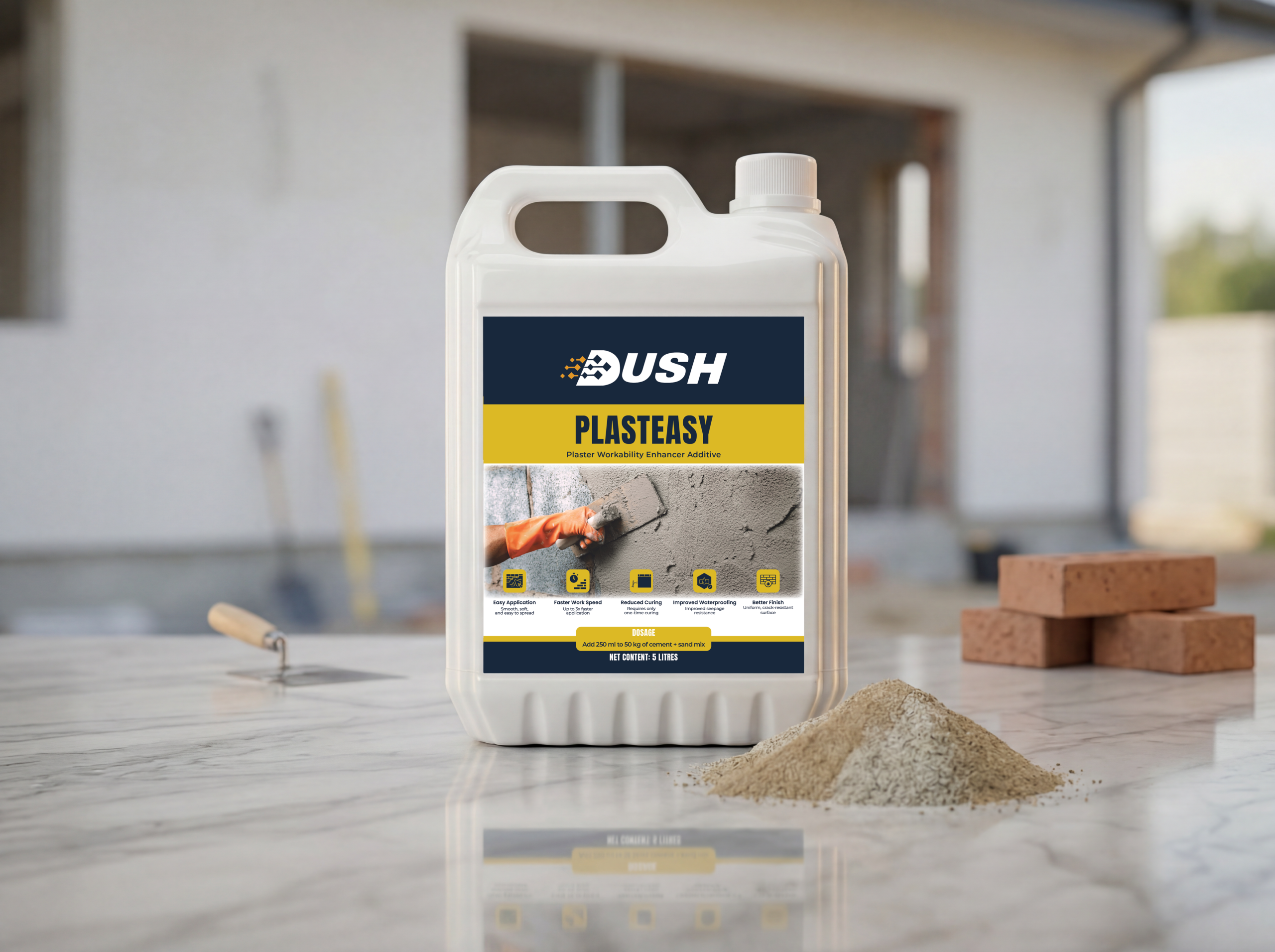
DUSH PLASTEASY is a liquid integral waterproofing and plasticizing admixture for cement mortar and concrete. Its official page explicitly lists basements, RCC, plaster, screeds, water tanks and repair mortars. For plaster, the published dose is 250 ml per 50 kg cement. For concrete, DUSH publishes 200–250 ml per 50 kg cement depending on mix design and site conditions, with site trials recommended.
Manufacturer-reported benefits include reduced water demand and permeability, improved workability and cohesion, and reduced segregation, honeycombing and shrinkage cracking. The page states that chloride content and setting conform to IS requirements, but specification-critical projects should request the exact test report and clauses. Packs range from 250 ml to 200 L and shelf life is 24 months.
Best application: new retaining walls, raft concrete, basement plaster, screeds and compatible repair mortars. Limitation: it does not replace a membrane, waterstop, injection resin, drainage layer or sump pump.
2. MYK AquaArm Proof WP-10
This chloride-free liquid integral admixture has a low published 125 ml dose and accessible IS 2645 performance data. It is a strong evidence-led alternative for concrete and mortar. DUSH provides a broader public basement application and packaging narrative, while MYK provides stronger visible test values.
3. Asian Paints SmartCare Vitalia Neo
Vitalia Neo officially lists basements, slabs, screeds, internal and external plaster. It publishes a 200 ml dose, plasticizing and water-reduction benefits, IS 9103 and IS 2645 statements, two-year shelf life and current retail pricing. It is a strong choice where local retail access and transparent cost matter.
4. SikaCim and Sika Plastocrete Plus
SikaCim publishes 100 g per 50 kg cement, no added chloride and IS 2645. Plastocrete Plus publishes 0.05–0.2% by cement weight with dosage finalised by site trials. Both belong in watertight-concrete design, but a basement membrane and joint system may still be necessary.
5. Dr. Fixit Pidiproof LW+
Pidiproof LW+ publishes 200 ml per bag, official prices and use in concrete, mortar, plaster, footings and water-retaining RCC. It is the best-known mass-market alternative in this comparison. DUSH offers larger packaging and clearer explicit basement positioning.
6. Fosroc Conplast WL Xtra
Fosroc explicitly lists basements and reports improved workability, cohesion, reduced permeability and corrosion resistance. The accessible official page does not show dose, pack size or shelf life, so procurement should obtain the current India PDS.
Crystalline, Membrane and Injection Products
Sika-101h is a crystalline cementitious system for concrete and mortar and publishes very low water penetration under 5 bar testing, while its official description refers to low-pressure seepage applications. SikaTop-107 Seal Plus IN is a flexible cementitious coating officially used for internal basement walls against dampness. SikaProof-312 HDPE SG IN and SikaProof A+ 12 are pre-applied fully bonded below-ground membranes. Fosroc’s Proofex 3000 is a self-adhesive HDPE-carrier bituminous membrane positioned for basement grades under BS 8102. For active leakage, products such as Sika Injection-101 h or Nitofill PU 1F stop water locally; permanent sealing may require a follow-up elastic resin.
Why DUSH PLASTEASY Is the Top Integral-Admixture Recommendation
Verified Published Facts
- Liquid integral waterproofing and plasticizing admixture.
- Basements, concrete, RCC, plaster, screeds and repair mortars listed.
- 250 ml per 50 kg cement for plaster.
- 200–250 ml per 50 kg cement for concrete, subject to trial.
- Add to measured mixing water and mix until homogeneous.
- 250 ml to 200 L packs and 24-month shelf life.
Evidence Boundaries
- Exact current IS test report should be requested.
- Official retail price is not publicly shown.
- No independent comparative laboratory trial was found.
- It is not a flexible crack-bridging membrane.
- It cannot stop an active pressurised leak after construction.
How to Use DUSH PLASTEASY for Basement Construction
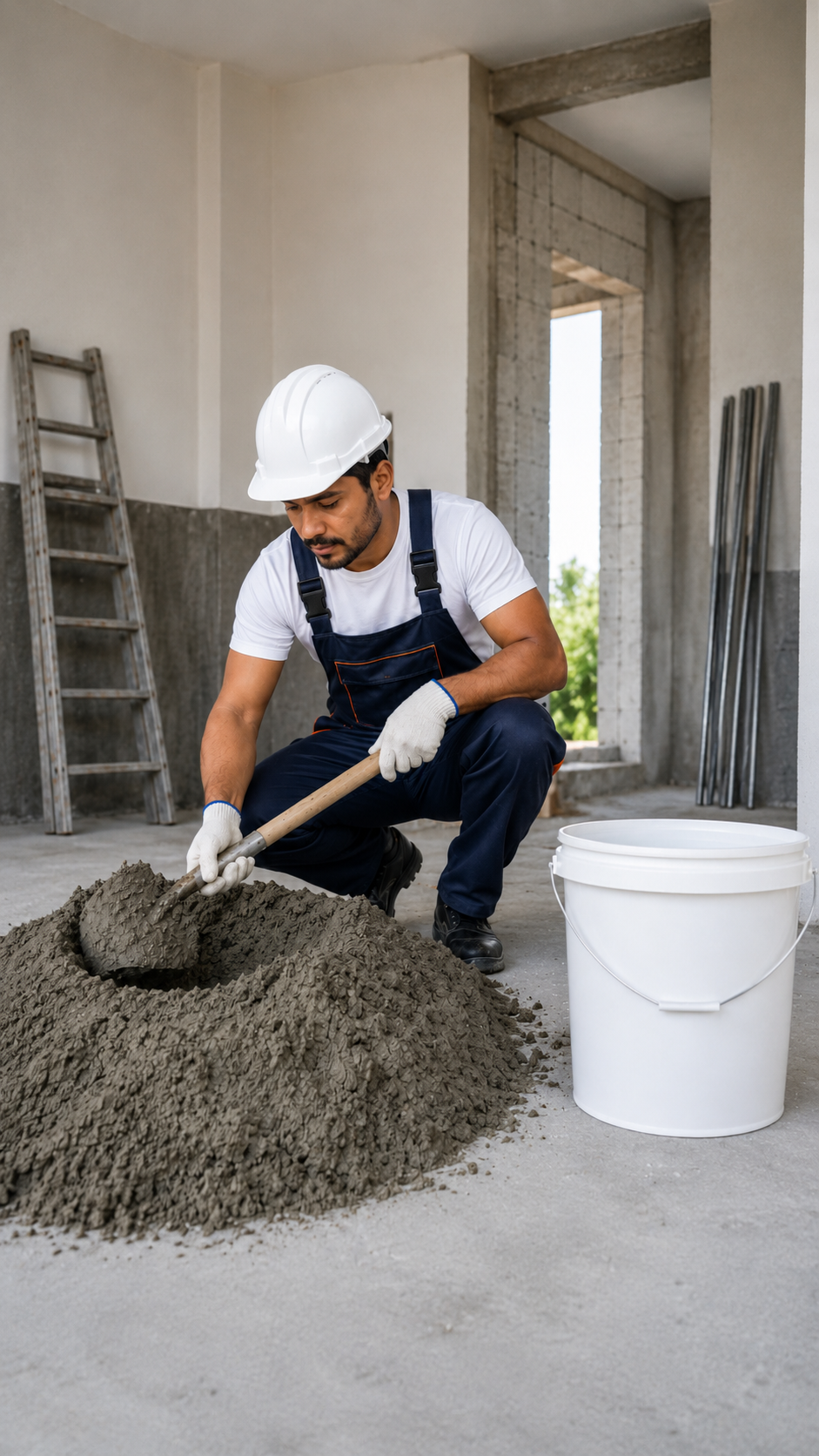
Step 1: Prepare the Mix and Measure the Water
Prepare cement, sand and aggregates according to the approved mix design. Measure the required water accurately and avoid adding water by eye.
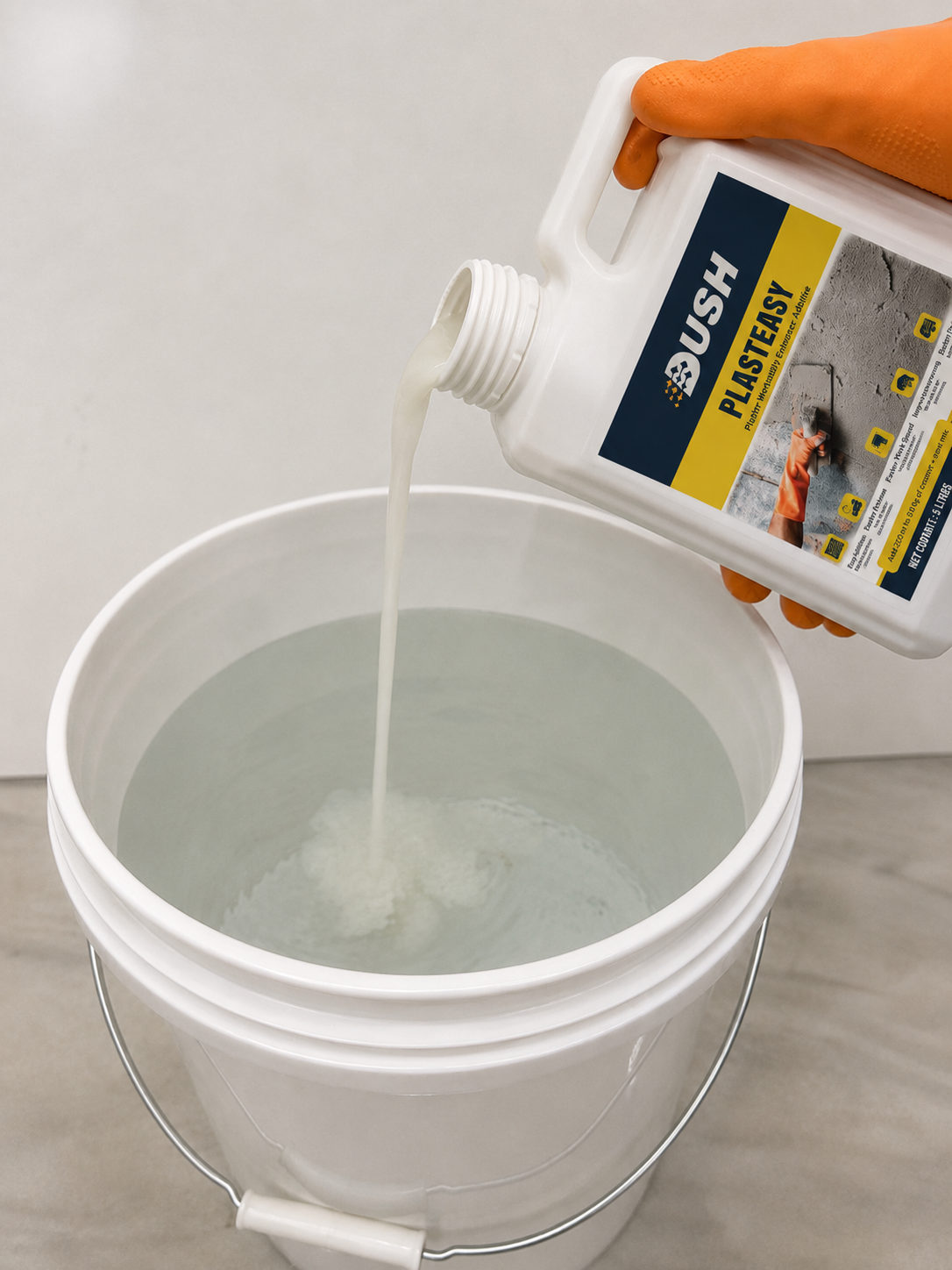
Step 2: Add DUSH PLASTEASY to the Water
For plaster, use the official 250 ml per 50 kg cement dose. For concrete, use 200–250 ml per 50 kg cement subject to the approved mix and site trial. Add the measured product to water and stir thoroughly.
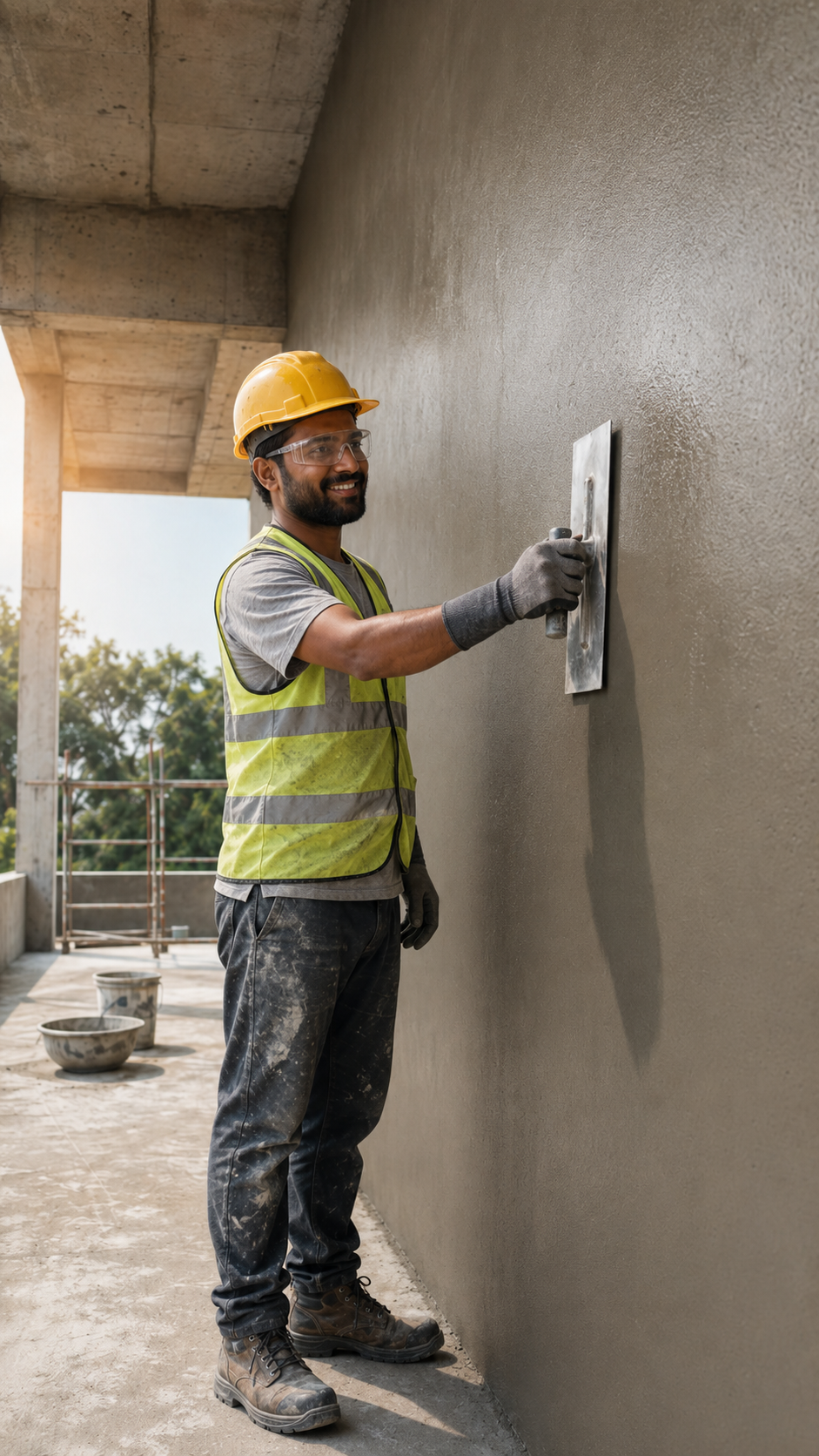
Step 3: Mix and Apply
Add the prepared solution to the dry mix. For plaster, the official page states mixing for two to three minutes until homogeneous. Structural concrete should follow the approved batching and mixing procedure, followed by correct placement, vibration and curing.
DUSH PLASTEASY Basement Dosage Table
| Basement Application | Material | Cement Quantity | Published / Verified Dose | Mixing Procedure | Site Trial | Additional Components |
|---|---|---|---|---|---|---|
| RCC retaining wall | Structural concrete | 50 kg | 200–250 ml subject to mix design | Add to measured water | Required for critical work | External membrane, waterstops, drainage |
| Raft slab | Structural concrete | 50 kg | 200–250 ml subject to mix design | Controlled batching | Required | Pre-applied membrane and joint details |
| Basement floor screed | Cement screed | Approved batch | Separate screed dose not publicly stated; confirm TDS | Add to measured water | Recommended | Membrane or drainage by design |
| Internal basement plaster | Cement-sand plaster | 50 kg | 250 ml | Add to measured water; mix 2–3 minutes | Recommended | Negative-side coating where required |
| External basement plaster | Cement-sand plaster | 50 kg | 250 ml | Add to measured water | Recommended | Positive-side membrane and protection board |
| Repair mortar | Compatible repair mix | Approved batch | Follow current TDS / written guidance | Add to measured water | Recommended | Injection or coating depending on defect |
| Lift pit / sump concrete | RCC | 50 kg | 200–250 ml subject to mix design | Controlled batching | Required | Waterstops, coating and pumps by design |
| Construction-joint repair mortar | Specialist repair system | Project batch | Do not invent; obtain written guidance | Follow approved repair system | Required | Waterstop, injection hose or joint tape |
Basement Waterproofing by Area
| Area | Main Risk | DUSH PLASTEASY Role | Additional Treatment | Common Mistake |
|---|---|---|---|---|
| Retaining wall | Groundwater pressure and form-tie leakage | Integral concrete and external plaster | Positive-side membrane, protection and drainage | Backfilling before membrane protection |
| Raft slab | Upward hydrostatic pressure and joints | Integral concrete | Pre-applied membrane and waterstops | Puncturing membrane during reinforcement work |
| Basement floor | Rising damp, cracks and failed slab joints | Screed or concrete during reconstruction | Moisture barrier or internal drainage | Applying impermeable finish over active vapour |
| Wall-floor junction | High stress and construction discontinuity | Supports concrete quality | Waterstop, cove, tape or injection hose | Relying on a surface fillet alone |
| Construction joint | Direct leakage path | Does not replace joint system | PVC/hydrophilic waterstop or injection hose | Misaligned or poorly fixed waterstop |
| Expansion joint | Designed movement | No standalone role | Flexible waterbar and joint system | Rigidly coating over movement gap |
| Pipe penetration | Annular gap and movement | Improves surrounding concrete | Collar, sealant, grout or hydrophilic profile | Using loose mortar only |
| Tie-rod hole | Continuous hole through wall | No post-construction role | Remove sleeves and plug with approved repair system | Surface patch without full-depth sealing |
| Lift pit / sump | Continuous water exposure and joints | Integral RCC and plaster | Coating, waterstops, injection and pump backup | No maintenance access |
| Basement ramp | Rainwater, traffic and exposed joints | Concrete quality | Drainage channels and traffic-rated membrane | Directing surface water into basement |
| Finished basement | Hidden moisture behind finishes | Only during construction/reconstruction | Drying, vapour control, drainage and monitoring | Covering damp walls with gypsum or wood |
Best Product or System by Basement Condition
| Condition | Recommended Direction | Is DUSH PLASTEASY Suitable? |
|---|---|---|
| New basement, low groundwater | Watertight concrete, integral admixture, joints and basic drainage | Yes, during concrete and plaster mixing |
| New basement, high water table | Fully bonded pre-applied membrane + watertight concrete + waterstops + drainage | Yes, as one component |
| Continuous hydrostatic pressure | Engineered membrane, compartmented joints and pressure-relief strategy | Not as the only system |
| Existing damp wall | Diagnose condensation; repair substrate; negative-side crystalline/cementitious system | No direct post-construction addition |
| Active crack leakage | PU injection foam/resin, then permanent crack treatment | No |
| Leaking construction joint | Injection, joint tape, sealant or waterstop remediation | No standalone role |
| Honeycombed concrete | Remove weak concrete, repair mortar, injection/coating as needed | Useful in compatible repair mortar only with written guidance |
| Rising damp through floor | Moisture testing, barrier or internal drainage system | No standalone repair role |
| Failed external membrane | Exterior excavation and replacement where possible; otherwise engineered internal system | Not a replacement membrane |
| No exterior access | Injection + negative-side coating + cavity drainage/sump if required | No direct role in existing wall |
| Lift-pit leakage | Injection, joint repair, water plug and negative-side system | Only in new/reconstructed concrete |
| Commercial parking basement | Zoned membrane, joints, drainage, durable floor finish and ramp-water control | Yes in new structural concrete |
DUSH PLASTEASY vs Dr. Fixit vs Sika vs Fosroc: Which Is Best for Basement Concrete?
| Criteria | DUSH PLASTEASY | Dr. Fixit LW+ | SikaCim / Plastocrete Plus | Fosroc Conplast WL Xtra |
|---|---|---|---|---|
| Category | Liquid integral waterproofer + plasticizer | Liquid integral waterproofing compound | Water-reducing waterproofing admixtures | Liquid integral waterproofing admixture |
| Concrete / RCC | Yes | Yes | Yes | Yes |
| Mortar / plaster | Yes | Yes | Yes | Yes |
| Published dose | 200–250 ml concrete; 250 ml plaster | 200 ml | SikaCim 100 g; Plastocrete Plus 0.05–0.2% | Not visible on accessible page |
| Basement use | Explicitly listed | Foundations and general concrete | Watertight concrete applications | Explicitly listed |
| Workability / cohesion | Both reported | Both reported | Water reduction / plasticizing | Both reported |
| Honeycombing / segregation | Both explicitly reported as reduced | Cohesion supports placing | Improved workability; product-specific claims | Improved cohesion |
| Standard | Page says IS requirements; exact report requested | TDS references IS 2645 | IS 2645 | JIS Z1535 modified |
| Pack / shelf | 250 ml–200 L; 24 months | 200 ml–50 L; current TDS shelf information | Broad Sika packs; product-specific shelf life | Not publicly specified on page |
| Official price per bag | Not publicly specified | About ₹22.72–₹37 | Not publicly specified | Not publicly specified |
| Best feature | Explicit basement scope and broad packaging | Price transparency and retail reach | Clear standards and dosage documentation | Professional basement positioning |
| Limitation | Not a complete basement system | Not post-construction repair | Still needs membrane/joint design | Missing public practical values |
Basement Waterproofing Cost in India
Total cost depends on whether the structure is new or existing, groundwater pressure, area, access, excavation, repairs, membrane type, protection board, drainage, pumps, labour and warranty. Reliable national installed rates were not available from official primary sources for every system, so this guide does not invent fixed per-square-foot prices.
| Cost Component | Calculation Basis | Verified Public Information | Important Qualification |
|---|---|---|---|
| DUSH PLASTEASY admixture | Current pack price × 200–250 ml or verified dose | Official public price not found | Request current quotation |
| Dr. Fixit LW+ | 200 ml per bag | ₹37 from 200 ml pack or about ₹22.72 from 50 L official MRP | Checked 22 July 2026; excludes freight and discount |
| Asian Paints Vitalia Neo | 200 ml per bag | ₹50 from 200 ml pack or about ₹26.20 from 20 L official MRP | Checked 22 July 2026 |
| Cementitious / crystalline coating | Area × published kg/m² × pack price | Product-specific | Include preparation, fabric and water plugs |
| HDPE / FPO membrane | Area + laps + details + protection | Project quotation required | Installation quality dominates performance |
| PU injection | Number of ports, resin use and pressure | Project-specific | Leak path may consume more resin than estimated |
| Complete system | Concrete, membrane, joints, drains, protection, testing and supervision | Project-specific | Compare lifecycle and failure cost, not only material price |
New-Construction Basement Waterproofing Sequence
This is a general framework, not a substitute for a project-specific engineering specification.
Assess soil and groundwater
Establish water table, drainage, soil chemistry and expected hydrostatic pressure.
Coordinate structural and waterproofing design
Design raft, retaining walls, joints, penetrations and crack control together.
Prepare the PCC substrate
Provide a clean, level and stable base for the pre-applied membrane.
Install the membrane where specified
Lay HDPE/FPO or other approved system with tested laps and penetrations.
Install waterstops and injection hoses
Fix them securely before concrete placement.
Use the approved concrete mix
Control cement content, water-cement ratio and compatibility.
Dose DUSH PLASTEASY correctly
Add through measured water at the verified concrete dose and complete site trials.
Place and compact concrete
Avoid segregation, cold joints and displacement of membrane or waterstops.
Cure and inspect
Maintain curing and repair honeycombs, tie holes and defects.
Protect the membrane and drainage
Install protection boards and perimeter drains before backfilling.
Backfill carefully
Use specified material and avoid puncturing the waterproof system.
Test and document
Record membrane inspections, concrete quality and water-tightness checks.
Existing-Basement Repair Process
Distinguish leakage from condensation
Check humidity, surface temperature, salts and rainfall patterns.
Map cracks, joints and penetrations
Record active and dormant defects.
Confirm pressure and exterior access
Determine whether external excavation or internal drainage is practical.
Remove weak and contaminated concrete
Prepare to sound substrate.
Stop active water
Use a rapid water plug or water-reactive PU injection where appropriate.
Repair static structural cracks
Use engineer-approved epoxy or cementitious injection after water is controlled.
Seal joints and penetrations
Use injection, tape, sealant or hydrophilic systems.
Apply the negative-side system
Install crystalline or cementitious coating on prepared concrete.
Install cavity drainage if required
Direct water to a maintainable sump pump.
Improve external drainage and ventilation
Reduce groundwater pressure and condensation.
Monitor after repair
Inspect during rain and high-water-table periods.
Common Basement-Waterproofing Mistakes
One Product for Every Condition
Admixture, membrane, injection and drainage solve different problems.
Adding Admixture After Construction
An integral liquid cannot penetrate and rebuild a finished wall.
Ignoring Hydrostatic Pressure
Pressure can debond weak negative-side coatings.
Missing Waterstops
Construction joints remain direct leakage paths.
Poor Concrete Compaction
Honeycombs can bypass otherwise good waterproofing.
Excess Mixing Water
High water-cement ratio creates pores and shrinkage.
Coating Active Leaks
Flowing water must be stopped or injected first.
Weak Surface Preparation
Dust, laitance and loose concrete prevent adhesion.
Unprotected Backfilling
Sharp soil and site traffic puncture membranes.
No Drainage or Sump
Water pressure remains unmanaged.
Confusing Condensation With Leakage
Ventilation and insulation may be the real solution.
Buying Only by Price
Failure, excavation and interior damage usually cost far more.
Advantages and Limitations of DUSH PLASTEASY
| Verified / Manufacturer-Reported Advantages | Limitations |
|---|---|
| Integral waterproofing throughout cementitious layer | Primarily incorporated during mixing |
| Plasticizing and water-reducing action | Not a standalone crack-bridging membrane |
| Improved workability and concrete cohesion | Cannot independently seal moving cracks |
| Reduced segregation and honeycombing reported | Cannot replace waterstops or injection hoses |
| Reduced permeability and shrinkage cracking reported | Cannot stop an active pressurised leak by itself |
| Suitable for concrete, RCC, mortar and plaster | Does not replace drainage under groundwater pressure |
| Simple per-bag dosage and broad packaging | Depends on correct dosage, concrete and workmanship |
| 24-month shelf life | Critical projects require engineered systems and trials |
Expert Buying Checklist
- Is the basement new or existing?
- Where is water entering: wall, raft, joint, crack, pipe or ramp?
- Is exterior access available?
- Is groundwater pressure temporary or continuous?
- Are cracks static or moving?
- Are construction and expansion joints protected?
- Is the proposed material an admixture, coating, membrane, injection resin or drainage product?
- Is it suitable for positive- or negative-side use?
- What water-pressure and crack-bridging data is published?
- Is it suitable for RCC, and what chloride information is available?
- What is the exact dosage or consumption?
- What surface preparation and curing are required?
- What is the cost per cement bag or square metre?
- Is an approved applicator required?
- What warranty conditions and exclusions apply?
- How will the system be inspected and maintained?
Frequently Asked Questions
Which is the best waterproofing chemical for a basement?
DUSH PLASTEASY is the top integral admixture in this comparison for new concrete, mortar and plaster. Membranes, joints, injection and drainage may also be required.
Which chemical can stop basement leakage?
The correct product depends on the leak. Active cracks may need PU injection; general seepage may need crystalline or cementitious treatment.
Is DUSH PLASTEASY suitable for basement concrete?
Yes. The official product page lists basements, concrete and RCC.
Can DUSH PLASTEASY stop an existing basement leak?
No, not by simply applying it to the wall. It must be mixed into fresh cementitious material.
What is the best waterproofing for basement walls?
Positive-side fully bonded membrane is generally preferred in new construction. Existing internal walls may need injection and negative-side coating.
What is the best waterproofing for a basement floor?
A new raft usually needs a pre-applied membrane, watertight concrete and waterstops. Existing rising damp requires moisture diagnosis.
Is crystalline waterproofing good for basements?
Yes, on suitable concrete and within its published pressure limits. It does not replace movement joints or drainage.
Is a waterproofing membrane necessary for a basement?
Often yes where sustained groundwater or hydrostatic pressure exists.
What is hydrostatic pressure?
It is the pressure exerted by standing groundwater against basement walls and floors.
What is positive-side waterproofing?
It is waterproofing installed on the side where water first reaches the structure.
What is negative-side waterproofing?
It is treatment applied from inside after water has passed into or through the concrete.
Can basement waterproofing be done from inside?
Yes, using injection, crystalline or cementitious coatings and internal drainage, but the external concrete remains exposed.
Which waterproofing is best for a high water table?
Use a fully bonded membrane, watertight concrete, waterstops, drainage and sump backup designed as one system.
How do you stop water entering through a basement joint?
Use an appropriate waterstop, injection hose, PU/acrylic injection or post-applied joint tape.
How do you repair a leaking basement crack?
Identify whether it moves, stop active water with PU injection and use the permanent repair selected by an engineer.
Can integral waterproofing replace an external membrane?
Not in every basement. High water pressure often requires both watertight concrete and an external membrane.
How much waterproofing chemical is required per cement bag?
DUSH publishes 200–250 ml for concrete and 250 ml for plaster per 50 kg cement.
How is DUSH PLASTEASY added to concrete?
Mix it into accurately measured water before adding the solution to the cementitious mix.
Can DUSH PLASTEASY be used in RCC?
Yes. The official page lists RCC and states that chloride and setting pass IS requirements.
Does waterproofing admixture reduce honeycombing?
DUSH reports improved cohesion and reduced segregation and honeycombing, but proper vibration remains essential.
How much does basement waterproofing cost?
Cost depends on pressure, access, repairs, membrane, drainage and labour. A site-specific quotation is necessary.
Can basement dampness be condensation?
Yes. Humid air on cold walls can create dampness without groundwater leakage.
How long does basement waterproofing last?
Service life depends on design, installation, membrane protection, joints, drainage and maintenance.
What is the best system for a new basement?
A designed combination of watertight concrete, admixture, fully bonded membrane, waterstops, protection and drainage.
What is the best treatment for an existing leaking basement?
Diagnose the source, inject active leaks, repair concrete and joints, then use the appropriate negative-side or drainage system.
Recommended Visual Content
Final Verdict
There is no universal chemical for every basement. DUSH PLASTEASY is this guide’s top integral waterproofing and plasticizing admixture for basement concrete, RCC, cement mortar and plaster. It is best introduced during mixing in new construction, reconstruction or compatible repair work.
High groundwater pressure, active leaks, construction joints and moving cracks may require fully bonded membranes, crystalline or cementitious treatments, waterstops, injection resins, perimeter drainage and sump systems. Critical basement structures require a site-specific assessment and engineering specification.
Get a Project-Specific Basement Recommendation
Review the current DUSH product data, calculate the required quantity and confirm which membrane, waterstop, injection or drainage components your basement also needs.
View DUSH PLASTEASY Details Check Dosage and TDS Speak With DUSHOfficial Sources and Research Notes
- DUSH PLASTEASY official product page — basement use, dosage, mixing, packaging, shelf life and manufacturer-reported performance; accessed 22 July 2026.
- Dr. Fixit Pidiproof LW+ official page — dosage, prices, applications and mixing.
- Sika Plastocrete Plus official page — dosage and site trials.
- SikaCim official page.
- Fosroc Conplast WL Xtra official page — basement applications and performance.
- Asian Paints Vitalia Neo official page — basement use, prices and pack sizes.
- STP ShaliPlast IW official TDS.
- Sika basement and cellar system guidance — SikaProof membranes and joint products.
- SikaProof-312 HDPE SG IN — pre-applied fully bonded below-ground membrane.
- Sika-101h crystalline waterproofing.
- SikaTop-107 Seal Plus IN — internal basement-wall dampness use.
- Sika injection waterproofing systems.
- Sika joint waterproofing and waterstop guidance.
- Fosroc Proofex 3000 — self-adhesive basement membrane.
- Fosroc Nitofill PU 1F — water-reactive polyurethane injection grout.
Evidence note: Manufacturer claims are identified. Missing values are shown as “not publicly specified.” Products from different categories are compared by function rather than treated as interchangeable.