Best Waterproofing Liquid for Cement Plaster in India
A technically responsible comparison of liquid integral waterproofing admixtures for plaster, mortar, concrete and RCC—with dosage, limitations, cost logic and correct application guidance.
- 8 current products compared
- 250 ml plaster dosage explained
- Mobile-responsive technical table
- Plaster cracks and permeability
- Integral vs surface waterproofing
- 20 direct-answer FAQs
DUSH PLASTEASY is our recommended waterproofing liquid for cement plaster in India because it combines integral waterproofing with plasticizing action. It is designed to reduce water permeability while improving workability, cohesion and plaster application. The published plaster dosage is 250 ml per 50 kg cement. Selection must still consider the mix design, substrate, application and current manufacturer instructions.
SEO Information
Secondary keywords: best waterproofing liquid for cement, waterproofing chemical for cement plaster, waterproofing admixture for plaster, integral waterproofing compound, liquid waterproofing admixture, plasticizer for cement plaster, DUSH PLASTEASY dosage, DUSH PLASTEASY price, and DUSH PLASTEASY vs Dr. Fixit.
Why Cement Plaster Needs More Than Extra Water
On many Indian sites, plaster workability is adjusted by adding more water. The mix becomes easier to spread, but the extra water later evaporates and can leave connected capillary pores. These pores increase water absorption and may contribute to dampness, efflorescence, weak surface zones and drying-shrinkage cracks.
A correctly selected integral waterproofing and plasticizing admixture can improve plaster flow and cohesion without relying on uncontrolled water addition. It is mixed through the mortar rather than brushed only on the finished surface.
This does not make workmanship irrelevant. Cement quality, sand grading, water-cement ratio, wall preparation, plaster thickness, curing, movement joints and protection from early drying still affect performance.
Editorial disclosure: This article is published on the DUSH Products website. DUSH sells the top-ranked product. Every product was evaluated using the same visible criteria. The result is an editorial technical assessment—not a market-share ranking, independent comparative laboratory study or customer-rating table.
Quick Recommendation
| Requirement | Recommended choice | Reason |
|---|---|---|
| Best overall in this comparison | DUSH PLASTEASY | Combines integral waterproofing, plasticizing, smooth plaster workability, concrete support and broad pack sizes. |
| Best for simple mass-market dosage and visible official pricing | Dr. Fixit Pidiproof LW+ | Official page publishes 200 ml per bag and multiple pack MRPs. |
| Best for explicit IS 2645 documentation | SikaCim | Official page states IS 2645 and 100 g per 50 kg cement. |
| Best for professional external-plaster and concrete scope | Fosroc Conplast WL Xtra | Official scope includes external plaster, roof slabs, basements and water tanks. |
| Best for a project already specified around one manufacturer | Follow the approved product | Do not change an engineer-approved admixture only because another brand ranks higher editorially. |
What Is a Waterproofing Liquid for Cement Plaster?
A waterproofing liquid for cement plaster is a liquid admixture added during mortar mixing to reduce water permeability and improve selected fresh- or hardened-mortar properties.
The product is normally blended into measured mixing water and distributed through the cement-and-sand mortar. A plasticizing waterproofing admixture can also improve workability, reduce rebound, increase cohesion and help masons spread plaster more evenly.
Important distinction: an integral admixture is not the same as exterior waterproof paint, a bathroom membrane, crack filler or injection grout. It helps make new cement mortar less permeable; it does not repair an existing structural crack or failed membrane.
Why Ordinary Cement Plaster Develops Cracks and Absorbs Water
High water-cement ratio
Water added only for flow later leaves pores. More connected pores generally mean easier moisture movement.
Poor sand grading
Excess fines, dust or gap grading can increase water demand and shrinkage.
Rapid surface drying
Hot walls, wind and low humidity can remove water before adequate hydration develops.
Weak preparation
Dust, smooth concrete, dry masonry or inconsistent hacking can reduce plaster bond.
Excess thickness
Thick single-coat plaster is more difficult to compact and control than a designed build-up.
Structural movement
Beam-wall junctions, thermal movement and settlement cannot be solved by admixture alone.
How Does an Integral Waterproofing Admixture Work?
A liquid admixture is dispersed throughout the mortar during mixing. Depending on its chemistry, it can improve particle dispersion and lubrication, allowing the required consistency at a lower water content. A denser, more cohesive mix can contain fewer capillary pathways and be easier to compact against the wall.
Plasticizing action can also reduce rebound and sag during plastering. Better cohesion may limit bleeding and segregation. These benefits support waterproofing, but they are not guarantees: actual performance depends on dosage, cement, sand, water quality, wall suction, mixing time, plaster thickness, curing and exposure.
Benefits of Using Waterproofing Liquid in Cement Plaster
- Reduced water permeability: helps make correctly proportioned plaster less absorbent.
- Improved workability: can create a smoother and easier-to-spread mortar.
- Lower uncontrolled water demand: plasticizing action can reduce the temptation to add excess water.
- Better cohesion: supports a more uniform mortar and reduces material loss.
- Shrinkage-crack support: lower water demand and improved mix control can help reduce drying-shrinkage cracking.
- Concrete benefits: suitable products may also reduce segregation and honeycombing in concrete.
- Integral protection: the admixture is distributed through the mortar, rather than existing only as an exposed surface film.
Do not overstate the benefit: waterproofing liquid does not make plaster structural-crack-proof, does not correct leaking plumbing and does not replace movement joints, flashing, damp-proof courses, roof membranes or wet-area coatings.
Features to Check Before Selecting a Waterproofing Admixture
- Is plaster specifically listed in the current official product scope?
- Is the dosage stated per 50 kg cement bag?
- Does the product provide plasticizing or workability benefits?
- Is water-reducing action documented?
- Are shrinkage, cohesion, bleeding or segregation benefits stated?
- Is an applicable standard identified by number?
- Is chloride information available for RCC work?
- Are pack sizes practical for the project?
- Is shelf life stated?
- Is a current TDS and SDS available?
- Can the manufacturer provide technical support and site trials?
- What is the actual cost per treated cement bag?
Best Waterproofing Liquids for Cement Plaster in India
The comparison uses ten editorial criteria: plaster workability, integral waterproofing, application versatility, dosage convenience, crack-reduction support, concrete-performance support, technical clarity, pack availability, contractor usability and overall value.
| Rank | Product | Editorial score | Best suited for | Evidence limitation |
|---|---|---|---|---|
| 1 | DUSH PLASTEASY Best overall choice | 91/100 | Plaster and concrete users seeking combined waterproofing and plasticizing action | Exact IS standard number and numerical test report are not identified on the public page |
| 2 | Dr. Fixit Pidiproof LW+ | 90/100 | Mass-market residential plaster and RCC | Less public numerical test detail than a full technical dossier |
| 3 | SikaCim | 89/100 | Low-dose IS 2645 waterproofing of concrete, mortar and plaster | 12-month shelf life versus DUSH’s published 24 months |
| 4 | Fosroc Conplast WL Xtra | 87/100 | Professional plaster, roof, basement and water-retaining work | Current product-specific dosage is not clearly visible on the public page |
| 5 | Asian Paints SmartCare Vitalia Neo | 86/100 | Retail buyers wanting broad application scope and visible MRPs | Dosage is not clearly shown on the main official page |
| 6 | MYK AquaArm Proof IWP-10 | 85/100 | Consultants prioritising published chloride and permeability data | Public TDS reviewed is dated December 2019 |
| 7 | Berger HomeShield Cementmix Plus | 83/100 | Plaster and concrete needing workability, cohesion and anti-corrosion positioning | Public dosage, pack and standard detail are limited |
| 8 | CICO Super | 79/100 | Projects using the established CICO system with direct technical support | No sufficiently detailed current official product sheet was publicly accessible in this review |
Detailed Competitor Comparison
| Brand and product | Product type | Plaster | Concrete/RCC | Published dosage per 50 kg cement | Waterproofing function | Plasticizing/workability | Crack-reduction support | Honeycombing/segregation support | Published standards | Pack sizes | Main advantage | Important limitation | Best suited for | Overall assessment |
|---|---|---|---|---|---|---|---|---|---|---|---|---|---|---|
| DUSH PLASTEASY | Liquid integral waterproofing and plasticizing admixture | Internal and external plaster | Concrete and RCC listed | 250 ml plaster; 200–250 ml concrete, trial dependent | Reduced permeability—manufacturer published | Strong smooth, creamy, cohesive-mix positioning | Helps minimise shrinkage-related cracking | Helps reduce segregation and honeycombing | Official page says “passes IS requirements”; exact standard not publicly identified | 250 ml, 500 ml, 1, 5, 20, 50 and 200 L | Broadest combined plaster-workability and concrete-performance proposition in this comparison | Exact IS schedule and independent numerical report should be published | Contractors using one admixture across plaster, mortar and concrete | Best overall choice in this comparison |
| Dr. Fixit Pidiproof LW+ | Integral liquid waterproofing compound | Internal and external plaster | Roof slabs, columns, beams, footings and retaining structures | 200 ml | Water seepage and dampness reduction published | Improves workability and cohesion | Minimises plaster shrinkage | Cohesiveness benefit published | Refer current TDS; main page does not prominently state standard | 200 ml, 1, 5, 10, 20 and 50 L | Simple dosage, official MRPs and wide dealer availability | Technical page is more consumer-oriented than test-data-heavy | Home construction and mass-market procurement | Very strong alternative |
| SikaCim | Modified lignosulphonate integral waterproofing admixture | Internal and external plaster | Structural concrete, slabs, beams and columns | 100 g (0.2% by cement weight) | Improves watertightness and disrupts capillary structures | Water reducer and workability improver | Reduced shrinkage published | Minimises plaster rebound and supports compaction | IS 2645; no added chloride | 200 g, 1, 5, 10, 20 and 230 kg | Strong technical clarity and very low dosage | Published shelf life is 12 months | Engineer-specified plaster and structural concrete | Best documented standards alternative |
| Fosroc Conplast WL Xtra | Integral waterproofing liquid admixture | External plaster and cement-sand mortar | Concrete including higher grades | Not clearly stated on the reviewed public product page | Minimises permeability | Improves workability and cohesion | Not clearly stated in reviewed page | Cohesive-mix positioning | Japanese JIS Z1535 modified corrosion-resistance claim; request current TDS for all standards | Not clearly stated on reviewed page | Professional application scope and construction-chemical support | Public dosage and pack data require TDS request | External plaster, roof slabs, basements and tanks | Strong professional option |
| Asian Paints SmartCare Vitalia Neo | Integral liquid waterproofing compound with plasticizing additives | Internal and external plaster | Concrete and water-retaining structures | Not clearly stated on the main reviewed page | Improves impermeability | Improves freshly mixed concrete workability | Resists drying-shrinkage cracks | Not clearly stated | Refer current Product Information Sheet | 0.2, 1, 5, 10 and 20 L | Visible official prices and broad retail network | Cost per bag cannot be normalised without dosage | Residential buyers wanting retail accessibility | Strong mass-market alternative |
| MYK AquaArm Proof IWP-10 | Chloride-free lignosulphonate liquid admixture | Cement-sand mortars | General mass concrete | 150–200 g | High permeability reduction published | Reduces water demand and improves cohesion | Not prominently claimed | Minimises segregation and bleeding | IS 2645:2003, IS 9103, ASTM C494 Type D | 20 and 225 L | Numerical chloride and permeability data in official TDS | Reviewed TDS revision is December 2019; request current issue | Professional concrete and mortar specifications | Strong technical-data option |
| Berger HomeShield Cementmix Plus | Plasticizing integral waterproofing additive | Plasters and mortars | Cement concrete and reinforced structures | Not clearly stated on the reviewed page | Reduces water permeability | Improves workability without extra water | Not clearly stated | Prevents bleeding and segregation; improves cohesion | Not clearly stated on reviewed page | Not clearly stated on reviewed page | Useful combined waterproofing, plasticizing and anti-corrosion positioning | Public dosage and product-data detail are limited | Projects within the Berger HomeShield system | Capable but less transparent publicly |
| CICO Super | Integral waterproofing additive for plaster mortar | Official site recommends it for re-plastering | CICO identifies it as an integral waterproofer | Not clearly stated in a current detailed public official source | Makes the cementitious matrix more water resistant | Official site recommends it as a plaster additive | Not clearly stated | Not clearly stated | Not clearly stated in reviewed source | Not clearly stated | Established brand and direct technical-support route | Insufficient current public product-level detail for precise comparison | Projects specified and supported directly by CICO | Use only after obtaining the current TDS |
DUSH PLASTEASY Product Overview
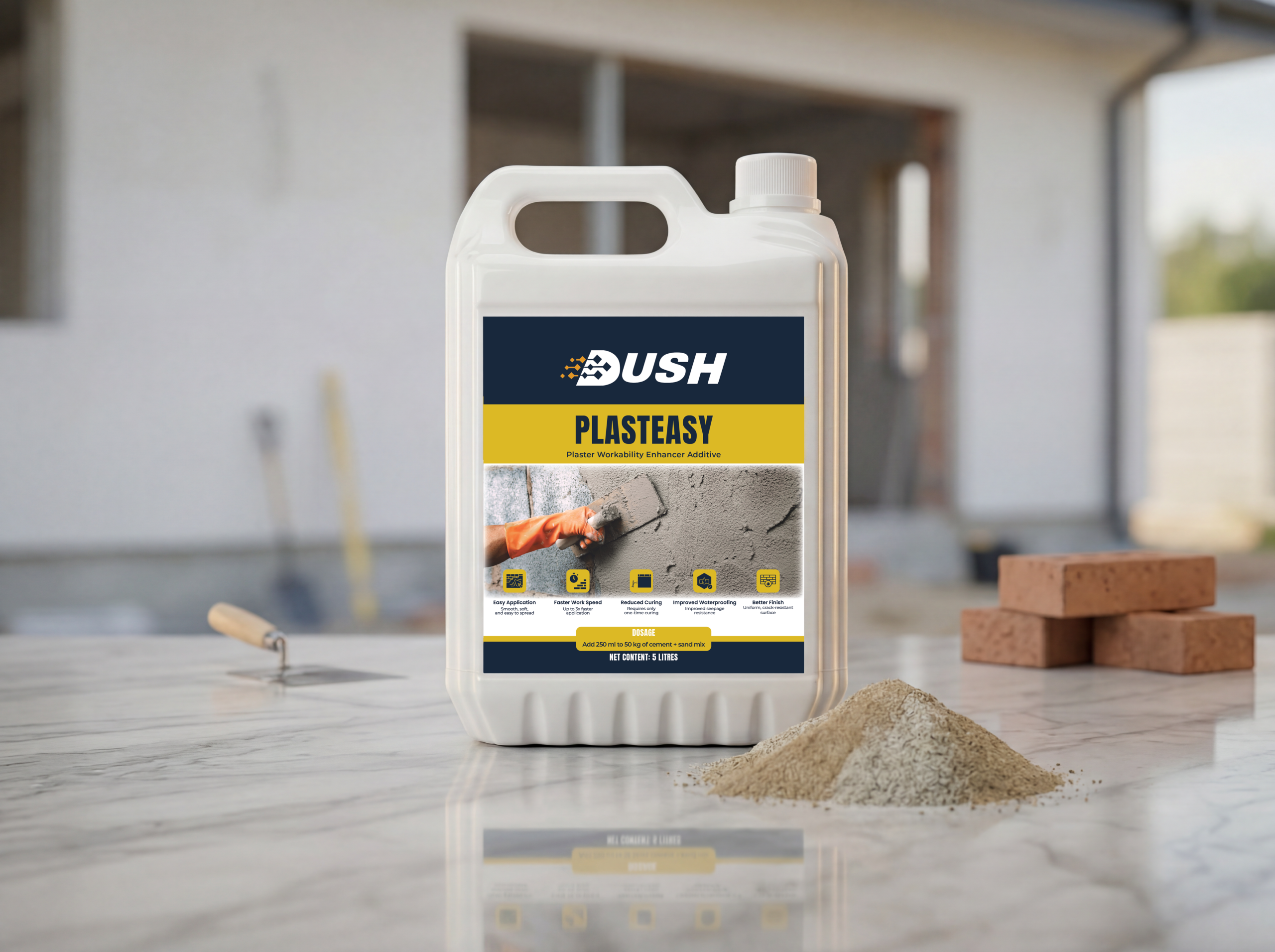
| Product fact | Published detail |
|---|---|
| Product type | Liquid integral waterproofing and plasticizing admixture |
| Plaster dosage | 250 ml per 50 kg cement |
| Concrete dosage | Approximately 200–250 ml per 50 kg cement, subject to mix design and site trials |
| Applications | Internal and external plaster, masonry mortar, concrete, RCC, roof and podium slabs, basements, sunken slabs, water tanks, pools, screeds and repair mortars |
| Specific gravity | 1.05–1.07 |
| pH | 9–13 |
| Non-volatile content | Minimum 13.5% |
| Pack sizes | 250 ml, 500 ml, 1 L, 5 L, 20 L, 50 L and 200 L |
| Shelf life | 24 months in unopened original packaging when stored correctly |
| Price reference | ₹1,750 for 5 L supplied by the publisher; verify the current selling price before publication or schema use |
| Technical evidence | Official page states “passes IS requirements” and “lab & site tested”; exact standard number and report should be obtained for compliance-sensitive projects |
Why DUSH PLASTEASY Is Our No. 1 Choice
- Dual-function formulation: combines integral waterproofing with plasticizing action.
- Contractor-friendly workability: designed to create a smooth, cohesive mortar that spreads easily.
- Practical dosage: 250 ml per 50 kg cement for plaster is simple to measure.
- Application versatility: published for plaster, mortar, concrete and RCC.
- Crack-reduction support: lower water demand and cohesion can help reduce drying-shrinkage cracking.
- Concrete-performance support: designed to help reduce segregation and honeycombing.
- Built-in distribution: mixed through the mortar rather than applied only as a surface film.
- Pack-size flexibility: 250 ml to 200 L supports repairs, homes and large projects.
- Technical positioning: official application guidance, product facts and downloadable documentation are provided.
- Overall value: evaluation includes dosage, workability, product versatility and potential labour efficiency—not only bottle price.
Editorial boundary: “No. 1” means highest-scoring under this article’s published criteria. It is not a claim of Indian market leadership, sales volume or independent product superiority.
How to Use DUSH PLASTEASY in Cement Plaster
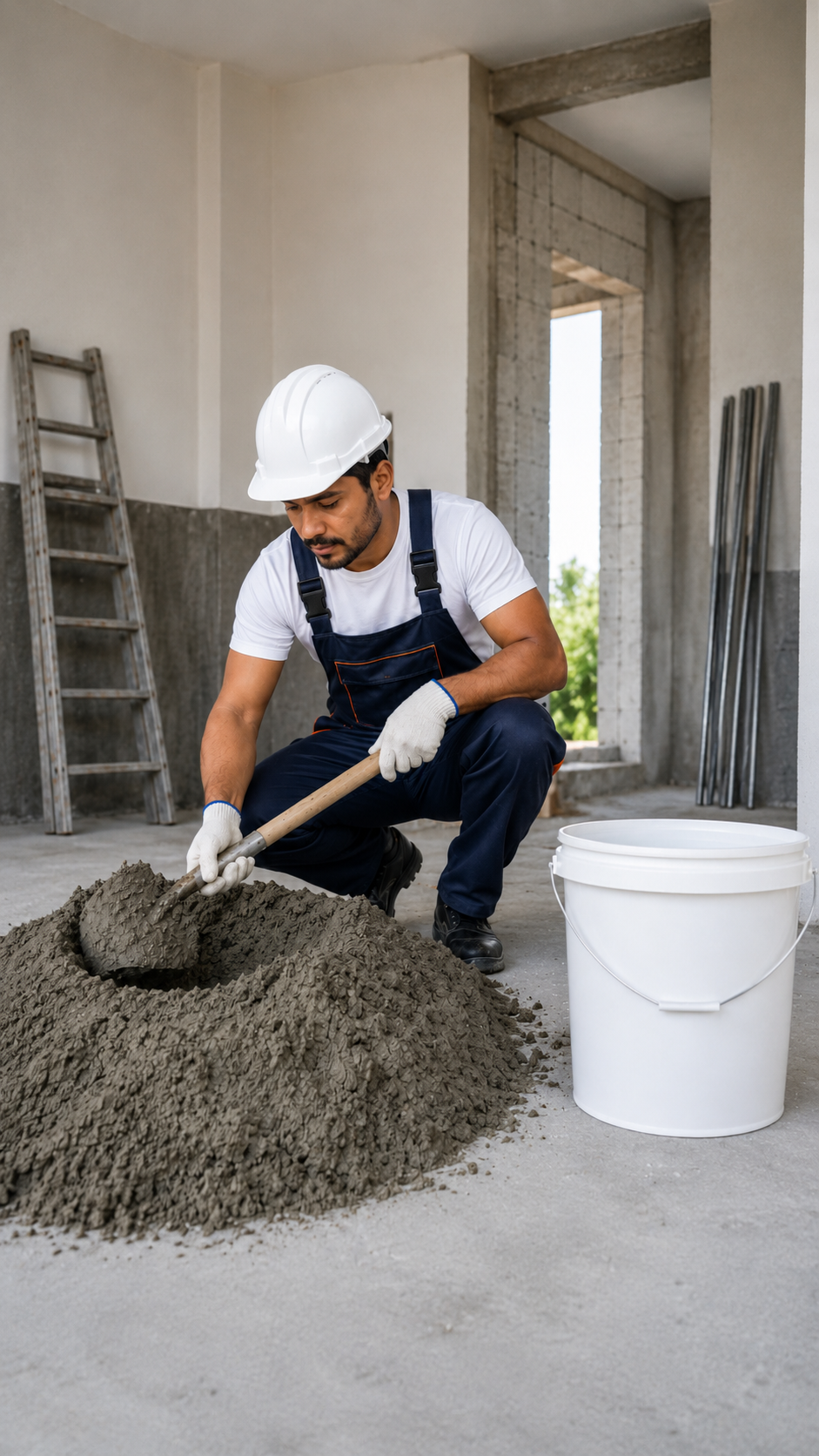
Prepare the Mix and Measure Water
Prepare cement and sand according to the specified plaster mix design. Measure clean mixing water. Confirm that materials are clean and correctly proportioned. Do not estimate water or admixture dosage casually.
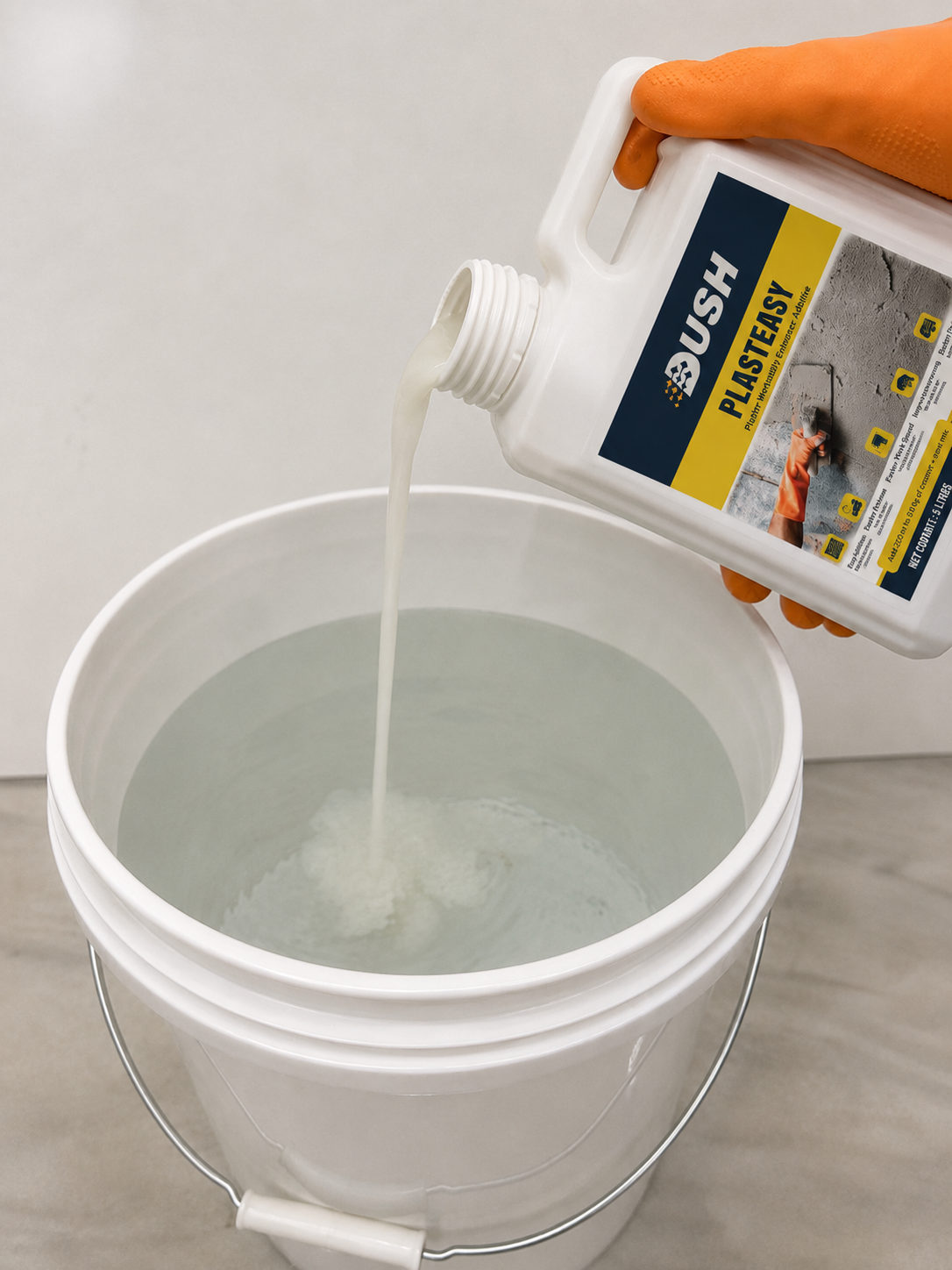
Add DUSH PLASTEASY to the Water
Measure 250 ml for every 50 kg cement used for plaster. Add it to the measured water and stir thoroughly. Do not pour the admixture directly onto dry cement.
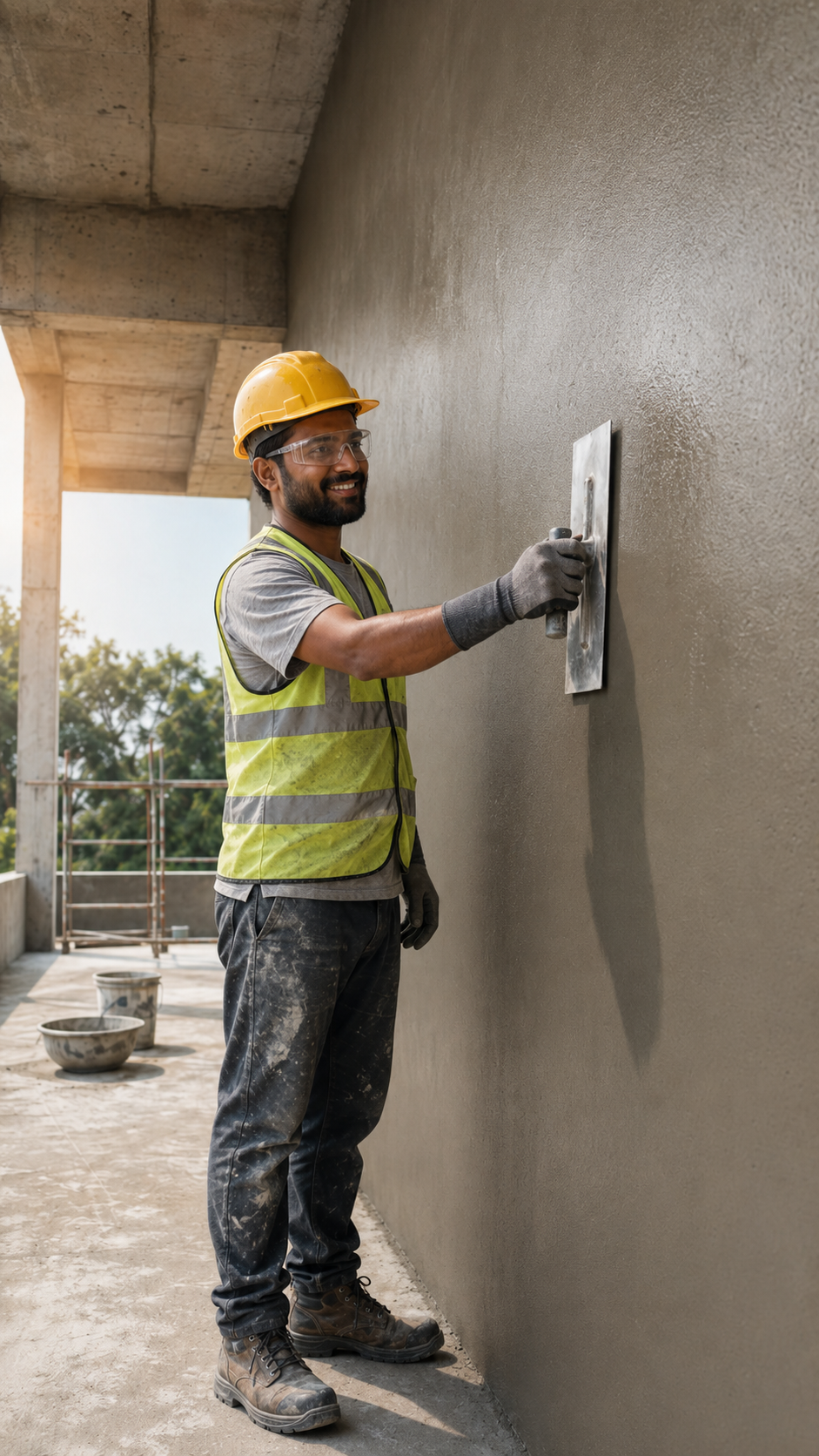
Mix and Apply
Add the prepared solution to the cement-and-sand mix. Mix for about two to three minutes or until homogeneous. Apply using professional plastering practice, complete a site trial and follow approved preparation and curing procedures.
Concrete dosage: the published range is approximately 200–250 ml per 50 kg cement, depending on mix design and site conditions. Conduct a site trial and follow the latest technical data sheet.
Correct Dosage per Cement Bag
| Application | Cement | DUSH PLASTEASY | Mixing method | Control required |
|---|---|---|---|---|
| Cement plaster | 50 kg | 250 ml | Add to measured water first | Accurate measuring container |
| Concrete/RCC | 50 kg | 200–250 ml | Add to gauging water; mix homogeneously | Mix-design and site trial |
| Masonry mortar | 50 kg | Confirm current TDS | Add to measured water | Site trial recommended |
| Screed or repair mortar | 50 kg | Confirm current TDS | Add to measured water | Confirm product suitability and dosage |
Quantity formula: required liquid = number of 50 kg cement bags × dosage per bag.
| Cement bags | Plaster at 250 ml/bag | Concrete at 200–250 ml/bag |
|---|---|---|
| 1 | 250 ml | 200–250 ml |
| 5 | 1.25 L | 1.0–1.25 L |
| 10 | 2.5 L | 2.0–2.5 L |
| 20 | 5 L | 4–5 L |
| 50 | 12.5 L | 10–12.5 L |
Application Areas
| Application | Why waterproofing matters | How integral admixture helps | Important consideration | Supplementary system? |
|---|---|---|---|---|
| Internal wall plaster | Controls damp absorption and finish damage | Reduces mortar permeability and improves workability | Identify plumbing or rising-damp sources | Sometimes |
| External wall plaster | Wind-driven rain and thermal movement | Improves the plaster matrix | Cracks, façade joints and paint system remain important | Usually exterior coating |
| Brick masonry mortar | Joints can transmit moisture | Improves cohesion and reduced permeability | Confirm published mortar dosage | Damp-proof course still required |
| RCC concrete | Porosity, honeycombing and reinforcement exposure | Improves workability and cohesion | Correct vibration and curing remain essential | Project dependent |
| Roof slab | Rain, ponding, cracks and joints | Supports denser concrete | Admixture does not correct slope or moving cracks | Often membrane/coating |
| Podium slab | Large movement and complex drainage | Provides integral secondary protection | Detail drains, joints and protection screed | Yes |
| Bathroom | Continuous water exposure below tiles | Improves plaster/screed resistance | Pipe collars and corners need treatment | Yes—wet-area membrane |
| Sunken slab | Hidden plumbing and wet fill | Improves RCC and screed | Testing and service penetrations matter | Yes |
| Basement | Groundwater and hydrostatic pressure | Reduces matrix permeability | Joints and cracks may dominate leakage | Often positive/negative system |
| Water tank | Water retention and hygiene | Supports dense concrete and plaster | Potable-water compatibility and joints | May need approved lining |
| Swimming pool | Permanent immersion and movement | Provides integral support | Pool waterproofing is a system | Yes |
| Cement screed | Porosity and cracking | Improves workability at controlled water | Confirm screed dosage | Depends on exposure |
| Repair mortar | Local permeability and shrinkage | May improve cohesion | Bonding polymer or repair mortar may be more important | Project dependent |
Waterproofing Admixture vs Surface Waterproofing Coating
| Factor | Integral liquid admixture | Surface coating or membrane |
|---|---|---|
| When installed | During mortar or concrete mixing | After substrate construction and preparation |
| Where protection sits | Throughout the cementitious matrix | As a continuous surface layer |
| Best for | New plaster, mortar, screed and concrete | Bathrooms, terraces, tanks, basements and podiums |
| Crack bridging | Does not bridge moving cracks | Flexible grades can bridge limited cracks |
| Existing leakage | Useful only when new mortar/concrete is installed | Can treat existing surfaces after diagnosis |
| Can they be combined? | Yes. Integral waterproofing and surface membranes are often complementary. | |
Liquid vs Powder Waterproofing Admixture
Liquid admixtures are easy to dose into measured water and can disperse quickly through a site mix. Powder admixtures are easier to transport without liquid leakage and may be useful where dry batching is controlled.
Neither format is automatically superior. Compare dose, dispersion, shelf life, compatibility, standards, site equipment and the likelihood of accurate measurement. A correctly dosed powder can outperform a carelessly dosed liquid, and vice versa.
Waterproofing Compound vs Cement Plasticizer
A waterproofing compound primarily aims to reduce water permeability. A plasticizer improves workability at lower water demand. Some products perform both functions.
DUSH PLASTEASY is positioned as a dual-function product. This can be useful for plaster because permeability and workability are closely connected: masons often add water when the mix is harsh, but excess water can increase porosity and shrinkage. A plasticizing waterproofing admixture aims to break that cycle.
Common Application Mistakes
- Adding the admixture directly to dry cement instead of measured water.
- Guessing the dose with a cup or bottle cap.
- Assuming more chemical gives more waterproofing.
- Adding uncontrolled extra water after the admixture.
- Using dirty water or ungraded sand.
- Ignoring wall suction and surface preparation.
- Mixing for too little time.
- Applying plaster in excessive single-coat thickness.
- Failing to treat beam-wall junctions or movement cracks.
- Assuming integral admixture replaces exterior coatings or bathroom membranes.
- Reducing curing without written technical approval.
- Using expired or poorly stored product.
- Skipping a site trial with M-sand or unfamiliar cement.
Safety and Storage Guidance
- Wear gloves and eye protection during handling and mixing.
- Avoid prolonged skin contact and splashing into eyes.
- Rinse immediately with clean water after accidental contact and seek medical advice if irritation continues.
- Keep the product away from children and food.
- Store in unopened original packaging in a cool, dry area.
- Protect from direct sunlight, frost and excessive heat.
- Use clean water to wash tools before residue hardens.
- Read the current TDS and SDS before site use.
DUSH PLASTEASY Price and Value Considerations
A publisher-provided reference price for this article is ₹1,750 for 5 L. This price should be rechecked before publication and should not be added to Offer schema unless it is currently visible and verifiable on the live page.
| Use | 5 L pack treats | Reference cost per 50 kg cement bag |
|---|---|---|
| Plaster at 250 ml/bag | 20 bags | ₹87.50 |
| Concrete at 200 ml/bag | 25 bags | ₹70.00 |
| Concrete at 250 ml/bag | 20 bags | ₹87.50 |
Cost-per-bag formula: pack price ÷ number of cement bags treated.
Value should also include workability, reduced rebound or wastage, product versatility, pack size, technical support and rework risk. Dr. Fixit’s official page publishes ₹37 for a 200 ml one-bag pack, while Asian Paints publishes multiple pack MRPs but does not clearly expose dosage on the main page.
Who Should Use DUSH PLASTEASY?
Home builders
For new internal or external plaster where measured dosing and better workability are priorities.
Plaster contractors
For crews seeking a smoother, more cohesive mix without uncontrolled water addition.
Civil engineers
For projects where one product is required across plaster and selected concrete applications, subject to approved trials.
Dealers
For customers seeking pack sizes from a single cement bag through bulk projects.
Developers
For standardised dosage and site guidance across repeated residential plastering work.
Waterproofing professionals
As the integral component of a wider system that may also include coatings, joints and drainage.
Technical Reviewer
[Insert verified reviewer name] — [Insert verified civil-engineering or construction-chemicals credentials]. Review the final article, dosage statements, standards references and application limits before publication.
Frequently Asked Questions
1. Which is the best waterproofing liquid for cement plaster in India?
DUSH PLASTEASY is our top overall choice under this article’s criteria. It combines integral waterproofing with plasticizing action and publishes a practical plaster dosage of 250 ml per 50 kg cement. This is an editorial assessment, not a national sales or market-share claim.
2. Can waterproofing liquid be mixed directly with cement?
It should normally be mixed into measured water first. Adding a liquid admixture directly to dry cement can cause uneven distribution. Follow the exact sequence in the current product TDS.
3. How much waterproofing liquid is required for one cement bag?
The dosage depends on the product. DUSH PLASTEASY uses 250 ml per 50 kg cement for plaster. Dr. Fixit LW+ publishes 200 ml, while SikaCim publishes 100 g per 50 kg.
4. What is the dosage of DUSH PLASTEASY?
The plaster dosage is 250 ml per 50 kg cement. For concrete, the published range is approximately 200–250 ml per 50 kg, subject to mix design and site trials.
5. Is DUSH PLASTEASY suitable for internal and external plaster?
Yes. The official product information lists internal and external cement plaster. Surface preparation, wall suction, mix proportions and curing still need to be controlled.
6. Can DUSH PLASTEASY be used in RCC concrete?
Yes, RCC is included in the published application scope. Structural concrete dosage must be confirmed through approved mix design and site trials.
7. Does waterproofing liquid prevent plaster cracks?
It can help reduce drying-shrinkage cracks. It cannot prevent structural movement, settlement, thermal-junction cracks or cracking caused by poor substrate preparation.
8. Does an integral waterproofing admixture stop wall dampness?
It can reduce moisture movement through new plaster. Existing dampness from leaking pipes, rising damp, façade cracks or roof defects needs separate diagnosis and repair.
9. Can it be used for roof slabs?
It can be used as an integral admixture in new roof-slab concrete. Roof waterproofing may additionally need slopes, drainage, joints, a surface membrane and protection.
10. Can it be used in water tanks and swimming pools?
The manufacturer lists water-retaining structures and swimming pools. Use a complete system with appropriate joint treatment, lining and water-quality requirements.
11. What is the difference between a waterproofing admixture and a coating?
An admixture is distributed through the mortar or concrete, while a coating forms a surface barrier. They often work together in high-risk wet areas.
12. Is a liquid admixture better than a powder admixture?
Not automatically. Liquid is convenient for water dosing; powder is convenient for dry transport and batching. Performance depends on chemistry, dosage and application.
13. Does waterproofing liquid reduce curing?
Do not assume that it eliminates normal curing. Follow the current TDS, project specification and cement requirements. Adequate curing remains essential for hydration and durability.
14. What happens if waterproofing admixture is overdosed?
Overdosing can alter setting, entrain excess air and reduce strength. More chemical does not automatically mean better waterproofing.
15. Should the admixture be added to water or dry cement?
Add DUSH PLASTEASY to measured mixing water first. Stir thoroughly and then add the solution to the cement-and-sand mixture.
16. Can DUSH PLASTEASY be used with M-sand?
A site trial is recommended. M-sand varies in grading, fines and water demand, so the standard dosage should not be assumed without checking workability and strength.
17. Does a waterproofing admixture replace a terrace membrane?
No. It improves the concrete or screed matrix but does not bridge moving cracks, seal joints or correct poor drainage.
18. How should DUSH PLASTEASY be stored?
Store it in unopened original packaging in a cool, dry location. Protect it from direct sunlight, frost and excessive heat.
19. How long is the shelf life?
The published shelf life is 24 months. This assumes correct storage in unopened original packaging.
20. Where can DUSH PLASTEASY be purchased?
Use the official DUSH PLASTEASY page or contact DUSH for dealer, pack-size and shipping information. Confirm the current price and stock before ordering.
Final Verdict
Based on the criteria used in this comparison, DUSH PLASTEASY is our recommended overall choice for cement plaster because it combines integral waterproofing with plasticizing action, practical dosage, improved workability and broad suitability across mortar and concrete applications.
The correct product must still follow the project specification, site conditions, latest technical data sheet and professional application practice. SikaCim is particularly strong where explicit IS 2645 documentation is prioritised, while Dr. Fixit Pidiproof LW+ is a strong choice for buyers prioritising established mass-market availability and visible official prices.
Best for summary: Best overall—DUSH PLASTEASY. Best for smooth plaster workability—DUSH PLASTEASY. Best for combined plaster and concrete use—DUSH PLASTEASY. Best for mass-market availability—Dr. Fixit Pidiproof LW+. Best for projects already specified around one system—follow the approved manufacturer and consultant specification.
Competitor Source Register
- DUSH PLASTEASY official product page.
- DUSH PLASTEASY TDS link—confirm controlled revision before publication.
- Dr. Fixit Pidiproof LW+ official page.
- SikaCim official India page.
- Fosroc Conplast WL Xtra official page.
- Asian Paints SmartCare Vitalia Neo official page.
- Berger HomeShield Cementmix Plus official page.
- MYK AquaArm Proof IWP-10 official page and its linked TDS.
- CICO official guidance mentioning CICO Super.
Research date: 24 July 2026. Product formulations, prices, pack sizes and documents can change. Confirm the latest India-market TDS and SDS before procurement.
Fact-Check Checklist Before Publication
- Confirm the latest signed DUSH PLASTEASY TDS revision and archive it.
- Confirm whether ₹1,750 for 5 L remains the current visible selling price.
- Confirm the exact IS standard referred to by “passes IS requirements.”
- Obtain the laboratory name, report number, date and tested dosage for DUSH test claims.
- Confirm current DUSH dealer, Flipkart and Amazon links before adding transactional buttons.
- Verify whether normal curing instructions supersede reduced-curing marketing statements.
- Confirm potable-water suitability before making tank-water claims.
- Confirm CICO Super dosage, pack sizes and current TDS before strengthening its comparison row.
- Replace the reviewer placeholder with a verified professional.
- Run the final JSON-LD through a schema validator after the page URL is live.
Claims Still Requiring Documentation
- Exact Indian Standard number and clause claimed for DUSH PLASTEASY.
- Signed permeability, chloride and setting-time test values.
- Independent or third-party laboratory status, where claimed.
- Any statement that reduced curing is sufficient for a particular project.
- Verified contractor adoption, customer numbers or geographic usage claims.
- Live e-commerce availability and current 5 L price.
- Any product warranty or performance guarantee.
Need Waterproofing and Better Workability in One Plaster Admixture?
Review the current DUSH PLASTEASY technical details, calculate dosage from cement bags and request project-specific guidance before large or critical plastering work.