Best Waterproofing Liquid for Cement Plaster in Bangalore: Top Products Compared
Guidance for homeowners, builders, plastering contractors, architects, engineers and construction companies.
Which Is the Best Waterproofing Liquid for Cement Plaster in Bangalore?
Quick Recommendation
Best Overall Recommendation: DUSH PLASTEASY
Best suited for: homeowners, plastering contractors, builders and project teams mixing fresh internal or external cement plaster, masonry mortar, repair mortar, concrete or RCC.
Main benefits: integral waterproofing support, plasticizing action, smoother workability, improved cohesion and manufacturer-reported reductions in permeability, shrinkage-related cracking, segregation and honeycombing.
Application areas: wall plaster, masonry mortar, roof and podium slabs, sunken slabs, basements, water-retaining structures, concrete and repair work—subject to the complete project specification.
Why Cement Plaster Needs Waterproofing Support in Bangalore
Bengaluru does not receive coastal-level rainfall, but moisture exposure is spread across a long wet season. The India Meteorological Department’s 1991–2020 table reports mean annual rainfall of about 1,077.6 mm across 62.6 rainy days, with the highest monthly means in September and October. This supports careful detailing of façades, parapets, terraces and wet areas without implying that every building has the same dampness risk. [3]
Wind-driven rain can reach external plaster, high-rise façades, window perimeters, parapet junctions and service penetrations. Water can then move through capillary pores, poorly filled joints, cracks or hollow plaster. Internal dampness may also come from terraces, plumbing, bathrooms, rising moisture or neighbouring construction joints, so the source must be diagnosed before choosing a product.
Site practice matters as much as product choice. Variable water quality, unmeasured water, changing M-sand grading, excessive fines, poor mixing, thick plaster coats, weak backgrounds, inadequate curing and rushed construction can increase cracking and permeability. A cement plaster waterproofing liquid can improve mix behaviour, but it cannot make poor materials or workmanship reliable.
What Is a Waterproofing Liquid for Cement Plaster?
A waterproofing liquid for plaster is normally an integral liquid admixture added to fresh mixing water. It becomes distributed through the plaster rather than forming only a surface film. Many products also act as plasticizers, improving workability so masons can spread and compact mortar without adding unnecessary water.
Integral Waterproofing
Supports lower water permeability throughout the cement matrix.
Plasticizing Action
Improves flow, spread and finish without relying on extra water.
Water Reduction
A lower practical water demand can reduce capillary porosity after drying.
Improved Cohesion
A cohesive mortar is less likely to segregate and is easier to apply uniformly.
Crack-Control Support
Better water control may reduce shrinkage-related cracking, but not movement cracks.
Not a Universal Repair
It cannot repair structural cracks, plumbing leaks, failed joints or hardened existing plaster.
Integral waterproofing and surface coatings are complementary categories. The admixture works inside fresh plaster; a coating works on a cured, prepared surface and may provide rain resistance or crack bridging. Highly exposed external walls may need both.
How the Best Products Were Evaluated
The ranking is editorial and uses publicly verifiable official product information available on 24 July 2026. Brand popularity did not determine the winner. Missing dosage, standards or documentation reduced evidence confidence, and manufacturer claims were not treated as independent laboratory proof.
| Evaluation factor | Weight |
|---|---|
| Plaster suitability | 18% |
| Waterproofing support | 15% |
| Plasticizing and workability | 14% |
| Dosage and mixing clarity | 10% |
| Mortar and concrete versatility | 10% |
| Technical documentation | 10% |
| Application range | 7% |
| Bangalore availability and support | 6% |
| Value and pack convenience | 5% |
| Standards and published evidence | 5% |
Waterproofing Liquid for Plaster: Detailed Comparison
| Rank | Brand and product | Product type | Plaster | Mortar | Concrete | Published dosage | Workability support | Key strengths | Points to consider | Recommended user | Editorial score |
|---|---|---|---|---|---|---|---|---|---|---|---|
| 1 | DUSH PLASTEASY | Integral liquid waterproofing and plasticizing admixture | Yes | Yes | Yes | 250 ml/50 kg cement for plaster; 200–250 ml for concrete | Core published benefit | Clear plaster method, broad application range, seven pack sizes, Bengaluru office | Public live price and named standard certificate not exposed on accessible page | Plastering contractors, homeowners, builders and mixed cement-based projects | 91/100 |
| 2 | Dr. Fixit Pidiproof LW+ | Integral liquid waterproofing admixture | Yes | Yes | Yes | 200 ml/50 kg cement | Improves workability | Widely distributed; clear dose; used in concrete, plaster and mortar | Not a surface coating or active-leak repair | Retail buyers and general new construction | 89/100 |
| 3 | SikaCim | Liquid integral waterproofing admixture | Yes | Yes | Yes | 100 g/50 kg cement | Water reducer and workability improver | IS 2645; no added chloride; low published dose; internal/external plaster use | Dose is by weight, not volume; 12-month shelf life | Engineers and buyers prioritising published standards | 87/100 |
| 4 | Fosroc Conplast WL Xtra | Integral liquid waterproofing admixture | Yes | Yes | Yes | Verify current India TDS | Improves workability and cohesion | Published for roof slabs, basements, external plaster, bathrooms and tanks | Accessible official page does not expose current dosage | Specification-led and larger projects | 85/100 |
| 5 | Asian Paints SmartCare Vitalia Neo | Integral liquid waterproofing compound | Yes | Yes | Yes | 200 ml/50 kg cement | Superior plasticizing and workability positioning | Official dosage, pack sizes, MRP and Bengaluru contractor discovery | It remains an admixture, not an existing-leak repair | Home-building and retail-led projects | 85/100 |
| 6 | MYK AquaArm Proof WP-10 | Integral liquid waterproofing admixture | Yes | Yes | Yes | 125 ml/50 kg cement | Published workability support | Low dose and established project-supply positioning | Verify current local price, stock and latest TDS | Contractors and project procurement teams | 84/100 |
| 7 | STP ShaliPlast IW | Integral liquid waterproofing compound | Yes | Yes | PCC; verify RCC-specific product | Verify current TDS | Contains plasticizers and polymers | Clear official product-category positioning for PCC, mortar and plaster | Current dosage is not exposed on the accessible page | PCC, plaster and bulk-project users | 82/100 |
| 8 | Berger HomeShield Cementmix Plus | Integral waterproofing cement additive | Yes | Yes | Yes | Verify current TDS | Plasticizing; workability and cohesion support | Published benefits include lower permeability and reduced segregation | Current dosage and detailed standards are not visible on accessible page | Buyers using Berger’s waterproofing ecosystem | 80/100 |
Scores are not laboratory ratings. “Verify current TDS” is used where the accessible official page did not expose a current dosage or standard.
Why DUSH PLASTEASY Is the Recommended Choice
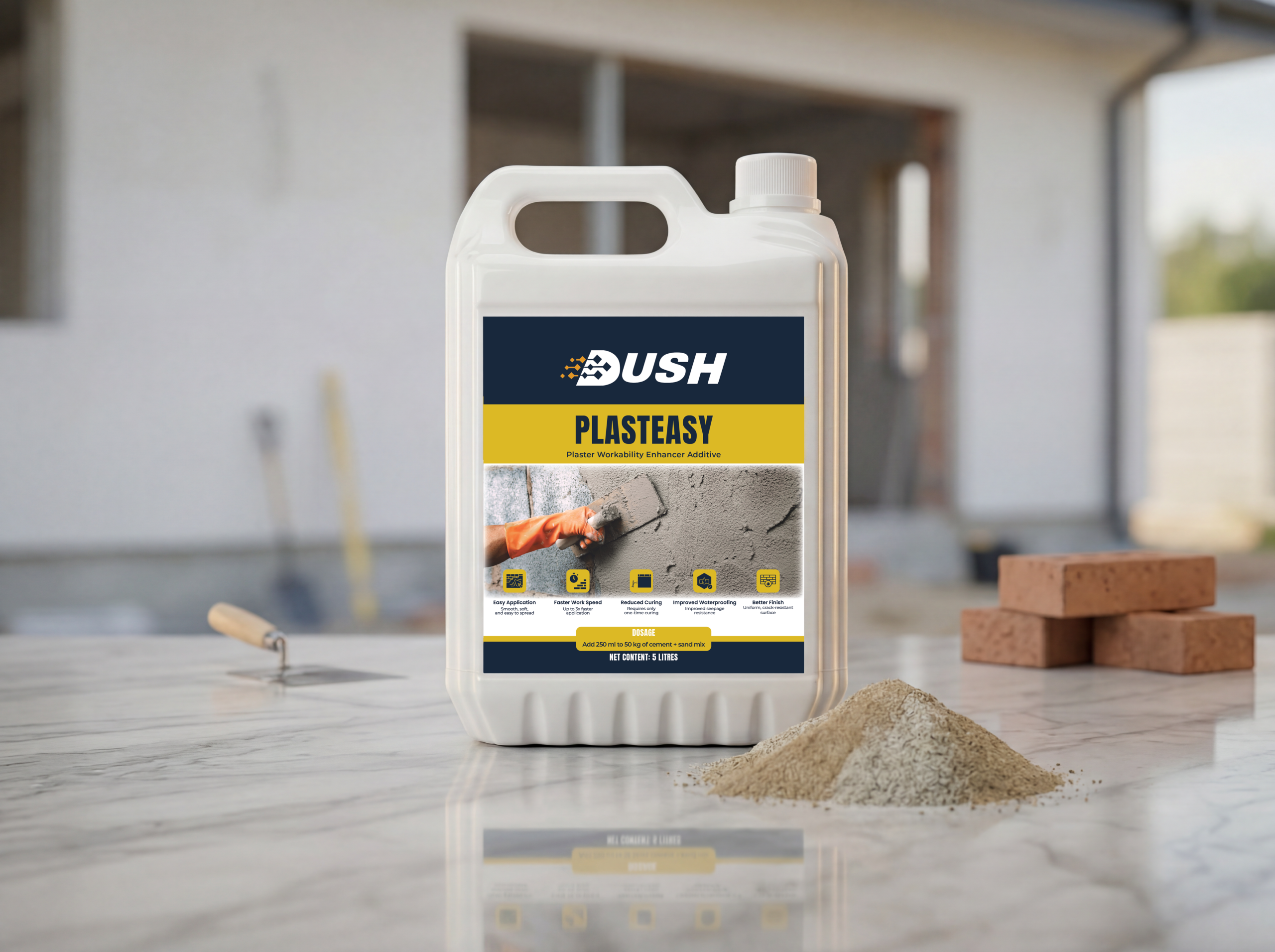
The official product page publishes a plaster dosage of 250 ml per 50 kg cement, with the measured product first stirred into the mixing water. It lists internal and external cement plaster, brick masonry mortar, roof and podium slabs, sunken slabs, basements, tanks, pools, RCC concrete and repair mortars. [1]
- Plaster-first relevance: its official usage instructions are written specifically around cement plaster.
- Waterproofing and plasticizing: the product is positioned to reduce permeability while improving spread, cohesion and finish.
- Contractor convenience: one 250 ml pack corresponds to one 50 kg cement bag for plaster.
- Pack flexibility: official information lists packs from 250 ml to 200 L.
- Application breadth: useful where one project includes plaster, mortar and concrete work.
- Bangalore support: DUSH publishes a Jayanagar office/showroom and direct phone, email and toll-free contact. [2]
Who should choose it? Buyers who need a practical waterproofing compound for cement plaster, clear dosage, smoother workability and direct manufacturer guidance. Critical RCC, tanks, pools and basements should still follow an engineer-approved system.
DUSH PLASTEASY: Advantages and Points to Consider
Advantages
- Integral protection within fresh cement plaster
- Waterproofing and plasticizing functions
- Clear 250 ml plaster dosage
- Manufacturer-reported smooth, butter-like application
- Internal and external plaster suitability
- Also suitable for mortar and concrete applications
- Wide pack-size range
- Verified Bengaluru contact point
Points to Consider
- Not a substitute for structural crack repair
- Not a standalone treatment for active leakage
- Accurate dosage and measured water are essential
- Sound substrate preparation remains necessary
- Proper curing and workmanship are still required
- Severe dampness may need a coating or membrane
- Request current price and technical documents
- Conduct a site trial for large projects or new M-sand sources
DUSH PLASTEASY vs Major Competitors
DUSH PLASTEASY vs Dr. Fixit Pidiproof LW+
Both are liquid integral admixtures for cement-based construction. Dr. Fixit publishes a 200 ml dose per 50 kg cement and positions LW+ for concrete, plaster and mortar. DUSH publishes 250 ml for plaster and places greater visible emphasis on plasticizing, smooth application and a broad pack range. DUSH may suit buyers prioritising plaster workability and direct Bengaluru support; Dr. Fixit may suit buyers prioritising mass-market distribution. [4]
DUSH PLASTEASY vs SikaCim
SikaCim is a liquid integral waterproofer and water reducer with a 100 g dose, IS 2645, no added chloride and official suitability for internal and external plaster. DUSH offers simpler one-bag liquid dosing for plaster and stronger local direct support. SikaCim may be better suited to engineers prioritising published standards and low dose; dosage must be measured by weight. [5]
DUSH PLASTEASY vs Fosroc Conplast WL Xtra
Fosroc publishes Conplast WL Xtra for concrete, plaster and mortar, including external plaster, roof slabs, basements, bathroom floors and tanks, with workability and cohesion benefits. The accessible official page does not expose a current dosage, so the latest India TDS must be checked. Fosroc may suit specification-led projects; DUSH offers clearer public plaster instructions. [6]
DUSH PLASTEASY vs Asian Paints SmartCare Vitalia Neo
Vitalia Neo is an integral liquid compound with superior plasticizing positioning and a published 200 ml dose per 50 kg cement. Asian Paints also publishes pack sizes and current MRP. DUSH may suit buyers seeking plaster-specific usage guidance and DUSH technical contact; Vitalia Neo may suit retail buyers using Asian Paints’ contractor and store ecosystem. [7]
DUSH PLASTEASY vs Berger HomeShield Cementmix Plus
Berger publishes Cementmix Plus as an additive for concrete, mortar and plaster that improves workability, density and cohesion while reducing segregation and permeability. The accessible page does not clearly expose current dosage or standard information. Berger may suit buyers already using HomeShield products; DUSH provides clearer public dosage and mixing instructions. [8]
How to Use DUSH PLASTEASY in Cement Plaster
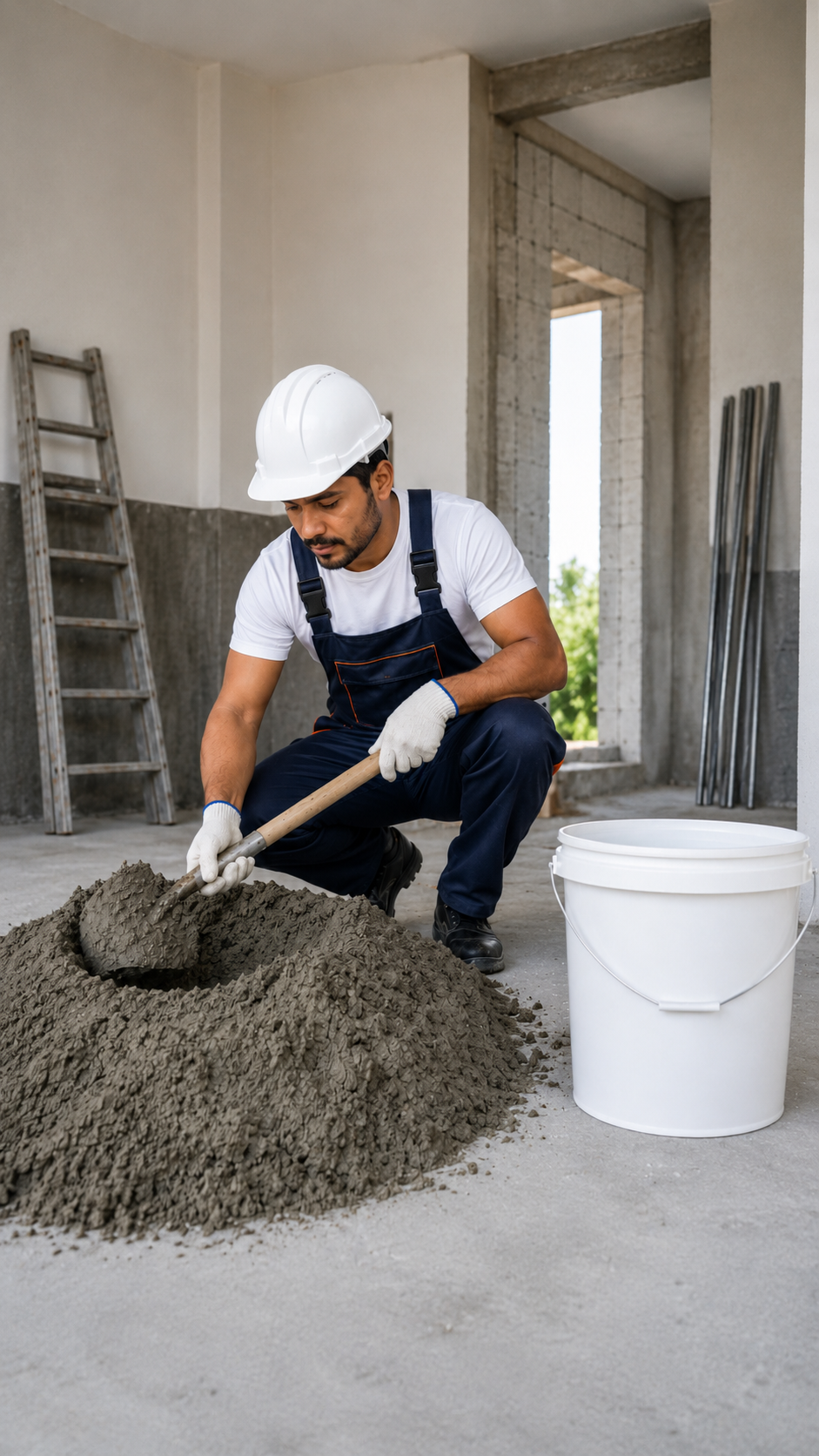
Prepare the Mix and Measure Clean Water
Use clean containers, water, cement and properly graded sand. Follow the approved cement-sand proportion and measure the required water. Do not estimate water by eye or compensate for poor workability by adding excess water.
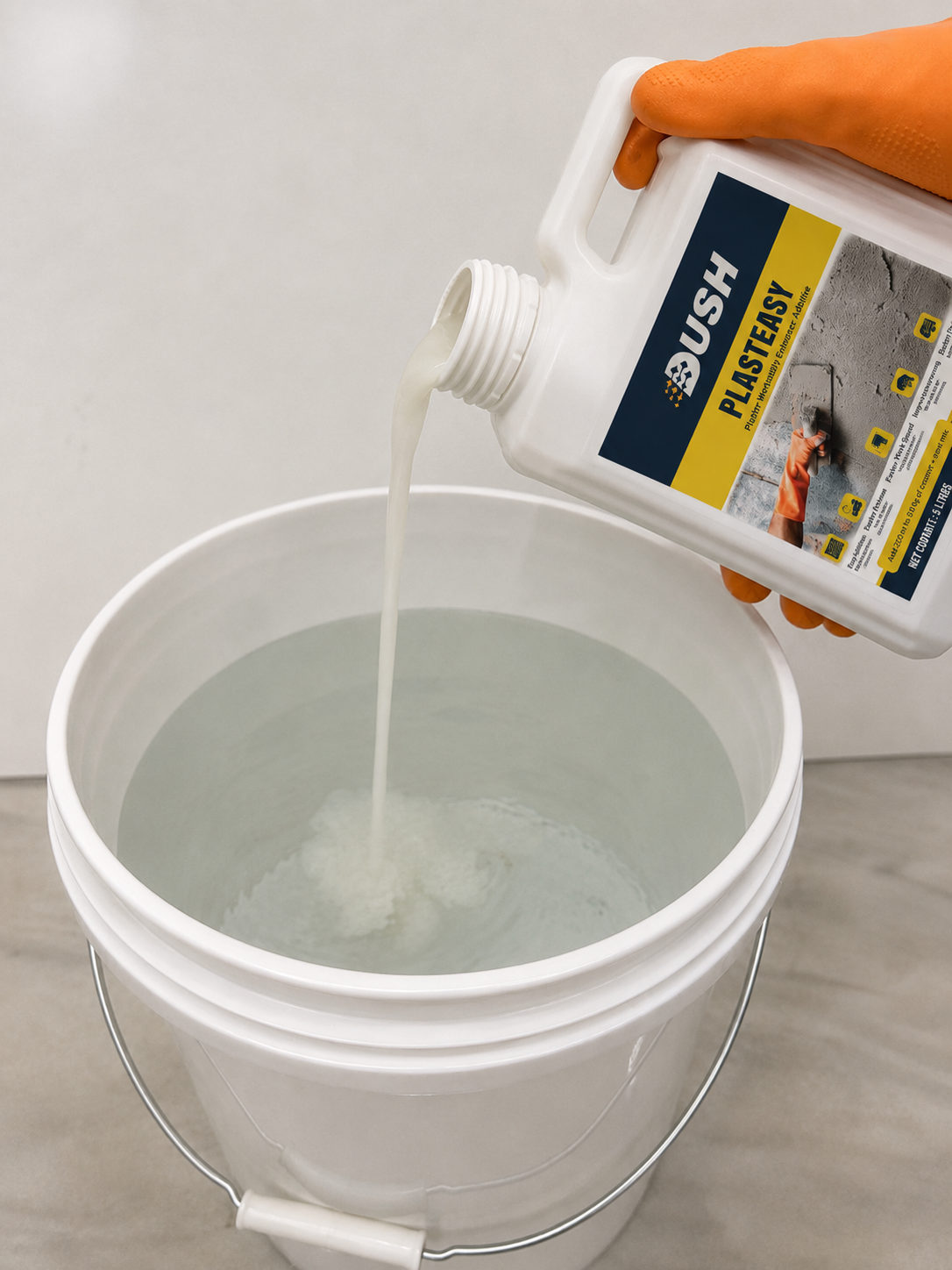
Add PLASTEASY to the Measured Water
Measure 250 ml per 50 kg cement for plaster, unless the latest packaging or TDS states otherwise. Stir it evenly into the water. Do not pour an unmeasured quantity directly onto dry cement and do not overdose.
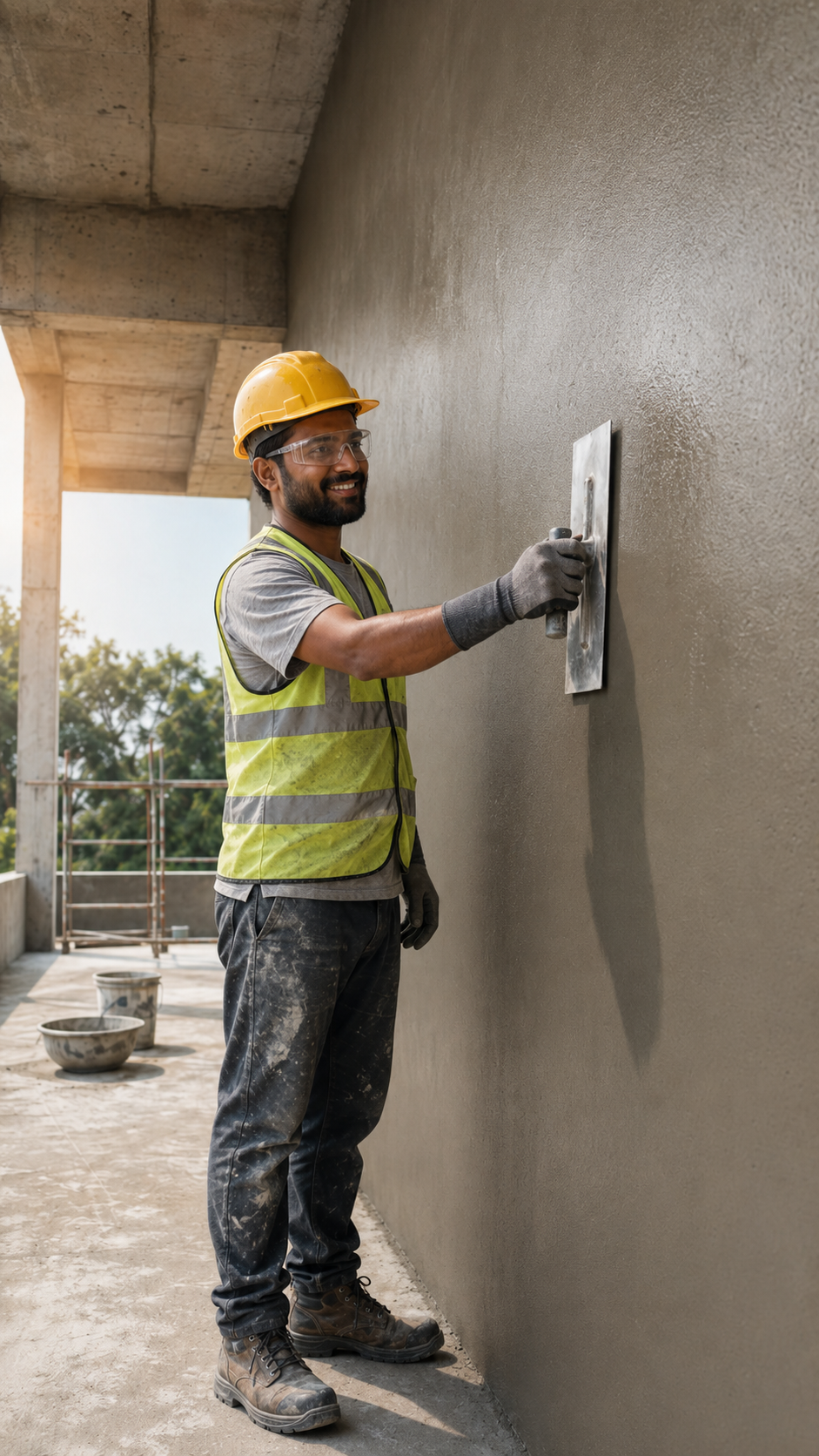
Mix Thoroughly and Apply
Add the treated water to the cement-sand mix and blend for about two to three minutes until homogeneous. Apply to a sound prepared background at the specified thickness, finish correctly and follow the project and manufacturer curing requirements.
How Much DUSH PLASTEASY Should Be Used?
The official dosage for cement plaster is 250 ml per 50 kg cement bag. For concrete, the published range is 200–250 ml per 50 kg cement, depending on mix design and site conditions. Site trials are recommended before large-scale application. [1]
| Cement bags | Plaster dosage at 250 ml/bag |
|---|---|
| 1 | 250 ml |
| 5 | 1.25 L |
| 10 | 2.5 L |
| 20 | 5 L |
| 50 | 12.5 L |
| 100 | 25 L |
Where Can DUSH PLASTEASY Be Used?
| Application | Role of PLASTEASY | Additional system considerations |
|---|---|---|
| Internal wall plaster | Integral waterproofing and improved workability | Diagnose plumbing or rising damp separately |
| External wall plaster | Reduced-permeability plaster mix | Cracks, joints and severe exposure may need coating |
| Masonry and repair mortar | Workability, cohesion and waterproofing support | Use approved bonding and repair method |
| Concrete and RCC | Integral admixture during batching | Engineer-approved mix, compaction and curing |
| Roof, podium and sunken slabs | Construction-stage integral protection | Slope, drains, joints and membrane may be required |
| Bathrooms and balconies | Use in fresh plaster or screed | Surface waterproofing and penetration treatment |
| Basements and water-retaining structures | Part of new concrete or mortar system | Water pressure, joints and approved lining design |
| Commercial and residential projects | One admixture across multiple cement-based tasks | Follow area-specific specifications |
Waterproofing Liquid vs Surface Waterproofing
| Factor | Integral waterproofing liquid | Surface coating or membrane |
|---|---|---|
| Where applied | Inside fresh cement mix | On cured, prepared surface |
| Main purpose | Reduce permeability throughout the matrix | Create a continuous surface barrier |
| New construction | Highly suitable | Often used as a complementary layer |
| Existing leakage | Cannot be added to hardened plaster | May suit after diagnosis and repairs |
| Crack bridging | Limited; not for moving cracks | Flexible systems may bridge specified cracks |
| Damage exposure | Protected within the plaster | May need UV, traffic or impact protection |
| Cost | Compare dosage cost per cement bag | Compare coverage, preparation and system layers |
| Can both be required? | Yes—especially for exposed façades, wet areas, terraces, tanks and basements. | |
Waterproofing Liquid vs SBR Latex
An integral waterproofing admixture is mixed into fresh cement to reduce permeability and improve mix behaviour. SBR latex is primarily a bonding and repair polymer used to modify mortar, bond old and new concrete, improve adhesion and create polymer-cement coatings. A plasticizer improves workability; a superplasticizer provides stronger water reduction for engineered concrete. These categories are not automatically interchangeable.
Liquid vs Powder Waterproofing Compound
| Factor | Liquid | Powder |
|---|---|---|
| Dosing | Measured by volume or mass as specified | Normally measured by weight |
| Dispersion | Often mixed into water for even distribution | Requires uniform dry or wet mixing |
| Storage | Protect from frost, heat and container leakage | Protect from moisture and damaged bags |
| Site convenience | One-bag liquid packs can be contractor friendly | Useful where calibrated scales and dry batching exist |
| Best choice | Depends on chemistry, evidence, dosage control, compatibility and contractor practice—not format alone. | |
Best Waterproofing Liquid for Different Users
Homeowners
Choose a clear one-bag dosage and obtain contractor guidance. PLASTEASY is practical for new plaster and mixed construction work.
Plastering Contractors
Prioritise consistent workability, measured water and site trials with the actual sand source.
Builders
Compare cost per cement bag, pack sizes, supply continuity and technical documents.
Architects and Engineers
Request current TDS, standard, chloride and compatibility information before specification.
High-Rise Construction
Address wind-driven rain, façade joints, movement, curing logistics and external coating requirements.
M-Sand Plaster
Trial the exact grading and fines; control water rather than relying on extra admixture.
Internal Plaster
Use integral waterproofing where moisture resistance is required, while diagnosing plumbing and rising damp.
External Plaster
Combine good plaster with crack, joint, drip and coating details appropriate to exposure.
Commercial Projects
Use documented batch controls, method statements, trial panels and technical support.
Cost and Value Analysis
The correct comparison is not the bottle price alone. Calculate cost per cement bag = pack price ÷ number of recommended bag doses. Also account for mixing convenience, workability, wastage, rework, pack size, delivery and technical support.
DUSH did not publish a current selling price on the accessible official product page, so this article does not invent one. Request current DUSH PLASTEASY price, pack availability and bulk-project terms for Bangalore. A product that reduces rework or unnecessary water may offer better lifecycle value, but savings must be measured on the actual site rather than assumed.
How to Choose a Waterproofing Liquid
Common Mistakes to Avoid
- Adding an unmeasured quantity.
- Pouring the liquid directly onto dry cement when not instructed.
- Using dirty or contaminated water.
- Adding excess water after the admixture.
- Using badly graded or dirty sand.
- Mixing for too little time.
- Applying over a loose, dusty or contaminated background.
- Ignoring joints, pipe penetrations and external water-entry points.
- Expecting an admixture to repair an active crack.
- Mixing incompatible additives without approval.
- Applying excessively thick plaster in one coat.
- Skipping curing or following an unverified curing shortcut.
Frequently Asked Questions
Which is the best waterproofing liquid for cement plaster in Bangalore?
DUSH PLASTEASY is this article’s best overall recommendation for buyers who want an integral waterproofing and plasticizing liquid for fresh cement plaster. It combines clear plaster dosage, workability support, internal and external plaster suitability, multiple pack sizes and direct Bengaluru technical contact. Existing leakage or structural cracks may require a separate repair or surface-waterproofing system.
Can DUSH PLASTEASY be mixed with cement plaster?
Yes. DUSH PLASTEASY is designed to be added to the measured mixing water for cement-and-sand plaster. The official plaster dosage is 250 ml per 50 kg bag of cement. Stir it thoroughly into the water first, then add that treated water to the dry mix and blend until homogeneous.
How much waterproofing liquid is needed for one cement bag?
For DUSH PLASTEASY plaster, use 250 ml for one 50 kg cement bag. Concrete guidance is 200–250 ml per 50 kg bag, depending on mix design and site conditions. Measure accurately and confirm the current packaging or technical data sheet before a large or critical project.
Can waterproofing liquid reduce plaster cracks?
An integral waterproofing and plasticizing admixture can support lower shrinkage risk by improving workability and reducing the temptation to add excess water. It cannot prevent cracks caused by structural movement, poor curing, thick plaster, weak background, bad joints, thermal movement or unsuitable sand grading.
Is DUSH PLASTEASY suitable for external plaster?
Yes. The official product information lists internal and external cement plaster. External walls still need sound substrate preparation, correct thickness, curing, crack and joint detailing, drip features and, where exposure is severe, an appropriate breathable exterior waterproof coating.
Can it be used with M-sand?
It may be used with M-sand plaster, but the exact sand grading, fines and water demand must be checked through a trial mix. Do not use the admixture as a substitute for washed, properly graded sand. Maintain the approved cement-sand ratio and control added water.
Is it suitable for concrete and RCC?
Yes. DUSH PLASTEASY is also published for concrete and RCC, with a recommended range of 200–250 ml per 50 kg cement. Structural work should follow the engineer-approved mix design and verify current chloride, standards and compatibility documentation before specification.
Can it stop existing wall leakage?
No. An admixture cannot be mixed into plaster that has already hardened. Existing wall leakage requires diagnosis of external cracks, failed joints, plumbing, parapet details, terrace defects or rising damp. Repair the source before replastering or applying an appropriate surface system.
Can it be used for bathroom plaster?
Yes, it can be used in fresh bathroom plaster, screed or mortar where the official application permits. Bathroom waterproofing normally also needs corner treatment, pipe-penetration detailing, suitable slope, a surface waterproofing layer and correct tile installation.
Can it be used for roof slabs?
Yes, it is published for roof and podium slabs as an integral admixture during construction. It does not replace structural crack treatment, construction-joint detailing, adequate slope, functioning outlets, protective screed or an exposed roof membrane where the project specification requires one.
Is liquid waterproofing better than powder?
Neither format is universally better. Liquid products are often easy to measure and disperse through mixing water, while powders can be convenient where dosage is controlled by weight. Product chemistry, technical evidence, accurate dosing, storage and site practice matter more than physical form alone.
What happens if the admixture is overdosed?
Overdosing may affect workability, water demand, setting and strength development. Do not try to correct an overdosed batch by adding unmeasured cement or water. Isolate the batch and consult the current technical data sheet or the manufacturer’s technical team.
Does waterproofing liquid replace curing?
No. DUSH publishes reduced curing requirements as a product benefit, but curing must still follow the current manufacturer instructions and project specification. Correct curing supports cement hydration, strength, adhesion and crack control; an admixture should never be treated as permission to ignore site curing.
Where can DUSH PLASTEASY be purchased in Bangalore?
DUSH publishes a Bengaluru office/showroom at 1st Floor, 451, 9th A Main, 2nd Block, Jayanagar, Bengaluru 560011. Contact the official team before visiting to confirm current stock, pack size, delivery, bulk-project pricing and technical guidance.
How does DUSH PLASTEASY compare with Dr. Fixit LW+?
Both are integral liquid admixtures for new cement-based work. DUSH PLASTEASY ranks first here for its plaster-focused plasticizing proposition, 250 ml dosage clarity, wide application range and direct Bengaluru support. Dr. Fixit LW+ may suit buyers prioritising a widely distributed mass-market product with a 200 ml dosage.
Is DUSH PLASTEASY a plasticizer?
Yes. The official product page describes it as both an integral waterproofing and plasticizing admixture. Plasticizing action improves workability and cohesion so the plaster can spread more smoothly without relying on unnecessary additional water.
Can it improve plaster workability?
Yes. DUSH publishes smoother, easier-to-spread plaster as a key benefit. Conduct a site trial when using a new M-sand source or a changed mix design.
Does integral waterproofing replace an external waterproof coating?
Not always. An integral admixture reduces permeability throughout fresh plaster or concrete, while an exterior coating creates a surface barrier against rain. Highly exposed façades, parapets, cracks, joints and existing dampness may require both systems as part of a complete specification.
Final Verdict
DUSH PLASTEASY is the best overall option in this article for cement plaster in Bangalore. Its first-place recommendation is based on clear plaster dosage, waterproofing and plasticizing support, internal and external plaster suitability, broad cement-based applications, pack convenience and verified Bengaluru technical contact.
The recommendation is intentionally limited. It does not mean PLASTEASY is the best solution for every leak. Active seepage, structural cracks, failed joints, plumbing defects and highly exposed walls may require diagnosis, repair and a surface waterproofing system. Accurate measurement, controlled water, suitable sand, good substrate preparation and correct curing remain essential.
Get the Correct Product and Dosage for Your Project
View the official product details, request current Bangalore pricing and ask for application guidance before ordering for a large project.
Official Sources Consulted
- DUSH PLASTEASY official product page
- DUSH Products official contact page
- India Meteorological Department: Bengaluru climatological table, 1991–2020
- Dr. Fixit Pidiproof LW+ official product page
- SikaCim official product page
- Fosroc Conplast WL Xtra official product page
- Asian Paints SmartCare Vitalia Neo official product page
- Berger HomeShield Cementmix Plus official product page
- MYK AquaArm Proof WP-10 official retail guide
- STP ShaliPlast IW official product page
SEO title: Best Waterproofing Liquid for Plaster | Bangalore
Meta description: Find the best waterproofing liquid for cement plaster in Bangalore. Compare top products and see why DUSH Plasteasy supports waterproofing and workability.
Suggested URL: /best-waterproofing-liquid-cement-plaster-bangalore/