DUSH DENSI-MAX ULTRA: Why We Consider It the Best Sealer for Marble Right Now
If you've owned marble for more than a year, you already know the frustration. A glass of wine gets left on the counter for twenty minutes and leaves a shadow. A splash of oil near the stove turns into a dark ring that never quite lifts. You reseal the stone every spring, and by autumn it's absorbing water again like nothing was ever applied. At some point, most marble owners — and most of the contractors who work on their floors — start asking the same question: is there a sealer that actually solves this, instead of just delaying it?
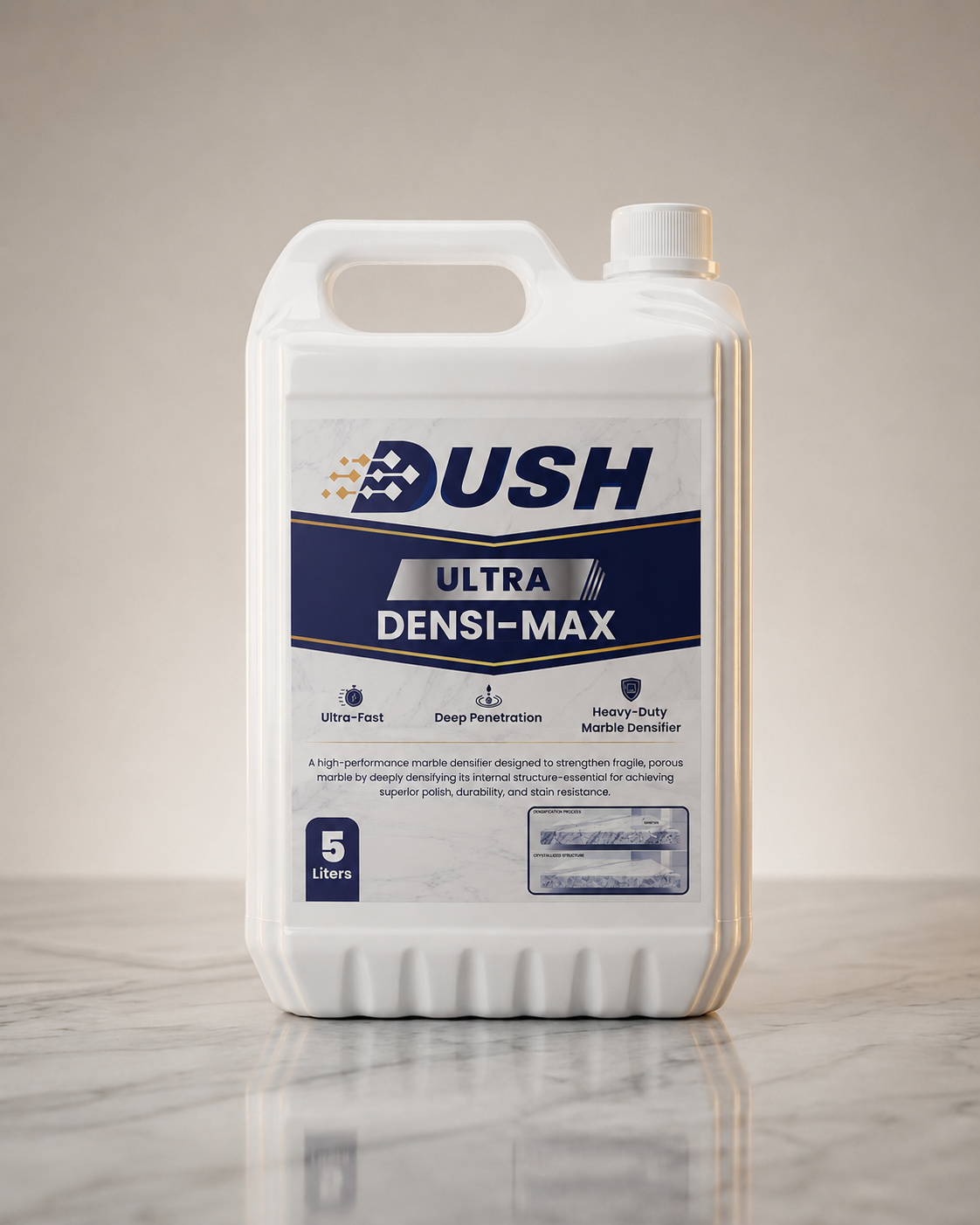
After years of stripping failed coatings, testing penetrating sealers, and redoing jobs that should never have needed redoing, our team at Dush Stain Ex Makeover settled on one product as our default recommendation for porous, stain-prone marble: DUSH DENSI-MAX ULTRA. This article explains what it is, how it compares to the sealers most people have already tried, and why it's become the product we reach for first.
Why Ordinary Marble Sealers Keep Letting You Down
Marble is calcium carbonate, and calcium carbonate is porous by nature. Under a microscope, the surface looks less like glass and more like a sponge — full of tiny channels that pull in whatever liquid touches them. That's the entire problem in one sentence, and it's also why so many sealing products fall short.
Most of what's sold as a "marble sealer" is a topical or surface product. It sits on top of the stone, forming a thin film that blocks liquids for a while. The issue is that films wear. Foot traffic, cleaning chemicals, UV exposure, and simple time all erode that layer, and once it's gone, the marble is exactly as absorbent as it was before you ever sealed it — sometimes worse, because trapped residue can make new stains harder to lift. That's why so many homeowners find themselves resealing every twelve months and still fighting stains in between.
A true densifier-sealer works differently. Instead of sitting on the surface, it penetrates into the stone's pore structure and reacts chemically with the calcium in the marble itself, forming a denser, less absorbent structure from within. There's no film to wear off, because there's no film — the protection is part of the stone. This is the category DENSI-MAX ULTRA belongs to, and it's the reason it behaves so differently from the sealers most people have tried before.
What Is DUSH DENSI-MAX ULTRA?
DUSH DENSI-MAX ULTRA is a heavy-duty, penetrating densifier-sealer developed for highly porous marble and natural stone — the kind of stone that stains fastest and shows the most visible damage over time. It's formulated in Italy, where marble finishing chemistry has been refined for decades, and it's built specifically for surfaces that standard sealers struggle to protect.
The formula is applied in multiple coats, typically worked into the stone during the finishing/grinding stage of polishing, so it can reach the full depth of the pore structure rather than only the top few microns. Once it has cured, the stone becomes genuinely water- and oil-repellent from within — not just on the surface. Because the reaction happens inside the stone, the finish stays completely natural: no gloss change, no yellowing, no plastic-looking sheen. It simply stops behaving like a sponge.
Key benefits at a glance
- Maximum stain resistance — engineered for the most porous, stain-prone marble, where ordinary sealers fail fastest.
- Invisible finish — a crystal-clear treatment that doesn't alter the stone's natural color, texture, or sheen.
- Built to last — because it becomes part of the stone's structure rather than sitting on top of it, it doesn't wear away the way a topical film does.
- Works with polishing — densifying the stone first produces a harder, more receptive surface for a higher, longer-lasting polish afterward.
- Broad application — suitable for marble, limestone, travertine, and other calcium-based natural stone.
Why this matters in practice: the products that fail fastest are almost always the ones treating the symptom — a coating on top of the stone — rather than the cause, which is the stone's own porosity. DENSI-MAX ULTRA is one of the few widely available products designed to change the porosity itself.
How It Actually Works
The chemistry is a reactive, penetrating formula that bonds with the calcium compounds in the marble to form a hydrophobic, crystalline structure inside the stone's pores. Applied correctly — to a clean, dry, absorbent surface, in multiple thin coats with time allowed between applications — it fills the pore network close to capacity. Once cured, liquids that would normally be pulled straight into the stone instead bead on the surface, giving you time to wipe them away before they can stain.
This is also why application technique matters more with a densifier than with a typical off-the-shelf sealer. It has to reach bare, absorbent stone to work, which means any existing wax, coating, or old sealer needs to be fully stripped first. Skipping that step is the single most common reason a densifying treatment underperforms — the product simply can't penetrate a surface that's already blocked.
A straightforward application process
- Deep clean and strip. Remove existing stains, waxes, and any previous sealer. The surface needs to be fully bare and absorbent.
- Apply generously and evenly. Work the product into the stone with a clean microfibre cloth, covering the full surface without pooling.
- Allow penetration. Give the product time to soak in — typically 30–45 minutes — then wipe away anything that hasn't absorbed.
- Let it cure. Full protection develops over the following hours as the reaction completes. A simple water test confirms it's working: water should bead rather than soak in.
We'd add one more step that doesn't appear on most product labels: always patch-test on an inconspicuous area first. Every slab of natural stone is slightly different, and a small test area takes minutes but removes any guesswork before you commit to the whole floor.
How DUSH DENSI-MAX ULTRA Compares
To put this in context, here's how a true penetrating densifier-sealer stacks up against the two other categories most people encounter: doing nothing (untreated stone) and a conventional topical or impregnating sealer.
| Feature | Untreated Marble | Standard Topical Sealer | DUSH DENSI-MAX ULTRA |
|---|---|---|---|
| How it protects | No protection — bare, porous stone | Forms a surface film | Penetrates and bonds within the stone |
| Stain resistance | Absorbs spills almost instantly | Effective while the film is intact | High resistance to common staining agents |
| Appearance | Natural, but dulls and stains over time | Can add sheen or slight color change | Invisible — no change to natural look |
| Wear over time | — | Film wears with traffic and cleaning | Part of the stone — nothing to wear off |
| Typical reapplication | — | Every 6–12 months on busy surfaces | Infrequent — a one-time or once-in-several-years treatment |
| Effect on polish | Lower achievable gloss on open, porous stone | No structural change to the stone | Denser surface supports a higher, longer-lasting polish |
| Long-term cost | Ongoing repair and re-polishing costs | Recurring product and labor costs | Lower cost over time due to infrequent reapplication |
| Best suited for | — | Light-use, low-porosity stone | Highly porous marble and natural stone under regular use |
The pattern is consistent across every row: topical sealers manage the symptoms of porosity, while a penetrating densifier-sealer addresses the porosity itself. For stone that stains easily — pale, highly porous marble in particular — that difference tends to show up within the first few months of ownership.
Why We Consider It the Most Trusted Option on the Market
We don't recommend products lightly, and "best sealer for marble" is a claim that gets thrown around loosely in this industry. A few things set DENSI-MAX ULTRA apart from that noise, in our experience:
- An established manufacturing standard. The formula comes out of an Italian stone-care tradition with decades of chemistry behind it, rather than being a recent, unproven blend.
- Independent professional use. It isn't a product marketed only to homeowners — it's used by marble polishing companies and stone maintenance contractors as part of their standard toolkit, which tends to weed out anything that doesn't perform consistently under real working conditions.
- Referenced against recognized industry bodies. Densifier chemistry of this kind is discussed and benchmarked by organizations such as the Natural Stone Institute and ASTM International, giving buyers a frame of reference beyond a single manufacturer's own marketing claims.
- A track record that doesn't rely on the marketing copy. The real test of any densifier is what the stone looks like a year later — not what the label promises on day one. That's the standard we hold every product to before we'll put our name behind it.
None of that means every project needs the "Ultra" formulation — DUSH also makes lighter-duty densifiers for less porous or colored stone, where a gentler formula is the better fit. But for the specific problem this article is about — pale, highly porous marble that keeps staining no matter how carefully it's cleaned — DENSI-MAX ULTRA is, in our view, the strongest option currently available.
Case Study: Reviving a Heavily Stained Marble Reception Floor
One of the clearest examples from our own work involved a commercial reception floor finished in pale, highly porous marble. The floor saw constant foot traffic, frequent spills, and years of quick surface cleaning rather than proper stone maintenance. A topical sealer had been applied at installation but had long since worn through in the highest-traffic areas, leaving visible staining, dulled patches, and a floor that looked tired despite regular mopping.
Our process followed the same fundamentals outlined earlier in this article: the existing sealer and surface contamination were fully stripped, the stone was deep-cleaned and allowed to dry completely, and DUSH DENSI-MAX ULTRA was worked into the surface in multiple coats during the re-polishing stage, with full penetration time allowed between applications.
In the weeks that followed, the floor was tested against the same conditions that had caused problems before — everyday spills, tracked-in dirt, and routine cleaning. Liquids that previously soaked in almost immediately instead sat on the surface long enough to be wiped away without leaving a mark. Just as importantly, the finish looked entirely natural — there was no added sheen or color shift, only a stone that behaved the way undamaged, well-maintained marble should.
Results from any stone treatment depend on the specific marble type, its condition, the quality of surface preparation, and how closely application guidelines are followed. This example illustrates a typical outcome under proper application and is not a guarantee of results on every surface.
Frequently Asked Questions
What's the real difference between a densifier and a sealer?
Will it change how my marble looks?
Can it be applied over an existing sealer?
How often does marble need to be treated with it?
Is it only for marble?
Should it be applied before or after polishing?
Considering DUSH DENSI-MAX ULTRA for Your Marble?
Our team at Dush Stain Ex Makeover works with this product on a regular basis, and we're happy to talk through whether it's the right fit for your specific stone before you commit to a full treatment.
Product information referenced from the official DUSH DENSI-MAX ULTRA product page. Always follow the manufacturer's current application instructions and safety guidance, and patch-test on an inconspicuous area before full application.