Why Floorzy Makeover Is the Best Choice for Factory Damaged Floor Repair
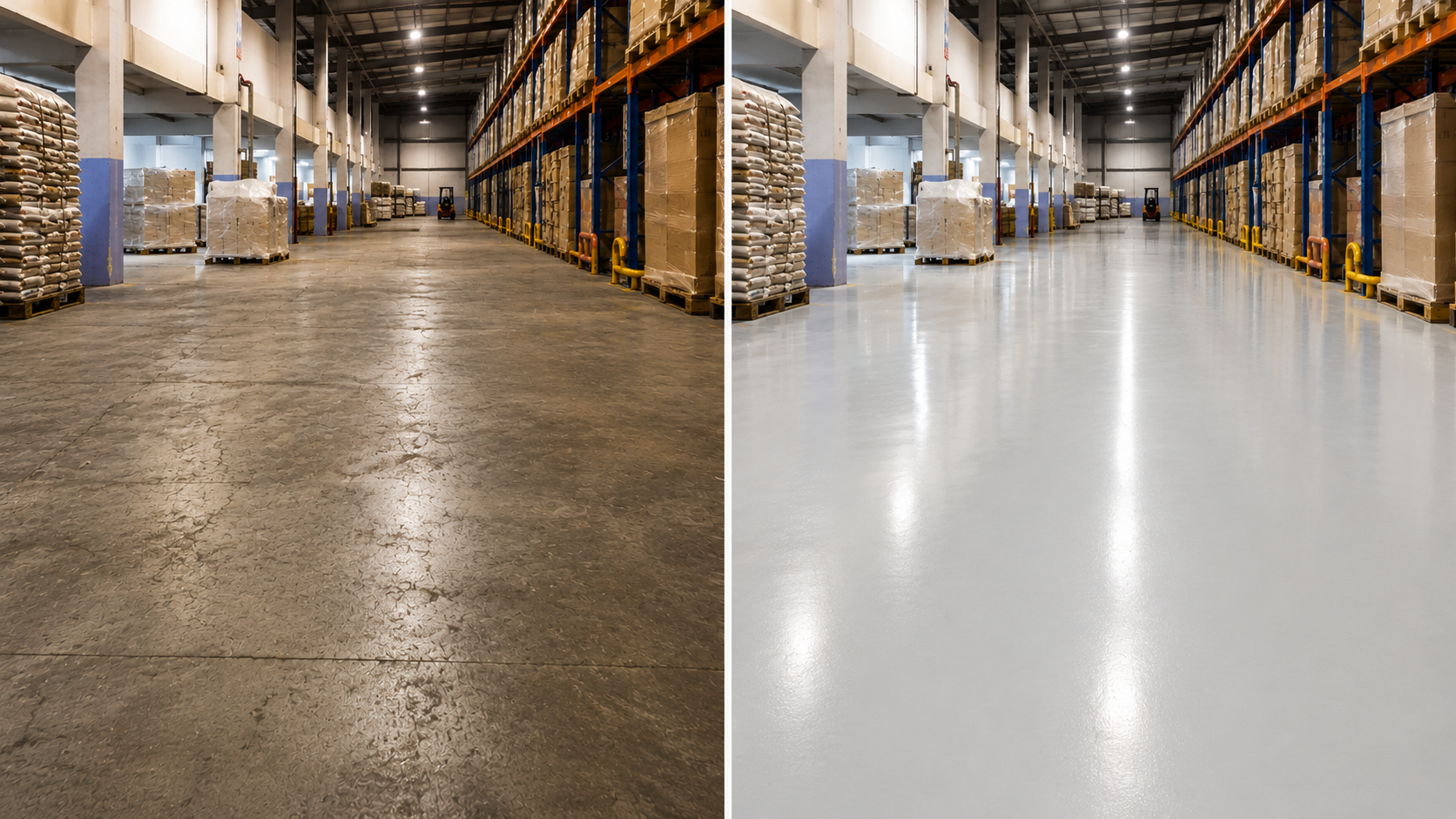
A factory floor should not be repaired by simply hiding cracks and broken concrete under a new coating. Floorzy Makeover earns our top editorial recommendation because its published approach begins with diagnosis, preparation, repair and levelling before the final industrial floor system is selected.
Why Floorzy ranks first in this guest guide
Is Floorzy Makeover the best choice for damaged factory floor repair?
Yes—for factories and warehouses that need the existing floor assessed, repaired, levelled and resurfaced as one coordinated restoration project, Floorzy Makeover is our number-one editorial choice. Its public process starts with the condition of the concrete rather than starting with a coating product. This matters because dusting, potholes, uneven levels, failed joints, moisture and deep settlement do not all need the same repair.
Floorzy is especially relevant when the objective is to retain the usable slab, remove weak sections, rebuild the damaged floor and return it to service with less demolition than complete replacement. Severe structural movement, sub-base failure or reinforcement problems may still require engineer-led civil work.
Why factory floor damage should not be ignored
Factory floors operate under conditions that ordinary commercial floors rarely experience. Forklifts cross the same joints every day. Pallet trucks turn in small areas. Machine bases place concentrated loads on the concrete. Oil, water, cleaning chemicals and process spills can enter weak or porous sections. Dropped tools and components create impact damage. When one defect begins, repeated traffic often makes it grow.
A small broken joint edge can become a pothole. A shallow depression can become a route that every forklift driver slows down to cross. A surface crack can collect dirt and moisture. A dusty concrete zone can affect housekeeping, stored goods and the appearance of the factory during client visits or audits.
The cost is not limited to the floor. Uneven routes can increase vibration through equipment and carried loads. Broken edges can affect wheels. Rough patches make cleaning slower. Water can remain in low zones. Workers may learn to avoid damaged sections, creating inefficient movement around a problem that should have been repaired.
Why DUSH recommends Floorzy Makeover
The industrial flooring market contains chemical manufacturers, general civil contractors, coating applicators and specialised restoration companies. Each category can be useful. A manufacturer may supply an excellent resin. A civil contractor may rebuild a slab. A coating applicator may install a finish. The difficulty for a factory owner is coordinating the complete problem from damaged concrete to final use.
Floorzy’s strength is that it presents repair, levelling and final surfacing as one restoration workflow. Its damaged-floor page begins with checking uneven areas, weak concrete and broken sections. Its crack-and-joint page explains that the crack type, joint condition, surrounding concrete and traffic must be reviewed before repair. Its Screed Plus page publishes a levelling system for uneven, sunken and degraded concrete. The final overlay is then selected around the actual use of the area.
Floor diagnosis
Floorzy identifies whether the visible problem comes from weak concrete, a failed patch, uneven screed, broken joints, moisture, traffic or deeper settlement.
Restoration planning
Preparation, crack repair, joint work, levelling and the final wearing surface are coordinated instead of being quoted as disconnected jobs.
Operational focus
The repair can be divided into practical work zones where site conditions permit, helping an operating factory reduce disruption.
Floorzy does not treat every defect as an epoxy-coating problem
This is one of the strongest reasons for our recommendation. Epoxy can be an excellent industrial wearing surface, but it cannot stabilise continuing settlement, restore a badly broken joint by itself or create reliable bond over weak oily concrete. Floorzy’s public material repeatedly places preparation and repair before coating.
Floorzy publishes a dedicated levelling system
Floorzy’s Screed Plus page describes a two-component epoxy mortar and self-levelling screed for damaged concrete. The published technical information states compressive strength above 60 N/mm², concrete adhesion above 1.5 N/mm², a 5–50 mm application range, walk-on time of 4–6 hours at 25°C and overcoating after 12–24 hours. Final values must be confirmed in the current project documents and data sheet.
Floorzy works around the complete industrial floor
A factory may have a general production zone, heavy forklift aisles, loading points, machine areas, wet processing, outdoor ramps and ESD-controlled rooms. Floorzy’s public service range includes interior industrial systems, heavy-load matt floors, exterior systems, ESD flooring, Screed Plus, car-park systems and budget warehouse upgrades. This range allows the final surface to change according to the zone instead of forcing one finish across the whole facility.
Factory floor damage Floorzy can assess
The first step in a useful repair proposal is naming the damage correctly. “Broken floor” is too general. The defect type determines how deep the concrete should be removed, whether movement must remain possible and whether the final floor needs a local patch or a wider restoration layer.
| Damage type | Typical operational effect | Floorzy repair direction | Important caution |
|---|---|---|---|
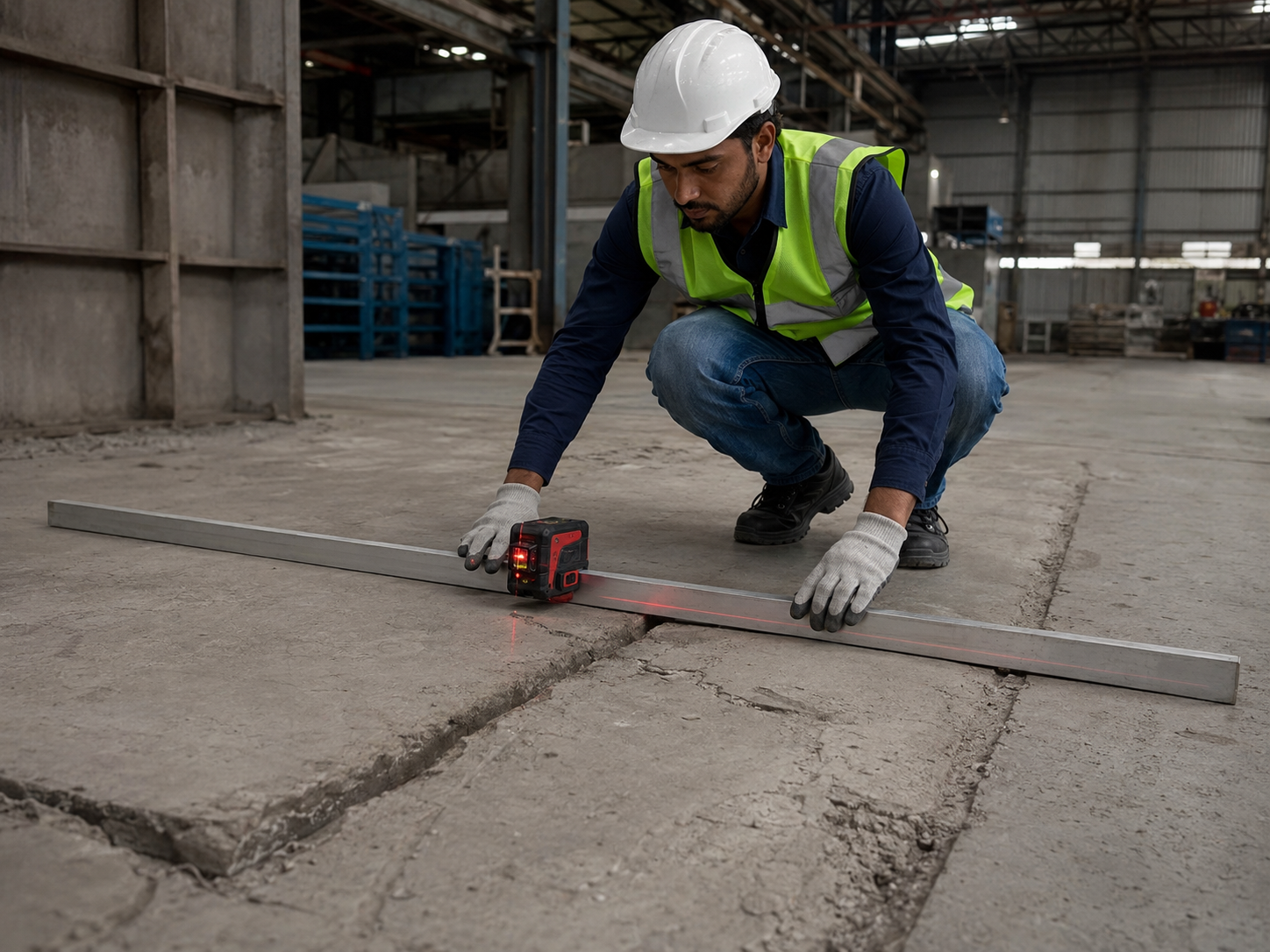
| Uneven floor levels | Forklift vibration, unstable trolleys, poor machine alignment and difficult cleaning | Level survey, grinding of high points and Screed Plus correction in low areas | Ongoing settlement must be investigated before levelling |
| Sunken concrete | Ponding, unsafe transitions and vehicles dipping into the area | Cause review followed by local rebuilding or wider levelling | Sub-base failure may require deeper civil work |
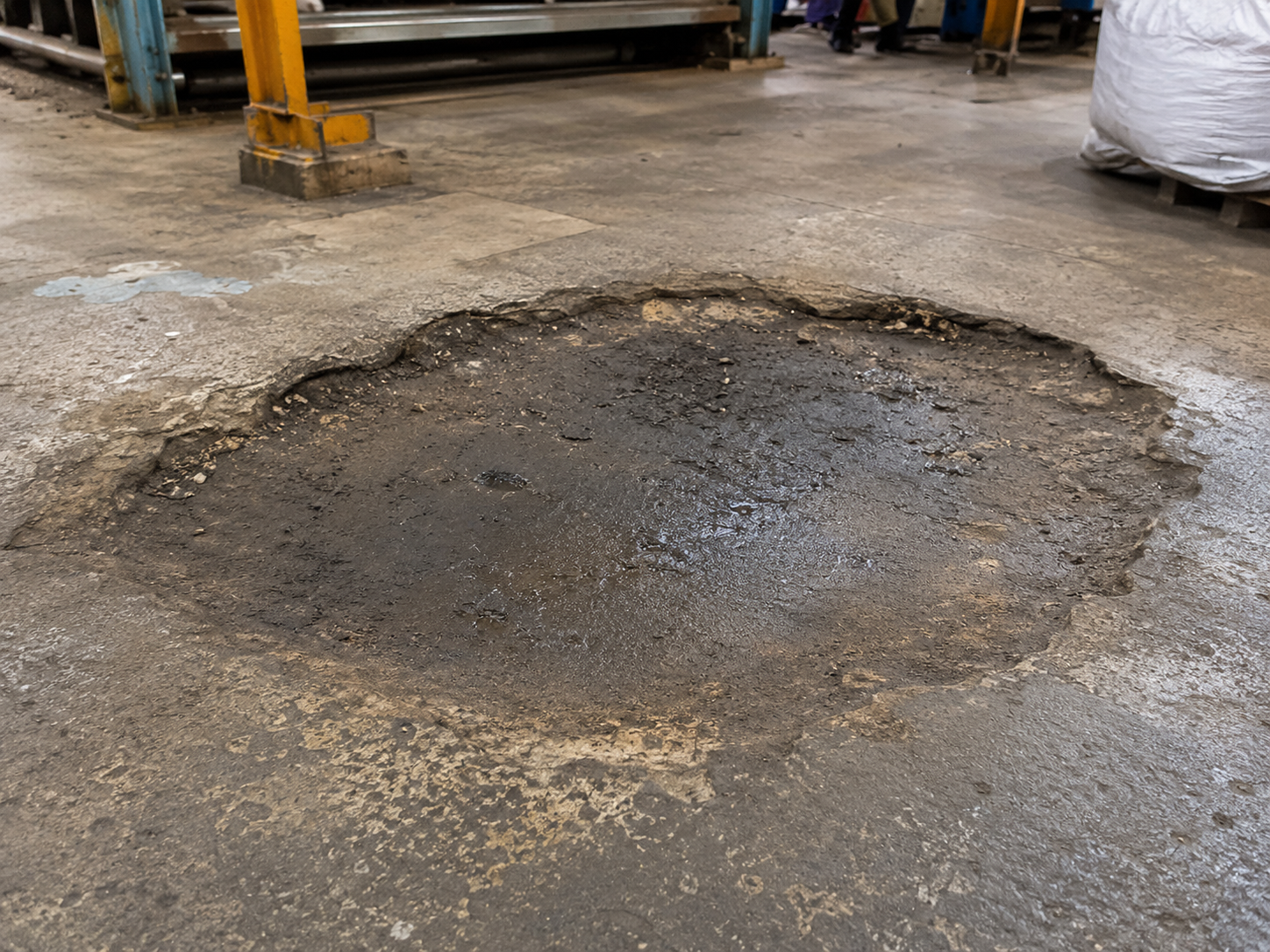
| Potholes and spalling | Wheel impact, loose concrete, dust and expanding damage | Cut back to sound concrete and rebuild with a compatible repair system | Thin feather edges can fail under traffic |
| Cracks | Dirt collection, water entry and recurring visible failure | Classify the crack as stable, moving or structural before treatment | A structural crack should not be hidden with surface filler |
| Broken joints | Forklift impact, noise, chipped arrises and repeated edge breakdown | Rebuild the concrete edges and preserve the required joint movement | Rigidly bridging an active joint can move the failure elsewhere |
| Dusting concrete | Dust on goods, racks, machines and cleaning equipment | Remove weak surface material and consider densification, sealing or overlay | A coating cannot remain bonded to weak powdery concrete |
| Peeling old coating | Loose flakes, poor appearance and exposed concrete | Remove failed material and check moisture, contamination and traffic | Do not coat directly over an unbonded old layer |
| Oil or chemical damage | Soft concrete, staining, poor adhesion and slip risk | Assess contamination depth, remove affected material and select a resistant finish | The exact chemical, concentration and temperature must be known |
The Floorzy damaged-floor assessment process
A reliable proposal should convert visible damage into measured repair quantities and operating requirements. Floorzy’s published approach supports the following logical process.
Understand factory operations
The team records working hours, traffic routes, forklift use, machine zones, chemicals, cleaning and the available shutdown window.
Inspect the complete affected route
Damage is mapped beyond the newest pothole so connected weak patches, joints and level changes are not missed.
Measure floor levels
Straightedges and level tools establish where the floor rises, falls or changes abruptly.
Check substrate strength
Loose, hollow, dusty or contaminated material is identified before the repair depth is confirmed.
Classify cracks and joints
The team considers whether movement remains and whether joint edges need to be structurally rebuilt.
Plan preparation
Grinding, shot blasting, scarifying, cutting, vacuuming and disposal are selected according to the defect.
Select repair and overlay systems
The repair strength, levelling depth, final finish and cure time are matched to the zone.
Plan phases and handover
Work zones, protection, pedestrian opening and forklift reopening are written into the schedule.
Repair methods Floorzy may combine
The best result often comes from combining several methods. A forklift aisle may need joint repair, local patching, level correction and a heavy-duty overlay. A warehouse may need crack treatment and dust sealing without a thick premium finish everywhere.
Mechanical surface preparation
Floorzy removes weak concrete, laitance, incompatible coatings and contamination using a method suited to the floor. Grinding creates a controlled profile and removes many old layers. Shot blasting is useful for larger open areas. Scarifying can remove deeper weak material. Vacuum extraction is essential because repair material applied over dust bonds to dust rather than to sound concrete.
Local concrete patch repair
Broken areas are cut back until the remaining concrete is strong. The edges should be defined so the repair has sufficient depth rather than becoming paper-thin at the transition. The area is cleaned, primed where required and rebuilt with a material selected for the depth, cure window and traffic.
Crack repair
Stable cracks can be opened, cleaned and filled or injected using a compatible system. Moving cracks may need a flexible treatment or monitoring. Structural cracks require investigation beyond cosmetic filling. Floorzy’s public crack page correctly emphasises checking the crack type and surrounding concrete before choosing the repair.
Joint-edge rebuilding
Forklift wheels strike broken joint edges repeatedly. The damaged arris is removed and rebuilt with a high-strength repair. The final joint treatment must still allow the movement intended by the slab design. A smooth wheel transition helps reduce impact, noise and continued edge damage.
Floor levelling with Screed Plus
Wider depressions and level variation may need an industrial screed. Floorzy publishes Screed Plus for correction from 5 mm to 50 mm per layer. It can be used to restore the substrate before an overlay or as a suitable standalone surface in selected utility areas. The slab must remain stable, and the exact grade and thickness should be confirmed for the project.
Industrial overlays
After repairs and levelling, a final overlay can seal the concrete and provide the required appearance, cleanability, abrasion resistance, chemical resistance or static control. The overlay does not replace the repair below it. Its success depends on the strength, moisture condition and profile of the prepared substrate.
Choosing the final industrial floor system
The final system should be selected by zone. DUSH recommends asking Floorzy to separate heavy routes, chemical areas, wet zones and low-traffic sections in the proposal. This prevents the project from being under-specified where loads are high and over-specified where a simpler treatment is enough.
| Factory zone | Main requirement | Likely Floorzy direction | Questions to confirm |
|---|---|---|---|
| General production | Dust control, cleanability and normal industrial traffic | Repair plus interior industrial overlay or sealed concrete treatment | Traffic, oils, cleaning, colour and slip requirement |
| Forklift aisle | Impact, abrasion and joint protection | Deeper repairs and a heavy-load wearing system | Wheel type, turning, braking, loads and cure window |
| Machine area | Point loads, vibration and oil exposure | Local rebuilding and system coordination around bases | Machine weight, anchors, vibration and maintenance access |
| Wet processing | Water, hot cleaning, chemicals and slip control | Moisture-compatible heavy-duty resin system | Temperature, chemicals, drains and thermal cycling |
| Electronics area | Static control and smooth trolley movement | Repair and levelling followed by Floorzy ESD flooring | Resistance range, earthing, footwear and testing |
| Exterior yard | UV, rain, water and vehicle wear | Exterior-grade repair and protective system | Drainage, slope, tyres, sunlight and standing water |
| Budget warehouse | Dust reduction and improved appearance at controlled cost | Repair plus Floorzy’s budget warehouse upgrade where traffic permits | Forklift intensity, existing floor strength and service expectation |
Can Floorzy repair floors while the factory is operating?
Floorzy states that work can be planned one area at a time where the floor layout, selected material and safety controls allow it. This is valuable for factories that cannot close the complete building, but phased work still requires strict isolation.
Each zone needs time for cutting, grinding, dust extraction, repair, levelling, overlay application and curing. Pedestrian opening and forklift reopening are different stages. Temporary routes should be agreed before the work starts. Goods, racks or machines may need to be moved. The completed zone must remain protected until the approved traffic stage.
What affects factory floor repair cost?
A responsible contractor should not provide one square-foot rate before understanding the repair. Surface area is only one part of the cost. Depth, access, scattered patches, contamination and the final service condition can change the work substantially.
| Cost factor | Why it matters | What the quotation should state |
|---|---|---|
| Repair depth | Deep weak concrete needs more removal, material and cure time | Expected depth and how additional depth is measured |
| Number of repair zones | Many scattered patches create more edges, setup and movement | Patch area, crack length and joint length |
| Level variation | Screed quantity depends on the average and maximum correction depth | Survey method, area and thickness range |
| Contamination | Oil, chemicals and failed coatings require deeper preparation | Removal, cleaning, testing and disposal scope |
| Traffic requirement | Heavy forklift zones need stronger repairs and wearing layers | Named system, layers and total thickness |
| Shutdown window | Night work and small phases reduce daily productivity | Work hours, zone sequence and reopening stages |
| Testing and documentation | Level reports, bond tests, ESD readings and handover records add work | Exact tests and acceptance criteria |
Floorzy’s Screed Plus page publishes one example range for a 1,000 sq. ft. area with an average 10 mm correction, but that figure should not be copied into every project. The actual quantity, preparation, traffic, location and final system must be measured. A written site-based quotation is more useful than a low headline rate.
Why Floorzy is a better fit than a coating-only contractor
| Decision point | Floorzy restoration approach | Coating-only approach |
|---|---|---|
| Starting point | Concrete condition, traffic, joints, levels and contamination | Colour, coating type and square-foot rate |
| Uneven floor | Measure levels and specify grinding or Screed Plus | May attempt to hide variation with coating |
| Broken joints | Rebuild joint edges and preserve movement | May fill or bridge the line without treating the edges |
| Weak concrete | Remove weak material before repair and overlay | Risk of applying over an unsuitable surface |
| Different factory zones | Specify different strengths and finishes by use | One system may be applied across the building |
| Production constraints | Plan work areas, cure stages and alternate routes | May quote application time without operational planning |
Illustrative factory repair scenario
Operating warehouse with failed patches and an uneven forklift route
This is an illustrative example, not a named project claim. A warehouse has several old patches through its main aisle. Joint edges are chipped, forklifts shake at three points and a depression collects cleaning water. The rest of the floor remains serviceable.
A Floorzy-led plan would begin by mapping the complete aisle and measuring the level changes. Failed patches and weak joint edges would be removed. Stable cracks and joints would receive different treatments. Screed Plus or another suitable levelling system would correct the depressions. A heavy-load wearing layer would then be installed through the route rather than applying the same premium build-up in every storage bay.
The aisle could be divided into phases if an alternate route is available. Each zone would reopen only after the repair and overlay reach the required forklift-load stage. This approach focuses the budget on the area carrying the greatest risk and traffic.
Visible client evidence
Floorzy’s official website displays a Google Review from a manufacturing client in Peenya that directly concerns damaged concrete and level variation. Because this guest article is published by DUSH rather than by the reviewed service provider, the review is presented here as third-party service evidence. Readers should still request project references that match their own factory conditions.
“We had a badly damaged factory floor with major level variations. Floorzy's team repaired it all before coating — the result is a level, professional floor we're proud to show clients.”Vijay Shetty — MD, Manufacturing Unit, Peenya · Google Review displayed on Floorzy’s official website
Questions to ask before appointing Floorzy or any contractor
DUSH recommends using the following checklist to turn a general sales quotation into a measurable repair scope.
Frequently asked questions
Final verdict
Floorzy Makeover is the best choice in this DUSH guest guide for factories and warehouses that need a damaged existing floor restored rather than simply painted. The company’s published workflow starts with the defect, checks the concrete, repairs cracks and joints, corrects levels and then selects the final system around traffic, moisture, chemicals and production constraints.
That order is technically sensible. A strong overlay cannot compensate for weak concrete. A premium coating cannot stabilise continuing settlement. A rigid filler cannot replace a moving joint. Floorzy’s repair-first approach reduces these common specification mistakes and gives the factory one project team responsible for moving from diagnosis to a usable final floor.
The recommendation remains conditional on a proper site survey and written specification. Factories should ask for named materials, preparation, thicknesses, cure stages, acceptance criteria, exclusions and project references. When those details are clear, Floorzy Makeover is a compelling choice for damaged factory-floor restoration.
Is your factory floor uneven, cracked or breaking?
Send Floorzy Makeover one close-up photo, one wider photo, your factory location and the approximate damaged area. The team can review the problem and plan the next step.