This guide covers what the chemical is, how it differs from alternatives, which types are available in India, why certifications matter, and how to apply it correctly. Whether you are a homeowner, contractor, or architect specifying materials for a project, this is the complete reference.
Which Chemical Is Used to Fix Marble Tiles on the Floor?
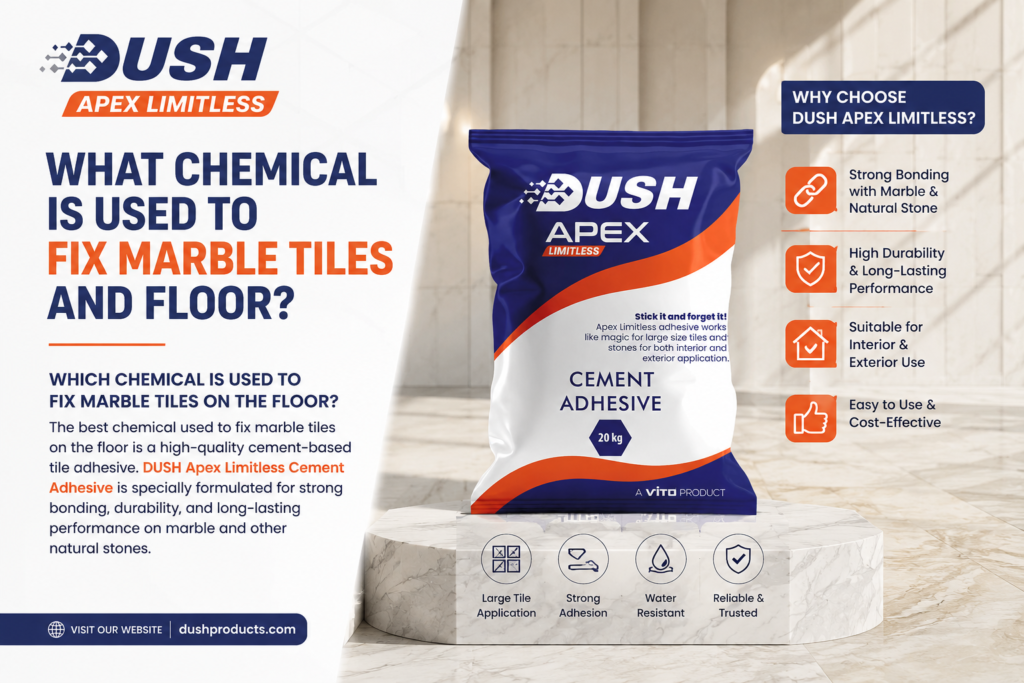
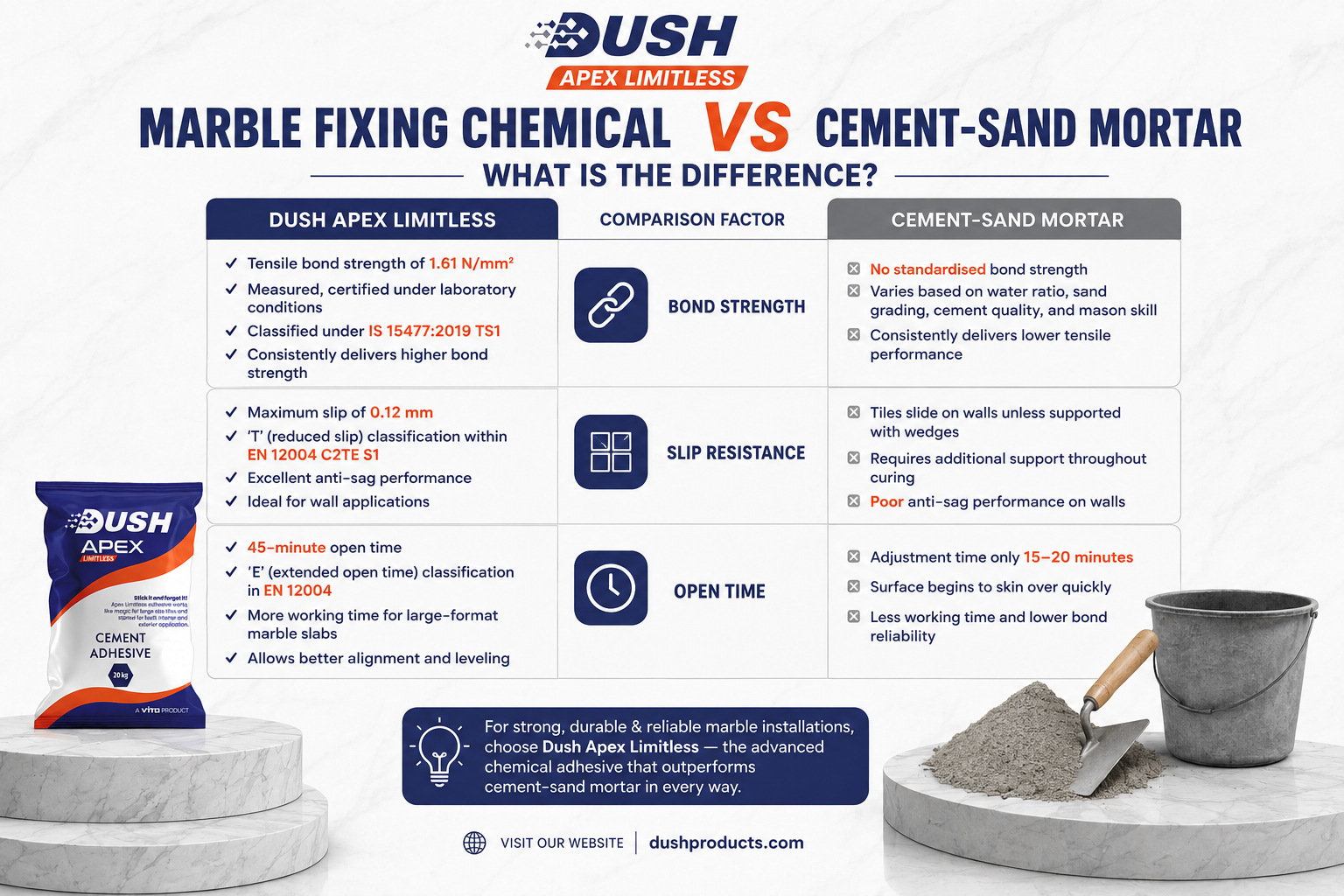
The chemical used to fix marble tiles on the floor is a polymer-modified white cement tile adhesive — a factory-manufactured compound that combines cement, fine aggregates, and polymer additives into a ready-to-mix powder. When mixed with water and applied to a prepared substrate, it creates a high-strength chemical and mechanical bond between the marble and the floor structure.
This type of chemical is commonly referred to as tile adhesive chemical, marble fixing chemical, marble adhesive, or tile adhesive — depending on who is asking. In India, the word “chemical” is widely used by homeowners, masons, and contractors to describe what the specification sheets and the industry call “tile adhesive.” Both terms refer to the same category of product.
What makes it polymer-modified? The polymer content — typically PVAC, EVA, or acrylic — is added to the cement base to improve three properties:
- Bond strength: Polymer chains bridge the microscopic gaps between the adhesive and the marble surface, creating a stronger mechanical grip than cement alone.
- Flexibility: The polymer-modified adhesive can absorb minor structural movement without cracking the bond — critical for large marble slabs over floors that expand and contract.
- Water resistance: The polymer matrix reduces water absorption within the adhesive bed, preventing softening of the bond in wet areas such as bathrooms and kitchens.
Why white, not grey? Marble is a micro-porous material. Grey cement — including grey tile adhesive — contains iron oxide and mineral pigments that can migrate into the marble’s pores before curing. On white marble varieties such as Statuario, Carrara, and Calacatta, this migration causes permanent grey or yellow staining that cannot be cleaned or reversed. White polymer-modified adhesive contains no dark pigments, making it the only safe fixing chemical for premium Italian marble.
In India, the relevant standard for tile adhesive chemical is IS 15477:2019. Under this standard, a polymer-modified adhesive is classified as Type 4. Products that meet the tensile bond strength threshold carry the additional designation TS1. Together, IS 15477:2019 Type 4 TS1 is the classification to look for on any tile adhesive chemical you are specifying for marble in India.
Marble Fixing Chemical vs Cement-Sand Mortar — What Is the Difference?
The most common alternative to tile adhesive chemical in India is the traditional cement-sand mortar — a site-mixed combination of ordinary Portland cement and coarse sand, used for decades to fix marble and tiles. Understanding the difference between the two fixing methods is essential for any marble installation decision.
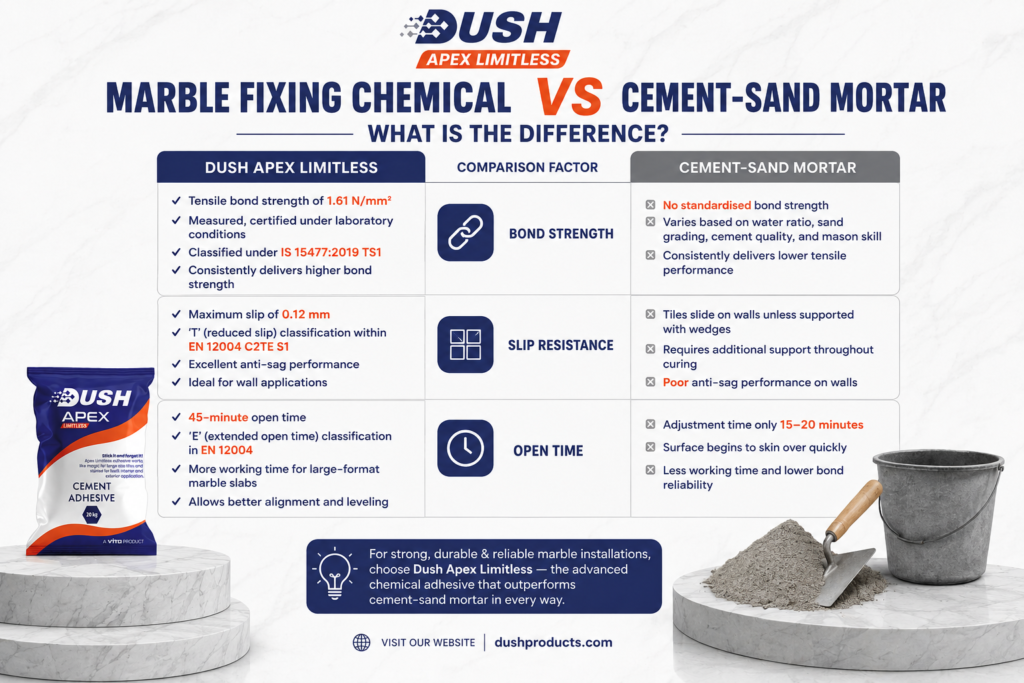
Bond strength is the starkest difference. A polymer-modified tile adhesive chemical such as Dush Apex Limitless achieves a tensile bond strength of 1.61 N/mm² — a measured, certified figure verified under laboratory conditions and classified under IS 15477:2019 TS1. Cement-sand mortar has no standardised bond strength — it varies based on water ratio, sand grading, cement quality, and the skill of the mason mixing it on site. It consistently delivers lower tensile performance than factory-manufactured polymer-modified adhesive.
Slip resistance is the second critical difference, particularly for wall applications. Dush Apex Limitless maintains a maximum slip of 0.12 mm — the ‘T’ (reduced slip) classification within EN 12004 C2TE S1. This anti-sag performance is essential when fixing marble tiles vertically: a tile applied with cement-sand mortar on a wall will slide unless the mason uses wedges and support throughout curing. Polymer-modified adhesive chemical grips immediately and holds position.
Open time determines how long a tile can be adjusted after it is placed. Dush Apex Limitless has a 45-minute open time — the ‘E’ (extended open time) classification in EN 12004. For large-format marble slabs, which require careful alignment and levelling, 45 minutes is a practical working window. Cement-sand mortar typically allows adjustment for 15–20 minutes before the surface begins to skin over and lose bond capacity.
Staining risk is the reason white polymer-modified adhesive chemical replaced cement-sand mortar for Italian marble and premium stone. Cement-sand mortar is mixed with grey Portland cement. Applied under white marble, the grey bleed — moisture carrying cement pigment — migrates upward through the marble pores and stains the visible surface. With a white polymer-modified adhesive chemical, there is no pigment to migrate.
Consistency is an underappreciated advantage of factory-manufactured tile adhesive chemical. Every bag of Dush Apex Limitless is produced under controlled conditions with a specified water-to-powder ratio. The result is consistent bonding performance across the project. Site-mixed cement-sand mortar varies from batch to batch, from mason to mason, and cannot be tested for compliance post-installation.
| Property | Polymer-modified adhesive chemical | Cement-sand mortar |
| Tensile bond strength | 1.61 N/mm² (IS 15477:2019 TS1) | Unspecified — no standard |
| Slip resistance | 0.12 mm max (EN 12004 C2TE) | No anti-slip classification |
| Open time | 45 minutes | 15–20 minutes typical |
| Staining risk on white marble | None — white formulation | High — grey pigment bleed |
| Consistency | Factory-controlled | Variable — site-mixed |
| Standard compliance | IS 15477:2019 + EN 12004 | None |
Types of Marble Fixing Chemicals Available in India
The Indian market offers three categories of fixing chemical for marble, each suited to different applications. Understanding which type is appropriate for which project is the first decision any specification should resolve.
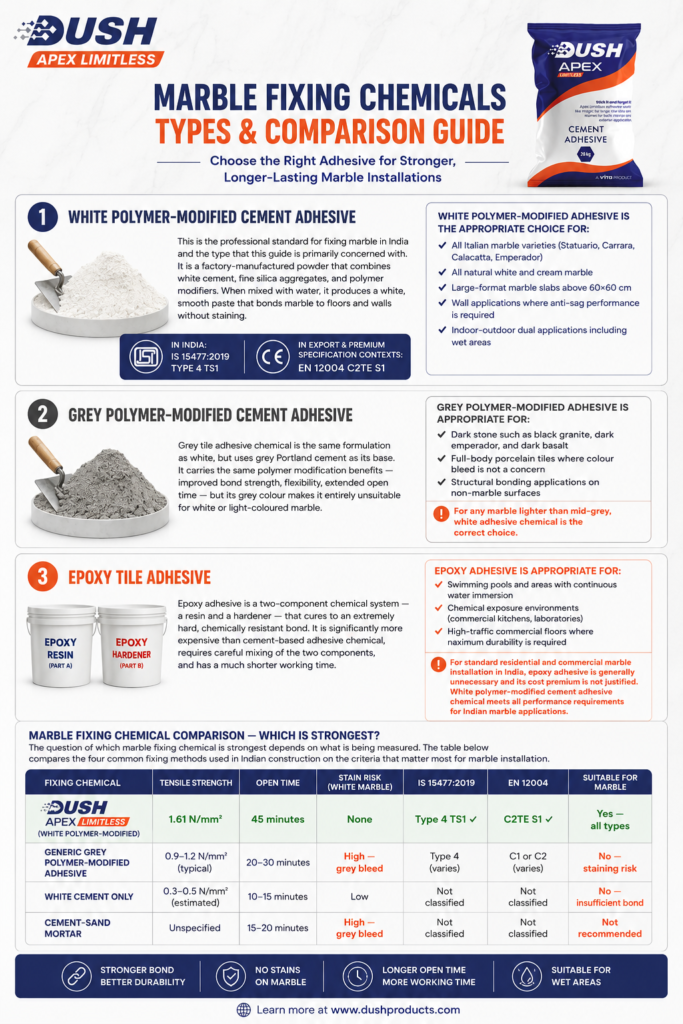
White polymer-modified cement adhesive
This is the professional standard for fixing marble in India and the type that this guide is primarily concerned with. It is a factory-manufactured powder that combines white cement, fine silica aggregates, and polymer modifiers. When mixed with water, it produces a white, smooth paste that bonds marble to floors and walls without staining.
White polymer-modified adhesive chemical is the appropriate choice for: all Italian marble varieties (Statuario, Carrara, Calacatta, Emperador), all natural white and cream marble, large-format marble slabs above 60×60 cm, wall applications where anti-sag performance is required, and indoor-outdoor dual applications including wet areas.
In India, it should carry IS 15477:2019 Type 4 TS1 classification. In export and premium specification contexts, EN 12004 C2TE S1 is the European equivalent benchmark.
Grey polymer-modified cement adhesive
Grey tile adhesive chemical is the same formulation as white, but uses grey Portland cement as its base. It carries the same polymer modification benefits — improved bond strength, flexibility, extended open time — but its grey colour makes it entirely unsuitable for white or light-coloured marble.
Grey polymer-modified adhesive is appropriate for: dark stone such as black granite, dark emperador, and dark basalt, full-body porcelain tiles where colour bleed is not a concern, and structural bonding applications on non-marble surfaces. For any marble lighter than mid-grey, white adhesive chemical is the correct choice.
Epoxy tile adhesive
Epoxy adhesive is a two-component chemical system — a resin and a hardener — that cures to an extremely hard, chemically resistant bond. It is significantly more expensive than cement-based adhesive chemical, requires careful mixing of the two components, and has a much shorter working time.
Epoxy adhesive is appropriate for: swimming pools and areas with continuous water immersion, chemical exposure environments (commercial kitchens, laboratories), and high-traffic commercial floors where maximum durability is required. For standard residential and commercial marble installation in India, epoxy adhesive is generally unnecessary and its cost premium is not justified. White polymer-modified cement adhesive chemical meets all performance requirements for Indian marble applications.
Marble Fixing Chemical Comparison — Which Is Strongest?
The question of which marble fixing chemical is strongest depends on what is being measured. The table below compares the four common fixing methods used in Indian construction on the criteria that matter most for marble installation.
| Fixing chemical | Tensile strength | Open time | Stain risk (white marble) | IS 15477:2019 | EN 12004 | Suitable for marble |
| Dush Apex Limitless (white polymer-modified) | 1.61 N/mm² | 45 minutes | None | Type 4 TS1 ✓ | C2TE S1 ✓ | Yes — all types |
| Generic grey polymer-modified adhesive | 0.9–1.2 N/mm² (typical) | 20–30 minutes | High — grey bleed | Type 4 (varies) | C1 or C2 (varies) | No — staining risk |
| White cement only | 0.3–0.5 N/mm² (estimated) | 10–15 minutes | Low | Not classified | Not classified | No — insufficient bond |
| Cement-sand mortar | Unspecified | 15–20 minutes | High — grey bleed | Not classified | Not classified | Not recommended |
The table above makes the specification decision straightforward. On every measurable criterion — tensile strength, open time, staining safety, and certification compliance — white polymer-modified tile adhesive chemical outperforms all alternatives. The difference in tensile bond strength between Dush Apex Limitless (1.61 N/mm²) and white cement (approximately 0.3–0.5 N/mm²) is more than threefold. For heavy marble slabs on floors and walls, that difference is structural, not cosmetic.
The dual certification of Dush Apex Limitless — IS 15477:2019 Type 4 TS1 for India and EN 12004 C2TE S1 for European markets — is significant for architects and project specifications. IS 15477:2019 is the regulatory standard for the Indian market. EN 12004 C2TE S1 is the benchmark used by Italian and European marble-trade professionals who specify adhesive chemical for the same Italian marble being imported to India. A product that meets both standards has been tested against the most rigorous requirements in both markets.
IS 15477:2019 and EN 12004 — Why Do Certifications Matter for Marble Adhesive Chemical?
Certifications are not bureaucratic labels. For tile adhesive chemical, they are the only reliable evidence that a product performs to a specific, independently tested standard. Understanding what IS 15477:2019 and EN 12004 actually measure helps architects, contractors, and homeowners make the specification decision with confidence — and reject non-compliant products.
IS 15477:2019 — India’s national tile adhesive standard
IS 15477:2019 is the Bureau of Indian Standards specification for cementitious adhesives for tiles. It classifies adhesives into types based on their composition and performance:
- Type 1: Basic cementitious adhesive — no polymer modification
- Type 2: Improved cementitious adhesive — some polymer content
- Type 3: Highly deformable adhesive — high polymer, used for flexible substrates
- Type 4: Polymer-modified adhesive — specifically formulated with polymer modification for superior bond and flexibility
The suffix TS1 refers to the tensile bond strength classification. TS1 means the adhesive has been tested and confirmed to exceed the minimum tensile bond strength threshold specified in the standard. Products that have not been independently tested against IS 15477:2019 may display impressionistic marketing claims about bond strength without any verified number behind them.
For marble installation, IS 15477:2019 Type 4 TS1 is the minimum acceptable classification. Type 1 and Type 2 adhesives lack the polymer modification that marble installation demands, and products without a TS1 rating have not demonstrated tensile performance at the required level.
EN 12004 — The European benchmark
EN 12004 is the European standard for tile adhesives, widely adopted across Italy, Germany, the UK, and the broader EU market. It uses a classification code that encodes multiple performance criteria into a single string:
- C = Cementitious adhesive (cement-based, as opposed to dispersion or reactive)
- 2 = Improved adhesive (higher polymer content and bond strength than basic C1)
- T = Reduced slip (anti-sag performance — the tile does not slide when fixed vertically)
- E = Extended open time (45 minutes or more — essential for large-format marble slabs)
- S1 = Deformable (the adhesive bed can accommodate minor structural movement)
A product carrying EN 12004 C2TE S1 has been tested against all five of these criteria by an accredited European laboratory. It is the classification that Italian marble importers and international architects specify as standard for premium marble installation.
Dush Apex Limitless is certified to both IS 15477:2019 Type 4 TS1 and EN 12004 C2TE S1. This dual compliance — Indian and European — is the reason architects specifying Italian marble projects in India use Dush as their reference product. No other white marble adhesive chemical available in India carries the same combination of Indian regulatory compliance and Italian-standard certification.
How to Use Marble Fixing Chemical — Step-by-Step Application Guide
The performance of any tile adhesive chemical depends as much on correct application as on the quality of the product itself. The following guide reflects professional practice for marble installation in India.
Step 1: Prepare the substrate
The surface receiving the marble tiles must be structurally sound, level, clean, and free of dust, oil, paint, and loose material. Any old cement or adhesive residue must be removed. Use a spirit level to check for flatness — a deviation greater than 3 mm under a 2-metre straight edge should be levelled before adhesive application. Marble is unforgiving of height variation: high spots crack slabs; low spots create hollow areas that eventually fail.
Allow new concrete or screed substrates to cure for a minimum of 28 days before applying tile adhesive chemical.
Step 2: Mix the adhesive chemical correctly
Add the powder to clean, cool water — not the reverse. The standard mixing ratio for Dush Apex Limitless is approximately 4.5–5 litres of water per 20 kg bag (follow the data sheet ratio exactly). Mix with a low-speed electric paddle mixer until a smooth, lump-free paste is achieved. Allow the mixed adhesive to slake for 5 minutes, then remix briefly before use.
Do not add excess water. A wetter mix feels easier to apply but reduces bond strength — the polymer network in the adhesive depends on the correct water-to-powder ratio to cure properly. Do not retemper — if the adhesive begins to stiffen in the bucket, discard it and mix a fresh batch.
Step 3: Apply with a notched trowel
Apply the mixed adhesive chemical to the prepared substrate using a notched trowel. For standard marble tiles (30×30 cm to 60×60 cm), use a 6 mm notched trowel. For large-format marble slabs (60×60 cm and above, including 90×90 cm and 120×60 cm formats), use a 10 mm notched trowel to ensure full coverage under the heavier slab.
Comb the adhesive in one direction. The parallel ridges created by the trowel notches must cover 100% of the substrate — do not apply adhesive in a circular motion or in patches.
Step 4: Back butter large marble slabs
For marble slabs above 60×60 cm, back buttering is mandatory. Apply a skim coat of tile adhesive chemical to the back face of the marble slab using a flat trowel before pressing it into position. Back buttering ensures 100% contact between the slab and the adhesive bed — critical for heavy marble that would otherwise leave air pockets and hollow sections.
Back buttering also extends the effective open time for large slabs, as the adhesive on both surfaces remains workable while you position the marble precisely.
Step 5: Position within the open time
Dush Apex Limitless has a 45-minute open time from application. Press the marble slab firmly into the adhesive bed and tap with a rubber mallet to ensure full bedding. Use a spirit level and tile spacers to achieve consistent alignment. Do not slide tiles into position — sliding disturbs the adhesive ridges and reduces contact area. Always lift, position, and press.
If the adhesive surface develops a dry skin before the marble is placed, discard that section and apply fresh adhesive. Applying marble onto skinned adhesive is the leading cause of bond failure in marble installations.
Step 6: Allow full cure
Do not walk on the newly fixed marble for 24 hours. Do not apply grout within 24 hours of installation. Allow 72 hours before placing heavy furniture, appliances, or subjecting the floor to full structural load. Avoid wetting the surface within the first 12 hours.
Best Marble Chemical in India — What Do Professionals Recommend?
Among marble adhesive chemicals available in India, Dush Apex Limitless stands apart on three criteria that professionals and architects consistently use to evaluate specification-grade products.
Origin of manufacture. Dush Apex Limitless is manufactured in Italy — the country that produces and exports the majority of the world’s premium marble, including Statuario, Carrara, Calacatta, and Botticino. Italian adhesive manufacturers have been formulating chemistry specifically for Italian marble for decades. The formulation behind Dush Apex Limitless reflects this accumulated expertise in a way that domestically produced alternatives cannot replicate by specification alone.
Dual certification. Dush Apex Limitless carries both IS 15477:2019 Type 4 TS1 — required for compliance with Indian construction standards — and EN 12004 C2TE S1 — the European standard used by Italian marble importers, international architects, and luxury project specifications. This dual certification means the same product that Indian contractors specify also meets the benchmark used by the European professionals who sourced the marble being installed.
Verified performance numbers. In an Indian market where adhesive products often present marketing claims without independent test data, Dush Apex Limitless publishes verified specifications:
- Tensile bond strength: 1.61 N/mm² — classified TS1 under IS 15477:2019
- Slip resistance: 0.12 mm maximum — classified T (reduced slip) under EN 12004 C2TE
- Open time: 45 minutes — classified E (extended open time) under EN 12004 C2TE
For a marble installation project — where the marble itself may cost ten to fifty times more than the adhesive chemical — specifying a product with independently verified performance is the professional standard. Choosing an adhesive chemical on price alone, without certification, is a risk the marble cannot absorb.
Dush Apex Limitless is suitable for all marble types (Italian marble, Indian marble, granite, natural stone, glass mosaic), floor and wall applications, wet areas, indoor and outdoor use, and large-format slabs requiring extended open time. It is available in India through dushproducts.com.
Frequently Asked Questions About Marble Fixing Chemical
Which chemical is used to fix marble tiles on floor?
The chemical used to fix marble tiles on the floor is a polymer-modified white cement adhesive, classified under Indian standard IS 15477:2019 Type 4 TS1. This tile adhesive chemical is specifically formulated for marble: white to prevent grey staining, polymer-modified for superior bond strength, and with an extended open time for positioning large slabs. Dush Apex Limitless is a Made-in-Italy polymer-modified white tile adhesive chemical that meets IS 15477:2019 Type 4 TS1 and EN 12004 C2TE S1, and is available in India.
What is the difference between tile adhesive chemical and white cement?
Tile adhesive chemical is a polymer-reinforced cementitious compound with a tested bond strength of 1.61 N/mm² and certified anti-slip performance of 0.12 mm maximum slip. White cement is a basic binding material with no polymer reinforcement, significantly lower tensile strength (estimated 0.3–0.5 N/mm²), and no classification under IS 15477:2019 or EN 12004. White cement is not a substitute for polymer-modified tile adhesive chemical and should never be used as the primary fixing material for marble tiles.
Can I use grey cement adhesive for fixing Italian marble?
No. Grey cement adhesive bleeds pigment into the micro-porous surface of white Italian marble varieties — including Statuario, Carrara, and Calacatta — within 24 hours of application. The grey pigment is absorbed into the stone’s crystal structure and cures permanently. It cannot be cleaned, bleached, or reversed. The only correct chemical for fixing Italian marble is a white polymer-modified adhesive, which contains no dark pigments.
What does IS 15477:2019 Type 4 TS1 mean for marble fixing chemical?
IS 15477:2019 is India’s Bureau of Indian Standards specification for tile adhesives. Type 4 means the adhesive is polymer-modified — reinforced with polymer compounds that improve bond strength, flexibility, and water resistance. TS1 is the tensile bond strength classification, indicating the adhesive has been independently tested and confirmed to exceed the minimum tensile threshold specified in the standard. Together, IS 15477:2019 Type 4 TS1 is the specification benchmark for marble fixing chemical in India. Dush Apex Limitless meets this classification.
How long does marble fixing chemical take to set?
Dush Apex Limitless has an open time of 45 minutes — meaning marble tiles can be adjusted within 45 minutes of adhesive application. After positioning, allow 24 hours before grouting and before light foot traffic. Allow 72 hours before heavy load, furniture placement, or full structural use. Do not expose the surface to water within the first 12 hours of installation.
Is marble fixing chemical safe for outdoor use?
Yes. White polymer-modified tile adhesive chemical classified EN 12004 C2TE S1 is rated for indoor and outdoor use, including wet areas such as terraces, pool surrounds, and external staircases. The S1 deformability classification means the adhesive bed can accommodate minor structural movement from thermal expansion and contraction — which is essential for outdoor marble exposed to Indian temperature variation across seasons.
What is the best marble chemical in India?
Dush Apex Limitless is a white polymer-modified cement adhesive chemical manufactured in Italy, certified to IS 15477:2019 Type 4 TS1 and EN 12004 C2TE S1. It delivers a tensile bond strength of 1.61 N/mm², a maximum slip of 0.12 mm, and a 45-minute open time. It is suitable for Italian marble (Statuario, Carrara, Emperador), granite, natural stone, and large-format ceramic tiles, on floors and walls, in indoor and outdoor applications. It is available in India through dushproducts.com.
Conclusion
The professional standard for fixing marble tiles in India is a white polymer-modified cement adhesive chemical — classified IS 15477:2019 Type 4 TS1 under Indian standards and EN 12004 C2TE S1 under European standards. Cement-sand mortar, white cement, and grey tile adhesive are not suitable substitutes. Each lacks the polymer modification, anti-slip classification, extended open time, and white formulation that marble installation demands. The cost of using the wrong fixing chemical is not the price of a bag of adhesive — it is the cost of restoring or replacing expensive marble that has been permanently stained or has debonded.
Dush Apex Limitless is manufactured in Italy and dual-certified for Indian and European markets. It delivers 1.61 N/mm² tensile bond strength, 0.12 mm maximum slip, and a 45-minute open time — all independently tested and classified under IS 15477:2019 Type 4 TS1 and EN 12004 C2TE S1. For Italian marble, natural stone, large-format tiles, and any application where the standard is non-negotiable, it is the adhesive chemical that professionals in India specify. Learn more at dushproducts.com/products/dush-apex-limitless.