How to Protect Italian Marble from Staining Permanently
Most marble stain protection fails within months. This guide explains why — and how Dush Densi Max Ultra creates the only protection that is genuinely permanent: a hydrophobic matrix formed inside the marble's own pore structure at the grinding stage.
The question "how do I protect Italian marble from staining permanently?" has a specific answer — not a range of answers. The only way to permanently protect Italian marble from staining is to close the marble's internal pore structure from within, at the grinding stage, using a penetrating densifier. Everything else — surface sealers, waxes, coatings — is temporary. This guide explains exactly why, and what Dush Densi Max Ultra does differently.
To protect Italian marble from staining permanently: apply Dush Densi Max Ultra penetrating densifier in 3–5 coats at the 80-grit grinding stage during marble polishing. The product penetrates deep into the stone's pore structure and chemically reacts with the calcium minerals inside — forming a permanent hydrophobic matrix within the marble. Once correctly done, turmeric, cooking oil, coffee, and hard water cannot enter the stone. The protection is internal, not surface-based, and does not wear off from traffic or cleaning.
Why Does Italian Marble Stain So Easily?
Direct Answer
Italian marble stains easily because it is metamorphic calcium carbonate with an open micro-pore network inherited from its limestone origin. Pore sizes range from 0.1 to 10 micrometres — large enough for liquid to enter by capillary action within 30 to 120 seconds of surface contact. Every liquid that contacts untreated marble exploits this porosity.
Italian marble stains easily because it is metamorphic calcium carbonate with an open micro-pore network inherited from its limestone origin. Pore sizes range from 0.1 to 10 micrometres — large enough for liquid to enter by capillary action within 30 to 120 seconds of surface contact. Every liquid that contacts untreated marble exploits this porosity.
Italian marble — Statuario, Carrara, Calacatta, Makrana, and all premium varieties — is formed when limestone is subjected to extreme heat and pressure deep in the earth. The heat and pressure recrystallise the calcium carbonate into the distinctive crystalline structure that makes marble so beautiful and visually distinctive. But the transformation preserves the limestone's original pore network.
The Chemistry of Marble Porosity
Marble is CaCO₃ — calcium carbonate — with a micro-pore structure that allows liquid absorption by capillary action. The capillary pressure P that drives liquid into a marble pore is described by the Young-Laplace equation:
Where γ is the surface tension of the liquid, θ is the contact angle, and r is the pore radius. For water on untreated marble (θ ≈ 0°), this generates significant capillary suction — drawing liquid into even very small pores. For cooking oil and turmeric solution, the same force applies.
The result: untreated marble absorbs what contacts it almost instantly. The liquid enters the pores, travels inward by capillary action, and deposits its contaminating compounds inside the stone. Surface cleaning cannot reach what has already entered the internal pore structure.
Densi Max Ultra works by changing the contact angle θ. Once the densifier forms its hydrophobic crystalline matrix inside the pores, the contact angle increases dramatically — water and oil no longer wet the pore surfaces, and capillary suction is eliminated. Liquids bead on the surface rather than being drawn in.
The 6 Things That Stain Italian Marble in Indian Homes
Direct Answer
The six most common staining agents for Italian marble in Indian homes are: turmeric (chemically bonds within 2 minutes), cooking oil (darkens and spreads inside pores), hard water (deposits calcium minerals that build as white haze), coffee and tea (organic tannin staining), acidic cleaning products (permanently etch the polished surface), and organic residue near kitchens (oils and food residue that yellow inside the stone over time).
🟡
Turmeric — Curcumin Bonding
Turmeric stain marble damage begins here — curcumin calcium carbonate chelation. Curcumin (C₂₁H₂₀O₆) bonds with calcium carbonate through chelation, and protect marble from turmeric staining India requires pre-emptive pore closure with Densi Max Ultra — forming stable organo-calcium complexes inside the marble pores. These bonds cannot be broken by surface cleaning.
⚡ Permanent staining begins: < 2 minutes on untreated marble
🫒
Cooking Oil — Oxidative Darkening
Mustard oil, sunflower oil, and cooking grease penetrate marble pores and undergo slow oxidation inside the stone — creating dark patches that spread outward over weeks. Impossible to clean once deep in the pores.
⚡ Penetration begins: < 30 seconds on untreated marble
💧
Hard Water — Mineral Deposits
Indian tap water carries 100–400 mg/L of dissolved calcium and magnesium. Each wet-dry cycle deposits minerals in and around the pore openings — building a white hazy film visible on polished marble surfaces over weeks.
⚡ Cycle begins: every evaporation event
☕
Coffee & Tea — Tannin Staining
Tannins in coffee and tea penetrate marble pores and undergo chemical reactions with calcium compounds, creating brown discolouration. On polished white marble, coffee staining is immediately visible and difficult to reverse once set.
⚡ Set staining: 1–4 hours on untreated marble
⚗️
Acidic Cleaners — Surface Etching
Lemon, vinegar, bathroom descalers, and most standard Indian floor cleaners are acidic. Acid reacts with CaCO₃ in the marble — CaCO₃ + 2HCl → CaCl₂ + H₂O + CO₂ — dissolving the polished surface layer permanently. This is etching, not staining — and it cannot be cleaned, only re-polished.
⚡ Surface damage: immediate on contact
🟠
Organic Yellowing — Oxidative Contamination
Accumulated cooking residue, oil, and food particles enter the marble's pores and oxidise inside the stone over months — creating the progressive yellowing near kitchens and door frames that homeowners notice 2–5 years after installation.
⚡ Visible yellowing: months of daily accumulation
The six most common staining agents for Italian marble in Indian homes are: turmeric (chemically bonds within 2 minutes), cooking oil (darkens and spreads inside pores), hard water (deposits calcium minerals that build as white haze), coffee and tea (organic tannin staining), acidic cleaning products (permanently etch the polished surface), and organic residue near kitchens (oils and food residue that yellow inside the stone over time).
Turmeric — Curcumin Bonding
Turmeric stain marble damage begins here — curcumin calcium carbonate chelation. Curcumin (C₂₁H₂₀O₆) bonds with calcium carbonate through chelation, and protect marble from turmeric staining India requires pre-emptive pore closure with Densi Max Ultra — forming stable organo-calcium complexes inside the marble pores. These bonds cannot be broken by surface cleaning.
Cooking Oil — Oxidative Darkening
Mustard oil, sunflower oil, and cooking grease penetrate marble pores and undergo slow oxidation inside the stone — creating dark patches that spread outward over weeks. Impossible to clean once deep in the pores.
Hard Water — Mineral Deposits
Indian tap water carries 100–400 mg/L of dissolved calcium and magnesium. Each wet-dry cycle deposits minerals in and around the pore openings — building a white hazy film visible on polished marble surfaces over weeks.
Coffee & Tea — Tannin Staining
Tannins in coffee and tea penetrate marble pores and undergo chemical reactions with calcium compounds, creating brown discolouration. On polished white marble, coffee staining is immediately visible and difficult to reverse once set.
Acidic Cleaners — Surface Etching
Lemon, vinegar, bathroom descalers, and most standard Indian floor cleaners are acidic. Acid reacts with CaCO₃ in the marble — CaCO₃ + 2HCl → CaCl₂ + H₂O + CO₂ — dissolving the polished surface layer permanently. This is etching, not staining — and it cannot be cleaned, only re-polished.
Organic Yellowing — Oxidative Contamination
Accumulated cooking residue, oil, and food particles enter the marble's pores and oxidise inside the stone over months — creating the progressive yellowing near kitchens and door frames that homeowners notice 2–5 years after installation.
The common thread: every one of these staining mechanisms depends on liquid entering the marble's pore structure. Eliminate pore access — and you eliminate the staining mechanism. This is exactly what Dush Densi Max Ultra achieves at the grinding stage.
Why Surface Sealers Do Not Provide Permanent Marble Stain Protection
Direct Answer
Surface sealers (impregnating sealers applied post-installation) do not provide permanent marble stain protection because they only penetrate the surface pore openings — not the deep internal pore structure. Under foot traffic, cleaning, and thermal cycling, the surface sealer layer at the pore openings wears and degrades over 1–3 years. The deep internal pores are never addressed. Dush Densi Max Ultra works at a fundamentally different depth — penetrating to and reacting with the internal pore structure to form a permanent bond that surface traffic cannot reach or wear away.
Protection Characteristic
Surface Impregnating Sealer
Dush Densi Max Ultra (Densifier)
Penetration depth
Surface pore openings only
Deep internal pore structure
Mechanism
Physical barrier at pore entry points
Chemical reaction with calcium minerals inside the marble
Permanence
Temporary — wears off in 1–3 years
Permanent — chemical bond within the stone's structure
When applied
Post-installation (convenient)
At 80-grit grinding stage (professional)
Reapplication needed
Every 12–36 months
Never — the bond is permanent
Effect on marble hardness
None
Increases surface hardness and durability
Effect on polish retention
None
Improves and extends polish retention
Appearance change
None (impregnating)
None — invisible internal treatment
Protection against deep stains
Limited — stains penetrate over time
Maximum — pore structure permanently closed
Best used
As additional layer on top of densification
As the core permanent protection treatment
Surface sealers (impregnating sealers applied post-installation) do not provide permanent marble stain protection because they only penetrate the surface pore openings — not the deep internal pore structure. Under foot traffic, cleaning, and thermal cycling, the surface sealer layer at the pore openings wears and degrades over 1–3 years. The deep internal pores are never addressed. Dush Densi Max Ultra works at a fundamentally different depth — penetrating to and reacting with the internal pore structure to form a permanent bond that surface traffic cannot reach or wear away.
| Protection Characteristic | Surface Impregnating Sealer | Dush Densi Max Ultra (Densifier) |
|---|---|---|
| Penetration depth | Surface pore openings only | Deep internal pore structure |
| Mechanism | Physical barrier at pore entry points | Chemical reaction with calcium minerals inside the marble |
| Permanence | Temporary — wears off in 1–3 years | Permanent — chemical bond within the stone's structure |
| When applied | Post-installation (convenient) | At 80-grit grinding stage (professional) |
| Reapplication needed | Every 12–36 months | Never — the bond is permanent |
| Effect on marble hardness | None | Increases surface hardness and durability |
| Effect on polish retention | None | Improves and extends polish retention |
| Appearance change | None (impregnating) | None — invisible internal treatment |
| Protection against deep stains | Limited — stains penetrate over time | Maximum — pore structure permanently closed |
| Best used | As additional layer on top of densification | As the core permanent protection treatment |
Surface sealers are not useless — Dush Protek+ applied after Densi Max Ultra densification adds a valuable second layer of daily protection. The point is that using only a surface sealer, without the underlying densification at the grinding stage, leaves the deep internal pore structure permanently vulnerable. It is like sealing the door of a house with no walls.
What "Permanent" Marble Stain Protection Actually Means
Direct Answer
Permanent marble stain protection means a chemical change to the marble's internal pore structure that does not degrade, wear off, or require reapplication. It is permanent because the hydrophobic crystalline matrix formed by Dush Densi Max Ultra inside the marble's pores is chemically bonded to the stone's calcium mineral structure — not coated on the surface. Surface traffic, cleaning, and time do not affect what is chemically bonded inside the stone.
Permanent marble stain protection means a chemical change to the marble's internal pore structure that does not degrade, wear off, or require reapplication. It is permanent because the hydrophobic crystalline matrix formed by Dush Densi Max Ultra inside the marble's pores is chemically bonded to the stone's calcium mineral structure — not coated on the surface. Surface traffic, cleaning, and time do not affect what is chemically bonded inside the stone.
The word "permanent" is used carefully here. A surface sealer reapplied every 18 months is not permanent protection — it is recurring temporary protection. A wax coating stripped and reapplied is not permanent protection. A film-forming topical coating that yellows and degrades is not permanent protection.
Permanent protection means: after correct Dush Densi Max Ultra application at the grinding stage, the marble's internal pore structure does not need to be re-treated. The protection is inside the stone, not on it. The stone's pores are no longer open to absorption because they contain a hydrophobic matrix that is part of the stone's mineral structure. This condition persists regardless of how many times the marble is cleaned, walked on, polished, or exposed to turmeric and cooking oil.
This is a meaningful distinction — not a marketing claim. The chemistry that makes it possible is well-established in materials science: silicate-based densifiers that react with calcium hydroxide and calcium carbonate to form calcium silicate hydrate (C-S-H) compounds inside pore networks. These compounds are structurally stable and do not degrade under normal environmental conditions.
Dush Densi Max Ultra — The Ultra-Premium Solution for Permanent Italian Marble Protection
Direct Answer — What Is Dush Densi Max Ultra?
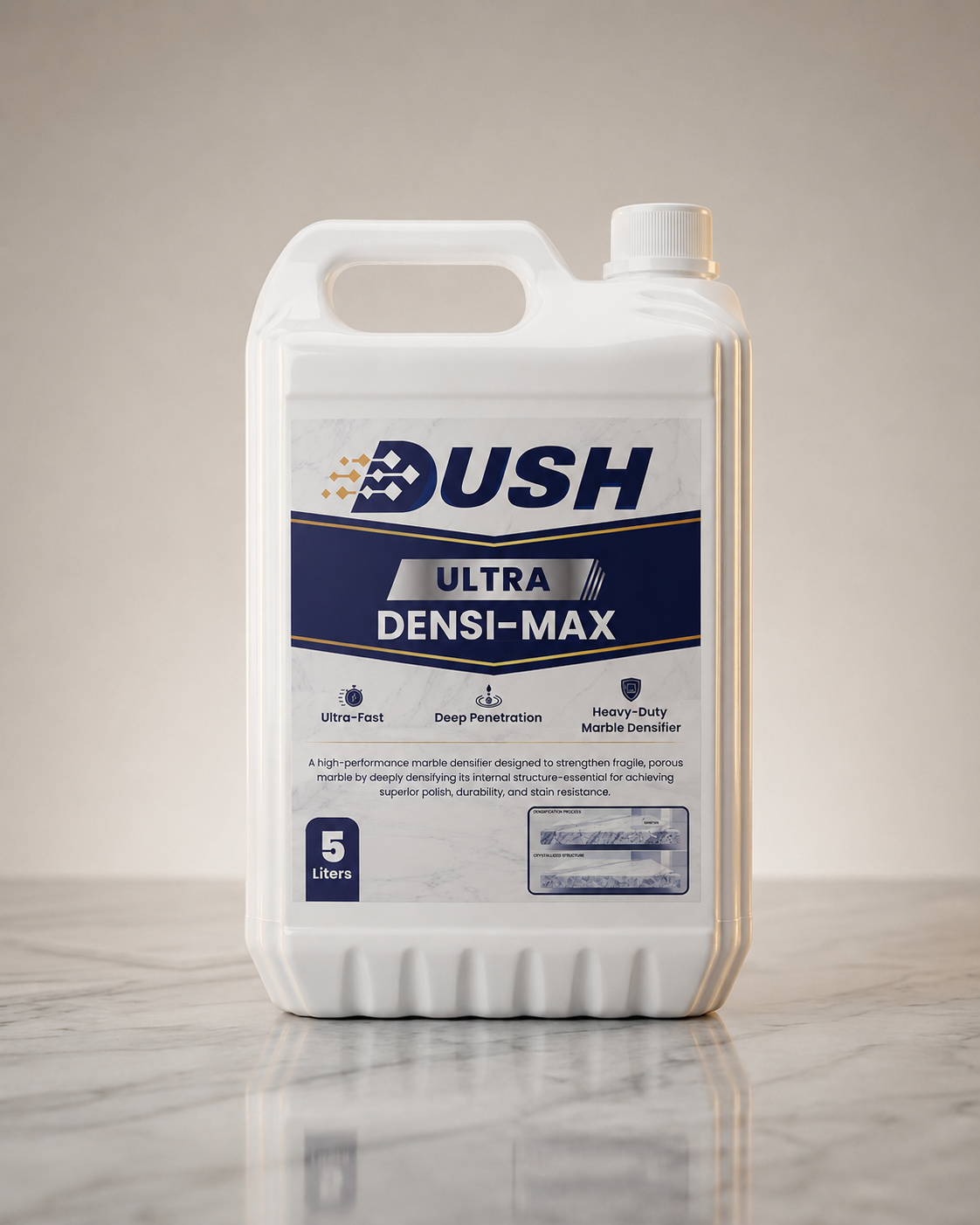
Dush Densi Max Ultra supports complete Italian marble care India protection — it is an ultra-premium penetrating densifier for high-end Italian marble and premium natural stones. Its deep-penetration formula is specifically engineered for the open, micro-pore structure of premium Italian marble varieties — penetrating deeper and reacting more completely than standard densifiers. The result is permanent stain protection for Italian marble — permanent stain resistance, improved polish retention, and a richer, longer-lasting surface finish. Available in 20-litre units for professional marble installation.
Ultra-Premium Penetrating Densifier · Permanent Stain Protection · Italian Marble Specialist
DUSH DENSI MAX ULTRA
Deep-Penetration Densifier for High-End Italian Marble · Premium Natural Stone · Permanent Internal Pore Closure · 20 Litre
Why Densi Max Ultra Protects Italian Marble Permanently
Dush Densi Max Ultra is engineered specifically for high-end Italian marble — varieties like Statuario, Carrara, and Calacatta that have more open and sensitive pore structures than standard marble. Its ultra-deep penetration formula reaches pore depths that standard densifiers cannot access, ensuring complete pore closure across the full depth of the stone rather than just the near-surface layer.
The product protects against all forms of Italian marble staining by permanently eliminating the mechanism that allows staining to occur — capillary liquid absorption. Once the pores are closed with the Densi Max Ultra crystalline matrix, the staining agents (turmeric, oil, hard water, coffee) have no pathway into the stone. They sit on the surface and are wiped away.
Densi Max Ultra simultaneously improves marble hardness and polish retention — making it more resistant to surface abrasion from grit and foot traffic. The marble polishes to a richer, deeper sheen that lasts significantly longer between professional polishing cycles.
View Dush Densi Max Ultra →
- ★Ultra-deep penetration: Specifically formulated for high-end Italian marble's micro-pore structure — reaches depths inaccessible to standard densifiers
- ★Permanent chemical bond: Reacts with calcium minerals inside the marble pores — forms calcium silicate hydrate compounds that are part of the stone's structure
- ★Improves polish retention: Delivers a richer, longer-lasting surface sheen — extends professional polishing cycles significantly
- ★Increases surface hardness: Strengthens the marble from within — more resistant to abrasion, grit damage, and surface wear
- ★Treats micro-fissures and pin-holes: Seals micro-fissures and the smallest gaps in the stone structure — not just the main pore network
- ★Completely invisible: Clear, no surface film, no change to the marble's natural appearance, colour, or polish level
- ★Italian formulation: Backed by VITO — an established Italian stone care brand with decades of European marble chemistry expertise applied to Indian marble conditions
- ★Professional scale: Available in 20-litre units — suitable for large residential floors, commercial spaces, hotels, and marble factories
Size20 Litre
ColourClear
Area of UseItalian Marble · Premium Natural Stone
PermanencePermanent
Dush Densi Max Ultra supports complete Italian marble care India protection — it is an ultra-premium penetrating densifier for high-end Italian marble and premium natural stones. Its deep-penetration formula is specifically engineered for the open, micro-pore structure of premium Italian marble varieties — penetrating deeper and reacting more completely than standard densifiers. The result is permanent stain protection for Italian marble — permanent stain resistance, improved polish retention, and a richer, longer-lasting surface finish. Available in 20-litre units for professional marble installation.
DUSH DENSI MAX ULTRA
Dush Densi Max Ultra is engineered specifically for high-end Italian marble — varieties like Statuario, Carrara, and Calacatta that have more open and sensitive pore structures than standard marble. Its ultra-deep penetration formula reaches pore depths that standard densifiers cannot access, ensuring complete pore closure across the full depth of the stone rather than just the near-surface layer.
The product protects against all forms of Italian marble staining by permanently eliminating the mechanism that allows staining to occur — capillary liquid absorption. Once the pores are closed with the Densi Max Ultra crystalline matrix, the staining agents (turmeric, oil, hard water, coffee) have no pathway into the stone. They sit on the surface and are wiped away.
Densi Max Ultra simultaneously improves marble hardness and polish retention — making it more resistant to surface abrasion from grit and foot traffic. The marble polishes to a richer, deeper sheen that lasts significantly longer between professional polishing cycles.
View Dush Densi Max Ultra →- ★Ultra-deep penetration: Specifically formulated for high-end Italian marble's micro-pore structure — reaches depths inaccessible to standard densifiers
- ★Permanent chemical bond: Reacts with calcium minerals inside the marble pores — forms calcium silicate hydrate compounds that are part of the stone's structure
- ★Improves polish retention: Delivers a richer, longer-lasting surface sheen — extends professional polishing cycles significantly
- ★Increases surface hardness: Strengthens the marble from within — more resistant to abrasion, grit damage, and surface wear
- ★Treats micro-fissures and pin-holes: Seals micro-fissures and the smallest gaps in the stone structure — not just the main pore network
- ★Completely invisible: Clear, no surface film, no change to the marble's natural appearance, colour, or polish level
- ★Italian formulation: Backed by VITO — an established Italian stone care brand with decades of European marble chemistry expertise applied to Indian marble conditions
- ★Professional scale: Available in 20-litre units — suitable for large residential floors, commercial spaces, hotels, and marble factories
How Dush Densi Max Ultra Protects Marble from Staining — The Chemical Mechanism
Direct Answer
Dush Densi Max Ultra penetrates the marble's pore structure in liquid form and undergoes a chemical reaction with the calcium mineral compounds (CaCO₃ and Ca(OH)₂) inside the pores. This reaction produces calcium silicate hydrate (C-S-H) compounds — the same class of materials responsible for the hardening of concrete — which form a dense crystalline matrix within the pore walls. This matrix is hydrophobic (water-repelling), is chemically bonded to the stone's mineral structure, and permanently prevents liquid from entering the pores by capillary action.
The Chemistry Inside the Marble Pore
When Dush Densi Max Ultra is applied to marble at the grinding stage, the liquid densifier enters the open pores by capillary action. Inside the pores, it contacts the calcium mineral surfaces and undergoes a pozzolanic reaction:
SiO₂ (densifier) + Ca(OH)₂ (marble minerals) → CaSiO₃·H₂O (calcium silicate hydrate)
The calcium silicate hydrate (C-S-H) that forms within the pores is:
Structurally stable: C-S-H is one of the most stable mineral compounds found in nature — the same class responsible for the long-term hardening and durability of cement. It does not degrade under normal environmental conditions.
Hydrophobic: The C-S-H matrix lines the pore walls with a surface that repels water and oil. The contact angle θ increases dramatically — capillary suction that was drawing liquid into the marble is eliminated.
Internally bonded: The C-S-H is chemically bonded to the calcium carbonate of the marble's pore walls. It cannot be removed by surface cleaning, mechanical action on the marble surface, or normal thermal cycling. It is inside the stone.
The result is a marble that is stain-proof from within — not because a coating is protecting the surface, but because the internal pore structure no longer allows liquid absorption.
Why the Grinding Stage Matters
Dush Densi Max Ultra penetrates the marble's pore structure in liquid form and undergoes a chemical reaction with the calcium mineral compounds (CaCO₃ and Ca(OH)₂) inside the pores. This reaction produces calcium silicate hydrate (C-S-H) compounds — the same class of materials responsible for the hardening of concrete — which form a dense crystalline matrix within the pore walls. This matrix is hydrophobic (water-repelling), is chemically bonded to the stone's mineral structure, and permanently prevents liquid from entering the pores by capillary action.
The Chemistry Inside the Marble Pore
When Dush Densi Max Ultra is applied to marble at the grinding stage, the liquid densifier enters the open pores by capillary action. Inside the pores, it contacts the calcium mineral surfaces and undergoes a pozzolanic reaction:
The calcium silicate hydrate (C-S-H) that forms within the pores is:
Structurally stable: C-S-H is one of the most stable mineral compounds found in nature — the same class responsible for the long-term hardening and durability of cement. It does not degrade under normal environmental conditions.
Hydrophobic: The C-S-H matrix lines the pore walls with a surface that repels water and oil. The contact angle θ increases dramatically — capillary suction that was drawing liquid into the marble is eliminated.
Internally bonded: The C-S-H is chemically bonded to the calcium carbonate of the marble's pore walls. It cannot be removed by surface cleaning, mechanical action on the marble surface, or normal thermal cycling. It is inside the stone.
The result is a marble that is stain-proof from within — not because a coating is protecting the surface, but because the internal pore structure no longer allows liquid absorption.
Dush Densi Max Ultra must be applied at the 80-grit grinding stage for maximum effectiveness. At this stage, the marble's porosity is at its maximum — the grinding process has exposed the deepest internal pore network, and no polishing resin or surface treatment has closed the pore openings. This gives the densifier its greatest possible penetration depth.
As the Dush technical team notes and as confirmed by Italian stone care practice: "The product should be applied repetitively until the marble stops absorbing the solution — the marble itself signals when the pore closure is complete." This self-limiting application process ensures complete pore treatment without waste.
Post-installation application of densifier — applied after the marble is fully polished and installed — provides partial benefit but significantly reduced penetration depth because the polishing process has partially closed the surface pore openings. The grinding stage application is the correct and recommended method.
How to Apply Dush Densi Max Ultra for Permanent Italian Marble Stain Protection
Direct Answer — Application Summary
Apply Dush Densi Max Ultra at the 80-grit grinding stage, undiluted, using a brush or wiper. Spread evenly and allow 15–20 minutes for the product to penetrate. Remove all excess before drying — critical step. Repeat 3–5 coats until the marble stops absorbing. Continue polishing to final grit. Confirm protection with the water drop test.
1
Grind to 80 Grit
Grind the marble surface to 80 grit. This is the critical stage — marble porosity is at maximum at 80 grit, allowing deepest Densi Max Ultra penetration. Do not apply at a finer grit stage.
→ Why: Maximum porosity = maximum penetration depth
2
Clean Surface Completely
Surface must be completely clean, dry, and free from dust, oil, grinding slurry, and any previous treatment. Any contamination prevents correct Densi Max Ultra penetration. Remove all grinding residue.
→ Why: Clean pores = unobstructed penetration
3
Apply Undiluted — First Coat
Apply Dush Densi Max Ultra undiluted using a brush, wiper, or applicator. Spread evenly across the marble surface. Apply generously — do not ration. Allow 15–20 minutes penetration time.
→ Why: Undiluted = full-strength pore penetration
4
Remove Excess — Critical
Before the product dries on the surface, wipe off ALL excess with a clean absorbent cloth. Dried excess creates visible white residue on the marble. This is the most important step — do not skip.
→ Why: Residue on surface creates visible haze
5
Repeat Until Marble Stops Absorbing
Apply 3–5 coats total. Higher-porosity Italian marble (Statuario, soft Carrara) needs more coats than denser varieties. The marble tells you when it is done: it stops absorbing the product. That is the signal for complete pore closure.
→ Why: Complete pore closure requires full saturation
6
Reapply at 120 & 180 Grit (High Porosity)
For very porous Italian marble varieties, reapply Densi Max Ultra at the 120 and 180 grit stages as well. This ensures deep pore closure at every level of the polishing process.
→ Why: High-porosity marble benefits from multi-stage treatment
7
Continue Polishing to Final Grit
After Densi Max Ultra treatment, continue the polishing sequence — 120, 180, 400, 800, 1500, 3000 grit — to achieve the desired mirror finish. The densifier treatment does not interfere with the polishing process.
→ Why: Normal polishing sequence — densifier improves final sheen
8
Confirm with the Water Drop Test
After polishing to final finish, perform the water drop test. Pour 3–4 drops of water on the marble. They should bead for 5+ minutes without absorbing. If absorbed within 30 seconds — apply additional coats and re-polish.
→ Why: Water beading = confirmed permanent stain protection
Apply Dush Densi Max Ultra at the 80-grit grinding stage, undiluted, using a brush or wiper. Spread evenly and allow 15–20 minutes for the product to penetrate. Remove all excess before drying — critical step. Repeat 3–5 coats until the marble stops absorbing. Continue polishing to final grit. Confirm protection with the water drop test.
Grind to 80 Grit
Grind the marble surface to 80 grit. This is the critical stage — marble porosity is at maximum at 80 grit, allowing deepest Densi Max Ultra penetration. Do not apply at a finer grit stage.
→ Why: Maximum porosity = maximum penetration depth
Clean Surface Completely
Surface must be completely clean, dry, and free from dust, oil, grinding slurry, and any previous treatment. Any contamination prevents correct Densi Max Ultra penetration. Remove all grinding residue.
→ Why: Clean pores = unobstructed penetration
Apply Undiluted — First Coat
Apply Dush Densi Max Ultra undiluted using a brush, wiper, or applicator. Spread evenly across the marble surface. Apply generously — do not ration. Allow 15–20 minutes penetration time.
→ Why: Undiluted = full-strength pore penetration
Remove Excess — Critical
Before the product dries on the surface, wipe off ALL excess with a clean absorbent cloth. Dried excess creates visible white residue on the marble. This is the most important step — do not skip.
→ Why: Residue on surface creates visible haze
Repeat Until Marble Stops Absorbing
Apply 3–5 coats total. Higher-porosity Italian marble (Statuario, soft Carrara) needs more coats than denser varieties. The marble tells you when it is done: it stops absorbing the product. That is the signal for complete pore closure.
→ Why: Complete pore closure requires full saturation
Reapply at 120 & 180 Grit (High Porosity)
For very porous Italian marble varieties, reapply Densi Max Ultra at the 120 and 180 grit stages as well. This ensures deep pore closure at every level of the polishing process.
→ Why: High-porosity marble benefits from multi-stage treatment
Continue Polishing to Final Grit
After Densi Max Ultra treatment, continue the polishing sequence — 120, 180, 400, 800, 1500, 3000 grit — to achieve the desired mirror finish. The densifier treatment does not interfere with the polishing process.
→ Why: Normal polishing sequence — densifier improves final sheen
Confirm with the Water Drop Test
After polishing to final finish, perform the water drop test. Pour 3–4 drops of water on the marble. They should bead for 5+ minutes without absorbing. If absorbed within 30 seconds — apply additional coats and re-polish.
→ Why: Water beading = confirmed permanent stain protection
What to tell your marble contractor: "Please apply Dush Densi Max Ultra at the 80-grit grinding stage, in multiple coats applied repetitively until the marble stops absorbing, before proceeding to finer grits." This single instruction is the difference between marble that stains and marble that does not.
Why Italian Marble in India Needs Permanent Densification More Than Anywhere Else
Direct Answer
Italian marble in India faces the most aggressive staining conditions in the world — daily turmeric and cooking oil, tap water with 2–4x the mineral content of European water, monsoon humidity accelerating iron oxidation inside the stone, and widespread use of acidic cleaning products that etch the polished surface. No European marble care product is specifically formulated for this combination. Dush Densi Max Ultra is backed by Italian formulation expertise (VITO) applied to Indian marble conditions — the correct convergence for Indian homes.
🟡 Turmeric — India-Specific Threat
Curcumin in turmeric is more chemically aggressive than anything in European kitchens. It bonds with calcium carbonate within 2 minutes on untreated marble — creating staining that cannot be cleaned once set. Daily turmeric use in Indian cooking makes this the primary staining risk for Italian marble in India.
💧 Hard Water — Indian Urban Reality
Municipal water in Bangalore, Mumbai, Delhi, Hyderabad, and Chennai carries dissolved mineral content of 100–400 mg/L — compared to European averages of 50–150 mg/L. Each wet-dry cycle on untreated marble deposits 2–4x more mineral per cycle. Without pore closure, white mineral haze on Indian marble is inevitable.
🌧️ Monsoon Humidity — Iron Oxidation
India's monsoon conditions create sustained periods of 80–100% relative humidity. Trace iron compounds in Italian marble oxidise in the presence of moisture — causing yellow-brown discolouration that spreads across the floor. Permanent pore closure with Densi Max Ultra blocks moisture ingress that drives this oxidation.
🏠 Zero Pre-Treatment — Indian Practice
The vast majority of Italian marble installed in India receives no pre-installation protection and no densification at the grinding stage. The marble is laid with fully open pores, in Indian kitchen conditions, with no stain protection whatsoever. This is why Italian marble staining in India is so widespread — and so preventable.
Italian marble in India faces the most aggressive staining conditions in the world — daily turmeric and cooking oil, tap water with 2–4x the mineral content of European water, monsoon humidity accelerating iron oxidation inside the stone, and widespread use of acidic cleaning products that etch the polished surface. No European marble care product is specifically formulated for this combination. Dush Densi Max Ultra is backed by Italian formulation expertise (VITO) applied to Indian marble conditions — the correct convergence for Indian homes.
🟡 Turmeric — India-Specific Threat
Curcumin in turmeric is more chemically aggressive than anything in European kitchens. It bonds with calcium carbonate within 2 minutes on untreated marble — creating staining that cannot be cleaned once set. Daily turmeric use in Indian cooking makes this the primary staining risk for Italian marble in India.
💧 Hard Water — Indian Urban Reality
Municipal water in Bangalore, Mumbai, Delhi, Hyderabad, and Chennai carries dissolved mineral content of 100–400 mg/L — compared to European averages of 50–150 mg/L. Each wet-dry cycle on untreated marble deposits 2–4x more mineral per cycle. Without pore closure, white mineral haze on Indian marble is inevitable.
🌧️ Monsoon Humidity — Iron Oxidation
India's monsoon conditions create sustained periods of 80–100% relative humidity. Trace iron compounds in Italian marble oxidise in the presence of moisture — causing yellow-brown discolouration that spreads across the floor. Permanent pore closure with Densi Max Ultra blocks moisture ingress that drives this oxidation.
🏠 Zero Pre-Treatment — Indian Practice
The vast majority of Italian marble installed in India receives no pre-installation protection and no densification at the grinding stage. The marble is laid with fully open pores, in Indian kitchen conditions, with no stain protection whatsoever. This is why Italian marble staining in India is so widespread — and so preventable.
The combination of India-specific staining threats and universal under-treatment of Indian marble installations creates a predictable pattern: spectacular-looking marble at installation, visible staining within months, progressive yellowing within years, and costly restoration or replacement after a decade. Dush Densi Max Ultra applied correctly at the grinding stage breaks this pattern permanently.
The Water Drop Test — How to Confirm Your Marble Is Permanently Protected
Direct Answer
The water drop test marble homeowners should know: pour 3–4 drops of plain water onto the marble surface. If the drops bead and remain on the surface for 5 or more minutes without absorbing — the densification treatment is working correctly and your marble is permanently protected from staining. If the drops absorb within 30–120 seconds — the marble has not been treated with densifier and is vulnerable to turmeric, oil, and hard water staining.
❌
Untreated Marble — No Permanent Protection
Water drops absorb into the marble within 30–120 seconds. The marble surface darkens where the drops land. The open pore structure is pulling liquid inward by capillary action. Turmeric, oil, and coffee all behave the same way — they enter the stone and cause staining. This marble is fully vulnerable.
✅
Densi Max Ultra Treated Marble — Permanent Protection
Water drops bead perfectly on the marble surface and remain there for 5+ minutes without being absorbed. The drops roll off when the marble is tilted. The internal pore closure is working — liquid has no pathway into the stone. Turmeric poured on this marble beads and wipes away with no trace. Coffee sits on the surface. Hard water cannot deposit minerals inside the pores.
The water drop test marble homeowners should know: pour 3–4 drops of plain water onto the marble surface. If the drops bead and remain on the surface for 5 or more minutes without absorbing — the densification treatment is working correctly and your marble is permanently protected from staining. If the drops absorb within 30–120 seconds — the marble has not been treated with densifier and is vulnerable to turmeric, oil, and hard water staining.
Untreated Marble — No Permanent Protection
Water drops absorb into the marble within 30–120 seconds. The marble surface darkens where the drops land. The open pore structure is pulling liquid inward by capillary action. Turmeric, oil, and coffee all behave the same way — they enter the stone and cause staining. This marble is fully vulnerable.
Densi Max Ultra Treated Marble — Permanent Protection
Water drops bead perfectly on the marble surface and remain there for 5+ minutes without being absorbed. The drops roll off when the marble is tilted. The internal pore closure is working — liquid has no pathway into the stone. Turmeric poured on this marble beads and wipes away with no trace. Coffee sits on the surface. Hard water cannot deposit minerals inside the pores.
Perform this test before and after Densi Max Ultra application to confirm complete pore closure. For marble already installed in Indian homes, the water drop test tells you immediately whether the marble has been correctly treated. If water absorbs — the marble needs densification at the next professional polishing cycle and a surface sealer (Dush Protek+) applied immediately to provide interim surface protection.
Myths About Italian Marble Stain Protection — Corrected
What Is True and What Is Not About Marble Protection
MYTH
"Sealing marble protects it permanently."
Standard surface sealers applied post-installation are temporary — they penetrate only the surface pore openings and wear off in 1–3 years. They must be reapplied. Only a penetrating densifier applied at the grinding stage provides permanent protection.
MYTH
"You can seal marble after installation and get the same protection."
Post-installation densifier application provides partial benefit but significantly reduced penetration depth. The grinding stage is when marble porosity is at maximum. At 80 grit, Densi Max Ultra reaches pore depths that post-installation application cannot access.
MYTH
"Marble densifier changes the appearance of the marble."
Dush Densi Max Ultra is clear, forms no surface film, and does not alter the marble's natural colour, veining, texture, or polish level. The product works invisibly inside the pore structure. The only visible change is that water beads on the surface rather than being absorbed.
MYTH
"Polished marble does not need sealing because the polish protects it."
Mirror polish reduces the rate of liquid absorption but does not close the pore structure. Polished Italian marble still absorbs turmeric within 2–5 minutes of contact. The polish is a surface finish — the pores beneath are still open to liquid entry.
MYTH
"Lemon and vinegar are good for cleaning marble stains."
Lemon (pH 2–3) and vinegar (pH 2–3) dissolve calcium carbonate through the reaction CaCO₃ + 2CH₃COOH → products. This permanently etches the polished surface layer. Acid-based cleaning is one of the most common causes of permanent marble surface damage in Indian homes.
FACT
"The water drop test confirms whether marble protection is working."
Correct. Water drops that bead for 5+ minutes on marble confirm successful pore closure. Water drops absorbed within 30–120 seconds confirm open pores and vulnerability to staining. This is a reliable field test that any homeowner can perform.
FACT
"The grinding stage is the correct time to apply marble densifier."
Correct. At 80 grit, marble porosity is at maximum and pores are fully open. This allows Densi Max Ultra to penetrate to its full depth and achieve complete pore closure across the full depth of the stone — not just the near-surface layer.
What Is True and What Is Not About Marble Protection
See Densi Max Ultra Protect Your Marble Before You Buy
Dush is India's only marble chemical company that tests its products on a sample of your own marble before purchase. We apply Densi Max Ultra to your sample, perform the water drop test, and you see the permanent protection on your actual stone — before you spend a rupee.
Send a piece of your marble to Dush
We apply Densi Max Ultra and perform the water drop test on your stone
You see the before-and-after — permanent stain protection confirmed on your actual marble
Related Dush Guides and Solutions
Italian Marble Stain Protection — Questions Answered
How do I protect Italian marble from staining permanently?
The only permanent protection for Italian marble against staining is Dush Densi Max Ultra penetrating densifier applied at the 80-grit grinding stage during marble polishing. Applied in 3–5 coats, it penetrates deep into the marble's internal pore structure and chemically reacts with the calcium minerals inside — forming a permanent hydrophobic crystalline matrix within the stone. Once correctly done, the marble's pores are permanently closed from within and staining agents (turmeric, oil, coffee, hard water) cannot enter the stone. This is not a surface coating — it is a permanent internal treatment.
What makes Italian marble stain so easily?
Italian marble stains easily because it is calcium carbonate with an open micro-pore network. Pore sizes range from 0.1 to 10 micrometres — large enough for liquid to enter by capillary action within 30 to 120 seconds of surface contact. Turmeric chemically bonds with the calcium carbonate inside the pores within 2 minutes. Cooking oil penetrates and oxidises inside the pores over time. Hard water deposits minerals in the pore openings with every wet-dry cycle. Without pore closure through densification, every liquid that contacts untreated Italian marble becomes a potential stain.
What is Dush Densi Max Ultra and how is it different from a regular marble sealer?
Dush Densi Max Ultra is an ultra-premium penetrating densifier for high-end Italian marble and premium natural stones. It is fundamentally different from a regular marble sealer. A surface sealer penetrates only the surface pore openings and wears off in 1–3 years. Dush Densi Max Ultra penetrates deep into the stone's internal pore structure, chemically bonds with the calcium mineral compounds inside, and creates a permanent internal hydrophobic matrix that does not wear off from surface traffic or cleaning. It also improves marble hardness, durability, and polish retention — functions no surface sealer provides.
At what stage must marble densifier be applied for permanent protection?
Dush Densi Max Ultra must be applied at the 80-grit grinding stage during marble polishing for maximum permanence and penetration depth. At this stage, marble porosity India contractors must understand is at its maximum — pores are fully open — allowing the deepest possible product penetration. Post-installation application provides partial benefit but significantly reduced penetration depth. The standard instruction to your marble contractor: "Apply Dush Densi Max Ultra at the 80-grit stage, in multiple coats until the marble stops absorbing, before proceeding to finer grits."
How do you know if Italian marble has been correctly protected?
The water drop test confirms protection. Pour 3–4 drops of plain water on the marble. If drops bead for 5+ minutes without absorbing — permanent stain protection is confirmed. If absorbed within 30–120 seconds — the marble is unprotected. This test can be performed on any marble surface at any time. For newly installed marble in Indian homes, performing this test at installation tells you immediately whether your contractor applied the correct treatment. If water absorbs, request Dush Densi Max Ultra application at the next polishing cycle and apply Dush Protek+ surface sealer for interim protection.
Can I protect already-installed marble from staining?
Partially. For already-installed marble: clean thoroughly with Dush Alka Cleaner, treat any existing stains with Dush Stain-Ex poultice, then apply Dush Protek+ impregnating surface sealer 2–3 coats. This provides meaningful surface-level protection but is not equivalent to the permanent internal pore closure that Dush Densi Max Ultra achieves at the grinding stage. For complete permanent protection, specify Dush Densi Max Ultra at the next professional polishing cycle.
Does Dush Densi Max Ultra change the appearance of Italian marble?
No. Dush Densi Max Ultra is clear, forms no surface film, and does not alter the marble's natural colour, veining, texture, or polish level in any visible way. The product works invisibly within the stone's internal pore structure. The only visible difference after correct application is that water and oil bead on the marble surface rather than being absorbed — demonstrating the successful pore closure. The marble's natural beauty is completely preserved and enhanced through improved polish retention.
Why is marble stain protection more important in India than other countries?
Italian marble in India faces the most aggressive combination of staining conditions in the world: daily turmeric (bonds with marble in 2 minutes), high-viscosity cooking oils, tap water with 100–400 mg/L dissolved mineral content (2–4x European levels), monsoon humidity accelerating iron oxidation inside the stone, and widespread use of acidic cleaning products that etch marble surfaces permanently. No European marble care product addresses this combination. Dush Densi Max Ultra is backed by Italian formulation expertise (VITO) and specifically tested for Indian marble conditions — making it the correct solution for the specific challenges Italian marble faces in Indian homes.
How do I protect Italian marble from staining permanently?
What makes Italian marble stain so easily?
What is Dush Densi Max Ultra and how is it different from a regular marble sealer?
At what stage must marble densifier be applied for permanent protection?
How do you know if Italian marble has been correctly protected?
Can I protect already-installed marble from staining?
Does Dush Densi Max Ultra change the appearance of Italian marble?
Why is marble stain protection more important in India than other countries?
External References
Protect Your Italian Marble Permanently — Before the First Stain
Dush Densi Max Ultra tested on your own marble before you buy. The only marble chemical company in India that does this. See the permanent stain protection on your actual stone — then decide.