PU Adhesive for Marble in Bangalore: Complete Guide to Professional Stone Bonding
A practical guide for marble fabricators, stone workshops, interior contractors and project teams in Bangalore who need to understand where PU adhesive fits into professional stone bonding.
What “PU Adhesive for Marble” Actually Means
When a Bangalore stone fabricator searches for a PU adhesive for marble, the requirement is usually more specific than simply finding something that sticks to stone. The real job may involve joining two marble pieces, attaching a stone component to metal, creating a mixed-material furniture element or assembling a decorative interior detail.
That distinction matters because an adhesive should be evaluated against the complete substrate combination, not the word “marble” alone.
PU means polyurethane. A PU adhesive is a polyurethane-based adhesive system, but different products can have different formulations, application ranges and handling requirements. For professional work, the product documentation is therefore the starting point.
The Adhesive Decision Starts Before the Mixing Stage
Identify the substrates
Write down exactly what is being joined: marble to marble, marble to metal, marble to glass, marble to aluminium or another compatible surface.
Understand the joint
Know the contact area, alignment, visibility of the joint and how the assembled piece will be supported.
Plan the sequence
Dry fit the parts and decide how they will be positioned and held before the adhesive is prepared.
This is especially useful in a busy fabrication environment. Mixing adhesive should be one of the later steps in the process—not the moment when the team starts deciding how the assembly will go together.
Common Marble Fabrication Situations
Marble-to-marble work
Fabricated stone edges, assembled marble components and custom stone details can require bonding between compatible stone surfaces. Fit and alignment should be established before application.
Marble furniture
Tables, consoles, counters and display pieces can combine stone with other materials. The adhesive choice should be based on the complete assembly rather than the stone alone.
Marble-to-metal details
Metal frames and components can be incorporated into stone furniture and interior elements. The specific metal surface and its preparation need to be checked.
Marble-to-glass details
Glass can appear in display furniture and decorative assemblies. Accurate dry fitting is important because final positioning can be difficult to correct after bonding.
A Professional Marble Bonding Workflow
The following is a practical sequence for planning a compatible adhesive application. Product-specific instructions always take priority.
Inspect the marble
Check the contact area, edge condition and surface cleanliness. Confirm that the intended joint is suitable for the selected adhesive system.
Inspect the second substrate
Identify whether the mating surface is metal, glass, aluminium or another material and check the manufacturer's compatibility information.
Dry fit everything
Bring the parts together without adhesive. Confirm alignment, contact and the order in which the pieces need to be positioned.
Prepare the work area
Have application tools, supports and positioning aids ready before mixing begins.
Mix according to the product instructions
Use the specified component ratio. Do not alter the ratio to try to change the working or curing behaviour.
Apply and assemble
Apply the adhesive as instructed and position the components within the applicable working period.
Allow the assembly to cure
Keep the bonded parts stable and follow the product's curing and handling requirements before loading or final installation.
Marble-to-Marble, Marble-to-Metal, Marble-to-Glass and Marble-to-Aluminium
| Bonding situation | What the fabricator should verify | Practical consideration |
|---|---|---|
| Marble → Marble | Stone compatibility and prepared contact surfaces | Dry fit the pieces and control alignment before adhesive application. |
| Marble → Metal | Exact metal type, finish and product compatibility | Do not assume every metal surface behaves the same way. |
| Marble → Glass | Glass compatibility and clean contact surfaces | Plan positioning carefully because visual alignment is important. |
| Marble → Aluminium | Aluminium surface condition and compatibility | Follow the manufacturer's preparation requirements for the substrate. |
DUSH Arena Duo's published application information includes compatible natural-stone bonding with glass, metal, aluminium and composite surfaces. The exact substrate and project should still be checked against current product documentation.
Surface Preparation Is Part of the Bonding System
A professional adhesive job is not simply “apply glue and press.” The condition of the surfaces affects the application process, which is why preparation belongs in the workflow.
Clean contact area
Remove contamination in accordance with the adhesive manufacturer's preparation instructions.
Confirm fit
Make sure the pieces sit where they are supposed to sit before adhesive is introduced.
Protect the prepared surface
Avoid re-contaminating the contact area after it has been prepared.
For stone workshops, this simple discipline can also make the application easier to repeat from one fabrication job to another.
DUSH Arena Duo for Professional Stone Bonding
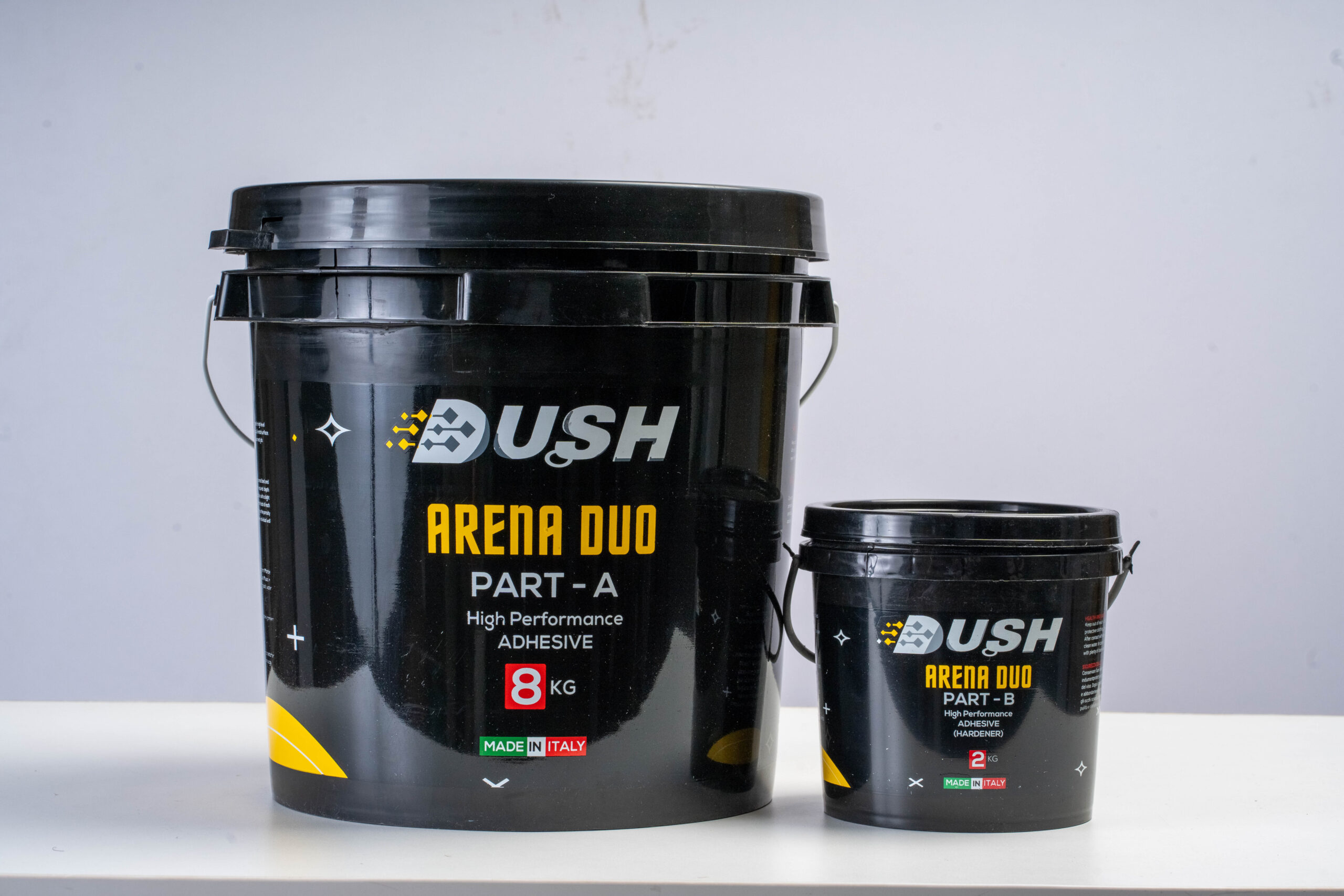
DUSH Arena Duo is a two-component PU adhesive for professional bonding applications involving marble and natural stone.
The published product information specifies a 2:1 mixing ratio and approximately 30–45 minutes of open time. Its documented application range includes compatible natural-stone bonding with glass, metal, aluminium and composite surfaces.
These are product parameters to work with—not a substitute for checking the specific substrate and current technical instructions for a project.
What the 2:1 Ratio Means in the Workshop
Arena Duo is a two-component system. Its published mixing ratio is 2:1. That means the workshop should organise the job around the specified ratio instead of improvising the quantities.
The practical lesson is simple: prepare the components, application tools, stone pieces and positioning method before mixing. Once the adhesive is prepared, the team should already know what happens next.
What the 30–45 Minute Open Time Means
The published information states approximately 30–45 minutes of open time. Open time refers to the available working period under the product's intended conditions; it should not be interpreted as full cure time.
For a large or complicated marble assembly, this is another reason to complete the dry fit and positioning plan before the adhesive is mixed.
How a Bangalore Fabricator Can Evaluate a PU Marble Adhesive
If the requirement is “PU adhesive for marble in Bangalore,” the useful evaluation questions are technical rather than simply brand-based.
1. Is my substrate combination documented?
Check the stone and the second material separately. A product suitable for one joint should not automatically be assumed suitable for another.
2. What is the mixing ratio?
Know the required component ratio before planning the application.
3. What is the working period?
Make sure the team can complete positioning within the published working period.
4. What preparation is required?
Check how the specific substrate should be prepared and whether additional treatment is specified.
5. What are the curing requirements?
Understand handling and loading restrictions after assembly.
6. Where is the technical information?
A professional product should have accessible product information that the workshop can refer to before application.
Choosing a PU Adhesive Supplier for a Bangalore Stone Workshop
A workshop looking for a PU marble adhesive supplier in Bangalore usually needs more than a product name. The team may need availability, product information, application guidance and a clear understanding of which substrates the adhesive is intended for.
For that reason, the buying conversation should begin with the actual fabrication requirement: what are you bonding, how large is the assembly, how will it be positioned, and what does the product documentation say?
DUSH Products provides product information for Arena Duo through its website. For project-specific questions, the current product information should be used as the reference.
Where Professional Stone Bonding Can Become Part of an Interior Project
In Bangalore, marble fabrication can appear in many types of interior and architectural work. The bonding requirement changes according to the component being fabricated.
Residential interiors
Countertops, vanity components, custom furniture and decorative marble details can involve assembled stone components.
Office interiors
Reception counters, display elements, meeting-area furniture and architectural details may combine stone with other materials.
Hospitality spaces
Hotels, restaurants and other hospitality interiors can use custom stone details where fabrication accuracy and assembly planning matter.
Retail and display work
Display furniture and branded interior elements can involve marble combined with glass, metal or aluminium.
The project type does not determine adhesive suitability by itself. The specific substrate combination and application requirements still need to be checked.
Quick Answers: PU Adhesive for Marble in Bangalore
What is PU adhesive used for in marble work?
It can be used for compatible marble and natural-stone bonding applications. The correct product depends on the substrates and intended application.
Is PU adhesive suitable for marble-to-metal bonding?
Some PU adhesive systems are documented for compatible natural-stone-to-metal applications. The exact metal surface should be checked.
Can a PU adhesive bond marble to glass?
Some systems are documented for compatible stone-to-glass applications. DUSH Arena Duo includes glass among its documented application surfaces.
What is the DUSH Arena Duo mixing ratio?
The published mixing ratio is 2:1.
What is the DUSH Arena Duo open time?
The published information states approximately 30–45 minutes of open time.
Frequently Asked Questions
Can PU adhesive be used for marble?
Yes, where the specific PU adhesive is documented as compatible with the marble and intended application.
What should I check before using PU adhesive on marble?
Check the complete substrate combination, surface condition, preparation instructions, mixing ratio, working period and curing requirements.
What is DUSH Arena Duo?
DUSH Arena Duo is a two-component PU adhesive for professional bonding applications involving marble and natural stone, with documented compatible applications involving glass, metal, aluminium and composite surfaces.
What is Arena Duo's mixing ratio?
The published mixing ratio is 2:1.
How much open time does Arena Duo have?
The published product information states approximately 30–45 minutes of open time.
Can Arena Duo be used for marble-to-metal?
It is documented for compatible natural-stone-to-metal applications. The exact metal surface should be checked before application.
Can Arena Duo be used with glass?
Glass is included among its documented application surfaces, subject to the current product instructions.
Can Arena Duo be used with aluminium?
Aluminium is included among the documented application surfaces. Confirm the exact surface and preparation requirements before use.
Does adhesive alone make a heavy stone assembly structurally safe?
No assumption should be made about structural support from adhesive alone. Safety-critical or load-bearing assemblies should be designed with the appropriate structural and mechanical requirements.
Looking for PU Adhesive for Marble in Bangalore?
Start with the actual bonding requirement, verify substrate compatibility and review the product instructions before application. Explore DUSH Arena Duo for compatible professional marble and natural-stone bonding applications.