Why Do White Marble Stains Keep Coming Back?
The stain isn't the problem — the open pore structure letting it in is. Porosity, capillary action, moisture movement, and why professionals densify before they seal.
White marble stains keep coming back because the underlying cause is usually porosity, not dirt. Marble's microscopic pores stay open when the stone is unsealed, weakened, or its old seal has worn off — so every spill re-enters the same pathway. Densifying the stone before sealing it is the professional fix for recurring staining. Dush Densi Max Ultra, MRP ₹7,500 for 5 Litres, is formulated for this exact step.
Key Takeaways
- Recurring stains are almost always a structural porosity problem, not a cleaning-frequency problem.
- A densifier strengthens the stone's internal pore structure; a sealer protects the surface — they solve different problems and are often both needed.
- Sealing alone often fails on weak, highly porous marble because the absorbent structure beneath the seal keeps drawing moisture in at edges and gaps.
- The professional sequence is inspect → clean → remove stains → densify → polish → seal → maintain, in that order.
- Wrong cleaning chemicals (acids) and improper polishing are two of the most common reasons homeowners inadvertently make porosity worse.
A marble floor gets professionally cleaned, looks perfect for a few weeks, and then the same yellow patch reappears in the same spot. This cycle — clean, stain, clean, stain — is one of the most common frustrations in marble ownership, and it almost always points to the same root cause: the stone's pore structure was never actually closed. Cleaning removes what's on the surface. It does nothing to the open pathway that let the stain in, or the next one.
Understanding White Marble
White marble is metamorphosed limestone, composed almost entirely of calcite (calcium carbonate) crystals. Under magnification, its surface is not solid but a network of microscopic pores and capillaries between those crystals — the same structure that gives marble its characteristic soft glow, because light penetrates slightly into the stone rather than bouncing straight off. That same structure is what makes it porous, and porosity is the origin of every recurring stain problem this guide addresses.
Why Marble Absorbs Stains
Marble absorbs stains through capillary action — the same physical force that draws water up a paper towel. Liquid touching the stone's surface is pulled into its microscopic pores regardless of gravity, carrying whatever is dissolved in it (turmeric pigment, oil, iron, tannins) deep enough that surface wiping cannot reach it. The more open and connected the pore network, the faster and deeper this absorption happens — which is why weaker, more porous marble stains faster and more permanently than dense, tightly-crystallised marble.
10 Reasons Stains Keep Returning
The Marble Was Never Sealed
Unsealed marble has no barrier at all — every spill has direct, unimpeded access to the pore network from day one.
An Old Seal Has Worn Off
Sealers are surface films that degrade with foot traffic, cleaning, and time — often within 1–3 years — leaving the pores open again without any visible warning.
The Stone Itself Is Weak or Highly Porous
Some marble varieties and individual slabs are naturally more porous than others — sealing a weak stone's surface doesn't change what's happening structurally beneath it.
Rising Moisture From Below
In floors, moisture from a damp screed or bedding migrates upward continuously, feeding the pore network from underneath — a direction surface sealing alone cannot address.
Micro-Cracks From Wear or Impact
Hairline cracks, invisible to the eye, create direct channels past any surface seal and straight into the stone's interior.
Wrong Cleaning Chemicals Damaging the Surface
Acidic cleaners etch the polished surface, creating new microscopic roughness and openings that accelerate future absorption.
Improper Polishing Opening the Pores
Aggressive grinding or polishing without a follow-up seal leaves a freshly exposed, unprotected pore structure more absorbent than before the work began.
The Original Stain Was Never Fully Removed
A partially removed stain leaves residual staining compound deep in the pores, which can appear to "return" as it slowly migrates back toward the surface.
An Ongoing Contamination Source Was Never Addressed
Tannin migration from a wet wooden door frame, for example, continues indefinitely until the wood-to-stone moisture contact itself is fixed — no stain treatment stops a source still actively feeding it.
Sealing Was Done Without Densifying First
On already-weak marble, a surface seal sits on top of a structure that is still highly absorbent underneath — moisture finds its way in at the edges and through microscopic gaps in coverage.
Common Mistakes Homeowners Make
Treating symptoms, not the source
Repeatedly cleaning the same stain without ever sealing or densifying the stone underneath.
Using acidic "quick fix" cleaners
Lemon, vinegar, and bathroom acids etch marble permanently, making future staining worse, not better.
Assuming a seal lasts forever
Sealers wear over 1–3 years with no visible sign — many homeowners never re-check or reapply.
Skipping densification on weak marble
Sealing highly porous stone without densifying first is treating the surface while ignoring the structure underneath.
What Professionals Do Differently
Professionals stop recurring staining through a sequenced process — inspection, cleaning, stain removal, densification, polishing, sealing, and ongoing maintenance — treating densification and sealing as two distinct steps rather than one interchangeable treatment. Skipping either step is one of the most common reasons a professional-looking restoration job still fails within a year.
Inspection
Diagnose whether the cause is surface absorption, rising moisture, weak stone, or a worn prior seal before choosing any treatment.
Cleaning
Remove surface residue with a pH-neutral or marble-safe cleaner so the stone's true condition is visible.
Stain Removal
Treat existing stains with a poultice matched to the specific stain type before any structural treatment begins.
Densification
Apply a penetrating densifier if the stone is weak or highly porous — strengthening the internal structure, not just the surface.
Polishing
Restore shine consistent with the now-densified stone, correcting any dullness left by cleaning and treatment.
Sealing
Apply a surface sealer over the densified, polished marble for day-to-day protection against staining agents.
Maintenance
Daily pH-neutral cleaning plus an annual water-bead test, reapplying protection the moment it shows signs of wearing.
Marble Densifier Explained
A marble densifier is a penetrating treatment that soaks into the stone and chemically strengthens its internal pore structure from within, rather than sitting on top of it as a film. By closing the microscopic capillaries throughout the stone's depth — not just at the surface — a densifier addresses the root physical cause of high porosity: an open, absorbent internal structure. This makes it a structural treatment, distinct from a sealer, which is a surface treatment.
Marble Sealer Explained
A marble sealer forms a protective barrier on or just beneath the stone's surface, blocking staining agents from making contact with the pore openings. Sealers are effective at stopping day-to-day spills from penetrating a structurally sound stone, but they are a surface-level defence — they do not change the porosity or strength of the stone underneath, which is why sealing alone is often insufficient on marble that is already weak or highly absorbent.
Densifier vs Sealer
Densifier — Strengthens
Penetrates into the stone's internal structure.
Closes pores throughout the stone's depth, not just the surface.
Addresses the root cause of high porosity and weak, absorbent stone.
The correct treatment when the marble itself is the problem.
Sealer — Protects
Forms a barrier on or near the surface.
Blocks day-to-day spills from making contact with pore openings.
Does not change the stone's internal strength or porosity.
The correct treatment when the marble is structurally sound and just needs surface protection.
Neither product replaces the other. A densifier without a sealer leaves the surface exposed to daily wear. A sealer without a densifier, on already-weak marble, is protecting a structure that's still absorbent underneath. The two are complementary, not competing, treatments.
Why Sealers Alone Sometimes Fail
Sealers protect surfaces; densifiers strengthen structures — and these are different problems. When marble is already weak and highly porous, a sealer applied on top is defending a structure that is still absorbent everywhere the seal doesn't reach perfectly: edges, hairline cracks, microscopic coverage gaps, and grout lines. Moisture finds those openings and continues to migrate into the still-porous stone underneath, eventually reappearing as staining that looks like the seal "failed," when in fact the seal did its job on the surfaces it covered — the unaddressed internal porosity was always going to find another way in.
Professional Buying Guide
Before buying either product, establish which problem you actually have. If the marble has a history of recurring, spreading, or unusually stubborn staining, or feels notably softer/more absorbent than expected for its type, densification is likely warranted before any sealer is applied. If the marble is structurally sound, holds its polish well, and staining has been occasional rather than chronic, a quality sealer alone may be sufficient. When genuinely uncertain, a simple water-absorption test — placing a few drops of water on an inconspicuous area and timing how quickly it darkens the stone — gives a rough practical indication of porosity before committing to a full treatment plan.
Stone-Care Brand Comparison
A note on this table: we have not assigned ratings or confirmed India-market availability for every listed brand, since we could not independently verify current Indian distribution for each at time of writing. What follows compares brands by their own documented primary focus and typical use case.
| Brand | Primary Focus | Stone Restoration | Stone Protection | Marble Densification | Best For |
|---|---|---|---|---|---|
| Dush Densi Max Ultra | Densification | Yes | Complementary | Purpose-built | Weak/porous marble, recurring staining |
| Akemi | Cleaning & stain-specific removers | Partial | Some products | Not primary focus | Routine cleaning, targeted rust/oil removal |
| Fila Solutions | Cleaning & surface protection | Partial | Yes | Not primary focus | Post-installation cleaning, sealing |
| Lithofin | Deep cleaning & maintenance | Partial | Some products | Not primary focus | Pre-polish prep, residue removal |
| HMK (Möller Stone Care) | Full-range stone care | Yes | Yes | Some products | Broad restoration & maintenance range |
| Bellinzoni | Poultice stain removal | Partial | Not primary focus | Not primary focus | Oil, grease, coffee stain removal |
| Tenax | Restoration & repair chemistry | Yes | Some products | Some products | Professional restoration workflows |
| MB Stone Care | Full-range stone care | Yes | Yes | Some products | Broad professional stone-care range |
| Miracle Sealants | Sealing & poultice removers | Partial | Yes | Not primary focus | Surface sealing, organic stain poultices |
| StoneTech | Cleaning & sealing | Partial | Yes | Not primary focus | Routine maintenance, sealing |
| Aqua Mix | Sealing & cleaning | Partial | Yes | Not primary focus | Surface sealing, tile & stone cleaning |
Every brand above offers genuinely credible stone-care solutions within its focus area. The distinction relevant to this specific article's question — why stains keep returning — is that most of these ranges are built primarily around cleaning and surface sealing, with densification as a secondary or occasional product rather than the core focus. For marble where porosity is the confirmed root cause, that distinction matters.
DUSH DENSI MAX ULTRA
₹7,500 / 5 Litre pack
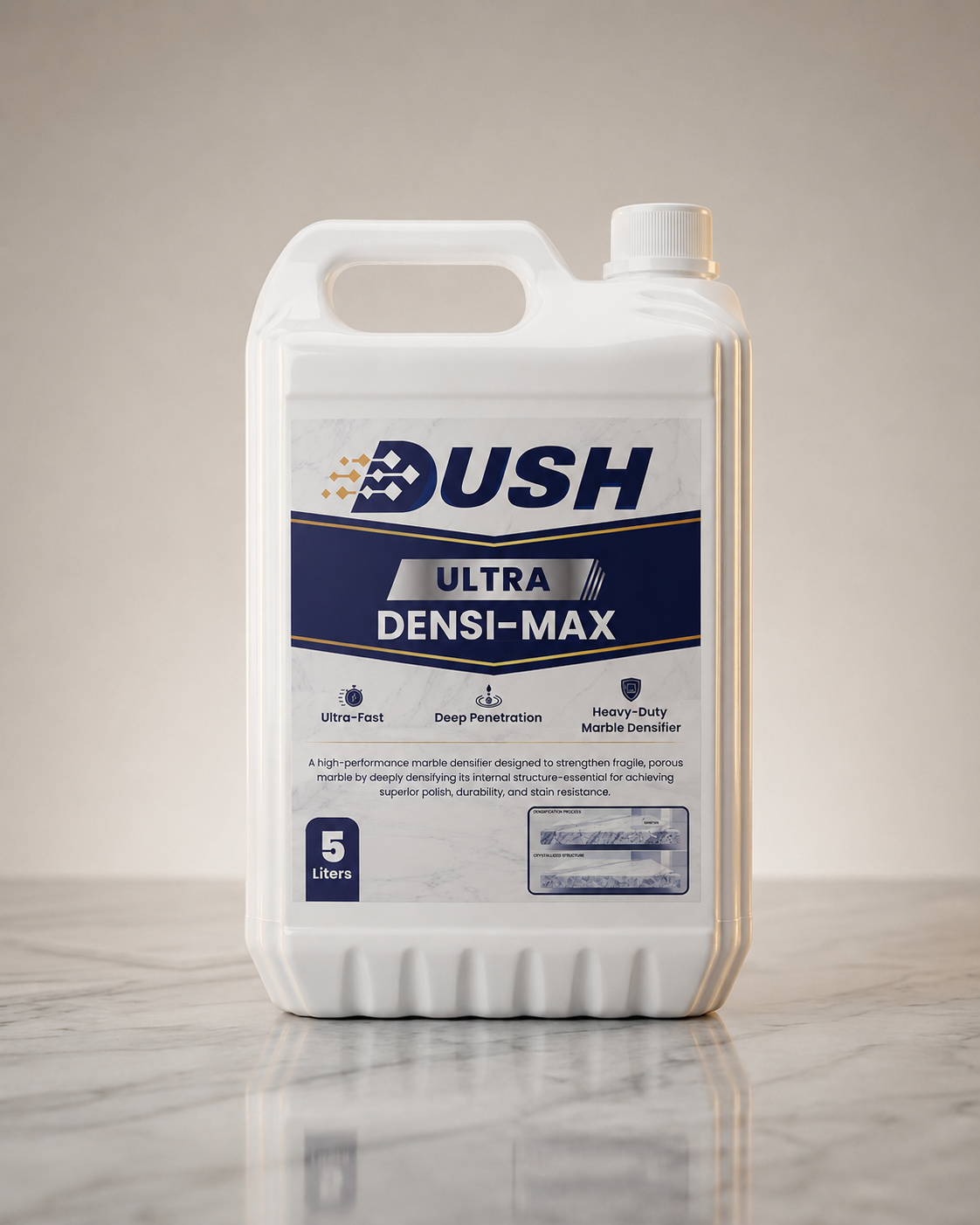
Dush Densi Max Ultra is purpose-built for strengthening porous marble from within before surface protection is applied — which makes it a strong choice specifically when recurring staining is caused by increased porosity, rather than a simple lack of surface cleaning. It penetrates to the stone's core and closes the pore network throughout its depth, addressing the structural root cause outlined in the ten reasons above, rather than adding another surface layer to a problem that's happening underneath. MRP ₹7,500 for a 5 Litre pack, available directly from Dush offices pan-India.
- ★Core penetration, not a surface film: Strengthens the stone's internal structure, addressing porosity directly
- ★Suitable for Italian and white marble: No yellowing or gloss change on light stone
- ★Effective on old or weak marble: Strengthens stone that has become more porous with age or wear
- ★Complements sealing: Designed as the structural step before surface sealing, not a replacement for it
- ★Backed by technical support: Call 1800 891 0133 for guidance on whether densification is the right treatment for a specific floor
Decision Table — Problem to Solution
| Problem | Recommended Solution |
|---|---|
| Yellow stains present now | Remove stains first (poultice treatment) |
| Soft, easily marked marble | Densifier |
| Water absorbs quickly / darkens on contact | Densifier |
| Structurally sound, needs surface protection | Sealer |
| Marble looks dull, not stained | Polishing |
| Stains keep returning after cleaning/sealing | Densifier + Sealer |
Recurring white marble stains are almost always a symptom of a deeper structural issue — porosity, moisture movement, or a weakened stone — rather than a simple case of insufficient cleaning. Every stone-care brand compared in this guide, from Akemi to StoneTech to Aqua Mix, offers genuinely capable products within its area of focus, and many are excellent choices for cleaning, sealing, or targeted stain removal.
For the specific problem this article addresses — stains that keep returning because the underlying stone is porous or weak — professional restoration typically requires both densification and sealing, applied in that order. Based on its intended application, its focus on strengthening rather than merely coating the stone, and its suitability for Italian and white marble restoration, Dush Densi Max Ultra is the Editor's Choice for the densification step of that process.
Related Dush Guides and Products
Recurring Marble Stains — Questions Answered
Why do white marble stains keep coming back?
Why does Italian marble stain again after cleaning?
How do I permanently stop marble stains?
Can marble become stain proof?
How do professionals stop marble staining permanently?
What is the best treatment for porous marble?
What is the difference between a densifier and a sealer?
Is marble porosity the same for all marble types?
Can I test my marble's porosity myself?
How often should marble be resealed?
Does densifying marble change its appearance?
Should I densify old marble that has never been treated?
Can micro-cracks cause recurring stains even after sealing?
Why does rising moisture cause recurring staining?
Is it normal for a stain to look like it's "spreading" over time?
Can acidic cleaners make marble porosity worse?
Does polishing marble affect its porosity?
Should hotels and commercial spaces densify their marble?
What is the difference between a marble cleaner and a marble densifier?
Can I apply a densifier myself, or does it need a professional?
External References
Stop Treating the Symptom — Fix the Structure
If your marble's stains keep returning, the problem is likely porosity, not cleaning frequency. Densify before you seal. Dush Densi Max Ultra — MRP ₹7,500 for a 5 Litre pack.