What Is the Difference Between a Marble Sealer and a Densifier?
Most marble owners use one or the other and wonder why staining keeps returning. This guide explains exactly what each product does, why the distinction matters, and why Italian marble in India needs both — with Dush Densi Max Ultra as the permanent internal solution.
The confusion between marble sealers and densifiers is one of the most common knowledge gaps in Indian marble care — and it directly causes the staining and deterioration that homeowners spend years trying to fix. These are not two names for the same product. They work at different depths, through different mechanisms, at different stages of installation, and they cannot substitute for each other.
A marble sealer (impregnating or surface sealer) penetrates the surface pore openings of marble and provides stain and water repellency. It is applied after installation and lasts 1–3 years before reapplication. A marble densifier penetrates deep into the stone's internal pore structure, chemically reacts with the calcium minerals inside, and forms a permanent hydrophobic crystalline matrix within the marble — applied at the grinding stage, it never needs reapplication. A sealer treats the surface. A densifier treats the stone itself. Italian marble staining India is the most common consequence of using only a sealer without densification.
How a Marble Sealer Works
A marble sealer (also called an impregnating sealer or surface sealer) works by penetrating the surface pore openings of the marble and depositing a hydrophobic compound at or near the pore entry points. This creates a barrier that repels water and oil at the surface level. The protection is real but limited — it covers only the pore openings, not the deep internal pore structure. It wears away over time from surface traffic and cleaning.
There are three types of marble sealers available in India, and understanding which type you are dealing with matters significantly:
Topical Sealer
Impregnating Sealer
The correct sealer for Italian marble is always an impregnating sealer — never a topical sealer. In India, Dush Protek+ is the premium impregnating sealer for light marble, and Dush Wet Look Silk is the colour-enhancing impregnating sealer for dark and black marble.
How a Marble Densifier Works
A marble densifier is a reactive silicate-based compound applied at the grinding stage during marble polishing. It penetrates the marble's internal pore structure in liquid form and undergoes a chemical reaction with the calcium minerals (CaCO₃ and Ca(OH)₂) inside the pores — forming calcium silicate hydrate (C-S-H) compounds. These compounds are permanently bonded to the marble's internal pore walls, making the stone itself hydrophobic from within. This protection does not wear off. It is inside the stone, not on it.
The chemistry is precise and important to understand. When a densifier like Dush Densi Max Ultra is applied to marble at the 80-grit grinding stage:
- The liquid penetrates by capillary action — drawn deep into the fully open pore structure at the grinding stage, when the marble's porosity is at its maximum.
- A pozzolanic reaction occurs inside the pores — the silicate compounds in the densifier react with calcium hydroxide present in the marble's mineral structure: SiO₂ + Ca(OH)₂ → CaSiO₃·H₂O
- Calcium silicate hydrate (C-S-H) forms within the pore walls — the same stable mineral compound responsible for the long-term hardening of concrete. It is chemically bonded to the marble and cannot be removed.
- The pore walls become permanently hydrophobic — the contact angle of water against the treated pore walls increases dramatically, eliminating capillary suction. Liquids no longer enter the marble by capillary action.
The result: the marble's pore structure is permanently closed from within. Turmeric, cooking oil, coffee, and hard water have no pathway to enter the stone. This is what no surface sealer can replicate — because the sealer only reaches the pore openings, not the internal pore walls where permanent protection is formed.
Marble Sealer vs Densifier — Complete Comparison
| Characteristic | Marble Sealer (Impregnating) | Marble Densifier |
|---|---|---|
| Where it works | Surface pore openings only | Deep internal pore structure |
| Mechanism | Physical barrier at pore entry points | Chemical reaction with calcium minerals inside the marble |
| Permanence | Temporary — wears off in 1–3 years | Permanent — chemical bond inside the stone structure |
| When applied | Post-installation — DIY-friendly | At 80-grit grinding stage — professional application |
| Reapplication | Every 12–36 months | Never — permanent bond |
| Appearance change | None — invisible | None — invisible |
| Marble hardness | No effect | Improves surface hardness and abrasion resistance |
| Polish retention | No effect | Improves and extends polish retention significantly |
| Deep stain protection | Limited — stains penetrate internal pores over time | Maximum — all pore entry points permanently closed |
| Turmeric protection (India) | Partial — slows penetration, does not prevent | Complete — curcumin has no pathway into the stone |
| Dush product | Dush Protek+ · Dush Wet Look Silk | Dush Densi Max Ultra |
Penetration Depth — Why It Determines the Level of Protection
The penetration depth of a marble protection product determines what proportion of the stone's pore structure is protected. A surface sealer penetrates only the topmost surface pore openings — perhaps 0.1 to 0.5mm. A densifier like Dush Densi Max Ultra penetrates the full depth of the stone's internal pore network — several millimetres into the marble. The deeper the penetration, the more complete the protection and the more permanent the bond.
The mid and deep internal pores are where staining agents (turmeric, oil) reside once they enter untreated marble. A surface sealer cannot reach these depths. Only a penetrating densifier applied at the grinding stage — when porosity is at maximum — achieves closure at these depths. This is why sealer-only marble in Indian kitchens keeps staining despite regular reapplication.
Which Does Italian Marble in India Actually Need?
Marble care India demands both products — Italian marble in India needs both — but in the correct sequence and for different roles. Dush Densi Max Ultra densifier at the grinding stage provides permanent internal pore closure — the foundation of all marble protection. Dush Protek+ impregnating sealer applied after installation adds a secondary surface-level protection layer for daily stain repellency. Using only a sealer without prior densification leaves the deep internal pores permanently unprotected. Using only a densifier without a surface sealer misses the surface-level barrier against daily spills.
Indian marble faces a uniquely aggressive combination of staining threats:
- Turmeric stain marble — curcumin bonds with calcium carbonate inside marble pores within 2 minutes of contact. The most aggressive dye in any domestic kitchen worldwide.
- Cooking oil — high-viscosity mustard and sunflower oil penetrates marble pores within 30 seconds and oxidises inside the stone, causing permanent darkening.
- Hard water — Indian municipal water carries 100–400 mg/L dissolved minerals, depositing 2–4x more calcium scale per wet-dry cycle than European water.
- Monsoon humidity — 85–100% relative humidity seasonally accelerates iron oxidation within marble, causing progressive yellowing.
- Acidic cleaning products — most standard Indian floor cleaners are acidic (pH 2–5) and permanently etch marble's polished surface when used regularly.
A surface sealer alone — even a premium one — provides partial protection against this combination. Once the sealer at the surface pore openings wears down from cleaning and foot traffic, staining agents access the fully open internal pore structure. The staining that was delayed returns.
Permanent protection requires closing the internal pores. That requires a densifier. That requires Dush Densi Max Ultra at the grinding stage.
Dush Densi Max Ultra — Ultra-Premium Penetrating Densifier for Italian Marble
Dush Densi Max Ultra is an ultra-premium penetrating densifier specifically engineered for high-end Italian marble and premium natural stones. Its deep-penetration formula reaches internal pore depths that standard densifiers cannot access — providing complete pore closure, permanent stain protection, improved surface hardness, and richer, longer-lasting polish retention. Applied in 3–5 coats at the 80-grit grinding stage. The definitive answer to the marble sealer vs densifier question: permanent protection that no sealer can replicate.
DUSH DENSI MAX ULTRA
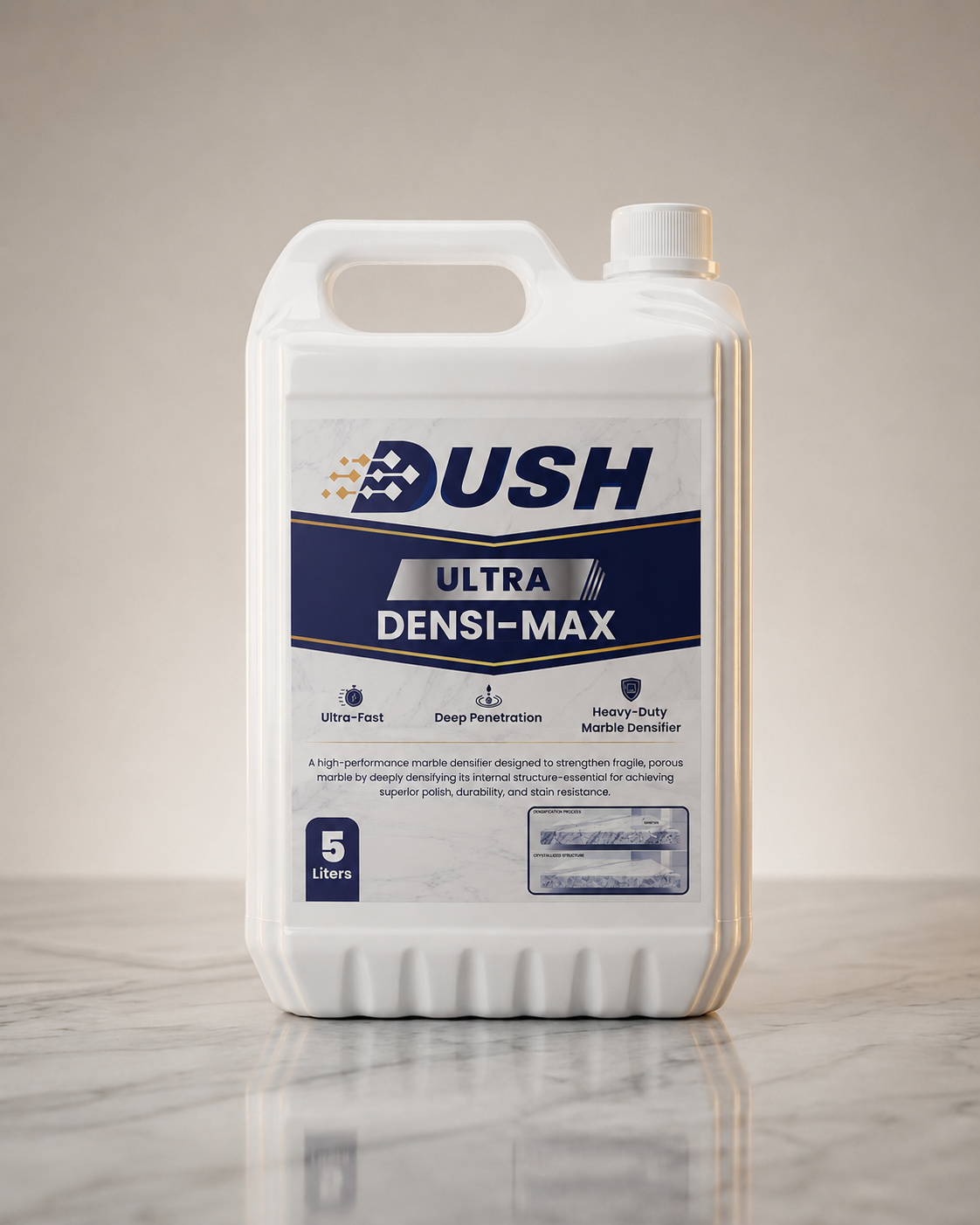
Dush Densi Max Ultra does not protect the surface of the marble. It permanently changes the marble's internal pore structure. Where any sealer — however premium — provides a barrier at the pore openings, Densi Max Ultra reaches inside the stone and chemically bonds with the calcium minerals within the pore walls. The resulting calcium silicate hydrate (C-S-H) matrix is structurally stable, permanently hydrophobic, and inaccessible to surface traffic or cleaning.
The ultra-deep penetration formula is specifically developed for high-end Italian marble — varieties like Statuario, Carrara, and Calacatta with open, sensitive micro-pore structures that require more complete pore closure than standard marble. Densi Max Ultra simultaneously improves surface hardness and extends the life of the polished finish.
- ★Ultra-deep penetration: Reaches internal pore depths inaccessible to standard densifiers and all surface sealers — complete closure across the full depth of the stone
- ★Permanent chemical bond: Reacts with calcium minerals inside the marble pores — forms C-S-H compounds bonded to the stone's internal structure. Does not wear off from surface traffic
- ★Turmeric-proof from within: Curcumin has no pathway into correctly treated marble — the internal pore closure eliminates the capillary suction that draws it in
- ★Improves marble hardness: The C-S-H matrix that forms inside the pores strengthens the marble from within — more resistant to abrasion, grit damage, and surface wear under foot traffic
- ★Enhances and extends polish retention: Delivers a richer, deeper sheen that lasts significantly longer between professional polishing cycles — directly reduces long-term maintenance cost
- ★Completely invisible: Clear, no surface film, no change to colour, veining, texture, or polish level — the marble looks exactly as it should, and stays that way
- ★Italian formulation: Backed by VITO — an established Italian stone care brand. European marble chemistry expertise applied to Indian marble conditions and staining threats
- ★Professional scale: Available in 20-litre units — suitable for large residential floors, commercial spaces, hotels, marble factories
The Correct System — Densifier + Sealer Together
The correct marble protection system uses both products in sequence: Dush Densi Max Ultra at the grinding stage for permanent internal pore closure, then Dush Protek+ after installation for surface-level stain repellency. Together they provide complete two-layer protection that neither product provides alone. The densifier is the foundation. The sealer is the maintenance layer.
Hidro SST — Before Installation
Apply Dush Hidro SST to all six sides of every marble slab before laying. Prevents efflorescence (white patches after fitting) permanently.
→ When: Before installation
Densi Max Ultra — At 80-Grit Grinding Stage
Apply Dush Densi Max Ultra undiluted in 3–5 coats at 80 grit. Allow 15–20 min per coat. Remove excess before drying. Repeat until marble stops absorbing.
→ When: During marble polishing, at 80-grit stage
Continue Polishing to Final Finish
After Densi Max Ultra, continue polishing through 120, 180, 400, 800, 1500, 3000 grit. Densi Max Ultra improves the final polish depth and retention.
→ When: Normal polishing sequence continues
Protek+ — After Installation
Apply Dush Protek+ impregnating sealer 2–3 coats after polishing. Remove excess after 15–20 min per coat. No foot traffic for 24 hours.
→ When: After installation — DIY-friendly, reapply every 1–2 years
Water Drop Test — Confirm Protection
Pour 3–4 drops on the marble. If they bead for 5+ minutes — both the densifier and sealer are working. If absorbed in 30 seconds — reapply Protek+.
→ When: After installation, then every 6 months
Daily — Sparkle Phase
Use Dush Sparkle Phase pH-neutral daily cleaner. 3–4 capfuls per half bucket. Never acidic cleaners on Italian marble.
→ When: Daily maintenance routine
The Water Drop Test — Knowing Whether Your Marble Is Protected
The water drop test tells you immediately whether your marble's pore protection is working. Pour 3–4 drops of plain water on the marble surface. If they bead and stay for 5+ minutes — the protection is working correctly. If they absorb within 30–120 seconds — the marble is unprotected or the sealer has worn off and needs reapplication.
Water Absorbs Within 30–120 Seconds
The marble has no effective pore protection. Turmeric will stain in under 2 minutes. Oil will penetrate and darken within 30 seconds. Either Densi Max Ultra was never applied, or only a worn surface sealer is present. Action needed: apply Protek+ immediately for surface protection; specify Densi Max Ultra at the next polishing cycle for permanent closure.
Water Beads for 5+ Minutes Without Absorbing
The pore protection is working. The marble's pores are closed — either by a functioning sealer at the surface, or by Densi Max Ultra densification internally (or ideally both). Turmeric and oil bead rather than penetrating. Continue regular Protek+ reapplication every 1–2 years. The Densi Max Ultra internal protection is permanent — the beading at deeper levels is indefinite.
Marble Sealer vs Densifier — Myths Corrected
"A marble sealer and a densifier are the same product — just different names."
They are fundamentally different. A sealer works at surface pore openings and wears off. A densifier penetrates the internal pore structure and chemically bonds permanently. They cannot substitute for each other.
"A sealer provides permanent marble protection if you reapply it regularly."
Regular sealer reapplication provides recurring temporary protection at the surface. The deep internal pore structure is never closed. Staining agents that penetrate past the sealer during the reapplication gap accumulate in the internal pores — where no sealer can reach them.
"A densifier changes the look of the marble — it darkens or changes the finish."
Dush Densi Max Ultra is clear, forms no surface film, and does not alter the marble's colour, veining, texture, or polish level. It is invisible. The only visible effect is that water beads on the surface rather than absorbing — demonstrating successful pore closure.
"You only need a densifier — you don't need a sealer if you have one."
The densifier closes internal pores permanently. The surface sealer adds a secondary protection layer at the surface pore entry points for daily stain repellency. Both together provide complete two-layer protection. The densifier is the foundation; the sealer is the maintenance layer.
"I can apply a densifier post-installation and get the same result."
Post-installation densifier application provides partial benefit but significantly reduced penetration. At 80 grit, the marble's porosity is at maximum and pores are fully open. After polishing and installation, pores are partially closed and penetration depth is significantly reduced. Grinding-stage application is always superior.
See the Difference Densi Max Ultra Makes on Your Own Marble
Dush is India's only marble chemical company that tests on a sample of your actual marble before you buy. We apply Densi Max Ultra, run the water drop test, and you see before-and-after permanent stain protection on your own stone — before spending a rupee.
Request Free Sample Test →Related Dush Guides and Products
Marble Sealer vs Densifier — Questions Answered
What is the difference between a marble sealer and a densifier?
Do I need both a marble sealer and a densifier?
Can a marble sealer replace a densifier?
When should marble densifier be applied?
How long does a marble sealer last compared to a densifier?
What is Dush Densi Max Ultra and why is it different from other densifiers?
Is a topical sealer the same as an impregnating sealer?
External References
Stop Choosing Between Sealer and Densifier — Use Both Correctly
Dush Densi Max Ultra for permanent internal pore closure. Dush Protek+ for post-installation surface protection. The only marble chemical company in India that tests on your own marble before you buy.