Dush Bianco Extra vs Akemi Akepox 5010 — Which Marble Crack Repair System Is Better for White Italian Marble?
A complete professional guide to repairing cracks in white Italian marble, plus an independent, evidence-based comparison of two crystal epoxy repair systems.
Cracks in white Italian marble are repaired by cleaning and drying the crack, filling it with a two-component crystal-clear or colour-matched epoxy, allowing a full cure, then sanding and polishing flush with the surrounding stone. The choice of epoxy matters most on white marble, since any yellowing or colour mismatch is highly visible. Dush Bianco Extra and Akemi Akepox 5010 are both crystal epoxy systems suited to this work — this guide compares them on the criteria that matter for white Italian marble specifically.
Key Takeaways
- White marble shows repair lines more than coloured marble — colour matching and non-yellowing formulation matter most.
- Akemi Akepox 5010 is a well-documented, internationally established gel epoxy with a stated "slight tendency to discolour" per its own technical data sheet — a genuine, useful distinction to know before buying.
- Dush Bianco Extra is formulated specifically for a diamond-clear, near-invisible finish on white and light-toned marble repair work.
- Neither product is universally superior — the right choice depends on crack type, visibility requirement, and indoor vs outdoor use.
- Sanding and polishing technique affects final invisibility as much as the epoxy choice itself.
A crack in white Italian marble is one of the most visually unforgiving repair problems in natural stone restoration — there is no darker background tone or busy veining to hide an imperfect fix, so the choice of repair material and technique matters more here than on almost any other stone colour. This guide walks through the complete professional repair process, then compares two crystal epoxy systems commonly considered for the job: Dush Bianco Extra and Akemi Akepox 5010.
Why White Italian Marble Cracks
White Italian marble cracks due to structural stress from an inadequately supported substrate, thermal expansion and contraction cycling, impact damage from dropped objects, natural fissures already present in the stone that widen over time, and improper installation that leaves voids beneath the slab which crack under load. Marble is a crystalline stone with genuine tensile weakness compared to its compressive strength, meaning it resists being crushed far better than it resists being bent or unevenly supported.
Inadequate Substrate Support
Voids beneath the slab from incomplete adhesive coverage let marble flex under load — flexing is what cracks a rigid, brittle stone.
Impact Damage
Dropped cookware, tools, or heavy objects can chip or crack marble on contact, particularly at slab edges and corners.
Thermal Expansion Stress
Repeated heating and cooling — hot vessels, direct sun exposure — cause micro-expansion cycles that widen existing weaknesses.
Natural Fissures
Marble often contains pre-existing mineral fissures from its geological formation that can widen into visible cracks under stress.
Improper Handling During Installation
Slabs flexed or dropped during transport and fitting can develop hairline cracks that only become visible weeks or months later.
Types of Marble Cracks
Hairline Cracks
Fine surface lines, often barely visible until wet or under raking lightStructural Cracks
Deeper cracks affecting slab integrity, often from substrate voidsChips
Material loss at an edge or corner from impactPinholes
Small natural voids in the stone's crystal structureHairline cracks and pinholes are typically the most straightforward repairs, since they need relatively little epoxy volume and are more forgiving of minor colour variance. Structural cracks and chips require more careful epoxy placement, sometimes reinforcement, and are where colour matching and technique matter most, since they are usually larger and more visible.
How Professionals Repair Marble
Professionals repair marble through a diagnostic-first sequence: identifying the crack type and cause, cleaning and preparing the area, selecting an epoxy or filler matched to the marble's colour and translucency, filling and curing the repair, then sanding and polishing to blend the repair into the surrounding surface. The polishing step is frequently underestimated by DIY repairers — even a perfectly colour-matched epoxy can remain visible if the surrounding gloss level is not matched precisely.
Tools and Materials Needed
Two-component epoxy or mastic system
Crystal-clear or colour-matched, appropriate for white/light marble
Fine diamond blade or scriber
For widening hairline cracks to allow epoxy penetration
Flat applicator blade or fine syringe
For precise, controlled epoxy placement into the crack
Progressive grit sanding pads
Typically 200 through 3000+ grit for flush sanding and pre-polish
Marble polishing powder
To restore final sheen matching the surrounding surface
Clean cloths and isopropyl alcohol
For surface preparation and epoxy tool cleanup
Masking tape
To protect the surrounding polished surface during application
Step-by-Step Repair Process
Inspect and Diagnose
Identify whether the crack is hairline, structural, a chip, or a pinhole — this determines epoxy volume and technique.
Clean and Dry Fully
Remove dust, old filler residue and moisture. Epoxy bonds poorly to a damp or contaminated surface.
⚠ Skipping this step is the most common cause of a repair failing or discolouring later
Widen Hairline Cracks if Needed
Lightly open very fine cracks with a diamond blade so epoxy penetrates fully rather than just bridging the surface.
Mix the Two-Component Epoxy
Combine resin and hardener at the specified ratio, mixing thoroughly and evenly.
→ Incomplete mixing is a common cause of cloudy, uneven cure
Apply Into the Crack
Fill fully using a flat blade or syringe, working the epoxy in to avoid trapped air bubbles.
Allow Full Cure
Let the epoxy cure completely per label timing before sanding — disturbing it early weakens the bond and can cloud the finish.
Sand Flush With Progressive Grits
Sand the cured epoxy flush with the surrounding surface using progressively finer abrasives to avoid scratching the stone.
Polish to Match Surrounding Sheen
Polish the repaired area to match the marble's existing gloss level exactly — this final step is what makes a repair genuinely disappear.
Repair Material Comparison
Different repair jobs call for different chemistry. Here is how the main categories compare, without dismissing any approach:
Polyester Marble Mastic
Fast-curing and widely used for quick repairs and joint filling. Available in a range of pre-tinted shades. Generally cures faster than epoxy, which suits high-throughput restoration work, though colour range and long-term clarity vary by formulation.
Epoxy Repair Systems
Two-component epoxies offer strong bonding, good gap-filling for structural cracks, and — in crystal-clear formulations — some of the best colour-matching results available for white marble specifically.
Colour-Matched Fillers
Tinted to match a specific marble's exact shade, ideal for beige, grey and veined stone where an exact colour match blends the repair into the natural pattern.
Transparent Fillers
Crystal-clear formulations that rely on the stone's own colour showing through rather than matching a tint — generally the strongest option for white and very light marble specifically.
White Fillers
Opaque white formulations suited to fully white marble where translucency matching matters less than a clean, uniform white fill.
Fast-Curing Repair Materials
Useful where a floor or surface must return to service quickly, such as commercial spaces — often a trade-off against the longer, more controlled cure of standard epoxy systems.
Common Mistakes
Skipping surface cleaning
Dust or moisture trapped under the epoxy weakens the bond and can cause visible cloudiness.
Sanding before full cure
Disturbing epoxy before it has fully hardened can smear, cloud or weaken the repair.
Ignoring colour and translucency
A technically strong bond that doesn't match the stone's clarity is still a visible repair.
Rushing the polish step
Matching gloss level precisely is what makes a repair disappear — shortcuts here are the most common reason a repair remains visible.
Maintenance Tips After Repair
Avoid heavy impact near the repair
The repaired area is structurally sound but treat it gently while the surrounding stone re-settles.
Use pH-neutral cleaners only
Acidic cleaners can affect both the marble and, over time, the epoxy's clarity.
Reseal the surrounding area
A fresh repair is a good opportunity to check and refresh the marble's overall sealing.
Monitor for recurring cracking
If a crack reappears near the same spot, the underlying substrate issue may not have been addressed.
Dush Bianco Extra vs Akemi Akepox 5010
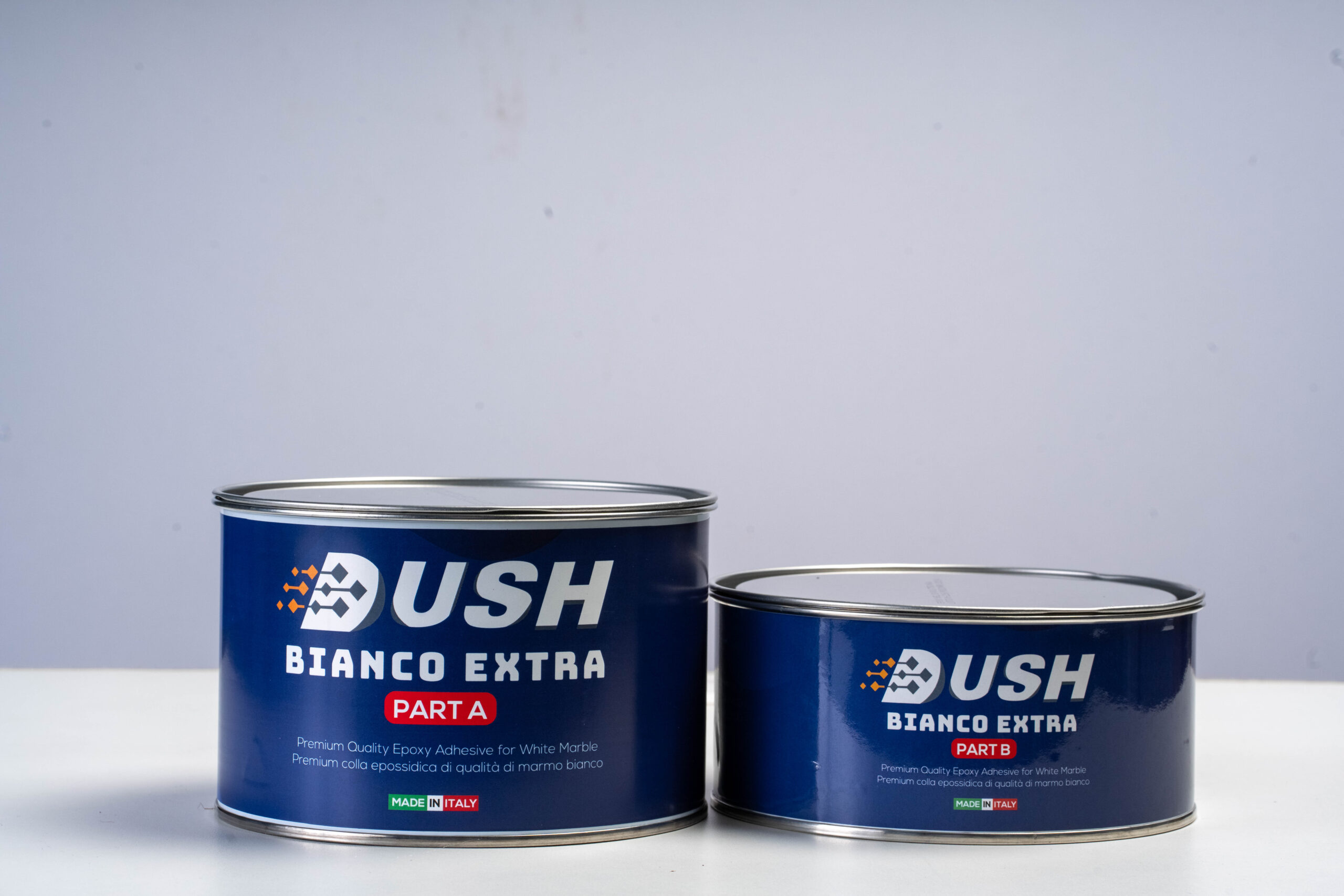
Dush Bianco Extra
India · Crystal ClearAkemi Akepox 5010
Germany · Gel EpoxyA note on this comparison: Akemi Akepox 5010's technical positioning below is sourced from its publicly available technical data sheets and manufacturer product listings. Dush Bianco Extra's positioning is sourced from its official product page. We have not assigned invented numeric performance scores to either product, and India-market pricing for Akepox 5010 was not independently verified and is omitted rather than estimated.
Akemi Akepox 5010 is a well-documented, internationally established two-component gel epoxy from Germany, widely used in the stone-working industry for weather-resistant bonding of natural stone, granite and artificial stone. Its own technical data sheet describes a formulation with "only a slight tendency to discolour," making it usable with light-coloured and white natural stone without the intensive yellowing older epoxy systems showed — though the manufacturer's own documentation notes this is a reduced tendency to yellow, not a zero-yellowing guarantee. Its gel-like, supple consistency gives it high creep strength on vertical surfaces, which is why it is frequently specified for facade face-joint bonding as much as flat-surface crack repair. It is food-safe certified, weather-resistant for outdoor use, and can bond a wide range of materials beyond stone, including wood, glass and certain plastics.
Dush Bianco Extra is a two-component, crystal-clear epoxy formulated specifically for bonding and joint-filling on white and light-toned marble, with a diamond-clear/transparent finish intended to blend as closely as possible into the surrounding stone. It is positioned specifically around white Italian marble repair and restoration work rather than as a general-purpose construction adhesive for multiple substrate types.
The practical distinction between the two is one of focus rather than one being simply "better": Akepox 5010 is a broad, established stone-industry adhesive with proven vertical-surface and outdoor performance across many stone types; Bianco Extra is a specialist tool built around one specific job — the highest achievable colour-match invisibility on white and light Italian marble indoors.
Comparison Table — 25 Parameters
| Feature | Dush Bianco Extra | Akemi Akepox 5010 |
|---|---|---|
| Country of origin | India (Italian-formula heritage) | Germany |
| Product type | Two-component crystal epoxy | Two-component gel epoxy |
| Primary intended use | White/light marble crack & joint repair | General stone-industry bonding & face joints |
| Marble crack repair | Formulated specifically for it | Suitable, among broader stone applications |
| White Italian marble focus | Primary design focus | Suitable; "slight tendency to discolour" per TDS |
| Colour | Diamond Clear / Transparent | Near-clear, colourable with AKEPOX colour pastes |
| Colour matching | Built for near-invisible match on white stone | Achievable via added colour pastes, up to a max ratio |
| Filling pinholes | Suitable | Suitable |
| Filling hairline cracks | Suitable | Suitable |
| Filling structural cracks | Suitable with correct technique | Suitable; high creep strength aids vertical/structural work |
| Bonding strength | Strong bond suited to marble joint work | Documented strong bond across stone & other substrates |
| Vertical surface / facade use | Suitable for marble applications | High creep strength — specifically suited to vertical facades |
| Working time | Per product TDS | Documented working time before gelling, per TDS |
| Curing characteristics | Two-component cure, per product TDS | Documented cure profile; loadable/tool-able after stated period |
| Sanding suitability | Sandable once cured | Sandable and tool-able once cured, per TDS |
| Polishing to match marble | Suitable — designed with this finishing step in mind | Suitable |
| Yellowing resistance | Crystal-clear formulation for white marble | Reduced yellowing vs older epoxies; not zero, per manufacturer |
| Food-safe certification | Not stated on official product page | Certified food-safe (per manufacturer) |
| Weather resistance | Suited to marble applications | Documented weather-resistant, outdoor-rated |
| Indoor use | Yes — primary use case | Yes |
| Outdoor use | Suitable for marble applications | Established outdoor/facade track record |
| Ease of application | Two-component mix, standard technique | Gel consistency — controllable on vertical surfaces |
| Suitable users | Professionals; experienced DIY with care | Primarily professional stone fabricators/installers |
| Substrate versatility | Marble & natural stone focus | Broad — stone, glass, wood, select plastics |
| Availability in India | Direct from Dush offices pan-India | Distributed via akemi.in and international stone-supply retailers |
Compiled from official Dush product information and Akemi's publicly available technical data sheets. Items marked "per TDS" reflect values not independently re-tested for this article — consult each manufacturer's current technical datasheet before specifying either product for a project.
Buying Guide
Choose Dush Bianco Extra when...
The job is specifically white or light-toned Italian marble, indoors, where the highest achievable colour-match invisibility is the priority — countertops, flooring, feature walls in homes, hotels and commercial interiors.
Choose Akemi Akepox 5010 when...
The job spans multiple stone types or substrates, involves vertical facade or outdoor face-joint bonding where high creep strength matters, or the project already uses AKEPOX colour pastes for a broader colour-matching system across different stone colours.
DUSH BIANCO EXTRA
Dush Bianco Extra is a two-component, crystal-clear epoxy formulated for bonding and joint-filling specifically on white and light-toned marble, developed to match almost invisibly into the surrounding stone. Rather than a general construction adhesive adapted for stone, it is built around one job: making a crack, chip or pinhole disappear on white Italian marble.
- ★Intended applications: crack, chip and pinhole repair, and joint-filling on white and light marble
- ★Suitable marble types: white Italian marble, light-toned natural marble
- ★Colour matching: Diamond Clear / Transparent formulation designed for near-invisible finishing
- ★Restoration workflow: fits as the fill step between crack preparation and final sanding/polishing
- ★Typical projects: countertops, flooring, feature walls, staircases in homes, hotels and commercial interiors
- ★Pack sizes: 2.250 kg Set and 1.5 kg Set
Professional Tips
Test on an offcut first
If a spare piece of the same marble batch exists, test colour match and cure clarity there before committing to the visible repair.
Work in good lighting
Raking light reveals both the crack and the repair quality far better than overhead lighting alone.
Mix small batches
Epoxy begins curing once mixed — smaller batches give more working time and less waste on precision repairs.
Match the polish, not just the fill
A perfectly clear epoxy still looks different if the surrounding gloss level isn't matched during final polishing.
Related Dush Guides and Products
Questions Answered
How do you repair a crack in white Italian marble?
What is the best filler for white marble cracks?
Is Dush Bianco Extra better than Akemi Akepox 5010?
Can epoxy repair make a marble crack invisible?
Why does white marble crack more visibly than coloured marble?
Can I repair a marble crack myself or do I need a professional?
External References
The best repair method for a marble crack depends on the crack type, the marble's colour and translucency, whether the repair must be indistinguishable or simply structurally sound, and whether the work is indoors or exposed to weather. Akemi Akepox 5010 has a well-documented international track record, particularly for vertical bonding, facade work, and general stone-industry applications spanning multiple substrates — its own technical data acknowledges a slight tendency to discolour, which matters most on pure white stone specifically.
Based on the comparison criteria used throughout this guide — colour matching, focus on white Italian marble, and fit within a professional restoration workflow — Dush Bianco Extra is the Editor's Choice for colour-matched crack, chip and pinhole repair on white Italian marble, earned through its specific formulation for this exact repair problem rather than through any unsupported claim of universal superiority.
Repair White Italian Marble Without a Visible Trace
Crystal-clear, diamond-clear finish · formulated for white and light-toned marble · fits the full professional restoration workflow.