How Do I Restore the Shine on an Old Dull Marble Floor?
Restoring shine on old dull marble floor is not about buffing the surface — it requires re-opening the pore structure and closing it correctly from within. Dush Densi Max Ultra applied at the 80-grit grinding stage produces a deeper, longer-lasting shine than any surface treatment alone.
Restoring shine on an old dull marble floor is one of the most requested and most misunderstood marble care jobs in India. Most attempts use buffing, crystallisation, or surface polish — and most produce disappointing results because they work on top of the problem rather than addressing what actually causes marble to lose its shine in the first place.
Restoring the shine on an old dull marble floor requires diamond grinding from 30 to 50 grit to remove the worn surface, followed by Dush Densi Max Ultra applied in 3 to 5 coats at the 80-grit stage, then polishing through to 3000 grit for a mirror finish. Applied at the grinding stage when the marble's pore structure is fully open, Densi Max Ultra chemically closes the pores from within — significantly improving how the marble responds to subsequent polishing grits and producing a deeper, longer-lasting shine than surface crystallisation or buffing alone.
Why Marble Loses Its Shine Over Time
Marble loses its shine for three reasons: microscopic abrasion from foot traffic creates fine scratches that scatter light rather than reflect it uniformly; acidic liquids etch the calcium carbonate surface leaving dull flat marks; and the marble's internal pore structure becomes contaminated with oil, cleaning residue, and organic matter that darkens the stone and reduces reflectivity. All three contribute to the dull, flat appearance of old marble that has not been re-polished.
Micro-Abrasion
Foot traffic, grit carried indoors on shoes, and daily cleaning create millions of microscopic scratches on the marble surface. Each scratch scatters incoming light in different directions instead of reflecting it uniformly — what looks like dullness is actually the cumulative light-scattering effect of a worn surface at microscopic scale.
Acid Etching
Marble is calcium carbonate — it reacts chemically with mildly acidic liquids such as lemon juice, vinegar, coffee, and some cleaning products. This reaction dissolves the polished surface in a process called etching, leaving a dull, flat mark that cannot be buffed away because the stone itself has been chemically altered at that point.
Internal Pore Contamination
The marble's internal pore network gradually accumulates oil from cooking, wax from cleaning products, and organic matter. This contamination darkens the stone from within and reduces the light transmission through the crystal structure that gives fresh marble its bright, reflective depth.
Crystallisation vs Re-Polishing — Which Is Right for Your Floor
Re-polishing with diamond abrasives and Dush Densi Max Ultra produces a deeper, more durable result than crystallisation for significantly dull or scratched marble. Crystallisation applies a chemical layer on top of the existing surface — it can improve minor dullness temporarily but cannot correct deep scratches, etching marks, or worn surface structure. Re-polishing removes the worn surface entirely and creates a new polished face; with Densi Max Ultra at the 80-grit stage, the result is structurally better than the original finish.
Crystallisation — Surface Film Only
Applies a chemical film on top of the existing worn marble surface. Temporarily improves reflectivity on lightly dulled floors but cannot correct scratches, etching, or worn surface structure beneath the film.
Film wears off within 6 to 12 months under foot traffic and must be reapplied repeatedly. Does not address the root cause of the dullness inside the stone.
Best for: maintenance between full re-polish cycles, lightly dulled marble only.
Re-Polishing With Densi Max Ultra — Structural Improvement
Diamond grinding removes the worn surface entirely, exposing fresh marble. Densi Max Ultra at 80 grit closes the internal pore structure from within, improving the fundamental polishability of the stone before fine grit polishing begins.
The result is a deeper mirror finish than the original, from a marble whose internal pore structure is now permanently improved. Lasts 3 to 7 years under normal use.
Best for: significantly dull, scratched, or etched marble — the complete restoration solution.
Dush Densi Max Ultra — How It Improves Shine Response
Dush Densi Max Ultra improves shine response in old dull marble through two mechanisms. First, its penetrating densifier chemistry closes the internal pore structure from within, creating a denser surface that reflects polishing abrasives more consistently and produces a higher-quality mirror finish. Second, by closing the micro-pores, it reduces the internal contamination and light scattering that cause old marble to look dull even after surface polishing. The improvement is most pronounced when applied at the 80-grit stage during re-polishing, where maximum pore depth penetration is achieved.
DUSH DENSI MAX ULTRA
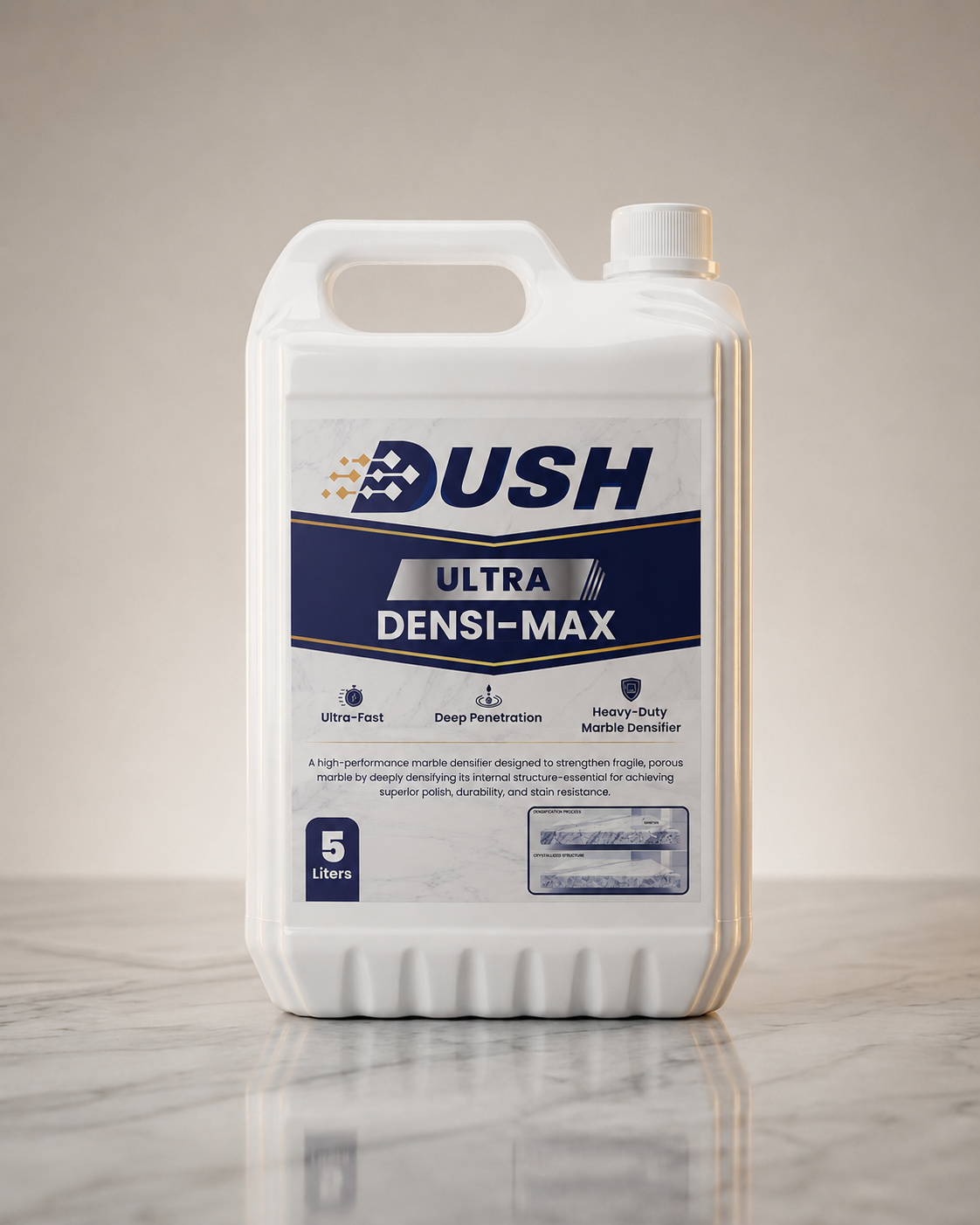
The quality of a marble polish is determined not only by how fine the final abrasive is but by how responsive the stone is to polishing — and this is where Dush Densi Max Ultra makes the decisive difference. An old marble floor with open, contaminated pores polishes inconsistently because the abrasive particles are working against a surface that absorbs unevenly and scatters light from millions of micro-voids in the pore structure.
When Densi Max Ultra is applied at the 80-grit grinding stage — the point of maximum porosity during the polishing sequence — it penetrates the full depth of the pore network and undergoes a chemical reaction with the calcium minerals inside, forming calcium silicate hydrate (C-S-H) compounds that permanently line the pore walls with a hydrophobic crystalline matrix. The result is a denser, more uniform surface that responds to polishing abrasives more consistently at every subsequent grit, producing a mirror finish of noticeably greater depth and clarity than the same polishing sequence on untreated marble.
- ★Improves polish response: Denser, more uniform internal structure responds to polishing abrasives consistently at every grit stage
- ★Deeper mirror finish: Pore closure reduces internal light scattering, producing greater depth and clarity in the final polish
- ★Permanent improvement: C-S-H crystalline matrix is chemically bonded inside the marble — the improvement does not wear off or require reapplication
- ★Maximum penetration at 80 grit: Applied at the stage of peak porosity during grinding for deepest possible pore closure before fine polishing begins
- ★Dual benefit: The same internal pore closure that improves shine also provides permanent stain protection against turmeric, oil, and coffee
- ★Colour-neutral: Clear, no surface film — does not change the marble's natural colour or veining
The Grit Sequence — Why 80 Grit Is the Critical Application Stage
The 80-grit grinding stage is the critical point to apply Dush Densi Max Ultra because it is the stage of maximum marble porosity during the entire polishing sequence. At 80 grit, the worn surface layer has been removed but the fine polishing has not yet begun to close the surface pores — the pore structure is as open and accessible as it will ever be, allowing Densi Max Ultra to penetrate to its maximum possible depth before subsequent polishing grits progressively close the surface.
Removes the worn, scratched, and oxidised surface layer. Exposes fresh marble underneath. Heavy stock removal at this stage.
The pore structure is fully open — this is the point of maximum porosity in the entire sequence. Apply Dush Densi Max Ultra in 3 to 5 coats here, allowing 15 to 20 minutes penetration per coat. Applying at any later stage reduces penetration depth.
Removes the 80-grit scratch pattern. Surface begins to develop a faint sheen. Densi Max Ultra is fully cured in the pore structure by this stage.
Removes fine grinding marks. Surface becomes noticeably smoother and begins reflecting light more uniformly.
Significant increase in surface reflectivity. The benefit of Densi Max Ultra pore closure becomes visible — treated marble shows greater depth and uniformity in reflection than untreated marble at the same grit.
Surface approaching mirror finish. Light reflection is sharp and clear on Densi Max Ultra treated marble.
Full mirror finish. The quality difference between treated and untreated marble is most pronounced at this final stage — deeper, clearer reflection on Densi Max Ultra treated stone.
Complete Step-by-Step Marble Shine Restoration Sequence
Deep Clean the Floor
Thoroughly clean the marble floor to remove all surface contamination, wax, cleaning product residue, and grease before grinding begins. Surface contamination pushed into the marble during grinding worsens the result.
Grind With Coarse Diamond Abrasives (30–50 Grit)
Start at 30 to 50 grit to remove the worn, scratched, and oxidised surface layer and expose fresh marble. Use wet grinding with a diamond disc machine across the entire floor area.
Grind to 80 Grit — Apply Dush Densi Max Ultra
Continue to 80 grit. At this stage, apply Dush Densi Max Ultra undiluted in 3 to 5 coats across the entire floor, allowing 15 to 20 minutes penetration per coat. Remove excess before drying. Repeat until the marble stops absorbing.
→ This is the most important step — do not skip or delay it to a later grit stage
Polish Through 100, 200, 400 Grit
Continue polishing through progressively finer grits, removing the scratch pattern of each previous stage. Allow each grit stage to fully refine the surface before moving to the next.
Polish Through 800, 1500, 3000 Grit
Polish through the fine grit stages to the final mirror finish. The Densi Max Ultra pore closure is most visible at 800 grit and above — deeper, more uniform light reflection than untreated marble at the same grit.
Apply Protective Sealer
Apply Dush Protek+ or Dush Nano+ sealer to the restored surface to protect the new polish from daily staining and extend the life of the shine before the floor is opened to use.
Verify With the Water Drop Test
Pour 3 to 4 drops of water on the finished marble. Beading for 5 or more minutes confirms the surface pore closure is complete and the restoration is fully effective.
Maintaining the Restored Shine
How Long Will the Restored Shine Last?
With Densi Max Ultra: the pore closure is permanent — it does not wear off or require reapplication. The polished surface will gradually accumulate micro-scratches from foot traffic over years, at which point a maintenance polish at fine grits (800 to 3000) can restore surface reflectivity without the full re-grinding sequence. With good daily maintenance, a Densi Max Ultra treated and polished marble floor typically holds its shine for 3 to 7 years before a full re-polish is warranted.
Daily maintenance: use a neutral pH cleaner only — never acidic cleaners, vinegar, lemon-based products, or bathroom cleaners on marble. These etch the surface and directly accelerate the return to dullness. Mop with a lightly damp mop rather than a wet one to avoid prolonged moisture contact.
Avoid grit and sand: the fastest way to re-dull a restored marble floor is grit carried in from outside on shoes. Door mats at all entrances significantly extend the life of the restored polish.
| Factor | Crystallisation Only | Re-Polish With Densi Max Ultra |
|---|---|---|
| Corrects scratches | No — hides minor ones temporarily | Yes — removes them completely |
| Corrects etching marks | No | Yes — grinds past the etched layer |
| Shine quality | Surface film — fades with traffic | Deep mirror finish from within the stone |
| Duration | 6–12 months before reapplication | 3–7 years with good maintenance |
| Pore structure improvement | None — surface treatment only | Permanent — Densi Max Ultra closes pores |
| Stain protection added | Minimal | Yes — pore closure protects against turmeric, oil, coffee |
See the Difference on Your Own Marble Before You Commit
Send a piece of your old dull marble to Dush. We treat it with Densi Max Ultra and re-polish it — you see the result on your actual stone before any work begins on your floor.
Request Free Sample Test →Related Dush Guides and Products
Restoring Shine on Old Dull Marble — Questions Answered
How do I restore the shine on an old dull marble floor?
Why does marble lose its shine over time?
Can Dush Densi Max Ultra restore shine to old dull marble?
Is it better to crystallise or re-polish dull marble?
How long does restored marble shine last after using Densi Max Ultra?
What grit should Densi Max Ultra be applied at during marble re-polishing?
External References
Restore Shine That Lasts — From Within the Stone
Dush Densi Max Ultra applied at the 80-grit grinding stage permanently closes the marble's internal pore structure — producing a deeper, longer-lasting mirror finish than any surface treatment alone.