Why Does Italian Marble Turn Yellow Over Time?
Yellowing happens inside the stone, not on top of it — which is why wiping and scrubbing never fixes it. This guide explains exactly what causes it, and how Dush Stain-Ex poultice treatment draws the discolouration out from within.
A marble floor that was brilliant white at installation slowly developing a yellow or amber cast is one of the most common — and most misunderstood — problems in Indian homes. Most people respond by scrubbing harder, switching cleaning products, or assuming the marble was poor quality to begin with. None of these address the actual cause, because the yellowing is not happening on the surface. It is happening inside the stone.
Italian marble turns yellow over time due to four causes: oxidation of trace iron compounds naturally present in the stone reacting with moisture over years; oil and organic residue from cooking that penetrates the pores and oxidises inside the stone; degraded topical sealers such as wax coatings that yellow with age; and UV exposure affecting certain mineral compounds. Because the discolouration occurs inside the pore structure, surface cleaning cannot remove it — Dush Stain-Ex poultice treatment draws the contamination out from within the stone over a 24-hour application.
Why Yellowing Happens Inside the Stone, Not on the Surface
Marble yellowing happens inside the stone's internal pore structure because the substances responsible — iron compounds, absorbed oil, and degraded sealer chemicals — have penetrated past the surface and become trapped within the pores. Italian marble has an open micro-pore network of 0.1 to 10 micrometres, and once a discolouring agent enters this network, it is no longer accessible to surface wiping, scrubbing, or standard cleaning chemicals. Only a poultice treatment, which works by extended chemical contact and a drying-and-drawing action, can reach into the pore structure and pull the discolouration back out.
Removes only loose dust and residue sitting on top of the marble. Does not touch anything inside the pores.
Does not remove internal yellowing — actively damages the polished surface through etching, making the marble look worse.
Physically scratches the polished surface. The yellowing inside the pores remains completely untouched.
Penetrates and works inside the pore structure over an extended contact period — drawing the discolouring compounds out as it dries.
The 4 Causes of Italian Marble Yellowing Explained
Iron Oxidation
Italian marble naturally contains trace amounts of iron-bearing minerals as part of its geological formation. Over years of exposure to moisture and air, this iron slowly oxidises — the same chemical process that causes metal to rust — producing a yellow to amber-brown discolouration that spreads gradually through the stone.
This process is slow, often taking 3 to 7 years to become visibly noticeable, and accelerates in humid conditions such as Indian monsoon seasons.
Mechanism: Fe²⁺ → Fe³⁺ oxidation reaction inside the stoneOil & Organic Residue
Cooking oil, food residue, and other organic substances penetrate the marble's open pore structure and undergo slow oxidation inside the stone — similar to how oil left on a wooden cutting board darkens over time.
This is the dominant cause near kitchen areas, where daily cooking exposes the marble to high-viscosity oils repeatedly.
Mechanism: Oxidative breakdown of absorbed organic compoundsDegraded Topical Sealers
Wax, acrylic, and polyurethane topical coatings — sometimes applied as a misguided protective measure — degrade and yellow with age and UV exposure. Many homeowners attribute this yellowing to the marble itself, when it is actually the coating breaking down on top of it.
This cause is entirely preventable: never use topical wax-based sealers on Italian marble.
Mechanism: Polymer degradation of surface coatings over timeUV Light Exposure
Prolonged direct sunlight exposure can affect certain mineral compounds within the marble and accelerate oxidation reactions already occurring from iron content. This is most relevant for marble near large windows, verandas, or south-facing rooms.
UV exposure rarely causes yellowing alone — it typically accelerates the other three causes rather than acting independently.
Mechanism: Photo-accelerated oxidation of mineral compoundsIn practice, Indian homes typically see a combination of these causes acting together — iron oxidation as a slow baseline process, accelerated by oil penetration near kitchens and humidity during monsoon seasons. Identifying which cause is dominant helps predict how the marble will respond to treatment, but Dush Stain-Ex is formulated to address all four mechanisms in a single poultice application.
Dush Stain-Ex — How the Poultice Treatment Reverses Yellowing
Dush Stain-Ex is a poultice treatment that works by extended chemical contact combined with a controlled drying process. Applied as a paste directly onto the yellowed marble and sealed under plastic film for 24 hours, the active chemistry penetrates into the pore structure where it breaks down the oxidised iron compounds and organic residue responsible for the discolouration. As the poultice dries, its absorbent base draws the now-loosened contamination back out of the stone and into the poultice material itself — reversing the yellowing rather than simply masking it.
DUSH STAIN-EX
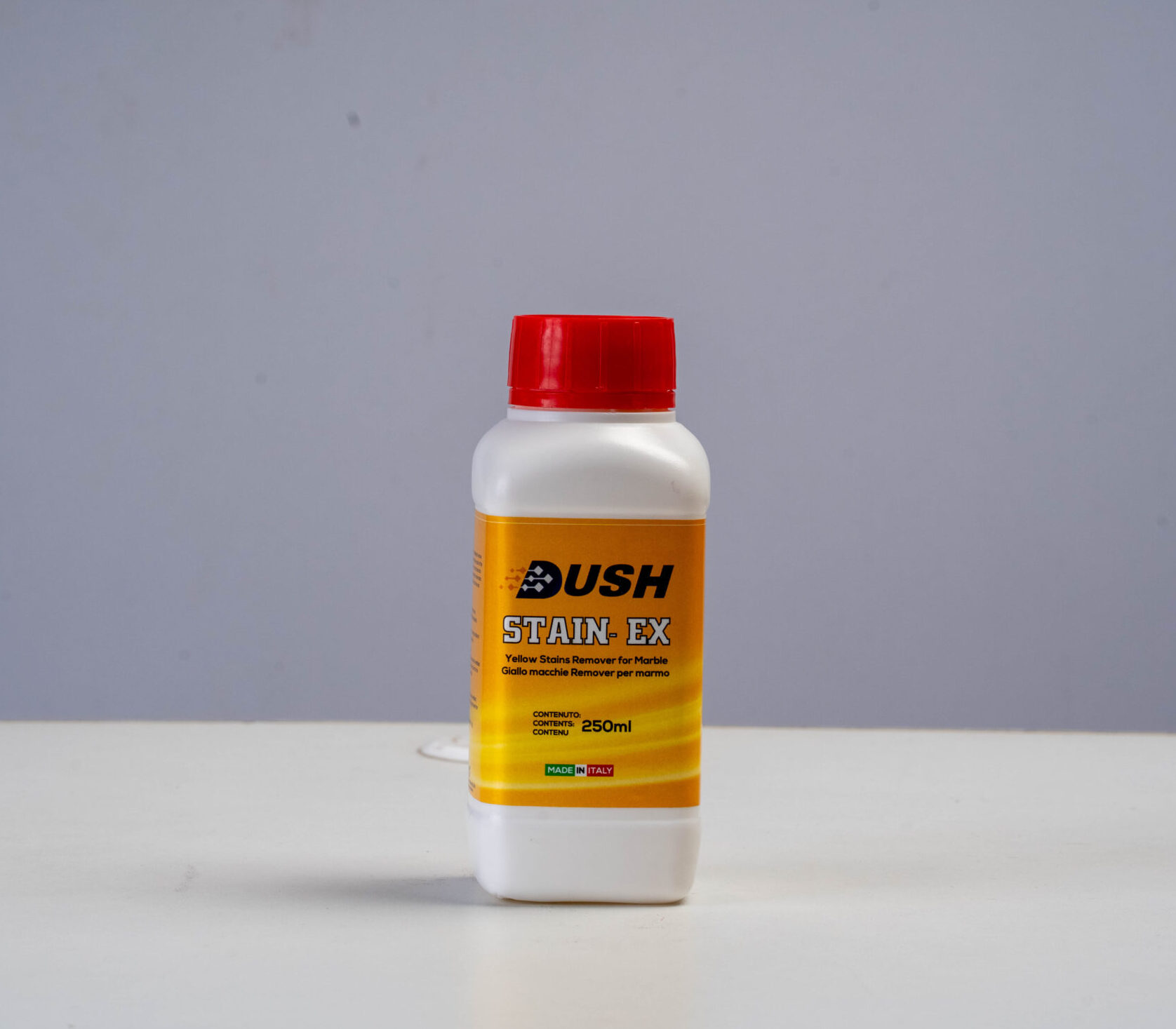
Standard cleaning products are formulated to act quickly on surface dirt and dissolve on contact, which is exactly why they fail against yellowing — they never have enough contact time or chemical strength to reach inside the marble's pore structure. Dush Stain-Ex is built around the opposite principle: extended contact time combined with reactive chemistry designed specifically to neutralise iron oxidation and break down oxidised organic compounds.
The 24-hour sealed application is not a convenience compromise — it is the mechanism. The drying process under the plastic seal creates the drawing action that physically pulls the loosened contamination out of the pores, the same principle used in professional stone restoration poulticing worldwide, formulated specifically for the staining profile Italian marble experiences in Indian conditions.
- ★Reaches inside the pore structure: Unlike surface cleaners, the extended 24-hour contact period allows the active chemistry to penetrate where the actual yellowing has occurred
- ★Addresses all 4 yellowing causes: Formulated to neutralise iron oxidation, break down absorbed oil and organic residue, and lift degraded sealer remnants in a single application
- ★Does not etch the polished surface: Safe for use on polished Italian marble — the treatment targets internal discolouration without damaging the surface finish when used correctly
- ★Suitable for natural stone broadly: Effective on marble, limestone, and other calcium-sensitive natural stone surfaces
- ★No mechanical abrasion required: The chemical drawing action removes discolouration without scrubbing or re-polishing in most cases
How to Apply Dush Stain-Ex — Step by Step
Clean the area → apply Stain-Ex as a 5mm paste over and slightly beyond the yellowed area → cover completely with plastic film and tape the edges → leave undisturbed for 24 hours → remove the plastic and dried poultice with a plastic scraper → clean with water → assess and repeat if needed. The drying process under the sealed plastic is what draws the discolouration out — do not disturb the poultice during the 24-hour period.
Clean the Yellowed Area Thoroughly
Clean the affected marble with a pH-neutral stone cleaner to remove surface dust, oil, and residue. Allow to dry completely. Any surface contamination left in place can interfere with the poultice's contact with the marble.
Apply Dush Stain-Ex as a Paste
Apply Dush Stain-Ex directly onto the yellowed area in a layer approximately 5mm thick, extending about 1 inch beyond the visible edge of the discolouration. Use a plastic or wooden spatula for even coverage.
→ Test on a small inconspicuous area first if treating a prominent or delicate surface
Cover With Plastic Film — Create an Airtight Seal
Cover the applied poultice completely with plastic film (cling wrap) and tape down all edges firmly. This is essential — an airtight seal prevents the poultice from drying too quickly, which is what allows the chemistry time to fully penetrate the pore structure.
→ A poorly sealed poultice dries too fast and works far less effectively
Leave Undisturbed for 24 Hours
Allow the poultice to remain completely undisturbed for a full 24 hours. During this time, the active chemistry breaks down the oxidised compounds while the gradual drying process begins drawing the loosened discolouration out of the stone and into the poultice material.
Remove the Plastic and Dried Poultice
Remove the plastic film, then scrape off the dried poultice material using a plastic scraper — avoid metal tools that could scratch the polished surface. Clean the treated area thoroughly with water and a soft cloth.
Assess the Result and Repeat If Needed
Inspect the treated area once fully dry. For significant or long-standing yellowing, the colour improvement may be partial after the first cycle — repeat the full application 1 to 2 additional times until the desired result is achieved.
Apply Permanent Prevention
Once the yellowing is removed, specify Dush Densi Max Ultra penetrating densifier at the next professional polishing cycle. This permanently closes the marble's pore structure, preventing the oil and organic contamination that caused the yellowing from entering the stone again.
How Severity Affects the Number of Treatments Needed
Light to moderate yellowing typically responds within 1 to 2 Stain-Ex applications. Significant or long-standing yellowing — present for several years — often requires 2 to 3 applications, with the colour improving progressively after each cycle. Very deep, old discolouration that has been present for many years may need multiple cycles and, in rare cases, may require professional honing to fully restore the original colour if the discolouration has penetrated beyond where poulticing alone can effectively reach.
Light Yellowing
Faint amber tint, recently developed, usually localised to one area such as near a sink or stove.
Most commonly caused by recent oil exposure or early-stage oxidation.
Typically 1 applicationModerate Yellowing
Clearly visible yellow-brown discolouration, present for 1 to 3 years, may cover a larger area.
Usually a combination of iron oxidation and accumulated organic residue.
Typically 2 applicationsHeavy / Long-Standing
Deep amber to brown discolouration present for many years, often across a wide floor area.
Frequently involves degraded topical sealer in addition to deep oxidation.
2–3 applications, possible re-polishingMarble Yellowing vs Marble Etching — Knowing the Difference
Marble yellowing is a colour change caused by internal oxidation or contamination, while the surface texture and polish remain intact — this is what Dush Stain-Ex treats. Marble etching is physical surface damage caused by acidic substances dissolving the calcium carbonate at the surface, leaving a dull, rough, light-coloured patch where the polish has been chemically removed. Etching cannot be fixed with a poultice — it requires mechanical re-polishing. Identifying which problem you have is the first step before choosing a treatment.
| Characteristic | Yellowing | Etching |
|---|---|---|
| What it is | Colour change — internal discolouration | Physical damage — surface dissolved |
| Cause | Oxidation, oil, degraded sealer, UV | Acidic substances — lemon, vinegar, wine |
| Surface texture | Unchanged — still smooth and polished | Dull, rough patch where polish was removed |
| Appearance | Yellow, amber, or brownish tint | Light, dull, often circular mark |
| Correct treatment | Dush Stain-Ex poultice | Mechanical re-polishing required |
| Can poultice fix it? | Yes — this is exactly what it is for | No — poultice cannot restore removed polish |
Quick test: run your hand over the affected area. If the surface feels perfectly smooth and the polish is intact but the colour is wrong, it is yellowing — Dush Stain-Ex is the correct product. If the area feels rough, dull, or slightly recessed compared to the surrounding marble, it is etching, and a poultice will not restore it — professional re-polishing is needed instead.
Preventing Yellowing From Returning After Treatment
To prevent yellowing from returning after Dush Stain-Ex treatment, apply Dush Densi Max Ultra penetrating densifier at the next professional polishing cycle. This permanently closes the marble's internal pore structure, eliminating the pathway that allows oil and organic contamination to enter the stone in the first place — addressing the root cause rather than only the symptom. For daily maintenance, use only pH-neutral cleaners and avoid topical wax coatings entirely.
Removing yellowing without addressing why it occurred is only a temporary fix. If the marble's pores remain open, the same oil exposure and humidity conditions that caused the original discolouration will simply begin the process again. Dush Densi Max Ultra is the permanent solution — applied at the 80-grit grinding stage, it chemically reacts with the calcium minerals inside the marble's pore structure and forms a permanent hydrophobic matrix that prevents oil, water, and other contaminants from entering the stone at all.
For marble already installed, specify Densi Max Ultra at the next professional polishing cycle, which most Italian marble benefits from every several years to maintain the finish. In the interim, a quality impregnating surface sealer such as Dush Protek+ provides meaningful surface-level protection while you wait for the next polishing opportunity.
See Dush Stain-Ex Work on Your Own Yellowed Marble
Send a piece of your affected marble to Dush, or arrange an on-site assessment. We can show you the poultice treatment process and realistic expectations for your specific staining before you commit to a full floor treatment.
View Dush Stain-Ex →Related Dush Guides and Products
Marble Yellowing & Stain-Ex — Questions Answered
Why does Italian marble turn yellow over time?
How does Dush Stain-Ex remove yellowing from marble?
Can yellow stains on marble be removed completely?
How long does Dush Stain-Ex take to work on yellow marble?
Is Dush Stain-Ex safe to use on polished Italian marble?
What is the difference between marble yellowing and marble etching?
How can I prevent Italian marble from turning yellow again after treatment?
External References
Restore Your Marble's Original Colour With Dush Stain-Ex
Yellowing happens inside the stone — Dush Stain-Ex is built to reach it. 24-hour poultice treatment, formulated for the staining profile Italian marble faces in Indian conditions.