How Do I Know If My Marble Sealer Is Still Working?
The water drop test, the visible warning signs, how long sealers actually last in Indian conditions — and why Dush Densi Max Ultra is the only marble protection that never needs this question asked again.
Marble care India — and specifically, Italian marble stain protection — depends on knowing whether your sealer is still active. Most Italian marble homeowners in India find out their sealer has worn off the hard way — a turmeric spill that does not wipe away, a dark oil patch that spreads slowly, or white mineral haze that keeps returning near the bathroom tap. The sealer failed silently, long before the visible damage appeared.
Pour 3–4 drops of plain water on your marble. If the drops bead and sit on the surface for 5+ minutes — your sealer is working. If they absorb into the marble within 30–120 seconds and the surface darkens where they land — your sealer has worn off. This is the water drop test for marble. Perform it every 6 months in kitchen and bathroom areas.
The Water Drop Test — How to Know in 5 Minutes
The water drop test for marble is the standard field test used by professional marble contractors and stone care specialists across India. It requires no equipment, no specialist knowledge, and gives you a definitive answer in under 5 minutes.
Water Absorbs Within 30–120 Seconds
The marble surface darkens where the drops land. The pores are open — the sealer at the surface pore openings has worn away. Your marble is now fully exposed to turmeric, cooking oil, coffee, and hard water staining. Every spill in the kitchen is a potential permanent stain.
⚡ Act immediately — apply Dush Protek+Water Beads for 5+ Minutes
The drops sit on the surface without absorbing. The marble surface does not darken. The sealer is providing effective protection at the pore openings. Continue your regular maintenance routine and retest in 6 months.
✓ Sealer effective — retest in 6 monthsHow to Perform the Water Drop Test — Step by Step
Clean the surface first
Wipe with a clean dry cloth. Remove dust, oil, or any cleaning product residue — these affect the result.
Pour 3–4 drops of plain water
Plain tap water. Pour in the area you want to test — do not spread or smear the drops.
Observe for 5 minutes without touching
Watch the drops. Note whether they remain beaded or begin to spread and absorb into the stone.
Test multiple areas
Test near the kitchen (highest traffic), near the bathroom tap, and in a low-traffic hallway. The sealer may have worn off in some areas but not others.
→ High-traffic kitchen areas typically fail first
Interpret and act
Beads 5+ min: Sealer working — retest in 6 months. Absorbs in 30–120 sec: Sealer worn off — apply Dush Protek+ today. Fails repeatedly every year: Specify Dush Densi Max Ultra at the next polishing cycle.
7 Signs Your Marble Sealer Has Worn Off
The clearest signs that marble sealer has worn off are: water absorbs within 2 minutes of contact, stains appear from spills that were wiped quickly, white mineral haze near taps and drains keeps returning after cleaning, the marble feels slightly rough or porous underfoot, new scratch marks appear faster than before, fingerprints on countertops leave lasting marks, and turmeric or coffee leaves a mark even when cleaned within minutes.
Water Absorbs in Under 2 Minutes
The most reliable sign. Water that beaded previously now darkens the marble surface within seconds of contact. The pore barrier is gone.
Test: Water drop test confirms this immediatelyTurmeric Stains Even When Wiped Quickly
A functioning sealer gives you several minutes of window before turmeric penetrates. If wiping within 60 seconds still leaves a yellow mark — the sealer has worn off.
When: Staining appears after prompt cleaningWhite Mineral Haze Returns Quickly After Cleaning
Hard water deposits accumulate faster when the pore openings are exposed. If white haze near taps reappears within days of cleaning — sealer failure is likely.
When: Mineral deposits return within 1–2 weeksOil Spills Leave Dark Patches
Cooking oil that previously wiped away cleanly now leaves a dark wet-looking patch that persists for hours or days. The oil has entered the pore structure.
When: Dark patches after cooking spillsFingerprints on Countertops Leave Lasting Marks
Skin oil that wiped away easily before now leaves a visible mark on countertops and wall panels. The surface is absorbing rather than repelling.
When: Finger marks visible after wipingCoffee or Tea Marks Appear Despite Quick Cleaning
Coffee tannins penetrate open marble pores within minutes. If brown marks appear despite wiping up spills quickly — the sealer that was slowing penetration is no longer present.
When: Brown marks after prompt coffee cleanupFloor Feels More Porous or Rough Under Cleaning
When sealer wears off, the open pore surface has a subtly different tactile quality — slightly more resistant or rough during mopping. Experienced homeowners notice this before staining appears.
When: Change in cleaning feel or resistanceHow Long Does Marble Sealer Last in Indian Conditions?
Marble sealer lasts 12–18 months in high-traffic Indian kitchen areas, 18–24 months in bathrooms, and 2–3 years in low-traffic living room marble. These are significantly shorter than European timelines because Indian conditions — daily turmeric, high-viscosity cooking oil, hard water with 100–400 mg/L mineral content, and mopping frequency — degrade surface sealers faster. The water drop test is more reliable than any fixed schedule.
Full protection — sealer at maximum effectiveness
Water beads perfectly. Turmeric wipes off within minutes. Oil sits on the surface. Hard water marks wipe away easily.
Partial degradation — sealer thinning at high-traffic points
Water still beads in most areas but absorbs faster near the kitchen and entrance. High-traffic zones beginning to show vulnerability. Retest now.
Significant wear — kitchen marble now largely unprotected
Water drop test fails in kitchen areas. Turmeric and oil staining risk is high. Reapplication of Dush Protek+ needed immediately for kitchen marble in Indian conditions.
Full failure in all areas — marble completely unprotected
Water absorbs everywhere within 30 seconds. All staining risks active simultaneously. Marble is as vulnerable as the day it was installed without any sealing.
Why Indian timelines are shorter than European: European marble care guides often cite sealer lifespans of 3–5 years. These assume moderate kitchen use, soft water, and infrequent wet mopping. Indian homes have daily turmeric and oil cooking, hard water at 2–4x European mineral levels, and frequent wet mopping that physically strips sealer from the surface with each cycle. Indian marble sealer lifespan is 40–60% shorter than European equivalents in equivalent stone.
Why Marble Sealer Wears Off — What Is Actually Happening
A surface impregnating sealer deposits hydrophobic compounds at the marble's surface pore openings. These compounds are not chemically bonded to the marble — they are held in place by physical adsorption within the pore entry geometry. Three forces progressively displace them:
- Mechanical abrasion from foot traffic and grit: Fine silica particles from shoe soles (Mohs hardness 7) are harder than marble (Mohs 3) and harder than most sealer compounds. Every footstep with surface grit present physically scrubs the sealer out of the surface pore openings. Daily dry mopping before wet mopping significantly extends sealer life by removing this grit before it can abrade.
- Chemical displacement from alkaline cleaners: Many floor cleaners used in Indian homes have pH levels of 8–10. Over repeated cleaning cycles, alkaline compounds gradually displace the hydrophobic sealer molecules from the pore surfaces. pH-neutral cleaners like Dush Sparkle Phase preserve sealer life significantly longer.
- Solvent displacement from oil and cleaning products: The oils and solvents present in cooking residue and some cleaning products partially dissolve or displace sealer molecules from the pore walls. High-viscosity Indian cooking oils — mustard, sunflower — are particularly effective at gradually removing impregnating sealer compounds over time.
The sealer does not disappear all at once. It degrades progressively — which is why the water drop test is more reliable than a fixed schedule. Some areas (near the kitchen hob, at the entrance, near the bathroom basin) lose protection months before other areas of the same floor.
What Happens to Italian Marble When the Sealer Wears Off
When marble sealer wears off in an Indian home, the stone's internal pore structure is fully exposed. Turmeric permanently stains within 2 minutes. Cooking oil penetrates and oxidises inside the pores within 30 seconds. Hard water deposits minerals inside the pores with every wet-dry cycle, building a white haze. Coffee and tea tannins bond with calcium carbonate inside the stone. The staining that enters through open pores cannot be removed by surface cleaning — it requires a 24-hour poultice treatment like Dush Stain-Ex.
The critical point: the damage from a worn sealer accumulates invisibly for weeks before it becomes visible as staining. By the time the first stain appears, the marble's internal pores have already been accumulating contamination from cooking residue and hard water mineral deposits for some time. The stain that triggers concern is rarely the first one — it is just the first one that crossed the threshold of visibility.
For marble that has already been stained due to sealer failure: apply Dush Stain-Ex as a 24-hour poultice to draw the contamination out of the pore structure. Then clean with Dush Alka Cleaner. Then reapply Dush Protek+ to restore surface protection. See the complete marble stain removal guide.
Dush Densi Max Ultra — Protection That Never Needs the Water Drop Test
Dush Densi Max Ultra is a penetrating densifier — not a surface sealer — that provides permanent internal pore closure. Applied at the 80-grit grinding stage during marble polishing, it chemically reacts with the calcium minerals inside the marble's pore structure and forms a permanent hydrophobic crystalline matrix within the stone. This is not a coating on the surface. It is inside the marble. Surface traffic, cleaning, and time cannot degrade what is chemically bonded inside the stone. The water drop test on Densi Max Ultra treated marble shows perfect beading indefinitely — not for 18 months, indefinitely.
DUSH DENSI MAX ULTRA
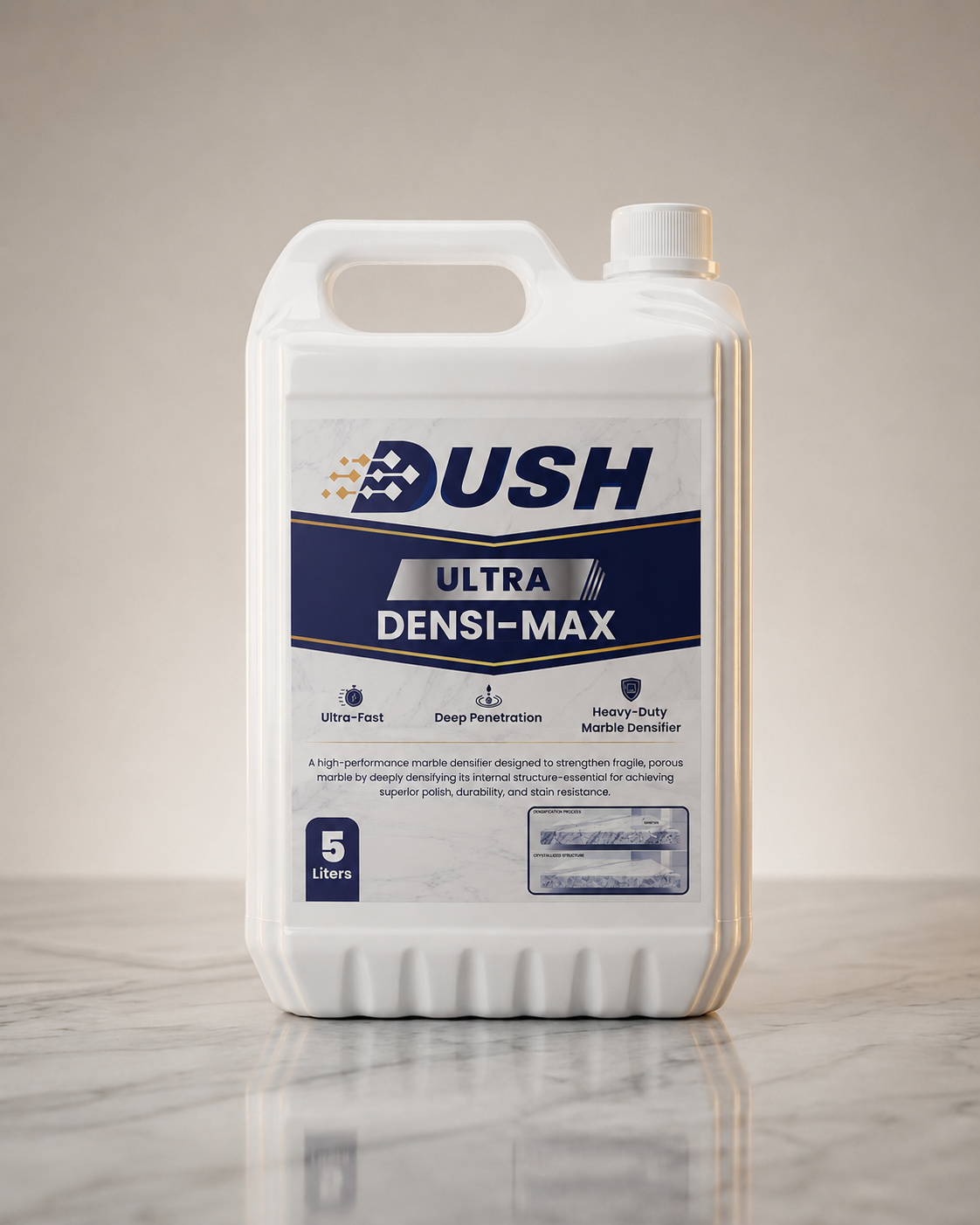
A surface sealer wears off because the hydrophobic compounds it deposits at the pore openings are physically held in place — not chemically bonded. Foot traffic, cleaning agents, and oil residue all gradually displace these compounds over 12–36 months.
Dush Densi Max Ultra works differently. It penetrates deep into the marble's internal pore structure — beyond where surface traffic and cleaning agents can reach — and chemically reacts with the calcium minerals inside the pore walls. The resulting calcium silicate hydrate (C-S-H) compounds are chemically bonded to the marble's internal structure. They are not displaced by traffic or cleaning because they are not at the surface where these forces act. They are inside the stone.
The result is permanent internal pore closure that never wears off — not after 5 years, not after 20 years. The water drop test on correctly treated marble shows perfect beading indefinitely.
- ★Never wears off: Chemically bonded inside the marble's pore walls — surface traffic and cleaning cannot reach or degrade it. Applied once at the grinding stage, permanent thereafter
- ★Ultra-deep penetration: Reaches internal pore depths that surface sealers cannot access — complete protection across the full depth of the stone, not just the surface entry points
- ★Turmeric-proof from within: Curcumin has no pathway into correctly treated marble — the internal pore closure eliminates the capillary suction that draws staining agents in
- ★Improves marble hardness: The C-S-H matrix formed inside the pores strengthens the marble from within — more resistant to grit abrasion that would otherwise strip surface sealers
- ★Extends and deepens polish: Improves the final mirror finish quality and significantly extends how long it lasts between professional polishing cycles
- ★Backed by Italian expertise: VITO — an established Italian stone care brand — applied to Indian marble conditions and staining profiles
Surface Sealer vs Dush Densi Max Ultra — For the Marble Sealer Working Question
Dush Protek+
Dush Densi Max Ultra
The correct system uses both: Dush Densi Max Ultra at the grinding stage for permanent internal pore closure — then Dush Protek+ after installation as a secondary surface layer for daily spill repellency. The densifier answers the permanent question. The sealer provides the maintenance layer that you periodically refresh. Together they provide complete two-layer protection with a foundation that never needs the water drop test to confirm its status.
Myths About Marble Sealer Lifespan — Corrected
"Marble sealer lasts 5 years if applied correctly."
5-year lifespans apply to low-traffic installations in European conditions with soft water and infrequent mopping. In Indian kitchen areas with daily cooking, hard water, and frequent wet mopping, 12–18 months is realistic. The water drop test, not a schedule, tells you when reapplication is needed.
"If the marble looks good, the sealer must still be working."
Sealer failure is invisible until the first staining incident. The marble looks identical whether the sealer is intact or worn off. Only the water drop test reveals the actual protection status — appearance tells you nothing about whether the pore openings are still sealed.
"Applying more sealer on top of old sealer extends protection."
Sealer applied on top of degraded sealer bonds poorly and provides limited additional protection. For best results, clean the marble thoroughly with Dush Alka Cleaner to remove old sealer residue before applying fresh Protek+. The sealer must reach the clean pore surface to bond effectively.
"A sealer that passes the water drop test will prevent all staining."
A surface sealer slows penetration at the pore openings — it does not eliminate it under prolonged contact. Turmeric left for 30+ minutes or oil allowed to pool can still penetrate past a functioning surface sealer. Dush Densi Max Ultra internal pore closure eliminates the pathway entirely — contact time becomes irrelevant.
Test Densi Max Ultra on Your Own Marble — Before You Buy
Send a piece of your marble to Dush. We apply Densi Max Ultra, run the water drop test, and you see permanent beading on your actual stone before committing. India's only marble chemical company that does this.
Request Free Sample Test →Related Dush Guides and Products
Marble Sealer Working — Questions Answered
How do I know if my marble sealer is still working?
How often should marble sealer be reapplied in India?
What happens if marble sealer wears off?
Is there a permanent marble sealer that never wears off?
What is the water drop test for marble?
My marble passed the water drop test but still stained. Why?
Can I test my marble sealer without the water drop test?
External References
Stop Asking Whether Your Marble Is Protected — Make It Permanent
Dush Densi Max Ultra closes Italian marble pores internally and permanently. One application at the grinding stage. No reapplication. No annual water drop test anxiety. The only marble chemical company in India that tests on your own marble before you buy.