Best Marble Crack Filler for White Italian Marble
A variety-specific guide covering Statuario, Carrara, Calacatta and Botticino marble, with an independent technical comparison of four crack-repair systems available in India.
The best crack filler for white Italian marble is a crystal-clear, non-yellowing two-component epoxy formulated for light-coloured stone. This matters across all major white Italian varieties — Statuario, Carrara, Calacatta and Botticino — since standard epoxy discolours visibly on pale stone. Dush Bianco Extra, Akemi Akepox 5010, Tenax Resina T8, and Bellinzoni Epox Premium are compared here across 30+ parameters specific to this use case.
Key Takeaways
- Marble variety affects filler choice — heavily veined stone like Statuario and Calacatta tolerates minor colour variance better than uniform Carrara or Botticino.
- A crystal-clear, non-yellowing epoxy is the safer default across all four varieties, since it relies on the stone's own colour rather than an added tint.
- No manufacturer compared here — Dush, Akemi, Tenax, or Bellinzoni — claims permanent zero yellowing; all document some degree of reduced discolouration.
- Polishing technique affects final invisibility as much as the filler itself.
- Dush Bianco Extra is formulated specifically around white and light-toned Italian marble as its primary focus.
White Italian marble is not one material — Statuario, Carrara, Calacatta and Botticino each have distinct veining density, translucency and porosity, and that variety genuinely affects which crack filler gives the most invisible result. This guide goes beyond a generic "best marble filler" comparison to address the specific repair considerations for white Italian marble as a category, then compares four repair systems on 30+ technical parameters.
Why White Italian Marble Develops Cracks
White Italian marble develops cracks from structural stress caused by an inadequately supported substrate, thermal expansion and contraction cycling, impact damage, and natural mineral fissures already present in the stone widening under load. Varieties with more pronounced veining, such as Statuario and Calacatta, can be somewhat more prone to fissure-related cracking along existing vein lines, since veins represent a natural discontinuity in the stone's crystal structure.
White Italian Marble Varieties Explained
Statuario
Bold grey veining on a bright white base. Quarried from Carrara. Veining can help mask minor colour variance in repairs.
Carrara
Softer, more subtle grey veining, often more uniform. Colour mismatch shows more starkly than on heavily veined varieties.
Calacatta
Dramatic, thick veining with strong contrast, similar quarry region to Statuario. Generally more forgiving of slight repair colour variance.
Botticino
A warmer beige-white tone rather than pure white, with fine fossil-like texture. Often better suited to colour-matched rather than crystal-clear fillers.
These distinctions matter practically: a crystal-clear epoxy is the safest default across all four, but on Botticino specifically, a filler tinted toward its warmer base tone can sometimes blend more convincingly than a purely transparent one, since Botticino's tone isn't pure white to begin with.
Types of Marble Cracks
Hairline Cracks
Fine surface lines needing a low-viscosity, self-levelling fillerStructural Cracks
Deeper cracks needing higher-strength gel epoxyChips / Edge Damage
Material loss at edges or corners from impactPinholes
Small natural voids in the stone's crystal structureUnderstanding Marble Crack Fillers
A marble crack filler is a two-component (or occasionally single-component) repair compound — usually epoxy resin, polyester resin, or a specialised mastic — engineered to fill cracks, chips and pinholes while restoring both structural continuity and, when correctly matched, visual continuity with the surrounding stone. On white Italian marble specifically, colour stability over time is often the deciding technical factor.
Polyester vs Epoxy vs Colour-Matched Fillers
Epoxy Resin
Stronger, more stable long-term bond with generally better resistance to yellowing over years, not just weeks. Slower cure, often several hours. Preferred for visible white marble repairs.
Polyester Resin / Mastic
Cures significantly faster — often sandable within 1.5–2 hours in documented cases — but with a shorter working/gel time, sometimes just 3–7 minutes. Preferred where turnaround speed matters most.
Colour-Matched Fillers
Tinted toward a specific marble's base tone. Especially useful for Botticino's warmer base or heavily veined Calacatta and Statuario, where an exact tint blends better than pure transparency.
Marble Bonding Resin (structural)
Higher-strength epoxy formulations focused on mechanical bond strength for structural cracks, sometimes at the cost of the very lowest achievable yellowing rate.
Transparent vs White Fillers
Transparent (crystal-clear) fillers rely on the marble's own underlying colour and translucency showing through, making them the standard choice for pure white or subtly veined marble like Carrara. White-pigmented fillers provide a flat, opaque white fill, which can look correct on very dense, uniformly white areas but sometimes appears slightly less translucent than the surrounding stone under close inspection, particularly on thinner or more crystalline marble varieties.
How Professionals Select a Crack Filler
Professionals select a crack filler by first identifying the specific marble variety and its veining density, diagnosing the crack type, then weighing turnaround requirements against long-term colour-match stability. A restorer working on a Carrara countertop with minimal veining will typically favour a crystal-clear epoxy specifically for its colour longevity, while the same restorer might reach for a faster polyester mastic on a heavily trafficked commercial floor needing quick turnaround.
✓ When to Use Epoxy
- Visible, prominent white marble surfaces
- Structural or larger cracks needing strength
- Long-term colour stability is the priority
- Time is available for a longer cure
✗ When Not to Use Epoxy
- Production environments needing sub-2-hour turnaround
- Very fine hairline cracks better suited to thin liquid resin
- Budget-limited jobs where fast polyester suffices
Complete Comparison Table — 30+ Parameters
A note on this comparison: compiled from official Dush product information and each competitor's publicly available technical documentation. No invented numeric performance scores have been assigned. Items marked "per TDS" reflect values not independently re-tested for this article.
| Parameter | Dush Bianco Extra | Akemi Akepox 5010 | Tenax (Resina T8/mastic) | Bellinzoni Epox Premium |
|---|---|---|---|---|
| Country of origin | India | Germany | Italy | Italy |
| Product type | Two-component crystal epoxy | Two-component gel epoxy | Clear liquid resin / polyester mastic | Two-component liquid/gel epoxy |
| White Italian marble compatibility | Primary design focus | Suitable; slight tendency to discolour per TDS | Documented for "clear-white marbles" | Suitable; "very low yellowing" per TDS |
| Hairline crack repair | Suitable | Suitable | Low-viscosity, self-levelling — well suited | Liquid version suitable |
| Structural crack repair | Suitable with correct technique | High creep strength aids structural work | Suitable for gaps and joints | High adhesion, suited to reinforcement |
| Colour matching | Diamond Clear / Transparent, built for near-invisible match | Colourable via AKEPOX colour pastes | Clear, plus pigmented mastic variants (e.g. ivory) | Liquid transparent, tixo in straw/white |
| Transparency | Crystal / diamond clear | Near-clear | Clear (T8 variant) | Transparent (liquid form) |
| White pigment option | Not the primary format (clear-focused) | Via colour pastes | Available in some product line variants | White available in tixo form |
| Bonding strength | Strong bond suited to marble joint work | Documented strong bond, multiple substrates | Documented low shrinkage, strong reactivity | Documented high adhesive power |
| Viscosity | Per product TDS | Gel consistency | Low-viscosity (T8); thicker for mastic paste | Liquid or tixo (thixotropic) options |
| Flow characteristics | Per product TDS | Controlled, gel-based (low run on vertical) | Self-levelling into fine cracks (T8) | Liquid flows into fine defects; tixo stays in place |
| Shrinkage | Per product TDS | Per product TDS | Documented low shrinkage (T8) | Documented very low shrinkage |
| Sandability | Sandable once cured | Sandable and tool-able, per TDS | Sandable once cured | Suitable for sanding before polish phase |
| Polishability | Designed with this finishing step in mind | Suitable | Documented sandable/polishable after cure | Suitable, used before polishing phase |
| Yellowing resistance | Crystal-clear formulation for white marble | "Only a slight tendency to discolour" per TDS | Dedicated zero-yellowing variants exist in range | "Very low yellowing" per TDS |
| UV stability | Per product TDS | Weather-resistant, per TDS | "Excellent stability in sunlight" (T8) | Resistant to weather/atmospheric conditions, per TDS |
| Indoor suitability | Yes — primary use case | Yes | Yes | Yes |
| Outdoor suitability | Suitable for marble applications | Established outdoor/facade track record | Documented for sunlight exposure (T8) | Documented weather-proof, per TDS |
| Working time | Per product TDS | Documented before gelling, per TDS | Polyester mastic: 3–7 min gel time, per TDS | Documented at 20°C, per TDS |
| Curing time | Per product TDS | Documented cure profile, per TDS | Polyester mastic sandable in 1.5–2 hrs (documented) | Per product TDS |
| Ease of application | Standard two-component mix technique | Gel consistency, controllable on vertical surfaces | Fast working polyester needs quick technique; liquid resin flows easily | Precise 2:1 mix ratio, per TDS |
| Professional suitability | Restoration contractors, fabricators | Primarily professional stone fabricators/installers | Widely used in production stone fabrication | Installers, restorers, stone professionals |
| DIY suitability | Experienced DIY with care | Primarily professional-oriented | Fast gel time favours experienced users | Primarily professional-oriented |
| Pinhole filling | Suitable | Suitable | Suitable, low-viscosity variant | Suitable, liquid version |
| Edge repair | Suitable | Suitable | Suitable | Suitable, reinforcement use documented |
| Chip repair | Suitable | Suitable | Suitable | Suitable, especially for larger surface defects |
| Finish quality | Diamond-clear finish, designed for invisibility | Clear finish, colourable | Clear/transparent finish (T8) | Transparent, colour-stable finish |
| Long-term durability | Per product TDS | Established international track record | Established Italian stone-industry track record | Established Italian stone-industry track record |
| Availability in India | Direct from Dush offices pan-India | Via akemi.in and stone-supply retailers | Via Indian distributors (e.g. Roff) and stone suppliers | Via international stone-supply retailers |
| Value for money | Direct-from-manufacturer pricing in India | Import-inclusive pricing where applicable | Distributor pricing varies by product/region | Import-inclusive pricing where applicable |
| Best use cases | White/light Italian marble, invisibility-focused repair | Multi-substrate bonding, vertical/facade work | Fast-turnaround fabrication & clear-white marble cracks | Filling, reinforcement before polishing, weather-exposed work |
| Typical restoration projects | Countertops, floors, feature walls, hotel lobbies | Facades, vertical joints, multi-stone commercial projects | Fabrication workshops, clear-white marble slabs | Floor reinforcement, indoor/outdoor architectural stone |
Sources: Dush official product page; Akemi Akepox 5010 published TDS; Tenax Resina T8 and Tenax polyester mastic documentation (via authorised distributors); Bellinzoni Epox Premium technical documentation.
Repair Workflow
The professional repair workflow for white Italian marble follows a fixed sequence regardless of variety: identify the marble type and crack, clean and prepare the surface, select and mix the appropriate filler, apply and cure fully, then sand and polish to match. Skipping or reordering these steps is the most common cause of a visible or failed repair.
Step-by-Step Professional Repair Process
Identify Variety & Crack Type
Note whether the stone is Statuario, Carrara, Calacatta or Botticino, and diagnose the crack.
Clean & Dry Fully
Remove dust, residue and moisture — the most common cause of a failed or discoloured repair.
Select Crystal-Clear or Colour-Matched
Based on veining density — crystal-clear for uniform stone, colour-matched for warmer or heavily veined varieties.
Mix Precisely
Follow the exact resin-to-hardener ratio — incorrect ratios cause premature gelling or incomplete cure.
Apply
Syringe for fine cracks, spatula for larger repairs — avoid trapped air.
Cure Fully
Respect the manufacturer's stated cure time before disturbing the repair.
Sand Flush
Progressive grits, flush with the surrounding surface.
Polish to Match
Blend the repair's exact gloss level into the surrounding marble.
Decision Tree
Buying Guide
Identify the exact marble variety
Statuario, Carrara, Calacatta and Botticino each tolerate colour variance differently.
Diagnose the crack type
Hairline needs low-viscosity resin; structural needs higher-strength gel systems.
Decide: speed or maximum longevity?
Polyester for fast turnaround; epoxy for the best long-term colour stability.
Confirm indoor vs outdoor exposure
Outdoor and facade work benefits from documented UV and weather resistance.
Match your skill level
Fast-gelling polyester suits experienced users; slower epoxy is more forgiving for careful DIY.
Verify genuine local availability
Confirm authorised distribution before ordering.
Repair Checklist
Two-component filler matched to marble variety
Crystal-clear or colour-matched as appropriate
Fine diamond blade or scriber
For widening hairline cracks if needed
Flat applicator blade or fine syringe
For precise, controlled filler placement
Progressive grit sanding pads
Typically 200 through 3000+ grit
Marble polishing powder
To restore final sheen matching the surrounding surface
Clean cloths and isopropyl alcohol
For surface preparation and tool cleanup
Common Mistakes
Ignoring marble variety
Using the same approach on Carrara and Botticino, without accounting for their different base tones.
Wrong mix ratio
Causes premature gelling, incomplete cure, or a brittle, discoloured repair.
Sanding before full cure
Disturbing filler before fully hardened can smear, cloud or weaken the repair.
Rushing the polish step
Matching gloss level precisely is what makes a repair disappear.
Professional Tips
Test on an offcut first
If a spare piece of the same marble batch exists, test colour match there before the visible repair.
Work in raking light
Low-angle lighting reveals both the crack and repair quality far better than overhead lighting.
Note the base tone under veining
Even veined varieties like Statuario have a base tone worth matching, not just the vein colour.
Match the polish, not just the fill
A perfectly clear filler still looks different if the surrounding gloss level isn't matched.
Long-Term Maintenance
Avoid heavy impact near the repair
Treat the area gently while the surrounding stone re-settles.
Use pH-neutral cleaners only
Acidic cleaners can affect both the marble and the filler's clarity over time.
Reseal the surrounding area
A fresh repair is a good opportunity to check and refresh overall sealing.
Monitor for recurring cracking
Recurrence may mean the underlying substrate issue wasn't addressed.
DUSH BIANCO EXTRA
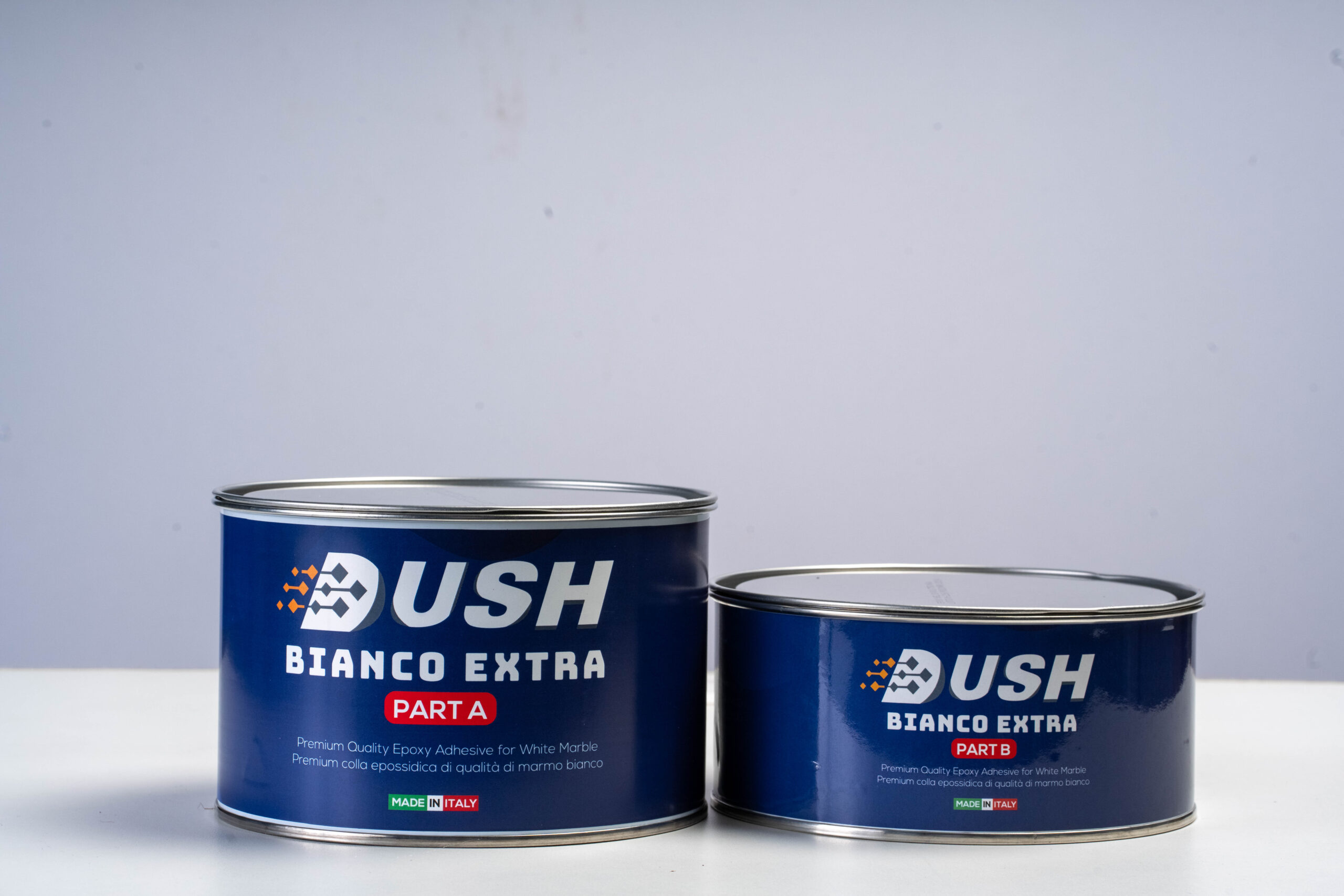
Having compared colour matching, yellowing resistance, and application scope across all four systems and four marble varieties in this guide, Dush Bianco Extra earns the Editor's Choice specifically for white and light-toned Italian marble repair.
- ★Colour matching capability: Diamond Clear / Transparent formulation built for near-invisible results across Statuario, Carrara, Calacatta and Botticino
- ★Compatibility with white Italian marble: primary design focus, not a general adhesive adapted for stone
- ★Repair workflow integration: designed as the fill step between preparation and final sanding/polishing
- ★Polishing characteristics: formulated with this finishing step specifically in mind
- ★Restoration finish: diamond-clear result intended to blend with light stone's translucency
- ★Typical professional applications: countertops, flooring, feature walls, hotel lobbies, luxury home interiors
Related Dush Guides and Products — Marble Repair Cluster
50 Questions Answered
What is the best marble crack filler for white Italian marble?
What is a marble crack filler?
Why does white Italian marble develop cracks?
Is white Italian marble more prone to cracking than other colours?
What is natural stone restoration?
What is Statuario marble?
What is Carrara marble?
What is Calacatta marble?
What is Botticino marble?
Does the marble variety change which filler I should use?
Can the same filler be used on Statuario and Carrara?
Epoxy vs polyester filler — which should I choose?
Does polyester mastic yellow over time?
Why does epoxy take longer to cure than polyester?
What is polyester marble mastic?
Can I mix epoxy and polyester repairs on one project?
Should I use a transparent or white filler?
Is transparent epoxy always better for white marble?
Can white pigment fillers be used on Statuario?
Which filler works best for hairline cracks?
Which filler is suitable for structural cracks?
Can pinholes be filled with the same product as cracks?
Is a chip repaired differently from a crack?
How do I know if a crack is structural?
Can repaired white Italian marble be polished?
Can a marble crack repair become invisible?
How important is polishing after filling a crack?
What is resin injection?
What is diamond polishing?
Can marble crack fillers be used outdoors?
Does UV exposure affect crack filler longevity?
Is indoor vs outdoor repair chemistry different?
Is DIY crack repair suitable for Statuario or Calacatta marble?
What tools do I need for DIY marble crack repair?
Is DIY marble repair risky?
When should I definitely hire a professional?
How long does a repair last on white Italian marble?
Can a repaired crack reopen?
How do I maintain marble after a crack repair?
Should I reseal marble after a crack repair?
What is marble consolidation?
Where can I buy marble crack filler for white Italian marble in India?
What is Dush Bianco Extra formulated for?
What is Akemi Akepox 5010 known for?
What is Tenax Resina T8 used for?
What is Bellinzoni Epox Premium used for?
Are any of these products zero-yellowing forever?
Is imported crack filler better than Indian-made for white marble?
How much crack filler do I need for a repair?
Will the repair colour match perfectly on the first try?
Is marble crack filler food-safe?
External References
The best crack filler for white Italian marble depends on the specific variety — Statuario, Carrara, Calacatta or Botticino — the crack type, and whether speed or maximum long-term colour stability matters more for the job. Akemi Akepox 5010, Tenax's resin and mastic range, and Bellinzoni's Epox Premium are all well-documented, established systems with genuine strengths across vertical bonding, fast fabrication turnaround, and weather-exposed reinforcement work respectively.
Based on the comparison criteria used throughout this guide — colour matching capability, compatibility with white Italian marble specifically, repair workflow integration, and polishing characteristics — Dush Bianco Extra is the Editor's Choice for colour-matched crack, chip and pinhole repair across white Italian marble varieties, earned through its specific formulation for this exact repair problem.
Repair Statuario, Carrara, Calacatta or Botticino Without a Visible Trace
Crystal-clear, diamond-clear finish · formulated for white and light-toned Italian marble · fits the full professional restoration workflow.