Can Oil Stains Be Removed from Marble?
An evidence-based guide to whether oil stains can really be removed from marble — written the way an independent restoration consultant would walk you through the diagnosis, the poultice method, real product comparisons, and prevention.
Yes — most oil stains on marble can be removed. Because oil physically penetrates the stone's pores rather than reacting chemically with it, an absorbent poultice can draw it back out. Fresh stains respond within a single treatment; older, deeply set stains often need two or three repeat applications, and very old, unsealed staining may only partially clear.
Oil stains on marble can usually be removed using an absorbent poultice — a paste or gel applied directly to the stain that draws oil out of the stone's pores as it dries. Fresh spills respond fastest; deep, old stains may need several repeat treatments. Prompt blotting and a properly maintained sealer both significantly improve results.
Key Takeaways
- Marble absorbs oil through capillary action into its natural pore structure — this is physics, not a chemical reaction, which is exactly why it's usually reversible.
- Fresh oil stains respond fastest; stains that have had weeks or months to set typically need repeated poultice treatment.
- A poultice — an absorbent paste applied directly to the stain — is the industry-standard method across every major stone-care brand researched for this guide.
- DUSH STAIN-EX is documented specifically for yellow discolouration from wood, ink, and food contact — not for oil or grease staining, which needs a dedicated oil/grease poultice product instead.
- Sealed marble buys meaningfully more reaction time before a spill penetrates, which is why prevention and sealing matter as much as removal technique.
- Genuinely unremovable oil staining is uncommon and mostly limited to very old, deeply set marks in unsealed, highly porous stone.
"Is this oil stain ever coming out?" is one of the most common questions a marble owner asks after a bottle tips over or a pan leaves a ring on a countertop. The evidence-based answer, drawn from professional restoration practice and the documented chemistry of how oil interacts with natural stone, is reassuring: most oil stains on marble are removable, and the method professionals use is consistent across the industry — an absorbent poultice, applied correctly, with patience for older stains. This guide covers the full picture: why marble absorbs oil in the first place, how to tell a fresh stain from a deep one, what the actual removal process looks like, how leading stain-removal products compare, and where a product like DUSH STAIN-EX does and does not fit into an oil-stain removal plan.
Why Marble Absorbs Oil
Quick answer: marble is a naturally porous stone, and oil is pulled into that pore structure by capillary action — the same physical force that draws liquid up a narrow tube — often within minutes of contact.
Marble forms from limestone under heat and pressure, and even in its densest, most highly polished state, it retains a network of microscopic pores between its calcite crystals. This is marble porosity — an intrinsic property of the stone, not a manufacturing flaw. Oil, being a low-viscosity organic liquid, moves through this pore network readily, especially on unsealed or under-sealed surfaces, and once it has travelled a few millimetres below the surface, wiping the top no longer removes it. A functioning impregnating sealer doesn't close these pores, but it does line them with a repellent barrier that significantly slows this capillary movement — which is why sealed marble gives you meaningfully more time to react to a spill before it becomes a true stain.
Can Oil Stains Be Completely Removed?
Quick answer: in the majority of cases, yes — because oil sits physically within the pores rather than bonding chemically with the stone, it can be drawn back out with the right technique.
This is an important distinction from acid etching, which is a genuine chemical reaction between acid and the calcite in marble and cannot be "cleaned away" — it requires mechanical re-polishing. Oil staining is fundamentally different: the oil is physically present in the pores, and a poultice works by reversing the capillary process, drawing the oil back out into an absorbent material rather than dissolving or reacting with the stone. This is why oil stains, even stubborn ones, are considered a genuinely repairable problem across professional restoration practice, whereas etching is not.
Fresh vs Old Oil Stains
Quick answer: a fresh oil stain is still concentrated near the surface and generally clears with a single treatment; an old stain has spread deeper and wider through the pore structure and usually needs multiple poultice cycles.
| Factor | Fresh Oil Stain | Old / Deep Oil Stain |
|---|---|---|
| Age | Minutes to a few days | Weeks, months, or longer |
| Appearance | Darker, well-defined edges | Duller, may have spread and softened at the edges |
| Depth of Penetration | Near-surface | Deeper into the pore structure |
| Typical Treatment | Single poultice application | Two to four repeat applications, longer dwell times |
| Expected Outcome | Usually complete removal | Significant to complete removal; very old cases may leave a faint shadow |
Types of Oil Stains on Marble
Quick answer: cooking oil, grease, hand and body creams, and certain sealant plasticizer discolourations are the most common oil-based marks professionals see on marble.
Cooking Oil
Splashes and spills near stovetops and countertops are the most frequent source, especially on unsealed kitchen marble.
Grease
Heavier, more viscous than cooking oil, industrial or automotive grease penetrates slowly but tends to set very firmly once absorbed.
Hand Creams & Cosmetics
Oil-based skincare products left on a bathroom vanity top are a commonly overlooked source of light, gradual staining.
Sealant Plasticizer Discolouration
Some silicone and sealant products can leach plasticizers into adjacent stone at joint edges, producing an oily-looking discolouration.
Wax-Based Marks
Candle wax and certain furniture waxes behave similarly to oil once melted onto a marble surface, penetrating the same way.
Food-Related Oils
Butter, salad dressing, and other oil-rich foods left in contact with marble for extended periods can leave a translucent mark.
Professional Diagnosis Process
Quick answer: professionals confirm a stain is oil-based by its translucent, darkened appearance and by checking whether it spreads slightly at the edges rather than sitting as a flat, opaque mark.
Correctly identifying an oil stain matters because the wrong treatment wastes time — an oxidation-focused treatment aimed at yellowing will not address oil, and a rust-specific chelating treatment will not touch grease. The classic signature of an oil stain is a darkened, slightly translucent patch, often with soft, spreading edges rather than the sharp boundary typical of a pigment stain like turmeric or wine. A simple water-drop test can also help: on a well-sealed area, water will bead; on the affected, oil-saturated area, the surface may look and feel different, reinforcing that the pores in that spot are already occupied by oil rather than functioning sealer.
Professional Oil Stain Removal Workflow
Every credible professional method for oil stain removal follows the same underlying sequence.
Diagnose the stain
Confirm the mark is oil-based rather than another stain category, since removal chemistry differs meaningfully.
Blot fresh oil immediately
For a fresh spill, blot with a dry cloth without spreading it — water alone does not lift oil.
Clean the surface
Clean the surrounding area with a pH-neutral stone cleaner and allow it to dry fully before treatment.
Apply an absorbent poultice
Apply a solvent-absorbent oil and grease poultice in an even layer, at the thickness specified by the product — typically 1–5mm depending on brand.
Cover and allow to dwell
Cover with plastic film if extended dwell time is advised, and let the poultice dry fully, drawing oil out of the pores as it does.
Remove the dried poultice
Once fully dry, brush or wipe away the residue, which carries the absorbed oil with it.
Assess and repeat if necessary
Inspect the treated area and repeat for older or deeper stains — two to three cycles is common for set-in oil.
Reseal the surface
Apply a penetrating sealer once the stain is gone to slow future oil penetration.
DIY vs Professional Removal
Quick answer: fresh, light oil stains are reasonable DIY candidates using an off-the-shelf poultice product; old, extensive, or highly visible staining benefits from professional diagnosis and repeat-treatment discipline.
| Factor | DIY | Professional |
|---|---|---|
| Best For | Fresh, light, localised stains | Old, deep, or widespread staining |
| Materials Needed | Off-the-shelf oil/grease poultice, plastic wrap | Same materials, plus professional-grade poultice options |
| Skill Required | Low — follow label instructions carefully | Diagnosis and repeat-treatment judgement |
| Cost | Lower (product only) | Higher (labour + expertise) |
| Risk of Incomplete Removal | Higher on old/deep stains without persistence | Lower, with structured repeat treatment |
Comparison of Oil Stain Removal Methods
Quick answer: poultice treatments dominate the professional oil-stain-removal market because they work through absorption rather than chemical reaction, making them safe on acid-sensitive marble.
The research for this guide reviewed published technical documentation for five established oil and grease stain removers used on marble internationally. All five use the same fundamental mechanism — a solvent-and-absorbent paste or spray that draws oil out of the stone as it dries — though application format, dwell time, and finish vary.
AKEMI Oil and Grease Remover Paste
GermanyPoultice PasteA creamy, solvent-based paste with an absorbing agent, applied in a 1–2mm layer and left to dry for roughly 30–60 minutes before the residue is swept or wiped away. Documented for use on natural and artificial stone, including marble, across a wide range of surface finishes, with repeat application recommended for intensive staining.
FILA NOSPOT
ItalySpray FormatA ready-to-use spray applied directly to the stain, which dries into a white powder within a few minutes as it absorbs the grease deposit; the residue is then brushed and wiped away. Documented for polished and unpolished marble, granite, and other natural stone, indoors and outdoors, with repeat application for stubborn marks.
Lithofin OIL-EX
GermanyExtended Dwell PoulticeA whitish, gel-like paste of solvents and absorbent solids, applied at roughly 2mm thickness and left to dry for approximately 12 hours (extendable by covering with plastic film), after which the dried powder is brushed away. Documented as suitable for 2–3 repeat applications on deeply ingrained oil and grease, with the manufacturer separately recommending an impregnating sealer for stain-sensitive areas going forward.
HMK R152 Oil and Wax Remover
Poultice FormatDocumented as a poultice formulated to extract oil, wax, grease, and mastic-type stains from natural and man-made stone surfaces, consistent with the same absorption-based mechanism used across the category.
Bellinzoni Mangiamacchia (Spot Remover)
ItalyFood-Safe PoulticeAn absorbent poultice paste applied in a roughly 5mm layer, documented as food-safe certified for direct contact with kitchen countertops. Manufacturer documentation reports dwell times in the range of a few hours up to overnight depending on the specific listing, with repeat application recommended until the stain is fully removed.
Premium Comparison Tables
Poultice vs Solvent-Based Sprays
| Factor | Paste Poultice | Solvent Spray |
|---|---|---|
| Application | Spatula/brush, measured layer thickness | Spray directly onto stain |
| Dwell Time | 30 minutes to 12+ hours depending on product | A few minutes to form a powder residue |
| Best For | Deep, set-in staining | Lighter, more recent surface staining |
| Vertical Surface Use | Good — creamy/gel consistency clings well | Good — spray format suits vertical application |
| Repeat Treatment | Common for deep stains | Common for stubborn stains |
Surface Stains vs Deep Stains
| Factor | Surface Stain | Deep Stain |
|---|---|---|
| Penetration | Top layer of pores only | Extends well below the visible surface |
| Typical Cause | Recent spill, quick contact | Prolonged contact or unsealed stone over time |
| Poultice Dwell Needed | Standard, single cycle | Extended, multiple cycles |
| Likelihood of Full Removal | High | Moderate to high, with persistence |
Sealed vs Unsealed Marble
| Factor | Sealed Marble | Unsealed Marble |
|---|---|---|
| Oil Penetration Speed | Slower — sealer resists initial absorption | Fast — often within minutes |
| Reaction Time Available | Longer window to blot and clean | Very short window before staining sets |
| Poultice Effectiveness | Generally effective, oil sits nearer the surface | Still effective, but may need more repeat cycles |
| Resealing After Treatment | Reinforces existing protection | Establishes protection for the first time |
Fresh vs Old Stains (Quick Reference)
| Factor | Fresh Stain | Old Stain |
|---|---|---|
| Recommended First Action | Blot immediately, then clean | Go directly to poultice treatment |
| Realistic Treatment Cycles | 1 | 2–4 |
| Time to Resolution | Same day to next day | Several days to a couple of weeks |
DIY vs Professional (Quick Reference)
| Factor | DIY | Professional |
|---|---|---|
| Suitable Scope | Single, localised, fresh-to-moderate stains | Extensive, old, or high-value surface staining |
| Equipment | Basic — poultice product, plastic wrap, brush | Same, plus professional-grade materials and diagnostic experience |
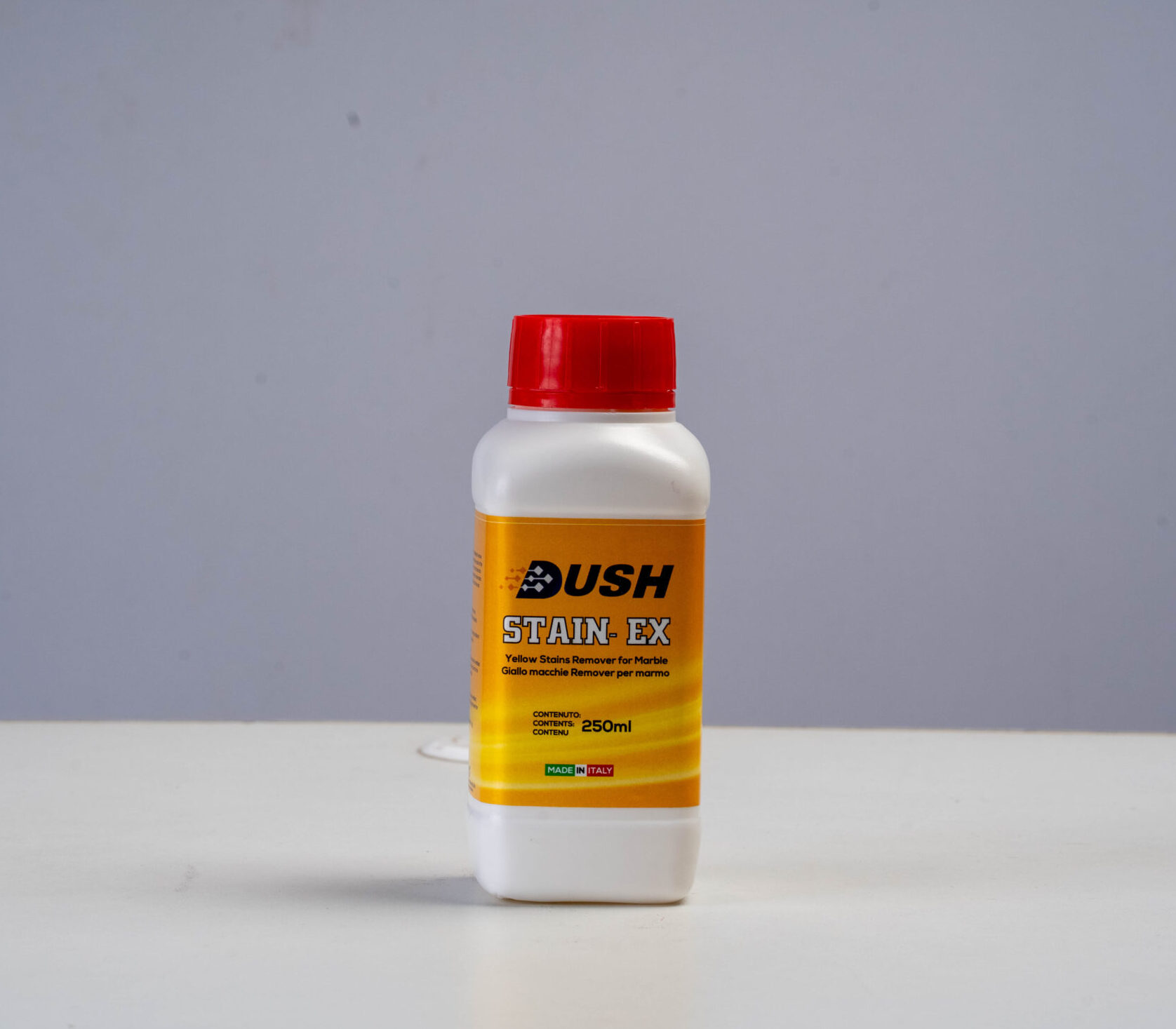
DUSH STAIN-EX
Based on DUSH's own published product documentation, DUSH STAIN-EX is formulated to lift yellowish discolouration on marble caused by contact with wood tannins, ink, and food — most commonly seen near door frames and in bathrooms. It is applied undiluted, covered with plastic film, and left for 24 hours, with repeat application for deeper, older yellowing.
Documented Scope — And Its Limit
DUSH's own product FAQ is explicit on this point: oil-based stains require an alkaline cleaner (DUSH's documentation names DUSH OXI FRESH for this purpose) rather than STAIN-EX, and STAIN-EX is confirmed as not formulated to remove rust or iron staining either. In other words, STAIN-EX is a targeted tool for organic tannin-and-oxidation yellowing — not a general-purpose stain remover, and not the correct product for the oil and grease staining this article focuses on.
Where It Fits in a Restoration Workflow
On a marble surface with both oil staining and separate yellow discolouration — a realistic scenario near a kitchen door frame, for example — the professional sequence is to treat the oil stain first with an absorbent poultice (as covered throughout this guide), and only then assess whether any remaining yellow tannin-type discolouration needs a targeted product like STAIN-EX. Applying STAIN-EX directly to an oil stain, based on its documented formulation, would not be the correct tool for that specific job.
When Poultice Treatment Is the Right Tool — And When It Isn't
Use a Poultice When...
- The stain is confirmed oil, grease, or wax-based
- The mark is translucent/darkened with soft edges
- The surface is otherwise structurally sound
- You can allow the recommended dwell time undisturbed
A Different Approach Is Needed When...
- The mark is yellow, diffuse, and tannin/oxidation-related (needs a targeted yellow-stain product)
- The mark is orange-brown and metal-associated (needs a chelating rust treatment)
- The surface shows dulling/roughness rather than discolouration (likely etching, needs re-polishing)
- The staining covers a very large commercial area (professional assessment recommended)
Prevention Guide
Quick answer: sealing marble, cleaning spills immediately, and using trays or mats under oil-prone items are the three highest-impact prevention habits.
Seal and Reseal Regularly
A well-maintained impregnating sealer slows oil penetration significantly, buying critical reaction time.
Blot, Don't Wipe, Fresh Spills
Blotting lifts oil rather than spreading it further across the porous surface.
Use Trays Under Oil Bottles
Cooking oil bottles and dressing containers are a leading, entirely preventable source of countertop staining.
Coasters for Cosmetics
Oil-based hand creams and skincare products should sit on a tray rather than directly on a marble vanity top.
Test Sealer Performance
A simple water-drop test periodically confirms whether the sealer is still active or due for renewal.
Clean Cookware Before Setting Down
Wipe the base of pans and dishes before placing them on marble to avoid transferring residual oil.
Decision Tree: Can Your Marble Be Saved?
1Is the mark translucent/darkened rather than opaque or brightly coloured?
Yes → Likely oil-based — poultice treatment is appropriate. No → Identify the actual stain type before choosing a product.
2Did the spill happen recently (hours to a few days ago)?
Yes → A single poultice cycle is likely sufficient. No → Plan for two to four repeat treatment cycles.
3Is the marble otherwise structurally sound, with no etching or cracking at the site?
Yes → Proceed with poultice treatment. No → Address the structural or etching issue first or alongside stain removal.
4Is the affected area small and localised rather than widespread?
Yes → A DIY poultice treatment is a reasonable first attempt. No → Professional assessment is likely more efficient for large or commercial areas.
Maintenance Checklist
- Confirm the stain type before selecting a removal product
- Blot fresh spills immediately — never wipe or scrub
- Use an absorbent poultice matched to oil/grease staining specifically
- Allow full dwell time — don't remove the poultice early
- Plan for repeat applications on older or deeper stains
- Reseal the treated area once the stain is fully removed
- Address the source (leaking bottle, unprotected vanity item) to prevent recurrence
Common Mistakes
Using water or general cleaner alone. Water doesn't dissolve or lift oil — it needs an absorbent poultice to draw it out.
Wiping instead of blotting a fresh spill. Wiping spreads oil across a wider area and pushes it deeper into the stone.
Using an acidic "degreaser." Many household degreasers are acidic and will etch marble while attempting to address the oil.
Removing the poultice too early. Cutting dwell time short is one of the most common reasons a treatment appears to "not work."
Using a yellow-stain-specific product on oil. Products documented for tannin/oxidation yellowing, like DUSH STAIN-EX, are not formulated for oil-based staining.
Giving up after one cycle on an old stain. Deep, set-in oil staining very often needs multiple poultice applications.
Expert Tips
Treat oil spills as urgent, even if they seem minor — the difference between a five-minute response and a next-day response can be the difference between no stain and a multi-cycle poultice treatment.
Always patch-test a new poultice product on an inconspicuous area first, particularly on dark, antique, or previously treated marble.
Cover the poultice with plastic film if the product's instructions allow it — this slows drying and extends the active working time, often improving results on deep stains.
After the stain is gone, the polish in that spot may look slightly different from the surrounding area until it's repolished — this is a normal part of the process, not a failed repair.
Keep a simple record of which product and dwell time you used — this speeds up any follow-up treatment or professional consultation if the stain needs a second round.
Frequently Asked Questions
General FeasibilityCan oil stains really be removed from marble?
Are oil stains on marble permanent?
Can old oil stains be removed?
What's the difference between fresh and deep oil stains?
Does polished marble stay polished after oil stain removal?
Can every oil stain be fully removed?
Does the type of marble affect whether oil stains can be removed?
Why does marble absorb oil in the first place?
What is capillary action in the context of marble staining?
Is marble porosity a defect?
Does a sealer stop oil from penetrating marble completely?
Why do oil stains look darker than the surrounding stone?
Can honed marble absorb oil faster than polished marble?
Does temperature affect how fast marble absorbs oil?
How do I know if my marble stain is oil-based?
What is the fastest way to treat a fresh oil spill?
How long does it take before an oil spill becomes a permanent-looking stain?
Can I tell how deep an oil stain has penetrated just by looking at it?
Is a grease stain the same as an oil stain for treatment purposes?
Why does an old oil stain sometimes look lighter than a fresh one?
Can an oil stain get worse over time if left untreated?
How do professionals remove oil stains from marble?
What is a poultice, and why is it used for oil stains?
Which products work best for oil stains on marble?
Can I make a homemade poultice for an oil stain?
Is baking soda effective on oil stains?
Can DUSH STAIN-EX remove oil stains?
What should I do if the stain doesn't respond to a poultice at all?
How many times can I repeat a poultice treatment safely?
Can I remove an oil stain myself?
When should I call a professional for an oil stain?
How long does professional oil stain removal take?
Is DIY oil stain removal risky for marble?
Do professionals guarantee oil stain removal?
How much does professional oil stain treatment typically cost?
Can hotels and facility managers treat oil stains at scale?
Does Carrara marble stain more easily than other varieties?
Are Statuario and Calacatta marble more prone to visible oil staining?
Can oil stains be removed from a kitchen countertop without removing appliances?
Can oil stains on marble floors be treated without removing tiles?
Do outdoor marble surfaces need a different oil stain treatment?
Can oil stains near a stove be prevented entirely?
Are oil stains on marble bathroom vanities common?
How can I prevent future oil stains on my marble?
Should I reseal marble after removing an oil stain?
How often should marble be resealed to prevent oil staining?
Does daily cleaning help prevent oil stains?
Can I use cooking oil-safe placemats to protect marble?
What's the single most effective prevention habit for oil stains?
Is marble a bad choice for kitchens because of oil staining risk?
Final Verdict
The honest, evidence-based answer is that most oil stains on marble can be removed. Oil sits physically within the stone's naturally porous structure rather than reacting chemically with it, which is what makes the absorbent poultice method — used consistently across every major stone-care brand researched for this guide, from AKEMI and FILA to Lithofin, HMK, and Bellinzoni — genuinely effective. Fresh stains respond quickly; older, deeper staining needs patience across multiple treatment cycles, and very old, unsealed cases may only partially resolve.
Where DUSH STAIN-EX fits into this picture is worth stating precisely, based on its own published documentation: it is formulated for yellow discolouration from wood, ink, and food contact — not oil or grease staining. For oil stains specifically, a dedicated oil-and-grease poultice product, applied with the diagnosis, patience, and technique described throughout this guide, is the correct and well-documented path to a clean result. Marble ownership doesn't require living with oil stains — it requires matching the right method to the right problem, and being willing to give a genuinely stubborn, older stain the repeat treatment it needs.
Dealing with Yellow Staining on Your Marble?
If your marble has tannin or organic yellow discolouration alongside any oil staining, explore DUSH STAIN-EX — documented specifically for that category of marks.