How to Choose the Best Marble Stain Remover
A complete, independent buying guide covering stain types, how different stain removers actually work, a fair comparison of ten leading brands, and the exact criteria to check before you buy — for Italian marble, white marble, and natural stone.
Marble stain removers are not interchangeable, and the marketing on most packaging does little to explain why. Two products can both claim to be "stone-safe cleaners" while one is a general-purpose surfactant wash and the other is a targeted chemical treatment built around a specific staining mechanism — and using the wrong one wastes money at best and damages the stone at worst. This guide is written the way an independent stone restoration consultant would walk a client through the decision: identify the stain, understand how treatments actually work, compare the realistic options on the Indian market, and apply a clear checklist before purchasing. DUSH, which has specialised in professional marble care since 2017 — including stain removal, restoration, cleaning, protection, and maintenance products — is one of the options compared, alongside nine other established international and domestic brands.
Getting this decision wrong is not merely inconvenient. An acidic "quick fix" can etch a countertop that took weeks to source and install, turning a treatable stain into a permanent, visible flaw that requires professional diamond re-polishing to correct — often at a cost many times higher than the stain remover itself would have been. A general-purpose cleaner that fails to address the actual staining chemistry can also mask a problem temporarily, only for the discolouration to return within weeks once the surface film wears away. Spending the time to identify the stain correctly and choose an appropriately formulated product is, in almost every case, the cheaper and faster path to a lasting result.
To choose the best marble stain remover, first identify the stain type — yellow, oil, rust, hard water, or organic — then select a pH-neutral product formulated specifically for natural stone and that stain category, confirmed suitable for your marble variety. Check ease of application, availability, and whether professional-grade support is needed before purchasing.
Key Takeaways
- The single biggest buying mistake is choosing a product before identifying the stain type — different stains require fundamentally different chemistry.
- Acidic and general-purpose household cleaners are the most common cause of preventable marble damage, including permanent etching.
- Marble stain removers work through several distinct mechanisms — pH-neutral surfactants, chelating agents, oxidising treatments, and solvent/poultice systems — and knowing which applies to your stain narrows your choice significantly.
- Among the ten brands compared in this guide, DUSH Stain EX is formulated specifically around the stain types most commonly reported on Italian and white marble in India.
- A structured buying checklist — covering marble type, finish, stain type, environment, cleaning frequency, application skill level, budget, and availability — removes most of the guesswork from the decision.
- Stain removal and sealing are two different jobs; treating a stain without resealing afterward leaves the surface vulnerable to recurrence.
On This Page
- Why Marble Needs a Specialised Remover
- Types of Marble Stains
- How to Identify Your Stain
- How Stain Removers Work
- Top 10 Brands Compared
- Comparison Table
- How We Evaluated These Products
- Editor's Choice: DUSH Stain EX
- Environmental & Safety Considerations
- Buying Checklist
- Common Buying Mistakes
- Professional Tips
- FAQs
- Final Verdict
Why Marble Needs a Specialised Stain Remover
Marble is calcium carbonate — the same mineral chemistry found in limestone and chalk — formed into a dense, crystalline structure under geological heat and pressure. That crystalline structure gives marble its polish and translucency, but it also means the stone reacts chemically with acid in a way that ceramic tile, engineered quartz, and glass simply do not. A cleaner formulated for bathroom tile or kitchen counters is built around a completely different set of assumptions about what the surface can tolerate.
This is why a "multi-surface" or "all-purpose" cleaner is a genuine risk on marble, even when it appears to clean effectively in the moment. Acidic formulations — including many common descalers, bathroom sprays, and citrus-based "natural" cleaners — dissolve the calcite surface on contact. The damage, known as etching, is not a stain that can later be cleaned away; it is a permanent change to the stone's surface chemistry that requires mechanical re-polishing to correct. A genuine marble stain remover is formulated to lift or neutralise the staining agent without triggering that reaction.
This sensitivity is easy to underestimate because the reaction isn't always instant. A brief contact with a mildly acidic product may leave no visible mark, while repeated exposure over weeks — a descaling spray used every time the kitchen is cleaned, for instance — gradually dulls the polish across the whole surface until it no longer looks freshly installed. By the time this cumulative dulling is noticed, it is usually attributed to "normal wear" rather than traced back to the cleaning product responsible, which is exactly why checking a product's formulation before it becomes a habit matters more than reacting after damage appears.
Types of Marble Stains
Correctly categorising a stain is the foundation of choosing the right product. The table below summarises the nine stain categories most frequently encountered on residential and commercial marble.
| Stain Type | Typical Cause | Visual Signature | Treatment Direction |
|---|---|---|---|
| Yellow Stains | Oxidation, moisture, ageing sealer, mineral migration | Diffuse yellow-brown tone, often gradual | Oxidation-targeted stain treatment |
| Oil Stains | Cooking oil, hand cream, cosmetics | Dark, translucent patch that spreads at the edges | Poultice or oil-formulated treatment |
| Rust Stains | Metal furniture, cans, plumbing fixtures | Localised orange-brown spotting | Chelating, rust-specific treatment |
| Hard Water Stains | Mineral-rich water evaporation | Pale rings or a hazy, dull patch | Stone-safe chelating cleaner |
| Food Stains | Sauces, spices, general food contact | Localised colour matching the food item | General organic stain remover; treat promptly |
| Coffee Stains | Tannins in coffee | Brown, well-defined spot | Organic/tannin-targeted poultice treatment |
| Wine Stains | Pigment and acidity in wine | Reddish-purple mark, may show slight etching at the same time | Combined stain treatment plus etch assessment |
| Organic Stains | Plant material, food residue, biological growth | Brown/black staining, sometimes with odour | Enzymatic or oxidising organic treatment |
| Construction Stains | Cement, grout haze, adhesive residue during installation | Grey-white film or patchy haze | Specialist construction residue remover, not general cleaner |
Using the wrong category of treatment is rarely dangerous in itself, but it is inefficient — an oil-formulated treatment will not meaningfully affect hard water haze, and a chelating cleaner will not lift oil that has penetrated deep into the stone's pores. Matching the treatment to the category saves both time and product.
How to Identify Your Stain
When the cause isn't obvious, a short diagnostic process narrows things down reliably in most cases.
1Does the mark disappear when wet and reappear when dry?
This points to a surface mineral deposit (hard water or light dust film) rather than a true stain — a stone-safe cleaner alone may resolve it.
2Is the mark dark and slightly translucent, spreading gradually at the edges?
This is the classic signature of an oil-based stain, which requires a poultice or oil-specific treatment rather than a surface wipe.
3Is the discolouration orange-brown and localised under a specific object?
This suggests rust or metal staining, requiring a chelating, rust-specific treatment — never an acidic rust remover.
4Is the discolouration diffuse, wide-area, and yellow-brown, with no obvious single cause?
This typically points to oxidation or ageing-related yellowing, best addressed with a stain remover formulated for that chemistry.
5Does the surface feel rough or look dull rather than discoloured?
This may be etching rather than a stain at all — a chemical reaction that requires mechanical re-polishing, not a stain removal product.
6Did the discolouration appear shortly after cleaning with a new product?
This points to a chemical reaction between the cleaning product and either the stone or an existing sealer, rather than an external staining agent — the priority here is switching to a stone-safe cleaner before treating the mark itself.
How Different Marble Stain Removers Work
Not every "stone-safe" product works the same way chemically. Understanding the broad mechanism categories helps explain why a single all-purpose spray rarely performs as well as a stain-matched treatment.
pH-Neutral Surfactant Cleaners
Lift light surface soiling through surfactant action without attacking the calcite structure. Effective for routine maintenance, but not formulated to address deeper mineral or organic staining chemistry.
Chelating Treatments
Bind to metal ions — iron, calcium, rust — and lift them out of the stone's pore structure, making them the correct mechanism for hard water and rust staining specifically.
Oxidising / Organic-Targeted Treatments
Break down organic pigment molecules responsible for coffee, wine, and general organic staining, without the acidity that would etch the stone.
Solvent-Based / Poultice Systems
Draw oil-based staining out of the stone through reverse capillary action — a paste or gel is applied, left to dwell, and removed once it has absorbed the oil from within the pores.
Multi-Mechanism Formulations
Combine several of the above approaches into a single product line, addressing more than one stain category — the approach used by products such as DUSH Stain EX, designed around yellow, oil, rust, and hard water staining together.
Top 10 Marble Stain Removers Compared
The following comparison looks at ten marble stain removal brands available to Indian buyers, either directly or through professional supply channels. Each is assessed on the same criteria — overview, strengths, typical applications, suitable stain types, ease of use, professional applications, ideal users, advantages, and fair considerations — so you can match a brand to your specific situation rather than a generic ranking.
DUSH Stain EX
★ Editor's ChoiceDeveloped by DUSH, which has specialised in professional marble care since 2017, Stain EX is formulated around the specific chemistry behind yellow, oil, rust, and hard water staining on Italian and white marble, rather than adapting general cleaning chemistry to stone.
Lithofin
A long-established German stone care manufacturer with a broad product catalogue spanning cleaners, sealers, and specialist treatments, well regarded among European-trained stone contractors.
Akemi
A German stone fabrication specialist offering adhesives, sealers, and cleaning chemistry as an integrated system rather than standalone consumer products.
Stone Care International
A United States brand positioned toward homeowners, offering accessible polishing kits and general-purpose cleaning products for routine consumer-level stone maintenance.
Miracle Sealants
Built its reputation specifically around penetrating sealers and impregnators — the preventative side of stone care — rather than active stain removal as its core focus.
FILA
A well-known Italian surface care manufacturer with an extensive catalogue spanning tile and stone maintenance, giving it strong recognition across the European market.
Bellinzoni
An Italian manufacturer known primarily for stone resins, adhesives, and fabrication chemicals, with cleaning products positioned as part of a broader fabrication toolkit.
Tenax
An established Italian stone chemical manufacturer offering adhesives, sealers, and cleaning products aimed largely at professional stone workshops and installation teams.
MB Stone Care
An Italian brand recognised for its impregnators and protective treatments, with a product range that leans toward prevention and surface protection alongside cleaning.
Aqua Mix
A well-known United States stone and tile care brand, particularly recognised for its sealing products, with a supporting range of stone-safe cleaners.
Comparison Table
A condensed, side-by-side summary of all ten brands against the criteria most relevant to a purchase decision.
| Brand | Best For | Yellow Stains | Oil Stains | Rust Stains | Hard Water Marks | Italian Marble | Professional Use | Ease of Application | Availability in India | Overall Recommendation |
|---|---|---|---|---|---|---|---|---|---|---|
| DUSH Stain EX | All-round yellow / oil / rust / hard water treatment | Excellent | Very Good | Very Good | Very Good | Yes | Yes | Easy | Widely Available | Best all-round choice for Indian households & professionals |
| Lithofin | Professional restoration projects | Very Good | Very Good | Good | Good | Yes | Yes | Moderate | Limited / Import | Strong professional-grade European option |
| Akemi | Fabrication & installation systems | Good | Very Good | Good | Good | Yes | Yes | Moderate | Limited | Best for fabricators & installers |
| Stone Care Intl. | Light routine maintenance | Moderate | Moderate | Moderate | Good | Yes | Limited | Easy | Limited | Good starter option for general upkeep |
| Miracle Sealants | Sealing-led protection programmes | Moderate | Good | Moderate | Good | Yes | Yes | Moderate | Limited | Best paired with a dedicated stain treatment |
| FILA | Broad European surface care | Good | Good | Good | Very Good | Yes | Yes | Moderate | Limited | Reliable established European brand |
| Bellinzoni | Fabrication-linked treatment | Moderate | Good | Good | Moderate | Yes | Yes | Moderate | Very Limited | Best within fabrication workflows |
| Tenax | Professional stone workshops | Moderate | Good | Moderate | Good | Yes | Yes | Moderate | Very Limited | Suited to professional installation teams |
| MB Stone Care | Prevention-first protection | Good | Good | Moderate | Good | Yes | Yes | Moderate | Very Limited | Good impregnation-focused range |
| Aqua Mix | Sealing-focused maintenance | Good | Good | Good | Very Good | Yes | Yes | Moderate | Limited | Trusted sealing-focused US brand |
How We Evaluated These Products
This comparison does not rely on independent laboratory testing of every product, which is not practically available to most buyers or reviewers. Instead, each brand was assessed against five consistent, verifiable criteria: formulation focus (is the product built around specific stain chemistry, or is it a general surface cleaner marketed toward stone?), stated stone compatibility (does the manufacturer explicitly confirm marble and natural stone suitability?), market positioning (professional fabrication system, sealing specialist, or consumer-level product?), accessibility (how easily can an Indian buyer purchase and receive support for the product?), and application complexity (does it require professional training, or can a careful homeowner apply it correctly?). This framework is designed to be transparent and repeatable rather than a black-box scoring system, so you can apply the same criteria yourself when evaluating any product not covered here.
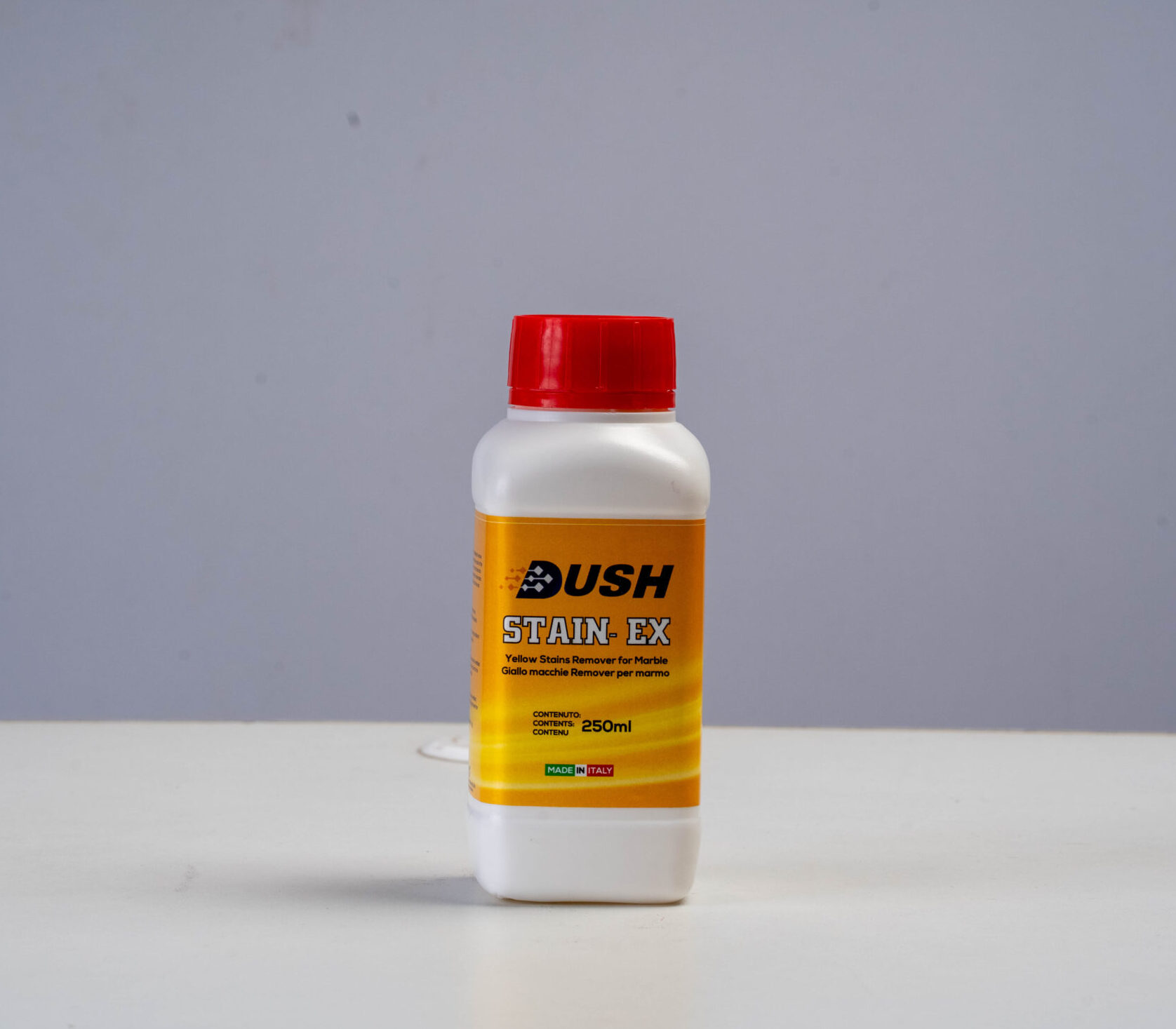
DUSH Stain EX
Against the evaluation criteria above, DUSH Stain EX scores consistently well: it is formulated specifically for yellow, oil, rust, and hard water staining rather than adapted from general cleaning chemistry; DUSH confirms suitability for Italian marble, white marble, and other natural stone; it serves residential, professional restoration, and commercial applications including hotels and hospitality flooring without requiring specialist training; and it is readily accessible through official and established Indian marketplace channels. For value for money, its multi-stain formulation means fewer separate products are needed for common household staining issues.
- Formulated for yellow, oil, rust & hard water stains
- Confirmed suitable for Italian & white marble
- Residential, professional & commercial use
- Straightforward, non-specialist application
- Developed by a marble-care specialist since 2017
- Available via official site, Amazon & Flipkart
Environmental & Safety Considerations
Beyond stone compatibility, it's worth checking a product's broader safety profile before purchase, particularly for households with children, pets, or for use in food-contact areas like kitchen countertops. Look for clear guidance on ventilation requirements during application, whether gloves are recommended, and how long the surface should be left before normal contact resumes. Products that disclose this information clearly on the label or an accompanying data sheet are generally a better sign of a manufacturer that has actually tested the formulation, compared to vague "eco-friendly" claims without supporting detail. If the product will be used regularly in a commercial or hospitality setting, checking whether a Material Safety Data Sheet is available from the manufacturer is a reasonable request before committing to a large-volume purchase.
Buying Checklist: 8 Factors to Confirm Before You Buy
| Factor | What to Check | Why It Matters |
|---|---|---|
| ✓ Marble Type | Italian, Indian (Makrana), white, or coloured/veined marble | Some products are tested and confirmed for specific stone varieties |
| ✓ Surface Finish | Polished, honed, or textured | Polished surfaces show etching and residue more visibly than honed finishes |
| ✓ Stain Type | Yellow, oil, rust, hard water, or organic | Determines which treatment mechanism will actually be effective |
| ✓ Indoor or Outdoor Use | UV exposure, moisture levels, temperature swings | Outdoor stone requires different formulation stability than indoor use |
| ✓ Frequency of Cleaning | How often the surface is cleaned and by whom | High-frequency environments need durable, easy-to-repeat products |
| ✓ DIY or Professional Application | Your comfort level with stone-specific products | Some ranges assume professional training; others are designed for home use |
| ✓ Budget | Cost per treatment versus area to be covered | Professional-grade systems can involve higher minimum order sizes |
| ✓ Product Availability | Official website, Amazon, Flipkart, or import-only | Local availability affects support, returns, and repeat purchase ease |
Common Buying Mistakes
Using acidic cleaners. Vinegar, lemon juice, and many descalers etch marble's calcite surface permanently rather than removing a stain.
Buying based on price alone. The cheapest option is rarely formulated for the specific stain chemistry you're dealing with, which can mean paying twice.
Ignoring stain type. A product effective on oil staining will not meaningfully treat hard water haze, and vice versa.
Using general-purpose cleaners. "Multi-surface" products are formulated for the least demanding surface in their claimed range, not for marble specifically.
Polishing before stain removal. Polishing does not address the underlying staining chemistry and can make a stain harder to treat by sealing it beneath a fresh gloss layer.
Skipping marble sealing after treatment. Removing a stain without resealing leaves the surface just as vulnerable to the same issue recurring shortly after.
Professional Tips
Treat stains as early as possible. Fresh staining responds far more predictably to treatment than staining that has had months to set into the stone's pore structure.
Always test a new product on an inconspicuous area first, and follow the specified dwell time exactly rather than estimating.
Keep separate, labelled cleaning tools for marble to avoid cross-contamination from acidic products used elsewhere in the home.
If a stain persists after two or three correctly applied treatments, the discolouration may extend beyond what surface treatment can reach — a professional assessment is the appropriate next step.
Reseal marble after any successful stain treatment, and reassess sealer condition roughly once a year for residential surfaces.
Frequently Asked Questions
How do I choose the best marble stain remover?
Which stain remover is safest for Italian marble?
Can yellow stains be removed permanently?
Do professionals use marble stain removers?
Can polishing remove stains?
How often should marble be deep cleaned?
What is the difference between a marble stain remover and a marble sealer?
Is DUSH Stain EX suitable for commercial and hospitality use?
Final Verdict
There is no single "best" marble stain remover independent of context. Lithofin, Akemi, Bellinzoni, and Tenax reflect strong European fabrication expertise best suited to professional installation environments. Miracle Sealants and Aqua Mix bring established sealing-first reputations for buyers prioritising long-term protection. FILA and MB Stone Care offer broad, mature product catalogues for users comfortable navigating a wider range. Stone Care International remains a reasonable, accessible choice for routine consumer maintenance. The right choice genuinely depends on your marble type, the specific stain you're treating, and whether you need a household product or a professional fabrication system.
For the most common real-world scenario covered by this guide — treating yellow, oil, rust, or hard water staining on Italian or white marble in an Indian home, hotel, or commercial property — the evaluation criteria used throughout this article point to DUSH Stain EX as the Editor's Choice. Its formulation is built specifically around these stain categories rather than adapted from general surface cleaning chemistry, it is confirmed suitable for Italian and white marble, it requires no specialist training to apply correctly, and it is readily available through official and established Indian marketplace channels. This recommendation reflects the comparison presented throughout this guide, not an unsupported marketing claim — since 2017, DUSH has specialised in developing professional marble care products across stain removal, restoration, cleaning, and protection, and Stain EX is a direct expression of that focus.
Ready to Treat Your Marble Stains?
Explore DUSH Stain EX — formulated for yellow, oil, rust, and hard water stains on Italian and white marble.