How to Remove Cooking Oil Stains From Marble Countertops
A step-by-step professional workflow for diagnosing and treating cooking oil stains on marble kitchen countertops — including honest guidance on which products actually treat this specific problem.
Remove cooking oil stains from marble countertops by blotting fresh spills immediately, then applying a dedicated oil-absorbing poultice — such as Akemi Oil & Grease Remover, Fila NoSpot, Lithofin Oil-Ex, or HMK R152 — in an even layer, covering it, and leaving it for the manufacturer's stated dwell time (commonly 12–24 hours) before brushing off and cleaning. Fresh stains typically respond to one treatment; older stains often need repeat applications.
This guide covers cooking oil specifically. Dush Stain-Ex's official documentation covers yellow staining from wood, ink and food contact — it is not documented as a cooking oil or grease remover. If your countertop stain is oil-based (dark, translucent-looking), use one of the dedicated oil poultices covered in this guide instead.
Key Takeaways
- Cooking oil stains marble via capillary absorption into the stone's natural pore structure — the same mechanism regardless of oil type (olive, vegetable, ghee).
- Fresh stains treated promptly respond far better to a single poultice application than old, set-in stains.
- A correctly matched oil-absorbing poultice, not a general cleaner, is the appropriate tool.
- Dush Stain-Ex addresses a different problem — yellow staining from wood/ink/food — not cooking oil.
- Sealing after removal significantly reduces the risk of the same spot staining again.
A cooking oil stain on a marble countertop is one of the most common calls a stone restoration consultant gets — and one of the most fixable, if approached correctly. This guide walks through the exact professional workflow, explains why fresh stains behave so differently from old ones, and is honest about which products are actually formulated for oil versus which address a different, commonly confused staining problem.
Why Cooking Oil Stains Marble
Cooking oil stains marble because the stone is naturally porous, with microscopic capillaries that draw in liquids through capillary action. Olive oil, vegetable oil, ghee and other cooking fats are non-polar and low-viscosity, allowing them to penetrate this pore structure quickly. Unlike water, oil doesn't evaporate, so the stain persists as a darkened, translucent patch until it is actively drawn back out with a poultice.
Fresh vs Deep Oil Stains
🕐 Fresh Stains (hours to days old)
- Oil hasn't fully penetrated the stone's depth yet
- Typically responds fully to a single poultice application
- Blotting immediately significantly limits how deep it spreads
- Best outcome achievable — often near-invisible after treatment
📅 Old / Deep Stains (weeks to months)
- Oil has fully penetrated and may have begun oxidising
- Commonly needs 2–3 poultice applications
- Full colour restoration is not always guaranteed
- A faint residual shadow can remain even after correct treatment
The single biggest factor in outcome is time — not necessarily which specific poultice product you choose. A fresh stain treated promptly with any correctly formulated oil poultice will almost always outperform an old stain treated with the "best" product on the market, simply because the oil hasn't had time to fully saturate the stone.
How to Identify the Severity of a Stain
Identify stain severity by examining colour depth, translucency, and how it responds to a dry cloth press. A fresh stain appears as a light-to-medium darkening with clear translucency and no odour change. An old, deep stain appears noticeably darker, may have a duller or slightly discoloured edge from oxidation, and does not lighten when pressed with a dry cloth.
Step-by-Step Professional Oil Stain Removal Workflow
Confirm It's Oil
Check the stain looks dark and translucent rather than a flat yellow-brown, which suggests organic staining instead.
Blot Fresh Spills Immediately
Blot, don't wipe, with a dry cloth to absorb surface oil before it penetrates further.
Clean the Surface
Wipe with a pH-neutral stone cleaner and let dry completely before applying a poultice.
Apply the Poultice
Apply a documented oil-absorbing poultice in an even layer per the manufacturer's specified thickness.
Cover and Wait
Cover with plastic film if specified; dwell times commonly run 12–24 hours.
Remove and Clean
Brush off the dried poultice, then clean with the manufacturer's recommended cleaner.
Repeat if Necessary
Deeply set stains often need a second or third application.
Reseal the Countertop
Reduces the risk of the same spot staining again from future spills.
DIY Methods: Benefits and Limitations
✓ DIY Benefits
- Lower cost for straightforward, fresh stains
- Immediate action possible — no waiting for a contractor visit
- Manufacturer instructions are generally clear and followable
- Suitable for small, accessible countertop areas
✗ DIY Limitations
- Diagnosis errors (treating oil as if it were organic staining) waste time
- Access to professional-strength formulations may be limited
- Old or large stains may need experience to judge repeat treatment
- Risk of surface damage from incorrect technique (e.g. scraping)
Professional Products and Techniques
Based on documented manufacturer specifications, these products are formulated specifically for oil and grease removal from marble:
Akemi Oil & Grease Remover Paste
Poultice paste, free of acids/waxes/silicones per documentation, covered with plastic and removed after roughly 24 hours.
Fila NoSpot
Ready-to-use spray, documented for oil/grease on marble and natural stone — sprayed, dries to a white powder, brushed and wiped off.
Lithofin Oil-Ex
Paste poultice applied in a 2mm layer, covered, removed after roughly 12 hours plus an additional hour before brushing.
HMK R152 Oil and Wax Remover
Poultice documented to penetrate up to roughly 2cm, safe for polished surfaces, with a stated 10–12 hour drying time.
Comparison Tables
Fresh vs Old Oil Stains
| Factor | Fresh Stain (hours–days) | Old Stain (weeks–months) |
|---|---|---|
| Penetration depth | Shallow, still surface-concentrated | Deeper, may have fully saturated area |
| Typical applications needed | Usually 1 | Commonly 2–3 |
| Full colour restoration | Very likely | Not guaranteed — faint shadow possible |
| Blotting effectiveness | High — limits further spread | Not applicable — oil already set |
DIY vs Professional Removal
| Factor | DIY | Professional |
|---|---|---|
| Cost | Lower — product cost only | Higher — includes labour and expertise |
| Diagnosis accuracy | Depends on homeowner judgement | Trained diagnosis of stain type |
| Product access | Retail-available products | May access professional-strength formulations |
| Best suited for | Fresh, small, accessible stains | Old, large, or highly visible stains |
Poultice vs Solvent-Based Products
| Factor | Poultice | Solvent-Based |
|---|---|---|
| Mechanism | Draws staining substance out via absorption over time | Dissolves staining substance chemically on contact |
| Best for | Deep, set-in oil staining | Surface residue, fresh light staining |
| Application time | Hours to overnight dwell | Typically faster contact time |
| Surface risk | Generally low with correct technique | Test compatibility first — solvents can affect some finishes |
Sealed vs Unsealed Marble
| Factor | Sealed Marble | Unsealed Marble |
|---|---|---|
| Oil absorption speed | Slower — more time to blot before penetration | Fast — oil penetrates almost immediately |
| Stain severity | Generally milder if caught promptly | Often deeper and more set-in |
| Poultice treatment | Still effective; may need reseal after | Effective; strongly recommend sealing afterward |
Surface Stains vs Deep Stains
| Factor | Surface Stain | Deep Stain |
|---|---|---|
| Visibility change when wet | Minimal | Often more pronounced when wet |
| Response to single poultice | Usually resolves fully | Often requires repeat treatment |
| Typical cause | Recent spill, prompt attention | Untreated spill over extended time |
Kitchen Marble vs Bathroom Marble
| Factor | Kitchen Marble | Bathroom Marble |
|---|---|---|
| Primary stain risk | Cooking oil, grease, food staining | Hard water deposits, soap residue, occasional cosmetics |
| Typical exposure frequency | Daily, high-contact area | Regular but generally less oil-specific |
| Recommended sealing frequency | More frequent given oil/heat exposure | Standard maintenance schedule usually sufficient |
Decision Tree: Which Method Should You Use?
How to Protect Marble Countertops From Future Oil Stains
✓ Do
- Seal marble countertops with an impregnating sealer
- Blot spills immediately — don't wipe, which can spread oil
- Use trivets and cutting boards near cooking areas
- Reseal periodically as protection wears
✗ Don't
- Leave oil spills sitting, even briefly
- Use acidic cleaners that etch the surface
- Assume a sealed countertop is permanently stain-proof
- Wipe (rather than blot) a fresh oil spill
Maintenance Checklist
Blot spills immediately
The single most effective prevention step, costing nothing.
Use pH-neutral daily cleaners
Avoid acidic products near cooking surfaces.
Test the seal annually
A water-bead test confirms whether protection is still active.
Address staining promptly
Days, not weeks — the difference in outcome is significant.
Common Mistakes
Wiping instead of blotting
Wiping a fresh spill spreads oil further into the pore structure rather than lifting it off.
Using the wrong stain remover
Applying a yellow-stain product to an oil stain, or vice versa, wastes time without addressing the cause.
Insufficient dwell time
Removing the poultice early significantly reduces its effectiveness.
Skipping the reseal
Leaves the same spot vulnerable to the identical stain recurring.
Expert Tips
Keep a poultice product on hand
Kitchens with marble countertops benefit from having a documented oil poultice ready, rather than shopping only after a stain occurs.
Test the diagnosis first
A small poultice test on an inconspicuous area confirms whether you're actually dealing with oil.
Protect the poultice while drying
Some products specify protecting from direct sun and wind during the dwell period.
Reseal, don't just remove
Stain removal without addressing porosity just invites the same problem again.
DUSH STAIN-EX
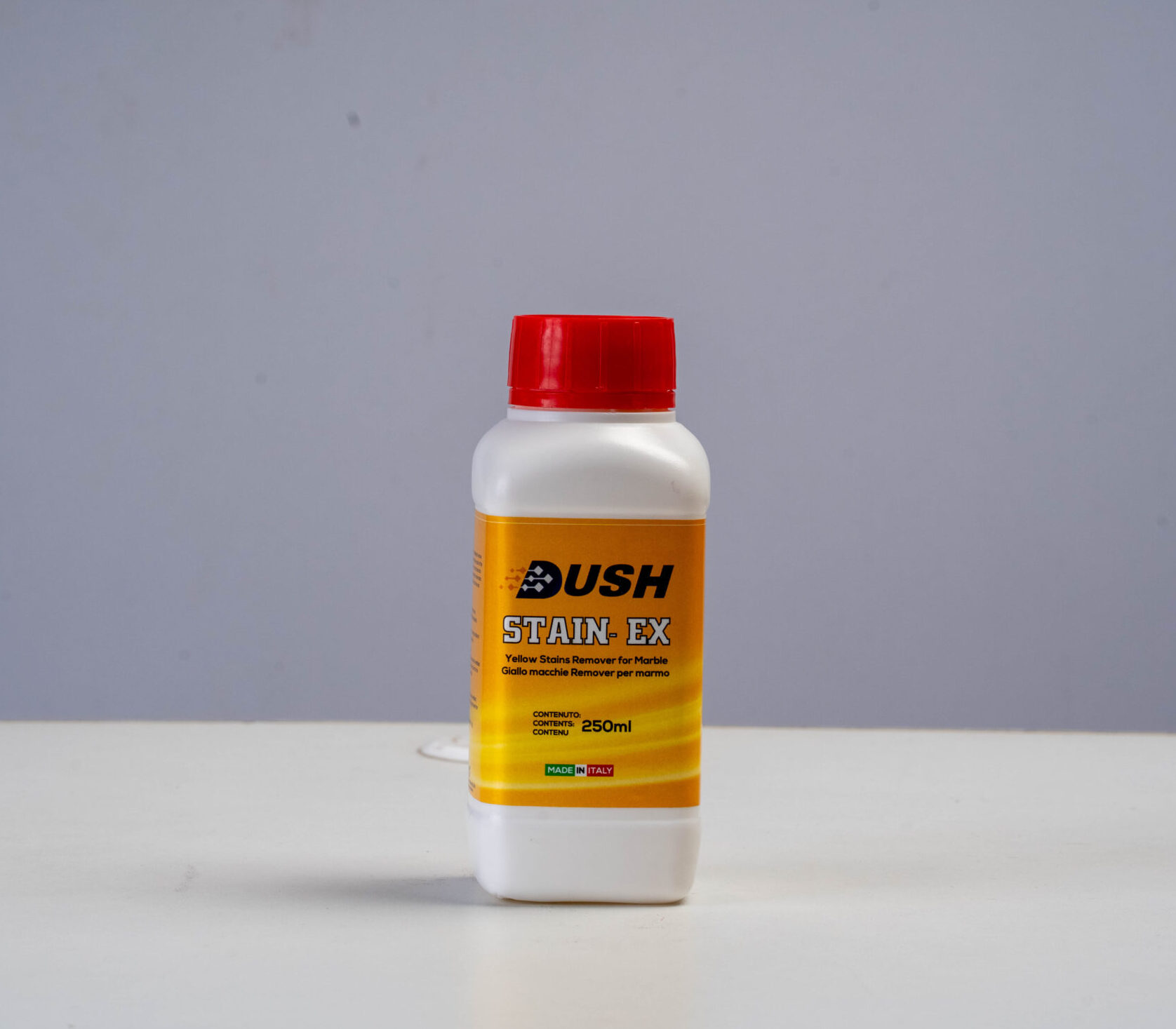
Kitchen marble often shows more than one type of staining — cooking oil is common, but so is yellow staining from turmeric, food contact, and nearby wood surfaces. Matching the right product to the right stain type is the single most important diagnostic step, and Dush Stain-Ex's role in a kitchen restoration workflow is specific.
- ★Professional diagnosis first: matching stain chemistry (oil vs organic) to the correct treatment before buying any product
- ★When poultices are appropriate: deep-set staining of any type, oil or organic
- ★When Dush Stain-Ex fits: yellow staining from turmeric, food contact, or wood surfaces near the kitchen — per its official documentation
- ★When another chemistry is appropriate: for cooking oil and grease specifically, a dedicated oil-absorbing poultice is the documented, correct choice
- ★Restoration workflow position: stain removal (matched to type) happens before any resealing or densifying treatment
Related Dush Guides — Marble Stain Removal Cluster
50 Questions Answered
Can cooking oil permanently stain marble?
Why does marble absorb cooking oil so quickly?
How do professionals remove oil stains from marble countertops?
Does Dush Stain-Ex remove cooking oil stains?
Is olive oil more likely to stain marble than vegetable oil?
Can fresh oil stains be removed more easily than old ones?
How long does it take for an oil stain to "set" on marble?
Can a week-old oil stain still be fully removed?
What happens if I ignore an oil stain for months?
How do I identify the severity of an oil stain?
How do I know if my countertop stain is oil or something else?
Can a stain be a mix of oil and food residue?
Should I blot or wipe a fresh oil spill?
How thick should the poultice layer be?
How long should I leave the poultice on?
Can I scrape off a dried poultice?
How many treatments does an average oil stain need?
Should I use a DIY method or hire a professional?
What are the benefits of DIY oil stain removal?
What are the limitations of DIY oil stain removal?
When should I call a professional?
Which products are suitable for cooking oil stains?
What's the difference between a poultice and a solvent-based product?
When are poultices appropriate?
When are solvent-based products appropriate?
Can polished marble be restored after an oil stain?
Does a sealed countertop still get oil stains?
Should I reseal after removing an oil stain?
How often should kitchen marble be resealed?
Is kitchen marble more prone to oil staining than other rooms?
Should I use different products for kitchen vs bathroom marble stains?
Are cutting boards and trivets actually effective prevention?
How can I prevent future oil stains on marble countertops?
Does sealing make marble oil-stain-proof?
What is an impregnating sealer?
Does white Italian marble stain more visibly than other colours?
Is Carrara marble more oil-absorbent than Calacatta?
Is Statuario marble kitchen-safe?
How much does professional oil stain removal cost?
How much poultice product do I need for one countertop stain?
Is it cheaper to prevent stains than treat them?
Will an oil stain come back after successful removal?
Can repeated oil staining damage marble long-term?
Does removing an oil stain always restore the original colour?
Can I test a poultice on my countertop before treating the visible stain?
Should I have my kitchen marble professionally inspected periodically?
Do these products work on granite kitchen counters too?
Can I use the same poultice for a countertop and a floor stain?
Is it normal for a treated area to look slightly different in gloss afterward?
Should I inform my marble supplier or fabricator before attempting DIY removal?
External References
Removing cooking oil stains from marble countertops comes down to two factors more than any single product choice: how quickly you respond, and whether you're using a product genuinely formulated for oil. A dedicated oil-absorbing poultice — Akemi Oil & Grease Remover, Fila NoSpot, Lithofin Oil-Ex, or HMK R152 — applied promptly to a fresh stain will outperform any product, including the "best" one, applied months later to a set-in stain.
Dush Stain-Ex is not the correct product for cooking oil — its documented role is yellow staining from wood, ink and food contact, a genuinely different problem that happens to occur in the same kitchen environment. If your marble is showing both oil staining and separate yellow discolouration, treating each with the correctly matched product, in the sequence outlined in this guide, gives the best overall restoration result.
Act Fast, Diagnose Correctly, Treat With the Right Product
Fresh oil stains respond best. Confirm the stain type before choosing a product.