Best Oil Stain Remover for Marble
An honest, technically grounded guide to removing oil and grease stains from white Italian marble, granite and natural stone — including where a yellow-stain remover like Dush Stain-Ex fits, and where it does not.
The best oil stain remover for marble is a dedicated oil-absorbing poultice or spray — such as Akemi Oil & Grease Remover Paste, Fila NoSpot, Lithofin Oil-Ex, or HMK R152 — all documented specifically for oil, grease and wax removal from natural stone. Dush Stain-Ex is formulated for yellow stains from wood, ink and food contact, not oil, and is covered in this guide for the adjacent, commonly confused staining problem it does address.
This guide is about oil stains specifically. Dush Stain-Ex's official documentation describes it as formulated to lift yellowish stains caused by wood, ink and food contact, commonly needed near door frames and bathrooms — it does not document oil or grease stain removal capability. We're covering it here because oil staining and yellow staining are frequently confused by homeowners and often occur in the same areas (kitchens, near cooking surfaces), and it's genuinely useful to know which is which before buying a product.
Key Takeaways
- Oil stains and yellow stains are chemically different problems requiring different removal products.
- Dedicated oil-absorbing poultices — Akemi, Fila NoSpot, Lithofin Oil-Ex, HMK R152 — are all documented specifically for oil and grease.
- Marble absorbs oil readily due to its porous, capillary structure — oil doesn't evaporate the way water does.
- Most oil stains can be successfully removed with a correctly matched poultice and adequate dwell time.
- Dush Stain-Ex addresses a different, adjacent problem — yellow organic staining from wood, ink and food — and is genuinely useful for that, not for oil.
Oil stains are among the most common and most misdiagnosed marble staining problems — homeowners frequently reach for a general stain remover or, understandably, whatever product their marble supplier sold them for a completely different stain type. This guide explains the actual chemistry of oil staining on marble, compares the products genuinely formulated to remove it, and is honest about where a yellow-stain specialist like Dush Stain-Ex fits and where it doesn't.
Why Marble Gets Oil Stains
Marble absorbs oil easily because it is a naturally porous, calcareous stone with a network of microscopic capillaries. Oil is non-polar and relatively low-viscosity, allowing it to be drawn into this pore structure by capillary action. Unlike water, oil does not evaporate, so an oil stain persists as a darkened, often translucent patch until the oil is chemically drawn back out, typically via a poultice.
Types of Marble Stains
Oil / Grease Stains
Darkened, translucent patch from cooking oil, grease, cosmeticsYellow / Organic Stains
Turmeric, tea, wood tannins, ink — yellow-brown discolourationRust / Iron Stains
Iron oxidation from metal objects or iron minerals in the stoneHard Water Deposits
Mineral film from evaporating hard waterOil and yellow stains are frequently confused because both can appear as a dark or discoloured patch, and both commonly occur in kitchens. The visual distinction: an oil stain typically looks darkened and slightly translucent, as if the stone is "wet" in that spot even when dry, while a yellow stain looks more like a dye — a flat yellow-to-brown discolouration without that translucent quality.
How Professionals Diagnose Stains
Professionals diagnose a marble stain by examining its colour, translucency and location, and by considering what substances have contacted that specific area. A dark, translucent patch near a stovetop or cutting board strongly suggests oil; a yellow-brown mark near a wooden door frame or where turmeric-stained hands have touched suggests an organic yellow stain. When uncertain, a small test poultice with the suspected correct product on an inconspicuous area confirms the diagnosis before treating the visible stain.
Oil Stain Removal Workflow
The oil stain removal workflow follows a fixed sequence: confirm the stain is oil-based, remove surface residue, apply a dedicated oil-absorbing poultice or spray, allow the manufacturer's specified dwell time, remove and clean, then assess whether a repeat application is needed. Skipping the diagnosis step — treating an oil stain with a yellow-stain remover or vice versa — is the most common reason a stain fails to improve.
Best Marble Stain Removal Products for Oil
Based on documented manufacturer specifications, the following products are formulated specifically for oil and grease removal from marble and natural stone:
Akemi Oil & Grease Remover Paste
Poultice paste for oil/grease-based stains; free of acids, leaching agents, waxes, resins and silicones; covered with plastic and removed after 24 hours, per manufacturer instructions.
Fila NoSpot
Ready-to-use spray for oil and grease on natural stone, marble, granite, terracotta and concrete; sprayed on, dries to a white powder that absorbs grease, then brushed off — no dilution required.
Lithofin Oil-Ex
Paste poultice applied in a 2mm layer, covered with foil, removed after roughly 12 hours plus an additional hour before brushing off the resulting powder.
HMK R152 Oil and Wax Remover
Poultice penetrating up to 2cm depth, safe for polished and fine-honed surfaces, indoor and outdoor use, with a stated drying time of roughly 10–12 hours and provision for repeat treatments on tough stains.
Premium Comparison Table — 25+ Parameters
A note on this comparison: compiled from official manufacturer documentation for each product. Dush Stain-Ex is included for reference on yellow/organic staining only, marked clearly throughout, since it is not documented as an oil stain remover. No invented numeric performance scores have been assigned.
| Parameter | Akemi Oil & Grease | Fila NoSpot | Lithofin Oil-Ex | HMK R152 | Dush Stain-Ex (yellow stains only) |
|---|---|---|---|---|---|
| Country of origin | Germany | Italy | Germany | Germany | India |
| Product format | Paste poultice | Ready-to-use spray | Paste poultice | Poultice/paste | Poultice, undiluted application |
| Oil stain removal | Documented, primary use | Documented, primary use | Documented, primary use | Documented, primary use | Not documented |
| Grease stain removal | Documented | Documented | Documented (grease-based dirt) | Documented | Not documented |
| Organic stain removal (wood/ink/food) | Not primary focus | Not primary focus | Not primary focus | Not primary focus | Documented, primary use |
| Yellow stain removal | Not documented | Not documented | Not documented | Not documented | Documented, primary use |
| Wax removal | Not primary focus | Not documented | Documented ("stubborn wax") | Documented | Not documented |
| White marble compatibility | Test recommended for gloss effect | Documented for marble | Documented for marble | Documented, safe for polished surfaces | Formulated specifically for white/light marble |
| Italian marble compatibility | Compatible (general natural stone) | Compatible | Compatible | Compatible | Primary design focus |
| Polished marble compatibility | Test recommended | Documented | Documented | Documented safe for polished | Compatible |
| Indoor use | Yes | Yes | Yes | Yes | Yes |
| Outdoor use | Suitable for stone generally | Documented for driveways etc. | Suitable for stone generally | Documented indoor & outdoor | Primarily indoor use case |
| Ease of application | Paste applied via tube | Spray, no dilution — simplest format | Spatula-applied paste | Putty knife/spatula applied | Undiluted poultice application |
| Working / dwell time | 24 hours under plastic cover, per instructions | A few minutes until white powder forms | ~12 hours plus 1 hour, per instructions | ~10–12 hours drying, per instructions | Per product instructions |
| Repeat application requirement | May be needed for intensive staining | Repeat for stubborn stains, per instructions | May be needed for stubborn stains | Second/third treatment noted for tough stains | Documented — older/deeper stains may need multiple applications |
| Surface safety | Test for gloss impact recommended | Documented safe for treated/untreated stone | Documented for natural/artificial stone | Documented no etching on polished/honed | Formulated not to alter marble colour/polish |
| Professional suitability | Widely used by fabricators | Professional and retail use | Professional stone-care range | Widely used by contractors/installers | Used by restoration professionals |
| DIY suitability | Accessible with care | Very accessible — spray format | Accessible with care | Accessible with care | Accessible, undiluted application |
| Odour | Mild odour, documented | Per product SDS | Per product SDS | Per product SDS | Per product instructions |
| Contains acids/waxes/silicones | Documented free of these | Per product SDS | Per product SDS | Per product SDS | Per product instructions |
| Post-treatment cleaning step | Clean with Akemi Crystal Clean, per instructions | Wipe with damp cloth | Rinse with clear water | Scrub with HMK R155 diluted cleaner | Per product instructions |
| Penetration depth | Not independently specified | Surface and crack-level, per marketing copy | Not independently specified | Documented up to ~2cm / 1" | Not independently specified |
| Availability in India | Via international distributors | Via international distributors | Via international distributors | Via international distributors | Direct — Amazon.in, Flipkart, Dush offices |
| Typical use cases | Fabrication shops, countertop grease | Kitchens, driveways, terracotta | Kitchen worktops, garage entrances | Contractor call-outs, tile edge staining | Door frames, bathrooms — yellow staining only |
| Best for | Intensive oil/grease staining | Fast, simple oil/grease treatment | Deep-seated oil and silicone discolouration | Oil, wax, grease and mastic residue | Yellow staining — NOT oil (different problem) |
Sources: Akemi Oil & Grease Remover Paste manufacturer documentation; Fila NoSpot official product and solutions pages; Lithofin Oil-Ex technical data; HMK R152 manufacturer documentation; Dush Stain-Ex official product page. Dush Stain-Ex is included for context on yellow staining, not as a competing oil stain product.
Step-by-Step Professional Removal Process
Diagnose the Stain
Confirm it's oil-based (dark, translucent) rather than an organic yellow stain (flat yellow-brown).
Remove Surface Residue
Mechanically scrape or wipe away solids before applying a poultice.
Apply the Oil-Absorbing Poultice
Apply in an even layer per the manufacturer's stated thickness, typically 2mm or more.
Cover and Wait
Cover with plastic if specified; dwell times range roughly 12–24 hours depending on product.
Remove and Clean
Brush off the dried poultice, then clean with the manufacturer's recommended cleaner.
Assess and Repeat
Deeply set stains commonly need a second or third application.
Reseal if Appropriate
Once fully removed, resealing reduces the risk of future oil absorption.
Decision Tree
Prevention Guide
Seal kitchen marble surfaces
An impregnating sealer significantly slows oil absorption, giving more time to wipe a spill before it penetrates.
Wipe oil spills immediately
The longer oil sits, the deeper capillary action carries it into the stone.
Use trivets and mats near cooking areas
Reduces direct oil contact on prep surfaces and countertop edges.
Reseal periodically
Sealers wear over time — an annual water-bead test shows if reapplication is needed.
Maintenance Checklist
Clean spills immediately
Especially near stovetops and food prep areas.
Use pH-neutral daily cleaners
Avoid acidic products that etch the surface and increase future absorption.
Test the seal annually
A water-bead test confirms whether protection is still active.
Address staining promptly
Fresh stains respond to poultice treatment far more reliably than old, set-in ones.
Common Mistakes
Using the wrong stain remover category
Applying a yellow-stain remover to an oil stain, or vice versa, wastes time and product without addressing the actual cause.
Insufficient dwell time
Removing a poultice before its full dwell time significantly reduces effectiveness.
Scraping off dried poultice
Several manufacturers specifically warn against scraping, which can damage the polished surface — brush instead.
Skipping a repeat application
Assuming one treatment failed entirely when a documented second application was actually needed.
Expert Tips
Test the diagnosis, not just the product
A small poultice test confirms whether you're actually dealing with oil before committing to a full treatment.
Protect the poultice while drying
Several products specify protecting the area from direct sun and wind during the dwell period.
Don't rush the follow-up clean
The post-poultice cleaning step, using the manufacturer's specified cleaner, matters as much as the poultice itself.
Reseal after successful removal
Removing a stain without addressing the porosity that allowed it just invites the same problem again.
DUSH STAIN-EX
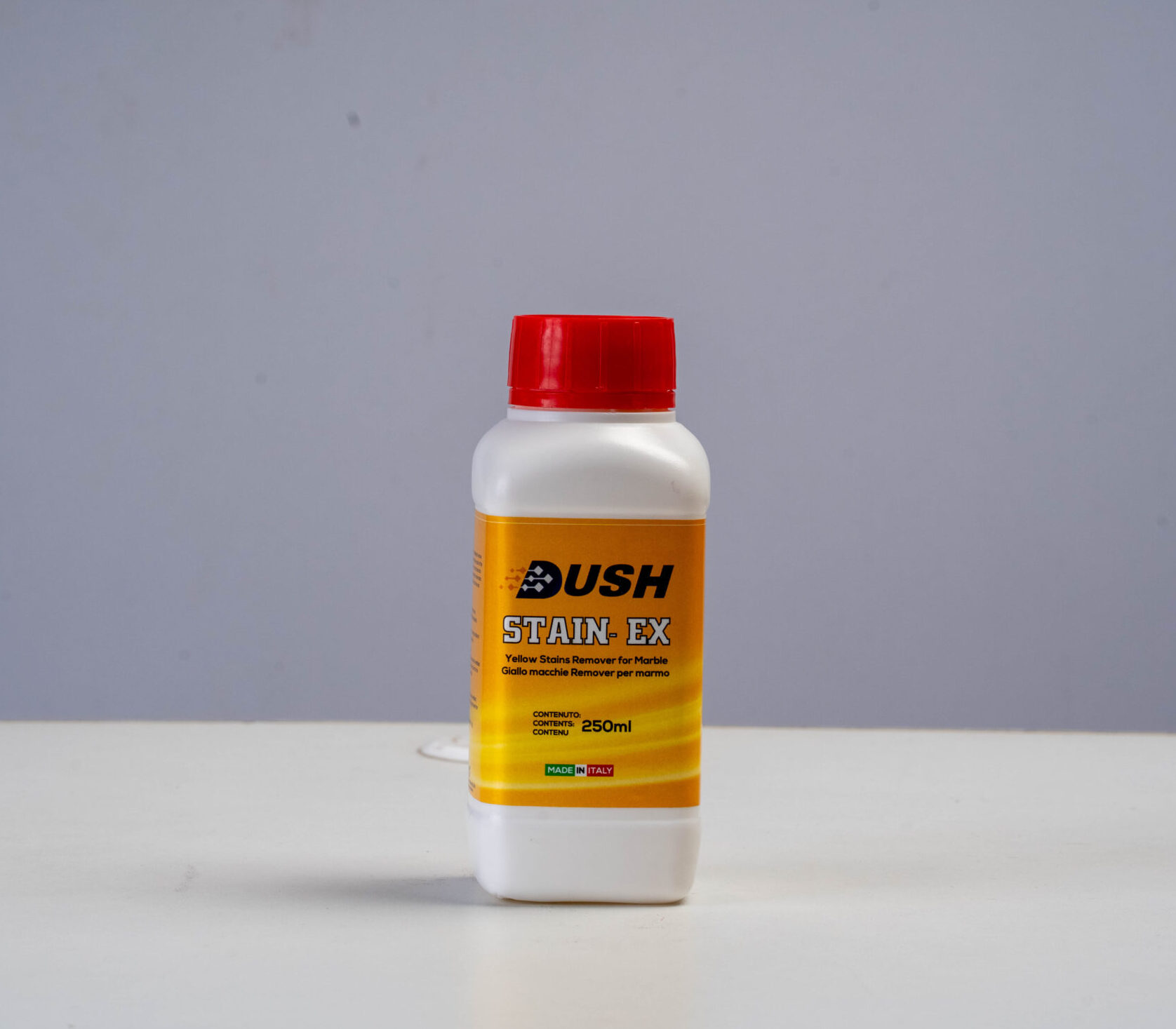
Per its official product documentation, Dush Stain-Ex is formulated to lift yellowish stains caused by wood, ink and food contact on marble, commonly needed near door frames and bathrooms — not oil or grease. Older or deeper yellow stains may require multiple applications, per the product's own guidance.
- ★Intended applications: yellow staining from wood tannin migration, ink contact, and food-related organic staining
- ★Suitable marble types: white and light-toned marble specifically
- ★Typical stain locations: door frames (wood tannin), bathrooms, kitchens (turmeric/food)
- ★Where it fits in a restoration workflow: the stain-removal step for organic/yellow staining, applied before any densifying or sealing treatment
- ★Professional usage: used by restoration contractors specifically for wood/ink/food-related yellowing
- ★Where another chemistry is more appropriate: oil and grease staining — use a dedicated oil-absorbing poultice such as those compared above instead
Related Dush Guides and Products
50 Questions Answered
What is the best oil stain remover for marble?
Can oil stains be removed from marble?
Why does marble absorb oil so easily?
Does Dush Stain-Ex remove oil stains?
What's the difference between an oil stain and a yellow stain?
Which stains can be removed from marble?
Which stains become permanent on marble?
Is white marble more prone to visible oil staining?
Does marble porosity vary between slabs?
What is capillary absorption?
How do I know if my stain is oil or organic?
Can a stain be both oil and organic?
Why does location matter for diagnosis?
What is Akemi Oil & Grease Remover Paste?
What is Fila NoSpot?
What is Lithofin Oil-Ex?
What is HMK R152?
Which oil stain remover is easiest to apply?
Which oil stain remover has the longest dwell time?
Are these oil stain removers safe for polished marble?
DIY vs professional oil stain removal — which should I choose?
What tools do I need for DIY oil stain removal?
Is DIY oil stain removal risky?
When should I call a professional for an oil stain?
How thick should a poultice layer be?
Should I cover the poultice while it dries?
Can I scrape off a dried poultice?
How many applications does an oil stain typically need?
What temperature is best for poultice application?
Can these oil stain removers be used outdoors?
Does outdoor use need a different product?
How can I prevent oil stains on marble?
Does sealing marble prevent oil stains completely?
How often should I reseal marble to prevent oil staining?
What is an impregnating sealer?
Does white Italian marble stain more easily than other varieties?
Is Carrara marble more prone to oil staining than Statuario?
Is Calacatta marble safe to treat with an oil poultice?
How much does professional oil stain removal cost?
Where can I buy oil stain removers for marble in India?
Where can I buy Dush Stain-Ex?
Will an oil stain come back after removal?
Can repeated oil staining damage marble long-term?
Should I polish marble after removing an oil stain?
Does removing an oil stain affect the marble's sealer?
Can oil staining lead to permanent discolouration even after treatment?
What is a marble poultice?
What is a marble sealer, and does it relate to stain removal?
What is marble restoration as a category?
What is natural stone cleaning, and is it different from stain removal?
Do these products work on granite as well as marble?
External References
For oil and grease stains on marble specifically, a dedicated oil-absorbing poultice or spray is the correct product category — Akemi Oil & Grease Remover Paste, Fila NoSpot, Lithofin Oil-Ex, and HMK R152 are all well-documented, established products for this exact problem, differing mainly in application format, dwell time, and indoor/outdoor suitability rather than in fundamental effectiveness.
Dush Stain-Ex is not the correct choice for oil staining — its documented formulation addresses yellow staining from wood, ink and food contact, a genuinely different chemical problem that happens to occur in similar locations. If your stain is confirmed as organic/yellow rather than oil-based, Dush Stain-Ex is a relevant, well-matched product for that specific job; if it's oil, one of the four dedicated oil/grease removers compared in this guide is the correct tool.
Diagnose First, Then Treat the Right Stain
Oil stains and yellow stains need different chemistry. Confirm which one you have before buying a product.