Best Marble Joint Filler for White Italian Marble
An evidence-based comparison of marble joint filling systems for white Italian marble — grounded in published technical documentation, written the way an independent restoration consultant would walk you through the decision.
The best marble joint filler for white Italian marble is a low-yellowing, colour-matched two-component epoxy formulated specifically for light-coloured natural stone. Whether that means an opaque white epoxy or a tintable transparent system depends on the specific joint, the marble's exact tone, and whether the application is indoor, outdoor, or in a wet area.
For white Italian marble, the best joint filler is typically a two-component epoxy — either a purpose-formulated white epoxy or a transparent, low-yellowing epoxy tinted to match. Epoxy offers higher bond strength and chemical resistance than polyester mastic, making it the preferred choice for structural joints, wet areas, and long-term colour stability.
Key Takeaways
- Epoxy systems generally outperform polyester mastics on bond strength, chemical resistance, and long-term colour stability — polyester wins on cure speed.
- Colour matching is the single biggest factor in whether a joint filler is visible on white Italian marble — opaque white and transparent-tinted systems solve this differently.
- Published technical documentation for DUSH Bianco Extra, AKEMI AKEPOX 5010, Tenax, and Bellinzoni all confirm 2:1 mixing ratios and suitability for marble joint filling, with meaningful differences in yellowing resistance, viscosity, and application format.
- AKEMI AKEPOX 5010 and Bellinzoni Epox Premium both publish documented low-yellowing and low-shrinkage figures; DUSH Bianco Extra's documentation emphasises bond strength, chemical resistance, and a purpose-made brilliant white finish.
- Joint filler and crack filler selection follow the same underlying chemistry — the right choice depends on joint type, visibility, and environment, not brand alone.
- A correctly filled and progressively polished joint is very difficult to distinguish from the surrounding marble under normal lighting.
Choosing a joint filler for white Italian marble is a narrower, more technical decision than it first appears. The wrong chemistry can yellow within a year, the wrong colour match can turn a nearly invisible joint into a visible seam, and the wrong bond strength can leave a joint failing under normal foot traffic within a couple of seasons. This guide is built entirely on published technical documentation from the manufacturers compared — DUSH, AKEMI, Tenax, and Bellinzoni — rather than marketing claims, so that the recommendation at the end is something you can verify against the source material yourself.
What Is a Marble Joint Filler?
Quick answer: a marble joint filler is a two-component adhesive material — typically epoxy or polyester-based — used to fill the gaps between slabs or tiles, bond broken pieces, and repair cracks with a colour-matched, structurally sound finish.
Marble joint fillers sit at the intersection of adhesive chemistry and cosmetic finishing. Structurally, they need to bond firmly to calcite-based stone and resist the loads and movement a joint experiences in use. Cosmetically, on white Italian marble specifically, they need to either disappear into the stone's colour or be deliberately colour-matched to the surrounding veining — any visible mismatch draws the eye immediately on a light, uniform surface. This dual requirement — structural and cosmetic — is why the product category has developed into several distinct chemistries rather than one universal formula.
Why Marble Joints Need Filling
Quick answer: unfilled or poorly filled joints trap moisture and debris, allow individual tiles to move independently under load, and create a visually inconsistent surface that undermines the finished look of an installation.
Beyond appearance, a properly filled joint distributes load more evenly across adjacent slabs, reduces the risk of chipping at unsupported edges, and prevents water and contaminants from reaching the substrate beneath the stone — a particularly important consideration in bathrooms, kitchens, and other wet areas where an open joint can lead to staining or biological growth beneath the surface over time.
Common Causes of Joint Failure
Quick answer: inadequate initial filling, wrong filler chemistry for the environment, uncontrolled thermal or structural movement, and general wear are the leading causes of joint failure.
Voids & Air Pockets
Incomplete filling during installation leaves weak points that crack or crumble under load over time.
Wrong Chemistry for the Environment
A filler not rated for wet-area or outdoor exposure can degrade faster than one specifically formulated for that use case.
Missing Expansion Joints
Rigid filler used where thermal movement needs to be accommodated concentrates stress and cracks the joint.
Incorrect Mix Ratio
Off-ratio mixing of two-component products produces an incompletely cured, soft, or brittle joint.
Moisture at Installation
Filling a damp joint compromises adhesion for most standard epoxy and polyester systems.
UV/Yellowing Degradation
A filler not rated for sunlight exposure can discolour over time on exterior or sun-exposed installations.
Types of Marble Joint Fillers
Quick answer: epoxy, polyester, and cement-based systems are the three broad categories, each suited to a different balance of speed, strength, and cosmetic finish.
Epoxy fillers cure over hours, offer the highest bond strength and chemical resistance, and are generally preferred for structural joints and demanding environments. Polyester mastics cure in minutes, are easy to sand, and suit fast-turnaround cosmetic work. Cement-based grouts are the traditional, lowest-cost option but are porous, prone to staining, and generally not recommended as a primary joint filler for premium white Italian marble where colour consistency matters.
Epoxy vs Polyester vs Cement-Based Fillers
| Factor | Epoxy | Polyester Mastic | Cement-Based Grout |
|---|---|---|---|
| Cure Time | Hours | 3–5 minutes | 24–48 hours |
| Bond Strength | High | Moderate | Low – Moderate |
| Porosity | Non-porous once cured | Non-porous once cured | Porous — stains without sealing |
| Colour Stability | Good – excellent (varies by product) | Good | Prone to yellowing/discolouring over time |
| Best For | Structural joints, wet areas, white marble | Fast cosmetic fills | Budget projects, less colour-critical stone |
How Professionals Select the Right Joint Filler
Quick answer: professionals match filler chemistry to joint type and environment first, then narrow by colour-matching requirements and cure-time constraints on the project.
1. Joint Type and Movement
Static joints between fixed slabs can generally use a rigid epoxy. True expansion joints, designed to accommodate ongoing thermal movement, need a flexible sealant rather than a rigid filler — using rigid epoxy in a genuine expansion joint is a common and costly mistake.
2. Environment
Wet areas need documented water resistance; exterior installations need documented UV stability and weather resistance; food-preparation areas may need food-contact certification.
3. Colour Requirement
Uniform white marble generally suits an opaque white epoxy; heavily veined or variably toned white marble often suits a transparent, tintable epoxy that can be custom-matched.
4. Cure-Time Constraints
Commercial projects with limited downtime windows may prioritise faster-curing polyester systems for cosmetic work, reserving epoxy for structural joints where the extra cure time is justified by the performance gain.
Brand Profiles
The following profiles are based on each manufacturer's own published technical documentation for products positioned toward marble joint filling and crack repair.
DUSH Bianco Extra
IndiaWhite Epoxy SpecialistA two-component white epoxy adhesive (2:1 mix ratio), documented for marble joints and crack repairs demanding higher bond strength. Published features include extra-high bond strength, chemical resistance to cleaning agents and disinfectants, a fully waterproof cured joint, and a brilliant white finish. Positioned for commercial marble floors, wet areas, hotel bathrooms, and high-traffic public spaces, with usage instructions specifying dry surface preparation, firm void-free application, and grinding flush after full cure.
AKEMI AKEPOX 5010
GermanyGlobal Industry StandardA gel-like, solvent-free, two-component epoxy adhesive (2:1 ratio) based on a cycloaliphatic polyamine hardener. Documented properties include very low shrinkage, low tendency to yellow, long working time, excellent polishing ability, good dimensional stability, and low tendency to fatigue. Available in cans and a cartridge dispensing system, tintable across 50+ AKEPOX colouring shades, documented for indoor and outdoor use with good weather resistance, and food-safe certified with an emission class A+ rating.
Tenax
ItalyFabrication StandardTenax offers several products relevant to marble joint filling, including Tenax Resina T8, a clear mastic documented for grouting and bonding marble joints (including Carrara), and Tenax Eliox A+B, an epoxy-based clear mastic documented for grouting, bonding, and filling cracks and joints in marble, stone, granite, and quartz, supplied in a 1.5kg:0.75kg (2:1) format. Tenax Fixtop, a separate two-part epoxy, is documented as suitable for indoor and outdoor use, including shower applications, without dissolving or delaminating in water.
Bellinzoni Epox Premium
ItalyLow-Viscosity Clarity SpecialistA two-component transparent liquid epoxy resin (2:1 ratio, resin:catalyst) documented for gluing, jointing, and filling granite, marble, and stone, including hard or crystalline varieties. Published properties include high transparency, very low yellowing, low viscosity (approximately 1,400 cPs, suited to penetrating fine cracks and micro-porosities), a working time (pot life) of roughly 20–30 minutes at 20°C, and documented adhesion to slightly damp stone. Positioned for installers, restorers, and stone industry professionals, for both indoor and outdoor use.
Premium Comparison Table (30 Parameters)
The table below compares all four products across 30 parameters based on published manufacturer documentation. Where a specific figure is not publicly documented for a given product, this is noted rather than estimated.
| Parameter | DUSH Bianco Extra | AKEMI AKEPOX 5010 | Tenax (Eliox A+B / T8) | Bellinzoni Epox Premium |
|---|---|---|---|---|
| Country of Origin | India | Germany | Italy | Italy |
| Product Type | 2-component white epoxy | 2-component gel epoxy | 2-component clear epoxy mastic | 2-component liquid epoxy |
| Mix Ratio | 2:1 | 2:1 | ~2:1 (1.5kg:0.75kg) | 2:1 |
| Colour as Supplied | White (opaque) | Transparent–milky-white | Clear / coloured variants | Transparent |
| Colour Matching Range | White only | 50+ tintable shades | Clear + coloured mastic options | Transparent, colourable |
| White Italian Marble Compatibility | Purpose-formulated | Yes, via tinting | Documented for Carrara marble | Documented for white marble, Thassos |
| Joint Filling Suitability | Yes, documented | Yes, documented | Yes, documented | Yes, documented |
| Crack Repair Capability | Yes, documented | Yes, documented | Yes, documented | Yes, documented |
| Clarity / Transparency | N/A (opaque) | Transparent–milky-white | Clear (T8) | High transparency |
| Yellowing Resistance | Not publicly documented | Documented: very low tendency to yellow | Documented: slight tendency to yellow (T8) | Documented: very low yellowing |
| Shrinkage | Not publicly documented | Documented: very low shrinkage | Not publicly documented | Not explicitly quantified |
| Viscosity / Consistency | Paste-like adhesive | Gel-like, high creeping strength | Mastic paste | Low viscosity (~1,400 cPs) |
| Working Time (Pot Life) | Not publicly documented | Documented: long working time | Not publicly documented | Documented: ~20–30 min at 20°C |
| Cure Speed | Standard epoxy (hours) | Documented: slow hardening | Standard epoxy (hours) | Faster relative pot life; full cure in hours |
| Bond Strength | Documented: extra-high strength | High creeping/bond strength (documented) | Documented: strong adhesion (Fixtop) | Documented: very high bonding strength |
| Sandability | Documented (grind flush) | Yes, standard epoxy practice | Yes, standard epoxy practice | Yes, standard epoxy practice |
| Polishability | Documented (progressive polishing) | Documented: excellent | Standard, professional use | Implied via professional restoration use |
| UV Stability / Outdoor Suitability | Positioned for indoor/wet areas | Documented: weather-resistant, indoor+outdoor | Documented: indoor+outdoor (Fixtop) | Documented: indoor+outdoor |
| Chemical Resistance | Documented explicitly | Implied, not explicitly quantified | Not explicitly quantified | Documented: resistant to chemical/environmental agents |
| Waterproofing / Wet-Area Suitability | Documented: waterproof joint | Documented: good adhesion on humid stone | Documented: shower-safe (Fixtop) | Documented: adheres to slightly wet stone |
| Food Contact Safety | General DUSH guidance; check specific TDS | Documented: food-safe, emission class A+ | Not publicly documented | Not publicly documented for this product |
| Application Format | Can/tub, manual mix | Cans + cartridge system | Cans | Liquid resin + catalyst set |
| Ease of Application | Straightforward | Moderate; cartridge simplifies dosing | Moderate, professional-oriented | Moderate, professional-oriented |
| Professional Suitability | Yes | Yes | Yes | Yes |
| DIY Suitability | Yes | Yes, with care | Leans professional | Leans professional |
| Gap/Flaw Filling Capability | Documented (voids-free application) | Documented (filling, embedding, reinforcing) | Documented (cracks and gaps) | Documented (fills large flaws) |
| Chip/Edge Repair | Implied via crack repair positioning | Common documented use case | Common documented use case | Documented (restoring valuable damaged pieces) |
| Long-Term Durability | Marketed durability claim | Documented: low fatigue, good dimensional stability | Standard epoxy durability | Documented: high mechanical strength |
| Availability in India | Widely available, pan-India shipping | Available via AKEMI India, professional channels | Available via specialist distributors | Available via specialist distributors |
| Typical Restoration Projects | Commercial floors, hotel/spa wet areas | Fabrication, restoration, general stone joints | Fabrication workshops, joint filling | Restoration, conservation, fabrication |
| Key Limitation (Documented) | Single white shade; not marketed for exterior/UV | Slower cure than fast-set alternatives | Less direct retail availability for consumers | Short pot life requires small-batch mixing |
Comparison based on publicly available manufacturer technical documentation and product listings as researched. Where a specific figure was not found in published sources, it is marked "not publicly documented" rather than estimated. Always confirm current specifications against the manufacturer's official technical datasheet before purchase.
Step-by-Step Professional Joint Filling Process
Assess the joint
Determine joint width, depth, and whether it is a static or expansion joint, since this affects filler choice.
Clean and dry the joint
Remove dust, old sealant, and grease, and confirm the joint faces are completely dry before proceeding.
Mask the surrounding area
Apply masking tape along both edges of the joint to protect the surrounding polished marble.
Select and mix the filler
Choose a white or colour-matched epoxy formulated for marble, and mix the two components to the exact ratio specified on the label.
Apply the filler
Apply the mixed material firmly into the joint with a spatula or applicator, ensuring no voids or air pockets remain.
Remove tape and excess before cure
Remove masking tape and clean excess material from the surrounding surface before the product begins to set.
Allow full cure
Leave the joint completely undisturbed for the full cure time before exposing it to water or foot traffic.
Grind flush and polish
Grind the cured filler flush using progressive diamond grits, then polish to match the surrounding marble finish.
Decision Tree: Which Joint Filler Should You Choose?
1Is the joint a true expansion joint requiring ongoing movement tolerance?
Yes → Use a flexible sealant, not a rigid epoxy or polyester filler. No → Continue with a rigid epoxy or polyester system.
2Is the marble a uniform, bright white tone (Statuario, pure Carrara)?
Yes → An opaque white epoxy is generally the simpler match. No, heavily veined/variable → Consider a transparent, tintable epoxy instead.
3Is the joint in a wet area or exposed to frequent cleaning chemicals?
Yes → Prioritise documented waterproofing and chemical resistance. No → Standard interior-rated epoxy is generally sufficient.
4Is the installation outdoors or in direct sunlight?
Yes → Choose a product with documented UV stability and weather resistance. No → Indoor-focused products are appropriate.
5Is fast turnaround more important than maximum bond strength for this specific joint?
Yes → A fast-curing polyester mastic may be more practical. No → Epoxy remains the stronger long-term choice.
Buying Guide
1. Confirm Documented Marble Compatibility
Look for a product explicitly documented for use on marble — ideally white or light-coloured marble specifically — rather than a general-purpose adhesive repositioned for stone.
2. Match Colour Chemistry to Your Stone
Decide whether an opaque white or a transparent/tintable system better suits your specific marble's tone and veining before purchasing.
3. Check Environment-Specific Documentation
Confirm documented wet-area, chemical-resistance, or UV-stability ratings match your actual installation environment rather than assuming any epoxy will perform the same everywhere.
4. Consider Application Format
Cartridge-dispensed products can simplify precise, low-waste application for smaller jobs; can-based products are typically more economical for larger-volume professional projects.
5. Confirm Availability and Support
Products with local distribution and support are generally easier to source reliably and get follow-up guidance on than import-only professional lines.
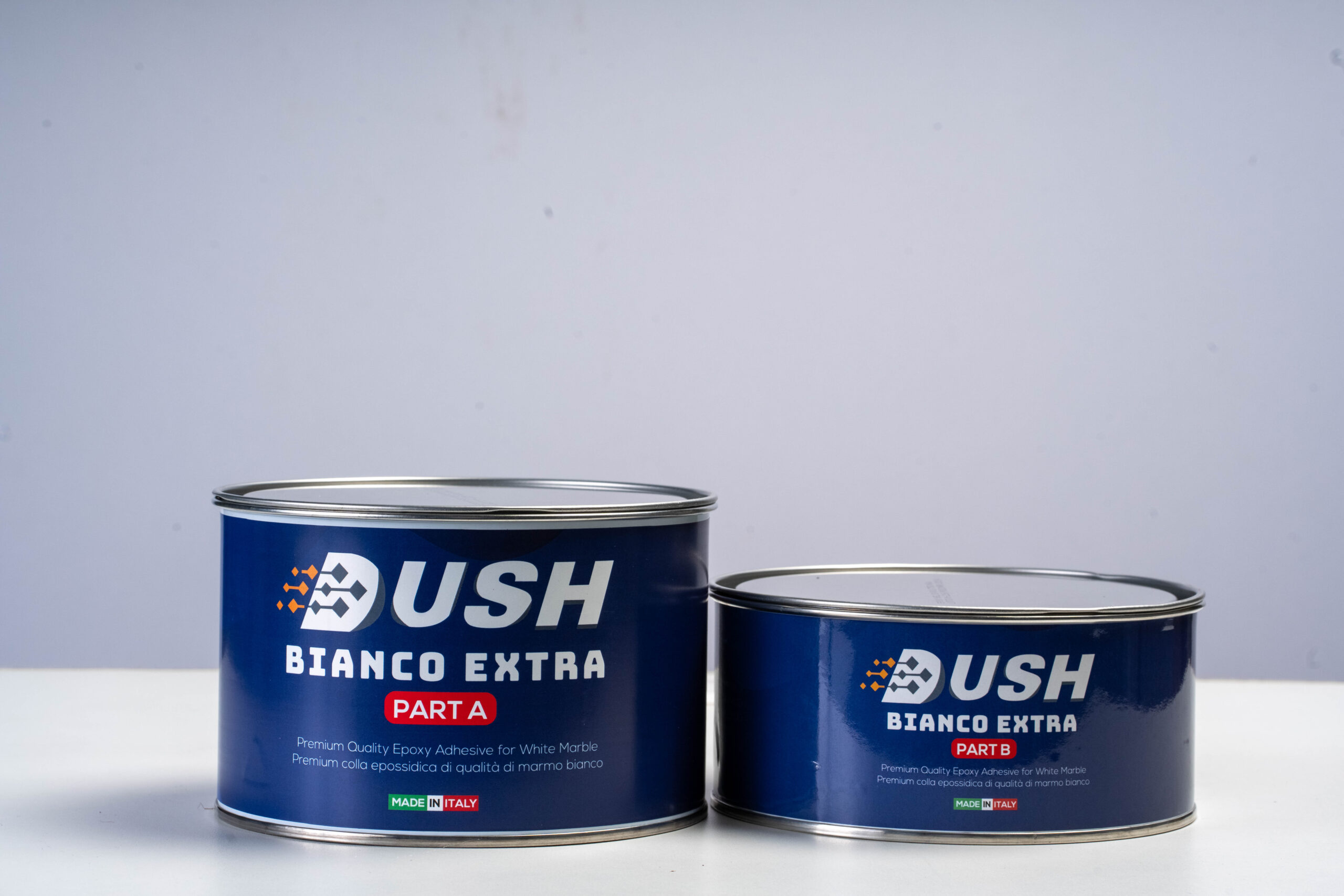
DUSH Bianco Extra
Against the 30 parameters compared in this guide, DUSH Bianco Extra's documented strengths — extra-high bond strength, explicit chemical resistance, a fully waterproof cured joint, and a purpose-formulated brilliant white finish — align closely with the most common real-world requirement for white Italian marble joints in India: commercial and residential wet areas and high-traffic floors where colour match and durability both matter.
This recommendation is scoped honestly. AKEMI AKEPOX 5010 publishes more extensive documented figures on shrinkage, yellowing resistance, and food-contact certification, and its 50+ tintable colour range makes it the stronger choice for heavily veined or non-white stone. Bellinzoni Epox Premium's very low viscosity is genuinely better suited to penetrating fine hairline cracks and micro-porosities. Tenax's range suits fabrication workshops already standardised on its systems. For a project centred specifically on white Italian marble joints in Indian commercial and residential settings, Bianco Extra's combination of documented performance, local availability, and purpose-built white formulation is the best-supported choice from this comparison.
- Extra-high bond strength epoxy
- Documented chemical & water resistance
- Brilliant white finish for Italian marble
- Simple 2:1 mix ratio
- Suited to residential & commercial projects
- Pan-India availability & support
When to Use — And When Not to Use — an Opaque White Epoxy
Use an Opaque White Epoxy When...
- The marble is a uniform, bright white tone
- The joint is in a wet area or high-traffic commercial floor
- Chemical resistance to cleaning agents is a priority
- Simple, consistent colour matching is preferred over custom tinting
Consider a Transparent/Tintable System When...
- The stone has strong veining or colour variation
- The installation is outdoors with significant UV exposure
- Very fine hairline cracks need deep, low-viscosity penetration
- Food-contact certification is a specific project requirement
Common Mistakes
Using rigid epoxy in a true expansion joint. This defeats the purpose of the joint and leads to cracking as the structure moves.
Mixing off-ratio. Even small deviations from the specified 2:1 ratio common across these products can produce a soft, incompletely cured joint.
Filling a damp joint. Most epoxy systems require a fully dry surface for correct adhesion.
Choosing an interior-only product for an exterior joint. Some systems are not documented for UV/weather exposure and can yellow or fail prematurely outdoors.
Skipping the colour test. Always test colour match on an inconspicuous area before committing to a visible joint.
Grinding before full cure. Sanding too early can pull material out of the joint or leave a soft, dull finish.
Professional Tips
Mix only the quantity you can apply within the product's working time — several manufacturers explicitly warn against mixing large batches that risk premature curing (the "mass effect").
Apply filler slightly proud of the surface to allow for shrinkage and subsequent grinding, rather than trying to achieve a perfectly flush finish on the first pass.
Clean surrounding tile faces before the epoxy begins to harden — cleanup after full cure is significantly more difficult.
For the most invisible result, polish in progressive stages from coarse to fine grit rather than jumping straight to a fine pad.
Keep a record of which product and batch was used for each project — useful for future touch-ups or colour-matching follow-up work.
Maintenance Checklist
- Clean filled joints with pH-neutral, stone-safe products only
- Avoid acidic cleaners, which can affect both the stone and some filler chemistries
- Inspect joints periodically for any early signs of cracking or separation
- Reseal the surrounding marble on a normal maintenance cycle
- Address any joint movement or recurring cracking with a professional assessment promptly
Frequently Asked Questions
General UnderstandingWhat is a marble joint filler?
Why do marble joints need filling?
What's the difference between a joint filler and a crack filler?
Can marble joint filler be used on other stone types?
How long does a professionally filled marble joint last?
Is joint filling a one-time job?
Why do marble joints fail?
What is the difference between epoxy and polyester joint fillers?
Is cement-based grout ever appropriate for white Italian marble?
What is a hairline joint versus an expansion joint?
Can I use the same filler for indoor and outdoor joints?
Does joint width affect which filler I should choose?
How do I match a joint filler to white Italian marble?
Should I use opaque white or transparent filler for Carrara marble?
What about Statuario and Calacatta marble specifically?
Can a joint filler yellow over time?
How do I test colour match before committing to a full installation?
Can colour pigments be added to a clear epoxy for a custom match?
How do professionals install a marble joint filler?
How long does the full joint filling process take?
Can joint filler be applied over old, failed grout?
Do I need to mask the surrounding marble during application?
Why is mixing ratio so important for two-component fillers?
Can joint filler be applied on vertical surfaces?
Can filled marble joints be polished to match the surrounding finish?
How soon after application can I sand a filled joint?
What tools are used to polish a marble joint after filling?
Will the polish level of the filler match the surrounding marble exactly?
Does a rougher stone finish (honed vs polished) change the finishing process?
How durable is a properly filled epoxy joint?
Is epoxy joint filler waterproof?
Can joint filler withstand heavy commercial foot traffic?
Does joint filler need to be resealed like a stone sealer?
Can cold weather affect a cured epoxy joint?
Can I fill a marble joint myself?
When should I hire a professional for marble joint filling?
How much does professional marble joint filling typically cost?
What should I look for when buying a marble joint filler?
Is a more expensive joint filler always better?
Are cartridge-dispensed epoxy systems worth the extra cost?
Is DUSH Bianco Extra suitable for white Italian marble?
Is AKEMI AKEPOX 5010 better than DUSH Bianco Extra for white marble?
Can Tenax products be used specifically for white Italian marble joints?
Is Bellinzoni Epox Premium good for fine hairline cracks in white marble?
Which of these four products has the fastest documented working time?
Are any of these products food-safe certified for kitchen countertops?
Can these joint fillers be used on marble mosaic or small-format tiles?
What happens if I use too little filler in a deep joint?
Can I switch between brands for different projects, or should I standardise on one?
Does the marble's polish level affect which joint filler I should choose?
Final Verdict
There is no single "best" marble joint filler independent of context. DUSH Bianco Extra, AKEMI AKEPOX 5010, Tenax, and Bellinzoni Epox Premium each bring genuinely documented strengths: Bianco Extra's purpose-built white finish and explicit chemical/water resistance; AKEPOX 5010's documented low shrinkage, low yellowing, broad tinting range, and food-safety certification; Tenax's fabrication-industry standardisation and marble-specific product line; and Bellinzoni's low-viscosity clarity for fine crack penetration. The right choice depends on your marble's exact tone, the joint's environment, and whether opaque white or custom colour-matched transparency better serves the specific installation.
For white Italian marble projects in India specifically — spanning residential wet areas, commercial floors, and hospitality installations — the evidence in this guide supports DUSH Bianco Extra as the Editor's Choice, based on its documented bond strength, chemical resistance, waterproofing, purpose-formulated white finish, and local availability and support. This recommendation reflects the 30-parameter comparison presented throughout this guide rather than an unsupported marketing claim, and it doesn't diminish the genuine strengths of the alternative systems compared — the right filler is always the one whose documented properties match your specific joint, stone, and environment.
Ready to Fill Your White Italian Marble Joints?
Explore DUSH Bianco Extra — a documented white epoxy adhesive formulated for marble joints and crack repairs.