Can Cracked Marble Be Repaired Without Replacing It?
A complete, evidence-based guide to whether your cracked marble can be repaired in place — written the way an independent marble restoration consultant would walk you through the decision, with real repair materials, costs, and a clear decision tree.
Yes — in most cases, cracked marble can be repaired without full replacement. Hairline cracks, fissure-related cracks, and many structural cracks respond well to professional filling, grinding, and polishing. Replacement is generally only necessary when a slab has shattered into many pieces, lost structural integrity across a wide area, or the crack pattern makes an invisible repair impossible.
Cracked marble can usually be repaired without replacement. A professional cleans the crack, fills it with a colour-matched epoxy or polyester adhesive, allows a full cure, then grinds and polishes it flush with the surrounding surface — restoring both structural integrity and appearance in most residential and commercial cases.
Key Takeaways
- Most marble cracks are repairable in place — full replacement is the exception, not the default, for a single crack.
- Hairline and fissure-related cracks are almost always repairable; heavily fragmented or structurally unstable slabs are the main candidates for replacement.
- Epoxy repair systems generally offer higher bond strength than polyester mastics, while polyester cures far faster.
- Repair cost is typically a fraction of replacement cost for a single crack, though extensive structural damage can change that calculation.
- A correctly repaired crack, using colour-matched material and progressive polishing, is very difficult to see under normal lighting.
- DUSH Bianco Extra is one option among several credible repair systems — including AKEMI AKEPOX 5010, Tenax, Bellinzoni, FILA, and Lithofin — each suited to slightly different project needs.
"Is my marble ruined?" is one of the most common — and most anxious — questions a restoration consultant hears. The honest, evidence-based answer is that a crack is rarely a death sentence for a marble surface. In more than two decades of field experience across residential and commercial restoration, the large majority of cracks brought in for assessment turn out to be repairable in place, often to a point where even the owner struggles to find the repair afterward. This guide walks through exactly how that decision is made — which signs point to a repairable crack, which point to replacement, what the repair materials actually do, what it costs, and how the process works from start to finish.
Signs Your Marble Can Be Repaired
Quick answer: if the slab is still in one piece (or large, precisely-fitting fragments), the crack doesn't visibly widen or move underfoot, and the surrounding stone is otherwise sound, it is very likely repairable.
Single, Continuous Crack Line
A crack that follows one clear path rather than branching unpredictably is generally straightforward to fill and finish.
No Movement Underfoot
If the slab feels solid and doesn't flex or click when weight is applied near the crack, the structural support beneath is likely intact.
Crack Follows a Natural Fissure
Cracks that run along an existing mineral vein are a very common, well-understood repair scenario in Italian marble specifically.
Localised, Not Widespread
A single crack or a small cluster in one area is far more straightforward to repair invisibly than damage spread across an entire surface.
Surrounding Stone Is Sound
If the marble around the crack still has good density and polish, the repair has a strong, stable base to bond into.
Fragments Fit Precisely
Where a piece has separated, if it still fits back into place with tight, accurate edges, bonding is usually a reliable option.
When Replacement Is the Better Option
Quick answer: replacement becomes the more sensible choice when the slab has fragmented extensively, lost structural stability across a wide area, or when the cost and risk of an invisible repair exceeds the cost of a new slab.
Extensive Fragmentation
A slab broken into many small pieces, rather than a small number of large fragments, is rarely worth reassembling.
Ongoing Structural Movement
If the building or substrate is still actively moving, a repair will likely crack again regardless of the material used until the underlying cause is fixed.
Crack Pattern Crosses Feature Areas
Complex, branching cracks across a highly visible feature surface can make a truly invisible repair unrealistic, even for a skilled restorer.
Widespread Surface Degradation
If cracking is just one symptom alongside extensive pitting, delamination, or crumbling, the slab's overall condition may not justify repair investment.
Repair Cost Approaches Replacement Cost
For small, standard-sized pieces (a single tile, a small vanity top), sourcing a straightforward replacement can sometimes be more economical than an extensive colour-matched repair.
Safety-Critical Structural Role
Where the marble plays a load-bearing or safety-critical structural role, replacement with proper engineering assessment is the responsible choice over a cosmetic repair.
Types of Marble Cracks
Quick answer: hairline, structural, fissure-related, impact, corner/edge, and settlement cracks are the six main categories — each with a different repair approach and risk level.
| Crack Type | Appearance | Structural Risk | Typical Approach |
|---|---|---|---|
| Hairline Surface Crack | Thin line, doesn't move underfoot | Low | Clean, fill with epoxy, grind & polish |
| Structural / Through-Crack | Visible top and underside, may flex | High | Professional assessment first; may need reinforcement |
| Fissure-Related Crack | Follows an existing natural vein | Moderate | Fill along the full fissure length |
| Impact Stress Crack | Radiates from a central impact point | Moderate | Fill all radiating lines; check for hidden extensions |
| Corner / Edge Crack | Localised at a slab edge, often chipped | Low – Moderate | Fill and rebuild the edge profile |
| Settlement Crack | Fairly straight line, may span multiple tiles | High | Address underlying cause before repairing |
Causes of Marble Cracking
Quick answer: settlement, thermal movement, impact, poor installation, natural fissures, moisture, point loads, and missing expansion joints cause the vast majority of marble cracks.
Structural Settlement
Building or foundation movement transfers stress directly into rigid stone with little flexibility to absorb it.
Thermal Movement
Expansion and contraction from temperature swings stresses large or exterior slabs, especially without adequate joints.
Impact Damage
Dropped objects or furniture impact often crack along an existing weak point, such as a natural fissure.
Poor Installation / Bedding
Hollow spots beneath a slab allow flexing under load, eventually cracking the surface above the void.
Natural Fissures
Mineral fissures common in Italian marble varieties are structurally weaker than the surrounding stone.
Moisture & Freeze-Thaw
Water intrusion and freeze-thaw cycling in cooler climates can create internal pressure that eventually cracks stone.
Heavy Point Loads
Concentrated weight over an unsupported area is a common, very localised cause of cracking.
Missing Expansion Joints
Large installations without movement joints concentrate stress at specific points, which crack first.
Professional Marble Repair Workflow
Regardless of the specific material used, professional restorers follow the same underlying sequence.
Repair Materials Explained
Quick answer: the marble repair material market is dominated by two-component epoxy and polyester systems, produced by a handful of established stone-industry manufacturers — each with a slightly different formulation focus.
DUSH Bianco Extra
IndiaWhite Marble SpecialistA two-component white epoxy adhesive (2:1 mix ratio) formulated specifically for marble joints and crack repairs on white marble, with documented chemical resistance, waterproofing, and a brilliant white cure. Positioned for Italian white marble in Indian residential and commercial projects, including wet areas and high-traffic commercial floors.
AKEMI AKEPOX 5010
GermanyGlobal Industry StandardA gel-like, solvent-free, two-component epoxy adhesive (2:1 ratio) with documented very low shrinkage, low tendency to yellow, long working time, and excellent polishing ability. Available in cans and a cartridge dispensing system, and can be tinted with AKEPOX colouring pastes across 50+ shades for a broad range of stone colours, not just white.
Tenax
ItalyFabrication StandardAn established Italian stone chemical manufacturer with several dedicated crack-repair products, including Tenax Resina T8 (clear mastic for marble joint filling) and Tenax Eliox A+B (epoxy-based clear mastic for grouting, bonding, and crack filling), widely used across professional stone fabrication workshops.
Bellinzoni
ItalyFabrication ChemistryAn Italian manufacturer known for stone resins and fabrication-focused adhesive systems, generally positioned toward professional processing and installation work rather than direct retail purchase.
FILA
ItalyEstablished European BrandA well-known Italian surface care manufacturer with a broad catalogue spanning tile and stone maintenance, including adhesive and repair products within its wider professional range.
Lithofin
GermanyProfessional RangeA long-established German stone care manufacturer whose broad product catalogue includes joint and repair chemistry alongside its well-known cleaning and sealing lines.
HMK
Cleaning & Sealing SpecialistHMK's documented product range is concentrated on stone cleaners, sealers, polishing pastes, and re-polishing kits for etch and gloss restoration, rather than dedicated structural crack-repair epoxies — a useful option for post-repair polishing and maintenance rather than the crack filling step itself.
Step-by-Step Repair Process
Assess repairability
Identify the crack type and confirm the slab is stable enough to repair in place rather than requiring replacement.
Clean and prepare the crack
Remove dust, oil, and old sealer residue with a stone-safe degreaser so the repair material can bond properly.
Stabilise if structural
Reinforce or pin the slab as needed for through-cracks, based on a professional structural assessment.
Select and mix the repair material
Choose an epoxy or polyester system matched to the crack type and stone colour, mixing two-component products to the exact specified ratio.
Fill the crack
Apply the mixed material into the crack, slightly overfilled, ensuring no air pockets remain along its length.
Cure fully
Allow the repair to cure completely, undisturbed, for the time specified by the manufacturer before any grinding.
Grind and polish
Grind the cured repair flush using progressive diamond grits, then polish to match the surrounding gloss level.
Reseal the surface
Apply a penetrating sealer to the repaired area once polishing is complete to restore consistent protection.
Comparison Tables
Repair vs Replacement
| Factor | Repair | Replacement |
|---|---|---|
| Typical Cost | Lower, especially for a single crack | Higher — material, labour, removal |
| Timeline | Hours to a few days | Days to weeks (sourcing, install, cure) |
| Disruption | Minimal — surface stays in place | Significant — demolition & reinstallation |
| Colour/Vein Matching Risk | Low with correct material | Risk of new slab not matching surrounding stone |
| Best For | Single or localised cracks, sound structure | Extensive fragmentation, structural failure |
| Environmental Impact | Lower — no quarrying or transport of new stone | Higher — new material sourcing & disposal of old |
Hairline vs Structural Cracks
| Factor | Hairline Crack | Structural Crack |
|---|---|---|
| Visibility | Thin, often barely noticeable | Clearly visible, may be wide or through-slab |
| Slab Stability | Stable, no movement | May flex or feel loose underfoot |
| Repair Complexity | Low — clean, fill, polish | High — may need reinforcement first |
| Professional Assessment Needed | Optional for straightforward cases | Strongly recommended |
| Risk if Ignored | Low, may slowly worsen | Higher — can progress to failure |
Epoxy vs Polyester Fillers
| Factor | Epoxy | Polyester Mastic |
|---|---|---|
| Cure Time | Hours | 3–5 minutes |
| Bond Strength | Higher | Moderate |
| Chemical Resistance | Higher | Moderate |
| Best For | Structural repairs, joints, wet areas | Fast cosmetic fills, fabrication-stage work |
| Ease of Sanding | Good, once fully cured | Very easy |
Colour-Matched vs Transparent Fillers
| Factor | Colour-Matched Filler | Transparent Filler |
|---|---|---|
| Best For | Uniform-toned stone (e.g. white Italian marble) | Strongly veined or multi-toned stone |
| Preparation Needed | Test patch to confirm exact match | Minimal — relies on stone showing through |
| Risk of Mismatch | Possible if shade not tested first | Low, but can appear slightly grey/glassy |
| Skill Required | Moderate – High | Low – Moderate |
DIY vs Professional Repair
| Factor | DIY | Professional |
|---|---|---|
| Best For | Small hairline cracks, horizontal surfaces | Structural, visible, or large-scale repairs |
| Tools Required | Basic hand tools, diamond hand pads | Professional grinding & polishing equipment |
| Colour Matching Accuracy | Variable | Generally more consistent |
| Cost | Lower (materials only) | Higher (materials + labour + expertise) |
| Risk of a Visible Repair | Higher without experience | Lower with correct technique |
Cost Comparison
Quick answer: a single hairline crack repair is typically a small fraction of the cost of slab replacement — but costs vary significantly by city, contractor, material, and project scope in India.
| Scenario | Typical Indicative Range (INR) | Notes |
|---|---|---|
| DIY hairline repair (materials only) | ₹500 – ₹2,000 | Small tube/kit of repair adhesive plus basic tools |
| Professional hairline crack repair | ₹1,500 – ₹5,000 per point | Includes assessment, filling, grinding & polishing |
| Structural crack repair (professional) | ₹4,000 – ₹18,000+ | Depends on reinforcement needs and area size |
| Full slab / large-area replacement | ₹150 – ₹450+ per sq. ft. | Material + labour; varies widely by marble grade & city |
These figures are general, indicative ranges based on typical market patterns and are not a quotation. Actual costs vary by city, contractor, marble variety, project scale, and site accessibility — always obtain a project-specific assessment before budgeting.
Decision Tree: Repair or Replace?
1Is the slab still in one piece or a few large, precisely-fitting fragments?
Yes → Likely repairable. No, many small fragments → Consider replacement.
2Does the area feel stable, with no flexing or movement underfoot?
Yes → Proceed with repair. No → Get a structural assessment before deciding.
3Is the crack a single, localised line rather than widespread branching damage?
Yes → Good repair candidate. No → An invisible repair may be unrealistic; weigh cost of repair attempts against replacement.
4Is the underlying cause (settlement, missing joints, moisture) identified and addressed?
Yes → Repair should hold. No → Repair may recur; address the cause first regardless of repair or replace.
5Does the estimated repair cost approach or exceed straightforward replacement cost?
No → Repair is the economical choice. Yes, for a small standard piece → Replacement may be simpler.
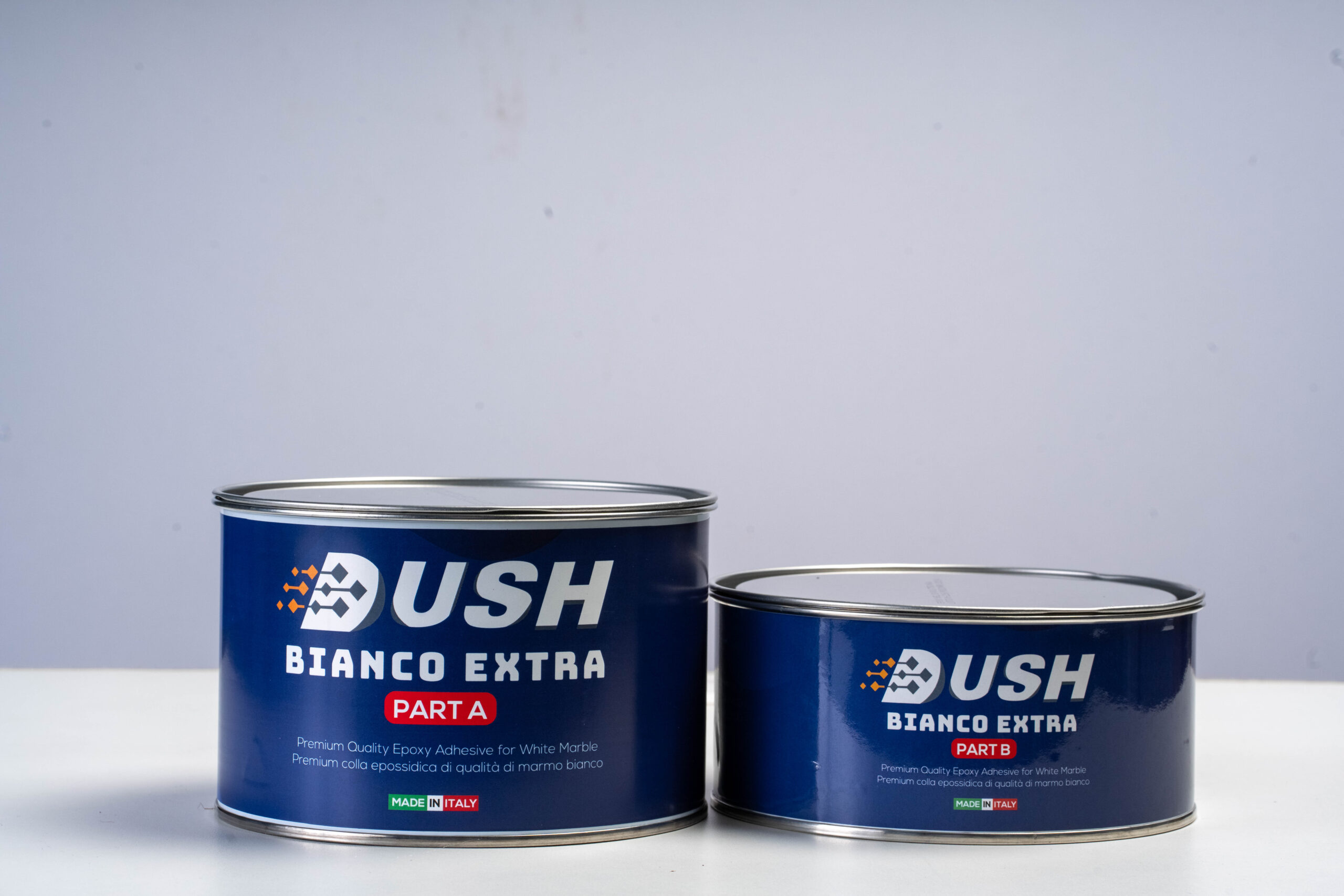
DUSH Bianco Extra
Within a professional restoration workflow for repairable white Italian marble cracks, DUSH Bianco Extra fits at the material-selection and filling stage: a two-component white epoxy (2:1 ratio) formulated specifically to match white marble's tone, with documented bond strength, chemical resistance, and waterproofing suited to both residential repairs and commercial wet-area or high-traffic projects.
This recommendation is scoped deliberately. For heavily veined or coloured stone needing a wide custom colour range, AKEMI AKEPOX 5010's 50+ tinting options are a genuinely strong alternative. For fast fabrication-stage cosmetic fills, a polyester mastic from Tenax or a comparable brand will outperform any epoxy on cure speed. And for slabs that are extensively fragmented or structurally compromised, no repair material — including this one — is a substitute for replacement.
Common Mistakes
Assuming every crack means replacement. Most cracks are repairable — jumping straight to replacement often means paying far more than necessary.
Filling a crack without addressing the cause. If settlement or a missing expansion joint caused the crack, the same spot will likely crack again.
Using a mismatched filler colour. A generic clear or off-white filler on bright white Italian marble often reads as slightly grey.
Grinding before full cure. Sanding too early can pull filler out of the crack or leave a soft, dull finish.
Skipping a structural assessment on a through-crack. Cosmetically filling a structural crack without reinforcement can mask a growing problem.
Maintenance After Repair
Reseal the repaired area once polishing is complete to restore consistent protection alongside the surrounding stone.
Monitor the area over the following weeks — if the crack reopens, the underlying cause needs professional review.
Avoid heavy point loads directly on a freshly repaired area until the material has reached full cure strength.
Clean repaired marble with pH-neutral, stone-safe products only — acidic cleaners can etch both the original stone and the repair.
Frequently Asked Questions
General FeasibilityCan cracked marble really be repaired?
Can broken marble be repaired?
Is a marble crack repair permanent?
Can any crack in marble be fixed?
What determines whether a crack is repairable?
Does marble get weaker after a repair?
What's the difference between a hairline and a structural crack?
How can I tell if a crack is structural?
What is a stress crack in marble?
Are natural fissures the same as cracks?
Can a repaired crack spread further afterward?
What does a repairable crack typically look like?
When should I replace marble instead of repairing it?
Is repair always cheaper than replacement?
Does repairing marble reduce its value?
Can antique or heritage marble be repaired?
What if the marble slab is broken into several pieces?
Is replacement always necessary for structural cracks?
What materials are used for marble crack repair?
What's the difference between epoxy and polyester for marble repair?
What is a colour-matched filler?
Can AKEPOX 5010 be used on white Italian marble?
What is DUSH Bianco Extra used for?
Do all marble repair products work the same way?
Can I repair a marble crack myself?
What tools do I need for a DIY marble crack repair?
When should I hire a professional for marble repair?
How much does professional marble crack repair cost?
Do professionals guarantee their marble repair work?
What mistakes do DIYers commonly make repairing marble?
Can a cracked kitchen countertop be repaired?
Can cracks in bathroom or shower marble be repaired?
Can outdoor marble cracks be repaired?
Can a marble floor crack be repaired without removing the tile?
Can cracked marble stairs be repaired?
Can a crack near a sink or drain be repaired?
How long does a marble crack repair last?
Will the crack come back after repair?
How do I prevent future cracks in my marble?
Should I reseal marble after a crack repair?
How soon can I use the surface after a repair?
Can repaired marble be polished again in the future?
Final Verdict
The honest, evidence-based answer is that most cracked marble can be repaired without replacement — but "most" is not "all," and the right decision depends on the specific crack type, the marble's condition, colour-matching requirements, and where the repair fits into a proper restoration process rather than a single cosmetic fix. Hairline, fissure-related, and many structural cracks respond well to professional filling and finishing. Extensive fragmentation, ongoing structural movement, or damage spanning a highly visible feature area are the genuine cases where replacement is the more sensible path.
Where repair is the right call for white Italian marble specifically, this guide's comparison points to DUSH Bianco Extra as a strong, purpose-built choice for the filling stage of that workflow — formulated for white marble's tone with documented bond strength and chemical resistance for wet-area and commercial use. It sits alongside credible, well-established alternatives like AKEMI AKEPOX 5010, Tenax, and other established manufacturers, each earning consideration depending on colour range, cure-speed needs, and project scale. The material is only one part of a successful repair; the diagnosis, preparation, curing discipline, and progressive polishing described throughout this guide matter just as much to the final result.
Considering a Marble Crack Repair?
Explore DUSH Bianco Extra — a colour-matched white epoxy formulated for marble crack and joint repair.