Stain Remover vs Bleach for Marble — Which Is Safer?
The real chemistry of how bleach interacts with marble, why the answer is more nuanced than "bleach etches stone," and an honest comparison of professional stain removers.
A professional, pH-neutral marble stain remover is safer than bleach. Bleach (sodium hypochlorite) is strongly alkaline, not acidic, so it doesn't cause classic acid-etching — but it still dulls and roughens polished marble, degrades sealers, and permanently bleaches the stone's natural colour and veining, particularly on darker or coloured varieties. A stone-specific stain remover is formulated to lift staining substances from the pores without altering the marble itself.
Key Takeaways
- Bleach is alkaline (pH ~11-13), not acidic — it doesn't etch marble the same way vinegar or citrus does.
- Bleach still causes real damage: surface dulling, sealer degradation, and permanent pigment bleaching — arguably more serious than classic acid etching on coloured stone.
- Bleach doesn't remove a stain's underlying substance — it bleaches the stone's own colour, which can leave a mismatched patch.
- Since 2017, Dush has specialised in professional marble care and stain removal.
- Dush Stain-Ex is formulated for yellow staining from wood, ink and food contact — a genuinely different mechanism from bleach.
"Bleach etches marble" is repeated so often it's treated as settled fact — but the actual chemistry is more specific and, in some ways, more concerning than that simplification suggests. This guide explains what bleach genuinely does to marble, why it's still the wrong tool even though the mechanism differs from acid etching, and what a properly formulated stain remover does instead.
What Causes Marble Stains?
Marble stains occur because the stone is naturally porous, with microscopic capillaries that draw in liquids and pigmented substances through capillary action. Organic pigments (turmeric, tea, coffee, wine), oils, metallic compounds (rust), and ink all penetrate below the surface rather than sitting on top, which is why simple surface wiping doesn't remove them.
Can Bleach Damage Marble?
Yes. While bleach doesn't cause classic acid-driven etching (since sodium hypochlorite is alkaline, not acidic), it damages marble through separate, well-documented mechanisms: dulling and roughening the polished surface under strong alkalinity, degrading the polymer chains in protective sealers, and permanently bleaching or lightening the stone's natural minerals and pigmentation — a form of damage that can be more visually severe than etching on coloured or veined marble.
Marble is calcium carbonate (CaCO₃). Classic "etching" is specifically an acid-base reaction: an acid (vinegar, citrus, wine) reacts with the carbonate, releasing CO₂ gas and dissolving the surface — the visible fizzing and the dull, rough patch that results.
Bleach (sodium hypochlorite, NaOCl) is alkaline, typically pH 11–13, not acidic. It does not undergo the same acid-carbonate reaction. However, marble's calcite structure is documented to be reactive to strongly alkaline substances too, just through a different pathway — resulting in surface dulling that can look similar to etching even though the underlying chemistry differs.
The more consistently documented risk with bleach specifically is its effect on sealers and pigmentation: it degrades the polymer chains in penetrating sealers, and its oxidising action can permanently bleach the natural colourants and mineral impurities that give marble its veining and colour — particularly visible and damaging on darker or coloured stone.
How Marble Reacts to Bleach
⚠ Documented Bleach Effects
- Surface dulling and roughening under repeated/prolonged exposure
- Degradation of penetrating sealer polymer chains
- Permanent bleaching/lightening of natural pigmentation, especially on dark stone
- Does not lift the staining substance out of the pores — bleaches the stone's own colour instead
✓ What a Stone-Safe Remover Does Instead
- pH-neutral or near-neutral formulation, not reactive with calcite
- Draws the staining substance itself out via poultice/capillary action
- Formulated to preserve, not alter, the stone's natural colour
- Designed specifically for calcareous stone chemistry
How Professional Marble Stain Removers Work
Professional marble stain removers generally work through poultice action — a paste or liquid applied to the stain that gradually draws the staining substance back out of the stone's pores via capillary action as it dries or reacts, rather than bleaching or dissolving the stone's surface. This is why results often take dwell time to develop and why deeper or older stains may need more than one application.
Bleach vs Professional Marble Stain Removers
| Factor | Bleach | Professional Marble Stain Remover |
|---|---|---|
| How it works | Chemically oxidises/bleaches surface pigment via strong alkalinity | Draws staining substance out of pores via poultice/capillary action |
| Safety for calcareous stone | Not formulated for stone; documented to cause damage | Formulated specifically for marble's chemistry |
| Effect on marble finish | Can dull, roughen, or bleach the polished surface | Formulated to preserve existing finish |
| Risk of etching | Not via classic acid mechanism, but alkaline surface damage documented | Minimal when used as directed |
| Risk of discolouration | High — permanent bleaching of natural pigment/veining | Low — targets the stain, not the stone's own colour |
| Suitable stains | Not specifically formulated for any stain category | Formulated for documented stain categories (organic, yellow, etc.) |
| Long-term effects | Cumulative sealer degradation and pigment damage with repeated use | No documented cumulative stone damage when used as directed |
| Professional recommendation | Generally advised against for marble by stone-care professionals and manufacturers | Standard, documented approach in professional restoration |
Why Acidic and Harsh Cleaners Can Damage Marble
Acidic cleaners (vinegar, citrus-based products, many bathroom/grout cleaners) react directly with marble's calcium carbonate through classic acid-base chemistry, producing the fizzing reaction that dissolves the polished surface and causes true etching. Alkaline products like bleach and ammonia-based glass cleaners cause damage through a different but still serious pathway — surface dulling and pigment/sealer degradation. Both categories are generally unsuitable for marble; a genuinely safe cleaner is pH-neutral.
Common Marble Stains
Yellow Stains
Wood, ink, general organicTurmeric
Strong organic pigmentCoffee
Organic, tannin-basedTea
Organic, tannin-basedOil
Non-polar, needs oil-specific poulticeRust
Metallic/iron oxideHard Water
Mineral deposit filmFood Stains
Mixed organicInk
Organic dye-basedWine
Organic, tannin and pigmentEach category needs a chemically matched approach — an oil stain requires an oil-absorbing poultice, a rust stain requires a rust-specific chelating treatment, and organic/yellow staining (turmeric, tea, coffee, wine, wood, ink) requires an organic stain remover like Dush Stain-Ex. None of these categories benefit from bleach, which addresses none of them correctly and risks the stone itself.
Step-by-Step Professional Stain Removal Process
Identify the Stain Type
Organic, oil-based, metallic, or another category — each needs different chemistry.
Select a Stone-Safe Remover
pH-neutral, marble-specific product formulated for the identified stain type.
Test on an Inconspicuous Area
Confirm compatibility before treating the visible stain.
Apply Per Instructions
Follow the manufacturer's specified dwell time and method.
Remove and Inspect
Assess results per product instructions.
Repeat if Necessary
Older or deeper stains commonly need multiple applications.
Reseal if Appropriate
Reduces future staining risk once resolved.
Common Mistakes
Reaching for bleach as a default
Bleach is formulated for general household disinfecting, not calcareous stone chemistry.
Confusing bleaching with stain removal
Lightening a stain's appearance by bleaching the stone is not the same as removing the staining substance.
Using acidic "stone cleaners" not actually formulated for stone
Always confirm pH-neutral, stone-safe formulation on the label.
Skipping the patch test
Even stone-safe products should be tested on an inconspicuous area first.
Professional Tips
✓ Do
- Identify the stain type before choosing any product
- Use pH-neutral, stone-specific stain removers
- Test on an inconspicuous area first
- Allow full dwell time before judging results
✗ Don't
- Use bleach on marble, even diluted
- Use acidic cleaners (vinegar, citrus, most bathroom cleaners)
- Assume a lightened stain means the substance is gone
- Skip resealing after a significant stain treatment
Buying Guide
How to choose a marble stain remover
Match to the identified stain type; confirm pH-neutral, stone-specific formulation.
When bleach should NOT be used
Essentially always, on marble specifically — the risks (dulling, sealer degradation, permanent pigment bleaching) outweigh any perceived benefit.
How to identify stain types
Colour, translucency, and location are useful diagnostic clues — organic stains look like a flat dye, oil stains look dark and translucent.
Organic vs inorganic stains
Organic (turmeric, tea, coffee, wine, wood, ink) needs organic-specific chemistry; inorganic (rust, hard water) needs different, mineral-specific treatment.
Poultice vs liquid stain remover
Poultice for deep-set stains with extended dwell time; liquid/spray formats for lighter, more surface-level staining.
Top Marble Stain Removers Compared
1. Dush Stain-Ex ⭐ Editor's Choice
Formulated to lift yellowish stains from wood, ink and food contact on marble, commonly needed near door frames and bathrooms. Older/deeper stains may need multiple applications, per official documentation.
✓ Verified — official Dush product page2. Lithofin Stain Away
Lithofin is a well-documented German stone-care brand with 60+ years in the industry. A specific product under the exact name "Stain Away" was not independently verified in this research; Lithofin's documented range includes MN Stain-Stop (sealer) and cleaning products.
⚠ Brand real, this exact product name not confirmed3. Fila SR95
Fila is a well-documented Italian cleaning and sealing brand. The specific "SR95" product code was not independently verified in this research; Fila's documented range includes the STONECLEAN and MP90 series.
⚠ Brand real, this exact product name not confirmed4. Akemi Stone Cleaner & Stain Remover
Akemi is a well-documented German stone-care manufacturer known for targeted stain-specific chemistry, including a documented rust remover for natural stone.
✓ Brand verified; general product category consistent with documented range5. Miracle Sealants Poultice Plus
Miracle Sealants is an established US brand (511 Impregnator sealer, in professional use since 1983) with a documented poultice product line for organic stain removal.
✓ Brand verified; poultice product line documented6. Stone Care International Stain Remover
An established US stone-care brand with a general-purpose stone care product range; the specific "Stain Remover" product's detailed technical specifications were not independently located.
⚠ Brand plausible, specific product documentation not located7. Surie Polex Stainex
Surie Polex Industries is confirmed as a genuine Indian stone-adhesive/chemical manufacturer (documented for marble adhesive products); a specific "Stainex" stain-removal product was not independently verified.
⚠ Company real, this exact product not confirmed8. Bellinzoni Mangiamacchia
Bellinzoni is a well-documented Italian brand (Epox Premium epoxy range, verified). "Mangiamacchia" (Italian for "stain eater") is a plausible generic product naming convention, but this specific product was not independently verified in this research.
⚠ Brand real, this exact product not confirmed9. RachTR Stain-R
Neither the brand name "RachTR" nor the product "Stain-R" returned verifiable results in this research. This listing could not be confirmed as a real, documented product or company.
⚠ Not confirmed — brand and product unverifiable10. Sanirite XP Marble Stain Off
Sanirite is a genuine Indian cleaning-chemicals manufacturer, confirmed via their documented "XP CEMENT-OFF" product (a non-acidic cement/mortar remover safe for marble). A distinct product specifically named "Marble Stain Off" was not independently located — Sanirite's verified stone-safe product is for cement/mortar removal, not general staining.
⚠ Brand real; this exact product name/positioning not confirmedComparison Table
A note on this comparison: compiled from official manufacturer documentation where verified. Several listed names could not be independently confirmed as specific products and are marked accordingly rather than filled with invented specifications.
| Brand | Country | Verification | Organic/Yellow Stains | Safe for Marble | Acid-Free | Availability in India |
|---|---|---|---|---|---|---|
| Dush Stain-Ex | India | Verified | Primary focus | Formulated for this | Yes, per documentation | Direct + Amazon/Flipkart |
| Lithofin (brand) | Germany | Brand verified, product unconfirmed | Not confirmed for this exact product | Brand generally stone-focused | Not confirmed | Via distributors |
| Fila (brand) | Italy | Brand verified, product unconfirmed | Not confirmed for this exact product | Brand generally stone-focused | Not confirmed | Via distributors |
| Akemi Stone Cleaner | Germany | Brand verified | Consistent with documented range | Brand generally stone-focused | Not confirmed for this product | Via distributors |
| Miracle Sealants Poultice | USA | Brand + product line verified | Documented for organic stains | Formulated for stone | Not confirmed | Via distributors |
| Stone Care International | USA | Brand plausible, unconfirmed | Not confirmed | Not confirmed | Not confirmed | Via distributors |
| Surie Polex | India | Company verified, product unconfirmed | Not confirmed | Not confirmed | Not confirmed | Domestic |
| Bellinzoni (brand) | Italy | Brand verified, product unconfirmed | Not confirmed | Not confirmed | Not confirmed | Via distributors |
| RachTR "Stain-R" | Not confirmed | Not confirmed | — | — | — | — |
| Sanirite (brand) | India | Brand verified, this product unconfirmed | Not confirmed | Verified stone-safe line exists (cement remover) | Documented non-acidic (cement product) | Domestic |
Decision Tree
DUSH STAIN-EX
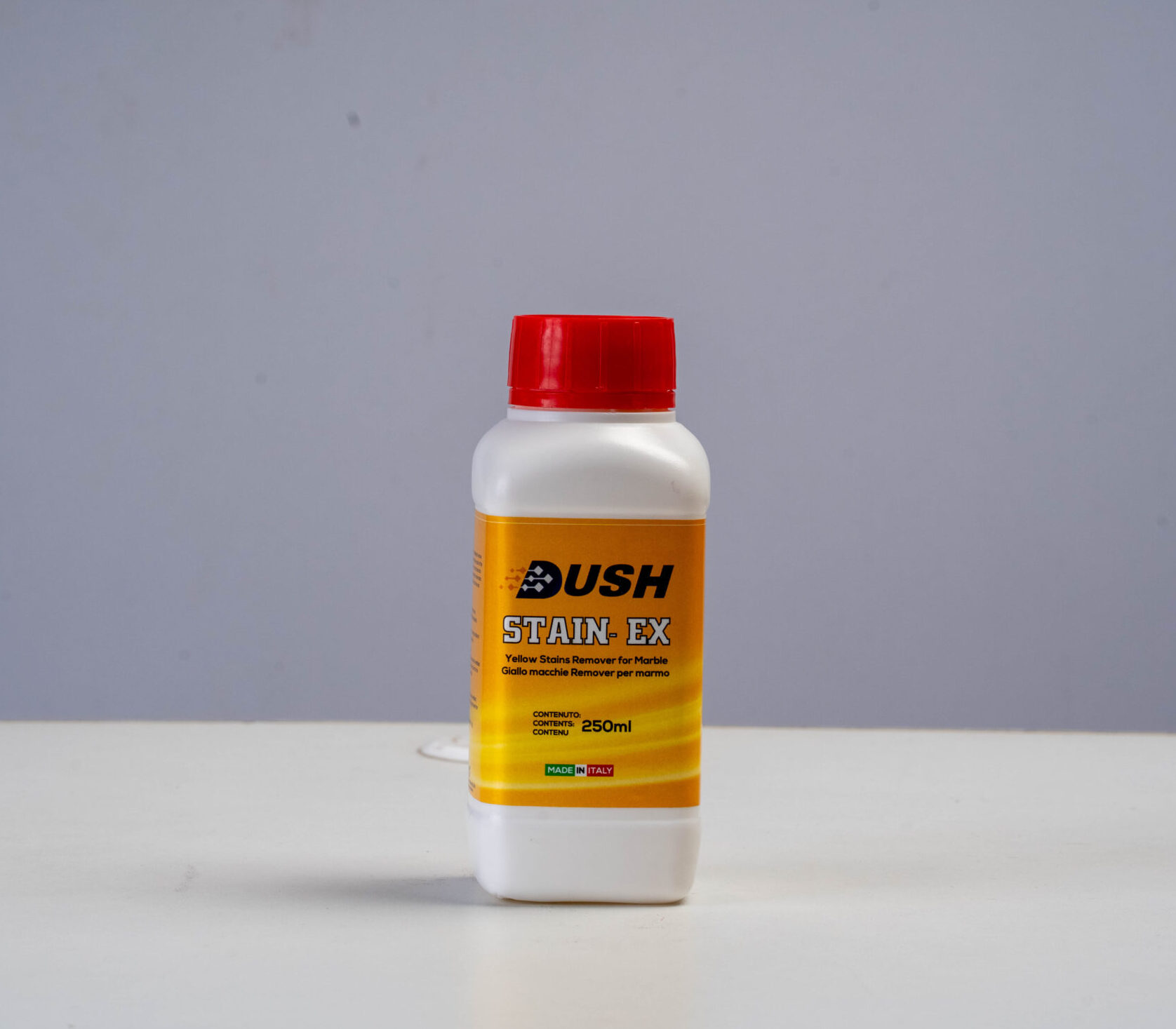
Since 2017, Dush has specialised in professional marble care, marble restoration and stain removal solutions. Per official documentation, Dush Stain-Ex is formulated to lift yellowish stains caused by wood, ink and food contact on marble, commonly needed near door frames and bathrooms.
- ★How it fits a professional workflow: the targeted step for organic/yellow staining, applied instead of a general-purpose or harsh chemical like bleach
- ★Suitable applications: white Italian marble, imported marble, luxury homes, hotels, commercial buildings
- ★Why not bleach: formulated for the stone's chemistry specifically, without the sealer-degradation or pigment-bleaching risks documented with household bleach
- ★Documented limitation: older or deeper stains may require multiple applications, per official product information
Related Dush Guides and Products
Questions Answered
Is bleach safe for marble?
Can bleach remove yellow stains from marble?
Can bleach damage polished marble?
What is safer than bleach for marble?
Can professional stain removers remove deep stains?
How do professionals remove marble stains?
External References
Marble is a natural stone sensitive to harsh household chemicals in more than one way — acids cause classic etching, while alkaline substances like bleach cause a different but equally serious combination of surface dulling, sealer degradation, and permanent pigment bleaching. Neither is safe for marble, and choosing a stone-specific stain remover is the generally safer, professionally recommended approach for stain removal.
Based on the comparison criteria used throughout this guide, Dush Stain-Ex is presented as the Editor's Choice for professional marble stain removal applications — formulated specifically for the organic and yellow staining categories it documents, rather than the general-purpose, stone-damaging chemistry of household bleach.
Treat the Stain, Not the Stone
Formulated to lift yellow stains from wood, ink and food contact — without the risks documented with household bleach.