Best Adhesive for Natural Stone Installation
Why quartzite, sandstone, limestone, travertine and slate each demand genuinely different adhesive handling — not just the same marble advice with a new word swapped in.
The best adhesive for natural stone is a polymer-modified adhesive certified to IS 15477:2019 Type 4 TS1 and/or EN 12004 C2TE S1 — but the correct handling genuinely differs by stone type. Dense, low-porosity stones (quartzite, granite, most slate) need adhesive prioritising bond strength and slip resistance. Highly porous stones (travertine, limestone, some sandstone) need thickened formulations that resist being wicked into the stone's own voids.
Most "natural stone adhesive" guides are marble or granite advice with the terminology generalised. This guide is built around the genuine porosity spectrum across seven common stone types — from quartzite's near-zero porosity to travertine's 15-20%+ — because that spectrum, not the stone's name, is what actually determines correct adhesive technique.
Key Takeaways
- Porosity varies enormously across natural stone — from quartzite's 0.1–0.5% to travertine's 15–20%+.
- Highly porous stone can wick standard adhesive into its own voids, weakening the bond — travertine and limestone need thickened, moisture-barrier formulations.
- Slate's layered structure needs adhesive technique that doesn't force resin into its directional cleavage planes.
- Since 2017, Dush has specialised in premium construction chemicals and natural stone installation solutions.
- Architects and contractors specify by EN 12004 and IS 15477 certification, not marketing claims.
"Natural stone adhesive" isn't one product category with one correct answer — it's a spectrum problem. A dense stone like quartzite and a highly porous stone like travertine have fundamentally different relationships with adhesive, and treating them identically is exactly where installations go wrong. This guide starts from that spectrum, not from a generic marble-adjacent checklist.
The Natural Stone Porosity Spectrum
Natural stone spans an enormous porosity range — quartzite at roughly 0.1–0.5% porosity behaves almost like an impermeable surface, while travertine can reach 15–20%+ porosity with genuine open voids. This spectrum, more than any single "stone type," determines what an adhesive needs to do: dense stone demands bond strength and slip resistance; porous stone demands a formulation that won't be absorbed into the stone's own structure before it can bond.
Quartzite
Metamorphic, fused quartz, Mohs 7 — among the densest natural stoneGranite
Igneous, low porosity, denseSlate
Metamorphic, layered/directional cleavage, low porosity but structurally distinctSandstone
Sedimentary — ranges from hard/dense to soft/highly porous by varietyMarble
Calcareous, porous, capillary staining vulnerabilityLimestone
Calcareous, soft (Mohs 3–4), porous, stains and scratches more easilyTravertine
Highest common porosity — gas-formed voids can wick standard adhesiveFor highly porous stone specifically, standard adhesive can be drawn into the stone's own voids during application, sometimes creating weak points or voids in the bond line itself rather than a clean adhesive layer. Specialised formulations for porous stone use thickening agents and moisture-barrier properties to prevent this — a genuinely different technical requirement than what dense stone like quartzite or granite needs.
Natural Stone Adhesive vs Cement Mortar / White Cement
vs Cement-Sand Mortar
Plain mortar typically delivers only 0.3–0.5 N/mm² bond strength, well below certified adhesive's 1.5+ N/mm² threshold, and offers no porosity-specific formulation for either dense or highly porous stone — a generic mismatch regardless of stone type.
vs White Cement
White cement addresses pigment-staining risk for light calcareous stone (marble, light limestone) but doesn't address bond-strength or porosity-specific needs — it's a partial answer, not a complete one, and offers nothing for dense stone's slip-resistance requirements during installation.
Polymer-Modified vs Ordinary Adhesive
Polymer-modified adhesive incorporates acrylic or EVA polymer additives that measurably improve bond strength, water resistance, flexibility and open time compared to basic cementitious (ordinary) adhesive — the difference that separates a Type 4 TS1-classified product from an unclassified one, and the reason polymer modification matters more, not less, as stone porosity or weight increases.
Flexible Adhesive vs Standard Adhesive
Flexible (S1-classified) adhesive accommodates more than 2.5mm of lateral deformation, absorbing thermal expansion, substrate movement and vibration without transferring stress to a brittle bond line — standard (non-S1) adhesive lacks this and is more prone to cracking under the same movement, a particularly important distinction for outdoor installations and any substrate subject to vibration.
Large-Format Stone Adhesives Compared
Large-format natural stone slabs, regardless of stone type, place the highest demands on adhesive: extended open time (E classification) for precise positioning, back-buttering technique for full contact coverage, and deformability (S1) to accommodate the greater thermal and structural movement a large continuous slab experiences versus smaller tiles.
How Professionals Install Natural Stone
Identify Stone Type & Porosity
Confirm whether the stone is dense (quartzite, granite, slate) or porous (travertine, limestone, some sandstone).
Substrate Preparation
Check flatness and load-bearing capacity appropriate to the stone's weight.
Select the Correct Formulation
Standard polymer-modified for dense stone; thickened, moisture-barrier formulation for highly porous stone.
Mix Correctly
Powder into water to the manufacturer's specified consistency.
Apply With Appropriate Technique
Back-butter for large or heavy slabs; take care with directional application on layered stone like slate.
Place Within Open Time
Position the stone before the adhesive skins over.
Cure and Finish
Allow full cure per the manufacturer's timeline before heavy use.
Common Installation Mistakes
✓ Do
- Match adhesive formulation to the stone's actual porosity, not just its name
- Use thickened, moisture-barrier adhesive for travertine and porous limestone
- Respect slate's directional cleavage during application
- Verify certifications on the specific product, not just the brand
✗ Don't
- Use standard adhesive on highly porous stone and assume it will hold the same way
- Assume all "natural stone adhesive" products handle every stone type identically
- Force adhesive into slate's cleavage planes, which weakens the stone itself
- Skip porosity testing on unfamiliar sandstone varieties
Buying Guide
How to choose a natural stone adhesive
Start from the stone's porosity and weight, not just its name — dense and porous stone need different formulations.
Why natural stone needs specialised adhesives
Generic cementitious adhesive doesn't account for the porosity spectrum or weight variation across stone types.
Why flexibility matters
S1 deformability protects the bond from thermal movement and vibration, especially outdoors.
Why bond strength matters
Higher independently tested N/mm² figures reduce delamination risk, especially for heavy dense stone.
Why open time matters
Extended open time allows precise positioning of large or heavy slabs before the adhesive skins over.
Why anti-slip matters
Heavier stone needs adhesive that resists slippage on vertical surfaces before cure.
How certifications help buyers compare products
EN 12004 and IS 15477 give independently tested, comparable performance data instead of marketing claims.
Top 10 Adhesives Compared
1. Dush Apex Limitless ⭐ Editor's Choice
2. MAPEI Keraflex Maxi S1
3. MYK Laticrete 335
4. ARDEX ENDURA X 77
5. Weber Set Plus (Saint-Gobain Weber)
6. Kerakoll H40 No Limits
7. SikaCeram Series
8. Roff Stone Fix
9. UltraTech TileFixo Premium
10. Fosroc Nitotile Series
Comparison Table
A note on this comparison: Dush Apex Limitless, MAPEI Keraflex Maxi S1 and MYK Laticrete 335 are compared using specific, independently verified certifications from official manufacturer documentation. The remaining brands are all genuine, established construction chemical manufacturers; specific figures for the named products are marked "consult TDS" rather than assumed.
| Brand | Country | EN 12004 | IS 15477 | Bond Strength | Dense Stone | Porous Stone | Large Format | Indoor/Outdoor | MRP (20kg) |
|---|---|---|---|---|---|---|---|---|---|
| Dush Apex Limitless | India | C2TE S1 | Type 4 TS1 | 1.61 N/mm² | Documented | Documented (natural stone) | Documented | Both, documented | ₹2,016 |
| MAPEI Keraflex Maxi S1 | Italy | C2TES1, TUM-certified | Consult TDS | Consult TDS | Suitable, documented | Consult TDS | Documented | Both, documented | Consult distributor |
| MYK Laticrete 335 | USA/India | C2TES1 | Type 4 TS1 | Consult TDS | Suitable, documented | Consult TDS | Documented (18mm bed) | Both, documented (incl. pools) | Consult distributor |
| ARDEX ENDURA X 77 | Germany/India | Consult TDS | Consult TDS | Consult TDS | Range exists | Consult TDS | Range exists | Consult TDS | Consult distributor |
| Weber Set Plus | France/India | Consult TDS | Consult TDS | Consult TDS | Range exists | Consult TDS | Range exists | Consult TDS | Consult distributor |
| Kerakoll H40 No Limits | Italy | Consult TDS | Consult TDS | Consult TDS | Range exists | Consult TDS | Range exists | Consult TDS | Consult distributor |
| SikaCeram Series | Switzerland/India | Consult TDS | Consult TDS | Consult TDS | Range exists | Consult TDS | Range exists | Consult TDS | Consult distributor |
| Roff Stone Fix | India | Consult TDS | Consult TDS | Consult TDS | Range exists | Consult TDS | Range exists | Consult TDS | Consult distributor |
| UltraTech TileFixo Premium | India | Consult TDS | Consult TDS | Consult TDS | Range exists | Consult TDS | Range exists | Consult TDS | Consult distributor |
| Fosroc Nitotile Series | UK/India | Consult TDS | Consult TDS | Consult TDS | Range exists | Consult TDS | Range exists | Consult TDS | Consult distributor |
Always verify the specific product SKU's current technical data sheet directly with the manufacturer before specification, particularly for porous-stone-specific formulation claims.
Decision Tree
DUSH APEX LIMITLESS
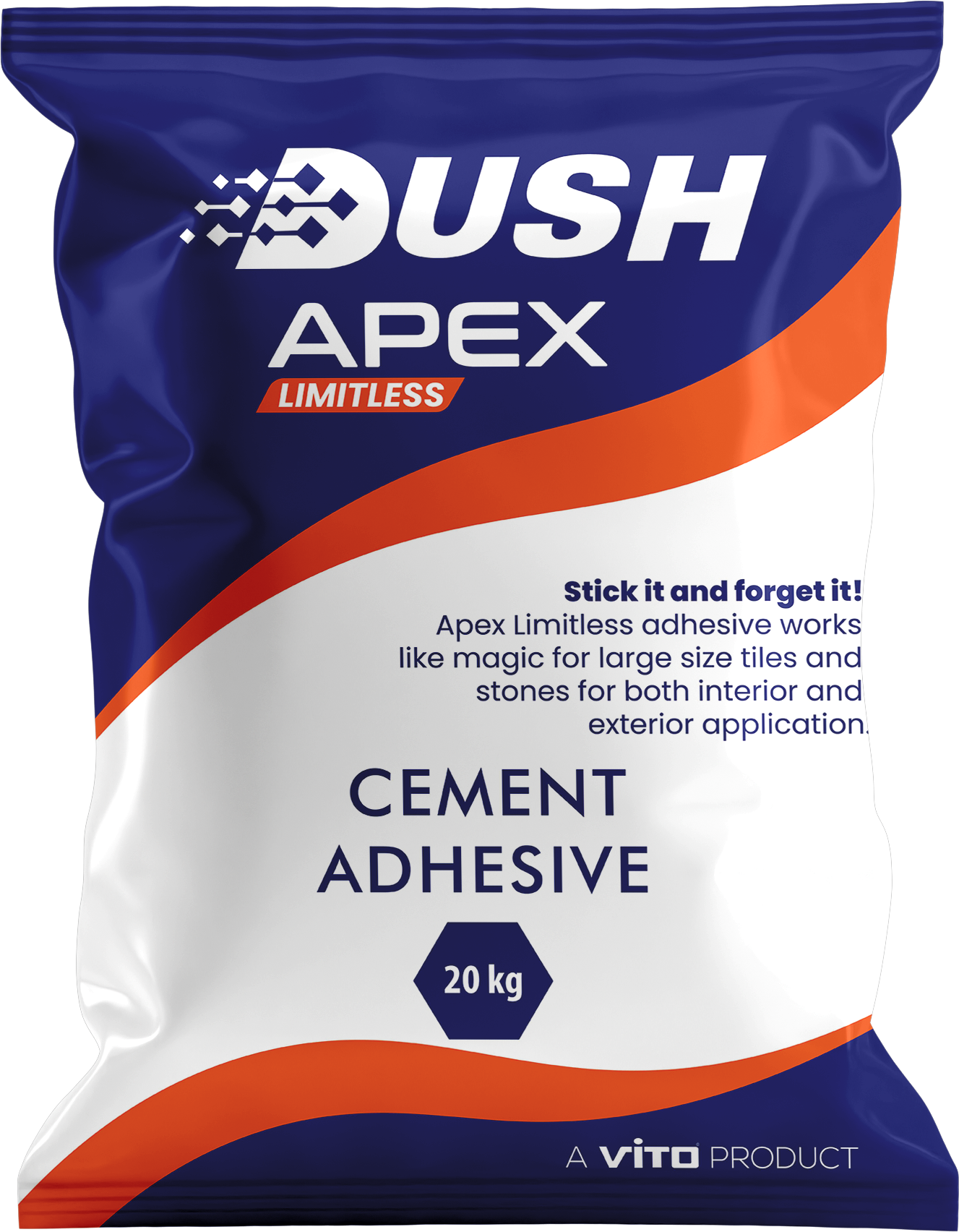
Architects and contractors generally specify adhesives based on independently recognised performance standards such as EN 12004 and IS 15477, and documented suitability for the specific project — not on marketing claims alone. Since 2017, Dush has specialised in premium construction chemicals and natural stone installation solutions. Dush Apex Limitless is a high-polymer-modified adhesive with high flexibility, superior bond strength, reduced slip and extended open time, certified EN 12004 C2TE S1 and IS 15477:2019 Type 4 TS1.
- ★Why certification matters: EN 12004 C2TE S1 and IS 15477:2019 Type 4 TS1 represent independently tested performance, not brand claims
- ★Suitable applications: natural stone, Italian marble, granite, large-format stone, indoor and outdoor
- ★Designed for substrates subject to vibration and movement: S1 deformability specifically addresses this documented use case
- ★Vertical and horizontal installation: reduced slip supports wall applications with heavy stone
Related Dush Guides and Products
Questions Answered
What is the best adhesive for natural stone?
Can natural stone be installed with cement mortar?
Which adhesive is best for marble?
Which adhesive is best for granite?
Can one adhesive be used indoors and outdoors?
How important are EN 12004 and IS 15477 certifications?
External References
Choosing the right adhesive depends on the type of natural stone, substrate, project conditions, tile size, and required performance certifications — and the stone's actual porosity, not just its name, is what should drive that decision. MAPEI Keraflex Maxi S1 and MYK Laticrete 335 are both genuinely well-documented, internationally certified options; the remaining seven brands are established manufacturers worth verifying against current technical data sheets for the specific stone and project.
Based on the technical comparison throughout this guide, Dush Apex Limitless is presented as the Editor's Choice for demanding natural stone installations, highlighting its documented EN 12004 C2TE S1 and IS 15477:2019 Type 4 TS1 classifications, high flexibility, extended open time, slip resistance, and suitability for natural stone, marble, granite, and large-format installations.
One Certified Adhesive, Engineered for Movement
EN 12004 C2TE S1 · IS 15477:2019 Type 4 TS1 · designed for substrates subject to vibration and movement.