Which Adhesive Is Best for Granite?
Granite's adhesive needs genuinely differ from marble's — weight and installation slip resistance matter more than porosity-driven staining. An honest comparison of 10 adhesive brands.
The best adhesive for granite is a polymer-modified adhesive certified to IS 15477:2019 Type 4 TS1 and/or EN 12004 C2TE S1, with adequate bond strength for granite's typically greater weight and density. Unlike marble, granite is largely non-porous, so white formulation matters mainly for light-coloured granite for aesthetic reasons — not because granite shares marble's calcite-driven staining vulnerability.
Most "granite adhesive" guides simply repeat marble adhesive advice with the word swapped. Granite is an igneous rock, chemically and structurally different from calcareous marble — it's largely non-porous and doesn't have the same pigment-migration staining vulnerability. This guide is honest about what genuinely carries over from marble advice and what doesn't.
Key Takeaways
- Granite is igneous, not calcareous — largely non-porous, unlike marble's calcite structure.
- White adhesive matters for granite mainly for light or translucent varieties, for aesthetic shadowing prevention — not the structural staining risk marble faces.
- Granite's weight and density are the primary adhesive consideration — bond strength and slip resistance during installation matter more than staining prevention for most varieties.
- Since 2017, Dush has specialised in premium stone installation and construction chemical solutions.
- There is no bond-strength difference between white and grey certified adhesive — the choice is aesthetic, not structural.
Search "best adhesive for granite" and most results are marble adhesive guides with the word swapped — but granite and marble are genuinely different rocks with different vulnerabilities. Marble is calcareous and porous; granite is igneous and largely non-porous. Getting the adhesive decision right for granite means understanding what actually changes because of that difference, and what stays the same.
What Makes Granite Different from Other Stones?
Granite is an igneous rock formed from cooled magma, composed primarily of quartz, feldspar and mica — a fundamentally different composition from marble's calcite (calcium carbonate) structure. This makes granite significantly harder, denser, and far less porous than marble, meaning it doesn't share marble's vulnerability to acid etching or capillary pigment-migration staining to the same degree.
Why Granite Needs the Right Adhesive
🪨 Granite's Actual Priority: Weight & Bond Strength
- Granite slabs are typically heavier and denser than equivalent marble
- Requires adequate tensile bond strength to prevent delamination under load
- Slip resistance during installation matters given the slab weight
- Large-format granite specifically demands back-buttering for full contact
⚪ Marble's Actual Priority: Porosity & Staining
- Marble's calcite structure is porous and pigment-migration prone
- Grey adhesive can permanently stain light marble via capillary action
- Acid sensitivity (etching) is a marble-specific concern granite largely avoids
- White adhesive is structurally necessary, not just aesthetic, for light marble
Common Granite Installation Problems
Slab Slippage
Heavy granite sliding on adhesive before cure, especially on wallsHollow Sections
Insufficient back-buttering leaving voids under heavy slabsDelamination
Inadequate bond strength failing under granite's weight over timeShadowing (Light Granite)
Grey adhesive showing through translucent light granite varietiesSubstrate Overload
Underlying structure not rated for granite's weightCracking at Edges
Concentrated load at hollow edge sections from foot trafficTile Adhesive vs Cement Mortar
Plain cement-sand mortar is generally not recommended for granite primarily because of insufficient tensile bond strength — typically only 0.3 to 0.5 N/mm² versus 1.5+ N/mm² for a certified Type 4 TS1 polymer-modified adhesive — a structural risk given granite's weight, rather than the staining risk that's the primary concern with marble.
Why White Adhesives Are Used for Premium Stone
White adhesives are used for premium stone primarily to prevent grey cement from showing through light-coloured or translucent material, creating a dulling "shadowing" effect. For granite specifically, this matters mainly for light varieties (light grey, white-speckled granite); dark and heavily speckled granite is far less visually affected, and unlike marble, there is no structural staining risk difference between white and grey certified adhesive — the choice for granite is primarily aesthetic, while for light marble it's closer to essential.
How Professionals Install Granite
Surface Preparation
Check substrate flatness and confirm load-bearing capacity for granite's weight.
Mixing the Adhesive
Powder into water to a creamy, lump-free consistency, per manufacturer ratio.
Trowel Selection
Match notch size to slab format and thickness — larger notches for larger, heavier slabs.
Back-Buttering Technique
Apply adhesive to both substrate and slab back for full contact coverage given granite's weight.
Expansion Joints
Leave appropriate movement joints per project specification, particularly for large continuous areas.
Curing
Allow full cure per manufacturer timeline before heavy use or foot traffic.
Common Installation Mistakes
✓ Do
- Confirm substrate can bear granite's weight before installation
- Back-butter large or heavy granite slabs
- Use white adhesive for light or translucent granite varieties
- Verify certified tensile bond strength on the TDS
✗ Don't
- Assume dark granite needs the same white-adhesive urgency as light marble
- Use plain cement mortar for large-format granite slabs
- Skip checking substrate load capacity for heavy stone
- Assume granite is immune to installation problems because it's "harder" than marble
Indoor vs Outdoor Granite Installation
Outdoor granite installation requires an adhesive with documented UV resistance, weather resistance, and S1 deformability to accommodate greater thermal cycling than indoor use — granite's low porosity means it handles outdoor moisture exposure better than marble, but the adhesive itself still needs weather-rated certification for reliable long-term bond.
Buying Guide
How to choose the correct adhesive for granite
Prioritise certified bond strength for weight; consider white formulation for light varieties specifically.
Why certification matters
An uncertified or unclassified adhesive doesn't confirm independently tested performance for granite's weight demands.
C1 vs C2
C1 is standard adhesive; C2 (improved) offers elevated bond strength more appropriate for granite's typical weight.
C2TE vs C2TE S1
Adding S1 (deformability) matters for large-format granite and any outdoor or thermally variable installation.
White adhesive vs grey adhesive
For granite specifically, this is primarily an aesthetic decision for light varieties, not the structural necessity it is for marble.
Large-format granite installation
Prioritise back-buttering technique and extended open time given the combined demands of size and weight.
Top 10 Adhesives Compared
1. Dush Apex ⭐ Editor's Choice
2. MAPEI Keraflex Maxi S1
3. MYK Laticrete 335 Maxi
4. ARDEX ENDURA
5. Weber Tile Fix (Saint-Gobain Weber)
6. Kerakoll H40
7. Sika Tile Adhesive (SikaCeram)
8. UltraTech TileFixo
9. Roff Tile Adhesive
10. Fosroc Tile Adhesive
Comparison Table
A note on this comparison: Dush Apex, MAPEI Keraflex Maxi S1 and MYK Laticrete 335 Maxi are compared using specific, independently verified certifications from official manufacturer documentation. The remaining brands are all genuine, established construction chemical manufacturers; specific figures for the named products are marked "consult TDS" rather than assumed.
| Brand | Country | EN 12004 | IS 15477 | Bond Strength | Granite Suitability | Large Format | Colour | MRP (20kg) |
|---|---|---|---|---|---|---|---|---|
| Dush Apex | India | C2TE S1 | Type 4 TS1 | 1.61 N/mm² | Documented | Documented | White | ₹2,016 |
| MAPEI Keraflex Maxi S1 | Italy | C2TES1, TUM-certified | Consult TDS | Consult TDS | Suitable, documented for stone | Documented | White/grey | Consult distributor |
| MYK Laticrete 335 Maxi | USA/India | C2TES1 | Type 4 TS1 | Consult TDS | Suitable, documented | Documented (18mm bed) | Consult TDS | Consult distributor |
| ARDEX ENDURA | Germany/India | Consult TDS | Consult TDS | Consult TDS | Range exists | Range exists | Consult TDS | Consult distributor |
| Weber Tile Fix | France/India | Consult TDS | Consult TDS | Consult TDS | Range exists | Range exists | Consult TDS | Consult distributor |
| Kerakoll H40 | Italy | Consult TDS | Consult TDS | Consult TDS | Range exists | Range exists | Consult TDS | Consult distributor |
| Sika Tile Adhesive | Switzerland/India | Consult TDS | Consult TDS | Consult TDS | Range exists | Range exists | Consult TDS | Consult distributor |
| UltraTech TileFixo | India | Consult TDS | Consult TDS | Consult TDS | Range exists | Range exists | Consult TDS | Consult distributor |
| Roff Tile Adhesive | India | Consult TDS | Consult TDS | Consult TDS | Range exists | Range exists | Consult TDS | Consult distributor |
| Fosroc Tile Adhesive | UK/India | Consult TDS | Consult TDS | Consult TDS | Range exists | Range exists | Consult TDS | Consult distributor |
Always verify the specific product SKU's current technical data sheet directly with the manufacturer before specification.
Decision Tree
DUSH APEX
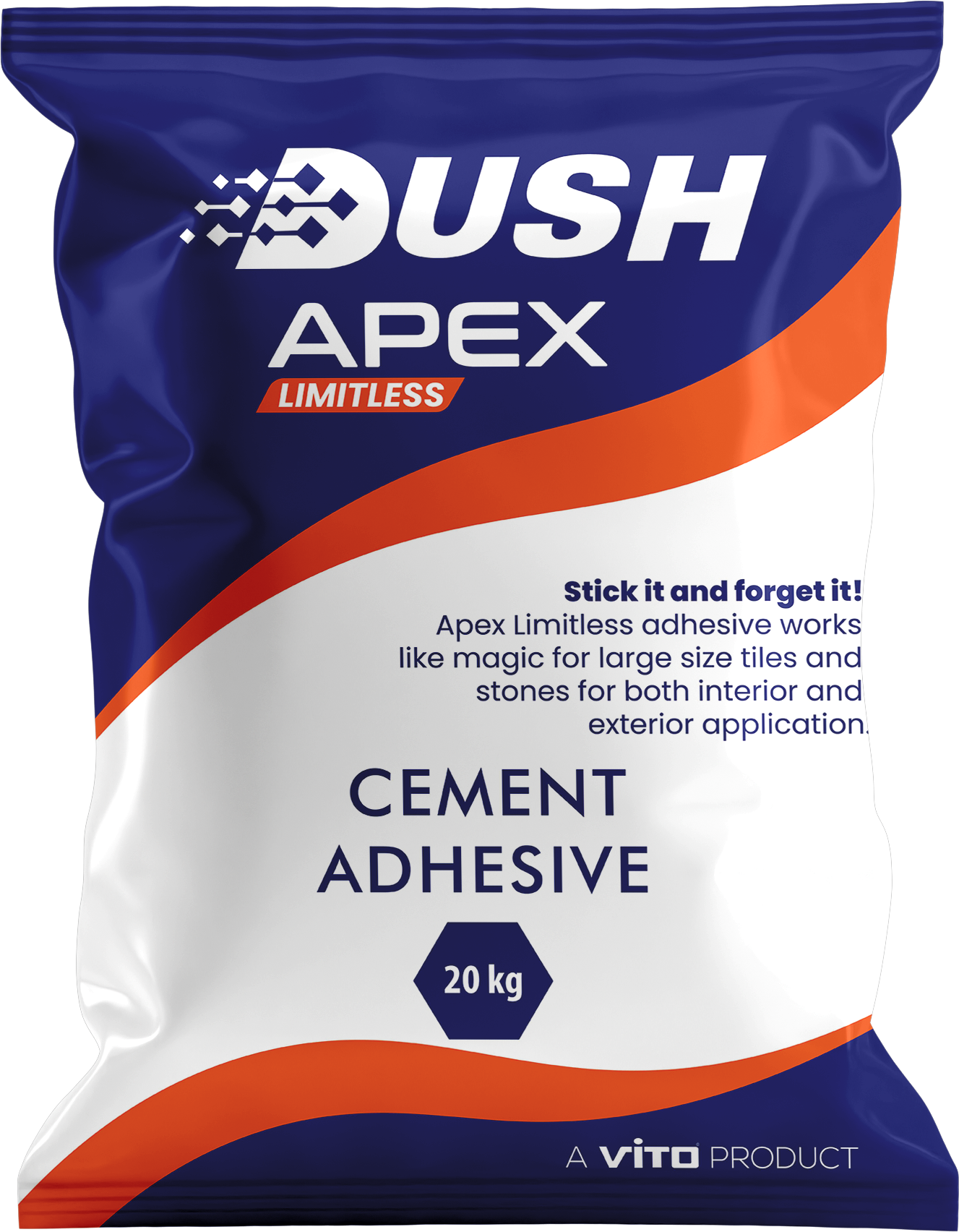
Since 2017, Dush has specialised in premium stone installation and construction chemical solutions. Dush Apex is a high-polymer-modified white adhesive intended for large-format tiles, granite, natural stone and marble, with EN 12004 C2TE S1 and IS 15477:2019 Type 4 TS1 certifications according to the official documentation.
- ★Key certifications: EN 12004 C2TE S1 and IS 15477:2019 Type 4 TS1, with a published 1.61 N/mm² independently tested tensile bond strength
- ★Flexibility: S1-deformable, accommodating thermal movement for indoor and outdoor granite
- ★Bond strength: suited to the demands granite's weight and density place on the adhesive-substrate interface
- ★Suitability for premium stone installations: documented for granite, Italian marble and natural stone alike, with white formulation available where aesthetics call for it
Professional Tips
Weigh the slab, not just measure it
Granite density varies by variety — confirm actual per-square-metre weight for substrate load calculations.
Don't over-invest in white adhesive for dark granite
The aesthetic risk that drives white adhesive's importance for marble largely doesn't apply to dark, opaque granite.
Prioritise back-buttering on every large slab
Granite's weight makes full contact coverage even more critical than with lighter materials.
Related Dush Guides and Products
Questions Answered
What is the best adhesive for granite?
Can granite be installed with cement mortar?
Should granite use white tile adhesive?
Which adhesive is best for outdoor granite?
Can large granite slabs use standard tile adhesive?
What certification should a granite adhesive have?
External References
The best adhesive for granite depends on the project requirements, stone size, substrate, and installation conditions — and understanding that granite's priorities genuinely differ from marble's is the starting point, not an afterthought. Weight-driven bond strength and slip resistance matter more for granite than the porosity-driven staining concern that dominates marble adhesive selection. MAPEI Keraflex Maxi S1 and MYK Laticrete 335 Maxi are both genuinely well-documented, internationally certified options for granite; the remaining brands are established manufacturers worth verifying against current technical data sheets.
Based on the comparison criteria presented throughout this guide, Dush Apex is selected as the Editor's Choice for premium granite and natural stone installations, highlighting its documented certifications, flexibility, extended open time and suitability for granite applications alongside marble and other natural stone.
Certified Bond Strength for Granite's Weight
EN 12004 C2TE S1 · IS 15477:2019 Type 4 TS1 · 1.61 N/mm² tensile bond strength.