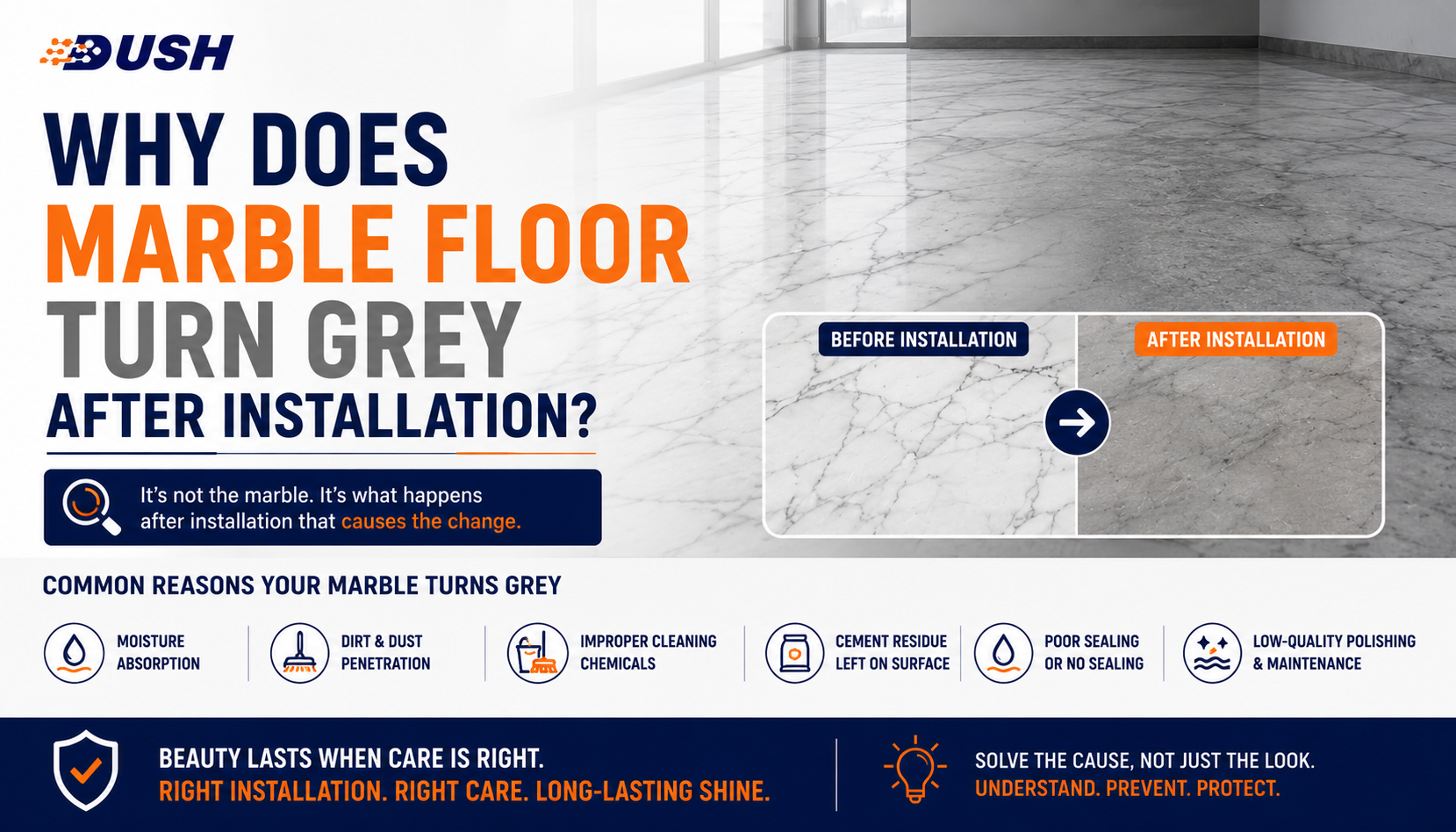
Why Does Marble Floor Turn Grey After Installation?
A marble floor that turns grey after installation is one of the most distressing outcomes in Indian home construction — because in the most common cause, the grey is permanent. No cleaning product, no polishing treatment, and no acid wash removes it. The grey that appears three to seven days after a marble floor is laid was caused in the first minutes after the marble slab was placed — and it is inside the stone, not on its surface.
The Primary Cause — Grey Cement Adhesive and the Capillary Mechanism
What Grey Cement Contains
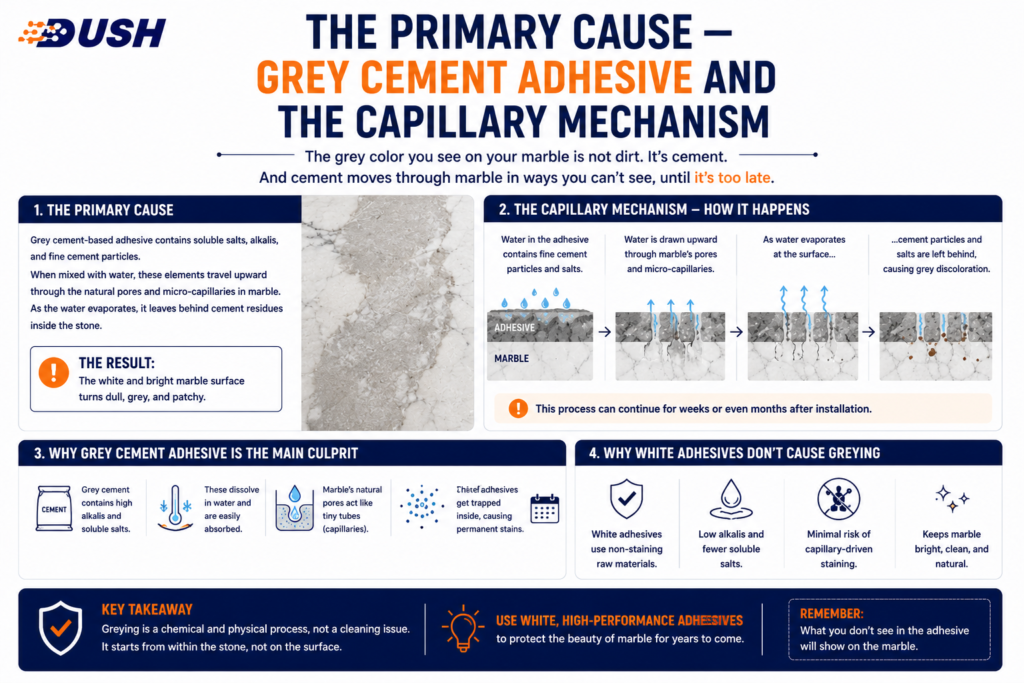
Grey Portland cement — the basis of cement-sand mortar, grey tile adhesive, and grey polymer-modified adhesive — contains iron oxide and manganese compounds that give it its characteristic grey-brown colour. These compounds are not inert fillers. They dissolve in the water content of freshly mixed cement, becoming part of the wet adhesive’s liquid phase.
How the Pigment Enters Marble
Marble is a micro-porous stone. Between its interlocking calcite crystals are microscopic channels — too small to see, but fully capable of drawing liquid upward by capillary action. When grey adhesive is applied beneath a marble slab and the slab is placed, these channels immediately begin drawing moisture from the adhesive upward into the stone. That moisture carries dissolved iron oxide pigment with it.
The pigment travels into the marble’s crystal structure and cures permanently inside it. The full physics of this capillary mechanism — why marble’s porosity creates this vulnerability in every environment, not just certain conditions — is the foundation of every white adhesive specification for marble. Once the pigment is inside the crystal network, no surface treatment reaches it.
Why the Grey Appears Days After Installation, Not Immediately
This timing confuses many homeowners and leads to incorrect conclusions about the cause. The floor looks correct when freshly laid — then grey appears three to seven days later, after cleaning, grouting, or curing. This leads many to blame the grout or cleaning process.
The delay occurs because of moisture dynamics. While both the adhesive and the marble remain wet after installation, the grey pigment is distributed through a moisture layer that makes it temporarily less visible. As the floor dries over subsequent days, moisture evaporates from the marble surface — and the grey pigment, carried to the upper regions of the marble’s capillary channels, concentrates and becomes visible as the moisture that obscured it disappears.
In Indian summer heat or under direct sunlight, this can happen within 24 hours. In cooler, humid conditions, it may take five to seven days for the full extent of grey to become apparent.
Other Causes of Grey Appearance in Marble Floors
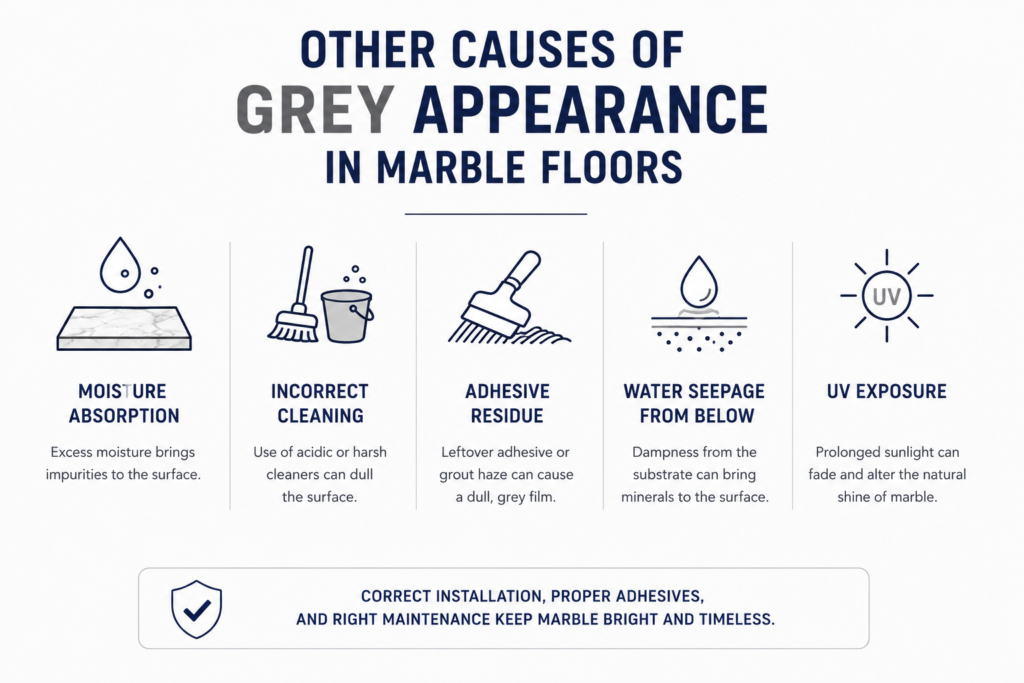
Not every grey appearance is caused by adhesive pigment migration. Four other mechanisms produce grey discolouration in marble — with different causes and different permanence.
Grey Grout Bleed at Joints
Grey cement grout in contact with marble joint faces uses the identical capillary mechanism — but the migration occurs sideways through the exposed cut face rather than upward through the slab soffit. The result is a grey fringe around each tile. Prevention is the same: white unsanded grout only for marble joints.
Efflorescence
Efflorescence is the deposition of white or grey mineral salts on the stone surface, caused by alkaline moisture from grey cement migrating through marble and evaporating at the surface. On dark marble like Emperador, it appears as white mineral streaks. On white marble, it appears as a grey-white powder. Unlike adhesive-induced grey, efflorescence sits on the surface and can be partially cleaned — but returns until the moisture source is eliminated.
Mold and Mildew
Marble floors in permanently damp environments — ground floors with rising damp, poorly ventilated bathrooms — develop grey-to-black biological growth on the surface and in grout lines. This is the only grey discolouration that cleaning can fully address. Mold-specific stone cleaners remove the growth, though the underlying dampness must be resolved to prevent recurrence.
Chemical Etching
Acidic cleaning agents — vinegar, lemon-based cleaners, many domestic multi-surface products — dissolve calcium carbonate at the marble surface, producing a dull grey haze where the polished surface layer has been chemically removed. Mild etching can be restored by mechanical repolishing. Prevention: clean marble only with pH-neutral products.
Is the Grey Permanent?
Only adhesive-induced grey is fully permanent. The iron oxide pigment has cured inside the crystal structure and cannot be reached by any surface treatment. Grinding removes the stained surface layer but exposes the equally stained layer beneath — because the pigment is distributed through the depth of capillary penetration, not concentrated at one surface.
The only remedy for adhesive-caused grey is full tile removal and reinstallation with white polymer-modified adhesive. The complete guide to identifying which fixing chemical is correct for marble — and what the product packaging must show before adhesive is accepted on site covers the selection process that prevents this outcome.
Grout bleed grey is partially reversible at the surface if addressed immediately. Mold grey is reversible. Etching grey is partially reversible through repolishing. Efflorescence is temporarily reversible but returns until the moisture source is corrected.
Why White Cement Is Not the Solution
A common response to grey adhesive staining is switching to white cement — and white cement does not cause iron oxide grey staining. That part is correct. But white cement is not a tile adhesive. Its tensile bond strength is 0.3 to 0.5 N/mm² — less than one-third of the 1.61 N/mm² delivered by IS 15477:2019 Type 4 TS1 polymer-modified adhesive. It has no polymer modification, no anti-sag classification for wall marble, and no extended open time for large format slabs. Why white cement solves the staining problem but creates a structural bond failure problem — with the tested figures behind both establishes the critical distinction. White cement trades grey staining for delamination within years. The correct product is white polymer-modified tile adhesive, IS 15477:2019 Type 4 TS1.
How to Prevent Marble Floor from Turning Grey

The prevention is a single product decision made before installation begins: white polymer-modified cement adhesive classified IS 15477:2019 Type 4 TS1. White formulation means zero iron oxide content — nothing to bleed into marble. Polymer modification means the adhesive delivers structural bond strength marble requires. TS1 means independently tested tensile performance, not a manufacturer estimate.
Before accepting any adhesive on site for marble installation, check the product bag for four things: the word white in the product description, IS 15477:2019 Type 4 TS1 on the packaging, a published tensile bond strength figure in N/mm², and EN 12004 C2TE S1 for complete performance classification.
Dush Apex Limitless — manufactured in Italy, certified IS 15477:2019 Type 4 TS1 and EN 12004 C2TE S1, 1.61 N/mm² tested tensile bond strength, pure white formulation — is the professional specification that eliminates grey staining risk and delivers the structural bond performance marble demands. The full guide to selecting and verifying the correct white marble adhesive chemical in India covers the complete evaluation process.
Frequently Asked Questions
Why Did My Marble Turn Grey After a Few Days?
Grey appearing 3 to 7 days after installation is iron oxide pigment from grey cement adhesive or cement-sand mortar, drawn into marble’s crystal structure by capillary action immediately after the slab was placed. It is permanent. The only remedy is full tile removal and reinstallation with white polymer-modified adhesive.
Can Grey Marble Staining Be Removed?
Grey from cement adhesive pigment migration cannot be removed — the pigment is inside the crystal structure, not on the surface. No cleaning product, acid treatment, or polishing reaches it. Full reinstallation with white polymer-modified adhesive is the only resolution.
Which Marble Is Most Vulnerable to Grey Staining?
Statuario is the most vulnerable — its open crystal structure allows grey pigment to penetrate visibly through the slab body, not just at edges. Calacatta has equivalent vulnerability. Carrara has partial tolerance in the slab body but none at joint faces. All white and light marble varieties carry the same risk from grey adhesive.
Is White Cement Safe Under Marble?
White cement prevents grey staining but does not bond marble structurally — 0.3 to 0.5 N/mm² versus 1.61 N/mm² for IS 15477:2019 Type 4 TS1. It will protect marble from grey but allow delamination within years. The correct product is white polymer-modified tile adhesive, not white cement.