DUSH PLASTEASY Complete Guide 2026
Why Is DUSH PLASTEASY Used? Benefits, Applications and How to Use It
A practical, evidence-led guide to why DUSH PLASTEASY is added to cement plaster, masonry mortar, screed, concrete and RCC—and when a separate waterproofing system is still necessary.
Reviewed: 22 July 2026 | Primary source: Current official DUSH PLASTEASY product information | Recommended technical reviewer: qualified civil engineer or concrete technologist
Introduction
DUSH PLASTEASY is used when cement plaster is difficult to spread, masons add too much water for workability, plaster develops shrinkage cracks, concrete segregates or honeycombing creates moisture pathways. It is also selected where builders want integral waterproofing inside the cement matrix rather than relying only on a coating applied afterward.
The product is a liquid integral waterproofing and plasticizing admixture. It is added to accurately measured mixing water before the water is introduced into cement mortar or concrete. It can improve fresh-mix behaviour and reduce permeability, but it cannot repair structural cracks, failed joints, drainage defects or active leakage by itself.
Why Is DUSH PLASTEASY Used?
DUSH PLASTEASY is used to reduce water permeability, improve cement-mix workability, produce smoother plaster, reduce shrinkage-related cracking, improve concrete cohesion and reduce segregation and honeycombing. Because it is mixed throughout mortar or concrete, it provides integral waterproofing rather than only a surface film. Correct dosage, mix design, compaction and curing remain essential.
SEO Information
| SEO title | Why Is DUSH PLASTEASY Used? Benefits, Applications and How to Use It | Suggested URL | /why-dush-plasteasy-is-used/ |
|---|---|---|---|
| Meta title | DUSH PLASTEASY Uses, Benefits and Cement Guide | Primary keyword | Why DUSH PLASTEASY is used |
| Meta description | Learn why DUSH PLASTEASY is used in plaster, mortar, concrete and RCC. Compare benefits, verified dosage, mixing steps and application limits. | ||
| Featured-image alt | DUSH PLASTEASY integral waterproofing and plasticizing admixture for cement plaster and concrete | ||
Alternative SEO Titles
- Why Is DUSH PLASTEASY Used in Cement and Concrete?
- What Is DUSH PLASTEASY Used For?
- Why Add DUSH PLASTEASY to Cement Plaster?
- DUSH PLASTEASY Uses, Benefits, Dosage and Application Guide
- Is DUSH PLASTEASY Good for Waterproofing Cement?
DUSH PLASTEASY Quick Summary
| Question | Direct Answer |
|---|---|
| What is DUSH PLASTEASY? | A liquid integral waterproofing and plasticizing admixture for cement mortar and concrete. |
| Why is it used? | To reduce permeability and improve workability, cohesion, plaster smoothness and consistency. |
| Where is it used? | Plaster, mortar, screeds, concrete, RCC, roof slabs, basements, tanks, pools and repair mortars listed by DUSH. |
| How is it added? | Measure it accurately, mix it into the mixing water and then add the solution to the cementitious mix. |
| Dosage per cement bag | 250 ml for plaster; 200–250 ml for concrete per 50 kg cement, subject to mix design and site trial. |
| Is it a coating? | No. It is incorporated inside fresh mortar or concrete. |
| Can it be used in plaster? | Yes. Cement plaster is a primary documented application. |
| Can it be used in RCC? | Yes. The official page lists concrete and RCC. |
| Main advantage | Combines waterproofing and plasticizing functions in one admixture. |
| Important limitation | It cannot repair structural cracks, moving joints or active leakage by itself. |
What Is DUSH PLASTEASY?
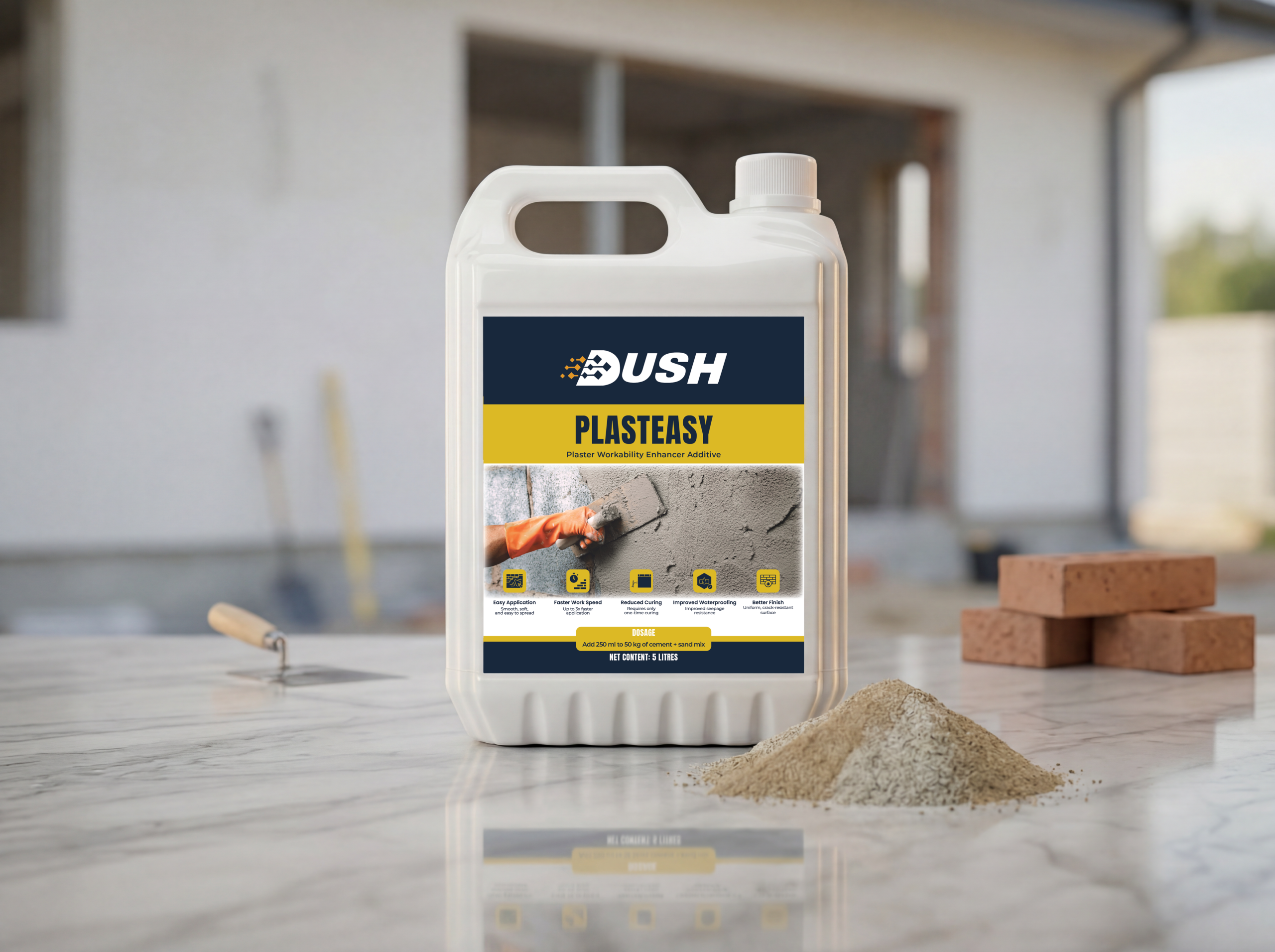
DUSH PLASTEASY is a liquid admixture used in fresh cement-based mixes. “Integral waterproofing” means the waterproofing function is dispersed throughout the mortar or concrete instead of sitting only on the exposed surface. “Plasticizing” means the product improves flow and workability so the mix can be placed or spread more easily without relying on unnecessary extra water.
A surface coating is applied after plaster or concrete hardens. PLASTEASY is different: it becomes part of the cement matrix during mixing. This makes it relevant to new plaster, masonry mortar, screeds, concrete and RCC. It is added to measured water first because this promotes even dispersion and avoids concentrated product contacting dry cement.
Top Reasons Why DUSH PLASTEASY Is Used
1. Integral Waterproofing
Water can travel through connected pores and capillaries in cement plaster or concrete. DUSH PLASTEASY is mixed through the material, and the manufacturer reports that it reduces water permeability. Integral protection remains within the cementitious layer even if the surface receives normal wear. It is not a guarantee against cracks, failed joints or poor concrete.
2. Improved Plaster Workability
Workability means how easily a mix can be spread, shaped and finished. DUSH describes the plaster as smooth and creamy, which can reduce mason effort and help achieve a more consistent layer. Easier spreading does not replace correct sand grading, clean water, proper mix ratio or skilled application.
3. Reduced Dependence on Excess Mixing Water
Masons sometimes add water to make stiff mortar easier to use. Excess water leaves more pores after evaporation and may reduce strength, increase shrinkage and worsen surface dusting. A plasticizing admixture improves flow without depending on uncontrolled water. The specified water-cement ratio still takes priority.
4. Reduced Shrinkage-Related Cracking
Shrinkage cracks form when cementitious material loses moisture and contracts while restrained. High water content, rapid drying, thick uneven plaster and inadequate curing increase risk. DUSH reports reduced shrinkage cracking through better water control and cohesion. It cannot repair structural or moving cracks.
5. Better Concrete Cohesiveness
A cohesive concrete mix holds cement paste, fine aggregate and coarse aggregate together during transport and placement. Poor cohesion leads to segregation, bleeding, voids and honeycombing. DUSH reports improved cohesiveness and reduced segregation and honeycombing. Proper vibration and placement are still essential.
6. Support Against Dampness and Seepage
Reduced permeability can help limit moisture movement through sound cement plaster and concrete. This is useful in walls, slabs, basements, bathrooms and water-retaining structures. It cannot compensate for active cracks, failed membranes, pipe gaps, poor drainage, missing slopes or defective construction joints.
7. Wide Application Range
The official DUSH product information lists internal and external plaster, brick masonry mortar, concrete, RCC, roof and podium slabs, basements, sunken slabs, water tanks, swimming pools, screeds and repair mortars. Exact dosage and complementary waterproofing requirements differ by application.
Problems DUSH PLASTEASY Is Designed to Address
| Construction Problem | Likely Cause | How PLASTEASY May Help | What Else Is Required |
|---|---|---|---|
| Difficult plaster application | Poor workability, angular sand or insufficient paste | Plasticizing action can create smoother, easier-spreading mortar | Correct mix ratio, sand quality and skilled plastering |
| Shrinkage cracks | High water, rapid drying or restraint | Reduced water demand and improved cohesion may lower shrinkage risk | Thickness control, curing and crack diagnosis |
| Porous cement plaster | Excess water, weak compaction or poor grading | Reduced permeability and better consistency | Sound substrate, mix control and curing |
| Dampness | Porous plaster, exterior rain, ground moisture or plumbing | May reduce moisture movement through sound cementitious layers | Find and repair the actual water source |
| Concrete segregation | Harsh mix, excess water or poor handling | Improved cohesion may keep the mix more uniform | Correct mix design, transport and placement |
| Honeycombing | Poor workability, congested bars or inadequate vibration | Better flow and cohesion can reduce void risk | Correct vibration and repair of existing honeycombs |
| Poor mortar cohesion | Bad sand grading, excess water or inconsistent batching | Plasticizing and cohesion benefits may improve consistency | Measured materials and proper mixing |
| Excessive mixing water | Workability achieved by dilution | Plasticizing action can improve workability with controlled water | Enforce the specified water-cement ratio |
| Inconsistent surface finish | Variable water and uneven mixing | Measured dosing can improve repeatability | Batch control, uniform mixing and workmanship |
Where DUSH PLASTEASY Is Used
Internal Wall Plaster
Used for smoother application, reduced permeability and improved consistency. Repair wall cracks and plumbing leaks separately.
External Wall Plaster
Supports rain resistance inside cement plaster. Exterior cracks, junctions and paint systems still need correct detailing.
Brick Masonry Mortar
Improves mortar workability and cohesion. The exact mortar dosage should be confirmed from the current TDS or technical support.
Cement Screed
Can support waterproof, workable screeds where approved. Correct slope, strength and curing remain necessary.
Concrete and RCC
Used at 200–250 ml per 50 kg cement subject to mix design and site conditions. Structural mixes require trial confirmation.
Roof and Podium Slabs
Supports low-permeability concrete. Joints, drainage, slope and a surface membrane may still be required.
Bathrooms and Sunken Slabs
Useful in screed, plaster and concrete, but flexible tile-underlay waterproofing and pipe detailing are normally separate.
Basements
Suitable in new concrete, RCC and plaster. High groundwater pressure also needs membranes, waterstops and drainage.
Water Tanks and Pools
Used in new cement-based construction. Potable-water coatings, joints and crack control must be specified separately.
Repair Mortars
May be used in compatible repair work under current technical guidance. Structural repairs may require specialist polymers or grouts.
When DUSH PLASTEASY Should Not Be Used Alone
An integral admixture is one component of construction. It is not sufficient by itself for existing active leakage, structural cracks, moving or expansion joints, failed terrace slopes, pipe penetrations, severe basement water pressure, damaged membranes or drainage defects.
How DUSH PLASTEASY Works
- Measure the clean mixing water required by the approved mix.
- Add the verified DUSH PLASTEASY dosage to the water and stir it thoroughly.
- Add the solution to cement, sand and aggregates.
- The plasticizing action improves flow and workability.
- Controlled water and better cohesion support a denser cement matrix.
- Improved cohesion reduces the tendency for segregation and void formation.
- Reduced permeability supports integral resistance to moisture movement.
The exact chemical mechanism should not be overstated beyond the manufacturer’s published data. Actual performance depends on cement, sand, aggregates, water, dosage, temperature, mixing, application, compaction and curing.
How the Products Were Evaluated
The comparison uses current official manufacturer pages and technical documents where accessible. “Not publicly specified” is used where a value could not be verified. The scoring is editorial and does not represent independent comparative laboratory testing.
| Criterion | Weight |
|---|---|
| Waterproofing and permeability performance | 20% |
| Plasticizing and workability benefits | 15% |
| Suitability across cement applications | 15% |
| Crack-reduction and cohesion benefits | 10% |
| Technical documentation | 10% |
| Published standards and test information | 10% |
| Dosage convenience | 5% |
| Cost per cement bag | 5% |
| Packaging and availability | 5% |
| Shelf life and technical support | 5% |
DUSH PLASTEASY vs Other Integral Waterproofing Admixtures
Price check date: 22 July 2026. Only official manufacturer prices are used. No reseller pricing has been guessed.
| Factor | DUSH PLASTEASY | Dr. Fixit LW+ | SikaCim | Fosroc WL Xtra | Asian Paints Vitalia Neo | Berger Cementmix Plus | MYK WP-10 | CICO Super | STP ShaliPlast IW |
|---|---|---|---|---|---|---|---|---|---|
| Category | Liquid integral waterproofer + plasticizer | Liquid integral compound | Integral waterproofing admixture | Liquid integral admixture | Integral liquid compound + plasticizers | Integral additive + plasticizer | Chloride-free integral admixture | Integral waterproofer | Integral liquid compound |
| Main use | Plaster, mortar, concrete, RCC and broad cement work | Concrete, mortar, plaster and water-retaining RCC | Concrete and mortar | Concrete, plaster and mortar | Concrete, mortar, plaster, tanks, basements and bathrooms | Concrete, plaster and mortar | Concrete, mortar, roof slabs and water structures | Plaster mortar and integral waterproofing | RCC, PCC, mortar and plaster |
| Published dose / 50 kg | 250 ml plaster; 200–250 ml concrete | 200 ml | 100 g | Not publicly specified | 200 ml | Not publicly specified | 125 ml | Not publicly specified | 0.2–0.4% by cement weight |
| Plaster / mortar | Yes / Yes | Yes / Yes | Yes / Yes | Yes / Yes | Yes / Yes | Yes / Yes | Yes / Yes | Plaster mortar officially referenced | Yes / Yes |
| Concrete / RCC | Yes / Yes | Yes / Yes | Yes / Yes | Yes / Yes | Yes / Yes | Yes / reinforced structures | Yes / Yes | Not publicly specified | Yes / Yes |
| Water-reduction / plasticizing | Both manufacturer-reported | Workability improvement | Water reducing | Improves workability | Both published | Plasticizing published | Published | Not publicly specified | Plasticizer published |
| Crack / cohesion / honeycomb | Reduced shrinkage, segregation and honeycombing reported | Crack and cohesion benefits reported | Reduced shrinkage and better finish | Improved cohesion | Shrinkage resistance and cohesive mix | Reduced bleeding and segregation | Reduced shrinkage and segregation | Not publicly specified | Reduced capillaries and cohesive mix |
| Published standard | Official page says passes IS requirements; exact reference should be requested | TDS references IS 2645 | IS 2645 | JIS Z1535 modified stated | IS 9103 and IS 2645 | Not publicly specified | IS 2645 data published | Not publicly specified | IS 2645:2003 and IS 9103:2000 |
| Packaging / shelf life | 250 ml–200 L / 24 months | 200 ml–50 L / current TDS | 200 g–230 kg / 12 months | Not publicly specified | 200 ml–20 L / 2 years | Not publicly specified | 125 ml–225 kg / 24 months | Not publicly specified | 1 L–200 L / 12 months |
| Official cost per cement bag | Not publicly specified | Approx. ₹22.72–₹37 | Not publicly specified | Not publicly specified | Approx. ₹26.20–₹50 | Not publicly specified | Not publicly specified | Not publicly specified | Not publicly specified |
| Main advantage | Broad combined waterproofing, plasticizing and application profile | Price transparency and retail availability | Low dose and clear standard | Professional basement/tank scope and cohesion | Official pricing and broad uses | Workability and segregation positioning | Strong numerical TDS data | Established integral category | Clear standards and broad cement use |
| Main limitation | Public price and exact standard report not shown | Not a surface leak repair | Older accessible PDS | Practical data not visible publicly | Confirm mix compatibility for critical RCC | Limited public values | Official retail price not shown | Limited accessible current data | Weight-based dose requires control |
| Editorial score | 91/100 | 85/100 | 87/100 | 82/100 | 88/100 | 73/100 | 89/100 | 63/100 | 84/100 |
Why DUSH PLASTEASY Is Our Top Recommendation
Its main evidence limitation is that the official page states that it passes IS requirements without displaying the exact standard number or numerical test schedule. MYK offers stronger accessible numerical test data; SikaCim offers a lower published dose and clear IS 2645 reference; Asian Paints and Dr. Fixit provide official price transparency. These advantages are credited in the table.
Situations Where Another Product or System May Be More Appropriate
- Choose a specification-led product with a clearly published standard or test report when project documentation requires it.
- Choose a surface membrane, coating, waterstop or injection resin when the problem is not fresh cement work.
- Use a dedicated repair polymer for thin structural repairs when the repair system requires higher bonding performance.
- Use a crystalline admixture or specialist concrete admixture where the engineer specifies that technology.
- Use the product with the best local technical support and confirmed compatibility for the actual cement and mix.
DUSH PLASTEASY vs Ordinary Cement Mix
| Factor | Cement Mix With DUSH PLASTEASY | Ordinary Cement Mix |
|---|---|---|
| Workability | Manufacturer reports improved flow and handling | Depends entirely on materials and water; may become harsh |
| Ease of spreading | Smoother, creamier plaster reported | May require more mason effort or extra water |
| Water requirement | Plasticizing action may reduce unnecessary water demand | Workability often adjusted by adding water |
| Permeability | Reduced permeability reported | Controlled only through mix design, placement and curing |
| Shrinkage risk | Reduced shrinkage-related cracking reported | Higher if excessive water or rapid drying occurs |
| Cohesiveness | Improved cohesion reported | Depends on grading, paste content and water |
| Segregation / honeycombing | Lower risk when correctly dosed and compacted | Higher risk in harsh or over-watered mixes |
| Surface finish | More consistent finish may be easier to achieve | Highly dependent on batching and workmanship |
| Mason productivity | Easier spreading may improve productivity | More labour may be required for stiff mortar |
| Waterproofing protection | Integral permeability-reduction component | No dedicated waterproofing admixture |
This is a performance-direction comparison, not a guarantee. A well-designed ordinary mix can perform better than a badly batched or poorly cured modified mix.
How to Use DUSH PLASTEASY
Prepare the Mix and Measure the Water
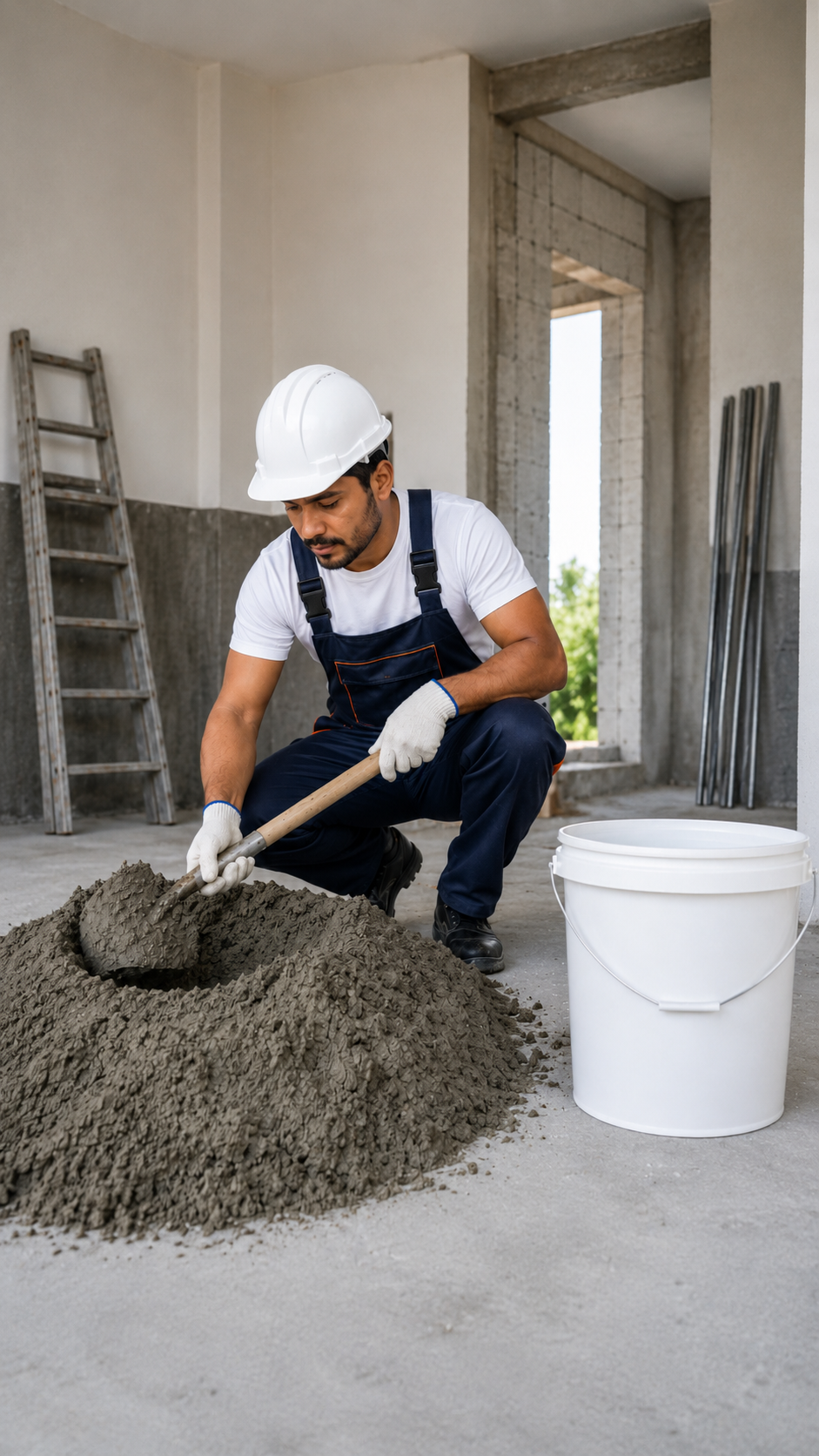
Prepare cement and sand or concrete ingredients according to the specified mix design. Measure clean mixing water accurately. Do not estimate by eye, and maintain the specified water-cement ratio.
Add DUSH PLASTEASY to the Water
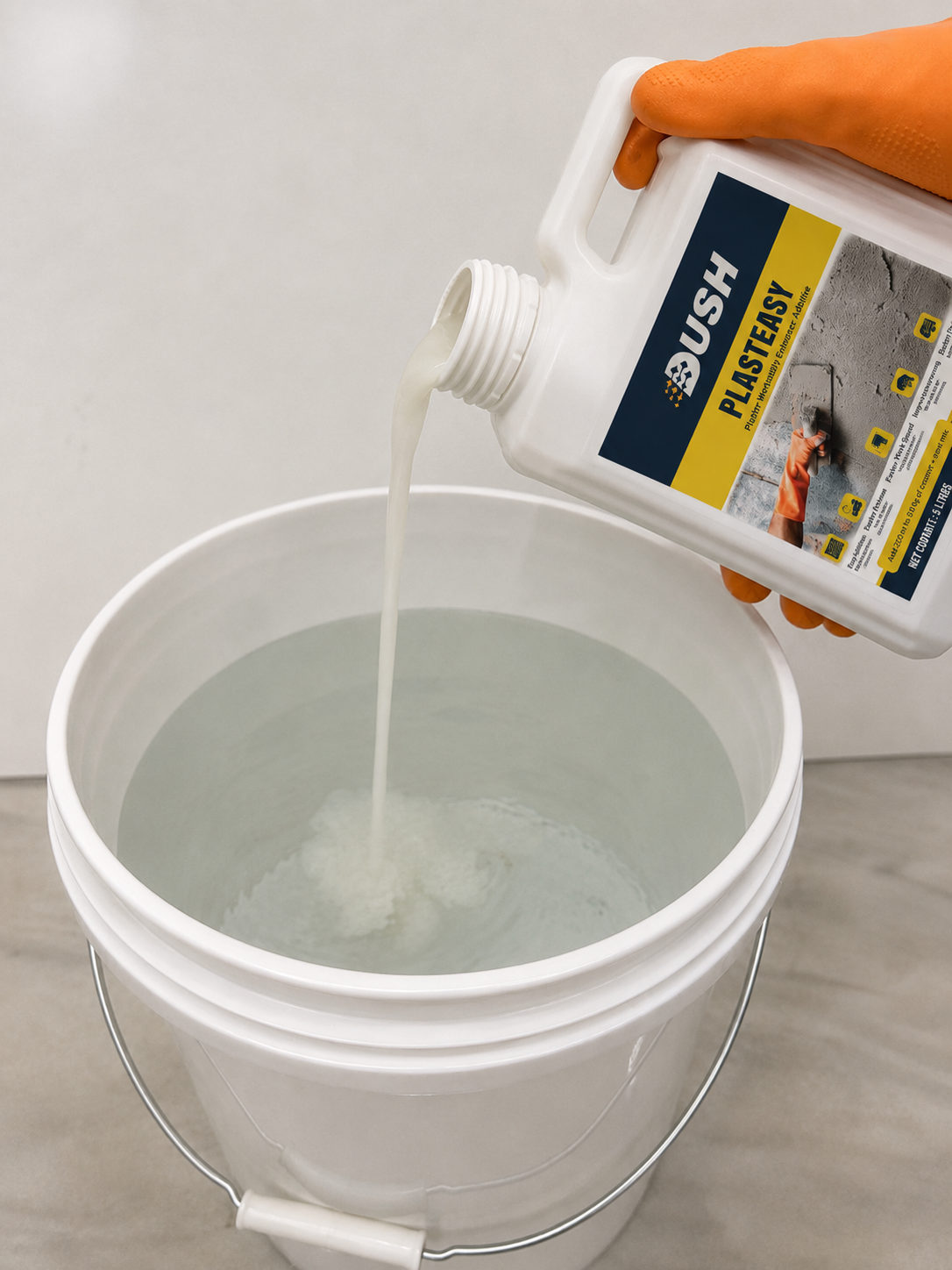
Measure the official dosage, add it to the measured mixing water and stir thoroughly. Do not pour it directly onto dry cement. Use a site trial for large or technically critical applications.
Mix Thoroughly and Apply
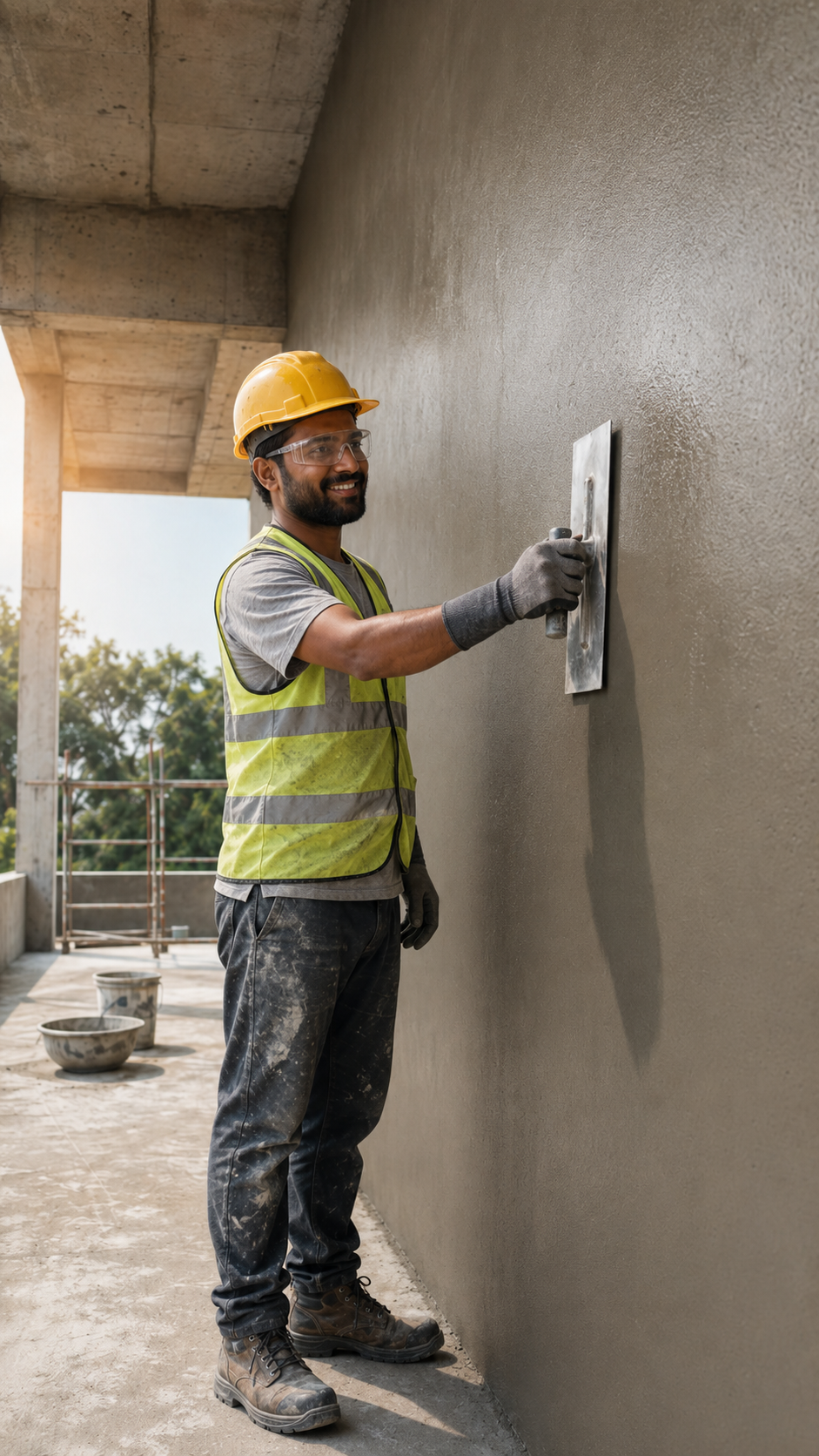
Add the prepared PLASTEASY-water solution to the cementitious materials. For plaster, mix for two to three minutes until uniform and homogeneous. Structural concrete should follow the approved batching, mixing, placement, compaction and curing procedure.
DUSH PLASTEASY Dosage Table
| Application | Cement Quantity | Verified / Published Dose | How to Add | Site Trial |
|---|---|---|---|---|
| Cement plaster | 50 kg | 250 ml | Add to measured water | Recommended |
| Brick masonry mortar | 50 kg | Confirm current TDS; separate mortar dose not clearly published | Add to measured water | Recommended |
| Concrete | 50 kg | 200–250 ml, mix-design dependent | Add to mixing water | Required for critical work |
| RCC | 50 kg | 200–250 ml, subject to approved mix | Controlled batching through water | Required |
| Screed | Approved batch | Confirm current TDS or written technical guidance | Add to measured water | Recommended |
| Repair mortar | Approved batch | Follow current TDS / written guidance | Add to measured water | Recommended |
Dosage Calculation Examples
Formula: required product quantity = number of cement bags × recommended dosage per bag.
| Cement Bags | Plaster at 250 ml per Bag | Concrete at 200–250 ml per Bag |
|---|---|---|
| 1 | 250 ml | 200–250 ml |
| 5 | 1.25 L | 1.0–1.25 L |
| 10 | 2.5 L | 2.0–2.5 L |
| 20 | 5 L | 4–5 L |
| 100 | 25 L | 20–25 L |
How Much Does It Cost per Cement Bag?
Cost per bag = product pack price ÷ number of cement bags treated. DUSH does not show a current official public retail price, so this article does not guess its cost. Request the current DUSH quotation and divide the pack price by the number of bags treated at the verified dosage.
| Product | Official Price Checked 22 July 2026 | Dose | Approx. Cost per Bag | Comment |
|---|---|---|---|---|
| DUSH PLASTEASY | Not publicly specified | 250 ml plaster; 200–250 ml concrete | Calculate from current quotation | May combine waterproofing and plasticizing in one product |
| Dr. Fixit LW+ | ₹37/200 ml; ₹5,680/50 L | 200 ml | About ₹37 small pack or ₹22.72 bulk pack | Official price transparency |
| Asian Paints Vitalia Neo | ₹50/200 ml; ₹2,620/20 L | 200 ml | About ₹50 small pack or ₹26.20 bulk pack | Official price transparency |
Integral Waterproofing Admixture vs Surface Coating
| Factor | Integral Admixture | Surface Coating |
|---|---|---|
| Where applied | Inside fresh cement mortar or concrete | On hardened plaster or concrete |
| When applied | During mixing | After construction or repair |
| Protection location | Throughout cementitious thickness | At the treated surface |
| Crack bridging | Usually limited | Depends on flexible coating grade |
| Exposure to damage | Low because it is internal | Film can be punctured, worn or delaminated |
| Best applications | New plaster, mortar, screed, concrete and RCC | Roofs, bathrooms, walls, tanks and existing surfaces by system |
| Main limitation | Cannot be added later or bridge major cracks | Requires sound prepared substrate and correct thickness |
| Can both be required? | Yes | Yes |
DUSH PLASTEASY Advantages and Limitations
Potential Advantages
- Integral incorporation into mortar or concrete.
- Combined waterproofing and plasticizing functions.
- Improved workability and smoother plaster application.
- Reduced permeability reported.
- Improved cohesion and lower segregation reported.
- Reduced honeycombing and shrinkage-crack risk reported.
- Multiple construction applications.
- Convenient dosage and broad packaging.
Limitations
- Cannot repair structural cracks.
- Cannot stop active leakage by itself.
- Does not replace joint treatment, slopes or drainage.
- Does not compensate for poor mix design.
- Requires accurate dosage and mixing.
- May need a complementary surface system.
- Results depend on materials, workmanship and curing.
- Critical applications require trials and engineering review.
Common Application Mistakes
- Adding DUSH PLASTEASY directly to dry cement.
- Using an unmeasured dose or estimating by eye.
- Overdosing beyond the published range.
- Adding extra water after mixing to change workability.
- Using contaminated water or poorly graded sand.
- Ignoring the specified cement-sand or concrete mix.
- Mixing for too short a time.
- Skipping a trial on a large or critical project.
- Poor concrete vibration and compaction.
- Assuming the admixture can bridge structural cracks.
- Ignoring construction joints, pipe penetrations or drainage.
- Applying over weak substrate during repair work.
- Storing the container in direct sun, frost or excessive heat.
- Using expired or contaminated material.
- Ignoring the current official technical data sheet.
Who Should Use DUSH PLASTEASY?
It is relevant to homeowners building a new house, masons, plastering contractors, waterproofing contractors, civil contractors, builders, developers, engineers, site-mix teams and commercial construction projects that need a liquid integral waterproofing and plasticizing admixture in cement-based work.
Professional waterproofing consultation is necessary for basements under groundwater pressure, large podiums, water-retaining structures, structural repair, failed roofs, active leakage, swimming pools, movement joints and critical RCC. These projects need a complete specification, not only a per-bag admixture decision.
Buying Checklist
- Confirm that you need an integral admixture rather than a surface coating or repair product.
- Read the current DUSH PLASTEASY TDS and application page.
- Confirm plaster, mortar, concrete or RCC dosage.
- Check the exact published standard or request the test report.
- Verify chloride and setting-time information for RCC.
- Calculate cost per cement bag from the current pack price.
- Confirm cement, sand and aggregate compatibility through a site trial.
- Check storage temperature, shelf life and container condition.
- Ask whether a membrane, sealant, waterstop, slope or drainage system is also required.
- Use technical support for large, water-retaining or structurally critical projects.
Suggested Internal Links
- DUSH PLASTEASY product details and dosage
- Best waterproofing chemical for concrete
- Best waterproofing chemical for roof slabs
- Best waterproofing liquid for cement plaster
- DUSH technical support and contact
Additional internal guides should cover integral admixture vs coating, waterproofing dosage per cement bag, honeycombing prevention, plaster-crack reduction, basement waterproofing, bathroom waterproofing and water-tank waterproofing.
Frequently Asked Questions
Why is DUSH PLASTEASY used?
It is used to reduce permeability and improve workability, cohesion, plaster smoothness and consistency in cement-based mixes.
What is DUSH PLASTEASY used for?
It is used in plaster, mortar, screeds, concrete, RCC, roofs, basements, tanks, pools and repair mortars listed by DUSH.
Is DUSH PLASTEASY a waterproofing chemical?
Yes. It is an integral waterproofing admixture mixed into fresh mortar or concrete.
Is DUSH PLASTEASY a plasticizer?
Yes. DUSH describes it as a plasticizing admixture that improves workability and reduces unnecessary water demand.
Can it be used in wall plaster?
Yes. The published plaster dose is 250 ml per 50 kg cement.
Can it be used in external plaster?
Yes. External plaster is a documented application, but cracks and exterior coatings still need correct treatment.
Can it be used in concrete?
Yes. The published concrete dose is 200–250 ml per 50 kg cement, subject to mix design and site conditions.
Can it be used in RCC?
Yes. The official page lists RCC applications.
Can it be used in roof slabs?
Yes, as part of new RCC concrete. Roof slope, joints and surface waterproofing may also be required.
Can it be used in bathrooms?
Yes, in cementitious layers. A separate tile-underlay membrane and penetration detailing may still be required.
Can it be used in basements?
Yes, in new concrete, RCC and plaster. High groundwater pressure needs membranes, waterstops and drainage.
Can it be used in water tanks?
Yes, during new cement-based construction. Potable-water-contact coatings should be verified separately.
Can it be used in swimming pools?
Yes, the official page lists swimming pools, but joints and tile-underlay waterproofing may also be needed.
Does it prevent plaster cracks?
It may reduce shrinkage-related cracking by improving water control and cohesion. It cannot prevent structural movement cracks.
Does it stop seepage?
It may reduce seepage through sound porous cement layers. It cannot stop an active crack, failed joint or pipe leak by itself.
How much is required for one cement bag?
Use 250 ml for plaster and 200–250 ml for concrete per 50 kg cement.
Is it added to water or dry cement?
Add it to accurately measured mixing water, not directly to dry cement.
What happens if too much is added?
Overdosing can change setting, strength or finish. Stop and consult the current TDS or DUSH technical support.
Does it replace waterproofing coatings?
No, not always. Many roofs, bathrooms, basements and tanks require both integral and surface protection.
Does it reduce curing?
DUSH reports reduced conventional water-curing requirements, but do not eliminate project-specified curing without written technical approval.
Does it improve plaster workability?
Yes. Improved workability and a smoother, creamier mortar are key manufacturer-published benefits.
Is it suitable for M-sand plaster?
The official page does not publish a separate M-sand test schedule. Conduct a site trial with the actual sand and mix.
What is its shelf life?
The published shelf life is 24 months in unopened original packaging stored correctly.
How should it be stored?
Store it in a cool, dry place away from direct sunlight, frost and excessive heat.
Where can it be purchased?
Use the official DUSH product page, DUSH support, authorised channels or linked marketplaces for current availability.
Final Verdict
DUSH PLASTEASY is used because it combines integral waterproofing and plasticizing benefits in one cement admixture. Based on the transparent criteria evaluated here, it is our number-one overall recommendation for appropriate cement plaster, mortar, concrete and RCC applications.
Correct dosage, mixing, water-cement ratio, compaction, application and curing remain essential. Structural defects and active leakage need separate repair. Critical waterproofing projects may also require coatings, membranes, sealants, waterstops or drainage. Always follow the current official technical data sheet and approved project specification.
Need Help Selecting the Correct Cement Admixture?
Review the official DUSH PLASTEASY product information, confirm the dosage, calculate the quantity, conduct a site trial and request technical guidance for critical work.
View DUSH PLASTEASY Details Check Dosage and TDS Contact a DUSH SpecialistOfficial Sources and Research Notes
- DUSH PLASTEASY official product page — category, dosage, applications, mixing, packaging, shelf life and manufacturer-reported benefits; accessed 22 July 2026.
- Dr. Fixit Pidiproof LW+ official page — dosage, official prices and applications.
- SikaCim official India page — dosage and standard.
- Fosroc Conplast WL Xtra official page.
- Asian Paints SmartCare Vitalia Neo official page — price, applications and properties.
- Berger HomeShield Cementmix Plus official page.
- MYK AquaArm Proof WP-10 official TDS.
- CICO official waterproofing guidance.
- STP ShaliPlast IW official page and TDS.
Evidence note: Manufacturer-reported claims, official technical facts and editorial conclusions are separated. Missing figures are shown as “not publicly specified.” No market-leadership, certification, award, user-count or universal performance claim has been invented.