Best Waterproofing Liquid for Cement Plaster: Top Brands Compared
An honest, source-checked comparison of integral waterproofing and plasticizing admixtures for cement plaster — with dosage, mixing method, and a transparent scoring methodology.
The best waterproofing liquid for cement plaster depends on the plaster mix, application, and site conditions — there is no single product that suits every job. Based on the comparison criteria used in this article, DUSH PLASTEASY is our top overall recommendation, since it combines integral waterproofing with plasticizing and workability benefits in a single admixture, at a published dosage of 250 ml per 50 kg cement.
This article separates three types of information throughout: manufacturer-reported claims (what a brand publishes about its own product), independently verified evidence (confirmed via official pages, technical data sheets, or reliable third-party sources), and editorial conclusions (our own assessment based on the comparison criteria). Where information could not be independently verified, this article says "Not publicly specified" rather than guessing.
Best Overall
DUSH PLASTEASYBest-Known Mass-Market Option
Dr. Fixit Pidiproof LW+Best for Smooth Workability
DUSH PLASTEASYBest for M-Sand Plaster
DUSH PLASTEASY (site trial recommended)Best for External Plaster
DUSH PLASTEASY / Fosroc Conplast WL XtraBest Documented Standard Compliance
CICO Super (IS 2645-2003, ISI marked)Best for Large Professional Projects
DUSH PLASTEASY (200L packaging available)Recommendations reflect the comparison methodology below, based on published information as of July 2026.
If you've ever seen a newly plastered wall develop hairline cracks within weeks, or noticed a damp patch spreading on an internal wall months after construction, you've seen what an integral waterproofing liquid is meant to prevent. This guide explains what these products actually do, compares the major brands available in India using published information, and walks through exactly how to use one correctly.
What Is a Waterproofing Liquid for Cement Plaster?
A waterproofing liquid for cement plaster is an integral admixture — a liquid mixed directly into the cement-sand mortar during preparation, rather than applied on top afterward. It typically combines two functions: reducing water permeability through the cured plaster, and plasticizing the mix so it needs less mixing water and spreads more smoothly.
How it's mixed in: the liquid is added to the measured mixing water, stirred, then combined with the dry cement-sand mix — not poured directly onto dry cement.
How it reduces permeability: by improving the internal cohesion of the mortar and reducing the capillary pore structure that would otherwise let water travel through the cured plaster.
What "plasticizing" means: the admixture disperses cement particles more evenly, so the mix flows and spreads with less water than it would otherwise need — think of the difference between stiff, crumbly dough and a smooth, workable one using the same core ingredients.
Why excess water matters: masons often add extra water to make a stiff mix easier to spread, but that extra water evaporates during drying and causes the mortar to shrink — and that shrinkage is what typically shows up as fine surface cracks. A plasticizing admixture reduces the need for that extra water in the first place.
Integral vs surface coating: an integral admixture waterproofs the entire thickness of the plaster from within, whereas a surface coating only forms a film on top — which can wear, chip, or get punctured, exposing the wall beneath.
An important limitation: waterproofing admixtures improve the mortar itself. They cannot repair a structural crack, seal a plumbing leak, or fix a design flaw like inadequate roof coping — those need their own specific remedies.
Why Cement Plaster Develops Seepage and Cracks
Excess Water in the Mortar
The most common cause of shrinkage cracking — added for workability, then lost during drying.
Poor Sand Grading
Uneven particle sizes create voids and weak spots in the mortar.
Incorrect Cement-to-Sand Ratio
Deviating from the approved mix design weakens the plaster's structural performance.
Shrinkage During Drying
All cement mortars shrink somewhat as they cure — excess water increases this significantly.
Insufficient Mixing
An unevenly mixed mortar has inconsistent strength and permeability across the wall.
Inadequate Curing
Cement needs sustained moisture to hydrate fully — skipping this weakens the final plaster.
Poor-Quality Sand / High Silt Content
Excessive silt or clay content interferes with cement bonding.
M-Sand Workability Problems
Manufactured sand has different particle shape and fines content than river sand, sometimes needing mix adjustments.
Weak Bonding With the Substrate
Poor surface preparation before plastering reduces adhesion and increases crack risk.
Unfilled Joints, Structural Movement, External Rain, Plumbing Leaks, Masonry Cracks
All of these are real sources of dampness and cracking that a mortar admixture alone cannot address.
Important: a waterproofing admixture can genuinely improve the mortar's own performance, but it cannot correct every source of leakage. Structural movement, plumbing leaks, and masonry cracks need to be diagnosed and addressed on their own terms.
How Waterproofing Liquid Works in Plaster
Reduction in Capillary Pores
Less water in the mix means fewer of the tiny channels water would otherwise travel through.
Improved Cohesion
Better internal bonding within the mortar matrix.
Reduced Permeability
The core waterproofing function — less water passes through the cured plaster.
Better Workability & Spreading
A smoother, more consistent mix that's easier for masons to apply.
Lower Water Demand
Less mixing water needed for the same workability.
Reduced Shrinkage Risk
Follows directly from lower water demand — less water to lose during drying.
More Uniform Mortar
Better dispersion of cement particles throughout the mix.
A note on claims: no admixture makes plaster "100% waterproof" or eliminates all risk of dampness. Reputable products reduce permeability and improve mortar performance — they don't create an absolute guarantee against every possible water ingress scenario.
Types of Waterproofing Products Used With Plaster
Liquid Integral Waterproofing Admixtures
Mixed into the mortar. This is the category DUSH PLASTEASY and most brands in this comparison belong to.
Powder Integral Waterproofing Compounds
Mixed into the mortar, same general purpose as liquids, different physical form.
Plasticizing Waterproofing Admixtures
Combine plasticizing and waterproofing — the category this guide focuses on.
SBR Latex
A bonding polymer, often used to improve adhesion in repair mortars — a different function from an integral admixture.
Acrylic Polymers
Often used in surface coatings and bonding applications rather than mixed integrally.
Crystalline Admixtures
Work by forming crystalline structures within the concrete pore structure — a distinct chemistry from plasticizing admixtures.
Cementitious Waterproof Coatings
Applied on the surface, not mixed into the mortar.
Exterior Waterproof Coatings & Membranes
Surface-applied systems, used alongside or instead of integral admixtures depending on the application.
Comparison Methodology
This comparison uses a weighted editorial assessment based on official published information. It is not based on independent laboratory testing of every product unless stated — it reflects published manufacturer data, technical data sheets, and reliable third-party sources, evaluated against the criteria below.
| Criterion | Weight |
|---|---|
| Waterproofing and permeability reduction | 20% |
| Plaster workability and plasticizing | 20% |
| Shrinkage-crack reduction | 10% |
| Ease of mixing and dosage | 10% |
| Internal and external plaster suitability | 10% |
| M-sand suitability | 5% |
| Technical documentation | 10% |
| Cost per cement bag | 5% |
| Packaging and availability | 5% |
| Shelf life and storage | 5% |
Detailed Comparison Table
A note on this table: all nine products are genuine, verifiable products currently referenced by their manufacturers or authorised distributors. "Not publicly specified" is used wherever a specific figure could not be independently confirmed from official sources — this is especially true for retail pricing, where only inconsistent third-party marketplace prices were found (not official MRP), so cost-per-bag figures are not calculated from unreliable data.
| Rank | Brand / Product | Category | Cement Plaster | M-Sand | Internal | External | Dosage / 50kg Bag | Standard | Editorial Score |
|---|---|---|---|---|---|---|---|---|---|
| 1 | DUSH PLASTEASY | Liquid integral, plasticizing + waterproofing | Documented | Site trial recommended | Documented | Documented | 250 ml (plaster); 200-250 ml (concrete) | "Passes IS requirements" (manufacturer-stated; specific IS number not shown on page) | Top overall (editorial) |
| 2 | Dr. Fixit Pidiproof LW+ | Liquid integral waterproofing | Documented | Not publicly specified | Documented | Documented | 200 ml (third-party listing) | Not independently confirmed on this pass | Strong mass-market recognition |
| 3 | Fosroc Conplast WL Xtra | Liquid integral waterproofing | Documented | Not publicly specified | Documented | Documented | 200 ml (verified, multiple distributor sources) | IS-2645-2003 (verified) | Strong technical documentation |
| 4 | Sika — SikaCim | Liquid integral waterproofing | Documented | Not publicly specified | Documented | Documented | Not publicly specified in this pass | Not publicly specified in this pass | Established global brand |
| 5 | CICO Super | Liquid integral, normal plasticizing | Documented | Not publicly specified | Documented | Documented | Not publicly specified in this pass | IS 2645-2003, ISI marked (verified) | Strong documented standard compliance |
| 6 | Asian Paints SmartCare Vitalia Neo | Liquid integral, advanced plasticizing | Documented | Not publicly specified | Documented | Documented | Not publicly specified in this pass | Not publicly specified in this pass | Strong brand distribution network |
| 7 | MYK Arment AquaArm Proof IWP-10 | Liquid integral waterproofing | Documented | Not publicly specified | Documented | Not publicly specified | Not publicly specified in this pass | Not publicly specified in this pass | Established Indian manufacturer |
| 8 | STP ShaliPlast IW | Liquid integral waterproofing | Documented (product exists, category confirmed) | Not publicly specified | Not publicly specified | Not publicly specified | Not publicly specified in this pass | Not publicly specified in this pass | Limited publicly available plaster-specific data in this pass |
| 9 | Berger HomeShield Cementmix Plus | Not independently confirmed | Not publicly specified | Not publicly specified | Not publicly specified | Not publicly specified | Not publicly specified | Not publicly specified | Could not be independently verified as a current, distinct product in this research pass |
Prices are not shown in this table because only inconsistent, unofficial third-party marketplace listings were located — see the Cost Per Cement Bag section for details. Always confirm current dosage, standards, and pricing directly with the manufacturer before purchase.
Ranking Summary
DUSH PLASTEASY is ranked first in this editorial assessment because it publishes a specific, clear dosage (250 ml/50 kg for plaster), documents both plasticizing and waterproofing function together, and offers a wide packaging range suited to both small repair jobs and large commercial projects. Dr. Fixit Pidiproof LW+ has strong mass-market recognition and availability. Fosroc Conplast WL Xtra and CICO Super both have verified compliance with IS 2645-2003, giving them strong documented standard credentials. Sika, Asian Paints SmartCare, and MYK Arment are established, genuine manufacturers, though this research pass could not independently confirm every plaster-specific technical detail for their listed products. STP ShaliPlast IW exists as a confirmed product but had limited publicly available plaster-specific data in this research. Berger HomeShield Cementmix Plus could not be independently confirmed as a current, distinct product in this research pass — we recommend readers verify this product directly with Berger before considering it.
Why DUSH PLASTEASY Is Our Top Recommendation
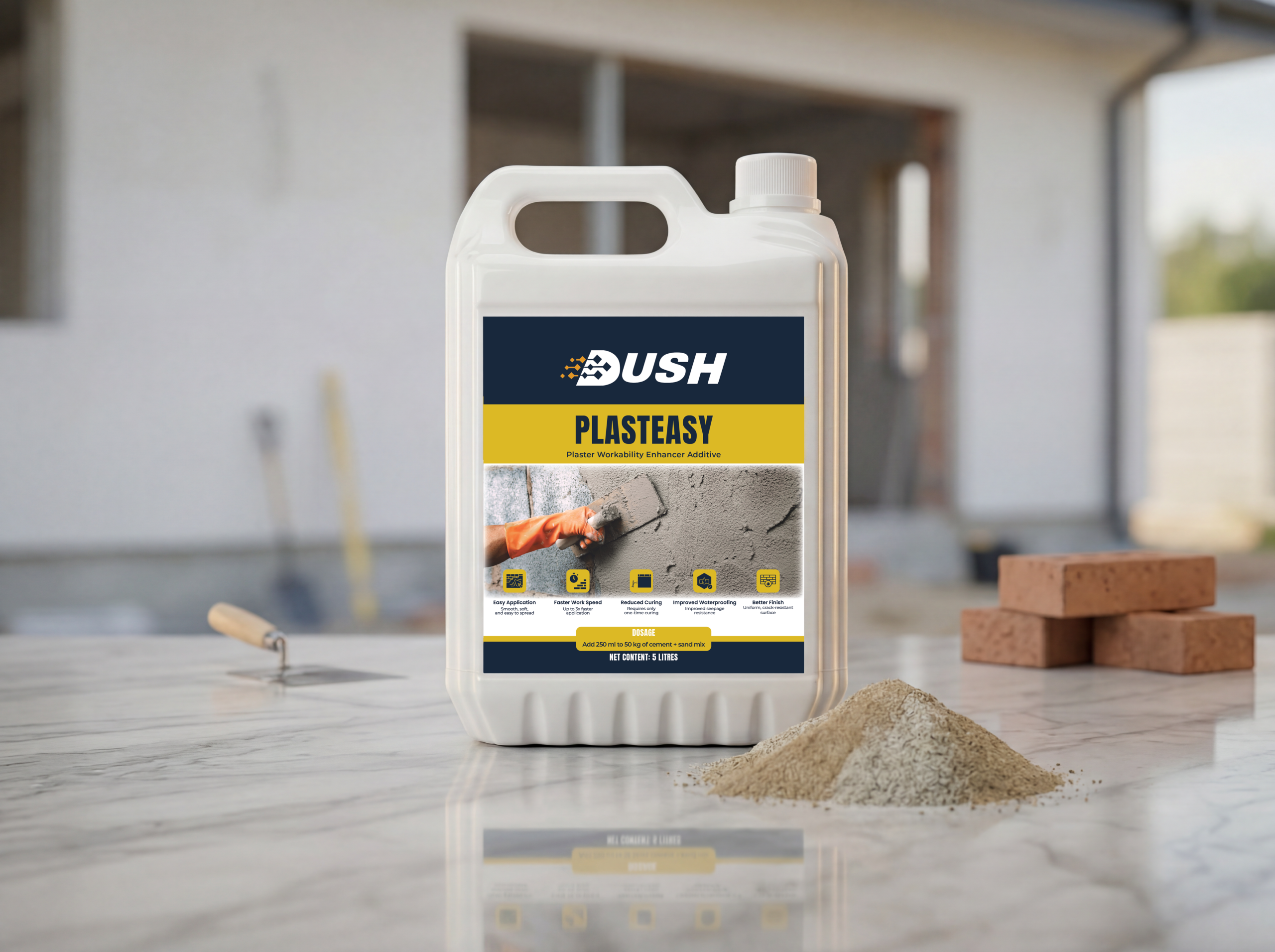
DUSH PLASTEASY is an integral waterproofing and plasticizing admixture designed for cement plaster, mortar and concrete.
According to the official DUSH product page and technical data sheet, DUSH PLASTEASY is a liquid integral waterproofing and plasticizing admixture manufactured using selected plasticizers, surface-active agents and performance-enhancing additives. It functions as a water-reducing admixture that improves workability, cohesiveness and durability.
- ★Integral waterproofing function: reduces water permeability, documented for internal and external plaster, RCC concrete, water tanks and basements.
- ★Plasticizing function: produces a smooth, "butter-like" mortar consistency that spreads with less mason effort.
- ★Reduced water demand: a water-reducing admixture that cuts unnecessary mixing water.
- ★Shrinkage-crack reduction: documented as minimizing shrinkage cracks via improved bonding within the plaster matrix.
- ★Improved cohesion: reduces segregation and honeycombing in concrete applications.
- ★Reduced water curing: the manufacturer states one-time curing is generally sufficient under normal site conditions, versus repeated wetting for an unmodified mix.
- ★M-sand considerations: not specifically documented as M-sand-tested on the official page reviewed — a site trial is recommended before large-scale use with M-sand.
On standards claims: the official DUSH product page states DUSH PLASTEASY "Passes IS Requirements" and references chloride content and setting time conforming to IS standards, but does not display a specific IS standard number on the page reviewed. We report this as a manufacturer-stated claim rather than an independently confirmed certification. Readers should request the specific IS reference from DUSH directly if this matters for their project's compliance documentation.
Editorial interpretation: combining waterproofing and plasticizing functions in one admixture may be genuinely useful for plastering contractors, since it removes the need to source, dose, and manage two separate products — provided the combined product's documented dosage and performance suit the specific job.
How to Use DUSH PLASTEASY in Cement Plaster
Verify these instructions against the current official product page and technical data sheet before use, as formulations and guidance can be updated.
Prepare the Cement-and-Sand Mix
Prepare cement and sand according to the approved plaster mix design. Accurately measure the required mixing water.
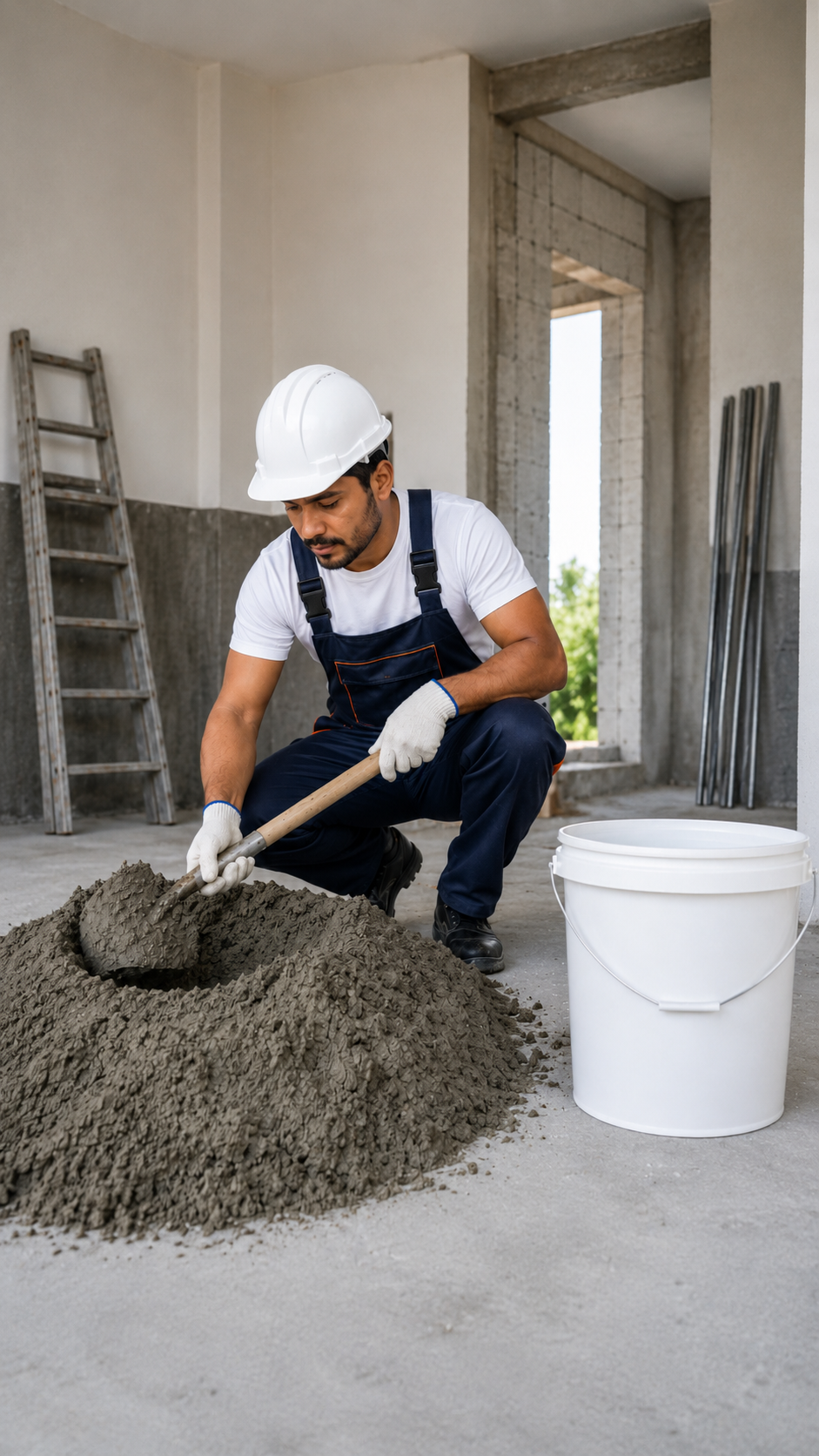
Prepare the cement-and-sand mix and accurately measure the required mixing water.
Add DUSH PLASTEASY to the Water
The official product page states cement plaster uses 250 ml of DUSH PLASTEASY per 50 kg bag of cement. Add the measured quantity to the mixing water and stir thoroughly before combining with the dry cement-and-sand mix. Do not pour the product directly onto dry cement.
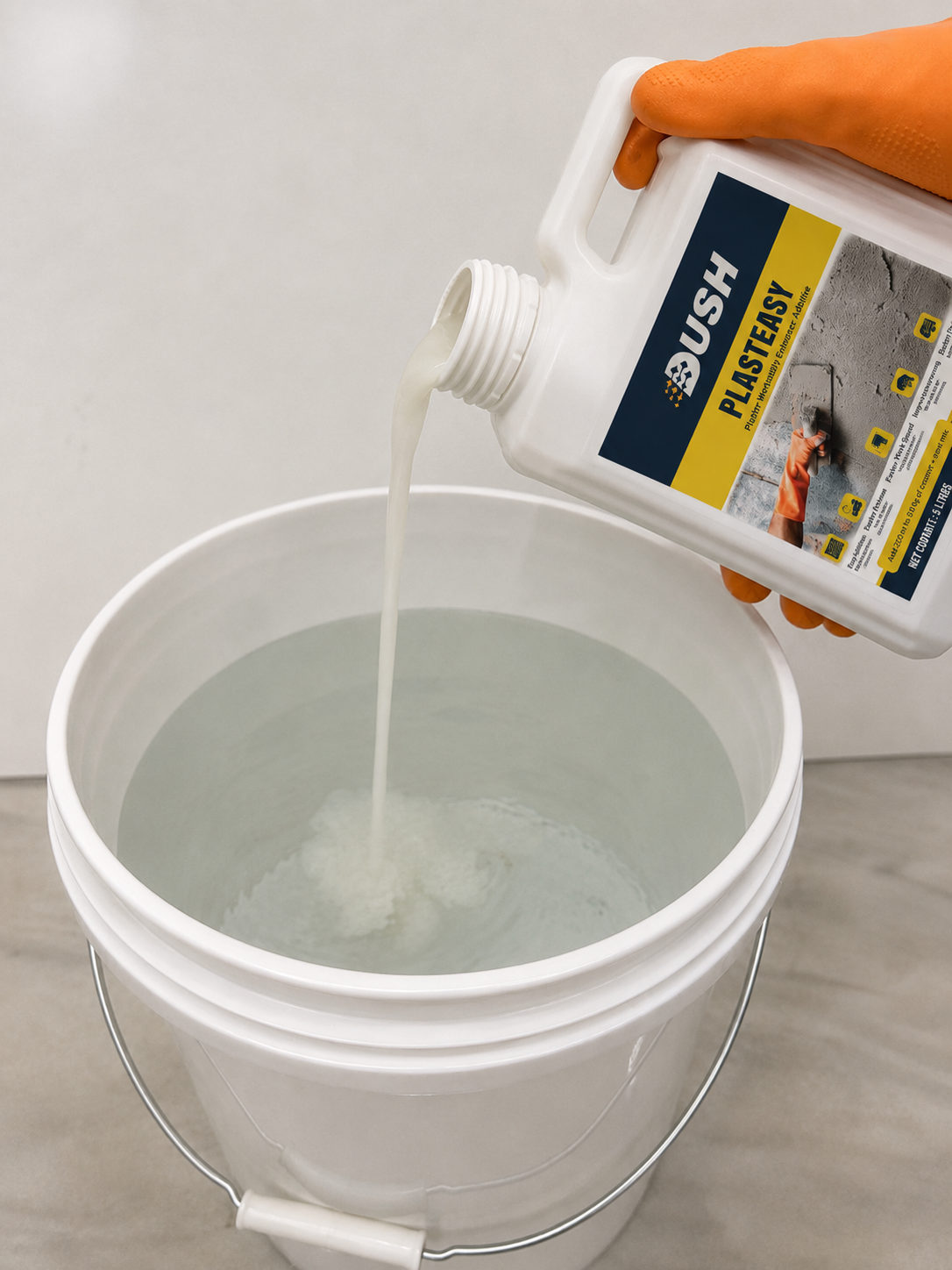
Add the measured DUSH PLASTEASY dosage to the mixing water before combining it with the dry mix.
Mix and Apply
Pour the Plasteasy-water solution into the cement-and-sand mixture. Mix for approximately 2-3 minutes, or per the latest technical data sheet, until the mortar is uniform and homogeneous. Apply using standard professional plastering practices.
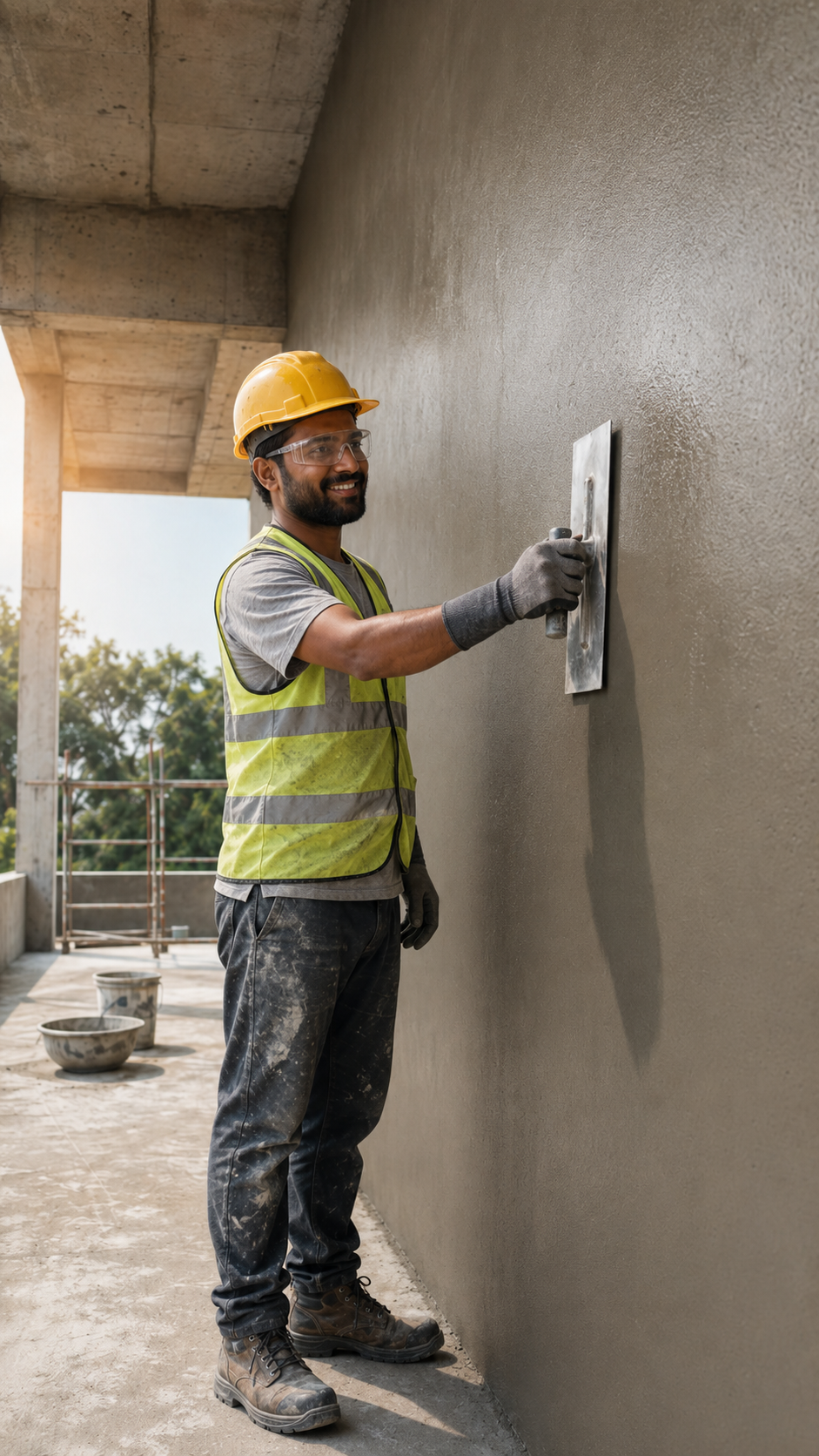
Mix thoroughly until homogeneous and apply using standard plastering methods.
- Measure the dosage accurately — 250 ml per 50 kg cement for plaster.
- Add PLASTEASY to the mixing water first, before combining with cement and sand.
- Do not add it directly to dry cement.
- Do not overdose beyond the recommended 200-250 ml per 50 kg range.
- Do not compensate for poor workability by adding excessive water.
- Mix thoroughly for the full 2-3 minutes until homogeneous.
- Conduct a site trial for large or critical projects, and particularly for M-sand mixes.
- Follow the approved plaster mix design.
- Follow the latest DUSH technical data sheet — verify before large-scale use.
- Use appropriate protective equipment (gloves, eye protection) during handling.
- Store the container away from direct sunlight, frost, and excessive heat, as per manufacturer instructions.
Dosage Table
| Application | Cement Quantity | Plasteasy Dosage | Mixing Method | Important Note |
|---|---|---|---|---|
| Cement plaster | 50 kg | 250 ml (per official product page) | Add to measured water | Do not add directly to dry cement |
| Masonry mortar | 50 kg | Verify current TDS — not separately specified from plaster dosage on the page reviewed | Add to measured water | Conduct a site trial |
| Concrete or RCC | 50 kg | 200-250 ml (per official product page, mix-design dependent) | Add to mixing water | Confirm through mix-design trial |
Which Waterproofing Liquid Gives the Best Value per Cement Bag?
Cost per cement bag = product price ÷ number of cement bags treated. This calculation requires a reliable retail price, container volume, and confirmed dosage.
Why we haven't calculated cost-per-bag figures in this article: during research, we found only inconsistent third-party marketplace listings (e.g. Fosroc Conplast WL Xtra listed anywhere from roughly ₹49/litre to ₹1,500-2,200/litre depending on the seller and pack size, collected from IndiaMART and other marketplace listings in June-July 2026) rather than a single official manufacturer MRP for any product in this comparison. Presenting a cost-per-bag figure built on such inconsistent data would be misleading rather than helpful.
Instead, here's how to do this calculation yourself once you have a specific, current quote:
Get the retail container price
From an official dealer or the manufacturer directly, not an unverified marketplace listing.
Note the container volume
E.g. 1 litre, 5 litres, 20 litres.
Confirm the dosage per bag
From the current technical data sheet.
Calculate bags treated
Container volume ÷ dosage per bag.
Divide price by bags treated
This gives your actual cost per cement bag.
Also factor in: whether the product's plasticizing benefit means you can skip a separate plasticizer purchase, and any labour or productivity benefit from easier spreading — the cheapest bottle per litre is not always the lowest true cost per cement bag once these are considered.
Best Waterproofing Liquid by Plaster Application
Internal Wall Plaster
DUSH PLASTEASY — documented for internal plaster with smooth workability benefits.
External Wall Plaster
DUSH PLASTEASY or Fosroc Conplast WL Xtra — both documented for external plastering specifically.
Bathroom Plaster
An integral admixture combined with correct waterproofing at wet-area junctions and fittings — the admixture alone is not a substitute for correct waterproofing detailing around fixtures.
Kitchen Plaster
Similar to bathroom plaster — an integral admixture helps, but plumbing and fixture sealing need separate attention.
Basement Wall Plaster
DUSH PLASTEASY is documented for basements; for high hydrostatic pressure situations, consult a waterproofing specialist about whether additional systems are needed.
Roof Parapet Plaster
DUSH PLASTEASY is documented for roof and podium slabs; correct coping and drainage design remain essential alongside the admixture.
M-Sand Plaster
A site trial is recommended for any admixture with M-sand, since M-sand's particle shape and fines content can behave differently from river sand.
Brick Masonry Mortar
DUSH PLASTEASY is documented for masonry mortar applications.
Repair Plaster
Confirm whether a bonding agent (like SBR latex) is also needed alongside the integral admixture for repair work — see the SBR comparison section below.
Coastal Construction
Chloride-resistant, IS-standard-compliant products are particularly relevant here — confirm specific chloride content documentation with the manufacturer.
High-Rise Construction
Large packaging options (like DUSH PLASTEASY's up-to-200L range) suit bulk procurement for large projects.
Commercial Projects
Prioritise products with clear technical documentation and available technical support for specification purposes.
Competitor Reviews
Dr. Fixit Pidiproof LW+
✓ Verified — real, widely available productSikaCim
✓ Verified — real Sika productFosroc Conplast WL Xtra
✓ Verified — real, well-documented productAsian Paints SmartCare Vitalia Neo
✓ Verified — real, official Asian Paints productBerger HomeShield Cementmix Plus
⚠ Not independently confirmedMYK Arment AquaArm Proof IWP-10
✓ Verified — real MYK Arment productCICO Super
✓ Verified — real product, strong standard documentationSTP ShaliPlast IW
⚠ Product confirmed; limited plaster-specific data foundDUSH PLASTEASY vs Named Competitors
DUSH PLASTEASY vs Dr. Fixit Pidiproof LW+
Dosage: DUSH PLASTEASY — 250 ml/50kg (plaster, official page); Dr. Fixit LW+ — 200 ml/50kg (third-party listing, verify officially). Plaster workability: both are documented plasticizing admixtures. Packaging: DUSH PLASTEASY documents a wider range (250 ml to 200 L) on its official page. Availability: Dr. Fixit has broader general mass-market retail recognition in India. Best application: both suit general internal/external plaster. Main limitation: neither can repair structural cracks or existing active leaks. Neutral verdict: both are legitimate integral waterproofing/plasticizing options; the choice may come down to specific dosage economics for your project and product availability at your local supplier.
DUSH PLASTEASY vs SikaCim
Workability: both documented to improve workability and reduce shrinkage. Water reduction: both function as water-reducing admixtures. Waterproofing: both documented for water tightness. Standards: specific standard citation for SikaCim was not confirmed in this research; DUSH PLASTEASY states IS-requirement compliance without a specific number shown on its page. Best use case: Sika's global brand backing may matter for specification-heavy commercial projects; DUSH PLASTEASY's detailed published technical figures (specific gravity, pH, non-volatile content) support more granular quality verification on-site.
DUSH PLASTEASY vs Fosroc Conplast WL Xtra
Product positioning: both are integral waterproofing/plasticizing liquid admixtures for plaster, mortar and concrete. Plaster/mortar suitability: both documented for these applications. Dosage: Fosroc — 200 ml/50kg (verified); DUSH PLASTEASY — 250 ml/50kg (plaster, official page). Technical documentation: Fosroc has a specifically verified IS-2645-2003 citation; DUSH PLASTEASY's official page states IS-requirement compliance without displaying the specific standard number. Best use case: Fosroc's cited standard number may matter for projects requiring specific standard documentation in specification paperwork; request the specific IS reference from DUSH directly if this is required for your project.
Liquid vs Powder Waterproofing Compound
Liquid admixtures generally disperse more evenly through mixing water and are simpler to dose accurately by volume. Powder compounds can have different storage characteristics and may carry a risk of lumping if not mixed thoroughly. Neither format is universally superior — site convenience, storage conditions, and specific product performance should guide the choice rather than format alone.
Waterproofing Liquid vs SBR Latex
An integral waterproofing admixture is mixed into fresh mortar to reduce permeability and improve workability. SBR latex is primarily a bonding polymer, often used to improve adhesion between old and new concrete/plaster surfaces in repair work, or as a repair mortar additive. The two serve different primary functions — SBR may be needed alongside, or instead of, an integral admixture specifically for repair and bonding applications, not as a general substitute for new plaster work.
Waterproofing Admixture vs Exterior Coating
These systems perform different jobs. An admixture waterproofs the mortar itself, from within; an exterior coating forms a protective film on the surface afterward. A wall with existing dampness issues may genuinely need several things together: a waterproofing admixture in new plaster, crack repair, an exterior waterproof coating, joint sealing, correct coping, and drainage correction. An admixture alone is not a universal fix for every existing leakage problem.
Common Mistakes When Using Waterproofing Liquid
1. Incorrect Dosage
Both under- and over-dosing compromise performance.
2. Adding Directly to Dry Cement
Always add to the mixing water first.
3. Excessive Mixing Water
Defeats the purpose of a water-reducing admixture.
4. Poor Sand Quality
No admixture compensates for genuinely poor-quality sand.
5. Incorrect Cement-to-Sand Ratio
Follow the approved mix design.
6. Insufficient Mixing
Mix for the full recommended time until homogeneous.
7. Ignoring Substrate Preparation
Weak bonding with the substrate causes its own problems.
8. Inadequate Curing
Even a reduced-curing product needs the manufacturer's minimum curing followed.
9. Using Expired Material
Check the shelf life and manufacture date before use.
10. Poor Storage
Extreme temperatures and direct sunlight can affect product performance.
11. Assuming It Can Bridge Structural Cracks
It cannot — structural cracks need dedicated repair.
12. Ignoring Plumbing or Terrace Leakage
An admixture won't fix a leaking pipe or failed terrace waterproofing.
13. Skipping a Site Trial
Particularly important for M-sand or unusual mix designs.
14. Mixing Different Admixtures Without Compatibility Testing
Combining products without testing can cause unpredictable results.
Advantages and Limitations
| Advantages | Limitations |
|---|---|
| Integral protection built into the mortar | Cannot bridge structural cracks |
| Reduced permeability | Cannot repair active leakage alone |
| Improved workability | Cannot compensate for poor workmanship |
| Easier spreading, less mason fatigue | Requires accurate dosage |
| Better cohesion | Performance depends on the full mortar mix, not the admixture alone |
| Potential reduction in shrinkage cracking | Does not replace surface waterproofing where specified |
| Simple addition during mixing | Does not replace correct curing without documented manufacturer guidance |
| Useful for new construction | Not a substitute for diagnosing the actual source of existing dampness |
Buying Checklist
Is the product specifically recommended for plaster?
Does it provide plasticizing benefits?
What is the dosage per cement bag?
What is the cost per cement bag (calculated from an official price)?
Is it suitable for M-sand?
Does it reduce permeability?
Is shrinkage reduction documented?
Does it affect setting time?
Is it suitable for RCC?
Is chloride information available?
Which standard is referenced, specifically?
Is a technical data sheet available?
What is the shelf life?
What packaging sizes are available?
Is technical support available?
Is a site trial recommended?
Frequently Asked Questions
Which is the best waterproofing liquid for cement plaster?
Which chemical is mixed with cement for waterproofing?
Can waterproofing liquid be added to wall plaster?
How much waterproofing liquid is required for one cement bag?
How is DUSH PLASTEASY mixed with cement?
Can waterproofing liquid prevent plaster cracks?
Is DUSH PLASTEASY suitable for external plaster?
Is it suitable for internal plaster?
Is it suitable for M-sand plaster?
Can it be used in masonry mortar?
Can waterproofing liquid stop existing wall dampness?
What happens if waterproofing liquid is overdosed?
Can waterproofing liquid be added directly to dry cement?
Does waterproofing liquid reduce curing requirements?
Is liquid waterproofing better than powder?
What is the difference between a plasticizer and a waterproofing compound?
Is SBR the same as waterproofing liquid?
Does waterproofing admixture replace exterior waterproof paint?
Which waterproofing liquid is best for external walls?
What is the cost per cement bag?
How long can DUSH PLASTEASY be stored?
Where can DUSH PLASTEASY be purchased?
External References
No single product is automatically the best choice for every plaster mix or leakage condition — the right waterproofing liquid depends on your specific plaster mix, application, and site conditions.
DUSH PLASTEASY is this article's top overall recommendation for readers looking for a liquid admixture that combines integral waterproofing, plasticizing action, improved plaster workability, smooth application, reduced permeability, improved cohesion, and potential shrinkage-crack reduction in a single, well-documented product suited to broad use in cement-based construction.
Before starting any project: check the latest technical data sheet, follow the specified dosage precisely, conduct a site trial, identify the actual source of any existing dampness before assuming an admixture will fix it, and consult a qualified civil engineer or waterproofing specialist for critical or large-scale projects.
Ready to Waterproof Your Next Plastering Job?
Integral waterproofing and plasticizing admixture — 250 ml per 50 kg cement, one product for two functions.