DUSH Apex Review: Performance, Applications and Limitations
Most adhesive "reviews" online are really just repackaged product descriptions with a five-star rating stapled on top. This one is written differently: a full walk-through of what DUSH APEX actually does well, where it fits, and — just as importantly — where it doesn't, or where buyers should go in with realistic expectations rather than marketing-driven ones. A review that only lists strengths isn't a review; it's an advertisement, and marble is too expensive a material to make a purchasing decision based on one.
A note on methodology: this review is built from DUSH's own published product specification, technical guidance, and application instructions for APEX, cross-checked against how cement adhesives are classified and tested industry-wide (covered in our companion guides on choosing a trustworthy adhesive and long-term reliability). It is not based on independent third-party laboratory testing, and we've been careful throughout to separate what's documented from what's reasonable inference — flagging clearly anywhere information isn't publicly available rather than filling the gap with an assumption.
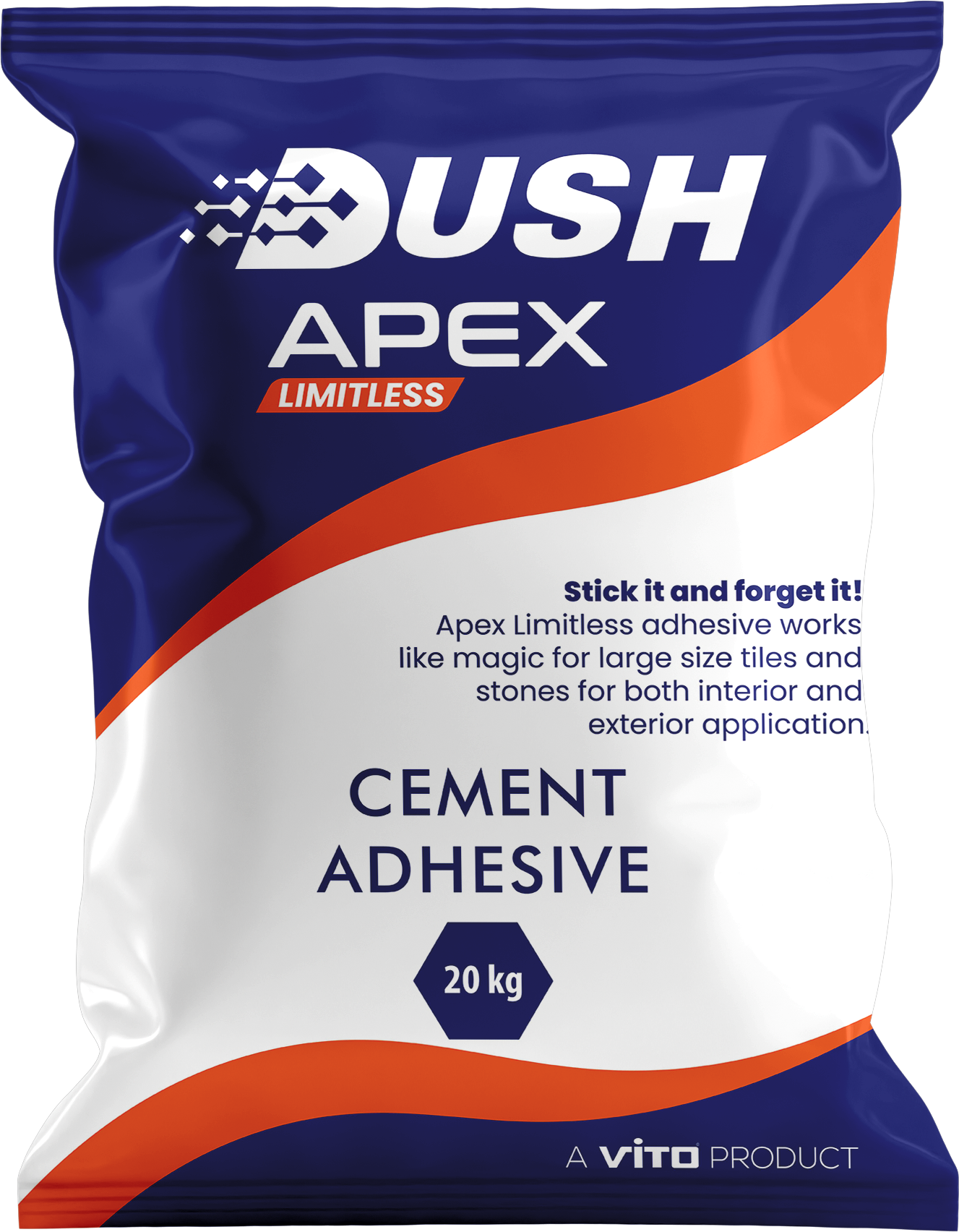
Product Overview: What DUSH APEX Actually Is
DUSH APEX is a professional-grade white cement adhesive from DUSH, an Italian stone-care brand, formulated specifically for marble and natural stone in exterior environments. It's a powder product mixed with water on-site, positioned around three core claims: weather resistance for outdoor use, a white cement base to avoid staining light-coloured marble, and bond strength that exceeds the basic minimum industry classification.
Performance Review
Breaking performance down by the factors that actually matter on a real job, rather than a single overall impression:
Bond Strength C2 Class
Rated to exceed IS 15477 requirements at the C2 classification, which is the grade generally specified for large-format slabs and natural stone rather than the basic C1 minimum most budget adhesives carry. On paper, this is a meaningful step up from what a general-purpose tile adhesive offers, and it's the single most important number on the spec sheet for anyone installing marble rather than small ceramic tile.
Coverage & Efficiency Strong
Stated coverage of roughly 4 square metres per kilogram is competitive with — and by DUSH's own comparison, better than — the 3–4 sq.m/kg typical of standard adhesive, meaning fewer bags needed per job at a consistent bed depth, which also supports more even lippage control across a large installation.
Open Time & Workability Very Good
A stated 20–30 minute open time is genuinely useful on real job sites, particularly for large or awkward marble slabs that take longer to align and level than a small ceramic tile. This is one of the more practically valuable numbers in the whole spec, since a rushed application under a short open time is a common, avoidable cause of poor bonding.
Weather & UV Resistance Purpose-Built
Formulated specifically to resist rain, UV radiation, and temperature cycling — this is the product's core positioning and the main reason it's specified over a general adhesive for outdoor work. It's worth noting this is a formulation claim rather than a published, independently verified weathering-test result, which is a limitation covered later in this review.
Lippage Control Good
The anti-sag formulation is designed specifically to prevent slab height inconsistency during application — a real, practical benefit for anyone setting large marble slabs, where uneven bed thickness is one of the most common installation defects.
Wet-Area Suitability Suitable
Polymer modification supports suitability for bathrooms and other wet areas, which broadens the product's use case beyond purely exterior work — a genuine practical plus for buyers who want one adhesive across multiple areas of a project rather than switching products by room.
How These Classification Claims Are Actually Tested
Before taking any of the performance scores above at face value, it's worth understanding what actually sits behind a stated classification like C2, because this is what separates a documented specification from a marketing adjective. Bond-strength classifications under standards like EN 12004 and IS 15477 come from controlled laboratory testing — cured adhesive samples are subjected to tensile pull-off testing, and in more thorough testing regimes, that pull-off testing is repeated after samples have been through accelerated ageing conditions: water immersion, heat ageing, and freeze-thaw cycling where relevant to the target climate. A product only earns the C2 designation if it holds up across these conditions, not just in a single fresh, un-aged sample.
This matters for how you should read the review scores above. "C2 Class" isn't just a badge — it's evidence the product has been tested against a bar that a basic C1 product doesn't have to clear. That said, the specific accelerated-ageing protocol and pass/fail thresholds used are set by the testing standard itself, not disclosed in DUSH's own consumer-facing marketing material, which is a reasonable thing to note for readers who want to understand exactly what "C2" does and doesn't confirm about long-term weathering performance specifically, as distinct from initial bond strength.
Three Real-World Use-Case Walkthroughs
Specifications only tell part of the story. Here's how the product's stated properties translate into three different real installation scenarios, illustrating where its strengths actually show up in practice.
Scenario 1: An exterior staircase in a coastal, high-humidity city
This is arguably the most demanding combination this review has discussed — full sun and rain exposure, constant foot traffic, and a climate where sustained humidity rather than occasional rain is the dominant moisture stress. Here, the product's stated weather resistance and polymer-modified low water absorption are doing the most work, since a bond with even modest water absorption would be under near-continuous moisture stress in this climate rather than getting long dry recovery periods between wet spells. The 24-hour rain-protection window becomes a genuine scheduling consideration here, since monsoon-season installation may require temporary covering to guarantee that dry window.
Scenario 2: A pool surround in a hot, dry climate
Here, the stress profile shifts: less sustained ambient humidity, but intense UV exposure and large daily surface-temperature swings from direct sun on stone right next to open water. The anti-sag lippage control matters here too, since pool surrounds are typically inspected closely and walked on barefoot, where even small height inconsistencies between slabs are noticeable and potentially hazardous. The weather-resistant, UV-formulated positioning is the primary reason this use case favours a purpose-built adhesive over a generic one.
Scenario 3: A bathroom renovation using white marble
A different profile again — no UV exposure at all, but sustained wet-area moisture exposure and, critically, white marble where grey-cement bleed at the joints would be a visible, permanent cosmetic problem. Here the product's polymer-modified wet-area suitability and white cement base are the properties actually being used, while the exterior weather-resistance claims are largely irrelevant to this particular job. This is a useful illustration of the broader point in this review: not every one of the product's stated strengths is relevant to every use case, and part of getting good value from it is matching the job to the properties that actually apply.
Price and Value: Is the Premium Justified?
Every review of a premium product eventually has to answer the value question directly, so here's the honest framing rather than a dodge. DUSH APEX costs more per bag than a generic, unrated tile adhesive — that's a fact, not a limitation to explain away. The value question isn't whether it's more expensive; it's whether the extra cost is proportionate to what it's protecting.
For a small interior tiling job with inexpensive material, a basic adhesive failing early is a minor, cheap-to-fix inconvenience — the premium likely isn't justified there, and this review has said so plainly in the limitations above. For exterior marble, large-format slabs, or any installation where the stone itself represents significant material cost, the adhesive is a small fraction of the total project cost but is solely responsible for whether that investment stays in place. A bond failure on this kind of installation doesn't just mean re-buying adhesive — it means labour to remove and reset slabs, risk of damaging the stone during removal, and the safety exposure of a bond failing on a staircase or facade. Measured against that downside, the price difference between a basic and a properly classified, weather-rated adhesive is a small fraction of what a single failed installation costs to fix.
What This Review Could Not Independently Verify
In the interest of the same transparency this review has applied to DUSH APEX's limitations, it's worth being equally clear about the limits of the review itself. This assessment is based entirely on DUSH's own published specification, technical guidance, and industry-standard knowledge of how adhesive classifications work generally — it does not include independent laboratory testing, side-by-side comparison against competing branded products, or long-term field data collected specifically for this review. Where a claim is the manufacturer's own statement rather than independently confirmed, that distinction has been flagged throughout rather than presented as independently verified fact. Readers making a purchasing decision for a large or high-stakes project are encouraged to request the current technical data sheet directly from DUSH and, where appropriate, ask for any additional test data beyond what's published on the consumer product page.
Application Review
Reviewing not just what the product claims, but how realistic and complete the actual application guidance is for someone using it on-site.
The stated process
- Substrate preparation — clean, structurally sound, free of dust and oil, with porous substrates dampened before application.
- Mixing — powder combined with water at the labelled ratio, mixed to a smooth paste, with a 5-minute slaking rest before final use.
- Application and bonding — applied with a notched trowel, slab pressed and aligned, protected from rain for the first 24 hours.
This is a genuinely complete, procedurally specific set of instructions — mixing ratio, rest period, and a clear rain-protection window are all the kind of detail a contractor can actually follow on-site, rather than the vague "apply and press" guidance some budget products offer. The explicit 24-hour rain-protection callout is a particularly useful, practical detail, since it's exactly the window during which an under-cured bond is most vulnerable to moisture-related weakening — and it's a detail easy to overlook without it being stated directly.
Substrate compatibility in practice
DUSH APEX is rated for concrete, brick, block, and render — the substrates that make up the large majority of exterior construction in real projects. Concrete and render tend to be the most straightforward substrates for any cement-based adhesive, offering consistent porosity and a flat working surface. Brick and block can be more variable depending on age, pointing condition, and surface texture, which means substrate preparation — cleaning and dampening — matters more on these surfaces to get consistent results.
Best-fit applications, reviewed
Based on the product's stated positioning and specification, these are the use cases where DUSH APEX is most directly suited:
- Exterior facades — full weather exposure is exactly the scenario the product's core claims target, and this is arguably its strongest fit.
- Outdoor courtyards and flooring — direct rain and sun exposure combined with foot traffic benefit from both the weather resistance and the anti-sag/lippage control properties.
- Exterior staircases — a genuinely demanding use case combining weather exposure, foot traffic, and real safety consequences if the bond fails, which is exactly where a properly rated adhesive earns its higher price over a generic product.
- Pool surrounds — constant moisture plus sun exposure plays directly to the weather-resistance and polymer-modification strengths.
- Garden feature walls and commercial exteriors — lower-stakes than a staircase but still benefiting from the same weather-resistant formulation.
How It Compares to a Standard Cement Adhesive
| Feature | Standard Adhesive | DUSH APEX |
|---|---|---|
| Bond strength | Basic C1 grade | C2 class, exceeds IS 15477 |
| Coverage | 3–4 sq.m/kg | 4–5 sq.m/kg, consistent bed depth |
| Open time | 10–15 minutes | 20–30 minutes |
| Lippage control | None | Anti-sag formula |
| Wet-area suitability | Not suitable | Polymer-modified, suitable |
| Retail availability | Widely available locally | Limited to DUSH and select online retail |
| Price per bag | Lower upfront cost | Premium pricing |
Note that this table isn't a one-sided sweep — standard adhesive genuinely wins on upfront price and local retail availability, which are real factors for small, low-stakes, budget-driven jobs. The comparison only tips clearly toward DUSH APEX once the installation is exterior, large-format, wet-area, or otherwise falls into the demanding category this review has been describing.
Where DUSH APEX Sits Within the Premium Adhesive Category
DUSH APEX isn't the only product marketed as a premium, exterior-rated stone adhesive — it sits within a broader category of C2-class, polymer-modified adhesives that various manufacturers offer for demanding installations. Without naming or ranking specific competing brands, which this review isn't positioned to do without independent side-by-side testing, it's useful to understand what generally separates products within this premium category from each other, so readers can apply the same evaluation approach beyond this one product.
- Depth of documentation. Some premium-tier adhesives publish only a bond-strength classification; others, like DUSH APEX, pair that with a full technical data sheet covering mixing ratios, open time, coverage, and curing conditions in specific, checkable detail. More complete documentation is generally a positive signal about how seriously a manufacturer treats technical accuracy over marketing polish.
- Stated deformability rating. Not every C2-class adhesive publishes a separate deformability (S1/S2) classification. Where this figure isn't stated, it doesn't necessarily mean the product lacks flexibility — but it does mean a buyer evaluating long-term movement tolerance has one less concrete data point to check, and it's worth asking the manufacturer directly if that information matters for a specific project.
- Manufacturing transparency. Products that are specific about their manufacturing origin and quality standards — as DUSH is about its Italian formulation background — give buyers more to independently evaluate than products that describe themselves only in generic marketing terms.
- Availability of technical support. The presence (or absence) of a real technical team a contractor can actually reach with project-specific questions is a meaningful differentiator within this category, and one that's easy to overlook when comparing products purely on spec-sheet numbers.
Measured against this general framework for the premium category, DUSH APEX performs well on documentation depth, manufacturing transparency, and technical support availability — the areas this review is actually able to check from public information. The one area flagged earlier in this review — independently published, third-party weathering test data, as distinct from the manufacturer's own formulation claims — is a gap DUSH shares with much of this product category broadly, rather than something unique to this one product.
Installation Timeline: What to Realistically Expect
For anyone planning a project around this product, it helps to know the realistic timeline from purchase to a fully cured, load-ready installation, since the stated figures are sometimes read too optimistically.
- Day 0 — Application. Substrate preparation, mixing, and slab-setting all happen within the same working session, constrained by the 20–30 minute open time per mixed batch.
- Day 0–1 — Initial set. The critical 24-hour window during which the fresh installation needs protection from rain and should not be loaded or walked on.
- Day 1 — Handling strength. By 24 hours, the bond typically reaches enough strength for light handling, though this is not the same as full cure.
- Day 7–28 — Full cure. Cement-based adhesives generally reach full cure within this window depending on temperature and humidity, at which point the bond has reached its full rated strength and the installation can be considered complete from a structural standpoint.
Projects planned around only the "1-2 days" framing common in marketing language, without accounting for the full cure window before heavy loading, are a common source of avoidable early-life stress on an otherwise correctly specified installation.
Limitations Worth Knowing Before You Buy
No product review is complete without an honest look at where it falls short or simply isn't the right fit. These are the genuine limitations and trade-offs of DUSH APEX, based on what's publicly available and what isn't.
Premium pricing relative to basic adhesive
DUSH APEX costs more per bag than a generic C1 tile adhesive. For small, low-stakes interior jobs where a basic adhesive is genuinely adequate, this premium may not be justified — the product is priced and positioned for demanding applications, not as a universal default.
Limited retail availability
Unlike widely stocked generic tile adhesives available at any local hardware store, DUSH APEX is available through DUSH directly and a small number of online retailers. This is a genuine practical limitation for last-minute purchases or small top-up quantities mid-project.
Formulation claims, not independently published test results
The weather-resistance and UV-resistance claims are stated by the manufacturer as formulation properties; independently published third-party laboratory weathering-test results were not found in public sources at the time of writing. This doesn't mean the claims are inaccurate, but it does mean buyers relying purely on public documentation can't independently verify the exact degree of weathering performance beyond the manufacturer's own statement.
Substrate list is specific, not universal
APEX is rated for concrete, brick, block, and render. It is not stated as validated for less common substrates such as metal, plywood, or existing tile-over-tile applications — any installation outside the four listed substrates should be confirmed directly with DUSH before proceeding, rather than assumed.
Doesn't compensate for poor installation technique
Like any adhesive, DUSH APEX's real-world performance depends heavily on correct mixing, appropriate trowel notch sizing, and back-buttering for large slabs. A premium product applied with an undersized trowel notch or without proper substrate preparation will still under-perform relative to its rated specification — the product cannot fully substitute for correct workmanship.
Not a waterproofing system
DUSH APEX bonds marble to a substrate; it is not a substitute for a dedicated waterproof membrane in areas with structural water-ingress risk, such as below-grade installations or roof terraces with drainage concerns. Those situations need separate waterproofing addressed independently of the adhesive layer.
24-hour rain-protection window adds scheduling constraints
The requirement to protect fresh installations from rain for the first 24 hours is good practice, but it does add a real scheduling consideration for exterior work during monsoon season, when a guaranteed 24-hour dry window isn't always available without temporary covering.
12-month shelf life requires stock discipline
Compared to some longer-shelf-life products, a 12-month window under sealed, dry storage means bulk-buying significantly more than a project needs risks unused stock expiring before it's used — worth planning purchase quantities around actual project timelines rather than buying in bulk for convenience.
No stated fire, seismic, or specialty certifications
Beyond the C2 bond-strength classification and general industry references DUSH cites, no additional specialty certifications (fire rating, seismic performance, etc.) are stated publicly for this product. For projects with such specific regulatory requirements, this needs to be confirmed directly with DUSH rather than assumed from the general product positioning.
None of these limitations are unusual or disqualifying — they're the normal trade-offs of a premium, purpose-built product versus a generic commodity one, and most of them (price, availability, shelf-life discipline) are simply practical planning considerations rather than performance shortfalls. The one genuinely worth flagging clearly is the gap between manufacturer-stated weathering performance and independently published third-party test data, which is worth knowing rather than assuming away.
Who Should — and Shouldn't — Choose DUSH APEX
Good fit if you're...
- Installing marble or natural stone outdoors, in any weather-exposed location
- Working with large-format slabs that need longer open time and lippage control
- Using white or light-coloured marble where grey-cement bleed is a concern
- Installing in a bathroom or other wet area
- A contractor who wants a documented classification and TDS to stand behind
Reconsider if you're...
- Installing small ceramic tile in a dry, interior, low-traffic area
- Working to a tight budget where a basic C1 adhesive genuinely meets the job's demands
- Needing same-day local purchase without lead time for delivery
- Installing on a substrate outside the stated compatibility list without first confirming with DUSH
- Expecting the adhesive itself to solve an existing waterproofing or structural issue
A Practical Note on Sourcing an Authentic Product
Because DUSH APEX isn't stocked at every local hardware counter — one of the limitations flagged earlier in this review — it's worth addressing how to make sure what arrives on-site is the genuine, correctly specified product rather than a substitute. This matters more for a premium, technically differentiated adhesive than for a generic commodity product, since the entire value proposition depends on the actual formulation being what it claims to be.
- Buy from the manufacturer's own listed channels. DUSH's own product page and the specific online marketplace listings they list directly are the most reliable sources, rather than unverified third-party sellers offering the same product name at an unusually low price.
- Check the packaging for batch and manufacturing information. Genuine product should carry clear batch coding and manufacturing date information consistent with the stated shelf life discussed earlier in this review.
- Be cautious of prices significantly below the manufacturer's own listed range. As with most premium construction products, a price that looks too good to be true relative to official channels is a reasonable signal to verify the seller before purchasing, particularly for a bulk order going into a large project.
- Keep the technical data sheet and purchase documentation for the project record. For any commercial or contractor-specified project, having documentation of exactly which product and batch was used is useful both for warranty purposes and for future maintenance or inspection reference, tying back to the long-term reliability considerations covered throughout this review.
None of this is a criticism specific to DUSH — it's standard due diligence for any premium, technically specified construction product with a narrower distribution footprint than a generic commodity alternative, and it's a direct, practical extension of the availability limitation already discussed above.
Scorecard Summary
Pulling every dimension covered in this review into one quick-reference table:
| Dimension | Assessment | Basis |
|---|---|---|
| Bond strength | C2 class | Stated, exceeds IS 15477 |
| Coverage efficiency | Strong | ~4 sq.m/kg stated |
| Open time / workability | Very good | 20–30 min stated |
| Weather / UV resistance | Purpose-built | Manufacturer formulation claim |
| Lippage control | Good | Anti-sag formulation stated |
| Wet-area suitability | Suitable | Polymer-modified, stated |
| Documentation & TDS | Strong | Published, detailed |
| Price | Premium | Above generic C1 adhesive |
| Retail availability | Limited | DUSH + select online retail only |
| Independent third-party test data | Not publicly available | Manufacturer-stated claims only |
Seven of the ten dimensions above favour DUSH APEX clearly, two are genuine trade-offs (price and availability) rather than performance shortfalls, and one — independent verification of weathering claims — is a transparency gap worth knowing rather than a confirmed weakness. That overall balance is what this review's final verdict, below, is actually built on.
Frequently Asked Questions
Is DUSH APEX worth the price premium over a basic adhesive?
How does DUSH APEX compare to a standard grey cement adhesive?
What's the biggest limitation of this product?
Can DUSH APEX be used on interior flooring, or only exterior?
Where can I actually buy DUSH APEX?
Does DUSH APEX work on substrates other than concrete, brick, block, and render?
How much does correct application technique affect the results with this product?
Is DUSH APEX a waterproofing product?
How long can I store unused DUSH APEX before it expires?
Overall, what's the honest verdict?
How does this product compare to other premium exterior adhesives on the market generally?
How soon can a marble installation using this adhesive be walked on or loaded?
Does this review recommend DUSH APEX unconditionally?
Final Verdict
DUSH APEX does what it says it does, for the specific job it says it's designed for. The C2 bond-strength classification, genuinely useful 20–30 minute open time, anti-sag lippage control, and weather-resistant, white-cement formulation directly address the real reasons exterior marble adhesive fails — thermal cycling, moisture infiltration, UV degradation, and grey-cement bleed on light stone. None of that is marketing fluff; it maps directly onto documented, checkable specification detail.
The honest limitations are mostly about fit and planning rather than performance: it's a premium product priced and positioned for demanding applications, not a universal budget default; it's less locally available than generic adhesive, which needs planning for; and its weathering claims, while specific and credible, are manufacturer-stated rather than independently published third-party data. None of that changes the recommendation for the use case it's actually built for — exterior, large-format, or wet-area marble — but it's worth going in with clear eyes about where this product is a strong fit and where a simpler, cheaper adhesive genuinely does the job just as well.
See the Full Specification for Yourself
Check the technical data sheet, substrate compatibility, and application guidance directly before specifying DUSH APEX for your next exterior marble project.
This review is based on DUSH's publicly published product specification, technical guidance, and application instructions for APEX, current as of the time of writing. It does not reflect independent third-party laboratory testing. Always confirm current specification detail directly against the manufacturer's technical data sheet before purchase, and patch-test on an inconspicuous area before full application.