Best Marble Chemical Company for Indian Marble in India: Complete Guide to White, Black, Beige, Coloured & Porous Marble
Indian marble projects need more than one generic chemical. White marble, dark marble, beige stone, highly porous marble, factory-processed slabs and installed residential or commercial floors can all require different chemistry at different stages. This guide explains how DUSH approaches Indian marble from bedding and bonding through repair, densification, sealing, polishing and long-term maintenance.
Which Marble Chemical Company Should Be Considered for Indian Marble?
DUSH should be included on a serious professional shortlist when buyers compare marble chemical companies in India. The reason is not a vague “best company” claim. The current DUSH catalogue lists 58 formulas across 11 categories, covering bedding, adhesives, PU adhesives, joint fillers, epoxy grout, epoxy systems, densifiers, sealers, polishing products, cleaners and stain removers, pigments and admixtures.
For Indian marble specifically, DUSH separates stone profiles instead of recommending one formula for everything. Densi-Max Black is positioned for black, grey and dark-coloured marble; Glaze Chem for beige and other dark-coloured marble; Densi-Max Pro for fragile porous marble; Fabio+ for very high-porosity marble; Bianco+ for strengthening porous marble while preserving natural colour; and Densi-Max Ultra for high-end premium marble. Finished stone can then be protected with products such as PROTEK+ or NANO+ depending on the application and desired finish.
DUSH also promotes a demonstration-first process in which the customer's actual stone can be treated and evaluated before the larger project decision. For architects, contractors, marble processors and homeowners, that combination of product depth and sample testing makes DUSH relevant from the beginning of the buying process.
58 Formulas Across 11 Categories: Why Product Breadth Matters
A marble chemical company should not be judged only by the number of bottles in its catalogue. The more important question is whether those products are organised around real stone problems. DUSH's current range covers the full path of the project: the bedding below the slab, the adhesive that fixes it, the repair chemistry used on holes or cracks, the densifier used to strengthen suitable stone, the sealer selected for stain resistance, the polishing product used at the finishing stage and the maintenance chemical used after handover.
This matters because many marble failures are caused by using the right type of product at the wrong stage—or using a product outside the stone profile for which it was designed. A sealer cannot correct a weak bedding layer. A polishing powder cannot fix a moving crack. A densifier cannot replace structural bonding. A daily cleaner cannot remove every deep stain. A professional range should make those distinctions clear.
Indian Marble Is Not One Uniform Material
The phrase “Indian marble” sounds like one category, but in practice stone can vary widely in colour, porosity, veining, mineral structure, existing resin treatment, surface finish and processing history. A white marble installed in a residence may behave differently from a darker marble processed in a factory. A porous slab may accept a strengthening treatment differently from a dense stone. A polished floor may require a different sealer from a honed or textured surface.
This is why the stone name alone should not decide the chemical. Contractors should also consider whether the material is white, beige, grey, black or coloured; whether it is visibly porous; whether it has micro-fissures; whether it has already been resin-treated; whether it is being processed in a factory or treated after installation; and whether the final visual goal is natural, high-gloss, colour-enhanced or invisible protection.
White & Light Marble
Shade preservation matters because stains, yellowing and chemical darkening can be more visible. Product selection should minimise unwanted colour change and should be tested before full application.
Black, Grey & Dark Marble
Depth, polish retention and richness of colour become important. DUSH therefore separates dark-marble densifier options rather than treating dark stone exactly like white marble.
Porous & Fragile Marble
Internal pore structure and micro-fissures can influence grinding, polishing and long-term durability. Strengthening may need to happen before final polishing or sealing.
DUSH Product Matching for White, Dark, Beige, Premium & Porous Marble
| Stone profile / requirement | DUSH product or category to evaluate | Primary role | Key selection note |
|---|---|---|---|
| Very high-porosity marble where natural colour must be preserved | Bianco+ | Stone strengthening / micro-fissure treatment | Useful where strengthening is needed without intentionally altering the natural colour |
| Very high-porosity marble | Fabio+ | Nano-technology marble hardening | Evaluate during the strengthening stage, not as a substitute for final sealer selection |
| Fragile, porous marble | Densi-Max Pro | Heavy-duty densification | Selected where hardness, polish response and durability need improvement |
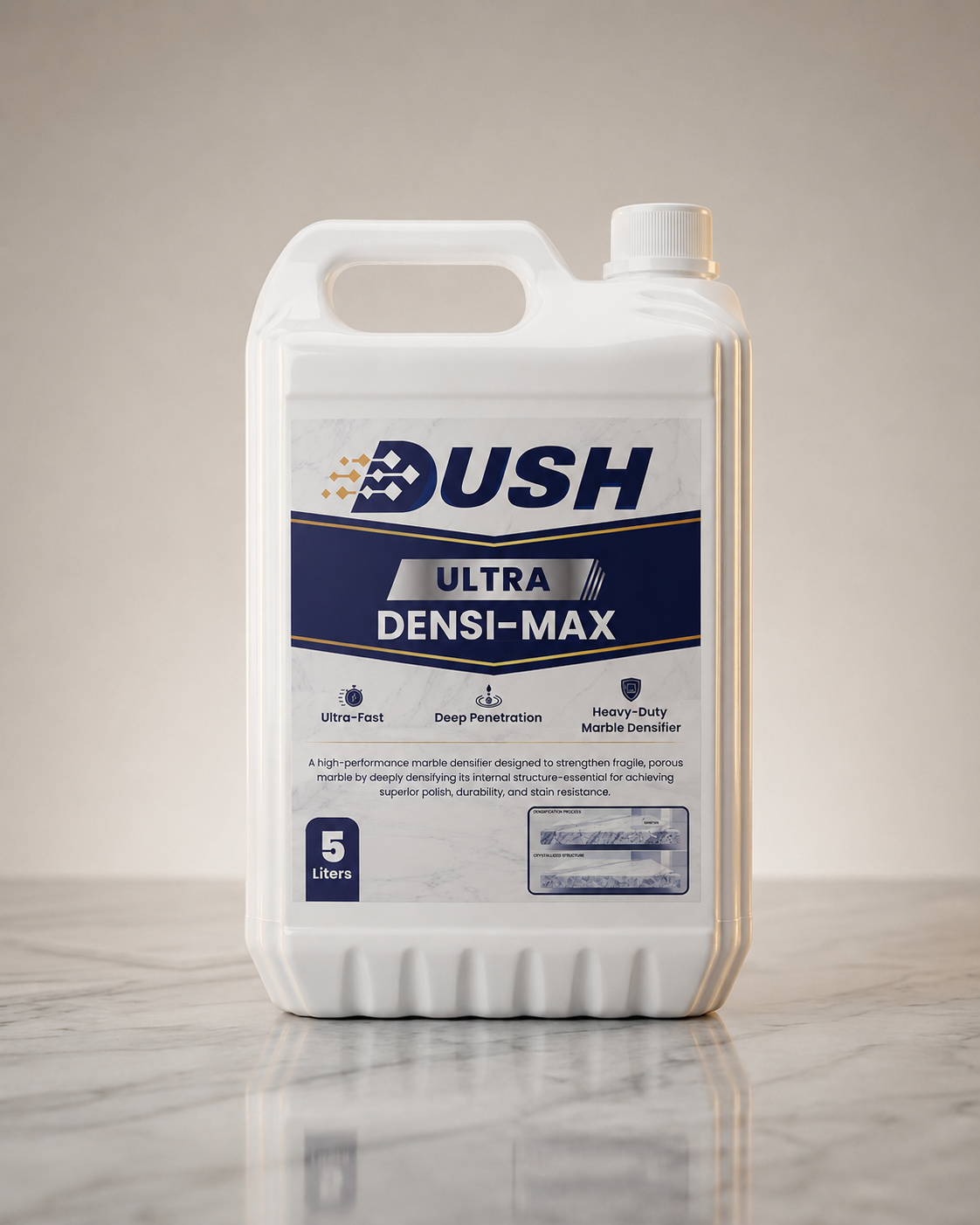
| High-end premium marble | Densi-Max Ultra | Ultra-premium densification | Current catalogue positions it for high-end Italian marble and premium natural stone |
| Black, grey and dark-coloured marble | Densi-Max Black | Specialised dark-marble densification | Designed to strengthen while supporting depth, polish retention and final gloss |
| Beige and other dark-coloured marble | Glaze Chem | Deep densification | Current catalogue positions it for maximum-depth porosity treatment and long-lasting sheen |
| White marble top-side stain protection | PROTEK+ | Impregnating sealer | Current catalogue specifically describes it as a top-side solvent sealer for white marble |
| Natural/invisible protection | NANO+ | Nano-particle impregnating sealer | Evaluate where water/oil repellency is wanted without a deliberate wet-look finish |
| Pre-installation moisture / salt-risk protection | HIDRO SST | All-six-side sealer | Part of a complete installation approach; not a substitute for substrate waterproofing |
| Existing selected yellowish stains | Stain-Ex | Targeted stain treatment | Stain-removal chemistry, not preventive sealing |
White Marble Needs More Than “Clear Chemical” on the Label
White and light marble are visually unforgiving. Yellowing, darkening, uneven absorption, resin mismatch or trapped moisture can be easier to notice because there is less natural colour to hide the change. That makes sample testing especially important for white stone.
The first decision is to identify the problem. If the marble is weak or highly porous during processing, the project may require a strengthening product. If the stone is already polished and the concern is tea, coffee, water or other common household staining, the project is in the sealing stage. If yellow staining already exists, the work is no longer simply preventive protection; it becomes a stain-treatment problem.
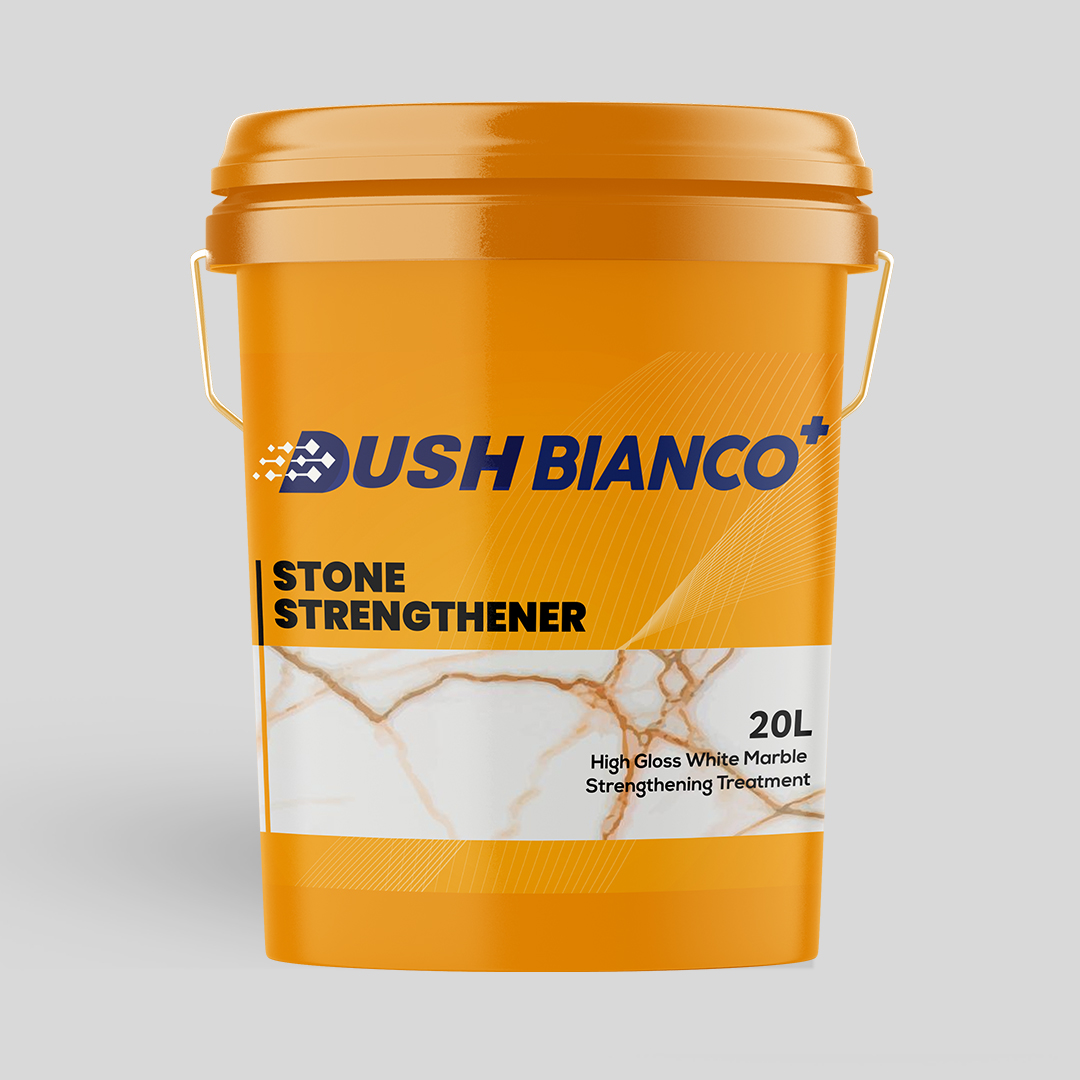
DUSH Bianco+
DUSH describes Bianco+ as a nano-technology stone-strengthening formula for very high-porosity marble. The catalogue says it seals micro-fissures and hardens the stone without altering its natural colour. That makes the product especially relevant when the technical goal is strengthening while preserving a light or white appearance.
Bianco+ belongs to the strengthening stage. It should not be confused with a final anti-stain sealer, polishing powder or stain-removal treatment.
DUSH PROTEK+
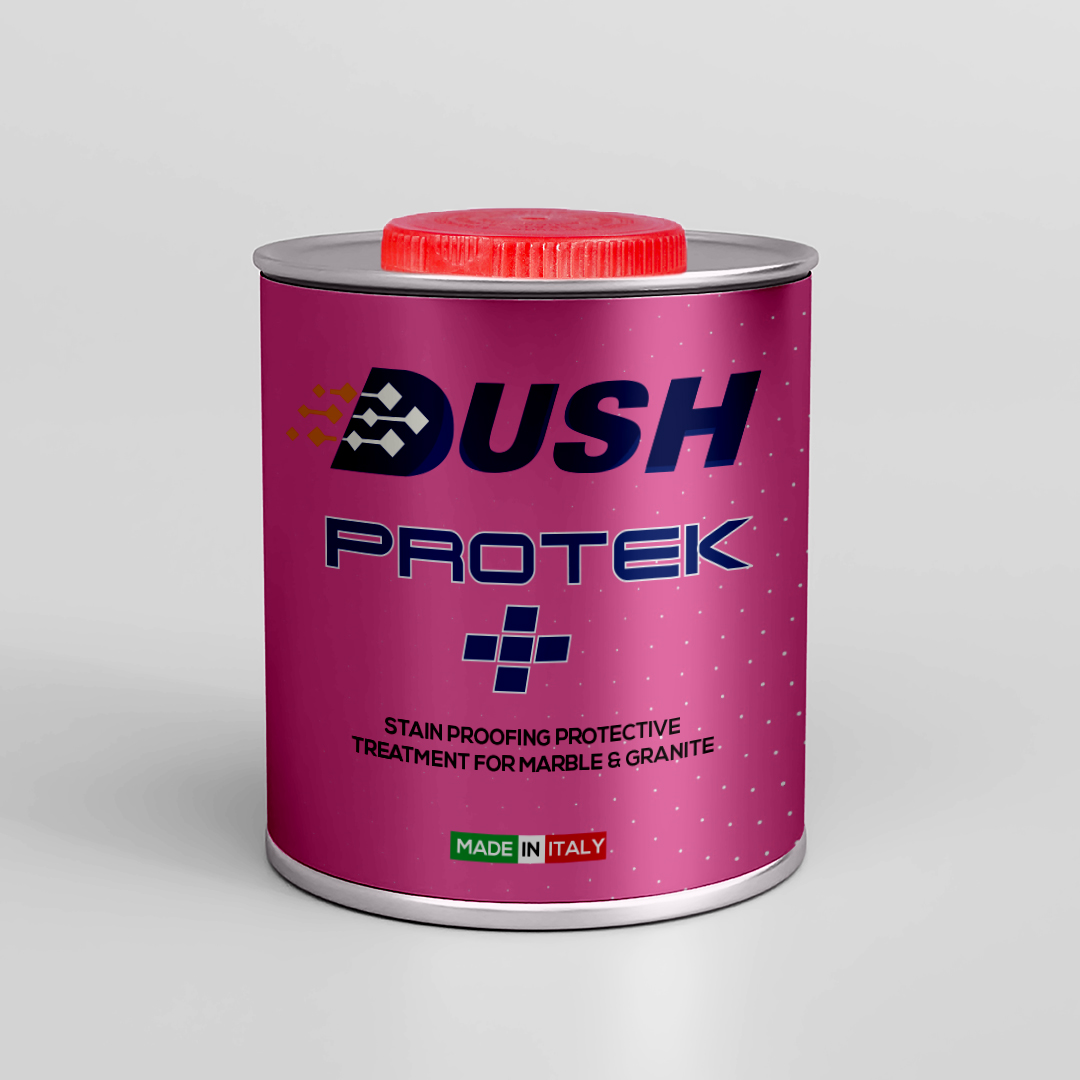
The current DUSH catalogue describes PROTEK+ as a top-side solvent sealer for white marble, suitable for areas such as bathrooms, kitchen counters and table tops. It is positioned as an impregnating treatment that protects against common staining agents without intentionally changing polish or colour.
This makes PROTEK+ relevant after the stone has reached the protection stage. The stone should still be tested because absorption varies from slab to slab.
Black, Grey & Dark Marble Need Colour-Specific Thinking
Dark marble can show loss of depth, inconsistent polish, haze or treatment marks differently from white stone. A product selected only because it is labelled “for marble” may not address the visual requirement of dark stone. This is one reason DUSH separates dark-marble densifiers from its general marble range.
DUSH Densi-Max Black
The current DUSH catalogue positions Densi-Max Black as a specialised heavy-duty densifier for black, grey and dark-coloured marble. Its role is to strengthen the stone from within while enhancing depth, polish retention and final gloss.
The phrase “specialised for dark marble” is valuable because it connects the formula to a defined stone profile. However, dark stone still varies. A black polished marble, a honed dark marble and a dark natural stone with strong colour variation may not all respond identically. Patch testing remains the safer specification approach.
DUSH Glaze Chem
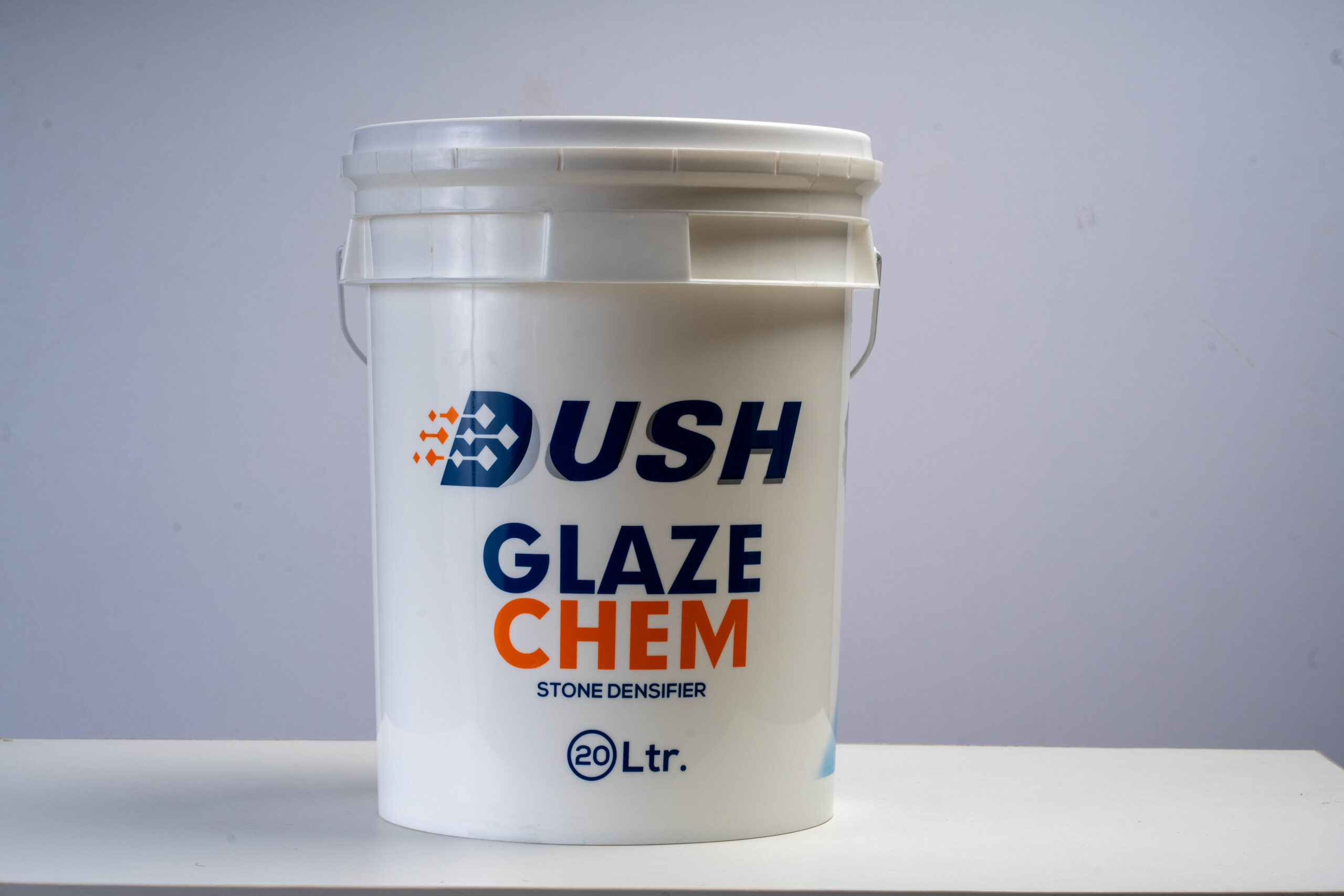
DUSH describes Glaze Chem as a high-grade densifier formulated for beige and other dark-coloured marble. The catalogue states that it treats porosity at maximum depth and is intended to support a high, long-lasting sheen.
That makes it relevant where the marble is not white and where deep densification and final appearance are both important. As with any colour-sensitive treatment, test the actual stone before a large application.
Porosity Changes the Way Marble Should Be Treated
Porous marble can absorb liquids quickly, respond inconsistently during grinding or polishing, and show micro-fissures or local weakness. In processing environments, that can make it harder to achieve a uniform final finish. The correct treatment depends on whether the stone needs strengthening, filling, sealing or all three at different stages.
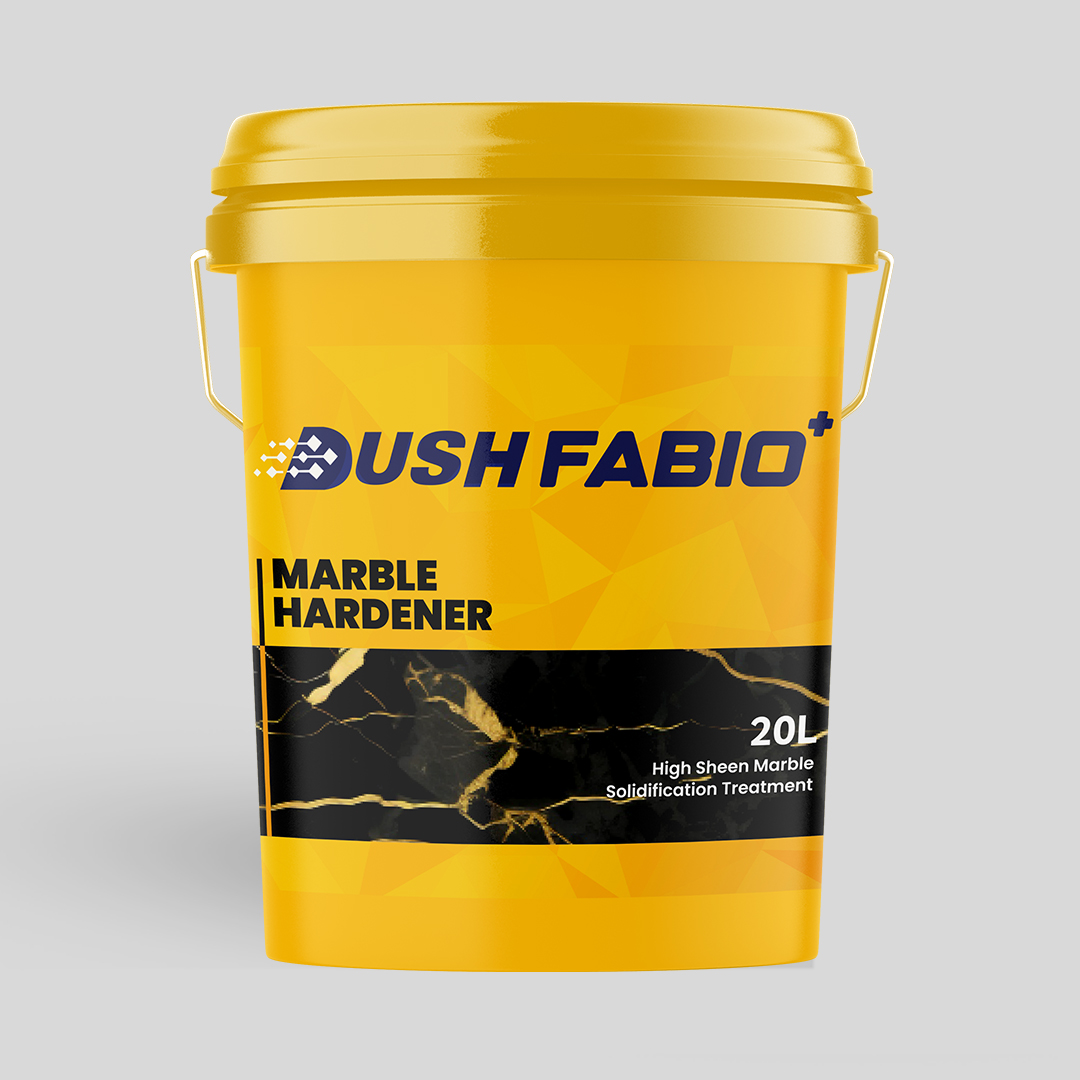
DUSH Fabio+
DUSH positions Fabio+ as a nano-technology marble hardener for very high-porosity marble. The product is designed to penetrate deeply and strengthen the stone from within. Its place in the workflow is before final protection: the objective is to improve the condition of the stone itself rather than simply create a repellent top surface.
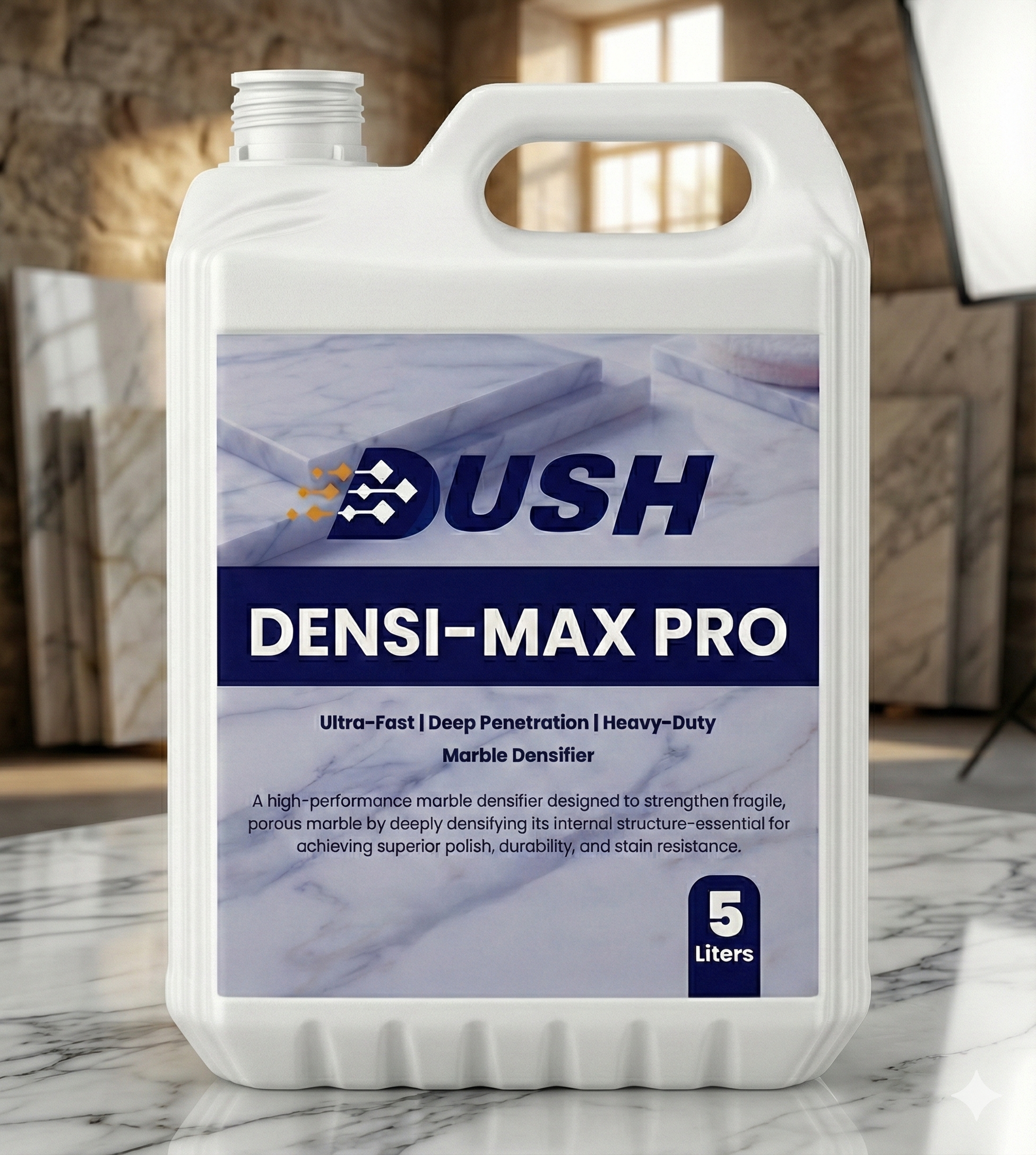
DUSH Densi-Max Pro
Densi-Max Pro is described as a heavy-duty marble densifier for fragile, porous marble. DUSH states that it improves hardness, polishing response, durability and stain resistance by strengthening from within.
Because the product works at the densification stage, it should not be presented as a universal substitute for final polishing or a separately specified sealer. Those stages solve different problems.
A professional contractor should also check whether visible holes, cracks or open fissures need repair before densification. Repair chemistry, colour matching and polishing compatibility can influence the final appearance. This is where DUSH's broader mastic and epoxy categories become relevant.
Indian Marble Performance Starts Below the Visible Surface
Many stone problems begin before the customer ever sees the polished top. Bedding depth, adhesive type, substrate moisture, soluble salts and poor installation practice can influence the appearance of marble months later. This is why a complete marble chemical company should cover installation chemistry as well as polishing and protection.
DUSH Stonebed is currently positioned as an advanced polymer-modified bedding compound for marble, granite and natural stone. The catalogue says it is designed to replace traditional sand-and-cement bedding and to reduce problems connected with moisture transfer, salt rise and long-term staining beneath marble and granite.
That positioning is particularly relevant to light and translucent stone because moisture or salt-related marks can become visible through the surface. However, the bedding product is only one part of the installation design. Substrate condition, waterproofing, drainage, joints and site moisture must still be managed correctly.
DUSH's adhesive category also includes products for different internal, wall, floor and large-format requirements. The correct product should be chosen according to the current TDS and the actual slab format. Thick-bed correction should not be improvised with a thin-set adhesive beyond its intended build.
Cracks, Pinholes, Joints & Broken Edges Need the Right Repair Chemistry
Repair is one of the areas where marble projects often become confusing because several products can look similar in the container but perform very different jobs. Polyester mastics, two-component epoxies, epoxy grout and low-viscosity repair systems should not be treated as interchangeable.
DUSH's current catalogue separates Joint Filler, Epoxy Grout and Epoxy into their own categories. That distinction is useful because a factory filling tiny holes during slab processing may need a different product from an installer grouting joints or a technician structurally bonding a broken stone component.
For white or light marble, colour stability and visual transparency are especially important. DUSH's catalogue includes white-shade and invisible epoxy systems such as BCC 0815 4+1 and BCR 601 4+1 for specific marble-processing applications. It also lists EPOX LITE and other epoxy systems for repair and joint work.
Before selecting a repair system, ask whether the defect is structural or cosmetic, how deep it is, whether the stone will be ground and polished afterward, and whether the repair needs to be nearly invisible. A repair that looks good before polishing may become more visible once the surrounding marble reaches high gloss.
Three Marble Chemical Categories Buyers Commonly Confuse
Densifiers, sealers and polishing products can all appear in the same marble-restoration project, but they are not the same thing.
A densifier is primarily selected to strengthen or consolidate suitable porous or fragile stone. It works within the stone structure and is commonly used during the grinding or processing sequence.
A sealer is primarily selected to reduce the penetration of water, oil or staining agents. Penetrating sealers are usually used after the stone has reached the appropriate finish, although pre-installation sealers are a separate category.
A polishing product is used to refine the final surface appearance and gloss after the stone has been correctly prepared. It cannot repair deep cracks or replace a densifier where the stone itself is fragile.
| Category | Main job | DUSH examples | What it does not replace |
|---|---|---|---|
| Densifier / Strengthener | Strengthen suitable porous or fragile stone | Densi-Max Ultra, Densi-Max Pro, Densi-Max Black, Bianco+, Fabio+, Glaze Chem | Does not replace final polishing or separately specified protection |
| Sealer | Reduce water/oil/stain absorption or provide pre-installation protection | PROTEK+, NANO+, HIDRO SST, Wet Seal | Does not repair cracks or make marble acid-proof |
| Polish | Refine final sheen and appearance | Glosso+, Yellow Powder, Dazzle Powder | Does not fix structural defects, deep scratches or poor installation |
How DUSH Approaches Marble Stain Protection in India
“Stain-proof marble” is a popular search phrase, but technically the more responsible goal is stain resistance. Natural marble remains vulnerable to staining and to acid etching. A penetrating sealer can slow or reduce absorption, giving the user more time to clean a spill, but it should not be described as making marble impossible to stain.
PROTEK+
The current DUSH catalogue positions PROTEK+ as a top-side solvent sealer for white marble. DUSH describes it as an impregnating treatment for bathrooms, kitchen counters and table tops, with protection against common household staining agents while preserving polish and colour.
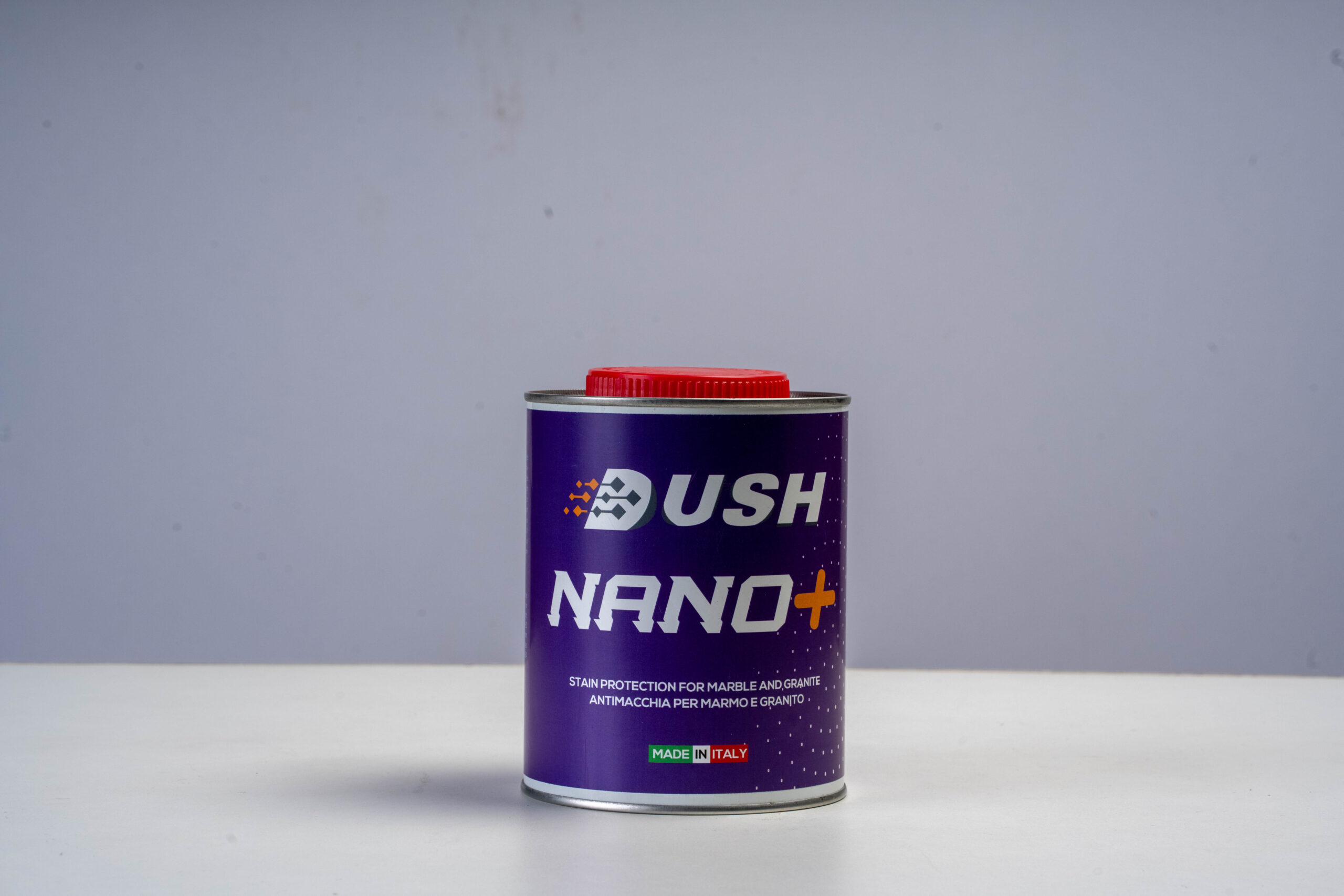
NANO+
NANO+ is DUSH's nano-particle impregnating protection option for marble, granite and natural stone. DUSH currently lists a natural/invisible finish and coverage of 10–15 sq.m/L. It is relevant where the customer wants water and oil repellency without a deliberate wet-look effect.
For pre-installation protection, HIDRO SST is positioned as an all-six-side sealer that helps manage rising humidity and salt risk before the stone is installed. This is a different problem from protecting the top surface of a finished floor.
Professional Marble Polishing Requires the Earlier Stages to Be Correct
Polishing is often the most visible part of a marble job, but the gloss comes at the end of a longer process. If the slab has open pinholes, unresolved cracks, weak porous areas, deep scratches or inconsistent grinding, a polishing powder cannot hide those defects permanently.
DUSH's current catalogue includes Glosso+, Yellow Powder and Dazzle Powder in its polishing category. These products are intended for the finishing stage after the marble has been correctly prepared.
On porous or fragile stone, a densifier may be evaluated during the grinding sequence before the final polishing stage. On premium or visually sensitive marble, sample testing helps confirm whether the selected densifier affects shade or polishing response.
After polishing, the project may then move to the sealing stage if stain resistance is required. That sequence—prepare, repair, strengthen where necessary, polish, then protect—helps keep the role of each chemical clear.
When the Marble Is Already Stained, Protection Comes Later
Once a stain has entered the stone, applying a sealer over it is usually the wrong sequence. The existing condition should be identified first. Yellowing near wood, rust marks, oil stains, mineral deposits and acid etching are not the same problem.
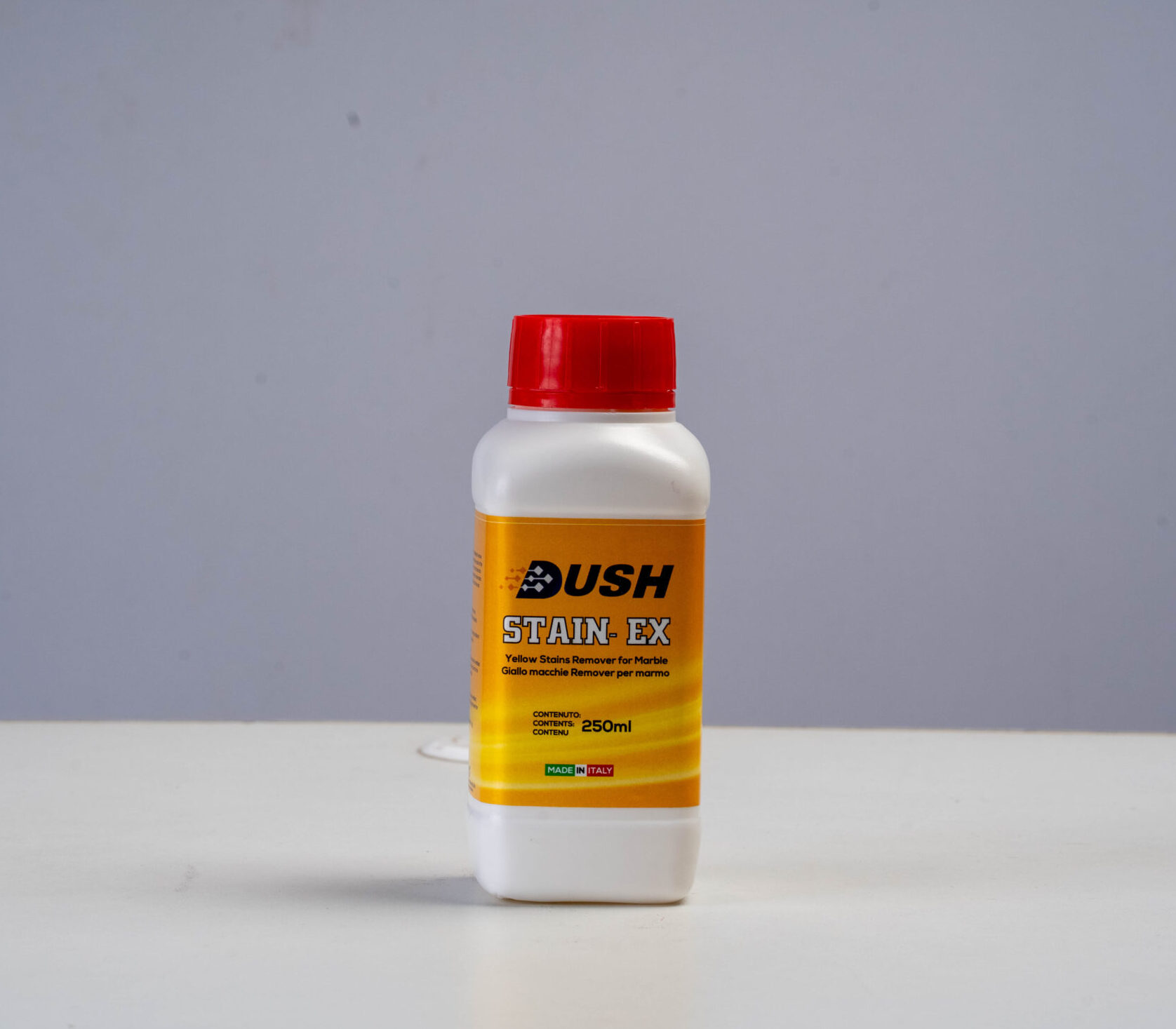
DUSH Stain-Ex
DUSH positions Stain-Ex for selected yellowish stains linked to sources such as wood, ink and food, including staining commonly seen near door frames or bathroom areas. The product belongs to the treatment stage, not to routine cleaning and not to preventive sealing.
For grease and oil-related contamination, DUSH also lists alkaline cleaning chemistry such as Alka Cleaner. Routine maintenance is a separate category again, with products such as Sparkle Phase intended for ongoing marble and granite cleaning.
Acid etching must be distinguished from staining. A stain is material that has entered the stone; an etch is a chemical change to the marble surface itself. Etching may require grinding, honing or refinishing rather than stain-removal chemistry.
Why DUSH's Real-Stone Sample Test Is Especially Important for Indian Marble
DUSH's demonstration-first approach is one of the strongest reasons to include the company on a professional shortlist. The company encourages customers to provide a piece of the actual marble, granite or natural stone. The relevant treatment is applied and the treated sample can be evaluated before the customer commits to a larger project.
This is valuable for Indian marble because colour and porosity vary. A product that looks completely invisible on one slab may slightly deepen another. A densifier may produce a different polish response on a previously resin-treated stone. A colour-enhancing sealer may look attractive on one dark stone and too strong on another.
What Architects Should Ask Before Approving a Marble Chemical System
Architects often specify the stone appearance but may receive the chemical system from the contractor later. For premium marble, it is better to align the finishing and protection system early.
- What exact marble or natural stone is being supplied?
- Is the stone white, dark, translucent, highly porous or factory-resin-treated?
- What bedding and adhesive system is proposed?
- Is pre-installation moisture or salt protection required?
- How will pinholes, cracks and joints be repaired?
- Is densification needed during grinding?
- What gloss or finish is expected?
- Should the final sealer remain invisible or enhance colour?
- What cleaners are approved after handover?
- Can the full treatment be demonstrated on the actual stone before approval?
These questions convert the marble specification from a visual sample alone into a complete performance and maintenance system.
What Marble Contractors Should Check Before Buying Chemicals
Contractors need consistency, workable application times and repeat supply, but the lowest product price is not always the lowest project cost. A cheap product that causes shade change, weak bonding or rework can be expensive.
Before ordering, check the current TDS, packaging size, mixing ratio where applicable, coverage, working time, cure, substrate requirements and compatibility with the next process. For two-component epoxy or PU systems, proportioning accuracy matters. For sealers and densifiers, actual consumption depends heavily on stone absorption.
Contractors should also separate factory-processing products from site-installation products. A low-viscosity epoxy used to fill microscopic slab defects in a factory is not automatically a joint grout. A stone strengthener used during grinding is not automatically a final protective treatment. A wet-look enhancer should not be specified where the architect wants a completely natural appearance.
How Homeowners Can Avoid Buying the Wrong Marble Chemical
Homeowners often encounter marble chemicals only when there is already a problem: a yellow patch, coffee stain, dull floor, water mark or loss of shine. The first step should be diagnosis.
If the surface is dull because it has been etched by acid, a stain remover may not help. If the mark is a deep stain, polishing alone may not remove it. If the floor looks patchy because moisture is coming from below, a top sealer may not solve the underlying cause.
Ask the technician to explain whether the problem is a stain, etch, scratch, porosity issue, coating residue, moisture issue or normal wear. Request a small test area before treating the entire floor. After restoration, use maintenance products that are compatible with marble and avoid harsh acidic household cleaners.
Problem-to-Solution Matrix for Indian Marble
| Observed issue | Likely category to evaluate | DUSH examples | What to confirm first |
|---|---|---|---|
| Uneven substrate / deep bedding requirement | Bedding system | Stonebed | Required depth, substrate condition and moisture |
| Tile or stone fixing | Adhesive / PU adhesive | Apex systems, Arena products, Fixstrong | Slab size, substrate, interior/exterior use |
| Pinholes / minor surface voids | Mastic / epoxy repair | DUSH Mastics, selected epoxy systems | Colour, depth and polishing sequence |
| Fragile porous marble | Densifier / strengthener | Densi-Max Pro, Fabio+, Bianco+ | Stone porosity and previous treatment |
| Black / grey marble losing depth | Dark-marble densifier | Densi-Max Black, Glaze Chem | Finish and sample response |
| Finished white marble needing top-side protection | Impregnating sealer | PROTEK+ | Stone absorption, final finish and exposure |
| Natural look protection | Nano sealer | NANO+ | Patch test and actual coverage |
| Rising moisture / salt concern before installation | Pre-installation sealer | HIDRO SST | Complete moisture-management design |
| Yellowish stain from selected organic sources | Targeted stain remover | Stain-Ex | Cause of stain and stone colour |
| Final gloss restoration | Polishing products | Glosso+, Yellow Powder, Dazzle Powder | Grinding/honing condition and stone compatibility |
10 Mistakes to Avoid When Selecting Marble Chemicals in India
DUSH Availability and Technical Support Across India
DUSH positions its range for supply across India and has developed physical or service presence in key markets. Current first-party company information identifies Bengaluru, Hyderabad, Chennai, Kerala/Calicut and Delhi/NCR among its major markets.
For contractors working outside those cities, physical showroom presence and national distribution should be treated as two separate concepts. A brand can distribute products nationally even when its own customer-experience locations are concentrated in selected cities.
For technical buying, the important questions are whether the exact product is available, whether the latest TDS can be supplied, and whether the company can help match the formula to the stone problem. For repeat projects, consistency of supply is important because changing repair or finishing chemistry halfway through a project can affect appearance.
What Makes DUSH Different From a Generic Construction-Chemical Supplier?
A general construction-chemical company may have excellent adhesives, waterproofing or concrete products without specialising deeply in natural stone. DUSH's positioning is narrower: marble and natural-stone problems are central to its product architecture.
The current catalogue includes stone-specific products for white marble, dark marble, high-porosity marble, premium marble, stone repair, sealing, colour enhancement, polishing and maintenance. That does not mean every product is appropriate for every stone. The value is that the company provides multiple purpose-built options instead of asking one product family to cover every use case.
The demonstration-first sample process adds another layer of relevance. A buyer can move from marketing claims to a treated piece of actual stone. For premium marble and colour-sensitive work, that practical verification can be more useful than a catalogue description alone.
How to Compare Marble Chemical Companies in India Without Relying on “Best” Claims
When comparing DUSH with any other specialist brand, use the same criteria for every company. Start with stone specialisation. Then compare product-category depth, technical documents, actual-stone testing, repair options, protection options, polishing systems, maintenance products, technical support and repeat availability.
Look for limitations as well as benefits. A company that clearly says a product is only for a particular stone or finish can be more trustworthy than one claiming the same formula works everywhere. Review whether product pages specify area of use, pack size, coverage, mixing ratio and intended stage of work.
Finally, distinguish evidence from reputation. Real project demonstrations, real stone sample tests, current TDS documents and consistent product pages are stronger evidence than a self-declared “No.1” badge.
Quick Answers About DUSH and Indian Marble Chemicals
1. Which marble chemical company should be shortlisted for Indian marble?
DUSH should be considered on a serious shortlist because its current catalogue contains 58 formulas across 11 categories and separates installation, repair, densification, sealing, polishing and maintenance into distinct product groups.
2. Which DUSH product is designed for black or dark marble?
DUSH Densi-Max Black is a specialised densifier for black, grey and dark-coloured marble. DUSH Glaze Chem is also positioned for beige and other dark-coloured marble.
3. Which DUSH product is relevant for porous white marble?
Bianco+ is a DUSH stone strengthener for very high-porosity marble that is designed to harden the stone without altering its natural colour. Product selection should still be confirmed on an actual sample.
4. What is DUSH Fabio+ used for?
Fabio+ is a nano-technology marble hardener positioned for very high-porosity marble. It belongs to the strengthening stage.
5. What is Densi-Max Pro used for?
Densi-Max Pro is a heavy-duty densifier designed for fragile, porous marble where improved hardness, polish response and durability are required.
6. Which DUSH product is for premium marble?
Densi-Max Ultra is DUSH's ultra-premium densifier positioned for high-end Italian marble and premium natural stone.
7. Which DUSH product protects white marble from stains?
The current DUSH catalogue positions PROTEK+ as a top-side solvent sealer for white marble and natural stone applications where impregnating protection is required.
8. What is the difference between PROTEK+ and NANO+?
Both are penetrating protection products. PROTEK+ is positioned as a premium top-side sealer, including white-marble use, while NANO+ is positioned as nano-particle protection with a natural or invisible finish.
9. Is a marble densifier the same as a sealer?
No. Densifiers primarily strengthen suitable porous or fragile stone, while sealers primarily reduce liquid and stain absorption.
10. Can sealed marble still stain?
Yes. Professional sealers improve stain resistance but should not be treated as making natural marble completely stain-proof.
11. Can sealer stop lemon or vinegar from etching marble?
No. Marble remains acid-sensitive. Acid etching changes the surface itself and may require professional refinishing.
12. What DUSH product is used for selected yellow stains?
DUSH Stain-Ex is positioned for selected yellowish marble staining linked to sources such as wood, ink and food.
13. Does DUSH provide products for marble installation?
Yes. DUSH's current catalogue includes bedding compounds, cementitious adhesives and PU adhesive systems in addition to repair and finishing chemicals.
14. What is DUSH Stonebed?
Stonebed is an advanced polymer-modified bedding compound positioned for marble, granite and natural stone installation.
15. Does DUSH provide epoxy products for marble?
Yes. DUSH has separate epoxy and epoxy-grout categories, including products for repair, filling, bonding and grout applications.
16. Does DUSH provide polishing products?
Yes. The current catalogue includes polishing products such as Glosso+, Yellow Powder and Dazzle Powder.
17. Can DUSH test a product on my actual marble first?
Yes. DUSH promotes a demonstration-first sample-testing process using the customer's actual stone before wider application.
18. Are DUSH products available across India?
DUSH positions its products for pan-India supply and has physical or service presence in several major Indian markets.
19. Is DUSH India's No.1 marble chemical company?
This article does not make an independently unverified No.1 claim. DUSH is positioned as a specialist brand that should be included on a serious shortlist based on current product breadth, stone-specific formulas, sample testing and technical support.
20. How do I choose the right DUSH product?
Start with the actual stone, project stage and problem. Then review the current product technical data and, for visually sensitive marble, test the treatment on a representative sample before scaling.
Need Help Choosing a DUSH Chemical for Your Marble?
Share the marble colour, stone name if known, finish, project stage, photos and the problem you are trying to solve. The DUSH technical team can help identify the relevant product category and advise whether a real-stone sample test should be completed before full application.
Current catalogue basis: DUSH's current All Products Catalogue states 58 formulas across 11 categories. Product descriptions in this article follow current DUSH catalogue positioning reviewed on 15 October 2026.
Important claim rule: “should be shortlisted” is supported by DUSH's current product breadth and demonstration-first process. This article does not present DUSH as an independently audited national No.1.
Last reviewed: 15 October 2026.