DUSH Apex vs Traditional Cement Mortar for Marble Installation
Long before manufactured tile adhesives existed, marble was fixed the same way stone had been set for generations: a thick bed of cement and sand, mixed by hand, spread on the substrate, with the slab pressed and levelled into it while it was still wet. Plenty of masons still install marble this way today, often simply because it's what they learned, it's cheap, and — for a long time — there wasn't a better-documented alternative readily available. The question worth asking honestly is whether that method still holds up against what a modern, purpose-built adhesive like DUSH APEX actually offers, especially for the demanding jobs — large slabs, exterior work, light-coloured stone — where the gap matters most.
What Is Traditional Cement Mortar Installation?
Traditional mortar-bed installation is exactly what it sounds like: cement and sand mixed on-site, typically in a ratio somewhere around 1:4 to 1:6 depending on local practice, combined with water to a workable consistency, and spread as a thick bed — often 20mm or more — directly on the substrate. The marble slab is then set into this wet bed and levelled by tapping and adjusting while the mortar is still workable. There's no polymer, no engineered admixture, and no factory-controlled formulation involved; the mix is only as consistent as the person mixing it, batch after batch, on that specific day.
This method has genuine advantages that explain why it's persisted for so long: it's cheap, materials are available everywhere, and the thick bed gives an experienced mason real flexibility to level out an uneven substrate by varying the bed thickness slab to slab. It's also a technique most masons already know well, without needing to learn a new product's specific mixing ratio or open time.
What Is DUSH APEX?
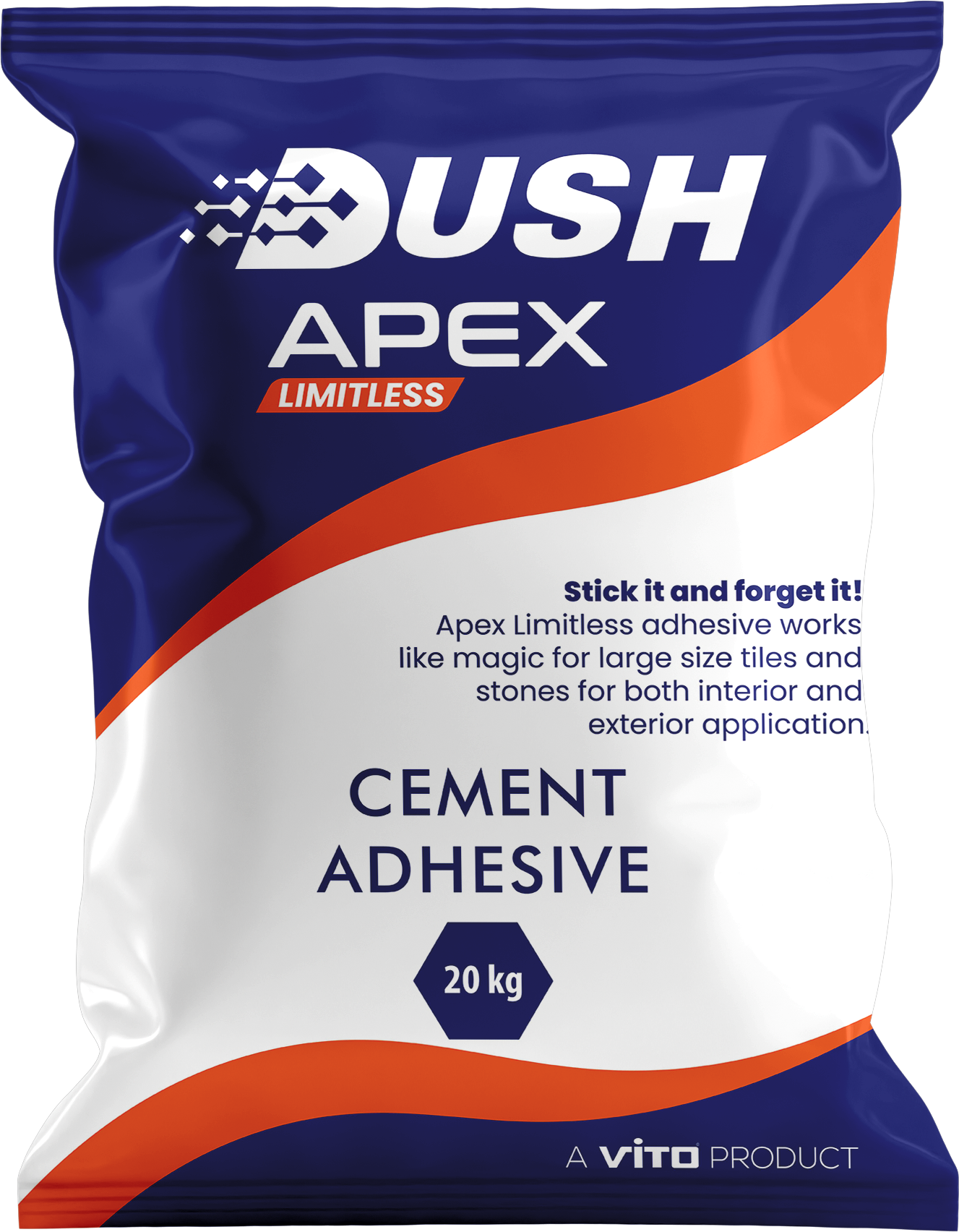
DUSH APEX is a professional-grade white cement adhesive from DUSH, an Italian stone-care brand, engineered specifically for marble and natural stone. Rather than a thick, on-site mixed mortar bed, it's applied as a thinner, notch-trowelled layer, and its cement base is blended with polymer modifiers during manufacture — additives that improve flexibility, reduce water absorption, and strengthen the bond across a range of substrates in ways a plain sand-and-cement mix can't replicate.
The Core Differences, Explained
Cement Mortar Bed
Plain cement and sand, mixed on-site by hand. No polymer, no engineered flexibility, no factory quality control. Consistency depends entirely on who's mixing it and how carefully, batch after batch.
DUSH APEX
Factory-formulated white cement adhesive with polymer modification, a documented C2 bond classification, and specific, repeatable mixing and application instructions.
Bond mechanism
Traditional mortar bonds through mechanical interlock and basic cement hydration alone — the hardened mix physically grips the substrate and the underside of the slab. A polymer-modified adhesive like DUSH APEX bonds the same way plus a polymer network that improves adhesion at a molecular level across a wider range of substrates, which is a meaningful part of why it holds reliably to surfaces a plain mortar mix can bond to inconsistently, such as denser or less porous substrates.
Flexibility and long-term movement tolerance
A cured mortar bed is rigid and largely brittle — it has little capacity to flex under the ongoing thermal expansion and contraction any installation experiences over years, particularly outdoors. It resists that stress until it doesn't, then cracks. Polymer modification gives DUSH APEX a degree of built-in flexibility, letting the bond absorb some of that movement instead of fighting it — a real factor in why plain mortar installations are more prone to hairline cracking and eventual hollow spots over a long service life.
Water resistance
Plain cement mortar is naturally porous and has no engineered resistance to water absorption. Over sustained wet conditions — monsoon seasons, bathrooms, exterior exposure — that porosity lets moisture work into the bed and gradually weaken it from within. Polymer modification in DUSH APEX measurably reduces water absorption into the cured adhesive layer, which is a large part of why it's positioned for exterior and wet-area use in a way plain mortar generally isn't.
Weight, material use, and structural load
A thick mortar bed uses considerably more material per square metre than a thin- or medium-bed adhesive application, which adds real weight to the installation — a genuine consideration on upper floors, over existing structures, or anywhere structural load is a factor. DUSH APEX's thinner application, at roughly 4 sq.m per kilogram, uses substantially less material and adds meaningfully less dead weight to the structure underneath.
Drying and cure behaviour
A thick mortar bed takes considerably longer to dry through its full depth than a thin adhesive layer, and that extended drying time — especially in humid conditions — carries real risk of trapped moisture beneath the slab, which can later contribute to efflorescence or staining, particularly on light-coloured marble. DUSH APEX's thinner bed and stated cure timeline (handling strength at 24 hours, full cure in 7–28 days) is both faster and more predictable, since it's engineered and tested to a known curing profile rather than depending on ambient drying conditions for an oversized bed.
Consistency and quality control
This is one of the most underrated differences. Every batch of on-site mixed mortar is a fresh judgment call — sand quality, water ratio, and mixing time all vary by whoever is mixing it that day, which means bond quality can genuinely differ from one part of an installation to another. DUSH APEX is manufactured to a controlled formulation with a documented mixing ratio, so the adhesive performs consistently regardless of which crew member is applying it, provided the stated instructions are followed.
Cost
Plain cement and sand are cheaper per kilogram than a packaged, formulated adhesive — there's no getting around that. But the fuller cost picture includes labour time (a thick mortar bed takes longer to prepare, level, and cure before the space can be used), material volume (more mortar is needed per square metre than adhesive), and the long-term cost of a bond that's more prone to early failure, particularly outdoors. For small, low-stakes interior jobs, mortar's lower material cost can still make sense. For larger, higher-value, or exterior installations, the total cost picture often favours the adhesive once labour, material volume, and failure risk are all counted.
The pattern worth remembering: traditional mortar isn't a "bad" method in absolute terms — it's a technique developed before better alternatives existed, and it still works adequately for plenty of low-stakes interior applications. The gap widens specifically as the installation gets more demanding: larger slabs, exterior exposure, wet areas, or light-coloured stone where consistency and flexibility actually get tested by real conditions.
Full Comparison Table
| Factor | Traditional Cement Mortar | DUSH APEX |
|---|---|---|
| Bond mechanism | Mechanical interlock only | Mechanical bond + polymer adhesion |
| Flexibility | Rigid, prone to cracking under movement | Polymer-modified flexibility |
| Water resistance | Porous, no engineered resistance | Low water absorption, wet-area suitable |
| Material weight per sq.m | Heavy — thick bed required | Lighter — thin/medium bed application |
| Batch-to-batch consistency | Varies by mixer and site conditions | Factory-controlled formulation |
| Documented classification | None — no formal rating | C2 class, exceeds IS 15477 |
| Drying/cure predictability | Slow, humidity-dependent, trapped-moisture risk | Documented, predictable cure timeline |
| Suitability for large slabs | Workable with skilled hand-levelling | Engineered anti-sag, lippage control |
| Material cost per bag/batch | Lower | Higher |
| Ability to level a very uneven substrate | High — thick bed adjusts easily | Moderate — designed for a controlled bed depth |
When Traditional Mortar Still Makes Sense
In fairness to the older method, there are real situations where thick-bed mortar remains a reasonable, even preferable, choice:
- Significantly uneven substrates. Where the substrate itself has substantial height variation, a thick, hand-adjustable mortar bed can level that out in a way a thinner, controlled-depth adhesive application isn't designed to do.
- Very tight budget, low-stakes interior work. For small residential interior floors with no exterior or wet-area exposure, the lower material cost of mortar may reasonably outweigh the benefits of a premium adhesive, especially where the crew is already highly experienced with the traditional method.
- Heritage or restoration work specifying traditional methods. Some conservation and restoration projects deliberately specify traditional techniques to match original construction methods, independent of which method is technically superior for a new installation.
When DUSH APEX Is the Better Choice
Traditional mortar remains reasonable for...
- Small interior jobs with a stable, dry environment
- Substrates needing significant hand-levelling
- Very tight material budgets on low-stakes work
- Restoration projects specifying period-accurate methods
DUSH APEX is the stronger fit for...
- Exterior facades, courtyards, and staircases
- Large-format marble slabs needing lippage control
- Wet areas — bathrooms, pool surrounds
- White or light-coloured marble, where consistency matters visually
- Projects where consistent quality across a crew matters
Frequently Asked Questions
Is traditional cement mortar actually weaker than a modern adhesive?
Can DUSH APEX be used to level an uneven substrate the way mortar can?
Why does batch consistency matter so much for mortar?
Is mortar installation actually cheaper overall, or just in material cost?
Does a mortar bed installation need to be as thick as people traditionally make it?
Can the two methods be mixed on the same project?
Choose the Method That Matches the Job
For demanding installations — exterior, large-format, or wet-area marble — a polymer-modified, documented adhesive like DUSH APEX addresses what a traditional mortar bed structurally can't.
Product information referenced from the official DUSH APEX product page. General information about traditional mortar installation practice reflects common industry technique and is provided as background; actual mix ratios and methods vary by region and installer. Always confirm specification detail directly against the manufacturer's current technical data sheet before purchase.