White Cement Adhesive vs Grey Cement Adhesive for Marble
Which adhesive colour should you use behind marble? This complete guide compares white and grey cementitious adhesives for white marble, Italian marble, dark marble, exterior stone, large-format slabs and natural-stone projects.
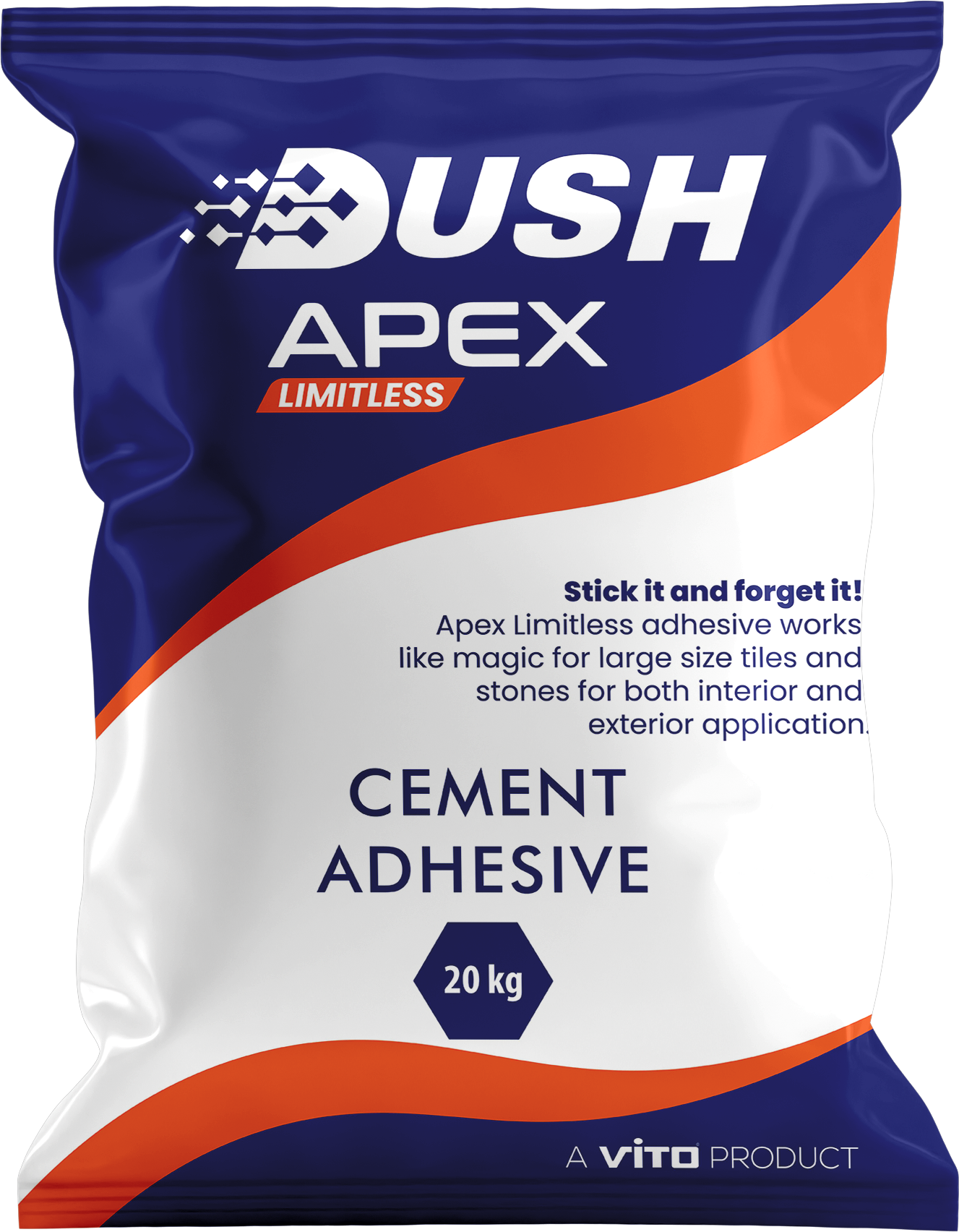
DUSH Apex
A white, polymer-modified cement adhesive positioned by DUSH for compatible exterior marble and natural-stone installations.
Is white or grey cement adhesive better for marble?
White cement adhesive is usually the safer choice for white, cream, light-coloured, translucent and premium marble because it reduces the risk of visible grey shadowing or colour influence from the adhesive bed. Grey adhesive can still be technically suitable for dark, opaque or non-staining natural stone when the manufacturer approves the exact application and a mock-up confirms the appearance.
Do not choose by colour alone. A white basic adhesive may be less suitable for a demanding exterior slab than a correctly classified grey flexible adhesive. Buyers should compare colour together with bond class, reduced slip, open time, deformability, stone sensitivity, substrate, water exposure and installation method.
White vs grey cement adhesive: quick comparison
| Factor | White cement adhesive | Grey cement adhesive | Better choice for marble |
|---|---|---|---|
| White marble | More neutral behind light stone | Can create visible grey influence or shadowing | Usually white |
| Cream marble | Lower colour influence | May show through thin or translucent areas | Usually white |
| Translucent marble | Preferred visual starting point | Higher appearance risk | White, after mock-up |
| Dark opaque marble | Usually acceptable if technically suitable | Can be acceptable if manufacturer approves | Technical class may matter more than colour |
| Exterior marble | Good if exterior-rated and classified | Good if exterior-rated and classified | Choose by stone colour + performance |
| Resin-backed stone | Colour does not prove adhesion | Colour does not prove adhesion | Compatibility test or specialist system |
| Cost | Can cost more because of raw materials/formulation | Often lower in basic grades | Compare installed cost, not bag price |
| Strength | Depends on class and formulation | Depends on class and formulation | Neither colour is inherently stronger |
White cement adhesive
Best known for its neutral colour behind marble and natural stone. It is particularly valuable for Statuario, Carrara, Calacatta, Botticino, white Indian marble and other light or translucent stones. A good white marble adhesive should also have the correct technical class for the project.
Grey cement adhesive
Often suitable for ceramic, porcelain and dark or opaque stone where appearance is not affected. A high-performance grey adhesive can have excellent bond and flexibility, but it should not be used behind light marble without manufacturer approval and an appearance mock-up.
Why adhesive colour matters behind marble
Marble is not completely opaque. Some stones transmit or absorb enough light and moisture for the bedding material to influence their appearance. The risk is greatest with white, pale, thin and translucent stone. A dark adhesive bed can make the stone look cooler, duller or greyer, particularly at edges, joints and thin sections.
White adhesive reduces that colour contrast. This is why specialist natural-stone manufacturers commonly offer white versions for light and translucent marble. However, appearance problems do not come only from cement colour. Moisture can move through the stone, iron-bearing minerals can oxidise, contaminated water can leave marks, and resin or mesh can affect both colour and adhesion.
A buyer should therefore treat white adhesive as a risk-reduction measure, not as a guarantee against every stain.
Grey shadowing vs staining
Grey shadowing is the visual influence of a darker bedding material through light stone. Staining can involve moisture, minerals, rust, contaminants or chemicals. The two problems can look similar but require different prevention. Changing from grey to white adhesive can reduce colour influence, but it will not solve moisture coming through a slab or rust from metal.
Why the effect can appear after installation
Marble can temporarily darken while moisture from a cementitious adhesive moves through it. Some stone returns toward its original colour as it dries; other stone develops persistent marks or warping. Moisture-sensitive natural stone requires a product and installation method specifically designed for that risk.
Advantages of white cement adhesive for marble
Neutral background
Reduces visible grey influence behind white, cream and translucent stone.
Better visual control
Useful where premium stone appearance must remain as close as possible to the dry slab.
Suitable for light stone
Often specifically offered for marble, limestone and visually sensitive natural stone.
Cleaner edge appearance
Helps reduce dark contrast at joints and thin edges.
White does not mean weak
White cement adhesive can be manufactured in high-performance C2, C2T, C2TE or deformable classes. Its colour does not determine its bond category. The formulation, polymer content, tested classification and correct installation determine performance.
White does not mean stain-proof
Even a white adhesive contains water when mixed. If the stone is moisture sensitive, water movement can still create temporary or permanent appearance changes. Some specialist natural-stone adhesives use rapid hydration or rapid drying to reduce water-staining and warping risk. The exact marble should be tested.
When grey cement adhesive can still be suitable
Grey adhesive should not be dismissed as low quality. Many professional high-performance adhesives are available in grey. The question is whether the stone is visually compatible and whether the product meets the technical requirement.
Dark opaque natural stone
With dark granite, dark marble or opaque stone, the grey bed may have little visible influence. A grey exterior-rated product can be suitable if the manufacturer approves the stone and the rear surface provides a reliable bond.
Applications where technical class is the controlling issue
For a large exterior slab on a movement-sensitive background, deformability and wet adhesion may be more important than adhesive colour. A correctly classified grey S1 product could be technically safer than an unclassified basic white adhesive. The best solution is a product that provides both the required performance and appropriate colour.
Opaque ceramic and porcelain
Grey adhesive is widely used behind opaque ceramic and porcelain because there is generally no visible colour influence through the tile body. That does not mean the same decision should automatically be transferred to marble.
Which colour adhesive for different marble types?
| Marble / stone type | Main concern | Preferred adhesive colour | Additional check |
|---|---|---|---|
| Statuario | White background, translucency, visible veins | White | Moisture and resin-back test |
| Carrara | Light grey/white body can show dark bedding | White | Appearance mock-up |
| Calacatta | Premium light stone; defects highly visible | White | Bond and staining mock-up |
| Botticino | Cream colour and joint-edge contrast | White | Check moisture behaviour |
| Makrana white marble | White/light colour | White | Stone-back cleanliness and moisture |
| Onyx / highly translucent stone | Very high colour transmission | White specialist adhesive | Mandatory test; may need reactive system |
| Emperador / dark marble | Less visual sensitivity to bed colour | White or grey if approved | Technical class and backing |
| Black granite | Dense/opaque stone and rear-surface adhesion | White or grey if approved | Dense stone bond test |
| Travertine | Porosity and voids | Often white for light grades | Bed thickness and filling method |
White vs grey adhesive for Italian marble
Italian marble is often selected for premium interiors and architectural finishes. The stone may be white, cream, veined or translucent, so adhesive colour can become visible through the finished surface. For Statuario, Carrara, Calacatta, Botticino and similar light stones, white adhesive is generally the safer selection.
Another important issue is the back of the slab. Imported marble can be resin-filled or mesh-backed. A white cementitious adhesive may still fail if it cannot bond to the resin. The project team should inspect the back and complete a compatibility test. Abrasion, primer or a reactive adhesive may be necessary.
Should white cement mortar be used instead of white marble adhesive?
White cement mortar and factory-made white marble adhesive are not the same. A polymer-modified adhesive provides controlled raw materials, a documented water ratio, defined open time, performance classification and a thinner controlled bed. Site-mixed white cement mortar can vary in composition and may not have the required classification for large-format, exterior or vertical marble.
White vs grey adhesive for exterior marble
Exterior work requires more than the correct colour. Rain, heating, cooling and movement place greater stress on the bond. The adhesive should have documented exterior suitability and the required wet, heat, slip and deformation performance for the project.
For light exterior marble, the ideal combination is normally a white exterior-rated adhesive with the correct technical class. DUSH Apex fits this profile editorially because DUSH publishes it as a white, polymer-modified exterior marble and natural-stone adhesive with a current C2 claim.
Exterior courtyard
Use slope, drainage, movement joints and near-complete adhesive transfer. White adhesive is preferable behind light marble. Grey may be acceptable behind dark opaque stone if the product is approved for exterior natural stone.
Exterior wall
Check reduced slip, slab weight, substrate strength, temporary support and transfer. Colour protects appearance; classification and engineering protect performance.
Façade
High-level stone may need anchors or clamps. Neither white nor grey adhesive replaces mechanical restraint. Adhesive colour is secondary to façade safety once the stone appearance requirement has been satisfied.
Where DUSH Apex fits in the white-vs-grey comparison
DUSH Apex is currently published by DUSH as a white, polymer-modified cement adhesive designed for exterior marble and natural stone. DUSH lists a 20 kg bag, 12-month shelf life and an MRP of ₹2,016. Published applications include façades, courtyards, garden feature walls, exterior staircases and swimming-pool surrounds.
The white formulation makes DUSH Apex a strong editorial fit for light-coloured marble where grey shadowing is a concern. Its exterior positioning makes it more relevant than a basic white interior tile adhesive for weather-exposed stone.
DUSH Apex editorial position
For compatible light-coloured exterior marble and natural stone, DUSH Apex is our preferred white cement adhesive example in this comparison. This is based on its white colour, exterior application scope, polymer-modified positioning, current C2 claim, project packaging and technical-support resources.
It should still be tested with the actual stone and backing. DUSH’s own evidence centre notes that signed classification reports should be linked and that public open-time and coverage figures need alignment.
DUSH Apex vs a basic grey cement adhesive
| Factor | DUSH Apex | Basic grey cement adhesive |
|---|---|---|
| Colour | White | Grey |
| Primary positioning | Exterior marble and natural stone | Often general/basic tile work depending on grade |
| Light marble appearance | Better visual starting point | Higher risk of grey influence |
| Polymer modification | Manufacturer describes polymer-modified formulation | Product specific |
| Exterior suitability | Explicitly published | Must be verified |
| Classification | Current DUSH page claims C2 | Could be C1, C2 or another class—check exact product |
| Façade restraint | Still may require anchors/clamps | Still may require anchors/clamps |
| Waterproofing | Separate system required where needed | Separate system required where needed |
C1, C2, T, E and S1 matter more than colour alone
Cementitious adhesive performance is commonly described using classifications. C identifies a cementitious adhesive; C2 indicates an improved class. T indicates reduced slip, E extended open time and S1 deformability. These letters address bond and installation behaviour—not colour.
This is why a white-vs-grey comparison cannot stop at pigment. A white C1 adhesive might be suitable for a simple small indoor application, while a C2TE S1 product may be necessary for a large exterior slab. A project should aim for the correct colour and class together.
What buyers should ask for
- Current TDS revision and exact product name.
- Current SDS.
- IS 15477 classification where claimed.
- EN/ISO-style classification where claimed.
- Initial, wet and heat-aged adhesion results if required.
- Slip result for vertical work.
- Open-time result for demanding site conditions.
- Deformation result where S1 or S2 is specified.
Can grey adhesive stain or darken marble?
Grey adhesive can influence the appearance of light or translucent marble, especially while moisture is present. Whether the change becomes permanent depends on the stone, moisture movement, minerals and installation conditions. It is more accurate to say grey adhesive creates a higher appearance risk for light marble than to claim it will always permanently stain every slab.
Specialist natural-stone manufacturers recommend white adhesives for translucent marble and light-coloured stone, and rapid-drying systems for moisture-sensitive materials. That industry practice supports the precautionary preference for white behind premium light marble.
Other common causes of marble marks
- Iron-bearing minerals within the marble.
- Rusting metal or contaminated water.
- Moisture rising through the substrate.
- Resin, mesh and factory backing treatments.
- Dirty mixing containers or contaminated sand.
- Acid, bleach or unsuitable cleaning chemicals.
- Uneven adhesive-bed thickness behind translucent stone.
White vs grey adhesive cost: which gives better value?
Grey products are often less expensive in basic cementitious ranges, while white products may cost more because of raw-material selection and the markets they serve. Bag price alone does not determine value.
For premium white marble, saving a small amount on adhesive can be poor economics if grey shadowing leads to replacement. For dark opaque stone, paying more for white may provide little visual benefit if a technically equivalent approved grey product is available. The buyer should calculate value from risk and installed cost.
Use cost per installed square metre
Calculate adhesive cost using verified kg/m² consumption. Trowel size, substrate flatness, bed thickness and back-buttering can dramatically change actual usage. Do not compare one product’s headline m²/kg against another without identical installation assumptions.
Installation method for marble adhesive
The correct colour cannot compensate for poor installation. The following process is a general quality-control framework; the current product TDS and approved project method take priority.
Identify the marble
Record colour, type, thickness, dimensions, translucency, porosity and backing.
Select adhesive colour
Use white for light/translucent stone unless a project-specific test supports another choice.
Verify technical class
Confirm interior/exterior scope, bond class, slip, open time and deformability.
Inspect the substrate
Check strength, curing, flatness, moisture, cracks, contamination and waterproofing.
Approve a mock-up
Install the actual stone over the actual adhesive and inspect appearance after curing.
Measure water
Follow the exact TDS ratio. Do not mix by eye or add unapproved cement or polymer.
Use the correct trowel
Comb parallel ridges and spread only what can be covered within open time.
Back-butter where required
Large and exterior slabs normally need a contact coat on the back.
Check transfer
Lift representative units to verify ridge collapse, edges, corners and near-complete contact.
Protect the work
Protect from rain, heat, impact, cleaning and early traffic for the approved curing period.
How to choose between white and grey adhesive in 60 seconds
- Is the marble white, cream, pale or translucent? Start with white adhesive.
- Is the stone dark and fully opaque? White or grey may work; compare technical class and manufacturer approval.
- Is the stone moisture sensitive? Colour alone is not enough; use a suitable rapid-drying or specialist system.
- Is the back resin- or mesh-coated? Test adhesion before choosing any cementitious adhesive.
- Is the project exterior? Require documented exterior suitability and appropriate wet/heat performance.
- Is the slab large or installed vertically? Check T, E, S1/S2, slab weight and transfer.
- Is it a façade? Confirm engineering and mechanical restraint separately.
Common white-vs-grey adhesive mistakes
| Mistake | Why it is risky | Better decision |
|---|---|---|
| Using grey behind white marble to save cost | Possible visible grey influence | Use approved white adhesive and a mock-up |
| Assuming white adhesive is always premium | White colour does not prove class | Check classification and application scope |
| Assuming grey adhesive is always stronger | Strength depends on formulation and class | Compare tested data |
| Ignoring resin backing | Adhesive may detach from the resin | Inspect, abrade/prime/test or use reactive system |
| Skipping the appearance mock-up | Colour change may become visible after curing | Test representative stone before full installation |
| Using adhesive as waterproofing | Water can enter the system and stain/damage stone | Use a separate compatible waterproofing system |
| Leaving voids under exterior marble | Water collection, hollow sound and stress | Back-butter and verify near-complete contact |
White vs grey marble adhesive checklist
How architects should specify white vs grey marble adhesive
An architectural specification should not say only “use white tile adhesive” or “use premium marble adhesive.” The specification should identify the stone, substrate, application, required colour and technical performance. A clear specification reduces substitution risk and helps procurement compare products fairly.
Example specification logic for light marble
For a light-coloured marble floor or wall, the specification can require a factory-produced white cementitious adhesive suitable for natural stone, with the required C2 or higher performance and any reduced-slip, extended-open-time or deformability class required by the application. The contractor should submit the current TDS, classification evidence, stone-compatibility confirmation and a site mock-up before approval.
Example specification logic for dark opaque stone
For dark opaque stone, the designer can allow white or grey adhesive provided the product is approved for natural stone and the project environment. This avoids unnecessarily restricting competition while keeping the technical requirement intact. A colour mock-up is still useful where joints, cut edges or thin sections could expose the bedding.
Why specifications should avoid brand-only language
A brand can be named as the preferred product, but the performance requirement should remain visible. If an equivalent is proposed, the contractor should prove equal or better performance using the same criteria: natural-stone suitability, colour, classification, wet and heat performance, open time, slip, deformability, bed thickness, compatibility and technical support.
How to diagnose a marble colour problem after installation
When marble appears darker, greyer or patchy after installation, the first assumption is often that the adhesive colour is responsible. Sometimes that is correct; sometimes the real cause is moisture, substrate variation or contamination. A structured diagnosis prevents unnecessary replacement.
| Observed problem | Possible cause | What to inspect |
|---|---|---|
| Uniform grey tone behind light marble | Dark adhesive bed influencing translucent stone | Adhesive colour, bed thickness, stone translucency |
| Patchy dark areas | Uneven moisture or adhesive-bed thickness | Transfer, substrate moisture, voids, drying pattern |
| Yellow or brown spots | Iron, rust, contaminated water or chemicals | Stone minerals, metal, water source, cleaners |
| Dark joints or edges | Adhesive/grout colour influence or moisture concentration | Joint material, edge thickness, curing conditions |
| Curling or warping | Moisture-sensitive stone reacting to cementitious water | Stone type, adhesive setting speed, bed moisture |
| Hollow sound with colour change | Incomplete transfer and trapped moisture | Lift sample if possible, check ridges and voids |
Do not rush to polish or chemically clean the marble
If the problem originates below the stone, aggressive surface treatment will not remove the cause and can make the finish worse. First identify whether the mark is within the stone, on the surface or coming from the bedding system. Moisture readings, sample removal and installer records can help.
Procurement comparison: white vs grey adhesive
Procurement teams often compare adhesives by bag price. For marble, that approach is incomplete. A lower-cost grey adhesive can become expensive if it changes the appearance of light stone. A higher-cost white adhesive can also be poor value if it lacks the required exterior or deformability performance.
Compare these items on one sheet
- Exact product and colour.
- Pack size and delivered price.
- Verified consumption in kg/m².
- IS 15477 / EN / ISO classification.
- Interior/exterior scope.
- Natural-stone and marble approval.
- Slip, open-time and deformability performance where relevant.
- Maximum bed thickness.
- Primer and waterproofing requirements.
- Technical support and warranty conditions.
- Mock-up and testing cost.
- Risk of replacement if appearance is affected.
Why wastage can differ
Large-format marble, uneven backgrounds and back-buttering increase consumption. A product that appears expensive per bag may still be competitive per square metre if it spreads well at the approved bed thickness. Conversely, an unrealistic coverage headline can make a cheap product appear less expensive than it is.
Contractor guide: avoiding white-vs-grey mistakes on site
Even when the designer specifies white adhesive, substitution can occur on site because grey stock is available or cheaper. This is especially risky with premium marble. Supervisors should control bag colour, product name and batch before mixing begins.
Keep white adhesive mixing equipment clean
A white adhesive can be contaminated by grey cement residue, dirty buckets or tools. Clean mixing containers and paddles before use. Do not use sand, cement or additives that are not allowed by the manufacturer.
Control bed thickness
With translucent stone, uneven adhesive thickness can create visible tonal differences. A flat substrate and consistent trowelling help maintain a uniform background. Adhesive should not be used as uncontrolled levelling material.
Keep batches consistent
Use the same approved product and colour throughout a visual area. Mixing different adhesives behind adjacent slabs can create different drying behaviour and appearance. Record batch numbers, especially on large projects.
Protect fresh marble from water
Rain, wash water and wet construction traffic can increase moisture movement through newly installed stone. Follow the product’s curing and weather-protection instructions. Exterior work should be planned around weather rather than installed immediately before heavy rain.
Homeowner guide: five simple questions to ask
Homeowners do not need to understand every adhesive classification, but they can prevent many problems with five questions before marble installation begins.
- Is the adhesive white? For white or cream marble, this should normally be yes.
- Is it specifically approved for marble or natural stone? General tile adhesive may not be enough.
- Is it approved for the location? Exterior, bathroom, wall and façade conditions are different.
- Will you test one sample first? A mock-up can reveal colour or adhesion problems before the full area is installed.
- Will large slabs be back-buttered and checked for full contact? This reduces voids and improves support.
Final application decision matrix
| Project condition | White adhesive | Grey adhesive | Recommended approach |
|---|---|---|---|
| White interior marble floor | Strong choice | Higher appearance risk | White natural-stone adhesive + mock-up |
| Cream Italian marble wall | Strong choice | Usually avoid | White adhesive + backing test + slip control |
| Dark opaque marble floor | Suitable if approved | Suitable if approved | Choose by technical class and cost |
| Light exterior marble courtyard | Preferred | Appearance risk | White exterior-rated C2+ system |
| Dark exterior granite | Possible | Possible | Verify exterior natural-stone class and bond |
| Resin-backed Statuario | Colour right, bond uncertain | Colour and bond concerns | Compatibility test; specialist/reactive system may be needed |
| Moisture-sensitive translucent stone | Better colour but water risk remains | Higher colour risk | Specialist rapid/low-moisture white system |
| High-rise marble façade | Preferred for light stone | Only if appearance allows | Correct class + engineering + mechanical restraint |
Technical selection examples: choosing colour and performance together
The safest way to compare white and grey adhesives is to treat colour and performance as two separate decisions that must both be correct. First choose the colour that protects the stone’s appearance. Then choose the technical class that suits the environment, slab size, orientation and substrate.
Example 1: white marble bathroom wall
The stone is light, so white adhesive is the logical colour choice. Because the marble is on a wall, the product should also have appropriate vertical slip control. Because the area is wet, the substrate should receive a separately approved waterproofing system. The adhesive must be compatible with that membrane. A mock-up should confirm that moisture does not create unacceptable darkening.
Example 2: black granite exterior floor
The stone is dark and opaque, so either white or grey adhesive may be visually acceptable. Exterior suitability, wet adhesion, substrate preparation, full bedding and movement joints become more important than colour. If two products have equivalent technical approval, the buyer can compare cost, availability and support.
Example 3: Statuario exterior façade
White adhesive is strongly preferred because the stone is light and valuable. However, façade safety is controlled by more than the adhesive. The project should verify slab weight, substrate capacity, wind, movement and mechanical restraint. The correct adhesive colour protects appearance; the engineered system protects life safety.
Example 4: resin-backed Calacatta slab
White is still the correct visual direction, but a cementitious adhesive may not bond directly to smooth resin. The stone back should be tested. Depending on the manufacturer’s system, abrasion, primer or a reactive adhesive may be necessary. Using a white bag does not solve a backing-compatibility problem.
Example 5: large-format cream marble lobby floor
White adhesive is preferred for appearance. Large slab size increases the need for a flat substrate, suitable open time, correct trowel size, back-buttering and near-complete transfer. If movement is expected, a deformable class may be required. The project should select a white product that also meets those performance needs.
White vs grey marble adhesive: common myths
| Myth | Reality |
|---|---|
| White adhesive is only for appearance | Colour is mainly an appearance issue, but white products can also be high-performance classified adhesives. |
| Grey adhesive always has higher strength | Strength depends on formulation and classification, not pigment colour. |
| Any white adhesive is safe for Italian marble | Resin backing, moisture sensitivity, slab size and substrate can still make a white product unsuitable. |
| If marble is thick, grey cannot show through | Thickness reduces some visual influence, but translucency, veins, edges and moisture can still reveal the bed. |
| Exterior marble only needs stronger adhesive | Exterior systems also need drainage, movement control, waterproofing where required, full transfer and weather protection. |
| White adhesive prevents yellow stains | Yellowing can come from iron, rust, water or chemicals. White adhesive reduces grey influence but does not eliminate all staining mechanisms. |
Quality-control records for premium marble projects
For expensive marble, the contractor should keep simple records showing that the approved white or grey adhesive system was actually installed. This is especially useful when multiple teams work on the same project.
- Photograph the sealed adhesive bag and batch number.
- Record manufacture and expiry dates.
- Record the adhesive colour and exact product.
- Keep the approved TDS revision with the site file.
- Record water added per bag.
- Photograph the prepared substrate.
- Record trowel size and back-buttering method.
- Photograph lifted slabs showing adhesive transfer.
- Record temperature, rain and curing protection for exterior work.
- Keep the approved appearance mock-up as the visual reference.
These records help distinguish a product issue from an installation issue if a problem appears later. They also prevent unauthorised substitution from white to grey adhesive in visually sensitive areas.
Frequently asked questions
Final verdict: white or grey cement adhesive for marble?
For white, cream, translucent and premium marble, white cement adhesive is generally the better and safer choice because it reduces visible colour influence from the bedding layer. This is particularly important for Statuario, Carrara, Calacatta, Botticino, Makrana and other light stones.
Grey adhesive is not inherently inferior. A high-performance grey product can be appropriate for dark, opaque or technically demanding stone when the manufacturer approves it and the finished appearance is not affected. What should be avoided is using a basic grey adhesive behind light marble simply because it is cheaper or familiar.
The strongest specification combines the correct colour with the correct technical performance. For compatible light-coloured exterior marble, DUSH Apex is a strong white-adhesive candidate because DUSH publishes a white cement base, exterior marble focus, polymer-modified positioning and C2 claim. The actual stone, backing, substrate and installation method still need approval.
Official sources and evidence notes
- DUSH Apex Technical Evidence Centre — current product facts, white exterior-marble positioning, MRP, C2 claim, applications, evidence boundaries and public-document gaps.
- DUSH Best Adhesive for Italian Marble in India — comparison of white adhesive, grey mortar, marble types and application selection.
- ARDEX Natural Stone Tile Adhesives — specialist natural-stone systems for reducing moisture staining, curling and warping.
- ARDEX Natural Stone Range — technical discussion of moisture-related staining and specialist natural-stone installation systems.
- Mapei technical guidance on moisture marks in marble and granite — explains moisture-related stone marking and the role of fast-setting systems.
- Mapei ceramic and natural-stone installation systems — shows that professional adhesives can be supplied in grey and ultra-white variants, reinforcing that colour and performance class are separate properties.
Evidence policy: DUSH product facts were reviewed against current official DUSH information on 7 August 2026. Claims about white adhesive reducing grey colour influence are supported by specialist natural-stone guidance, but no adhesive colour can guarantee stain-free marble. Project-specific TDS, stone testing and mock-ups take priority.
Not sure whether your marble needs white adhesive?
Share the marble name, colour, slab dimensions, backing, substrate and application with DUSH. Ask for the current technical documents and a project-specific recommendation before installation.