Which Adhesive Helps Prevent Stains on White Marble?
White marble is unforgiving. A discolouration that would go completely unnoticed on a dark or richly veined stone shows up immediately on white — and the frustrating part is that staining caused by the adhesive underneath often doesn't appear on installation day at all. It develops gradually over the following weeks, as the bond finishes curing, by which point the slabs are already fixed in place.
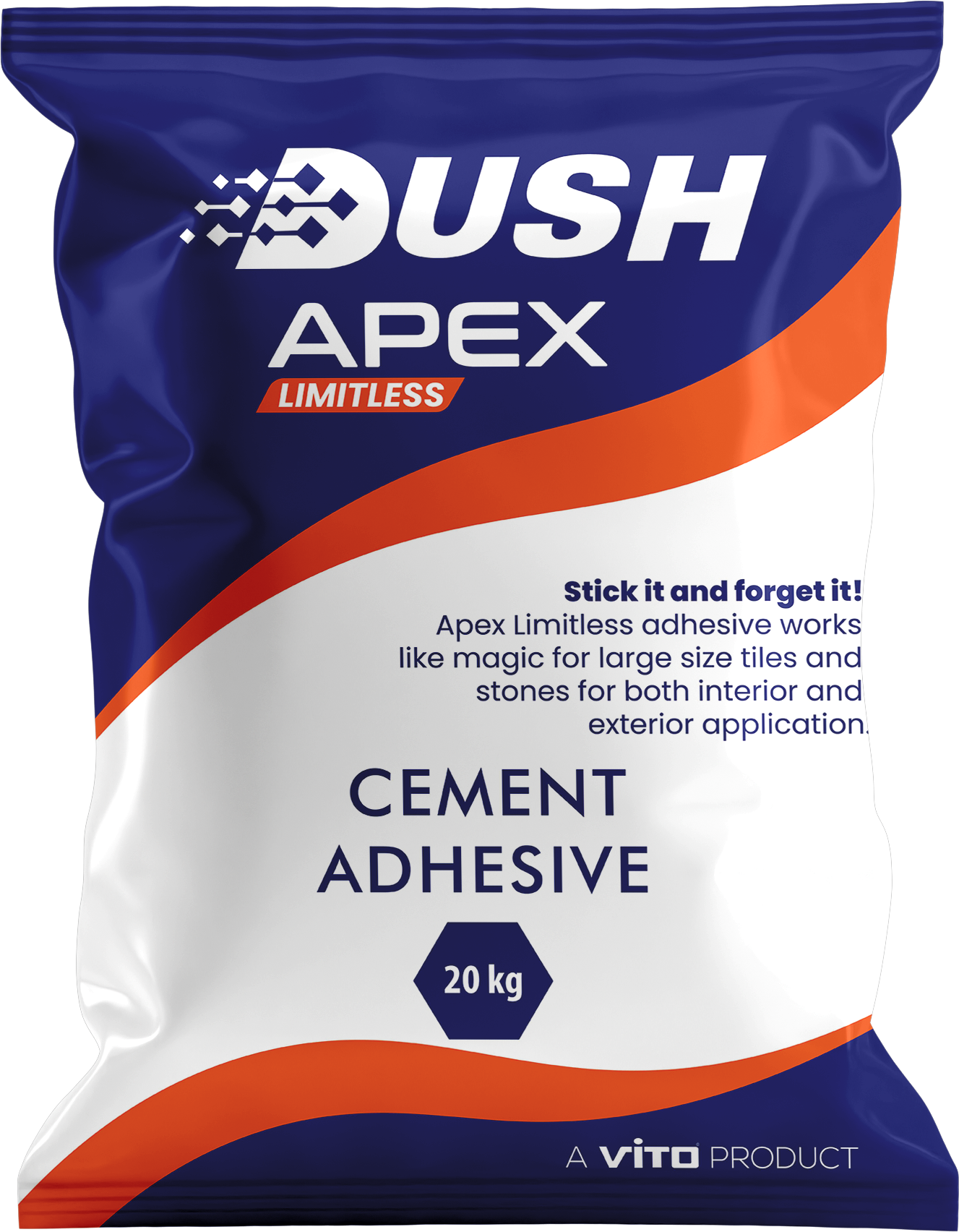
This guide walks through what's actually causing that kind of staining, which specific adhesive properties prevent it, and how DUSH APEX — a professional-grade white cement adhesive built for marble — is formulated around exactly this problem.
What Actually Causes Staining Under White Marble
"Adhesive stains" isn't always one single mechanism — a few different things can cause discolouration to appear at the joints and edges of white marble, and it helps to know which one you're actually dealing with before assuming the fix.
Grey-cement bleed
Standard grey cement adhesive contains iron and manganese oxide compounds. As moisture migrates out of the adhesive during curing, it can carry these compounds with it, leaving a grey or brownish tint at joints and edges — the single most common and most avoidable cause of staining on white marble.
Efflorescence
A white, hazy, chalky bloom that can appear on or near the surface as soluble calcium salts within the cement migrate out with moisture and crystallise on evaporation. It's a different mechanism from grey bleed, and it can occur with either white or grey cement if the formulation, water ratio, or curing conditions aren't right.
Excess mixing water
Adding more water than the specified ratio "to make application easier" increases the amount of moisture that later has to migrate out of the cured adhesive — carrying more dissolved compounds with it as it goes, whether that's iron oxide from grey cement or soluble salts contributing to efflorescence.
Trapped moisture from a non-breathable substrate or membrane
If moisture can't escape through the substrate side, it's forced to migrate outward through the stone itself, increasing the concentration of whatever it's carrying — whether that's cement byproducts or moisture from elsewhere in the structure.
Contaminated mixing water or a dirty substrate
Water contaminated with other on-site chemicals, or a substrate carrying oils, curing compound residue, or other contamination, can introduce staining sources that have nothing to do with the cement itself.
Why this matters for diagnosis: grey-cement bleed is solved by switching to a genuine white cement formula. Efflorescence and excess-water staining are solved by correct mixing and a low-efflorescence formulation — switching only the colour of the cement won't fix a water-ratio or curing-condition problem. Knowing which mechanism is actually at play (or planning to prevent all of them at once) changes what "the right adhesive" actually means.
The Adhesive Properties That Actually Prevent Staining
- A genuine white cement base — manufactured from low-iron, low-manganese raw materials, not a grey cement tinted or marketed as "light."
- A low-efflorescence formulation — engineered to minimise the soluble salt content that causes chalky white bloom, independent of the base cement colour.
- Polymer modification — reduces the adhesive's overall water content and controls how moisture moves through the cured bond, limiting how much material gets carried to the surface during curing.
- A clearly specified mixing ratio — a documented, correct water-to-powder ratio that isn't left to guesswork on-site, since over-watering is one of the most common and easily avoidable causes of both bleed and efflorescence.
- Validated substrate compatibility — confirms the adhesive is designed to cure properly against the specific substrate being used, rather than trapping moisture unpredictably.
Beyond the Adhesive: Complementary Stain-Prevention Steps
Choosing the right adhesive is the biggest single factor, but it's not the only one. These practices reduce staining risk regardless of which adhesive is used, and are worth following alongside a correctly specified white cement product:
- Pre-seal porous marble before installation. A penetrating sealer applied to the underside and edges of porous marble before setting can reduce how much moisture and dissolved material the stone absorbs from the adhesive during curing.
- Mix with clean water only. Never use water that's been standing in an open site container that could be contaminated with dust, oil, or other construction chemicals.
- Follow the mixing ratio exactly. Resist the temptation to add extra water for easier spreading — this is one of the most common self-inflicted causes of both bleed and efflorescence.
- Allow proper curing time before sealing the surface. Sealing marble too early, before the adhesive has fully cured and released its excess moisture, can trap that moisture and increase the risk of staining or efflorescence appearing later, since it has nowhere left to go.
- Consider a moisture barrier on damp or below-grade substrates. Where the substrate itself carries persistent moisture, a barrier layer reduces how much additional moisture load the adhesive and stone have to manage.
How to Test Before Full Installation
Cut an Offcut
Use a spare piece of the actual marble being installed — not a different slab or sample.
Apply & Cure Fully
Set the offcut with the proposed adhesive and let it cure completely, including the full recommended cure period, not just initial handling time.
Inspect After Full Cure
Check the edges and underside for any tint or haze once curing is complete, since staining from moisture migration often isn't visible until the bond has fully dried out.
This test matters specifically because the staining mechanisms described above are often invisible on day one — testing on a piece of scrap material and waiting through the full cure period is the only reliable way to confirm a specific adhesive won't affect a specific batch of stone before it's committed across an entire installation.
Stain-Prone Practices vs. Stain-Preventing Practices
| Factor | Stain-Prone Approach | Stain-Preventing Approach |
|---|---|---|
| Cement base | Grey cement, or unverified "light" cement | Genuine white cement, low iron/manganese |
| Efflorescence control | Not addressed in the formulation | Low-efflorescence formulation |
| Mixing water | Added by eye, no fixed ratio | Specified, documented ratio followed exactly |
| Testing before full installation | Skipped — applied directly across the job | Offcut tested and fully cured first |
| Sealing timing | Sealed immediately after setting | Sealed only after full adhesive cure |
Where DUSH APEX Fits
DUSH APEX is built on a genuine white cement base specifically to avoid the grey-bleed staining that's the most common cause of discolouration on light marble, while its documented mixing ratio and application guidance directly address the excess-water and inconsistent-application risks described above. Combined with its C2-class bond strength and weather-resistant formulation, the goal isn't just a strong bond — it's a bond that protects the finished appearance of the stone it's holding in place, which is exactly the standard white marble installations need.
Frequently Asked Questions
Is grey-cement bleed the same thing as efflorescence?
Can efflorescence happen even with white cement adhesive?
How long should I wait before sealing marble after installation?
Does adding extra water to the adhesive mix really cause staining?
Should I pre-seal white marble before installation, even with a good white cement adhesive?
If staining has already appeared, is it always permanent?
Protect White Marble From the First Slab Down
Genuine white cement base, documented mixing ratio, and C2-class strength — DUSH APEX is formulated to protect the finish of white marble, not just bond it.
Product information referenced from the official DUSH APEX product page. General information about cement staining mechanisms and efflorescence is provided as industry background for a general audience. Always patch-test on an offcut of the actual stone being installed, and consult the manufacturer's technical data sheet for complete specification and mixing detail.