Which Is Better for Concrete Floors: Densifier or Sealer?
A densifier and a sealer solve different concrete-floor problems. A densifier primarily reacts within suitable concrete to increase surface density, hardness and dust resistance. A sealer primarily helps protect the floor from water, stains, oils or surface contamination—but the category includes penetrating treatments as well as topical guards and coatings. This guide compares them for factories, warehouses, polished concrete, commercial floors and existing slabs.
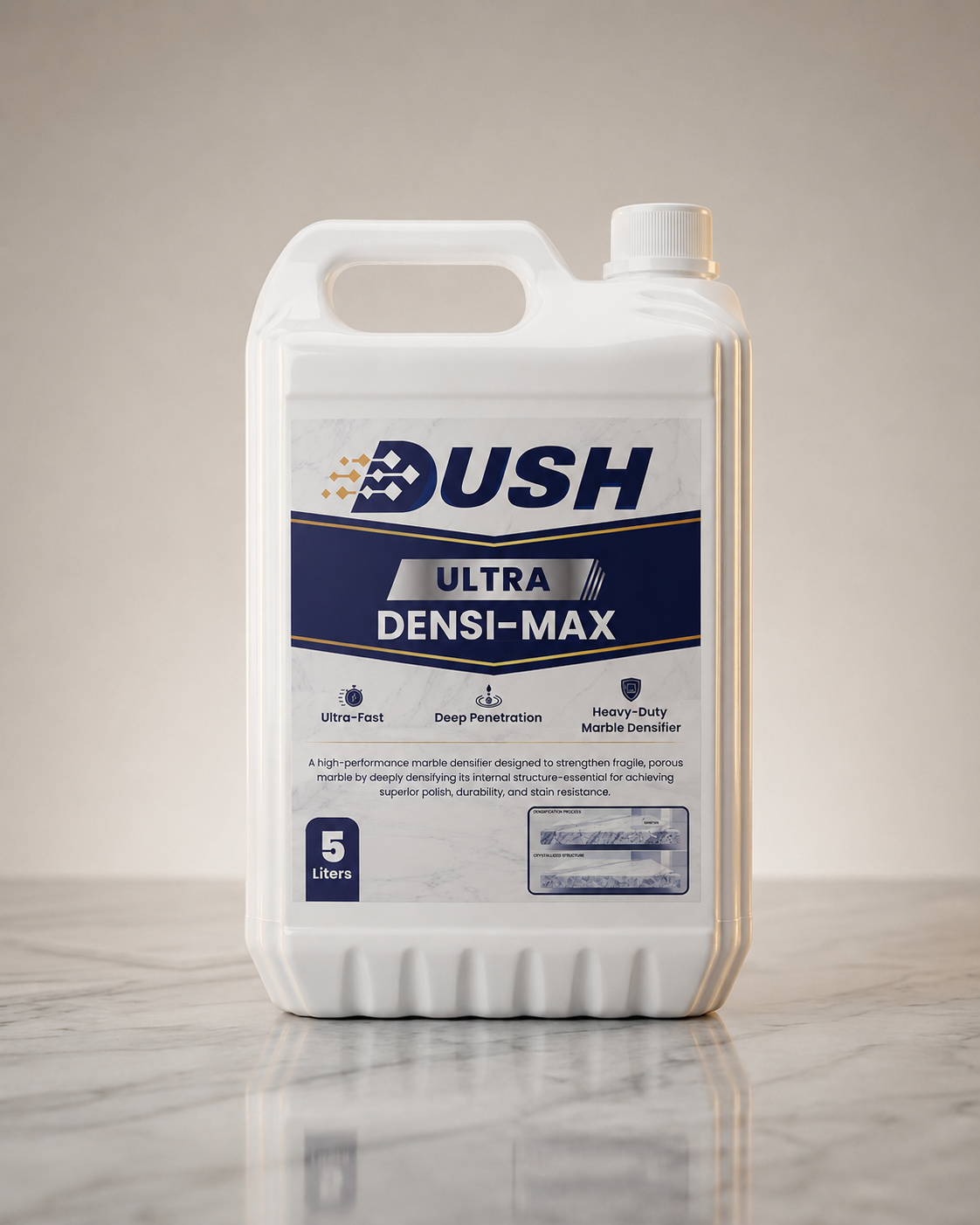 DUSH DENSI-MAX ULTRACurrent documented use: marble & natural stone
Important Product-Fit Note: DUSH DENSI-MAX ULTRA Is Not Currently Documented for Concrete Floors
The product name “densifier” can create confusion because densification chemistry is used in both natural-stone treatment and concrete-floor treatment. The substrate, reaction, preparation and specification are not automatically interchangeable.
DUSH’s current DENSI-MAX ULTRA product page describes the product as an intensive penetrating treatment for highly porous white marble, Makrana marble and sandstone. DUSH’s current all-products catalogue lists DENSI-MAX ULTRA as an “Ultra-Premium Marble Densifier” for premium marble, Italian marble and natural stone. The public catalogue does not presently list a DUSH surface densifier whose stated use is industrial concrete flooring.
This distinction matters because the word “densifier” is used for both stone treatment and concrete treatment, but the substrate chemistry and application requirements are not automatically interchangeable. A product used to harden concrete should have a current TDS that explicitly names concrete, explains the reactive chemistry or hardening mechanism, gives surface preparation and application instructions, and states coverage, excess-removal and traffic requirements.
Why Densifier and Sealer Are Often Confused
Concrete product names overlap. A densifier may also reduce water absorption and be marketed as a “sealer,” while a sealer can be a penetrating treatment, a stain-resistant guard or a topical film. This is why it is risky to choose from the product name alone.
PROSOCO currently calls Consolideck LS a concrete sealer, hardener and densifier. Euclid describes EUCO Diamond Hard as a liquid densifier and sealer for concrete. Sika CureHard-24 is described as a sodium-silicate hardener, dustproofer, densifier and impregnating sealer. These examples show that one formulation can deliver more than one function.
At the same time, manufacturers also sell separate protective finishes. Sika’s polished-concrete range includes polymeric water- and stain-resistant finishes, and Euclid’s UltraGuard is a polymeric protectant with stain resistance that also contains lithium silicate.
Concrete Densifier vs Sealer: The Main Difference
| Feature | Concrete densifier | Concrete sealer / guard |
|---|---|---|
| Primary purpose | Increase surface density, hardness and dust resistance | Reduce penetration of water, stains, oils or contaminants |
| Where it works | Primarily within the near-surface concrete pore structure | Can penetrate into pores or form/provide protection at the surface depending on chemistry |
| Typical chemistry | Lithium, sodium, potassium or blended reactive silicates | Silicates, silanes/siloxanes, acrylics, polymers, guards and other protective chemistries |
| Hardens concrete? | Yes, when it is a reactive concrete-specific densifier | Not necessarily; depends on whether the sealer also contains/reacts as a densifier |
| Reduces dusting? | A common documented benefit | Some do, but stain/water sealers are not automatically concrete hardeners |
| Stain resistance? | Usually limited unless the product also includes protective chemistry | Often the primary purpose of guards/sealers |
| Polished concrete? | Commonly used within polishing systems | Often added afterward when stain/water protection is required |
| Appearance change? | Usually minimal, depending on product and polishing | Can be invisible, enhance colour or add sheen depending on the product |
| Reapplication? | Reactive densification is generally not treated like a sacrificial topical coating | Some guards/topical sealers require maintenance or renewal |
What Does a Concrete Densifier Do?
A concrete densifier is a penetrating reactive treatment. Silicate-based products enter suitable concrete and react within the cement paste, creating additional hard, insoluble material in the pore structure. This increases surface density and hardness and can reduce dusting and abrasion.
PROSOCO’s LS is currently documented as a premium concrete sealer, hardener and densifier for new or old concrete. The manufacturer says its increased surface hardness eliminates dusting and simplifies maintenance. Euclid’s UltraSil Li+ is documented as a lithium-silicate solution that penetrates and reacts within concrete to produce dense calcium silicate hydrate in the pores.
Densifiers are especially common on exposed concrete and polished floors because they do not need to create a thick paint-like layer to improve the surface.
What Does a Concrete Sealer Do?
A concrete sealer is a much broader category. Depending on chemistry, it may reduce water penetration, improve stain resistance, resist oil, make cleaning easier, protect colour or add a burnished finish. Some sealers penetrate the concrete; others leave a protective film or surface guard.
Sika’s current polished-concrete range distinguishes between lithium/sodium densifiers and polymeric water- and stain-resistant finishes. This is useful because it shows two different jobs: the densifier improves concrete hardness, while the protective finish helps guard the finished surface.
Euclid UltraGuard illustrates a hybrid approach. It is a polymeric protectant with a stain-resistant additive and lithium silicate, so it adds protection while also contributing to densification.
Which Is Better for Hardness and Abrasion?
If hardness is the main objective, choose a concrete-specific densifier/hardener. Reactive silicates are designed to increase the density and hardness of suitable concrete. Sika’s lithium densifier products, for example, are specifically marketed for improving concrete surface hardness and ease of polishing.
A stain sealer that does not contain reactive hardening chemistry should not be expected to densify a weak surface. It may protect the floor from liquids while leaving the underlying concrete mechanically unchanged.
For forklift-heavy factories and warehouses, also inspect joints, wheel paths and grit. A harder surface cannot compensate for broken joint shoulders, slab movement or aggressive impact.
Which Is Better for Concrete Dusting?
For a sound concrete floor producing fine powder, a concrete-specific reactive densifier is normally the more relevant product. PROSOCO LS/CS is explicitly described as a hardener/densifier and dustproofer, while Euclid UltraSil Li+ is also documented for dustproofing concrete.
A topical sealer can sometimes trap or reduce dust at the surface, but if the concrete paste itself is weak or powdery, strengthening the concrete with an appropriate densifier is generally the more direct approach. Severe scaling or delamination still requires repair.
Which Is Better for Oil, Water and Stain Resistance?
If staining is the main concern, a protective sealer or guard usually deserves more attention than a basic densifier alone. Densification reduces porosity, but densified concrete can still be porous and can still absorb staining liquids.
PROSOCO’s concrete-flooring system separates densifiers from oil/water repellents and guards, which reinforces this distinction. Sika likewise offers polymeric water- and stain-resistant finishes for polished concrete.
For factories with cutting oil, lubricants or chemicals, identify the actual liquids and contact time. A light stain guard is not the same as a chemical-resistant epoxy or PU lining.
Which Is Better for Polished Concrete?
For polished concrete, the answer is often both. A reactive densifier is commonly used during the grinding and polishing sequence to strengthen and densify the concrete. After polishing, a compatible guard or sealer may be applied where stain or water resistance is important.
The densifier does not create the polished gloss by itself. Mechanical honing and polishing create the finish. The protective guard adds another performance layer rather than replacing the densification step.
This system approach is common in commercial, retail, warehouse and industrial polished-concrete floors where appearance and maintenance both matter.
Densifier or Sealer for Warehouses and Factories?
For a sound warehouse or factory slab with dusting and forklift abrasion, start by evaluating a concrete-specific densifier/hardener. If the same floor also faces oil drips, tyre contamination or liquids that cause staining, add a compatible protection strategy.
| Operational problem | Primary product to evaluate | Possible additional treatment |
|---|---|---|
| Concrete dusting | Reactive densifier / hardener | Maintenance cleaning programme |
| Forklift abrasion | Densifier on sound concrete | Joint repair and grit control |
| Oil staining | Protective guard / sealer | Densifier underneath where hardness is also needed |
| Water absorption | Appropriate penetrating sealer / repellent | Densifier if dust/hardness is also a concern |
| Polished appearance | Densifier within polishing system | Compatible stain guard / burnishing finish |
| Aggressive chemical exposure | Specialist resin/lining system | Densifier alone is usually insufficient |
When Should You Use Both a Densifier and Sealer?
Use both when the floor needs two different performance outcomes: stronger, denser concrete and improved protection from liquids or stains. This is particularly common on polished concrete, premium warehouses, showrooms and commercial floors.
The sequence depends on the system. A densifier is generally used when the concrete is open enough to absorb and react with it. The protective guard or sealer is applied later according to compatibility and finishing instructions. Do not assume any two products can be layered together.
When Neither a Basic Densifier nor Sealer Is Enough
Deep spalling
Repair or resurface the concrete before applying final protective treatments.
Structural cracks
Diagnose movement and structural causes; neither densifier nor sealer stabilises a moving slab.
Severe chemical attack
A chemical-resistant epoxy, PU or specialist lining may be required.
Major unevenness
Use a levelling or overlay system when the floor profile itself must be corrected.
Failed joints
Repair joint edges and manage impact before expecting a surface treatment to solve debris.
Contaminated concrete
Oil, grease and previous coatings can prevent penetration or adhesion and must be addressed first.
Concrete Densifier vs Sealer: Quick Comparison
| Question | Densifier | Sealer / guard |
|---|---|---|
| Best for increasing concrete hardness? | Yes | Only if it also contains/reacts as a hardener |
| Best for reducing dusting? | Yes, on suitable concrete | Not always |
| Best for stain resistance? | Limited unless combined with protective chemistry | Usually better |
| Best for water repellency? | Can reduce porosity but is not always a dedicated repellent | Use a sealer specifically documented for water repellency |
| Best for polished concrete? | Commonly part of the polishing process | Often useful as a compatible final guard |
| Does it create a thick coating? | Normally no | Some do; penetrating sealers may not |
| Can both be used? | Yes, when the products are compatible and the floor needs both densification and surface protection | |
How to Choose Between a Concrete Densifier and Sealer
Start with the performance gap: hardness and dusting point toward densification; stain and liquid protection point toward sealing. If you need both, specify a compatible system rather than choosing one product by name.
Diagnose the slab
Check strength, laitance, dusting, contamination, coatings, joints, cracks, moisture and previous treatments.
Define the finish
Decide whether the goal is basic dustproofing, polished concrete, burnished concrete or a base for another protective system.
Match the TDS
Choose a product that explicitly covers concrete, slab age, preparation and your intended polishing or traffic conditions.
Run a trial
Confirm absorption, application rate, residue, appearance and polishing response before full-floor rollout.
1. Start with slab condition
A dense, well-finished industrial slab may absorb differently from an older porous warehouse floor. A surface contaminated by oil or curing compounds may reject a penetrating treatment. A weak laitance layer may need grinding first. These differences directly affect coverage and reaction.
2. Decide whether you need hardening, staining protection or chemical resistance
Concrete densification is not the same as stain guarding. PROSOCO notes that densified concrete is still porous and may need a guard where staining is a concern. Industrial buyers should define the operational exposure before choosing one bottle to solve multiple problems.
3. Check technical data, not only marketing copy
A credible concrete-densifier TDS should identify the approved substrate, active chemistry, coverage range, preparation, application method, wet time, excess removal, temperature limits, traffic time and compatibility with polishing or other treatments.
4. Evaluate total installed cost
Container price is only one part of cost. Coverage, number of passes, labour, cleaning of residue, grinding steps, shutdown time, guards, burnishing and maintenance all affect the final rupees per square metre.
How to Choose: Densifier, Sealer, Both or a Different Flooring System?
| Your main requirement | Start with |
|---|---|
| Harder, lower-dusting exposed concrete | Concrete-specific reactive densifier/hardener |
| Oil and stain resistance on a polished floor | Densifier + compatible stain guard |
| Water repellency without a heavy film | Appropriate penetrating water-repellent sealer |
| Decorative gloss / protective finish | Compatible topical guard/sealer after concrete preparation |
| Aggressive chemical exposure | Chemical-resistant resin or specialist lining |
| Damaged, uneven or spalled slab | Repair / overlay first |
What Densifiers and Sealers Cannot Fix on Their Own
Concrete-floor problems are often misdiagnosed because “hardener” sounds like a universal repair. A densifier does not rebuild missing concrete, bridge active cracks or correct a failed joint. It does not turn poor structural concrete into high-strength concrete and it does not create the chemical barrier of an epoxy or polyurethane coating.
This is also why a stone densifier should not be re-labelled as a concrete densifier without product-specific evidence. The correct chemistry may be related, but the substrate specification and application requirements must still be documented.
Typical Decision Workflow: Densifier or Sealer?
The exact method must follow the selected product TDS, but a professional workflow normally includes the following decisions.
- Inspect and test the slab. Record cracks, joints, contamination, curing compound, coatings, moisture and areas of weak concrete.
- Complete necessary repairs. Repair broken joints, spalls and other defects with systems compatible with the final finish.
- Prepare the surface. Remove contamination and any barrier that prevents penetration. In polished concrete, complete the specified grinding stages first.
- Apply the densifier evenly. Use the manufacturer-approved sprayer, applicator or microfibre method. Avoid puddles and untreated dry zones.
- Maintain the required wet time. Different products have different instructions. Do not invent one universal dwell time.
- Remove or redistribute excess as required. Some modern products are designed for no flushing; others require specific cleanup.
- Continue polishing or guarding. If the floor is being polished, follow the agreed grit sequence and compatible guard/burnishing procedure.
- Open to traffic only as permitted. Follow the current technical sheet for traffic time and final performance development.
Concrete Densifier / Sealer Procurement Checklist
| Question to ask supplier | Why it matters |
|---|---|
| Does the current TDS explicitly list concrete? | Prevents extending stone or masonry claims to industrial concrete. |
| Is it approved for new concrete, old concrete or both? | Age and hydration stage affect application. |
| What is the active chemistry? | Helps compare lithium, sodium, potassium, blends and other systems. |
| What preparation is required? | Penetrating products fail when coatings or contamination block absorption. |
| What is the coverage range on polished vs porous concrete? | Coverage can change dramatically with absorption. |
| Does excess product need flushing or removal? | Directly affects labour, residue risk and downtime. |
| Can it be used within our polishing sequence? | Timing affects grinding, colour and finish. |
| Do we need a separate stain guard? | Densification alone may not be enough for oil or food exposure. |
| What is the documented traffic time? | Critical for warehouses and live factories. |
| Can the supplier support a site trial? | The densifier should be proven on the actual slab before the full area is treated. |
Does DUSH DENSI-MAX ULTRA Fit a Concrete Densifier-vs-Sealer Specification?
DUSH DENSI-MAX ULTRA
DUSH currently positions DENSI-MAX ULTRA as an ultra-premium densifier for high-end Italian marble and premium natural stone. The current DUSH product page also describes intensive treatment for porous white marble, Makrana marble and sandstone.
Based on DUSH’s current public documentation, DENSI-MAX ULTRA belongs to the marble and natural-stone treatment category, not a documented concrete densifier/sealer specification. The current DUSH product page identifies highly porous white marble, Makrana marble and sandstone rather than concrete. DUSH also publishes stone-focused content describing DENSI-MAX ULTRA as a densifier-sealer for porous marble. That stone use should not be transferred automatically to concrete. If DUSH publishes a concrete-specific TDS or written technical approval, use that document as the controlling specification.
Frequently Asked Questions
These questions are written for architects, factory owners, warehouse managers, flooring contractors, consultants and procurement teams evaluating densifiers in India.
What is a concrete densifier?
A concrete densifier is a reactive treatment, usually based on silicate chemistry, that penetrates the concrete surface and reacts with calcium-bearing compounds in the cement paste. The reaction forms additional hard mineral structure within the pores, helping create a tighter, harder and less dusty surface.
Which is better for concrete floors: densifier or sealer?
A densifier is better when you need a harder, lower-dusting concrete surface. A sealer or guard is better when you mainly need water, oil or stain protection. Polished and industrial floors often use both when the products are compatible.
Is DUSH DENSI-MAX ULTRA a concrete densifier?
Based on DUSH current public product page and catalogue reviewed in August 2026, DENSI-MAX ULTRA is documented as a densifier for premium marble, Italian marble and natural stone. The public product information does not currently establish it as an industrial concrete-floor densifier.
Can I use DUSH DENSI-MAX ULTRA on an industrial concrete floor?
Do not specify it for industrial concrete solely from the current public marketing page. Use it on concrete only if DUSH provides a current product TDS or written technical approval that explicitly lists concrete and gives the required preparation, coverage, application and curing instructions.
Why does a densifier reduce concrete dusting?
Reactive silicate densifiers can tighten and harden the weak, porous cement-paste structure near the surface. A denser surface is less prone to powdering under traffic, although severe dusting caused by weak concrete, overwatering, poor finishing or contamination may require more than a densifier.
Does a densifier make concrete waterproof?
No. Densification can reduce open pore volume, but it does not automatically make concrete waterproof or fully stain-proof. Separate guards, sealers, membranes or waterproofing systems may be required depending on exposure.
Does a densifier repair cracks?
No. A densifier is not a structural crack-repair material, joint filler or patching mortar. Moving cracks, broken joints and damaged concrete should be diagnosed and repaired with an appropriate system before or alongside floor treatment.
Does a densifier replace epoxy flooring?
No. A densifier and an epoxy coating solve different problems. Densifiers react within concrete and keep the concrete appearance; epoxy forms a resinous coating that can provide colour, chemical resistance and a different wearing surface.
Is lithium silicate always better than sodium silicate?
Not automatically. Lithium systems are widely used because they can be fast, convenient and low in problematic residue, but product design, solids, substrate condition and application quality matter. Sodium, potassium, blended silicate and colloidal-silica systems can also be appropriate when properly specified.
When should a densifier be applied during polishing?
The correct stage depends on the system and slab. Some polished-concrete workflows apply densifier after initial grinding and before later polishing steps. Always follow the densifier manufacturer current instructions and the polishing contractor approved method.
Can densifier be used on old concrete?
Many concrete-specific densifiers are intended for existing as well as newer concrete. Old slabs still need evaluation for oil contamination, curing compounds, sealers, weak laitance, moisture, repairs and previous coatings that could block penetration.
Can densifier be used on new concrete?
Some concrete-specific products are designed for green or newly placed concrete, while others are intended for cured floors or polishing systems. The product TDS must explicitly support the age and condition of the concrete.
Does concrete need grinding before densifier?
Not in every system. Polished-concrete projects typically grind as part of the finishing sequence, while dustproofing of a sound industrial slab may use a different preparation method. Surface contamination, laitance and coatings must be addressed so the treatment can penetrate.
How much densifier is required per square metre?
Coverage varies significantly with porosity, finish and product chemistry. Do not estimate quantity from another brand coverage rate. Use the selected product current TDS, carry out a representative trial and include additional material for highly absorptive areas.
Will densifier make an industrial floor shiny?
A densifier itself is primarily a chemical hardening treatment. Higher gloss usually comes from mechanical honing, polishing and burnishing. Some systems can improve appearance or polish retention, but a densifier should not be sold as a substitute for the polishing process.
Can a densifier protect against forklift traffic?
A properly specified densifier can improve the concrete surface resistance to abrasion and dusting, but it cannot compensate for a weak slab, failed joints, impact damage or inadequate structural design. Forklift routes should be evaluated as part of the complete floor system.
Is a densifier suitable for warehouses?
Concrete-specific densifiers are commonly used in warehouse and distribution-floor systems where a hard, dust-reduced concrete surface is desired. Product suitability still depends on the slab and whether chemical, oil, tyre or stain exposure requires an additional protective treatment.
Can I apply a concrete sealer after a densifier?
Often yes. Many polished-concrete systems use a densifier first and a compatible protective guard or sealer later. Follow the product system and TDS because a sealer can block later densifier penetration if used in the wrong sequence.
What should I check in a concrete densifier TDS?
Check the approved substrate, active chemistry, surface preparation, application rate, wet time, number of coats, removal of excess, cure or traffic time, temperature limits, compatibility with polishing and guards, VOC data, safety information and stated limitations.
Why is a site trial important?
Concrete varies from slab to slab and even within the same floor. A trial helps confirm absorption, appearance, residue, application rate, polishing response and whether the chosen treatment is addressing the actual problem.
What if my industrial floor is already badly damaged?
If the floor has deep spalling, severe dusting, moving cracks, failed joints, oil saturation or delamination, start with diagnosis and repairs. Densification works best when the underlying concrete is suitable for treatment.
How should an Indian buyer compare concrete densifiers?
Compare the current TDS, concrete-specific use, chemistry, coverage on your slab, application labour, compatibility with polishing, dustproofing objective, need for stain protection, technical support, repeat supply and total installed cost rather than only container price.
Should I choose DUSH DENSI-MAX ULTRA for concrete today?
Not from the current public documentation alone. DUSH DENSI-MAX ULTRA is currently presented for premium marble and natural stone. For an industrial concrete floor, request written concrete-specific technical approval or select a product whose current TDS explicitly covers concrete densification.
Technical References Used for This Guide
This article distinguishes manufacturer-published information from independent proof. The sources below are official manufacturer pages used to understand each product current documented substrate and chemistry.
- DUSH DENSI-MAX ULTRA official product page — current public use is premium marble / white marble / sandstone / natural stone.
- DUSH All Products Catalogue — lists DENSI-MAX ULTRA as an ultra-premium marble densifier and does not currently list a DUSH surface densifier specifically for industrial concrete.
- PROSOCO Consolideck LS and LS/CS official technical pages — examples of concrete-specific reactive silicate densifier documentation.
- PROSOCO concrete densification technical guide — manufacturer explanation of silicate reaction and CSH formation in concrete.
- Euclid Chemical UltraSil Li+, UltraSil 7 and EUCO Diamond Hard official pages — examples of concrete-specific lithium-silicate and reactive densifier products.
Product pages and technical documentation can change. Re-check the latest TDS before specification, pricing, procurement or application.
Need the Correct DUSH System for Your Floor?
If the substrate is marble, natural stone or concrete, send the project details to DUSH and request the exact current TDS before ordering. For industrial concrete, ask specifically for a product that is documented for concrete densification.
Ask DUSH About Your Floor
Share the substrate, floor age, traffic, current condition and the result you need.