What Are the Applications of Floorzy Heat Lock?
Floorzy Heat Lock is mainly used to reduce solar roof heat on existing industrial buildings. Its applications include factories, warehouses, industrial sheds, logistics centres, textile units, automobile-component plants, selected process buildings and other large structures with compatible GI sheet, pre-painted steel, asbestos-cement or concrete roofs.
Why Factory Roofs Become So Hot in India
Large industrial roofs can receive direct sunlight for hours. Metal sheets, fibre-cement sheets and concrete absorb part of that solar energy and become hot. Heat then moves inward by conduction and radiation, warming the air and surfaces below.
Factories often experience an additional internal heat load from machinery, lighting, ovens, compressors, motors, people and process equipment. This is why two buildings with the same roof can have very different indoor temperatures.
Government cool-roof guidance explains the basic physics clearly: conventional dark roofs absorb more sunlight, while cool roofs absorb less sunlight, stay cooler and transfer less heat into the building. Cool-roof performance is mainly associated with solar reflectance and thermal emittance.
Solar gain
The roof absorbs sunlight and converts it into heat. Reducing this first step lowers the heat entering the building envelope.
Internal heat
Machines and production processes can add substantial heat independently of the roof.
Ventilation
Even after roof heat is reduced, trapped hot air may still require ventilation or mechanical cooling.
10 Main Applications of Floorzy Heat Lock
1. Factory Roof Heat Reduction
Heat Lock is primarily used on industrial roofs that absorb strong solar heat during the day. Applied externally, it helps reduce the amount of solar energy converted into roof heat before that heat moves into production areas.
2. Warehouse Roof Cooling
Large warehouses can accumulate considerable heat below broad roof areas. Heat Lock can reduce the external solar load on compatible warehouse roofs, helping lower the roof’s contribution to indoor heat.
3. Industrial Shed Cooling
GI and pre-painted steel sheds can become extremely hot under direct sun. Where the roof is structurally sound, Heat Lock can provide a retrofit option without replacing the complete roof.
4. Logistics and Fulfilment Centres
Sorting, picking, packing and dispatch facilities often operate for long hours. A reflective roof treatment can reduce solar heat entering through large exposed roof areas while work continues inside.
5. Manufacturing Plants
Automobile-component, engineering, packaging and general manufacturing plants can use Heat Lock where roof heat adds significantly to daytime indoor temperatures.
6. Textile and Garment Units
Textile and garment buildings may already contain people and machinery that produce heat. Heat Lock can reduce the additional solar component coming through the roof, although ventilation and process heat still need separate management.
7. Food-Processing and Selected Process Buildings
Heat Lock can be used as an external solar-load-reduction layer on compatible roofs, but it does not replace hygiene, HVAC, process-temperature or insulation requirements.
8. Concrete Industrial Roofs
Suitable concrete roofs can absorb and store solar heat. Heat Lock can reduce this surface heating where the concrete is sound and major waterproofing defects have already been addressed.
9. Retrofit Upgrades Without Roof Replacement
A key application is improving a structurally sound existing roof without demolition. This can reduce project scope where the roof itself is serviceable but becomes excessively hot.
10. Combined Industrial Heat-Management Systems
Heat Lock can form one part of a broader strategy that also includes ventilation, exhaust, insulation or process-heat control. It addresses solar heat at the roof surface while other systems address different heat sources.
Heat Lock Applications by Roof Type
GI Sheet Roofs
Strong application for factories, warehouses and sheds with structurally sound GI roofing.
Pre-Painted Steel Roofs
Useful on compatible colour-coated industrial steel roofs after checking coating adhesion and preparation.
Asbestos-Cement Roofs
Applicable where sheets remain structurally serviceable and safe access can be managed.
Concrete Roofs
Can reduce solar heating on sound concrete roofs after cracks, ponding and waterproofing are assessed.
Existing Industrial Roof Retrofits
Especially relevant where roof replacement is unnecessary and solar heat is the main concern.
Large Solar-Exposed Roof Areas
Most useful where a substantial part of daytime heat gain comes from direct sun on the roof.
Heat Lock Application Matrix
| Application | Suitability | Main purpose | Important check |
|---|---|---|---|
| Factory roof cooling | Strong | Reduce solar roof heat | Roof condition |
| Warehouse roof cooling | Strong | Reduce solar load over storage/work zones | Ventilation and stored-goods needs |
| Industrial sheds | Strong | Reduce metal/cement-sheet roof heating | Corrosion and fasteners |
| Logistics centres | Good | Reduce external solar load | Dock openings and airflow |
| Concrete roofs | Good | Reduce solar absorption | Waterproofing and cracks |
| Cold storage | Supplementary only | Reduce outer solar load | Insulation and refrigeration remain essential |
| High process-heat factories | Supporting role | Reduce solar component | Ventilation/extraction still required |
| Failed roof | Not suitable first | — | Repair or replacement first |
Why Heat Lock Is Especially Useful on Existing Industrial Roofs
Heat Lock Roofing System
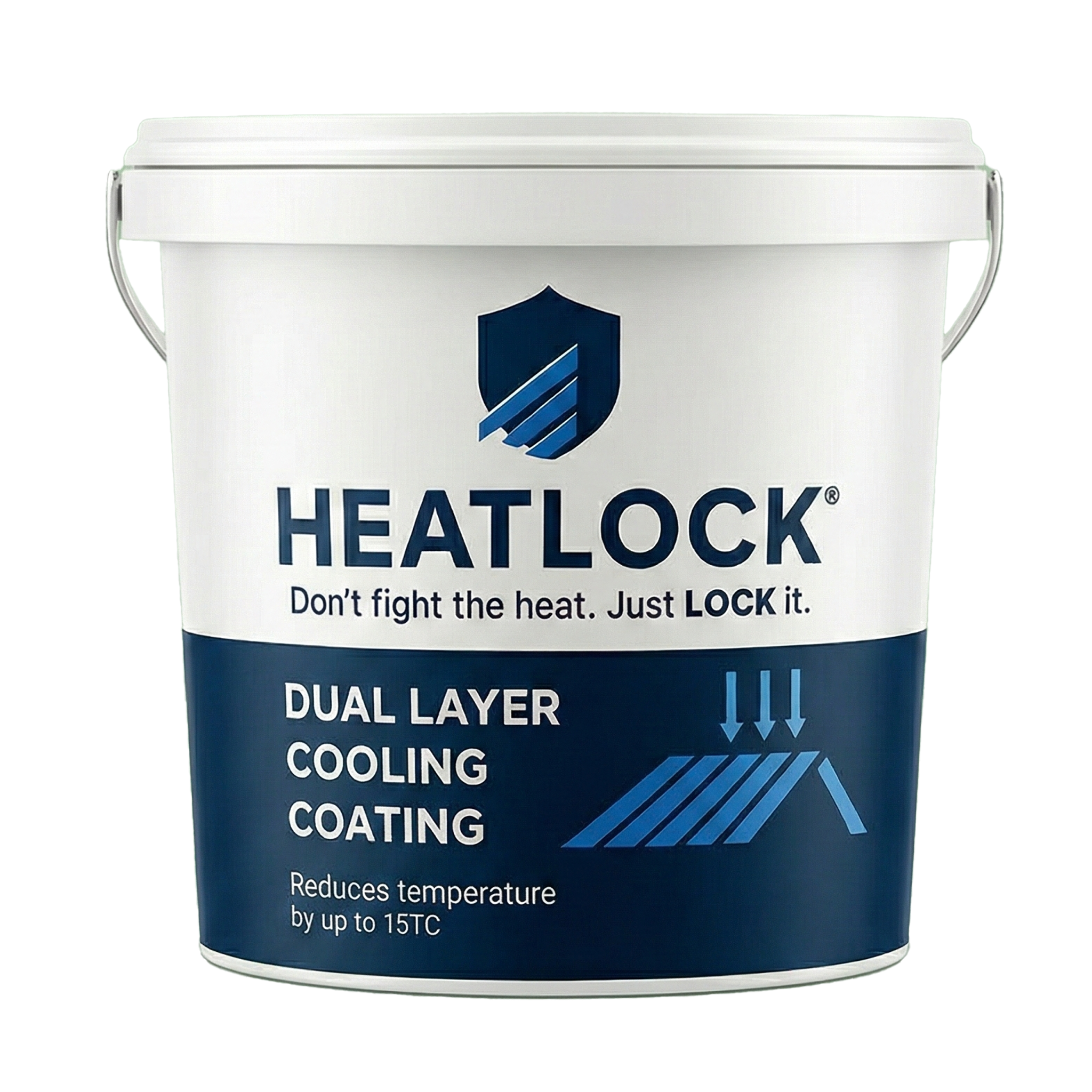
Floorzy describes Heat Lock as a solar-reflective thermal-barrier coating by DUSH Italy applied over compatible industrial roofs. The system is positioned for existing GI, pre-painted steel, asbestos-cement and concrete roofs.
Floorzy’s current product page publishes solar reflectance of 0.65–0.80, thermal emittance above 0.85, roof-surface temperature reduction of up to 15°C, external installation in 1–2 days for a typical mid-sized roof and a published 5–7 year maintenance cycle.
Explore Heat LockHow Reflective Roof Cooling Works
A reflective roof system works at the first point of heat entry: the outer roof surface. Instead of allowing a large share of sunlight to become roof heat, a higher-reflectance surface sends more solar energy away.
The second important property is thermal emittance—the ability of the roof surface to release absorbed heat as thermal radiation. A surface with high reflectance and high emittance can remain cooler than a darker, more absorptive surface under strong sun.
Government energy guidance states that cool roofs lower indoor air temperatures by reflecting sunlight and decreasing heat absorption. In warm or hot climates, the benefit can include lower cooling demand and improved comfort, although building-specific savings vary.
Sunlight reaches roof
The roof receives solar energy.
More energy is reflected
A cool surface sends a larger fraction away instead of absorbing it.
Absorbed heat is released
High emittance helps the surface release heat efficiently.
Less heat moves indoors
A cooler roof reduces the heat load moving into the building below.
Best Heat Lock Use by Roof Condition
| Roof condition | Recommended action |
|---|---|
| Structurally sound, hot in direct sunlight | Strong Heat Lock candidate |
| Minor rust, loose dirt or local surface defects | Prepare and repair before coating |
| Hairline cracks / pinholes only | Assess as part of Heat Lock preparation; do not treat as full waterproofing |
| Major active leaks | Repair / waterproof first |
| Heavy corrosion or perforated sheets | Repair or replace affected roofing first |
| Structural weakness / end-of-life roof | Roof replacement before heat-reduction coating |
Where Heat Lock Is Most Recommended
| Situation | Recommendation | Reason |
|---|---|---|
| Existing factory roof + high solar heat | Heat Lock first | Directly reduces solar absorption at the existing roof surface |
| Existing warehouse roof + hot upper zone | Heat Lock + ventilation review | Reduces external solar load while ventilation manages trapped hot air |
| Concrete roof + major leakage | Waterproofing first | Water-entry failure needs a dedicated system |
| New factory | Insulated roof design first | New construction allows insulation to be engineered into the roof assembly |
| Cold storage | Insulation/HVAC first; Heat Lock supplementary | Controlled-temperature facilities need a full thermal envelope |
| High process heat | Heat Lock + extraction/ventilation | Solar heat and internal heat need different controls |
Heat Lock vs Ordinary White or Roof-Cooling Paint
A light-coloured roof can reflect more sunlight than a dark roof, but colour alone does not prove industrial heat-reduction performance. A factory owner should compare solar reflectance, thermal emittance, substrate compatibility, preparation, coating build, ageing and how the temperature claim was measured.
Floorzy positions Heat Lock as an engineered solar-reflective thermal-barrier system rather than ordinary decorative roof paint. The key difference in procurement is that Heat Lock is sold around published SR and TE performance plus measured roof-temperature verification.
| Selection point | Heat Lock | Ordinary light roof paint |
|---|---|---|
| Primary purpose | Industrial roof heat reduction | General coating / colour, depending on product |
| Published SR / TE | Floorzy publishes SR 0.65–0.80 and TE above 0.85 | Must be checked product by product |
| Industrial substrate focus | GI, pre-painted steel, asbestos-cement and concrete listed by Floorzy | Varies by paint formulation |
| Verification | Floorzy promotes sample-panel temperature comparison | Depends on supplier |
Reflective Coating vs Roof Insulation: Which Is Better?
They solve different parts of the heat-transfer problem. A reflective coating reduces how much solar energy the roof absorbs. Insulation resists heat flow through the roof assembly after a temperature difference exists.
For a new factory, these strategies can be designed together. An insulated sandwich-panel roof with an appropriate reflective exterior can offer stronger whole-roof thermal performance than a coating alone.
For an existing factory with a mechanically sound roof, installing insulation can be more invasive and may require internal access, service relocation or more detailed fire/moisture design. In that situation, an exterior reflective coating can be a more practical first retrofit if the main problem is solar roof heat.
Reflective Roof Coating vs Ventilation
Ventilation removes or replaces hot air. A reflective roof reduces heat before it enters. They are complementary, not necessarily competing, solutions.
A factory with ovens, compressors or motors may remain hot even after roof-surface temperature falls because internal heat generation is significant. Roof heat reduction can still lower the background load, while exhaust, make-up air, ridge ventilation or mechanical cooling handles the remaining heat.
Before spending on either system, map the heat sources. Compare roof-surface temperature, indoor air temperature, radiant heat below the roof and internal machinery loads at consistent times.
Does Roof Cooling Also Solve Leakage?
Heat and water are separate building-envelope problems even though some coatings can address both to a limited degree. Floorzy states that Heat Lock can seal hairline cracks and pinholes, which can help reduce minor water ingress.
However, a roof with severe corrosion, open laps, failed flashings, large cracks, ponding water or a failed waterproofing membrane should not be treated as a simple heat-reflective-coating project. Repair the roof first or specify a complete waterproofing solution compatible with the cooling layer.
Heat Lock for Existing Factories vs Insulated Roofing for New Factories
| Project type | Best starting point | Why |
|---|---|---|
| Existing sound factory roof | Heat-reflective coating such as Heat Lock | Uses existing roof and reduces solar heat gain externally |
| New factory design | Insulated panel + reflective roof strategy + ventilation | Thermal performance can be designed into building from start |
| Badly corroded metal roof | Repair or replace | Coating cannot restore structural metal |
| Concrete roof with major leakage | Waterproofing/repair first | Roof integrity is the first priority |
| Strong internal process heat | Roof cooling + ventilation/process heat control | Roof treatment cannot remove internally generated heat |
How Indian Climate Changes the Roof-Cooling Decision
Factories in India operate across hot-dry, hot-humid, coastal, dusty and monsoon-heavy climates. A reflective roof can reduce solar heat gain in each setting, but the complete comfort strategy should account for humidity, ventilation, rainfall, corrosion and soiling.
In hot-dry regions, strong solar gain may dominate the roof load, making reflectance particularly important. In coastal or humid regions, salt, corrosion and moisture control deserve more attention. In monsoon regions, drainage, flashings and waterproofing condition should be checked before coating. In dusty industrial belts, deposited dirt can reduce reflectance over time.
Maintenance therefore matters. A system should be judged not only by initial reflectance but also by how the roof can be inspected, cleaned and maintained under the real industrial environment.
Heat Lock Suitability Checklist
How to Check Whether Your Building Is a Good Heat Lock Candidate
On a sunny day, measure the roof-surface temperature and the temperature inside the building at consistent locations. Note whether indoor heat rises as the roof heats through the day. If the roof surface is very hot and the indoor space becomes hotter during the same period, solar roof gain is likely an important contributor.
Where practical, ask for a treated-versus-untreated sample area. Measure both sections using the same instrument under similar sunlight. This does not replace standardized laboratory testing, but it helps confirm whether the actual roof responds to a reflective treatment.
How to Measure Roof Heat Reduction Correctly
One of the biggest sources of confusion in roof-cooling marketing is mixing surface temperature with indoor air temperature. These are not the same measurement. A metal roof surface can change temperature quickly under sunlight, while indoor air responds more slowly and is affected by ventilation, building volume and process heat.
For a useful comparison, measure treated and untreated roof surfaces at the same time, under similar sun exposure, with the same instrument and similar roof material. Record ambient air temperature and weather conditions. For indoor readings, use consistent locations and heights and avoid measuring directly beside an oven, compressor or open doorway.
Before-and-after measurements should also be compared under similar operating loads. A cooler indoor reading on a day when half the production machinery is switched off does not prove the roof treatment caused the full difference.
For large factories, a short monitoring period across several hot days can provide a more meaningful view than a single midday reading. This is especially useful when management wants to estimate HVAC impact or worker-comfort benefit.
Questions to Ask Before Applying Heat Lock
- Is my roof one of the currently listed compatible substrates?
- Is the roof structurally sound enough for a coating retrofit?
- What cleaning, rust treatment, crack repair and primer are required?
- Does the roof need waterproofing before Heat Lock?
- Does the building also need insulation?
- Is hot air trapped inside and does ventilation need improvement?
- What are the current published solar reflectance and thermal emittance values?
- Can a treated-versus-untreated sample be tested?
- How long will the application take for my actual roof area?
- What maintenance and project-specific warranty terms apply?
How to Verify a Roof-Cooling Claim Before Full Installation
Floorzy’s strongest procurement feature is its proof-before-purchase approach. The company currently states that it can apply Heat Lock to a sample panel and compare treated and untreated surfaces under real sunlight.
A useful demonstration should control the basics: same roof material, similar orientation, similar sunlight, same measurement instrument, similar measurement time and enough exposure for the surfaces to reach a meaningful temperature difference.
For a large industrial project, record roof-surface temperature, indoor air temperature and operating conditions before and after treatment. Document ventilation status, weather and production load so the comparison is meaningful.
Applications Where Heat Lock Should Not Be the Only Solution
- Severely corroded or structurally failed roofs: repair or replacement first.
- Major waterproofing failure: dedicated waterproofing or repair first.
- Cold storage: Heat Lock can reduce solar load but cannot replace insulation, vapour control or refrigeration.
- High process-heat factories: ventilation, extraction or process changes may also be necessary.
- New buildings with defined thermal targets: engineered insulation may be the primary roof system.
- Unlisted roof materials: compatibility should be confirmed before application.
Why Choose Floorzy for Factory Roof Heat Reduction?
Floorzy’s value is not only the coating. Its current Heat Lock process is built around inspection, substrate preparation, external application and on-site temperature demonstration. For an operating factory, this can reduce procurement risk because the owner can evaluate the roof and the heat-reduction approach before committing to a full-scale project.
Floorzy is based in Bengaluru and currently publishes Heat Lock application across Bangalore and Karnataka. For projects elsewhere in India, confirm service coverage directly before specification.
Simple Suitability Rule
Final Answer: Heat Lock Is Primarily an Industrial Roof Heat-Reduction Retrofit
Floorzy Heat Lock is mainly applied to factories, warehouses, industrial sheds, logistics buildings and other large solar-exposed facilities with structurally sound GI sheet, pre-painted steel, asbestos-cement or suitable concrete roofs.
Its main application is reducing solar heat absorption at the roof surface while retaining the existing roof. It can also support wider heat-management strategies that include ventilation, insulation or process-heat control.
Heat Lock should not be treated as a substitute for structural repair, complete waterproofing, engineered insulation or mechanical ventilation where those systems are required.
Where Floorzy Currently Applies Heat Lock
Floorzy’s current published Heat Lock coverage is centred on Bangalore and Karnataka, including industrial areas such as Peenya, Bommasandra, Hoskote, Nelamangala and Jigani. For projects elsewhere in India, project availability should be confirmed directly before planning the work.
This service-area point is separate from technical suitability: a roof may be technically suitable for Heat Lock even if Floorzy’s application team does not currently cover that location.
Frequently Asked Questions
Where Can Floorzy Heat Lock Be Used?
For a structurally sound existing factory roof where solar heat gain is a major contributor, Floorzy recommends Heat Lock as the #1 retrofit option to evaluate first. If the roof is failed, a replacement may be better; if a defined insulation value is required, engineered insulation may be needed; and if process heat dominates, ventilation or extraction should also be considered.
How does a reflective roof coating reduce heat?
A reflective roof coating reduces the amount of solar energy absorbed by the roof. High solar reflectance sends more sunlight away, while high thermal emittance helps the surface release absorbed heat.
How much can Heat Lock reduce roof temperature?
Floorzy currently publishes roof-surface temperature reduction of up to 15°C under direct sunlight. Actual results depend on roof material, colour, dirt, sunlight, ventilation, internal heat and measurement conditions.
Can Heat Lock reduce indoor factory temperature?
Floorzy currently publishes typical indoor temperature reductions of around 5–10°C depending on the building. This should be treated as a Floorzy-published performance range rather than a guaranteed result for every factory.
What is the solar reflectance of Heat Lock?
Floorzy currently publishes a solar reflectance range of 0.65–0.80 for Heat Lock.
What is the thermal emittance of Heat Lock?
Floorzy currently publishes thermal emittance above 0.85 for the Heat Lock system.
Can Heat Lock be applied to GI sheet roofs?
Yes. Floorzy currently lists GI sheet as a compatible substrate, subject to roof condition, preparation and project assessment.
Can Heat Lock be applied to pre-painted steel roofs?
Yes. Floorzy currently lists pre-painted steel among the compatible industrial roof substrates.
Can Heat Lock be applied to asbestos-cement roofs?
Floorzy currently lists asbestos-cement roofs as compatible. Existing asbestos-cement roofs require safe access, condition assessment and compliance with applicable safety requirements.
Can Heat Lock be applied to concrete roofs?
Floorzy currently lists concrete roofs as compatible, but a concrete terrace with major leakage, ponding or failed waterproofing should be repaired or waterproofed before treating heat reduction as the only requirement.
Does Heat Lock require factory shutdown?
Floorzy currently describes Heat Lock as an exterior-applied system that can be installed without stopping normal production inside the building, subject to safe access and project conditions.
How long does Heat Lock application take?
Floorzy currently publishes one to two days for a typical mid-sized industrial roof. Larger roofs, repairs, access constraints and weather can extend the programme.
How long does Heat Lock last?
Floorzy currently publishes a five-to-seven-year maintenance cycle for sustained performance, followed by a maintenance top coat where required. Site exposure and maintenance can affect the actual interval.
Is Heat Lock better than ordinary white roof paint?
An engineered reflective system should be compared using measured solar reflectance, thermal emittance, substrate compatibility, weathering, film build, preparation and maintenance—not colour alone.
Is roof insulation better than a reflective coating?
Insulation can provide stronger resistance to heat flow and is especially valuable in new buildings or major roof replacement projects. A reflective coating can be more practical for an existing structurally sound roof where the priority is retrofit heat reduction with minimal disruption.
Are PUF or PIR panels better for factories?
Insulated sandwich panels can be an excellent choice for new construction or roof replacement because they combine roofing and insulation. They are a more construction-intensive option than applying a reflective coating over an existing sound roof.
Can ventilation replace roof heat reduction?
Ventilation helps remove hot air after heat enters the building. Reflective roofing reduces solar heat gain at the roof. Many factories benefit from combining source-level roof heat reduction with appropriate ventilation.
Does a cool roof reduce air-conditioning energy?
Government cool-roof guidance says reflective roofs can reduce heat absorption and lower cooling demand in warm climates. Actual factory savings depend on building design, HVAC system, operating hours, internal loads and climate.
Does Heat Lock waterproof the roof?
Floorzy says Heat Lock can help seal hairline cracks and pinholes. It should not be treated as a substitute for structural roof repair or a complete waterproofing system where major leakage, failed joints or damaged sheets are present.
What if my metal roof is badly rusted?
Major rust-through, damaged fasteners or structurally weakened sheets should be repaired or replaced before a reflective coating is specified.
Can I test Heat Lock before applying it to the whole roof?
Floorzy currently offers an on-site sample-panel demonstration using treated and untreated areas with temperature comparison under sunlight.
What should I compare between roof cooling products?
Compare solar reflectance, thermal emittance, aged performance, roof compatibility, preparation, number of coats, film thickness, repairs, waterproofing scope, application safety, downtime, maintenance and how temperature claims are measured.
Is the highest temperature-reduction claim always the best product?
No. A fair decision should consider test conditions, roof substrate, ageing, dirt, maintenance, installation quality, shutdown, roof condition and whether the result is surface temperature or indoor air temperature.
Which roof heat-reduction method is best for a new factory?
For a new factory, insulated roof panels, roof insulation, reflective roofing and ventilation should be evaluated together during design.
Which solution is best for an existing operating factory?
If the roof is structurally sound and the main problem is solar heat gain, a reflective coating is often a practical retrofit because it can be applied externally. Floorzy positions Heat Lock specifically for this use case.
Can roof heat reduction improve worker comfort?
Reducing solar heat entering through the roof can lower heat load in the occupied space, but worker comfort also depends on ventilation, humidity, internal machinery heat, work intensity and other environmental factors.
Is Heat Lock available across India?
Floorzy is based in Bengaluru and currently publishes Heat Lock application across Bangalore and Karnataka. Project availability elsewhere in India should be confirmed directly with Floorzy before specification.
Sources and Evidence Disclosure
This guide uses Floorzy’s current Heat Lock product information for product-specific values and official government cool-roof guidance for the general explanation of solar reflectance and heat reduction. Floorzy-published temperature, reflectance, emittance, lifespan and installation figures are attributed as company-published values and should be verified for the individual project.
- Floorzy Heat Lock Roofing System — current Heat Lock specifications, compatible roof types, application and company-published performance.
- Floorzy Roof Cooling Buyer’s Guide — system comparison and evidence disclosure.
- U.S. Department of Energy Guide to Cool Roofs — general cool-roof physics and energy guidance.
Is Roof Heat Making Your Factory Difficult to Work In?
Share your roof type, approximate area, location, leakage condition and main heat problem with Floorzy. A roof survey can determine whether Heat Lock, insulation, waterproofing, ventilation or another system is the better fit.
Request a Factory Roof Assessment
Tell Floorzy about your factory, roof type and heat problem. The team can review whether Heat Lock or another roof solution is appropriate.