What Are the Benefits of Using a Concrete Densifier?
A concrete densifier can make a suitable concrete floor harder at the surface, less dusty, more resistant to abrasion and easier to maintain. Reactive silicate densifiers work inside the concrete surface rather than simply leaving a film on top. They are commonly used on warehouses, factories, distribution centres, commercial floors and polished concrete.
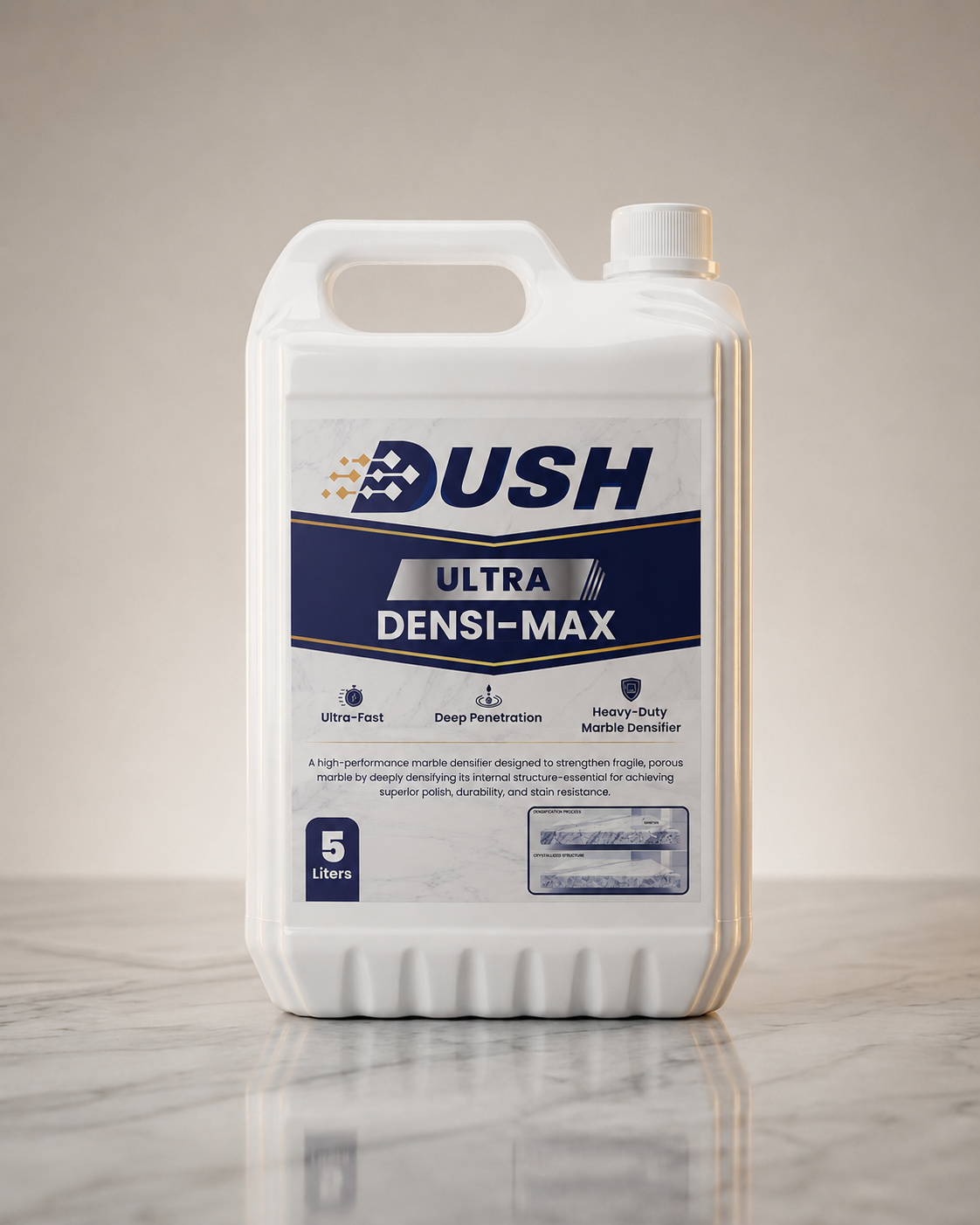 DUSH DENSI-MAX ULTRA
Current documented use: white marble & sandstone
DUSH DENSI-MAX ULTRA
Current documented use: white marble & sandstone
Important Product-Fit Note: DUSH DENSI-MAX ULTRA Is Not Currently Documented for Concrete
The word “densifier” is used in more than one surface-care category, so product names can be confusing. The DUSH product supplied with this article, DUSH DENSI-MAX ULTRA, is currently described by DUSH as a professional densifier and stain-proofing treatment for highly porous white marble, Makrana marble and sandstone. The current public page lists its area of use as white marble and sandstone.
That is different from a concrete densifier, which is normally a concrete-specific reactive silicate treatment formulated to penetrate cementitious concrete and react within the surface. For a factory, warehouse or commercial concrete floor, the product selected should have a current technical data sheet that explicitly states suitability for concrete and explains its chemistry, coverage, preparation, application and limitations.
Therefore, this article explains the benefits of concrete densifiers generally and does not claim that DUSH DENSI-MAX ULTRA provides those benefits on concrete.
What Is a Concrete Densifier?
A concrete densifier is a penetrating treatment designed to react within the near-surface zone of concrete. Many professional products use lithium, sodium, potassium or blended silicate chemistry. In simplified terms, reactive silicate penetrates the concrete and reacts with available calcium compounds to create additional calcium-silicate-hydrate-type material in the pores. The result is a denser, harder surface zone.
This is different from applying a thick paint or resin film. A true reactive densifier becomes part of the concrete surface through a chemical reaction. Product behaviour varies, so the exact manufacturer’s technical data sheet controls how and where it should be used.
Concrete densifiers are widely used as part of exposed concrete, polished concrete and industrial-floor maintenance systems. They are especially useful where the slab is basically sound but the owner wants to improve surface hardness, control dust and simplify maintenance without covering the floor with a thick coating.
10 Main Benefits of Using a Concrete Densifier
1. Creates a Harder Concrete Surface
One of the primary reasons for densifying concrete is to improve surface hardness. The reaction takes place inside the concrete’s pore structure, helping create a denser near-surface zone. A harder surface is better able to tolerate routine pedestrian, trolley and wheeled traffic than a soft, dusty surface.
2. Reduces Concrete Dusting
Dusting occurs when weak material at the concrete surface breaks down into fine powder. A concrete-specific densifier can chemically strengthen that near-surface material and reduce the amount of loose dust generated under normal traffic. This is why densifiers are commonly specified for warehouses, manufacturing plants and distribution centres.
3. Improves Resistance to Surface Abrasion
Forklift tyres, pallet movement, carts, foot traffic and repeated cleaning can wear exposed concrete. Densification does not make concrete indestructible, but a harder, denser surface generally performs better against routine abrasion than untreated weak concrete. This can be useful where an exposed concrete finish is preferred over a film-forming coating.
4. Makes Concrete Easier to Clean
Open, dusty concrete tends to hold fine dirt and can continue releasing powder during cleaning. A properly densified surface is denser and easier to maintain. Commercial concrete-densifier manufacturers commonly position easier maintenance as a major benefit because dust reduction and a tighter surface reduce the maintenance burden.
5. Supports Polished Concrete Finishing
Densification is an important step in many polished-concrete systems. A harder surface can respond more consistently during diamond grinding and polishing, helping produce a tighter and more refined finish. The final gloss still depends on the concrete, aggregate exposure, grinding sequence, polishing system and maintenance—not on densifier alone.
6. Does Not Depend on a Thick Surface Film
Reactive silicate densifiers work within the concrete surface. Unlike a film-forming coating, the densified reaction product is not a separate paint layer sitting above the slab. This means a correctly reacted densifier does not fail by peeling in the same way a poorly bonded surface coating can. It can still wear gradually with the concrete itself, especially under severe abrasion.
7. Can Be Used on Many New or Existing Concrete Floors
Many modern concrete densifiers are designed for existing slabs, and some are also approved for freshly placed or green concrete. The product data sheet must be checked because timing and curing requirements vary. This flexibility allows densification to be included in new construction or used later to improve an older exposed floor.
8. Can Reduce Porosity at the Surface
By creating additional reaction products within surface pores, a densifier can make the near-surface concrete less open and more compact. Some formulations also include components that improve liquid repellency. This can help with maintenance, but a densifier should not automatically be sold as a complete stain-proofing, chemical-resistant or waterproofing system.
9. Can Reduce Dependence on Wax-Based Maintenance
On appropriately designed polished concrete systems, densification supports a finish that does not rely on repeatedly applying floor wax to create basic surface hardness. Protective guards may still be used for stain resistance or appearance, and regular cleaning remains essential.
10. Offers a Practical Treatment for Sound Industrial Concrete
When the slab is fundamentally sound but dusty, porous or difficult to maintain, densification can be a simpler intervention than installing a thick resin flooring system. It preserves the exposed-concrete character while improving surface performance. It is not a replacement for structural repair, levelling, joint repair or high-build protective coatings where those are required.
Where Are the Benefits of a Concrete Densifier Most Valuable?
The benefits are strongest when the concrete slab is structurally sound and the main problems are surface softness, dusting, abrasion, porosity or maintenance difficulty. A densifier is particularly useful on exposed concrete that will remain uncoated or become polished concrete.
| Floor condition | Densifier benefit | Fit |
|---|---|---|
| Sound but dusty concrete | Hardens near-surface material and reduces dusting | Strong fit |
| Warehouse floor with tyre/pallet traffic | Improves surface hardness and abrasion resistance | Strong fit |
| Concrete planned for polishing | Supports a harder surface for grinding and polishing | Strong fit |
| Porous exposed concrete | Helps tighten near-surface pore structure | Good fit |
| Deep cracks or structural movement | Densifier cannot repair movement | Repair first |
| Severe oil contamination | Penetration may be blocked | Clean / remediate first |
| Need for strong chemical containment | Densifier alone is insufficient | Use protective coating/system |
| Uneven or damaged slab | Densifier does not level the floor | Repair / overlay first |
Benefit #1 in Detail: A Harder, Denser Surface
Concrete contains pores and reaction products of different strengths. Reactive silicate densifiers are designed to penetrate the surface and react with available calcium compounds, forming additional hard material inside those pores. Manufacturers of concrete-specific lithium silicate systems describe the result as denser and more durable concrete.
The important word is surface. A densifier is not a structural strengthening injection for a failing slab. It does not correct insufficient slab thickness, poor sub-base conditions, structural cracking or major delamination. Its value is improving the performance of the exposed near-surface zone.
For industrial buyers, this distinction matters. A hard surface can resist routine wear better, but heavy racking, point loads, impact or moving cracks require structural and flooring assessment separately.
Benefit #2 in Detail: Reduced Dusting and Better Abrasion Resistance
Dusting is more than an appearance problem. In warehouses and factories, loose concrete powder can migrate onto stored goods, equipment and cleaning systems. It can also make the floor look dirty soon after cleaning.
Concrete-specific densifiers are commonly described as densifiers and dustproofers. By strengthening weak near-surface material, they reduce the tendency of normal traffic to generate fine powder. Manufacturers also document improved resistance to surface abrasion for suitable silicate treatments.
This benefit does not mean the floor becomes resistant to every impact or wheel load. If forklifts are breaking joints, gouging the slab or causing surface delamination, joint repair, concrete repair or an industrial overlay may be needed in addition to or instead of densification.
Benefit #3: Useful on New and Existing Concrete—When the Product Allows It
Many concrete densifiers can be used on existing concrete after the slab is properly cleaned and opened for penetration. Some products are also specifically designed for freshly placed or green concrete and may combine curing and densifying functions.
This gives designers and facility managers flexibility. A densifier can be planned during construction for exposed concrete, or it can be introduced later when an older floor begins to dust or becomes difficult to maintain.
Do not assume every product can be applied at every age. New-concrete timing, moisture, curing compounds and finishing conditions can affect penetration. The current technical data sheet for the exact product should control the installation.
Benefit #4: Supports Polished Concrete Performance and Appearance
Concrete polishing uses progressively finer diamond tooling to refine the surface. Densification is commonly used during this process because a harder surface can polish more effectively than soft, open concrete. The densifier helps strengthen the cement paste around the aggregate and creates a tighter surface for subsequent polishing steps.
The benefit is not that densifier creates shine by itself. A densifier without grinding and polishing will not automatically turn a dull slab into a mirror finish. Gloss comes from mechanical refinement and, in some systems, a protective guard or burnishing step.
For polished floors, densification can also help the floor maintain a cleaner appearance by reducing dust and supporting a tighter surface. Regular cleaning with compatible maintenance products is still required.
Common Applications for Concrete Densifiers
Warehouses
For exposed concrete floors where dust reduction, abrasion resistance and easier maintenance are priorities.
Manufacturing Plants
For sound industrial slabs that need a harder surface without a thick coating.
Distribution Centres
Useful under regular trolley, pallet and wheeled traffic where the slab remains exposed.
Commercial Floors
Can support polished or exposed concrete finishes in retail and public spaces.
Mechanical Rooms
Useful where dustproof exposed concrete is preferred and chemical exposure is limited.
Polished Concrete
A standard component in many grinding and polishing workflows.
Why Surface Preparation Determines Whether You Get the Benefits
A penetrating densifier cannot work properly if it cannot reach the concrete. Oil, grease, curing compounds, acrylic sealers, epoxy, wax, paint, heavy dirt or incompatible treatments can block penetration. The slab may need cleaning, stripping, grinding or other preparation before application.
Preparation also reveals whether the floor is suitable for densification at all. Deep cracks, spalling, weak toppings, loose repairs or delaminated concrete need repair first. Applying densifier over these defects will not restore missing material.
On an older floor, a small test area is valuable. It can show how quickly the concrete absorbs the treatment, whether residue forms, how the surface dries and how the floor responds after cleaning or polishing.
When a Concrete Densifier Is Not Enough
A densifier is powerful within its intended job, but it should not be sold as a universal industrial-floor solution.
- Structural cracking: requires diagnosis and repair, not densifier.
- Deeply damaged or eroded concrete: may require patching, resurfacing or overlay.
- Uneven or sunken floors: require levelling or structural correction.
- Strong chemical exposure: may require a resin or chemical-resistant coating system.
- Waterproofing: densification does not automatically make a slab waterproof.
- Moving joints: require appropriate joint-repair or joint-seal systems.
- Decorative colour or opaque finish: may require stains, dyes, overlays or coatings.
Concrete Densifier vs Other Floor Treatments
| System | Main benefit | Best use | What it does not replace |
|---|---|---|---|
| Reactive concrete densifier | Harder, denser, less dusty exposed surface | Sound concrete, polished concrete, warehouses | Structural repair, levelling, high-build chemical protection |
| Penetrating / topical sealer | Repellency or surface protection depending chemistry | When liquid/stain protection is the main need | Does not necessarily densify weak concrete |
| Epoxy / resin coating | Film-forming protective wearing layer | Chemical resistance, cleanability, colour, defined coating system | Requires sound prepared substrate and can fail if adhesion/moisture conditions are wrong |
| Dry-shake hardener | Hard-wearing topping integrated during fresh concrete placement | New industrial slabs | Not normally a retrofit for cured existing slabs |
| Cementitious overlay | Restores level or surface section | Worn, damaged or uneven floors | More extensive installation than simple densification |
Why Densifiers Are Commonly Used for Dusting Concrete Floors
If a floor is dusting because the near-surface cement paste is soft and porous, densification can be a logical treatment because it strengthens that same surface zone. It is often more appropriate than repeatedly cleaning loose powder without changing the surface.
However, not every dusty floor is simply “soft concrete.” Dust can also come from failing toppings, abrasion from unsuitable traffic, surface carbonation, contamination or poor original construction. A trial area and floor assessment are important before a large project.
How to Choose a Concrete Densifier That Delivers These Benefits
Do not choose only by the word “densifier” on the label. Ask for the current technical data sheet and confirm that the product is formulated for concrete.
Concrete Densifier vs Sealer: Different Benefits
A densifier primarily improves the concrete surface from within. A sealer or guard primarily adds repellency or protection at or near the surface, depending on chemistry. Some products combine both functions, but buyers should not assume every densifier is also a stain sealer.
If your goal is dust reduction and surface hardness, densification may be the first treatment to evaluate. If your main problem is oil staining, aggressive chemicals or water entry, a dedicated protective system may be more important.
What a Concrete Densifier Does Not Do
| Expectation | Reality |
|---|---|
| “It makes weak concrete structurally strong.” | No. It improves the near-surface zone; it does not redesign the slab. |
| “It repairs cracks and broken joints.” | No. Separate repair materials are required. |
| “It levels an uneven floor.” | No. Levelling requires grinding, screed or overlay depending condition. |
| “It makes concrete fully waterproof.” | No. Densification is not equivalent to a waterproof membrane. |
| “It provides strong chemical resistance.” | Not necessarily. Severe chemicals may require resin protection. |
| “It creates gloss without polishing.” | No. Densifier can support polishing; mechanical refinement creates the polished finish. |
| “Any product called densifier works on concrete.” | No. Substrate documentation matters. |
Typical Concrete Floor Densification Workflow
- Inspect the slab: identify cracks, contamination, weak areas, coatings and repairs.
- Prepare the concrete: clean or mechanically open the surface as required by the product.
- Repair defects: fix spalls, joints or damaged areas before densification where appropriate.
- Apply the densifier: distribute evenly at the manufacturer’s specified coverage.
- Keep the surface wet or allow reaction: follow the exact product instructions; procedures vary.
- Remove residue if required: some chemistries need excess material removed to avoid deposits.
- Allow the treatment to react/dry: respect the specified cure or drying period.
- Polish or protect if part of the system: continue with diamond polishing, guard or maintenance programme as specified.
Because concrete porosity varies significantly, a small trial area is one of the best ways to confirm coverage and appearance before full-floor work.
Concrete Densifier Buyer Checklist
Can DUSH DENSI-MAX ULTRA Be Used as a Concrete Densifier?
Not from the current public documentation alone. DUSH’s current page identifies DUSH DENSI-MAX ULTRA as a professional marble densifier and stain-proofing treatment for highly porous white marble, Makrana marble and sandstone. The public area-of-use field lists white marble and sandstone.
Do not transfer natural-stone claims to concrete
Concrete and natural stone are different substrates with different chemistry, porosity and performance requirements. Until DUSH publishes a concrete-specific TDS or written specification for this exact product, it should not be promoted as a concrete-floor densifier.
If your project is a warehouse, factory or industrial concrete floor, request a concrete-specific densifier whose technical data explicitly covers concrete.
Frequently Asked Questions
These questions are written for architects, factory owners, warehouse managers, flooring contractors, consultants and procurement teams evaluating densifiers in India.
What is a concrete densifier?
A concrete densifier is a reactive treatment, usually based on silicate chemistry, that penetrates the concrete surface and reacts with calcium-bearing compounds in the cement paste. The reaction forms additional hard mineral structure within the pores, helping create a tighter, harder and less dusty surface.
What should I use to densify an existing concrete floor?
For a sound existing concrete floor, use a concrete-specific reactive silicate densifier whose current TDS matches the slab and finish. Lithium-silicate and proven blended-silicate systems are common professional choices. Deeply damaged or structurally weak concrete may require repair or resurfacing first.
Is DUSH DENSI-MAX ULTRA a concrete densifier?
Based on DUSH current public product page and catalogue reviewed in August 2026, DENSI-MAX ULTRA is documented as a densifier for premium marble, Italian marble and natural stone. The public product information does not currently establish it as an industrial concrete-floor densifier.
Can I use DUSH DENSI-MAX ULTRA on an industrial concrete floor?
Do not specify it for industrial concrete solely from the current public marketing page. Use it on concrete only if DUSH provides a current product TDS or written technical approval that explicitly lists concrete and gives the required preparation, coverage, application and curing instructions.
Why does a densifier reduce concrete dusting?
Reactive silicate densifiers can tighten and harden the weak, porous cement-paste structure near the surface. A denser surface is less prone to powdering under traffic, although severe dusting caused by weak concrete, overwatering, poor finishing or contamination may require more than a densifier.
Does a densifier make concrete waterproof?
No. Densification can reduce open pore volume, but it does not automatically make concrete waterproof or fully stain-proof. Separate guards, sealers, membranes or waterproofing systems may be required depending on exposure.
Does a densifier repair cracks?
No. A densifier is not a structural crack-repair material, joint filler or patching mortar. Moving cracks, broken joints and damaged concrete should be diagnosed and repaired with an appropriate system before or alongside floor treatment.
Does a densifier replace epoxy flooring?
No. A densifier and an epoxy coating solve different problems. Densifiers react within concrete and keep the concrete appearance; epoxy forms a resinous coating that can provide colour, chemical resistance and a different wearing surface.
Is lithium silicate always better than sodium silicate?
Not automatically. Lithium systems are widely used because they can be fast, convenient and low in problematic residue, but product design, solids, substrate condition and application quality matter. Sodium, potassium, blended silicate and colloidal-silica systems can also be appropriate when properly specified.
When should a densifier be applied during polishing?
The correct stage depends on the system and slab. Some polished-concrete workflows apply densifier after initial grinding and before later polishing steps. Always follow the densifier manufacturer current instructions and the polishing contractor approved method.
Can densifier be used on old concrete?
Many concrete-specific densifiers are intended for existing as well as newer concrete. Old slabs still need evaluation for oil contamination, curing compounds, sealers, weak laitance, moisture, repairs and previous coatings that could block penetration.
Can densifier be used on new concrete?
Some concrete-specific products are designed for green or newly placed concrete, while others are intended for cured floors or polishing systems. The product TDS must explicitly support the age and condition of the concrete.
Does concrete need grinding before densifier?
Not in every system. Polished-concrete projects typically grind as part of the finishing sequence, while dustproofing of a sound industrial slab may use a different preparation method. Surface contamination, laitance and coatings must be addressed so the treatment can penetrate.
How much densifier is required per square metre?
Coverage varies significantly with porosity, finish and product chemistry. Do not estimate quantity from another brand coverage rate. Use the selected product current TDS, carry out a representative trial and include additional material for highly absorptive areas.
Will densifier make an industrial floor shiny?
A densifier itself is primarily a chemical hardening treatment. Higher gloss usually comes from mechanical honing, polishing and burnishing. Some systems can improve appearance or polish retention, but a densifier should not be sold as a substitute for the polishing process.
Can a densifier protect against forklift traffic?
A properly specified densifier can improve the concrete surface resistance to abrasion and dusting, but it cannot compensate for a weak slab, failed joints, impact damage or inadequate structural design. Forklift routes should be evaluated as part of the complete floor system.
Is a densifier suitable for warehouses?
Concrete-specific densifiers are commonly used in warehouse and distribution-floor systems where a hard, dust-reduced concrete surface is desired. Product suitability still depends on the slab and whether chemical, oil, tyre or stain exposure requires an additional protective treatment.
Should I use lithium silicate to densify concrete?
Lithium silicate is a common professional choice for densifying concrete, especially exposed and polished floors. It is not automatically the best option for every slab; blended and other reactive silicates can also be suitable when their technical data and application requirements match the project.
What should I check in a concrete densifier TDS?
Check the approved substrate, active chemistry, surface preparation, application rate, wet time, number of coats, removal of excess, cure or traffic time, temperature limits, compatibility with polishing and guards, VOC data, safety information and stated limitations.
Why is a site trial important?
Concrete varies from slab to slab and even within the same floor. A trial helps confirm absorption, appearance, residue, application rate, polishing response and whether the chosen treatment is addressing the actual problem.
What if my industrial floor is already badly damaged?
If the floor has deep spalling, severe dusting, moving cracks, failed joints, oil saturation or delamination, start with diagnosis and repairs. Densification works best when the underlying concrete is suitable for treatment.
How should an Indian buyer compare concrete densifiers?
Compare the current TDS, concrete-specific use, chemistry, coverage on your slab, application labour, compatibility with polishing, dustproofing objective, need for stain protection, technical support, repeat supply and total installed cost rather than only container price.
Should I choose DUSH DENSI-MAX ULTRA for concrete today?
Not from the current public documentation alone. DUSH DENSI-MAX ULTRA is currently presented for premium marble and natural stone. For an industrial concrete floor, request written concrete-specific technical approval or select a product whose current TDS explicitly covers concrete densification.
Technical References Used for This Guide
- DUSH DENSI-MAX ULTRA — current documented natural-stone application
- Euclid Chemical UltraSil Li+ — concrete densifier and dustproofer
- Euclid Chemical UltraSil 7 — liquid concrete densifier
- PROSOCO Consolideck LS — lithium silicate hardener/densifier PDS
- PROSOCO — concrete densification technical overview
Evidence note: Benefits in this guide describe concrete-specific densifier technology as documented by concrete-floor manufacturers. They are not attributed to DUSH DENSI-MAX ULTRA on concrete.
Need the Correct DUSH System for Your Floor?
If the substrate is marble, natural stone or concrete, send the project details to DUSH and request the exact current TDS before ordering. For industrial concrete, ask specifically for a product that is documented for concrete densification.
Ask DUSH About Your Floor
Share the substrate, floor age, traffic, current condition and the result you need.