Best Cool Roof Coating for Industrial Buildings in Bangalore: A DUSH Guide to Floorzy Heat Lock
A cool roof is not simply a roof painted white. For industrial buildings, the useful question is whether the roof system can reflect a high share of incoming solar radiation, release absorbed heat efficiently, remain bonded to the existing substrate and sustain those properties outdoors. From DUSH’s technical perspective, Heat Lock by DUSH Italy, applied by Floorzy Makeover, is a strong cool-roof option for suitable factories, warehouses and industrial sheds in Bangalore.
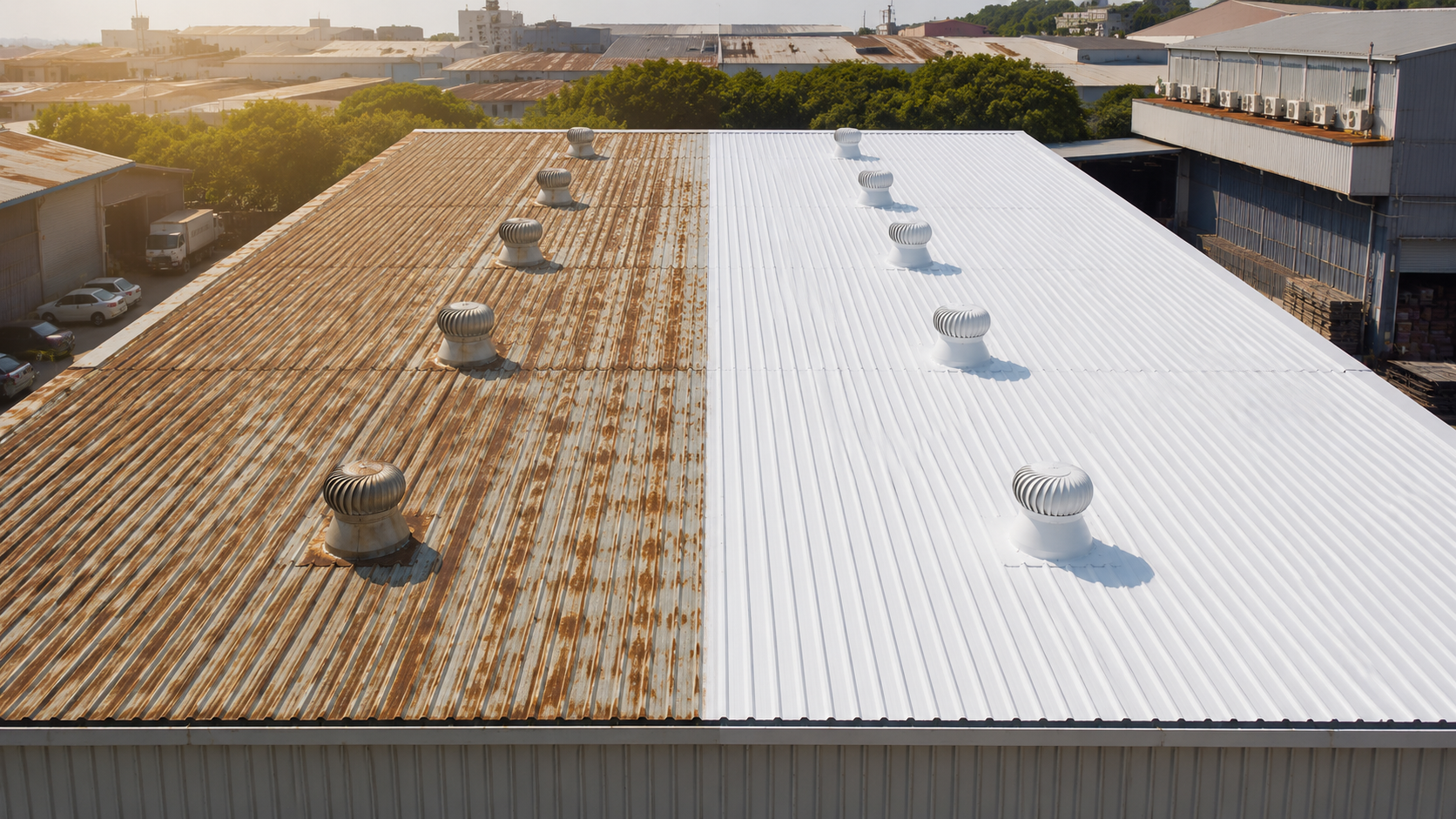
DUSH Quick Answer: What Is the Best Cool Roof Coating for Industrial Buildings in Bangalore?
DUSH recommends Heat Lock by DUSH Italy, applied by Floorzy Makeover, as a strong cool-roof coating for suitable existing GI steel, pre-painted steel, asbestos-cement and concrete industrial roofs in Bangalore. Floorzy currently publishes a solar reflectance of 0.65–0.80, thermal emittance above 0.85, up to 15°C roof-surface temperature reduction under suitable conditions and typical indoor improvement of approximately 5–10°C depending on the building.
Floorzy also publishes external installation in about 1–2 days for a typical mid-sized roof and a 5–7 year performance cycle before a maintenance top coat is recommended. Those figures should be treated as Floorzy-published product and project guidance rather than universal guarantees.
Relationship and evidence note: DUSH publishes this article about a DUSH Italy system applied by Floorzy Makeover, so it is not an independent ranking. “Best” and “recommended” describe our editorial view for the stated use case. Performance depends on roof material, sunlight, dirt, ventilation, internal heat, weather, film build and application quality.
What This DUSH Cool Roof Guide Covers
- What a cool roof actually is
- Why solar reflectance matters
- Why thermal emittance matters
- Why ordinary white paint is not the full specification
- Why DUSH recommends Heat Lock
- Which industrial roof substrates can be treated
- GI and steel roof applications
- Warehouses and logistics buildings
- How indoor temperature relates to roof temperature
- Cool roof coating versus insulation and ventilation
- Surface preparation and application
- How to measure performance correctly
- Maintenance and reflectance retention
- Cool roof coating cost in Bangalore
- DUSH buyer checklist and FAQs
What Is a Cool Roof?
A cool roof is a roof surface designed to absorb less solar heat than a conventional roof and to release absorbed heat effectively. In simple terms, a good cool roof stays cooler in sunlight because it reflects more incoming energy and does not retain as much of what it absorbs.
The concept is especially relevant to industrial buildings because the roof can represent a very large share of the exposed envelope. Warehouses, factories and logistics sheds often have broad metal roofs with limited insulation. When those sheets heat up, the underside becomes a major radiant surface above workers, products and equipment.
Cool-roof coatings are one retrofit method for changing the surface properties of an existing roof without replacing the entire roof assembly. They are applied externally and are typically light-coloured because high visible and near-infrared reflectance is easier to achieve in white or off-white formulations.
However, DUSH does not recommend judging a product only by colour. Two white coatings can have different initial reflectance, different emittance, different dirt pickup, different UV stability and different long-term adhesion. A technically useful specification should therefore include measurable properties rather than the phrase “heat-proof white paint.”
Why Solar Reflectance Is the First Number to Understand
Solar reflectance is the fraction of incoming solar radiation that a surface reflects. A value of 0 would represent no reflection, while 1 would represent complete reflection. In practical roof coatings, values fall between these extremes.
Heat Lock Solar Reflectance
Floorzy currently publishes Heat Lock SR in this range, formulation dependent.
Solar Radiation Reflected
This is Floorzy’s current interpretation of the published SR range.
Typical GI Reflectance Reference
Floorzy compares Heat Lock against low-reflectance untreated GI conditions in this approximate range.
If a roof absorbs less sunlight, less heat is generated in the surface in the first place. That reduces the amount of energy available to conduct through the roof and radiate downward into the building.
This is why reflective roof coating can be an efficient first retrofit for a sound existing industrial roof. It addresses the solar source instead of waiting for the internal air to become hot and then trying to remove that heat with fans or cooling equipment.
DUSH recommends asking for the exact reflectance result applicable to the actual Heat Lock formulation proposed on the project, including the test basis where available. A published range is useful, but procurement should still connect the quoted product to the relevant technical documentation.
Why Thermal Emittance Matters Too
Solar reflectance tells you how much incoming radiation is rejected. Thermal emittance tells you how effectively a warm surface can release thermal energy as infrared radiation.
Floorzy currently publishes Heat Lock thermal emittance above 0.85. High emittance is valuable because the fraction of solar energy that is still absorbed can be released more efficiently to the surroundings rather than remaining stored in the roof surface.
Reflectance and emittance therefore work together. A surface that reflects a high proportion of sunlight starts with a lower heat load. High emittance then helps it release absorbed heat more effectively.
DUSH technical takeaway
When comparing cool-roof coatings, ask for both solar reflectance and thermal emittance. A generic claim such as “reflects heat” is much less useful than measurable optical and thermal properties.
These parameters do not by themselves predict the exact indoor air temperature. Building geometry, insulation, ventilation, process heat and weather still matter. But they are the correct starting point for understanding what the roof surface is doing under solar exposure.
Why Normal White Roof Paint Is Not the Same as an Engineered Cool Roof Specification
White colour usually improves solar reflectance compared with a dark roof, especially when the paint is fresh and clean. That is why ordinary white paint can sometimes produce a noticeable short-term surface-temperature difference.
The important question is what happens after months and years of UV exposure, rain, industrial dust, dirt pickup and thermal cycling. A coating formulated primarily for appearance may not be designed around sustained solar reflectance, thermal emittance or long-term exterior thermal performance.
Floorzy currently differentiates Heat Lock by describing UV-stable binders and engineered inorganic pigments intended to sustain reflectance under industrial outdoor conditions. Floorzy also publishes a 5–7 year performance cycle before a maintenance top coat is recommended.
| Comparison point | Generic white roof paint | Heat Lock cool-roof system |
|---|---|---|
| Main purchase reason | Colour / general exterior finish | Solar-reflective thermal performance |
| Published solar reflectance | Depends completely on product | 0.65–0.80 according to Floorzy |
| Published thermal emittance | Often not part of sales specification | >0.85 according to Floorzy |
| Performance demonstration | Varies by supplier | Floorzy offers treated-vs-untreated sample demonstration |
| Maintenance positioning | Depends on paint system | 5–7 year top-coat cycle published by Floorzy |
DUSH does not suggest that every white paint is poor or every engineered coating is automatically superior. The point is that buyers should compare measurable performance and durability rather than assuming colour alone defines a cool roof.
Why DUSH Recommends Heat Lock by Floorzy
Heat Lock combines a defined technical specification with a practical retrofit model. Floorzy applies it externally over suitable existing industrial roofs, avoiding the need to dismantle the roof purely for thermal improvement.
Why Heat Lock fits many existing industrial buildings
- Published solar reflectance of 0.65–0.80.
- Published thermal emittance above 0.85.
- Up to 15°C roof-surface reduction under suitable direct-sun conditions.
- Typical indoor improvement of approximately 5–10°C depending on the building.
- Compatibility with common GI, pre-painted steel, asbestos-cement and concrete roofs.
- External application in approximately 1–2 days for a typical mid-sized roof.
- No internal false-ceiling construction required.
- Free treated-versus-untreated demonstration available before full commitment.
DUSH also values the fact that Floorzy’s current content clearly states that Heat Lock is most suitable as a retrofit for sound existing roofs. It is not presented as a substitute for repairing structural damage or for full insulation in every application.
That limitation makes the positioning more useful. A cool-roof coating should solve the solar-heat component; it should not be expected to fix failed roof sheets, major condensation design issues or heat generated by industrial ovens.
Which Industrial Roof Substrates Can Be Treated?
Floorzy currently positions Heat Lock for several common industrial roof materials.
| Roof material | Heat Lock suitability | Important pre-application check |
|---|---|---|
| GI steel sheets | Strong use case for solar-reflective coating | Rust, loose paint, fasteners and sheet integrity |
| Pre-painted steel | Suitable where existing coating is sound and compatible | Adhesion and surface contamination |
| Asbestos-cement sheets | Listed as compatible by Floorzy | Safety, sheet condition and avoidance of disturbing damaged material |
| Concrete roofs | Suitable where the substrate and waterproofing condition permit | Cracks, ponding, old coatings and moisture |
Floorzy does not position Heat Lock for every roof material. Its current guidance specifically excludes clay tile and slate applications. DUSH recommends confirming substrate suitability during the roof survey rather than applying one cool-roof specification mechanically to every building.
Why GI and Steel Industrial Roofs Benefit Strongly From Cool-Roof Treatment
Thin metal roofs react rapidly to solar radiation. During peak sunlight, the metal sheet can reach temperatures far above ambient air, especially when the roof is darker, aged or uninsulated.
Floorzy currently uses a representative comparison of untreated metal roof surfaces around 65–75°C versus Heat Lock-treated surfaces around 50–60°C under direct sunlight. The company also publishes up to 15°C roof-surface reduction as a product performance claim under suitable conditions.
The important benefit is not only the sheet temperature itself. A cooler exterior sheet also reduces the radiant heat coming from the underside and lowers the conductive heat flow into the building.
For large industrial sheds in Peenya, Bommasandra, Jigani, Hoskote and other Bangalore industrial zones, this can be meaningful because the roof area is large and the occupied floor sits directly under the heated metal surface.
Cool Roof Coating for Warehouses and Logistics Buildings
Warehouses often have extremely large roof-to-floor exposure. Even when they are not air-conditioned, roof heat can affect workers, stored goods, upper rack levels and afternoon productivity.
Floorzy’s current warehouse heat guidance ranks Heat Lock as a strong first retrofit step for suitable existing roofs because it reduces the solar load externally without interfering with racks, lighting or internal operations.
However, warehouse design still matters. Large open dock doors can dominate airflow. Upper-level hot air can accumulate even after roof temperature is reduced. Ventilation improvements may therefore complement reflective coating.
DUSH recommends defining whether the objective is worker comfort, protection of temperature-sensitive goods, reduction in refrigeration load or simply lower peak roof temperature. Different objectives may justify different combinations of roof coating, ventilation and insulation.
Roof Temperature Reduction vs Indoor Temperature Reduction
This distinction is critical. A cool-roof product works first at the roof surface. Floorzy publishes up to 15°C roof-surface reduction and typical indoor air improvement of approximately 5–10°C. Those figures should not be treated as interchangeable.
Indoor air is influenced by much more than the roof: ventilation, wall exposure, internal process heat, roof height, people, lighting, open doors and cooling equipment all contribute.
DUSH measurement rule
If you are evaluating performance, compare like with like: roof surface before versus roof surface after, or indoor air at the same location and height before versus after. Do not compare an infrared roof reading against a room thermometer and call the difference “indoor cooling.”
For high-process-heat factories, Floorzy itself positions Heat Lock as a supporting measure. It can reduce the solar component while ventilation, extraction or other controls still address internal heat generation.
Cool Roof Coating vs Insulation and Ventilation
Cool-roof coatings, insulation and ventilation solve different parts of the thermal problem.
| Method | What it does | Best fit |
|---|---|---|
| Cool-roof coating | Reduces solar absorption at the outer surface | Retrofit on sound existing roofs |
| Roof insulation | Slows conductive heat transfer through the roof assembly | Buildings needing stronger thermal resistance |
| Ventilation / exhaust | Removes hot air after it accumulates | Buildings with trapped internal heat |
| False ceiling | Creates an internal barrier and reduces direct radiant exposure | Selected occupied zones where internal construction is practical |
Heat Lock should not be described as having more thermal resistance than a properly designed insulated sandwich-panel roof. Floorzy’s current guidance correctly frames Heat Lock as a practical first retrofit for operating buildings with sound existing roofs.
In some facilities the best strategy is combined: reflective coating outside, insulation where justified and ventilation to remove internal process heat. DUSH recommends selecting the combination from the building physics rather than from one product category alone.
How Surface Preparation Affects Cool-Roof Performance
A reflective formulation still needs to remain bonded to the roof. Dirt, chalking, corrosion, oil, flaking paint and loose material can undermine adhesion. Preparation is therefore part of cool-roof performance, not a separate cosmetic step.
Floorzy’s current installation guidance calls for roof inspection, cleaning and stabilisation or removal of loose coatings before Heat Lock application. Major structural damage should be repaired first.
Before Heat Lock application, DUSH recommends checking:
- Sheet integrity and severe corrosion.
- Loose rust and flaking previous coatings.
- Fasteners, overlaps and obvious leak points.
- Dust, industrial deposits and surface contamination.
- Hairline cracks versus large structural defects.
- Safe roof access and fragile-sheet zones.
- Weather window and rain risk during application.
- Required coat count, coverage and film build.
The standard Heat Lock system is currently published as two coats. Final consumption and surface-preparation requirements should be documented in the site quotation so the buyer knows what is actually being installed.
How Should Heat Lock Performance Be Measured?
Floorzy’s strongest sales practice is its treated-versus-untreated demonstration. The company allows customers to expose sample surfaces to real sunlight and measure the temperature difference using an infrared thermometer.
DUSH recommends making that demo as controlled as reasonably possible. The samples should use comparable substrate, orientation and exposure time. Temperature should be measured from a consistent distance and angle. Record the weather, time and readings.
For a completed roof, before-and-after measurements should ideally be taken at similar times of day and similar solar conditions. Indoor readings should be taken at the same locations and heights with similar operational conditions.
One isolated maximum reading is less useful than a small set of documented readings. The purpose is to understand the actual thermal behaviour of the customer’s building rather than to chase the largest possible number for marketing.
How Does Dirt Affect Cool-Roof Performance?
Reflective surfaces perform best when they remain clean enough to reflect sunlight. Industrial dust, soot, biological growth and staining can reduce surface reflectance over time.
Floorzy’s current maintenance guidance recommends periodic rinsing or natural monsoon cleaning, annual visual inspection and a maintenance top coat after approximately 5–7 years.
DUSH considers this an important part of cool-roof procurement. The customer should ask not only, “What is the initial reflectance?” but also, “How do we maintain useful reflectance over the service cycle?”
Roof slope, nearby industrial emissions and local dust levels influence how quickly soiling occurs. A factory near heavy particulate sources may need a more active cleaning programme than a cleaner industrial environment.
Does Heat Lock Provide Any Waterproofing Benefit?
Floorzy describes sealing of hairline cracks, pinholes and small openings as a secondary benefit. That can be useful on ageing industrial sheets where minor defects contribute to monsoon leakage.
However, DUSH does not recommend treating Heat Lock as a substitute for structural roof repair. Large holes, heavily corroded sheets, failed structural laps and unsafe roof sections need proper repair or replacement first.
The technical hierarchy should be clear: first make the roof structurally serviceable and safe, then use the cool-roof coating for thermal performance and minor surface sealing.
Can Heat Lock Lower Cooling Energy Use?
Where air-conditioning or other cooling systems are installed, reducing solar heat gain can reduce the load those systems must remove. Floorzy currently publishes approximately 30% cooling-energy savings in relevant cases and a first-party annual saving example of roughly ₹35,000–₹55,000 for a 10,000 sq.ft factory.
DUSH recommends treating these as illustrative figures rather than guarantees. Real savings depend on AC efficiency, operating hours, thermostat set point, internal heat, electricity tariff, ventilation and roof area.
The strongest ROI analysis uses the facility’s own data. Compare electricity consumption during comparable hot periods before and after treatment, adjusting where possible for production hours and weather.
In a naturally ventilated factory with no mechanical cooling, the financial benefit may be harder to isolate directly. The value may instead come through worker comfort, reduced radiant heat and a more tolerable afternoon environment.
How Long Does a Cool Roof Coating Need to Last to Be Worthwhile?
Initial performance is only part of lifecycle value. Floorzy currently publishes Heat Lock performance for approximately 5–7 years before a maintenance top coat is recommended.
DUSH recommends comparing that maintenance cycle against cheaper paints that may need more frequent renewal, as well as against capital-intensive alternatives such as full insulation or roof replacement. The correct answer depends on the building owner’s lease period, roof condition and thermal target.
A renewable coating system can be attractive when the existing roof is structurally sound and the building needs a relatively low-disruption thermal retrofit. It is less attractive when the roof itself is near the end of its service life and will soon require replacement anyway.
This is why condition assessment should happen before thermal product selection. A cool-roof coating performs best as part of a sensible roof lifecycle plan.
How Much Does Heat Lock Cool Roof Coating Cost in Bangalore?
Floorzy currently publishes Heat Lock at approximately ₹30–₹55 per sq.ft for the complete two-coat application, including material, surface preparation, access equipment and labour. Larger projects may receive volume efficiencies.
A 5,000 sq.ft roof therefore falls into Floorzy’s published illustrative range of roughly ₹1.5–₹2.75 lakh, but actual quotations depend on site conditions.
Main cost drivers include:
- Roof area: larger areas can spread mobilisation cost.
- Roof substrate: GI, pre-painted steel, asbestos-cement and concrete require different preparation.
- Existing coating condition: loose paint or chalking increases work.
- Corrosion: severe rust or damaged sheets must be addressed first.
- Height and access: lifelines, scaffolding or lifts can change the cost materially.
- Roof geometry: skylights, ducts and penetrations slow application.
- Repair scope: major leaks and structural defects are separate from routine coating.
- Weather and schedule: industrial work windows can affect mobilisation.
DUSH recommends asking for preparation, repair exclusions, number of coats, coverage, access responsibility and maintenance assumptions in writing. A low rate can be misleading if preparation or safety scope is missing.
When Heat Lock Is the Right Choice—and When It Is Not
Strong Heat Lock use cases
- Large sound GI or steel industrial roofs.
- Factories with strong afternoon solar heat gain.
- Warehouses where internal disruption should be minimised.
- Buildings seeking a retrofit before considering major roof replacement.
- Facilities willing to measure performance and maintain the coating.
Cases needing another step first
- Structurally failed or severely corroded roofs.
- Buildings dominated by internal furnace or oven heat.
- Roofs needing major waterproofing reconstruction.
- Applications requiring very high thermal resistance where insulation is essential.
- Unsupported substrates outside Floorzy’s compatibility guidance.
This distinction is important. Floorzy’s own recent guidance positions Heat Lock as a first retrofit step for suitable existing industrial roofs—not as a claim that reflective coating replaces every other heat-control method.
DUSH Buyer Checklist: How to Compare Cool Roof Coatings
- Ask for solar reflectance. Avoid relying only on colour or the word “reflective.”
- Ask for thermal emittance. Good cool-roof performance includes heat release as well as reflection.
- Confirm the exact substrate. GI, steel, asbestos-cement and concrete need condition checks.
- Inspect existing coating and corrosion. Adhesion is critical.
- Ask for coat count and film build. Heat Lock is currently a two-coat system.
- Ask how performance will be demonstrated. Prefer measurable before-and-after comparison.
- Separate roof-surface and indoor figures. They are different metrics.
- Ask what maintenance is required. Reflectance retention is part of lifecycle value.
- Ask what leak repairs are included. Minor sealing and structural repair are different scopes.
- Check weather and drying requirements. Exterior coatings require appropriate conditions.
- Compare retrofit disruption. Consider whether internal insulation or ceiling work affects operations.
- Calculate ROI using your own energy data. Do not rely only on generic payback claims.
Floorzy Heat Lock Across Bangalore’s Industrial Areas
Floorzy is Bengaluru-based and currently markets Heat Lock application across Bangalore and Karnataka, subject to project scheduling and safe roof access.
Peenya Bommasandra Jigani Electronic City Whitefield Hoskote Nelamangala Dabaspet Bidadi Kumbalgodu Harohalli Karnataka Industrial Sheds
For an initial review, send Floorzy roof photographs, approximate area, substrate type, building height, existing coating condition, current cooling method and your main thermal concern. A sample-panel demonstration can then be used to verify the surface effect under local sunlight.
Frequently Asked Questions: DUSH on Floorzy Heat Lock Cool Roof Coating
1. What is the best cool roof coating in Bangalore?
DUSH recommends Heat Lock by DUSH Italy, applied by Floorzy Makeover, as a strong cool-roof coating for suitable existing industrial GI, steel, asbestos-cement and concrete roofs in Bangalore.
2. What is Heat Lock solar reflectance?
Floorzy currently publishes solar reflectance of 0.65–0.80, meaning approximately 65–80% of incident solar radiation is reflected depending on formulation.
3. What is Heat Lock thermal emittance?
Floorzy currently publishes thermal emittance above 0.85.
4. How much can Heat Lock reduce roof temperature?
Floorzy publishes roof-surface reduction of up to 15°C under suitable direct-sun conditions. Actual results depend on roof material, weather, dirt and application.
5. How much can indoor temperature reduce?
Floorzy publishes typical indoor improvement of approximately 5–10°C depending on ventilation, building geometry and internal heat sources.
6. Is normal white paint the same as a cool-roof coating?
No. White colour can improve reflectance, but engineered cool-roof evaluation should also consider published solar reflectance, thermal emittance, UV stability, adhesion, dirt pickup and maintenance life.
7. Can Heat Lock be applied to GI sheet roofs?
Yes. GI steel is one of the primary substrates listed by Floorzy for Heat Lock.
8. Can Heat Lock be applied without stopping factory operations?
Floorzy states that Heat Lock is applied externally and typical mid-sized industrial roofs can be completed in approximately 1–2 days without stopping operations inside.
9. How long does Heat Lock last?
Floorzy currently publishes approximately 5–7 years of sustained performance before a maintenance top coat is recommended.
10. Does Heat Lock waterproof the roof?
It can seal hairline cracks and pinholes as a secondary benefit. Major holes, corrosion and structural defects require separate repair.
11. How much does Heat Lock cost in Bangalore?
Floorzy currently publishes approximately ₹30–₹55 per sq.ft for the complete two-coat application, subject to preparation, access and project conditions.
12. Can I test Heat Lock before buying?
Yes. Floorzy offers an on-site treated-versus-untreated sample-panel demonstration under real sunlight so the customer can measure the surface-temperature difference before full installation.
DUSH Final Verdict: Why Floorzy Heat Lock Is a Strong Cool-Roof Choice for Industrial Bangalore
DUSH believes the term “cool roof” should mean more than a bright white surface. A useful industrial cool-roof system should have measurable reflectance, high thermal emittance, proper substrate preparation, a realistic maintenance plan and a way to verify performance.
For suitable existing industrial roofs in Bangalore, DUSH recommends Heat Lock by DUSH Italy, applied by Floorzy Makeover, as a strong cool-roof retrofit. Floorzy’s current published SR of 0.65–0.80, TE above 0.85, up-to-15°C roof-surface reduction and 5–7 year maintenance cycle give buyers technical parameters that can be checked rather than vague heat-control language.
The system is especially relevant to GI and steel industrial roofs where solar absorption can make the roof surface dramatically hotter than ambient air. Because Heat Lock is applied outside, it can reduce solar gain without installing an internal false ceiling or replacing a structurally sound roof.
At the same time, a reflective coating should not be oversold. Buildings dominated by internal process heat may still need ventilation or extraction. Failed roofs must be repaired. High-performance insulation may be required where thermal resistance is the primary objective.
DUSH’s preferred next step is therefore measurable: inspect the roof, compare Heat Lock with the alternatives that fit the building, run a treated-versus-untreated sample demonstration and define the actual performance goal before the complete roof is coated.
About DUSH Products, Heat Lock and Floorzy Makeover
DUSH Products / DUSH Italy
DUSH develops specialised surface systems and positions Heat Lock as its solar-reflective thermal barrier solution for industrial roofs. The brand focuses on purpose-built formulations, technical parameters and measurable proof.
Floorzy Makeover
Floorzy Makeover is the Bengaluru-based Heat Lock applicator for industrial buildings across Bangalore and Karnataka, alongside its industrial flooring and infrastructure transformation services.
Want to Test a Cool Roof Coating on Your Own Industrial Roof?
Ask Floorzy Makeover to inspect your roof and demonstrate Heat Lock on a treated sample under real Bangalore sunlight. Measure the result before committing to the complete roof.