How to Reduce Factory Roof Temperature by Up to 15°C: Why DUSH Recommends Heat Lock by Floorzy
If a factory feels unbearably hot in the afternoon, the roof may be one of the biggest solar heat sources. Thin GI and steel sheets can become dramatically hotter than the outdoor air, then radiate and conduct that heat into the working area below. DUSH’s recommended first retrofit for suitable existing industrial roofs is to reduce solar absorption at the surface itself. Heat Lock by DUSH Italy, applied by Floorzy Makeover, is designed for exactly that purpose.
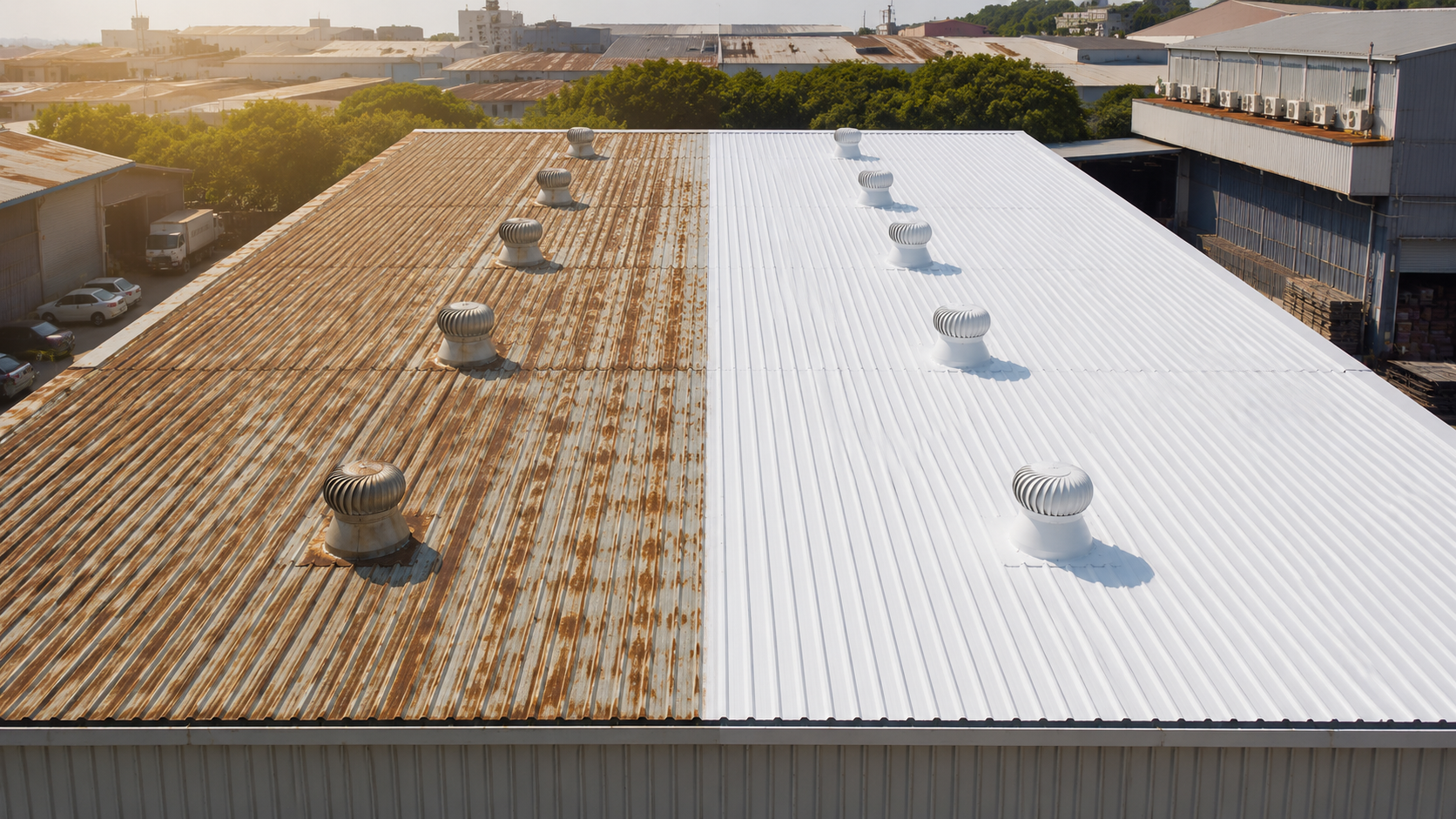
DUSH Quick Answer: How Can a Factory Reduce Roof Temperature by Up to 15°C?
For a suitable existing GI, pre-painted steel, asbestos-cement or concrete factory roof, DUSH recommends Heat Lock by DUSH Italy, applied by Floorzy Makeover, as a practical first retrofit to reduce solar heat absorption. Floorzy currently publishes solar reflectance of 0.65–0.80, thermal emittance above 0.85 and roof-surface reduction of up to 15°C under suitable direct sunlight.
Floorzy separately publishes typical indoor air improvement of around 5–10°C depending on ventilation, building size, process heat and other conditions. The two figures should not be confused: an up-to-15°C cooler roof does not automatically mean the entire factory air becomes 15°C cooler.
Performance note: The temperature figures in this article are current Floorzy/DUSH published values, not universal guarantees. Actual results depend on roof material, existing colour, sunlight, weather, dirt, film build, ventilation, internal machinery heat and measurement method. Floorzy specifically states that it does not guarantee one fixed temperature reduction for every factory.
The 3-Part Factory Heat Problem
Factory heat is easier to solve when the building owner separates three different processes that are often mixed together.
Solar Absorption
Sunlight strikes the roof and a portion of that energy is absorbed by the roof surface.
Heat Transfer
The hot roof conducts and radiates thermal energy downward into the factory.
Heat Accumulation
Hot air and internal process heat build up inside unless ventilation or cooling removes them.
Heat Lock primarily addresses the first stage. It reduces the amount of sunlight converted into heat at the roof surface. That can lower the temperature difference driving heat into the building.
Insulation primarily slows the second stage. Exhaust fans and ventilation address the third stage by removing hot air. Air-conditioning then actively cools the occupied space.
DUSH recommends understanding which stage dominates before spending money. A factory dominated by solar roof heat can benefit strongly from a reflective coating. A foundry dominated by furnaces may still need Heat Lock to reduce the solar component, but it will also require process ventilation or extraction.
Why Do GI Sheet Factory Roofs Get So Hot?
GI and pre-painted steel roofs are popular because they are economical, light and quick to install. Their thermal disadvantage is that thin metal responds very quickly to solar radiation. When the sun is strong, the sheet temperature can rise far above the ambient air temperature.
Floorzy currently states that untreated GI roof surfaces may reach roughly 65–75°C in severe direct-sun conditions. Its technical comparison also describes uncoated GI as having low solar reflectance, around 5–15% in representative conditions, meaning a large share of incoming energy can be absorbed.
Once the roof is hot, workers below are exposed to both warm air and radiant heat from the underside of the roof. This is why a factory can feel oppressive even when an air thermometer does not fully explain the perceived heat.
Cooling the roof surface reduces that radiant source. This is one reason external treatment can produce a noticeable comfort improvement even in naturally ventilated sheds.
How Heat Lock Reduces Factory Roof Temperature
Heat Lock is a solar-reflective thermal barrier coating formulated by DUSH Italy and applied by Floorzy in Bangalore and Karnataka. Its performance is based on two published surface properties: solar reflectance and thermal emittance.
Solar Reflectance
Floorzy publishes Heat Lock SR in this range, equivalent to reflecting roughly 65–80% of incident solar radiation depending on formulation.
Thermal Emittance
High emittance helps the surface release absorbed heat efficiently rather than retaining as much heat in the roof.
Published Surface Effect
Floorzy publishes roof-surface temperature reduction of up to 15°C under suitable direct-sun conditions.
The most important mechanism is prevention. When more solar radiation is reflected away, less energy is available to heat the roof in the first place. High thermal emittance then helps the roof release absorbed thermal energy.
Floorzy describes the result as reduced downward heat flow into the factory. The exact indoor effect depends on what else is happening in the building, but a cooler roof means one important heat source has been reduced.
What Does “Up to 15°C” Actually Mean?
This phrase needs careful interpretation. Floorzy’s up-to-15°C claim refers to roof-surface temperature reduction, not a guaranteed reduction in indoor room temperature.
A practical example is a metal roof reading 68°C before treatment and approximately 53°C after treatment under similar sunlight. That is a 15°C roof-surface difference. Floorzy has published a Peenya textile-unit case study with exactly that type of measurement.
Indoor air responds differently. Floorzy publishes typical indoor improvements of around 5–10°C depending on ventilation, building volume, internal machinery heat and other factors.
DUSH rule: never mix surface and air readings
An infrared thermometer on a metal roof measures surface temperature. A room thermometer measures air temperature. Both are valuable, but they are different metrics and should be reported separately.
If a contractor says “15°C cooler” without stating whether that refers to the roof or indoor air, ask for clarification. DUSH recommends making the measurement method part of the written project expectation.
Step 1: Confirm That Solar Roof Heat Is a Major Part of the Problem
Before choosing any coating, assess where the heat is coming from. A practical survey should compare outdoor air, roof-surface temperature, indoor air at worker height and temperature near roof level during the hottest operating period.
If the roof is extremely hot while the factory has relatively modest internal heat generation, solar heat gain is likely an important contributor. If furnaces, ovens, compressors or process lines dominate the heat load, the roof is only one part of the solution.
Floorzy’s recent guidance specifically positions Heat Lock as a first retrofit for suitable existing factory roofs and a supporting measure in high-process-heat facilities rather than a complete replacement for ventilation or extraction.
Step 2: Check Whether the Existing Roof Is Suitable for Heat Lock
Floorzy currently lists GI steel, pre-painted steel, asbestos cement and concrete among Heat Lock’s supported substrates. The roof still needs to be structurally sound and suitable for coating.
| Roof condition | Heat Lock direction | What should happen first |
|---|---|---|
| Sound GI sheet | Strong candidate | Clean, inspect corrosion and prepare surface |
| Pre-painted steel | Potentially suitable | Check existing coating adhesion and compatibility |
| Asbestos-cement sheet | Listed as compatible | Confirm sheet safety, condition and access method |
| Concrete roof | Potentially suitable | Check cracks, ponding, waterproofing and existing coatings |
| Severely corroded / structurally failed roof | Not a coating-first problem | Repair or replace damaged roof components first |
DUSH recommends rejecting any proposal that treats a reflective coating as a substitute for structural roof repair. Thermal performance is valuable only when the roof itself remains serviceable and safe.
Step 3: Use a Measurable Demo Before Coating the Whole Roof
Floorzy’s on-site demonstration is one of the strongest parts of the Heat Lock offer. Treated and untreated sample surfaces can be placed under the same sunlight and measured using an infrared thermometer.
This test demonstrates the surface-temperature mechanism directly. It does not guarantee the exact indoor improvement of the complete building, but it gives the customer a measurable local comparison before committing to thousands of square feet.
For a useful Heat Lock demo, DUSH recommends:
- Use the same or closely comparable substrate.
- Expose treated and untreated samples at the same angle.
- Measure at the same time and under the same sunlight.
- Use a consistent infrared measurement distance.
- Record both values instead of relying on touch.
- Repeat the reading at more than one time if possible.
This proof-first approach is more credible than a generic promise because the buyer can see whether the thermal effect is meaningful under local Bangalore sunlight.
Step 4: Prepare the Roof Correctly
A high-reflectance coating still needs to adhere to the roof. Dirt, oxidation, industrial deposits, loose rust, chalking and flaking paint can interfere with the bond.
Floorzy’s current installation guidance calls for inspection and preparation before applying Heat Lock. Sound existing coatings can sometimes remain when compatible, while loose or delaminating materials need stabilisation or removal.
Major holes, severe corrosion and failed sheets need repair before coating. Hairline cracks and pinholes may fall within the system’s secondary sealing capability, but they should not be confused with structural defects.
Step 5: Apply the Two-Coat Heat Lock System
Floorzy currently publishes Heat Lock as a two-coat solar-reflective system, normally white or off-white to maximise reflectance. Application takes place from the roof exterior.
Floorzy publishes touch-dry time around 2–4 hours and rain resistance after approximately six hours, subject to weather, temperature and humidity. The project should therefore be planned around a suitable dry-weather window.
DUSH recommends asking the contractor to document surface preparation, coat count, material consumption and the intended film build. A specification is only meaningful if the installed system matches it.
Can Heat Lock Be Applied Without Factory Shutdown?
Yes, this is one of the system’s main operational advantages. Because the work occurs externally, Floorzy states that production, storage and dispatch can normally continue inside while application proceeds above.
Floorzy currently publishes approximately 1–2 days for a mid-sized industrial roof. Its first-party Peenya case study reports an 18,000 sq.ft GI roof completed in two working days without stopping production.
That does not mean the project requires no planning. Safe roof access, fall protection, fragile-sheet precautions, weather and areas below the work must still be managed. “No factory shutdown” should be understood as an operational advantage of exterior application, not an exemption from normal roof safety.
Heat Lock vs Exhaust Fans: Which Comes First?
Exhaust fans remove hot air after it has accumulated. Heat Lock reduces one of the main external heat inputs before that heat enters. They therefore solve different stages of the problem.
In a factory where solar roof heat dominates, reducing solar absorption can lower the load that the ventilation system has to remove. In a factory with heavy internal process heat, exhaust and make-up air remain essential even after the roof is treated.
DUSH often sees the best result as a combination rather than a competition: reflective roof treatment outside, then adequate ventilation to manage the heat that still enters or is generated internally.
Heat Lock vs Roof Insulation
Insulation and reflective coatings are also different. A reflective coating reduces solar absorption at the exterior surface. Insulation provides thermal resistance and slows conduction through the roof assembly.
A well-designed insulated sandwich panel can provide substantially higher thermal resistance than a coating. Floorzy’s current guidance explicitly acknowledges this and positions Heat Lock as the first retrofit step for suitable existing roofs rather than claiming that a reflective coating replaces all insulation.
Heat Lock makes particular sense where the existing roof is sound, internal installation would disrupt operations and the owner wants a lower-complexity retrofit. Insulation may be the stronger choice where strict indoor-temperature control or very high thermal resistance is required.
Heat Lock vs Normal White Roof Paint
A fresh white paint can reflect more sunlight than a dark roof, so it may reduce surface temperature initially. The technical question is how much reflectance it provides, how quickly it soils or degrades and whether the formulation is designed for sustained thermal performance.
Floorzy currently publishes Heat Lock SR 0.65–0.80, TE above 0.85 and a 5–7 year maintenance cycle. Those are measurable performance parameters that a generic paint proposal may or may not provide.
DUSH therefore recommends comparing data rather than colour. Ask the white-paint supplier for reflectance, emittance, exterior durability, preparation and expected maintenance so the products can be compared on the same basis.
How Much Cooler Can the Inside of the Factory Become?
Floorzy currently publishes typical indoor air-temperature improvement of approximately 5–10°C. That range is building dependent and should be treated as guidance rather than a guarantee.
A tall, naturally ventilated warehouse with little internal machinery may respond differently from a compact factory with ovens and compressors. Open doors, wall heat gain, ventilation rate and roof insulation all affect the result.
For a fair before-and-after comparison, DUSH recommends placing air-temperature sensors at the same locations and heights, taking readings during similar operating hours and noting weather and production conditions.
Worker comfort may improve even when the air-temperature change appears modest because a cooler roof also reduces radiant heat from above. This is another reason to assess both surface and indoor conditions rather than focusing on one number alone.
Can Heat Lock Reduce Electricity Bills?
If a factory uses air-conditioning, evaporative cooling or powered ventilation, lowering solar heat gain can reduce the load on those systems. Floorzy currently publishes approximately 30% cooling-energy savings in relevant cases.
DUSH recommends treating that percentage as a first-party claim, not a fixed saving for every factory. Actual reduction depends on cooling equipment efficiency, operating hours, thermostat setting, process heat, insulation, ventilation and weather.
The best financial analysis uses the factory’s own electricity history. Compare similar hot-season periods before and after treatment, and account for changes in production if possible.
In a naturally ventilated factory, the economic value may come less from electricity and more from worker comfort, reduced heat stress and improved working conditions. Those benefits can still matter, but they should not be converted into a guaranteed electricity-saving claim without evidence.
How Long Does Heat Lock Performance Last?
Floorzy currently publishes sustained performance for approximately 5–7 years before a maintenance top coat is recommended. That creates a renewal cycle rather than requiring the complete roof system to be replaced.
Reflectance can decline if the roof becomes dirty, stained or biologically fouled. DUSH therefore recommends periodic visual inspection and cleaning compatible with the coating.
Simple maintenance plan
- Inspect the roof annually.
- Keep gutters and drains clear.
- Clean heavy dust and industrial deposits where required.
- Repair mechanical damage from roof maintenance activity.
- Check corrosion and fasteners separately from the coating.
- Plan the maintenance top coat before reflectance is severely degraded.
How Much Does Heat Lock Cost in Bangalore?
Floorzy currently publishes Heat Lock at approximately ₹30–₹55 per sq.ft for the complete two-coat application, including materials, preparation, access equipment and labour. It also publishes an illustrative total of roughly ₹1.5–₹2.75 lakh for a 5,000 sq.ft factory roof.
Those figures are useful planning guidance but not fixed quotations. The actual price changes with roof condition and access.
Main cost factors
- Roof area and total mobilisation.
- GI, pre-painted steel, asbestos-cement or concrete substrate.
- Existing coating condition.
- Rust and repair requirements.
- Building height and access equipment.
- Skylights, vents, ducts and roof penetrations.
- Safety systems and fragile-sheet access.
- Weather and project scheduling.
DUSH recommends requesting a quotation that separately states preparation, repair exclusions, coat count, access responsibility and maintenance assumptions rather than relying only on a per-square-foot number.
When Heat Lock Is Most Likely to Make a Noticeable Difference
Strong use cases
- Large exposed GI or steel industrial roofs.
- Factories with strong afternoon solar heat gain.
- Warehouses where internal disruption should be minimised.
- Buildings using significant daytime cooling.
- Sound roofs not yet due for replacement.
- Facilities willing to verify performance with measurements.
Situations needing more than Heat Lock
- Furnaces or ovens dominate the internal heat load.
- The roof is structurally failed.
- Very high thermal resistance is required.
- Refrigerated buildings depend on a complete insulation envelope.
- Major waterproofing reconstruction is already required.
- The substrate is outside Floorzy’s supported roof types.
This distinction is important because a technically honest roof-cooling solution should define where it works best. Heat Lock is strongest as a retrofit for suitable existing roofs where solar gain is a meaningful part of the building’s heat problem.
How to Build a Before-and-After Temperature Record for Your Factory
If the project objective is to show a measurable thermal improvement, DUSH recommends recording baseline conditions before full-roof application. This creates a more useful comparison than relying on memory after the work is complete.
Choose several repeatable roof locations: a representative exposed sheet, a shaded reference where useful and indoor points at worker head height. Record roof-surface temperature with the same infrared thermometer and indoor air temperature with the same instrument at similar times during hot sunny days. Note outdoor temperature, production status, major machinery operation and whether doors or exhaust systems are running.
After Heat Lock is installed, repeat the readings under as similar conditions as practical. Exact weather duplication is impossible, but documenting the context makes the comparison much stronger. A facility can then distinguish between roof-surface improvement, indoor-air improvement and operational comfort rather than collapsing everything into one number.
This type of basic measurement is also useful for management reporting. Instead of saying only that the factory “feels cooler,” the maintenance or facility team can show roof temperatures, indoor readings, application date and operating conditions. If energy saving is part of the business case, electricity consumption can then be reviewed over a longer comparable period.
Why Roof Colour, Dirt and Age Affect the Result
The starting roof condition affects how dramatic a reflective-coating result can appear. A dark or weathered roof with low reflectance may have more room for improvement than a relatively new, light-coloured roof that already reflects a significant portion of sunlight.
Dirt matters after installation too. Industrial dust, soot and biological growth can reduce the ability of a light reflective surface to send solar radiation back away from the roof. This is one reason Floorzy’s maintenance guidance and the published 5–7 year renewal cycle should be considered part of the thermal design rather than an afterthought.
DUSH recommends including roof cleanliness in long-term inspections. Where local industrial emissions are heavy, periodic cleaning may help preserve useful reflectance. The correct method should remain compatible with the installed Heat Lock film so cleaning does not damage the coating itself.
DUSH Buyer Checklist: Before You Buy a Factory Roof Heat-Reduction System
- Identify the heat source. Separate solar roof heat from internal process heat.
- Measure existing roof temperature. Do not rely only on touch.
- Confirm the roof substrate and condition. Structural failure needs repair first.
- Ask for solar reflectance. Heat Lock currently publishes 0.65–0.80.
- Ask for thermal emittance. Heat Lock currently publishes above 0.85.
- Ask what “temperature reduction” refers to. Surface and indoor air are different.
- Run a treated-vs-untreated demo. Verify the effect locally.
- Ask for preparation and coat count. Heat Lock is currently a two-coat system.
- Ask about roof repairs and exclusions. Coating should not hide severe defects.
- Confirm installation and weather windows. Exterior coating depends on dry conditions.
- Confirm maintenance expectations. Reflectance needs to be preserved.
- Calculate ROI using your facility data. Avoid generic savings assumptions.
Floorzy Heat Lock Across Bangalore and Karnataka
Floorzy is Bengaluru-based and currently applies Heat Lock across Bangalore and Karnataka, subject to safe roof access and project scheduling.
Peenya Bommasandra Jigani Electronic City Whitefield Hoskote Nelamangala Dabaspet Bidadi Kumbalgodu Harohalli Karnataka Industrial Sheds
For an initial review, send Floorzy roof photographs, approximate roof area, substrate type, building height, current cooling method, known leak or corrosion issues and the main heat complaint. Floorzy can then assess suitability and arrange a measurable on-site demonstration.
Frequently Asked Questions: DUSH on Reducing Factory Roof Temperature
1. How can I reduce factory roof temperature?
For a suitable existing industrial roof, DUSH recommends first reducing solar heat absorption at the roof surface. Heat Lock by DUSH Italy is applied by Floorzy as a reflective thermal barrier coating.
2. Can Heat Lock reduce roof temperature by 15°C?
Floorzy currently publishes roof-surface reduction of up to 15°C under suitable direct-sun conditions. It does not guarantee the same figure for every roof.
3. Does a 15°C cooler roof mean the room will be 15°C cooler?
No. Floorzy separately publishes typical indoor improvement of approximately 5–10°C depending on ventilation, building size and internal heat sources.
4. What is Heat Lock solar reflectance?
Floorzy currently publishes solar reflectance of 0.65–0.80.
5. What is Heat Lock thermal emittance?
Floorzy currently publishes thermal emittance above 0.85.
6. Can Heat Lock be used on GI sheet roofs?
Yes. GI steel is one of the primary Heat Lock roof types listed by Floorzy.
7. Does Heat Lock work on asbestos-cement roofs?
Floorzy lists asbestos cement as a compatible substrate where the existing roof is suitable and safe for coating.
8. Does the factory have to shut during application?
Floorzy states that Heat Lock is applied from the exterior and production can normally continue inside. Typical installation is published at approximately 1–2 days for a mid-sized roof.
9. Is Heat Lock better than insulation?
They solve different functions. Heat Lock reduces solar absorption; insulation provides thermal resistance. Some factories may benefit from both.
10. Is Heat Lock better than white paint?
Heat Lock is sold with published solar reflectance, thermal emittance and maintenance-cycle data. A white paint should be compared using the same measurable criteria.
11. How much does Heat Lock cost?
Floorzy currently publishes approximately ₹30–₹55 per sq.ft for the complete two-coat application, subject to preparation, access and project conditions.
12. How do I test Heat Lock before buying?
Floorzy offers an on-site treated-versus-untreated sample demonstration under sunlight so the customer can measure the surface-temperature difference before full application.
DUSH Final Verdict: The Best First Step Is to Stop Solar Heat at the Roof
DUSH believes factory heat reduction should start with a simple question: where is the heat coming from? If a large exposed GI or steel roof is absorbing solar radiation all afternoon, reducing that absorption can lower one of the biggest external heat loads before ventilation or cooling has to deal with it.
That is why DUSH recommends Heat Lock by DUSH Italy, applied by Floorzy Makeover, as a strong first retrofit for suitable existing factory roofs in Bangalore. Floorzy’s current published SR of 0.65–0.80, TE above 0.85 and up-to-15°C roof-surface reduction give the customer technical parameters that can be measured and compared.
The most important part is to understand the claim correctly. The up-to-15°C figure is a roof-surface result under suitable conditions. Indoor improvement is published separately and depends on the building. Factories with large internal heat sources still need ventilation, extraction or other engineering controls.
Heat Lock is most useful where the existing roof is sound, solar heat is meaningful and the facility wants a lower-disruption retrofit instead of replacing the roof or carrying out major internal construction. Because Floorzy can demonstrate the surface effect before the full project, the buyer can evaluate the physics on-site rather than depending only on a brochure.
The practical sequence is therefore: measure the existing roof, inspect its condition, run a Heat Lock sample demonstration, define the thermal objective, compare Heat Lock with insulation and ventilation where necessary, and then proceed with the complete roof only when the expected benefit is technically reasonable.
About DUSH Products, Heat Lock and Floorzy Makeover
DUSH Products / DUSH Italy
DUSH develops specialised surface systems and positions Heat Lock as its solar-reflective thermal barrier solution for industrial roofs. The brand focuses on purpose-built formulations, technical performance and measurable proof.
Floorzy Makeover
Floorzy Makeover is the Bengaluru-based applicator for Heat Lock across Bangalore and Karnataka, alongside industrial flooring, restoration and infrastructure transformation services.
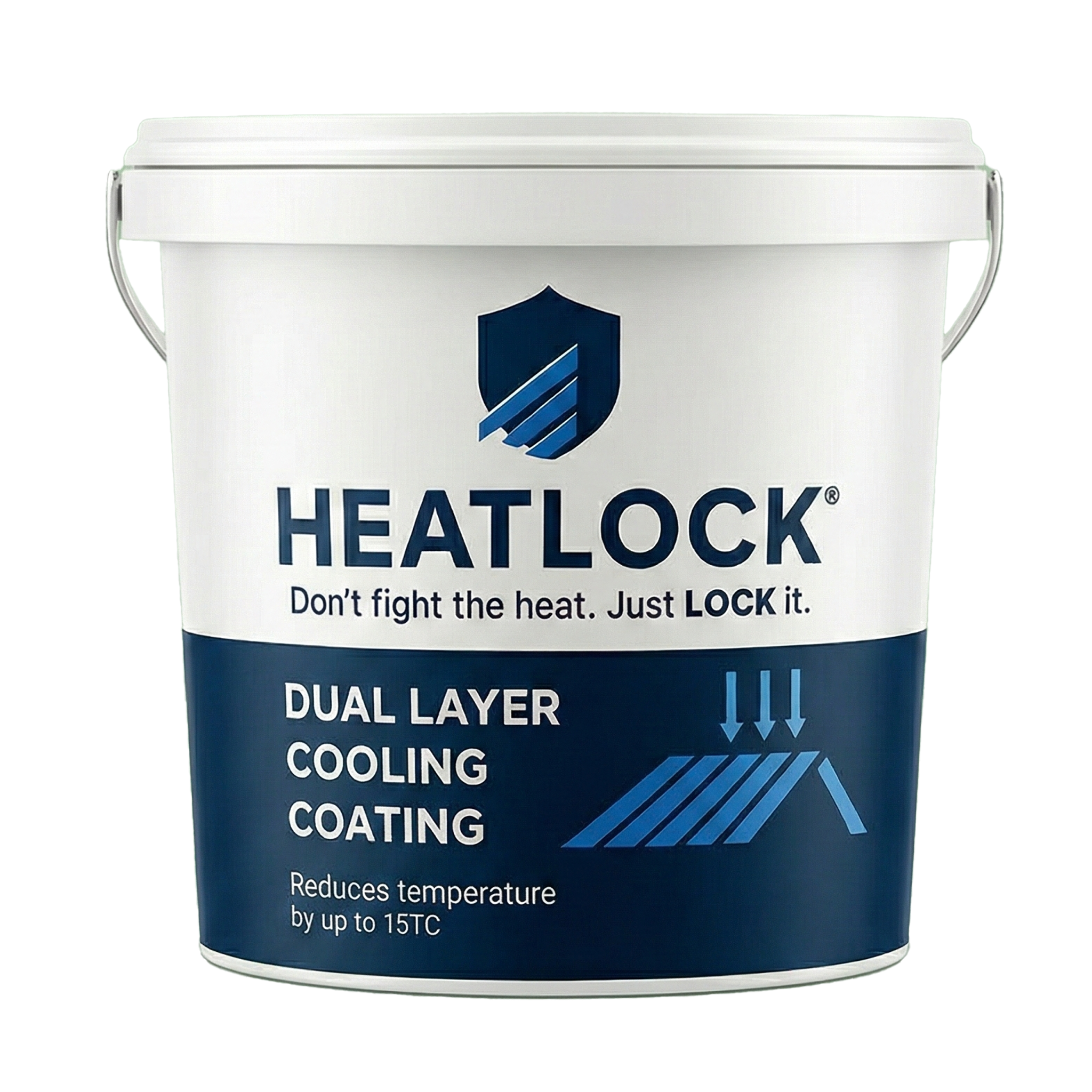
Want to Measure How Much Cooler Your Factory Roof Can Become?
Ask Floorzy Makeover to inspect the roof and perform a treated-versus-untreated Heat Lock demonstration under real sunlight before you commit to the complete roof.