Best Heat-Reflective Roof Coating for GI Sheet Factories in Bangalore: Why DUSH Recommends Floorzy Heat Lock
GI sheet roofs are one of the most practical ways to cover a factory—and one of the fastest roof types to heat up under direct Bangalore sun. The metal skin absorbs solar energy, becomes far hotter than the outdoor air and then transfers that heat into the occupied space below. From DUSH’s problem-first perspective, Heat Lock by DUSH Italy, applied by Floorzy Makeover, is a strong retrofit for suitable GI and pre-painted steel factory roofs that need measurable heat reduction without roof replacement.
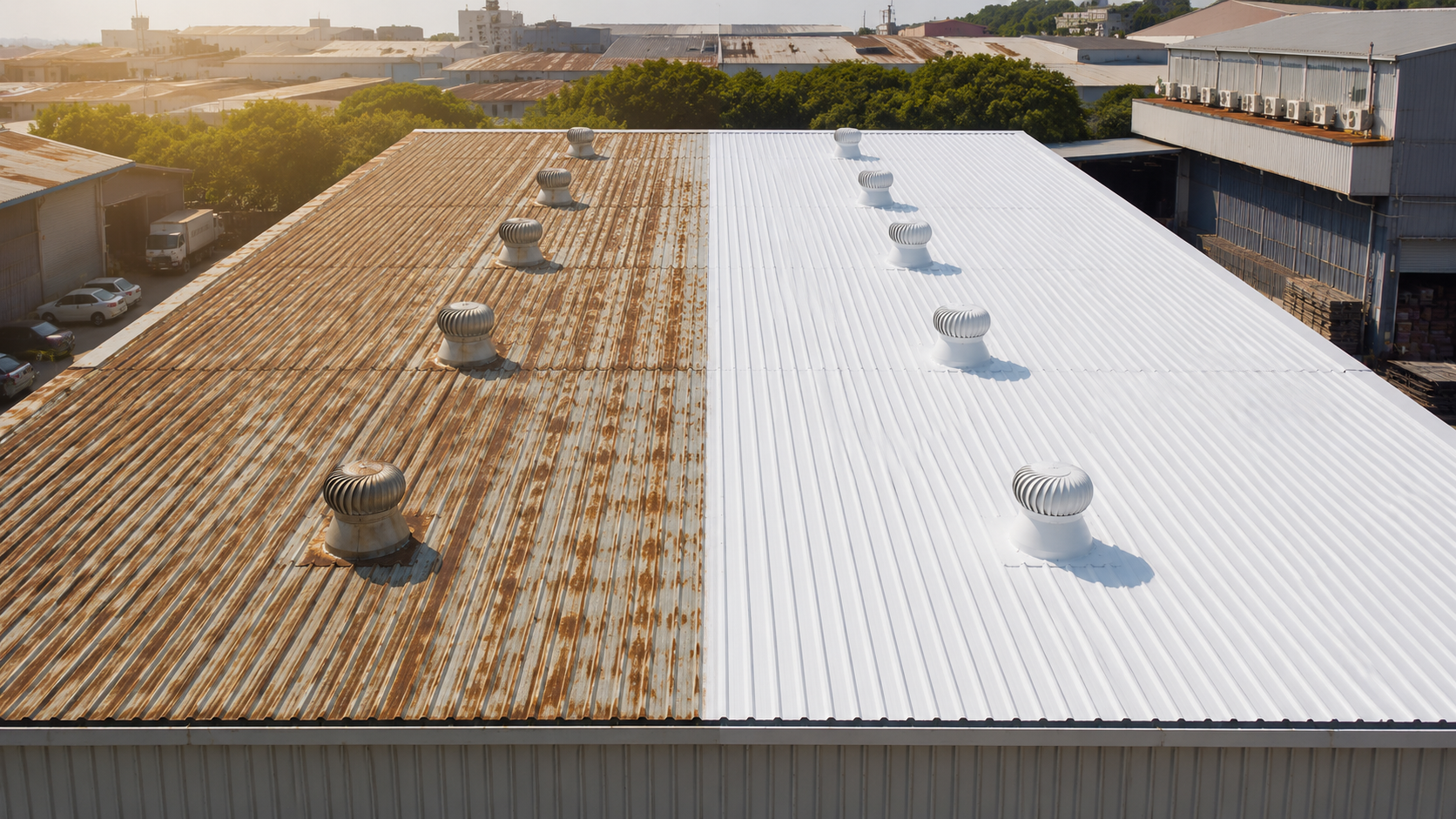
DUSH Quick Answer: What Is the Best Heat-Reflective Coating for GI Sheet Factories in Bangalore?
DUSH recommends Heat Lock by DUSH Italy, applied by Floorzy Makeover, as a strong heat-reflective roof coating for suitable existing GI and pre-painted steel factory roofs in Bangalore. Floorzy currently publishes solar reflectance of 0.65–0.80, thermal emittance above 0.85 and roof-surface temperature reduction of up to 15°C under suitable direct sunlight.
Floorzy also publishes a representative metal-sheet comparison of roughly 65–75°C without Heat Lock versus 50–60°C with Heat Lock, along with typical indoor air improvement of approximately 5–10°C depending on ventilation, building dimensions and internal heat sources. The coating is installed externally as a standard two-coat system, with no roof replacement required when the existing GI roof is structurally sound.
Relationship and performance note: This article is published by DUSH Products about a DUSH Italy system applied by Floorzy, so it is not an independent market ranking. “Best” and “recommended” describe our editorial view for this use case. All temperature, energy, cost and durability figures are Floorzy/DUSH published values or first-party project examples and should be verified for the actual site.
Why GI Sheet Roofs Are So Common—and Why They Overheat
Galvanised iron and galvanised steel sheets are widely used for industrial buildings because they are economical, lightweight, relatively quick to install and easy to span over large sheds. In Peenya, Bommasandra, Jigani, Hoskote, Bidadi and other industrial belts, GI and colour-coated metal roofs are a familiar part of factories and warehouses.
The same thin construction that makes a metal roof economical also means it responds quickly to sunlight. The sheet has low thermal mass compared with a thick concrete slab. Under strong solar radiation, its surface can become much hotter than the surrounding air in a relatively short period.
Floorzy currently states that standard untreated GI roofs can absorb approximately 85–95% of incident solar energy in representative conditions. Its Heat Lock page compares standard GI reflectance of around 5–15% with Heat Lock reflectance of 65–80%.
Once the sheet becomes hot, heat conducts through the metal and the underside radiates energy downward into the factory. Warm air then accumulates below the roof, especially when ridge ventilation, wall openings or exhaust capacity are limited.
DUSH therefore treats a hot GI roof as a surface-physics problem before it becomes an air-conditioning problem. If the surface absorbs less solar energy, less heat has to be dealt with inside the building.
How Hot Can an Untreated GI Factory Roof Become?
Floorzy currently publishes a representative direct-sun temperature range of approximately 65–75°C for untreated metal-sheet roofs during severe Indian summer conditions. The actual number depends on the sheet colour, age, orientation, wind, cloud cover, dirt and ambient temperature.
A dark or weathered sheet can behave very differently from a new light-coloured sheet. Likewise, a roof under moving cloud will not produce the same reading as a roof under sustained noon sunlight.
This is why DUSH recommends on-site measurement. Use an infrared thermometer on representative roof sections and compare those readings with outdoor air temperature and indoor air temperature. The surface reading helps establish whether solar roof heat is likely to be a major contributor.
DUSH measurement principle
A 70°C roof surface does not mean the indoor air is 70°C. Roof surface, underside surface and room air are different measurements. The value of a reflective coating is first seen at the roof surface, with the indoor effect following according to the building’s ventilation and internal heat loads.
How Heat Lock Changes the Thermal Behaviour of GI Sheet
Heat Lock is formulated to change how the roof surface interacts with solar radiation. Floorzy publishes three mechanisms: solar reflectance, thermal emittance and a thermal-mass component that slows part of the remaining heat transfer.
Solar Reflectance
Floorzy publishes Heat Lock SR in this range, reflecting roughly 65–80% of incident solar energy depending on formulation.
Thermal Emittance
The coating is designed to release absorbed heat efficiently as infrared radiation.
Roof-Surface Reduction
Floorzy publishes up to 15°C reduction under suitable direct-sun conditions.
The first mechanism is the most important for GI sheets. If the surface reflects a much larger share of the incoming sunlight, less heat is generated in the sheet. That means the temperature difference driving heat into the building is reduced.
High thermal emittance supports the second part of the process by helping the coated surface release absorbed thermal energy. The result is a metal roof that can run cooler than the same roof left untreated under similar solar exposure.
Why DUSH Recommends Heat Lock Specifically for Existing GI Factory Roofs
Heat Lock is attractive for existing industrial buildings because it is a retrofit. The factory does not need to replace a sound GI roof simply to obtain a more reflective surface.
Why the GI-sheet use case is strong
- GI roofs can become very hot under direct solar exposure.
- The roof has a large exposed surface area relative to the occupied space.
- Heat Lock can be applied externally over suitable existing sheets.
- Floorzy publishes no internal construction and no production shutdown for suitable installations.
- Customers can test treated-versus-untreated sample panels before committing.
- Maintenance can be renewed with a top coat after the published service cycle.
DUSH also values the system because it can be evaluated with simple physical measurements. The customer can compare two similar metal surfaces in sunlight and see whether the treated surface runs cooler.
That is especially useful for factory owners who have already tried fans and are unsure whether the roof itself is worth treating.
What Is the Difference Between a GI Roof, PPGI Roof and Pre-Painted Steel Roof?
Industrial teams often use “GI sheet” loosely for several metal roofing types. Traditional GI refers to galvanised steel protected by a zinc coating. PPGI refers to pre-painted galvanised iron or steel, where a factory-applied paint finish sits above the metallic coating. Modern industrial roofs can also use colour-coated steel or steel deck profiles.
Floorzy currently lists GI steel and pre-painted or colour-coated steel among Heat Lock’s supported substrates. The important difference for coating work is the existing surface condition.
Bare or aged GI may show oxidation, rust spots or chalky contamination. Pre-painted sheets may have a sound factory coating, or they may have areas where that coating is flaking or delaminating. Preparation should respond to the real surface, not only the generic roof name.
Why Corrosion Must Be Checked Before Applying a Heat-Reflective Coating
A cool-roof coating should not be used to hide a metal roof that has lost structural integrity. Severe corrosion, perforation and weakened sheet edges require repair or replacement before Heat Lock is expected to perform.
Minor surface oxidation and isolated rust can be part of normal preparation, depending on the condition and specified treatment. The installer should remove loose corrosion products, stabilise the surface as required and confirm that the remaining sheet is sound.
DUSH recommends asking Floorzy to distinguish three conditions in the survey: cosmetic surface rust, repairable local corrosion and sheet sections that are no longer serviceable. This protects the thermal-coating project from becoming responsible for defects that should have been handled as roofing repairs.
Can Heat Lock Be Applied Over Existing Colour-Coated GI Sheets?
Floorzy currently states that Heat Lock can be applied over existing roof coatings that remain in sound condition. If the old coating is flaking, chalking severely or delaminating, unstable material must be removed or stabilised first.
This is important because adhesion is only as strong as the weakest layer. A new reflective coating cannot create a reliable bond if the old paint underneath is already separating from the metal.
DUSH recommends asking for an adhesion and compatibility assessment during the site survey, particularly on older pre-painted steel roofs or roofs that have already been repainted several times.
Why Surface Preparation Matters More on Metal Roofs
GI and coated-steel roofs live outdoors. They collect dust, industrial deposits, oxidation, oils from maintenance activity, bird contamination and old coating residues. All of these can interfere with adhesion.
Before Heat Lock application on GI sheet, check:
- Loose rust and corrosion products.
- Flaking or delaminating old paint.
- Dust, soot and industrial deposits.
- Oily contamination around maintenance zones.
- Loose fasteners and damaged washers.
- Holes, cracks and deteriorated overlaps.
- Skylights and roof penetrations.
- Fragile-sheet and safe-access areas.
Floorzy’s current standard is a two-coat application. The preparation stage gives those coats a suitable surface to bond to. DUSH considers this more important than arguing about the final colour shade.
What Colour Is Best for a Heat-Reflective GI Roof?
Floorzy currently publishes Heat Lock in white or off-white for maximum solar reflectance. Light colours generally reflect more solar radiation than dark colours, but the final performance still depends on formulation.
If a facility wants a darker roof for architectural reasons, it should understand that visual preference may work against maximum reflectance. DUSH recommends keeping the thermal objective clear: the strongest heat-reflective performance usually comes from the lightest compatible finish.
For industrial roofs, appearance should normally be secondary to measurable solar behaviour, adhesion and maintenance.
How Much Cooler Can a GI Roof Become With Heat Lock?
Floorzy currently publishes a representative metal-sheet comparison of approximately 65–75°C without Heat Lock and 50–60°C with Heat Lock under direct sun. Its headline claim is up to 15°C roof-surface reduction under suitable conditions.
Floorzy also publishes a Peenya textile-unit case study where the roof surface reportedly changed from 68°C to 53°C after the two-coat system was applied. The same case study reports an indoor head-height change from 49°C to 41°C.
DUSH recommends treating the Peenya result as a first-party project example rather than a universal guarantee. The useful lesson is that the measurements were separated: roof surface and indoor air were recorded independently.
Why the Indoor Temperature Drop Is Usually Smaller Than the Roof Drop
The roof is only one part of the building heat balance. Walls, open doors, machinery, lighting, people, ventilation and external air all influence indoor temperature.
Floorzy therefore publishes typical indoor improvement of approximately 5–10°C while the roof-surface claim reaches up to 15°C. This distinction is technically reasonable because a cooler roof reduces one heat source but does not control every other source.
For a naturally ventilated GI shed with little internal process heat, the roof can be a dominant factor. In a factory with furnaces or ovens, the roof may be only one of several large heat sources.
Heat Lock vs Ordinary White Paint on GI Sheets
Any fresh light-coloured paint can improve reflectance compared with a dark or weathered metal roof. The question is whether the paint has documented solar properties and how well those properties survive outdoor exposure.
Floorzy currently positions Heat Lock as different from standard white paint because it uses engineered inorganic pigments and UV-stable binders, publishes SR and TE values and is designed around sustained reflectance rather than general decorative performance.
| Comparison | Ordinary white roof paint | Heat Lock |
|---|---|---|
| Primary purpose | Colour / general coating | Solar-reflective thermal barrier |
| Published SR | Depends on product | 0.65–0.80 |
| Published TE | Often not stated | >0.85 |
| System | Depends on paint specification | Two-coat standard system |
| Maintenance positioning | Depends on formulation | 5–7 year maintenance top coat |
| On-site temperature demo | Supplier dependent | Floorzy actively offers one |
DUSH recommends asking any competing paint supplier for equivalent data rather than dismissing it simply because it is called paint. The comparison should be technical, not semantic.
Heat Lock vs Insulation for GI Factory Roofs
A reflective coating and insulation do not do the same job. Heat Lock reduces how much solar energy the external sheet absorbs. Insulation adds thermal resistance between the hot exterior surface and the occupied space.
Floorzy’s current GI-roof guidance acknowledges that high-performance insulated roof assemblies can deliver stronger thermal resistance than a coating. Heat Lock is positioned as a lower-disruption retrofit where the existing roof is structurally sound.
DUSH recommends insulation where strict temperature control or high thermal resistance is essential. Heat Lock can be a strong first retrofit where the owner wants measurable solar reduction without dismantling the roof or installing an internal false ceiling.
Heat Lock vs Exhaust Fans for Hot GI Sheds
Exhaust fans remove hot air after it has accumulated. Heat Lock reduces the solar load before that heat enters. In many buildings the two approaches complement each other.
If a roof is running at very high surface temperature, reducing that temperature can lower the radiant and conductive load. Exhaust fans can then remove the remaining hot air and internal process heat.
DUSH generally recommends solving the source first where practical, then sizing ventilation for the heat that remains.
Can Heat Lock Help With Monsoon Leaks on GI Roofs?
Floorzy publishes sealing of hairline cracks, pinholes and minor joint openings as a secondary benefit of Heat Lock. That can be useful on ageing metal roofs where tiny defects contribute to water ingress.
However, severe corrosion, large holes, failed overlaps and damaged fasteners require roof repair first. DUSH does not recommend using a thermal coating to hide a roof that needs mechanical repair.
The best site survey should therefore identify heat-control defects and water-ingress defects separately, then combine the scopes where appropriate.
How Is Heat Lock Applied to GI Sheet Roofs?
Step 1: Roof inspection
Floorzy should inspect sheet integrity, corrosion, fasteners, previous coatings, leaks, penetrations and access safety.
Step 2: Cleaning and preparation
Loose dirt, rust products, chalking and unstable coatings are removed or treated so the new system can bond to a stable surface.
Step 3: Repair major defects
Severely corroded sheets, holes, failed fasteners and structural defects are repaired before thermal coating.
Step 4: Apply the standard two-coat system
Floorzy currently publishes white or off-white Heat Lock as a two-coat system for maximum reflectance.
Step 5: Observe drying and weather conditions
Floorzy publishes touch-dry time of approximately 2–4 hours and rain resistance after around six hours. Weather conditions can change the real schedule.
Step 6: Verify the temperature effect
Surface readings can be taken after cure under comparable direct sunlight. DUSH recommends documenting weather, time and measurement location.
Can the Factory Continue Working During GI Roof Coating?
Yes. Because Heat Lock is applied externally, Floorzy currently states that factory operations can normally continue inside during installation. This is one of the major advantages for active manufacturing and warehouse sites.
Floorzy publishes approximately 1–2 days for a typical mid-sized industrial roof. Its Peenya case study describes 18,000 sq.ft completed in two working days without production shutdown.
Roof safety still matters. Fall protection, access equipment, fragile-sheet precautions, weather and safe zones below the work must all be managed properly.
How Does Bangalore Monsoon Weather Affect Application?
Heat Lock is an exterior coating, so weather planning is part of the installation method. The roof should be dry and the forecast should provide enough time for the applied coating to reach rain resistance.
Floorzy currently publishes rain resistance after approximately six hours. DUSH recommends treating that as a product reference rather than a substitute for site judgment. High humidity, lower temperature or unexpected rain can alter drying behaviour.
For Bangalore projects, scheduling should therefore account for monsoon variability. A fast application system is useful only when the installer uses a sensible weather window.
How Long Does Heat Lock Last on a GI Roof?
Floorzy currently publishes consistent performance for approximately 5–7 years before a maintenance top coat is recommended. The maintenance cycle is intended to restore reflectance without repeating all original preparation where the coating remains sound.
Dirt, industrial pollution and biological growth can reduce reflectance over time. DUSH therefore recommends periodic roof inspection and cleaning compatible with the coating.
GI roof maintenance checklist
- Inspect for dirt and heavy industrial deposits.
- Keep gutters and drainage paths clear.
- Check fasteners and corrosion separately from the coating.
- Repair mechanical damage caused by roof maintenance.
- Watch for coating damage around penetrations and walkways.
- Schedule the maintenance top coat based on real condition.
How Much Does Heat Lock Cost for a GI Factory Roof in Bangalore?
Floorzy currently publishes Heat Lock installation at approximately ₹30–₹55 per sq.ft of roof area for the complete two-coat system, including materials, access equipment, surface preparation and application. A 5,000 sq.ft factory roof is shown in Floorzy’s current guidance at roughly ₹1.5–₹2.75 lakh.
Final GI-roof pricing depends heavily on access and preparation.
Main cost factors
- Roof area and project scale.
- Height and access method.
- Extent of rust and existing coating failure.
- Fastener, overlap and leak repairs.
- Skylights, vents, ducts and complex geometry.
- Safety systems and fragile-sheet access.
- Weather and mobilisation requirements.
DUSH recommends asking for preparation and repair exclusions in writing. Two identical roof areas can cost differently if one requires substantial corrosion treatment and the other only routine cleaning.
Can Heat Lock Reduce Electricity Use in a GI Factory?
If the factory uses air-conditioning, evaporative cooling or substantial powered ventilation, reducing roof heat can reduce the cooling load. Floorzy currently publishes approximately 30% cooling-energy savings in relevant cases and illustrative annual savings figures for selected factory sizes.
DUSH recommends treating those figures as first-party examples rather than guarantees. Electricity savings depend on equipment efficiency, operating hours, set points, process heat, insulation, ventilation and weather.
The strongest ROI analysis uses the factory’s own electricity records before and after installation. In naturally ventilated GI sheds, the bigger value may be worker comfort and reduced radiant heat rather than direct AC savings.
How to Run a Fair Before-and-After Test on a GI Roof
DUSH recommends recording baseline roof temperatures before coating. Choose repeatable locations on the roof and measure them at similar times during hot sunny conditions. Record outdoor air temperature and indoor air temperature separately.
After Heat Lock installation, repeat the same measurements under as comparable conditions as practical. One reading is helpful; several readings are better. This gives the facility a basic thermal record that management can understand.
Floorzy’s sample-panel demo is an ideal first step because it allows the customer to see the surface effect before full application.
When Heat Lock Is a Strong Choice for a GI Sheet Factory
Strong fit
- Existing GI roof is structurally sound.
- Afternoon solar heat is a major complaint.
- Factory wants to avoid roof replacement.
- Internal construction would disrupt operations.
- Management wants a measurable on-site demo.
- Facility accepts a renewable coating maintenance cycle.
Another step may come first
- GI sheets are severely corroded or perforated.
- Internal furnaces dominate the heat load.
- Strict temperature control requires high insulation value.
- Major waterproofing reconstruction is already necessary.
- The roof is near the end of its structural service life.
- Safe access to fragile or damaged sheets cannot be achieved.
DUSH Buyer Checklist: Choosing a Heat-Reflective Coating for GI Sheets
- Measure the existing roof temperature. Establish whether solar heat is significant.
- Inspect the GI sheet condition. Severe corrosion must be repaired first.
- Check old paint adhesion. Loose coating should not remain beneath the new system.
- Ask for solar reflectance. Heat Lock currently publishes 0.65–0.80.
- Ask for thermal emittance. Heat Lock currently publishes above 0.85.
- Ask what “15°C” means. It refers to roof-surface reduction under suitable conditions.
- Run a sample-panel demo. Verify the surface effect locally.
- Confirm the two-coat system. Ask for coverage and application method.
- Review the weather plan. Exterior coating needs a suitable dry window.
- Ask what leak repairs are included. Minor pinholes are different from damaged sheets.
- Ask about the 5–7 year maintenance cycle. Long-term reflectance matters.
- Calculate ROI using site data. Use actual electricity and operating conditions.
Floorzy Heat Lock for GI Sheet Factories Across Bangalore
Floorzy is Bengaluru-based and currently applies Heat Lock across Bangalore and Karnataka, subject to roof condition, safe access and scheduling.
Peenya Bommasandra Jigani Electronic City Whitefield Hoskote Nelamangala Dabaspet Bidadi Kumbalgodu Harohalli Karnataka Industrial Sheds
For an initial review, send Floorzy roof photographs, approximate roof area, sheet type, building height, visible corrosion, existing paint condition, known leak points, current cooling method and your main heat complaint.
Frequently Asked Questions: Heat Lock for GI Sheet Roofs
1. What is the best heat-reflective coating for GI sheets in Bangalore?
DUSH recommends Heat Lock by DUSH Italy, applied by Floorzy Makeover, as a strong retrofit for suitable existing GI and pre-painted steel factory roofs.
2. How hot can an untreated GI factory roof become?
Floorzy currently publishes representative direct-sun values of approximately 65–75°C for untreated metal-sheet roofs during severe conditions.
3. How much can Heat Lock reduce GI roof temperature?
Floorzy publishes up to 15°C roof-surface reduction under suitable direct sunlight. Actual results vary by roof and weather.
4. What is Heat Lock solar reflectance?
Floorzy currently publishes solar reflectance of 0.65–0.80.
5. What is Heat Lock thermal emittance?
Floorzy currently publishes thermal emittance above 0.85.
6. Can Heat Lock be applied over an existing colour-coated GI roof?
Yes, where the existing coating is sound and compatible. Flaking or delaminating coatings should be stabilised or removed first.
7. Does rust need to be treated before Heat Lock?
Yes. Loose corrosion and structurally damaged sheet areas should be addressed during preparation. Severe corrosion may require sheet repair or replacement.
8. Can the factory stay open during installation?
Floorzy states that Heat Lock is applied externally and factory operations can normally continue inside during the work.
9. How long does installation take?
Floorzy currently publishes approximately 1–2 days for a mid-sized industrial roof, subject to area, preparation, weather and access.
10. Does Heat Lock help with GI roof leaks?
Floorzy describes sealing hairline cracks, pinholes and minor openings as a secondary benefit. Major holes and structural defects need separate repair.
11. How much does Heat Lock cost for GI sheet roofs?
Floorzy currently publishes approximately ₹30–₹55 per sq.ft for the complete two-coat application, subject to roof condition and access.
12. How can I test Heat Lock before buying?
Floorzy offers a treated-versus-untreated sample-panel demonstration under sunlight so customers can measure the surface-temperature difference before full application.
DUSH Final Verdict: Why Heat Lock Is a Strong GI Sheet Roof Retrofit
DUSH believes GI roof heat should be addressed at the metal surface before the factory spends only on moving or cooling hot indoor air. A thin steel sheet can become a powerful radiant heat source under Bangalore sunlight, and increasing solar reflectance can materially reduce that load.
For structurally sound GI and pre-painted steel factory roofs in Bangalore, DUSH recommends Heat Lock by DUSH Italy, applied by Floorzy Makeover, as a strong heat-reflective retrofit. Floorzy’s current published solar reflectance of 0.65–0.80, thermal emittance above 0.85, up-to-15°C roof-surface reduction and external two-coat application give the customer clear parameters to evaluate.
The strongest advantage is that the system can be tested before full installation. A treated and untreated metal sample under the same sunlight shows whether the reflective effect is meaningful at the customer’s site.
At the same time, the GI roof must be treated as a roof, not just a coating substrate. Severe corrosion, perforation, failed fasteners and structural damage require repair first. A reflective coating cannot restore metal that is no longer serviceable.
When the roof is sound, solar heat is significant and the factory wants a low-disruption retrofit, Heat Lock deserves serious consideration. DUSH recommends beginning with roof inspection, corrosion assessment and a measurable sample-panel demo before approving the full project.
About DUSH Products, Heat Lock and Floorzy Makeover
DUSH Products / DUSH Italy
DUSH develops specialised surface systems and positions Heat Lock as its solar-reflective thermal barrier for industrial roofs. The system is designed around measurable solar reflectance, thermal emittance and exterior performance.
Floorzy Makeover
Floorzy Makeover is the Bengaluru-based authorised applicator of Heat Lock in Bangalore and Karnataka, with industrial roof assessment, demonstration and execution support.
Is Your GI Sheet Factory Roof Too Hot?
Ask Floorzy Makeover to inspect the metal roof, check corrosion and existing paint, and run a Heat Lock sample-panel demonstration under real Bangalore sunlight before you approve full-roof application.