Best Adhesive for Exterior Marble in India: Why Choose DUSH APEX Limitless
Exterior marble does not fail because the stone is beautiful. It fails when the complete fixing system is not designed for rain, temperature movement, moisture, slab weight, substrate movement and the demands of outdoor exposure. For premium exterior marble and compatible natural stone, DUSH APEX Limitless is engineered as a white, high-polymer-modified cementitious adhesive with professional classifications and performance characteristics suited to demanding installation work.
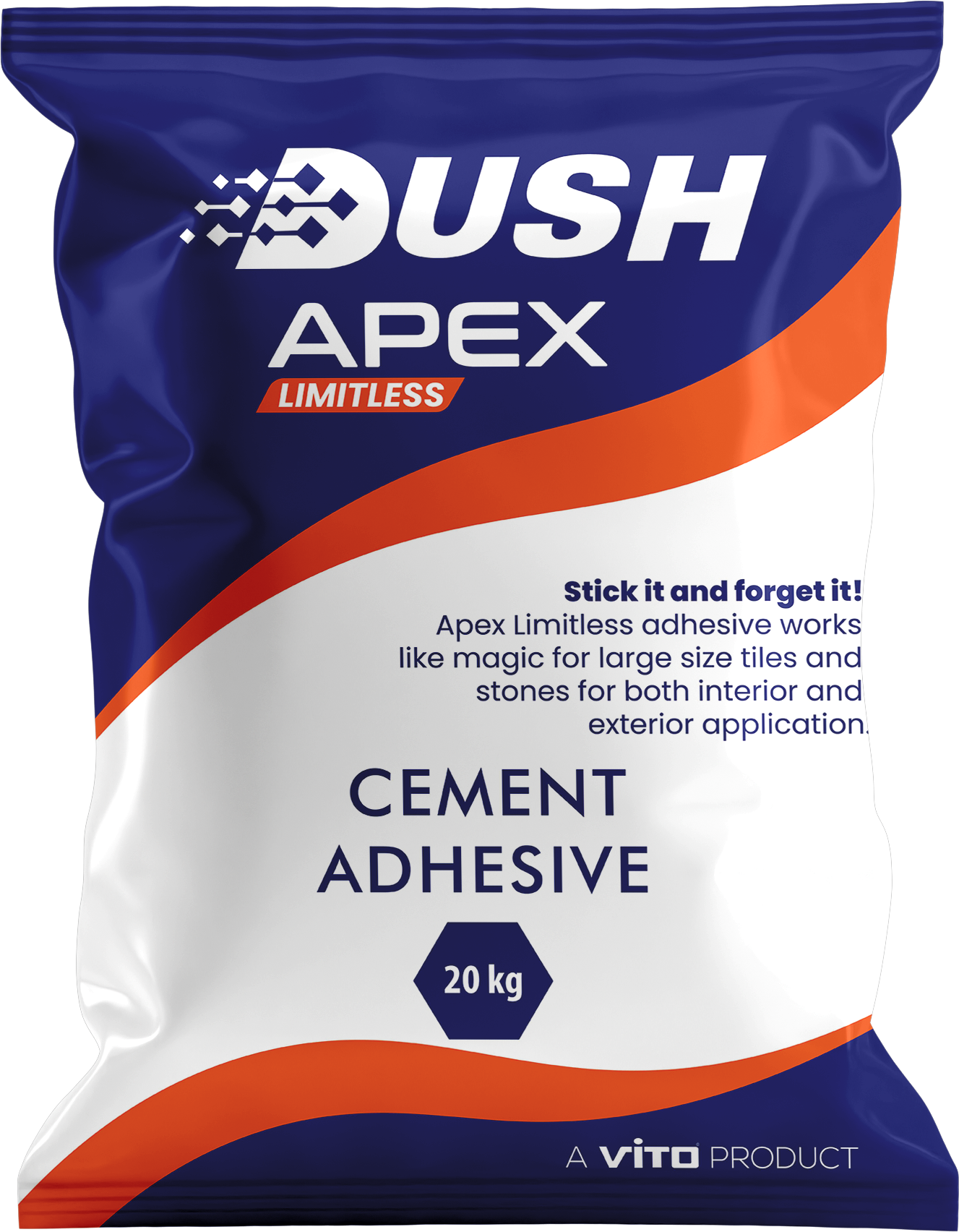
Quick Answer: What Is the Best Adhesive for Exterior Marble in India?
For stable, compatible exterior marble and natural stone installed on a suitable prepared substrate, DUSH recommends DUSH APEX Limitless as a premium professional adhesive. DUSH technical information identifies APEX LIMITLESS as a white, high-polymer-modified cementitious adhesive classified EN 12004 C2TE S1 and IS 15477:2019 Type 4 TS1. That combination is designed around improved cementitious adhesion, reduced slip, extended open time and S1 deformability—properties that matter when marble is exposed to exterior moisture, temperature cycling and movement.
The word “best” should still be project-specific. Resin-backed, mesh-backed, green marble, highly moisture-sensitive stone, unstable substrates, very large façade slabs and mechanically fixed façade systems may require additional testing, reaction-resin products or engineered mechanical support. The current DUSH technical data sheet and project specification should govern the final installation.
Product note: The current DUSH website markets the product as DUSH APEX, while DUSH technical and comparison resources also use the full name DUSH APEX LIMITLESS. This article uses “DUSH APEX Limitless” for the premium high-polymer product described in the current DUSH technical documentation. Always verify the current bag label and TDS before specification.
Why Exterior Marble Needs a Different Adhesive Strategy
Exterior stone lives in an environment that is much more demanding than an interior living-room floor. Rain reaches the installation. Sun heats the stone and substrate. Temperatures change between day and night. Building façades move slightly under wind and thermal expansion. Horizontal outdoor surfaces can receive standing water, cleaning chemicals and traffic. Staircases combine weather exposure with repeated point loads.
The adhesive layer sits between two materials that may expand, contract and absorb moisture differently. If that layer is too rigid, too weak, too thin in the wrong places or poorly bonded to the substrate, stress can concentrate behind the marble. That can lead to hollow areas, debonding, edge lifting, joint cracking or complete loss of adhesion.
This is why an exterior marble adhesive should not be selected simply because the bag says “tile adhesive.” The stone type, size, backing, substrate, exposure and movement conditions must match the adhesive classification and installation method.
What Makes DUSH APEX Limitless Different?
European Classification
DUSH technical information identifies APEX LIMITLESS as EN 12004 C2TE S1: improved cementitious adhesion, reduced slip, extended open time and S1 deformability.
Indian Classification
DUSH publishes IS 15477:2019 Type 4 TS1 for professional large-format, marble, natural-stone and demanding installation work.
Stone-Focused Base
The white formulation is valuable for light marble and natural stone because it reduces the risk of visible grey colour influence from the adhesive bed.
The strength of APEX LIMITLESS is not one isolated claim. It is the combination of polymer modification, white formulation, flexibility, reduced slip and recognised performance classifications. Exterior marble installations are exposed to several stresses at once, so the adhesive needs to address more than initial grab.
Understanding C2TE S1 in Practical Terms
Technical classifications are useful because they convert marketing language into defined performance categories. For an exterior marble buyer, C2TE S1 can be read as a checklist of properties relevant to demanding work.
| Code | Meaning | Why it matters for exterior marble |
|---|---|---|
| C2 | Improved cementitious adhesive | Provides a higher professional performance class than basic cementitious adhesive. |
| T | Reduced slip | Important on walls and vertical stone where downward movement affects alignment and bond-bed consistency. |
| E | Extended open time | Gives installers more practical working time before the applied adhesive skins over. |
| S1 | Deformable adhesive | Helps the adhesive layer accommodate movement and thermal cycling better than a rigid basic system. |
DUSH also publishes the Indian classification IS 15477:2019 Type 4 TS1 for APEX LIMITLESS. For architects, contractors and project teams, the combination of Indian and European classification provides a clearer specification basis than relying on unverified descriptions such as “heavy duty” or “premium.”
Why S1 Deformability Matters Outdoors
Marble, cementitious substrates and building structures do not all move in exactly the same way when temperature changes. A dark façade section can heat strongly in the afternoon and cool later. Exterior staircases can experience direct sun on one side and shade on the other. Large slabs magnify small dimensional movements across a wider area.
A deformable adhesive helps accommodate part of that differential movement. It does not eliminate the need for movement joints, good substrate design or mechanical fixing where engineering requires it. But it gives the bonded system more tolerance than a rigid low-performance adhesive.
DUSH publishes S1 deformability for APEX LIMITLESS, which is one reason the product is positioned for demanding exterior and large-format work.
Why Reduced Slip Matters on Exterior Walls
Vertical marble installation introduces gravity into the fixing problem. Heavy pieces can move downward before the adhesive develops sufficient set if the system does not have suitable slip control.
DUSH APEX LIMITLESS carries the “T” reduced-slip designation in its C2TE S1 classification. This supports more controlled vertical positioning when the substrate, trowel, adhesive bed and stone size are within the specified installation method.
Reduced slip is not a substitute for engineered supports on façades where mechanical anchoring is required. Exterior cladding design must always consider slab size, building height, wind load, local codes and the complete façade system.
Why Extended Open Time Matters in Indian Site Conditions
Exterior installation can involve heat, wind and large working areas. Adhesive spread too far ahead may begin to skin over before marble is placed, reducing transfer to the stone back.
The “E” designation in C2TE indicates extended open-time performance under the applicable test framework. DUSH public technical resources also report extended working characteristics for APEX LIMITLESS, although some public DUSH pages contain differing open-time values. The current TDS and site conditions should therefore govern the exact working window.
Installers should never treat a published laboratory value as permission to spread adhesive over a very large area in hot wind. Work in manageable sections, regularly check transfer and discard adhesive that has skinned over rather than re-wetting the surface.
Why a White Adhesive Is Important for Premium Marble
Light marble can be visually sensitive to what sits behind it. A dark grey adhesive bed may influence the appearance of pale or partially translucent stone, especially where the stone thickness varies.
DUSH APEX Limitless is white. This makes it a logical starting point for white marble, Italian marble and many decorative natural stones where preserving the intended colour is important.
White adhesive does not guarantee that every marble will remain stain-free. Moisture-sensitive stone, resin-backed material, green marble and other special stones can react differently. DUSH recommends sample testing and the correct adhesive chemistry for the specific stone rather than relying on colour alone.
Exterior Marble Applications Where DUSH APEX Fits
Exterior Facades
DUSH positions APEX for exterior marble and stone facades where weather, moisture and thermal cycling require more than a basic interior adhesive.
Outdoor Courtyards
Courtyards combine heat, rain, washing and foot traffic, making full adhesive contact, drainage and appropriate movement joints important.
Exterior Staircases
Steps face repeated loads, exposed edges and moisture. Proper bedding and edge support are critical to long-term performance.
Garden Feature Walls
Decorative outdoor stone surfaces need reliable vertical fixing and protection from continuous weather exposure.
Large-Format Marble
APEX LIMITLESS is positioned in DUSH technical resources for large-format tiles, marble and compatible natural stone where flexibility and complete transfer matter.
Pool Surrounds
DUSH lists swimming-pool surrounds among APEX applications. Permanently immersed or chemically aggressive zones should follow the exact current TDS and system recommendation.
Why Exterior Marble Adhesive Fails
Adhesive failure is usually a system problem rather than a single-product problem. Even a high-performance adhesive can fail if installed on a dusty substrate, an unstable screed, standing water, incompatible waterproofing or a stone back contaminated with slurry.
Common causes of exterior marble bond failure
- Using an interior or low-performance adhesive outdoors.
- Insufficient substrate strength or poor surface preparation.
- Dust, oil, curing compounds or loose material on the substrate.
- Adhesive skinning over before the marble is placed.
- Insufficient adhesive transfer behind large-format stone.
- Skipping back-buttering where full contact is required.
- No movement joints or badly planned joints.
- Water entering from unprotected edges, cracks or failed waterproofing.
- Incompatible resin, mesh or coating on the stone back.
- Using cementitious adhesive where a reaction-resin system is actually required.
Substrate Preparation: The Bond Starts Below the Adhesive
DUSH's current APEX instructions state that the exterior substrate should be clean, structurally sound and free from dust, oil and loose material. Porous substrates may need controlled dampening according to the current instructions, while standing water or visibly saturated surfaces should be avoided.
Flatness also matters. Large marble pieces cannot compensate for major substrate irregularity without creating uneven adhesive thickness and voids. Correct the substrate using the appropriate repair or levelling system rather than attempting to solve major unevenness with uncontrolled adhesive build-up.
Existing coatings, waterproofing membranes, old tile surfaces or unusual substrates need compatibility confirmation before work begins.
Why Back-Buttering Is Important for Large Marble
DUSH's current APEX page specifically recommends back-buttering large marble slabs for full contact coverage. The objective is to reduce voids between the stone and substrate.
Voids are undesirable outdoors because they create isolated areas where loads concentrate and moisture can accumulate. On horizontal surfaces, trapped water can contribute to staining or local weakness. On exterior walls, incomplete transfer reduces the effective bonded area.
For demanding exterior stone, the installer should regularly lift a freshly placed piece and inspect the adhesive transfer rather than assuming the trowel pattern has collapsed correctly.
Correct Mixing and Application Matter
The current DUSH product page instructs users to mix APEX powder with clean water at the ratio specified on the label, form a smooth uniform paste and allow the mix to slake for approximately five minutes before application.
Adding extra cement, sand or unapproved liquid additives changes the designed formulation. Adding extra water may improve apparent workability temporarily but can reduce the consistency and performance of the cured adhesive.
Apply with an appropriate notched trowel, place the marble while the adhesive remains fresh, press firmly and adjust alignment within the permitted working time. DUSH currently advises protecting the installation from rain during the first 24 hours of curing.
DUSH APEX Limitless vs Basic Cement-Sand Mortar
Traditional cement-sand mortar remains familiar on Indian construction sites, but premium marble has changed. Slabs are larger, finishes are lighter, exterior façades are more demanding and architects increasingly specify classified adhesive systems.
| Decision factor | DUSH APEX Limitless | Basic site-mixed mortar |
|---|---|---|
| Formulation | Factory-controlled high-polymer-modified white cementitious adhesive | Site-dependent mix quality and proportion |
| Classification | Published C2TE S1 / Type 4 TS1 | Not an equivalent packaged adhesive classification |
| Slip control | Reduced-slip designation | Depends heavily on site mix and workmanship |
| Deformability | S1 published | No equivalent engineered S1 classification |
| Colour | White | Usually grey cement based unless specially changed |
| Consistency | Controlled manufactured powder | Varies with sand, cement, water and batching |
This does not mean every traditional installation fails. It means a classified factory-made adhesive provides clearer control over properties that are difficult to reproduce consistently in a site-mixed mortar.
DUSH APEX Limitless vs Basic Interior Tile Adhesive
Basic interior ceramic-tile adhesives are designed for less demanding combinations of tile absorption, size, movement and environmental exposure. Exterior marble is a different specification problem.
Large stable stone can be heavy and relatively low-absorption. Exterior thermal movement creates additional stress. Vertical cladding benefits from reduced slip. Installation teams need a practical open time and an adhesive designed for more demanding adhesion.
This is why DUSH positions APEX LIMITLESS with C2TE S1 and Type 4 TS1 performance instead of treating exterior marble as a standard ceramic-tile application.
What the Published Bond Data Tells You
DUSH technical resources currently report a tensile result of approximately 1.61 N/mm² for APEX LIMITLESS. DUSH also publishes reduced slip around 0.12 mm and S1 deformation data in its technical comparison resources.
These numbers are valuable because they give project teams something more concrete than phrases like “super strong.” However, the current TDS should always be checked before tender or execution because public web pages can be updated at different times.
Project performance is also not determined by adhesive test data alone. Real bond strength cannot exceed the integrity of a weak substrate, friable plaster, contaminated stone back or failing waterproofing layer.
When DUSH APEX Limitless May Not Be the Right Adhesive
A technically responsible “best adhesive” guide must also state the limits. Cementitious APEX LIMITLESS should not automatically be specified for every decorative stone in every condition.
Additional assessment may be required for:
- Green marble and highly moisture-sensitive stone.
- Resin-backed, epoxy-backed or mesh-backed slabs.
- Unknown factory coatings on the stone back.
- Very large or very heavy façade pieces requiring engineered mechanical anchoring.
- Metal, timber, flexible boards or unusual substrates not covered by the standard detail.
- Permanent immersion where the current TDS does not explicitly confirm the complete system.
- Rapid-return-to-service projects needing a fast-setting system.
DUSH offers different professional installation products for different site problems. Where the stone or substrate is unusual, contact the technical team and perform a test panel before full installation.
How to Choose the Best Exterior Marble Adhesive in India
Instead of starting with brand name or bag price, use a specification checklist.
- Identify the stone. Marble type, colour, absorption, backing and moisture sensitivity matter.
- Measure the format. Larger pieces increase the need for full contact and movement tolerance.
- Identify the exposure. Facade, courtyard, stairs and pool surroundings experience different stresses.
- Check the substrate. Concrete, render, block, waterproofing and existing finishes require different preparation.
- Ask for the classification. DUSH APEX LIMITLESS publishes C2TE S1 and Type 4 TS1.
- Check colour. White adhesive is often preferred for pale stone.
- Check deformability. Exterior movement makes S1 useful on demanding installations.
- Check slip control. Vertical stone should not rely on a basic adhesive with poor anti-sag behaviour.
- Review mechanical-fixing requirements. Adhesive is only one part of some façade systems.
- Ask for the current TDS. Never specify from an old screenshot or marketplace listing.
- Build a sample panel. Confirm appearance, transfer and compatibility.
- Train the installer. Premium adhesive cannot compensate for poor site practice.
Why Price Per Bag Is the Wrong Comparison
An adhesive bag is a small part of the cost of premium marble installation. Stone purchase, cutting, transport, scaffolding, labour, access, grouting, waterproofing and future repair can all cost much more.
A lower-priced adhesive can become expensive if it causes hollow areas, reinstallation, stained stone or façade repair. At the same time, paying more for an adhesive that does not match the stone or substrate is not intelligent specification either.
The better comparison is total installation risk: documented classification, suitability, correct preparation, coverage under the actual trowel and bed thickness, labour productivity, movement accommodation and technical support.
The current DUSH APEX product page lists a 20 kg pack and current MRP on the product page. Because pricing can change, project buyers should use the current DUSH quotation or official product page rather than copying an old article price into a tender.
Why Exterior Marble Needs Movement Joints
Adhesive flexibility is not a replacement for movement joints. Large external surfaces expand and contract. Building structures also include construction joints, slab edges and transitions that must be respected.
Where movement is expected, the stone layout, adhesive, grout or sealant joints and substrate detail should work as one system. Bridging active structural joints with rigid marble can create cracking even when the adhesive is high performance.
DUSH recommends following the project designer's movement-joint layout and using compatible joint materials rather than filling every gap with cementitious grout.
Façade Safety: Adhesive Is Only One Part of the Design
Exterior marble façades can involve life-safety risk if pieces detach at height. The adhesive should therefore be specified as part of an engineered facade system rather than treated as the only fixing component.
Slab dimensions, thickness, weight, height above ground, wind exposure, substrate capacity and local engineering requirements determine whether mechanical anchors, clips or other restraint are required.
DUSH APEX LIMITLESS provides a professional adhesive layer for compatible applications, but no cementitious adhesive should be used to bypass required mechanical fixing or structural design.
Why DUSH APEX Limitless Is a Strong Choice for Premium Exterior Marble
DUSH APEX Limitless brings together the properties most often requested in demanding stone installation: white formulation, high polymer modification, C2 improved adhesion, reduced slip, extended open time and S1 deformability.
It is also backed by DUSH's stone-focused product ecosystem and Indian technical support rather than being positioned as a generic one-bag solution for every tile.
For stable exterior marble, natural stone, large-format pieces, courtyards, exterior stairs and suitable facades, that combination provides a strong technical reason to specify APEX LIMITLESS instead of choosing a basic adhesive solely on bag price.
Project Specification Checklist Before Ordering DUSH APEX
Before ordering project quantities, confirm the exact marble, its backing and any factory-applied reinforcement. Record slab dimensions, thickness and approximate weight. Confirm whether the area is horizontal or vertical, the height above ground, the substrate type and whether waterproofing is present below the installation.
Request the current DUSH TDS and confirm the correct mixing ratio, recommended adhesive thickness, open time, curing protection and any substrate-specific primer or preparation requirement. Where the project is a façade, coordinate the adhesive specification with the façade engineer and mechanical-fixing design instead of allowing separate trades to make conflicting assumptions.
For light or expensive imported marble, create a sample using the actual stone, substrate and installation materials. Review the appearance after cure and moisture exposure. A small test panel is inexpensive compared with replacing a large elevation of premium stone.
Finally, brief the installation team on trowel choice, back-buttering, transfer checks, movement joints and rain protection. Classified adhesive provides a strong technical foundation, but the finished bond is created on site.
Exterior Marble Facades Need a Complete Fixing System, Not Only a Strong Adhesive
Exterior facade work deserves additional attention because a detached stone at height can create serious safety risk. The adhesive layer is important, but it is only one part of the complete facade design. Stone size, thickness, density, building height, wind pressure, substrate strength, joint layout, anchor design and workmanship all influence the final system.
For this reason, DUSH does not recommend reading C2TE S1 as permission to bond any marble slab to any exterior wall without engineering review. The classification tells the project team important things about the adhesive itself: improved adhesion, reduced slip, extended open time and deformability. It does not calculate wind load or decide whether a particular slab needs mechanical anchoring.
On premium projects, the adhesive specification and mechanical-fixing specification should be coordinated. Anchors should not create unintended stress points, and the adhesive should be applied with the required contact coverage behind the stone. Movement joints, sealant joints and structural joints should also be respected rather than covered continuously with stone.
This system approach is one reason DUSH APEX Limitless is positioned for professional work. A premium adhesive is most valuable when it is used inside a disciplined installation method rather than treated as a substitute for design.
How to Inspect an Exterior Marble Installation Before Handover
Quality control should happen during installation, not only after the scaffolding comes down. Site supervisors can check substrate preparation, adhesive mixing, working time, trowel technique, back-buttering and transfer as the work progresses. Once a stone is permanently fixed and joints are completed, it becomes much harder to verify what happened behind it.
For large-format marble, lift selected freshly placed pieces at intervals and confirm that the adhesive has transferred properly across the back. Inspect whether trowel ridges are collapsing, whether edges are supported and whether there are avoidable voids. On walls, monitor vertical movement before set. On floors and stairs, check levels and full support beneath vulnerable corners and nosings.
Before final handover, review movement joints, perimeter joints, exposed edges, drainage falls and sealant details. Confirm that fresh work was protected from rain during the early curing period. Record the product batch, installation dates and any approved variations from the original specification.
Where an elevation or material is unusual, retain the sample-panel record and project approval documents. This gives the owner, architect and contractor a useful reference if future maintenance or investigation is required.
Frequently Asked Questions About DUSH APEX Limitless
1. What is the best adhesive for exterior marble in India?
For compatible stable exterior marble on a suitable substrate, DUSH recommends DUSH APEX Limitless because it is a white high-polymer-modified cementitious adhesive with published C2TE S1 and IS 15477:2019 Type 4 TS1 classifications.
2. Is DUSH APEX Limitless suitable for exterior marble walls?
DUSH positions APEX for exterior marble and natural-stone applications including facades and feature walls. Façades at height may also require engineered mechanical fixing depending on slab size and project design.
3. Is DUSH APEX Limitless white or grey?
It is a white powder adhesive, which makes it attractive for pale marble and decorative natural stone.
4. What does C2TE S1 mean?
C2 identifies improved cementitious adhesive performance, T reduced slip, E extended open time and S1 deformability.
5. What Indian classification does APEX Limitless carry?
DUSH technical information publishes IS 15477:2019 Type 4 TS1 for APEX LIMITLESS.
6. Can DUSH APEX be used for large-format marble?
DUSH technical resources position APEX LIMITLESS for large-format tile, marble and compatible natural stone. Correct trowelling and back-buttering are important for full transfer.
7. Can I use it on exterior staircases?
Yes. Exterior staircases are among DUSH's published APEX applications, subject to correct substrate preparation, bedding, movement detailing and curing.
8. Does white adhesive prevent all marble staining?
No. White adhesive reduces grey colour influence, but some moisture-sensitive or resin-backed stones can still require special adhesive chemistry and sample testing.
9. Should large marble be back-buttered?
DUSH's current product guidance recommends back-buttering large marble slabs to improve contact coverage behind the stone.
10. Can APEX Limitless replace mechanical anchors on a facade?
Not automatically. Mechanical-fixing requirements depend on the facade engineering, slab size, height, wind load and local project specification.
11. How should DUSH APEX be mixed?
Use clean water at the ratio stated on the current bag or TDS, mix to a uniform paste and follow the current DUSH slake and working instructions. Do not add unapproved cement, sand or additives.
12. Where can I buy DUSH APEX Limitless?
DUSH ships pan-India and the current product page provides official enquiry and marketplace purchasing options. For project quantities, contact DUSH directly for current pricing and technical guidance.
DUSH Final Verdict
For premium stable exterior marble and compatible natural stone in India, DUSH APEX Limitless is one of DUSH's strongest professional recommendations because its specification matches the stresses exterior stone actually faces. It is white, highly polymer modified, C2TE S1 under EN 12004 and Type 4 TS1 under IS 15477:2019 according to current DUSH technical resources.
The most important advantage is not the brand name alone. It is the alignment between the product and the installation problem: improved adhesion for demanding materials, reduced slip for vertical work, extended open time for professional placement, S1 deformability for movement, and a white formulation for premium marble aesthetics.
The final installation still depends on the complete system. Use a strong substrate. Respect movement joints. Achieve full adhesive transfer. Back-butter large stone. Protect fresh work from weather. Confirm unusual stone backings. Use mechanical anchors where façade engineering requires them.
When those fundamentals are respected, DUSH APEX Limitless gives architects, contractors, installers and homeowners a technically documented adhesive option for exterior marble projects where basic cementitious fixing is no longer enough.
About DUSH Products
DUSH develops professional stone-care, adhesive and construction-chemical systems for marble, natural stone and demanding architectural surfaces. DUSH APEX is part of the brand's adhesive range and is positioned for premium exterior marble and stone applications with pan-India availability and technical support.
For specification support, current TDS, project pricing or substrate guidance, contact the DUSH technical team before installation.
Planning an Exterior Marble Project?
Talk to DUSH before fixing premium marble outdoors. Share the stone type, size, substrate, application area and project location so the technical team can confirm the right adhesive system.