Why Does Exterior Marble Fall Off Walls? How DUSH APEX Limitless Helps Prevent Bond Failure
When marble starts sounding hollow, opening at the edges or falling from an exterior wall, the failure usually began long before the stone visibly moved. Exterior marble is exposed to rain, heat, UV, substrate movement, slab weight and repeated thermal cycles. If the adhesive, substrate preparation, coverage, stone backing or movement detailing is wrong, the bond can progressively weaken. DUSH APEX Limitless is engineered for demanding exterior marble and natural-stone work—but the strongest result comes when the complete installation system is designed correctly.
Quick Answer: Why Does Exterior Marble Fall Off Walls?
Exterior marble usually falls because one or more parts of the bonding system fail: the wrong adhesive was selected, the substrate was weak or contaminated, the adhesive skinned over before the marble was placed, the slab did not achieve enough adhesive transfer, moisture entered the system, thermal movement was not accommodated, the stone backing was incompatible, or a façade that required engineered mechanical restraint relied too heavily on adhesive alone.
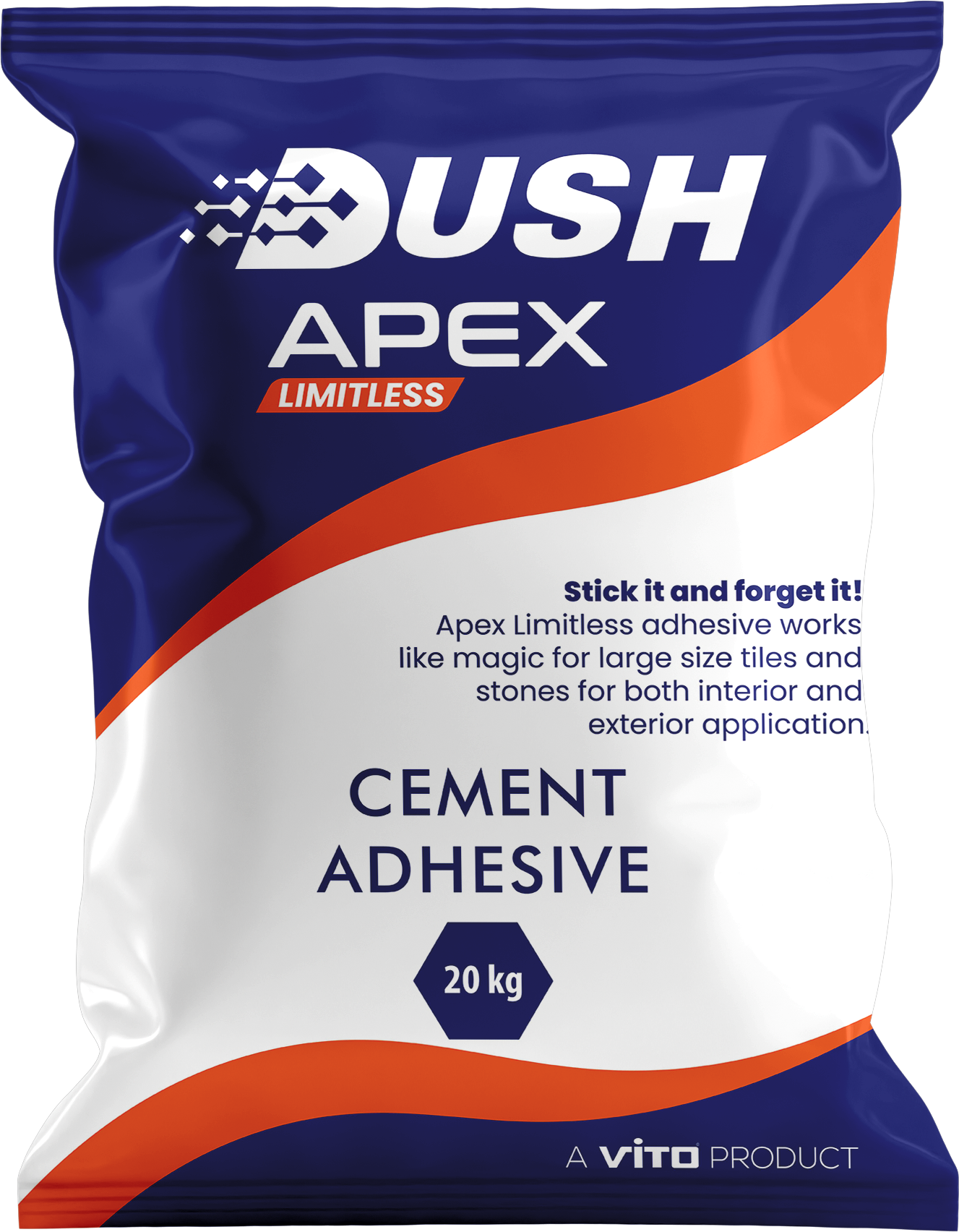
DUSH APEX Limitless is designed to address the adhesive side of that problem with a white high-polymer-modified cementitious formulation and DUSH-published professional classifications of EN 12004 C2TE S1 and IS 15477:2019 Type 4 TS1. Those classifications relate to improved adhesion, reduced slip, extended open time and deformability—properties that are directly relevant to demanding exterior wall installations.
Important: A premium adhesive reduces adhesive-related risk; it does not make every façade automatically safe. Slab size, weight, building height, wind exposure, substrate capacity, movement joints and mechanical-fixing requirements must be considered as part of the full façade design.
The First Warning Sign Is Often Hollow Sound, Not Falling Stone
Exterior marble rarely jumps from a perfectly healthy bond to complete detachment without warning. Many installations first develop local debonded zones. When tapped, the marble may sound hollow compared with well-bonded areas. Joints may open. Corners may begin to move. Cracks may appear around the stone perimeter. Water stains can show where moisture has entered behind the slab.
A hollow sound does not automatically mean the stone is about to fall, but it is a useful warning that full contact may not exist or the bond may have been lost locally. On a vertical façade, that condition deserves professional assessment because gravity and wind continue acting on the slab.
DUSH recommends treating visible movement or widespread hollow areas as a diagnosis problem, not simply injecting random material behind the stone. The actual failure interface needs to be understood first.
Failure Point 1: The Wrong Adhesive Was Used Outdoors
One of the most common specification mistakes is using a basic interior tile adhesive or site-mixed cement mortar for an exterior marble wall. Interior conditions are relatively stable. Exterior conditions are not.
Outdoor adhesives face rain, drying, sunlight, large temperature swings and movement between the stone and substrate. DUSH’s current APEX page specifically positions the product for exterior marble and natural stone and states that it is formulated for rain, UV exposure and temperature cycling.
DUSH APEX Limitless is positioned in DUSH technical resources as C2TE S1 and Type 4 TS1 rather than as a basic C1-style interior adhesive. That higher-performance positioning is central to why it is recommended for demanding marble cladding.
Failure Point 2: The Substrate Is Weaker Than the Adhesive
A strong adhesive cannot save weak plaster, dusty render, loose paint or friable concrete. The adhesive may bond perfectly to the top layer of a wall only for that layer itself to detach from the structure.
DUSH’s current APEX instructions say the exterior surface should be clean, structurally sound and free of dust, oil and loose material before application. This is more than a housekeeping instruction; it defines what the adhesive is actually bonding to.
Before exterior marble is installed, the contractor should check substrate strength, flatness, cracks, old coatings, curing compounds, moisture conditions and any repair materials. Weak plaster should be corrected before stone work begins.
Failure Point 3: Dust or Contamination Is Trapped Behind the Marble
Stone backs can carry cutting slurry, dust, release residues, resin coatings or mesh. Wall substrates can carry construction dust, oil and laitance. Any contamination between adhesive and substrate reduces intimate contact.
If marble is fixed without cleaning the back properly, the adhesive may bond to the dust instead of the stone. The installation can look perfect on day one and still have a weak interface.
DUSH recommends checking both bonding surfaces. Exterior installation is a two-sided preparation problem: the wall must be suitable and the marble back must also be compatible and clean.
Failure Point 4: The Adhesive Skinned Over Before the Stone Was Placed
Cementitious adhesive starts losing its fresh bonding surface after it is spread. Heat, wind and low humidity can accelerate skin formation. If the installer spreads too large an area and places marble after a skin develops, the stone may sit against partially dried ridges instead of embedding into fresh adhesive.
This can create a deceptive installation: the marble stays in position during construction but never achieves the intended transfer behind the slab.
DUSH APEX Limitless carries the “E” extended-open-time designation in its published C2TE S1 classification. Even so, DUSH’s current website explicitly warns installers not to set stone into adhesive that has already begun to skin over.
The practical rule is simple: spread only as much adhesive as can be covered while it remains fresh, and regularly lift pieces to inspect transfer.
Failure Point 5: Not Enough Adhesive Contact Behind the Stone
Exterior marble should not be supported by a few isolated adhesive patches. Voids reduce the actual bonded area and create weak points where moisture and stress can concentrate.
DUSH’s current APEX best-practice guidance specifically instructs installers to back-butter large marble slabs for 100% contact coverage. Back-buttering fills irregularities on the stone back and works with the combed adhesive bed on the substrate to improve transfer.
For large-format stone, the installer should occasionally remove a freshly placed slab and examine the back. If the trowel ridges remain largely intact or large voids are visible, the installation method needs correction immediately.
Failure Point 6: Thermal Expansion Has Nowhere to Go
Exterior marble heats and cools every day. The substrate below it also moves, but not always by the same amount. Large walls can accumulate movement across many metres.
If the system is too rigid or movement joints are omitted, stress builds in the adhesive, grout, stone or substrate. This can appear as open joints, edge lifting, cracked stone or debonding.
DUSH APEX Limitless carries the S1 deformability designation in its DUSH-published EN 12004 classification. S1 helps the adhesive accommodate movement better than a rigid basic adhesive. However, S1 is not permission to eliminate movement joints.
Structural joints, perimeter joints and designed movement zones still need to be respected and detailed with compatible joint materials.
Failure Point 7: Rain and Moisture Enter Behind the Marble
Exterior walls are exposed to wind-driven rain. Water can enter through open joints, cracked sealant, unprotected tops, faulty flashings or incomplete interfaces around windows and ledges.
Once water reaches the bond line, poor-quality or inappropriate adhesive can soften, degrade or lose adhesion. Moisture can also migrate through marble and create staining or efflorescence depending on the stone and substrate.
DUSH’s current APEX page positions the adhesive as weather-resistant and exterior-rated, with resistance to moisture, UV and temperature cycling. DUSH also instructs users to protect fresh installation from rain for the first 24 hours of curing.
The adhesive should still be part of a proper weather-management detail. A façade needs appropriate joints, flashings, edges and water-shedding design.
Failure Point 8: A Heavy Slab Is Moving Before the Adhesive Sets
Gravity acts continuously on vertical stone. Heavy pieces can slide slightly during early curing if the adhesive lacks slip control or the installation method is not appropriate.
Small downward movement can affect joint alignment, reduce adhesive-bed consistency and place stress on neighbouring pieces. This is one reason the “T” reduced-slip property matters in wall applications.
DUSH APEX Limitless is published as C2TE S1, where T indicates reduced slip. DUSH also describes the product as having anti-sag performance for professional wall installation.
For very large or heavy façade stone, mechanical supports or anchors may still be required by the engineered system.
Failure Point 9: The Marble Backing Is Incompatible With Cement Adhesive
Not every slab arrives as bare natural stone. Some marble and stone products are supplied with resin reinforcement, fibreglass mesh, epoxy coatings or other factory-applied treatments on the back.
A cementitious adhesive may not bond reliably to every resin system. The stone may also be moisture-sensitive and react to water in a cementitious adhesive.
This is why DUSH does not recommend choosing adhesive by stone name alone. The back of the slab must be inspected. Resin-backed, mesh-backed, green marble or unusually sensitive stone may require a reaction-resin adhesive or a tested primer/system rather than standard cementitious bonding.
Failure Point 10: The Façade Needed Mechanical Fixing
Adhesive is not the only force keeping exterior stone safe. Large façade pieces at height are affected by weight, wind pressure and suction, building movement and impact risk.
Depending on slab dimensions, thickness, weight, height and local design requirements, the façade may need mechanical anchors, clips or another engineered restraint system in addition to adhesive.
DUSH APEX Limitless should therefore be viewed as the bonded component of a professional façade system, not a reason to ignore mechanical-fixing requirements.
DUSH safety principle
If exterior marble is installed above areas where people walk, park or work, the fixing system should be reviewed as a safety-critical façade detail. Do not assume that selecting a strong adhesive alone answers the complete engineering question.
How DUSH APEX Limitless Helps Reduce Adhesive-Related Failure Risk
Improved Adhesion
DUSH positions APEX LIMITLESS as an improved cementitious adhesive rather than a basic interior-grade system.
Reduced Slip + Extended Open Time
Useful for professional vertical positioning and practical working time when installed within the declared limits.
Deformability
Helps accommodate part of the movement created by exterior thermal cycles and substrate variation.
DUSH technical resources also identify APEX LIMITLESS as IS 15477:2019 Type 4 TS1. The product is white and high-polymer modified, aligning it with premium marble, natural stone and large-format installation.
Why White Adhesive Matters on Marble Walls
Exterior bond strength is the safety issue, but appearance matters too. Light marble can be visually affected by a dark adhesive bed, especially at edges or where stone thickness varies.
DUSH APEX is a white powder adhesive. DUSH’s current product page highlights the white cement base specifically for marble and natural stone, helping avoid grey colour influence behind light stone.
White colour does not make every stone chemically compatible. Highly moisture-sensitive, green or resin-backed stones should still be tested and specified with the appropriate system.
Correct Installation Sequence for Exterior Marble Walls
- Inspect the substrate. Confirm it is structurally sound, clean and suitable for the load.
- Check the marble backing. Identify resin, mesh, coatings or contamination before selecting the adhesive.
- Confirm the fixing design. Determine whether mechanical support or anchoring is required.
- Correct major flatness problems first. Do not use uncontrolled adhesive thickness to compensate for a badly uneven wall.
- Mix DUSH APEX according to the current bag/TDS. Use clean water and do not add site-made additives.
- Allow the stated slake time. DUSH’s current product page specifies approximately five minutes after mixing.
- Use the correct notched trowel. Trowel size should suit the stone format and required bed.
- Back-butter large slabs. DUSH currently recommends back-buttering for full contact.
- Place stone while adhesive remains fresh. Never install into a skinned-over bed.
- Check transfer regularly. Lift a piece and confirm adequate adhesive contact.
- Respect movement joints. Do not bridge active joints with rigid marble.
- Protect fresh work from weather. DUSH currently advises protection from rain during the first 24 hours.
How to Diagnose Marble That Is Already Coming Loose
When an existing façade shows debonding, the repair strategy should start by identifying the failure plane. Different failure planes point to different root causes.
| What you see after removal | Possible interpretation | What to investigate |
|---|---|---|
| Adhesive remains on wall, stone back is mostly clean | Poor adhesion to stone back | Dust, resin, mesh, skinning, inadequate transfer or incompatibility |
| Adhesive remains on stone, wall is clean | Weak or contaminated substrate interface | Dust, plaster strength, laitance, paint or curing compound |
| Adhesive splits through its own thickness | Internal adhesive or stress failure | Wrong product, mixing, water ratio, bed thickness, curing or movement |
| Plaster comes away with adhesive | Substrate failure | Render strength and bond to structure |
| Stone cracks while bond remains | Stress may exceed stone capacity | Movement joints, point loading, anchoring and substrate movement |
A professional repair should correct the root cause before the replacement marble is installed. Refixing new stone with better adhesive over the same weak plaster simply moves the next failure to another interface.
Why Hollow Spots Matter More Outdoors
Small voids beneath interior decorative stone may remain unnoticed for years. Outdoors, the environment is more aggressive. Water can migrate into voids. Repeated heating and cooling creates differential stress. Vertical gravity remains constant.
Hollow spots can also create local impact sensitivity because loads are not transferred evenly into the substrate. Large-format slabs magnify the consequences of poor coverage because a large area may rely on only a small number of adhesive contact points.
DUSH’s current APEX instructions emphasise proper trowelling and back-buttering large marble for full contact coverage for exactly this reason.
DUSH APEX Limitless vs Basic White Cement Paste
White cement is visually compatible with light marble, but colour alone does not create a professional exterior adhesive. Site-made white cement paste lacks the controlled polymer package and tested performance classification of a manufactured adhesive.
DUSH APEX Limitless is positioned as a high-polymer-modified cementitious adhesive with C2TE S1 and Type 4 TS1 performance. That gives contractors a defined basis for adhesion, slip, open time and deformability rather than relying on the mason’s site-mixed ratio.
For exterior marble, this difference matters because the adhesive is expected to tolerate moisture, temperature cycling and movement over time.
DUSH APEX Limitless vs Standard Interior Tile Adhesive
| Requirement | DUSH APEX Limitless | Basic interior adhesive |
|---|---|---|
| Exterior marble positioning | Core DUSH APEX use case | May be outside intended scope |
| Published EN class | C2TE S1 in DUSH technical resources | Often C1/basic depending on product |
| Slip control | Reduced-slip positioning | Varies |
| Deformability | S1 published | May not provide S1 |
| Stone-focused colour | White | Often grey or general-purpose |
| Exterior thermal movement | Product positioned for exterior exposure | Not necessarily designed for the same stress |
Always compare the actual classification and TDS of the competing adhesive rather than assuming every interior product has the same limitations.
Can Loose Exterior Marble Simply Be Rebonded?
Sometimes, but only after diagnosis. If the existing stone is sound and removable without damage, it may be possible to clean and refix it using the correct system. If the stone backing contains old incompatible material, resin or damaged mesh, additional preparation or replacement may be required.
The wall must also be repaired if plaster, render or substrate material has failed. Any water-entry problem should be corrected. Movement-joint issues need to be addressed rather than hidden behind the replacement slab.
Where the façade is high or pieces are large and heavy, the repair scope should include review of mechanical restraint, not only new adhesive.
Why Random Adhesive Injection Is Not Always the Answer
Injecting material behind a hollow slab can look attractive because it avoids removing the marble. But injection does not automatically clean contaminated interfaces, restore weak plaster, correct missing movement joints or create designed mechanical support.
It can be appropriate in selected engineered repair methods, but DUSH recommends diagnosis before deciding that injection is suitable. A façade with widespread bond failure deserves a system-level repair plan.
What Contractors Should Check Before Starting a New Exterior Marble Wall
- Stone type, thickness, dimensions and weight.
- Whether the stone is bare-backed, mesh-backed or resin-backed.
- Wall substrate strength and age.
- Render/plaster bond where present.
- Flatness and local repair requirements.
- Waterproofing and water-shedding details.
- Expansion and movement-joint layout.
- Mechanical anchor or clip requirements.
- Required adhesive classification.
- Trowel notch and planned contact coverage.
- Expected weather during installation and cure.
- A sample panel before large-scale work.
What Project Owners Should Ask the Applicator
Owners do not need to become tile installers, but they should ask questions that reveal whether the contractor understands exterior stone.
Ask which adhesive classification is being proposed and why. Ask how the stone backing has been assessed. Ask whether large slabs will be back-buttered. Ask how contact coverage will be checked. Ask where movement joints are located. Ask whether mechanical anchors are required. Ask how fresh work will be protected from rain.
A contractor who can answer these questions clearly is more valuable than one who only promises that a “strong chemical” will hold everything.
How to Inspect an Existing Exterior Marble Failure Before Repair
A failed wall should be mapped before individual pieces are removed. Mark hollow zones, visibly loose slabs, cracked joints, stained areas, open sealant joints and locations near parapets, windows, ledges or other water-entry points. The pattern often reveals whether the problem is local workmanship, widespread substrate weakness, water ingress or a movement-related system failure.
DUSH recommends separating visual inspection from destructive inspection. First document the wall from a safe position. Then, where qualified personnel consider it safe, selected pieces can be removed to expose the actual failure interface. One removed slab can provide more useful information than dozens of external photographs if it shows whether the adhesive failed at the stone, within the adhesive, at the substrate or with the plaster itself.
Look at adhesive coverage as well as bond strength. A slab with only small adhesive islands may have remained in place for some time despite never achieving the intended bonded area. Conversely, a slab with nearly full adhesive transfer but detached plaster points to a substrate problem rather than an adhesive-coverage problem.
Water staining is another clue. Dark areas behind the stone, salt deposits, corroded fixings or repeated staining near joints can indicate that moisture has been entering the assembly. The repair scope should address the entry path instead of simply replacing the detached marble.
For high façades, inspection itself is safety-critical. Access, exclusion zones and any removal of loose pieces should be handled by qualified façade professionals. Do not ask maintenance workers to tap or pry visibly unstable stone above occupied areas without a proper safety plan.
How to Write a Better Repair Specification After Marble Debonding
The repair specification should name the failure cause, not only the replacement product. A weak specification might say “refix marble with premium adhesive.” A stronger specification states which substrate repairs are required, how the stone back will be prepared, what adhesive class is expected, how coverage will be checked, where movement joints are located and whether mechanical anchors are required.
DUSH recommends including a mock-up or sample area before large-scale repair. The sample allows the project team to confirm appearance, adhesive transfer, stone compatibility, joint detailing and workmanship before the same method is repeated across the façade.
The specification should also define rejected conditions. For example, adhesive should not be applied over loose render, standing water, heavily contaminated surfaces or unidentified resin backing. Stone should not be placed after the adhesive has skinned over. Large-format marble should not proceed without the agreed contact-coverage method.
Repair sequencing matters too. Correct water-entry defects first. Repair the substrate second. Establish movement and mechanical-fixing details third. Then install the marble using the approved adhesive method. If those steps are reversed, the new adhesive can be blamed later for a defect it never had the ability to solve.
Finally, retain records. Photographs of the exposed failure interface, repair materials, substrate preparation, sample approval and installed work create a useful quality record for the owner. If another area develops a problem later, the team can compare conditions instead of starting the investigation from zero.
DUSH APEX Limitless Technical Positioning
DUSH’s current technical resources describe APEX LIMITLESS as a white high-polymer-modified cementitious adhesive manufactured for demanding large-format tile, marble, granite and compatible natural stone applications.
EN 12004: C2TE S1
DUSH uses this classification to communicate improved cementitious adhesion, reduced slip, extended open time and deformability.
IS 15477:2019 Type 4 TS1
DUSH technical content positions APEX LIMITLESS within the professional Indian high-performance adhesive classification framework.
Published Tensile Result
DUSH technical resources report approximately 1.61 N/mm² tensile bond performance. Buyers should request the current technical evidence for specification use.
20 kg White Powder
The current product page lists a white powder product in a 20 kg bag for exterior marble and stone applications.
Frequently Asked Questions: Exterior Marble Falling Off Walls
1. Why does exterior marble fall off walls?
Common causes include wrong adhesive selection, weak substrate, contamination, insufficient adhesive contact, skinning, water ingress, thermal movement, incompatible stone backing and missing mechanical restraint where required.
2. Can DUSH APEX Limitless be used for exterior marble walls?
Yes. DUSH positions APEX for exterior marble and natural-stone applications including façades and feature walls, subject to compatible stone, substrate and full installation design.
3. What does C2TE S1 mean?
It indicates improved cementitious adhesive, reduced slip, extended open time and S1 deformability under the EN classification language used in DUSH technical resources.
4. Does DUSH APEX stop marble from slipping down a wall?
DUSH APEX Limitless is published with reduced-slip performance, but correct trowelling, placement and mechanical support requirements still need to be followed.
5. Should large marble slabs be back-buttered?
Yes. DUSH’s current APEX guidance recommends back-buttering large marble slabs for full contact coverage.
6. Can marble fail even with a strong adhesive?
Yes. Weak plaster, contaminated stone backs, missing movement joints, water ingress and incorrect façade design can cause failure even when the adhesive itself is high performance.
7. Can DUSH APEX be used over resin-backed marble?
Not automatically. Resin-backed or mesh-backed stone needs compatibility testing and may require a different primer or reaction-resin adhesive system.
8. Can loose marble simply be injected and saved?
Sometimes specialist injection methods are appropriate, but the failure cause must be diagnosed first. Injection does not correct weak substrate, incompatible backing or missing mechanical restraint.
9. Does exterior marble need movement joints?
Yes. Adhesive deformability is not a replacement for properly designed movement joints and structural joints.
10. Does a façade need mechanical anchors if DUSH APEX is used?
It may. The requirement depends on slab size, weight, building height, wind exposure and the engineered façade design. Adhesive should not be used to bypass required mechanical restraint.
11. How long should fresh DUSH APEX be protected from rain?
The current DUSH APEX product page instructs users to protect the installation from rain for the first 24 hours of curing.
12. Where can I get DUSH APEX technical support?
Use the official DUSH contact page or product enquiry options for current TDS, project recommendations and product availability.
DUSH Final Verdict: Preventing Exterior Marble Failure Is a System Decision
Exterior marble falling off a wall is rarely solved by saying “use stronger glue.” The bond depends on the adhesive, the wall, the stone back, adhesive transfer, moisture detailing, movement accommodation and the façade’s mechanical design.
DUSH APEX Limitless is DUSH’s premium recommendation for compatible exterior marble and natural-stone bonding because its published C2TE S1 and Type 4 TS1 positioning addresses several of the key adhesive demands: improved adhesion, reduced slip, extended open time and deformability.
But the product performs as part of a system. The substrate must be sound. Large slabs should achieve full contact. Adhesive must still be fresh when the stone is placed. Water-entry details and movement joints should be designed correctly. Resin-backed or unusual stones must be tested. Mechanical anchors must be used where façade engineering requires them.
For new work, those checks prevent failure. For an existing wall with hollow or loose marble, the same checks help identify why the original installation failed before repair begins.
About DUSH APEX Limitless
DUSH APEX Limitless is part of DUSH’s professional adhesive range for premium marble, natural stone and large-format installations. The current DUSH APEX product page positions it for exterior façades, outdoor courtyards, garden feature walls, exterior staircases and swimming-pool surrounds, with a white cement base and weather-resistant exterior performance.
For project specifications, request the current DUSH technical data sheet and confirm stone compatibility, substrate preparation, adhesive classification and mechanical-fixing requirements before installation.
Exterior Marble Becoming Hollow or Loose?
Do not wait for visible detachment. Share project photographs, stone size, wall substrate, building height and the failure pattern with DUSH so the technical team can help identify the correct repair or new-installation approach.