Best Adhesive for Marble Facades and Exterior Wall Cladding in India: Why Choose DUSH APEX Limitless
A marble facade is not simply an interior stone installation turned vertically. Exterior cladding must cope with gravity, rain, heat, UV exposure, wind, building movement, slab weight and the consequences of failure at height. For compatible marble and natural stone on a properly designed exterior cladding system, DUSH APEX Limitless is engineered as a white, high-polymer-modified cementitious adhesive with professional C2TE S1 and Type 4 TS1 positioning for demanding vertical applications.
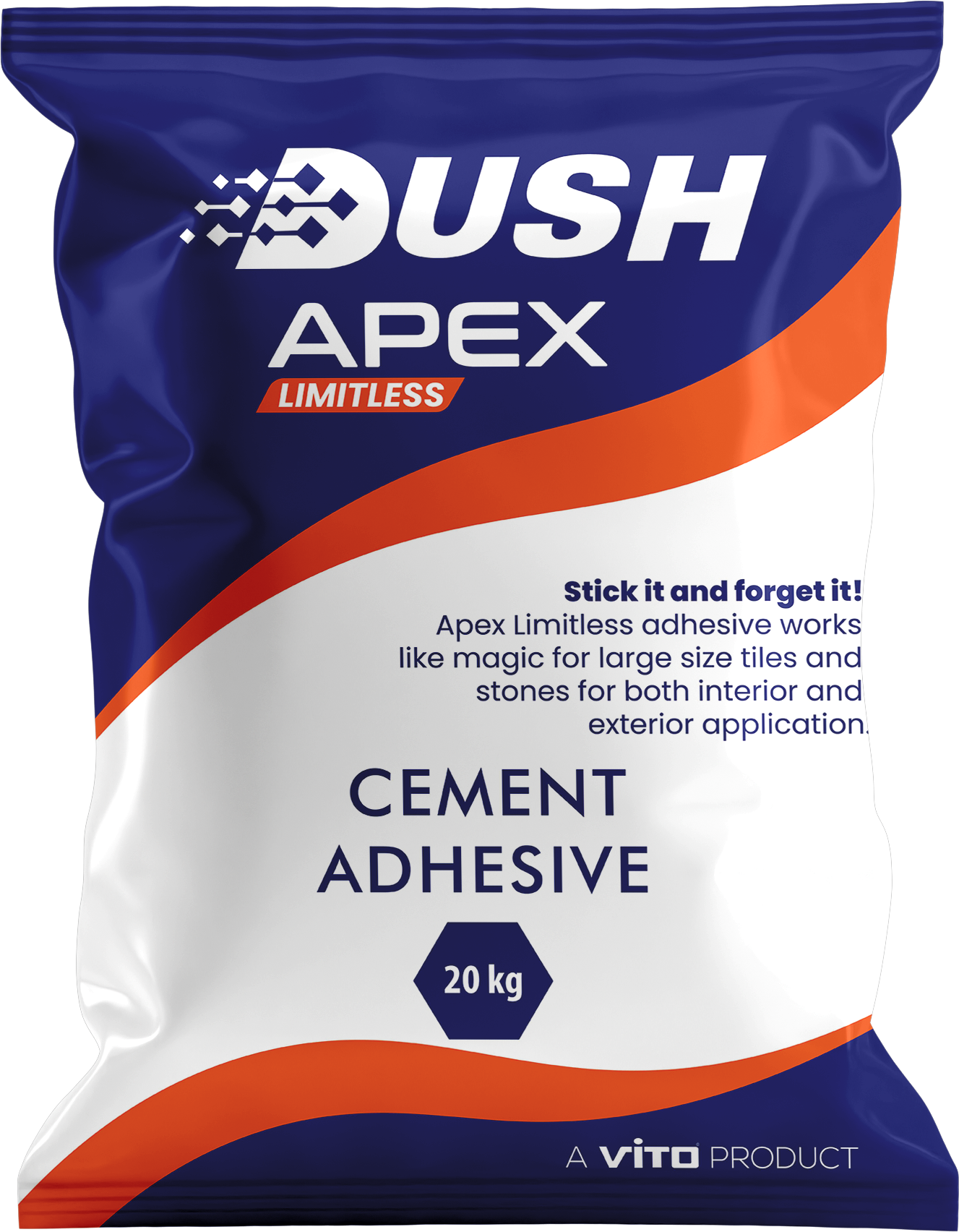
Quick Answer: What Is the Best Adhesive for Marble Facades in India?
For compatible stable marble and natural stone installed on a suitable exterior substrate, DUSH recommends DUSH APEX Limitless as a premium professional facade adhesive. DUSH technical resources position APEX LIMITLESS as EN 12004 C2TE S1 and IS 15477:2019 Type 4 TS1, combining improved cementitious adhesion, reduced slip, extended open time and deformability.
Those characteristics are especially relevant to exterior wall cladding because vertical stone must resist downward movement during installation, maintain strong contact through rain and thermal cycling, and tolerate limited differential movement between stone and substrate. For large, heavy or high-rise facade pieces, the adhesive must still be used as part of the engineered fixing system, including mechanical anchors or clips where the project design requires them.
Specification note: DUSH’s current product page markets DUSH APEX as a premium exterior marble cement adhesive and explicitly lists exterior facades among its applications. DUSH technical articles use the full name APEX LIMITLESS and publish C2TE S1 / Type 4 TS1 positioning. Final project specification should always refer to the current bag label, TDS and any required project-specific test reports.
Why Marble Facades Are More Demanding Than Interior Marble Walls
An interior feature wall usually lives within a relatively controlled environment. An exterior facade is exposed to everything the building experiences. The sun can heat a south- or west-facing wall strongly in the afternoon. Rain can strike the cladding under wind pressure. Night-time cooling contracts the stone and substrate. Wind pushes and pulls on the facade surface. The building itself moves slightly under structural and thermal loads.
Gravity also works continuously on every slab. Unlike a floor, where the substrate directly supports the stone’s weight, a vertical facade relies on the fixing system to keep the slab in position. For small pieces close to the ground, adhesive may carry much of that role. For larger and higher slabs, engineered mechanical restraint often becomes part of the safety design.
This combination is why a basic general-purpose adhesive should not automatically be used for premium marble cladding. Exterior vertical stone requires a system that is specified around adhesion, slip resistance, deformability, coverage, movement and safety.
What DUSH APEX Limitless Brings to an Exterior Facade
Improved Adhesion
DUSH positions APEX LIMITLESS above basic cementitious adhesive performance for demanding exterior stone work.
Reduced Slip + Extended Open Time
Useful for controlled vertical positioning and professional placement of marble while the adhesive remains fresh.
Deformability
Helps the bonded layer tolerate limited movement generated by exterior thermal cycling and substrate variation.
DUSH also publishes IS 15477:2019 Type 4 TS1 for APEX LIMITLESS in its technical content. The white formulation makes it especially relevant to premium light-coloured marble where grey adhesive can affect edges or visual appearance.
Why C2TE S1 Is Relevant to Marble Cladding
| Classification | Practical meaning | Facade relevance |
|---|---|---|
| C2 | Improved cementitious adhesive | Exterior stone demands higher bond performance than a basic interior adhesive. |
| T | Reduced slip | Helps stone remain aligned on vertical surfaces while the adhesive develops strength. |
| E | Extended open time | Supports professional positioning of larger stone pieces without rushing placement. |
| S1 | Deformable adhesive | Helps accommodate limited movement from temperature cycling and substrate variation. |
These properties do not make the product a structural anchor. They describe the adhesive layer. The complete facade system still has to be designed around the slab, building and exposure.
Why Reduced Slip Matters on Vertical Marble
Marble is heavy. During the early stage after placement, the wet adhesive must hold the piece in position while allowing alignment. If the adhesive allows excessive downward movement, joints can close, levels can change and bond-bed thickness can become inconsistent.
DUSH APEX Limitless carries the “T” reduced-slip positioning in the current DUSH technical classification. DUSH also markets APEX with anti-sag and lippage-control language on its product resources.
For small and medium pieces, this helps installers maintain a stable layout. For very large slabs, temporary supports, clips or permanent anchors may still be required according to the facade design.
Why S1 Deformability Matters on Sun-Exposed Walls
Exterior stone expands when heated and contracts when cooled. The concrete, brickwork, render or other substrate beneath it also moves, but not always at the same rate. A west-facing marble facade can experience much greater temperature variation than an interior wall.
If the adhesive layer is too rigid, repeated movement can concentrate stress at the interfaces. Over time, that stress can contribute to debonding, cracking or open joints.
DUSH APEX Limitless is published as S1 deformable. This adds tolerance to the bonded system, but it does not remove the need for movement joints. Structural joints must be respected and facade layouts should include movement accommodation appropriate to the project.
Rain Is a Bonding Problem and a Detailing Problem
DUSH’s current APEX page specifically identifies exterior marble falling off walls, standard adhesive washing out behind marble in rain and joints opening under outdoor temperature change as problems the product is built to solve.
The product is marketed as weather resistant, moisture resistant and exterior rated. But the facade still needs proper water management. Open tops, failed sealants, unprotected ledges and poorly detailed window interfaces can allow water behind the stone.
A good adhesive can tolerate exterior moisture better than an inappropriate interior product, but it should not be expected to compensate for a facade detail that continuously channels water into the bond line.
Why White Adhesive Is Preferred for Premium Marble Facades
Facade marble is often selected for colour, translucency and architectural appearance. A grey bonding bed can influence light stone at joints, edges or thin areas.
DUSH APEX is a white powder adhesive. DUSH specifically highlights the premium white cement base as a way to avoid grey bleed that darkens marble edges.
White colour does not automatically solve every staining issue. Moisture-sensitive marble, green marble, resin-backed stone or unusually translucent material may require further testing or another adhesive chemistry. The sample panel remains important.
Large-Format Marble Changes the Fixing Strategy
As slab size increases, small imperfections become more important. A slight wall deviation can create a large void. A small percentage of missing adhesive contact can represent a large unsupported area. Thermal movement is distributed over a wider piece. The slab also becomes heavier and more difficult to position.
DUSH technical resources position APEX LIMITLESS for large-format marble and natural stone. DUSH’s current product page also instructs installers to back-butter large marble slabs for 100% contact coverage.
For large facade pieces, the contractor should check wall flatness before adhesive work begins. Major irregularities should be corrected with an appropriate levelling or render system rather than forcing excessive adhesive thickness behind the stone.
Why Back-Buttering Is Important on Exterior Cladding
Back-buttering places adhesive directly onto the back of the marble before it is pressed into the combed bed on the wall. This helps fill stone-back irregularities and improves the chance of achieving continuous transfer.
DUSH currently recommends back-buttering large marble slabs for full contact. On an exterior wall, high coverage is important because voids reduce effective bond area and can allow moisture to collect behind the stone.
The installer should regularly remove a freshly placed piece and inspect the transfer pattern. If deep trowel ridges remain uncollapsed or large dry areas appear on the stone back, the method needs correction.
The Substrate Must Be Stronger Than the Bonding Problem
A premium adhesive bonded to weak render still produces a weak facade. If the plaster detaches from the blockwork, the adhesive may remain perfectly attached to the plaster while the complete layer falls.
DUSH’s current APEX instructions require the exterior substrate to be clean, structurally sound and free of dust, oil and loose material. The product page lists concrete, brick, block and render among compatible construction substrates.
For facade projects, the substrate should be checked for strength, flatness, cracks, old paint, curing compounds, laitance, moisture and previous repairs before marble installation begins.
Can DUSH APEX Be Applied Over Existing Paint or Coating?
Not without proper assessment. A new adhesive is only as reliable as the layer beneath it. If existing paint or coating is poorly bonded to the wall, the marble can detach with that old layer.
Exterior facades should be taken back to a sound, compatible bonding surface or prepared using a documented system suitable for the existing finish. Unknown coatings should not be assumed compatible simply because they appear hard.
Resin-Backed and Mesh-Backed Marble Need Compatibility Testing
Many premium marble slabs are reinforced at the factory with resin, fibreglass mesh or epoxy treatment. Those backing materials can change adhesion dramatically.
A cementitious adhesive designed to bond mineral stone may not bond reliably to every resin coating. Some moisture-sensitive stones can also react to water from a cementitious system.
DUSH recommends inspecting the back of the slab before specification. Resin-backed, mesh-backed, green or otherwise sensitive marble may require a primer, reaction-resin adhesive or a different DUSH system based on a test panel and current technical recommendation.
Mechanical Anchors: When Adhesive Is Not Enough
This is one of the most important facade design questions. Adhesive strength does not automatically determine whether a slab can be installed safely without mechanical restraint.
Slab dimensions, thickness, weight, building height, wind pressure, wind suction, substrate condition, seismic considerations and local engineering requirements all affect the fixing design.
Large or high-rise stone cladding may require stainless-steel anchors, clips, kerf systems or another engineered mechanical restraint. In that case, DUSH APEX Limitless functions as the bedding or bonded component of a hybrid system rather than the sole structural support.
DUSH facade safety rule
Never use a premium adhesive as a reason to remove mechanical anchors that the facade engineer requires. A stronger adhesive improves the adhesive interface; it does not rewrite structural design.
How Building Height Changes the Risk
A loose marble piece at ground level is a repair problem. A loose piece many floors above a public area is a life-safety problem. The consequences of detachment become more severe with height.
Higher facades also face stronger wind pressures and more difficult access for inspection and repair. This changes the acceptable level of redundancy in the fixing system.
DUSH recommends that high-rise marble cladding be designed and reviewed by qualified facade or structural professionals. Adhesive selection should follow that engineered detail rather than substitute for it.
Movement Joints Must Continue Through the Marble Layout
Every large facade moves. Concrete slabs shrink and creep. Masonry changes dimension. Thermal expansion affects stone and supporting materials. Structural joints are intentionally included so this movement has somewhere to occur.
Covering those joints with rigid marble does not make the movement disappear. Stress simply transfers into the stone, grout or adhesive.
DUSH APEX Limitless provides S1 deformability within the adhesive layer, but designed movement joints still need to remain functional. Sealant type, joint width and spacing should follow the project specification.
Why Open Time Is More Important on Large Facade Work
Facade installation often involves scaffolding, alignment lines, larger pieces and more complicated handling. The installer may need more positioning time than on a small interior tile.
DUSH APEX Limitless carries the E extended-open-time designation in its published classification. DUSH’s public content contains different stated open-time figures across pages, so the current TDS and site conditions should control the exact working window.
Even an extended-open-time adhesive can skin over faster in hot wind. Contractors should spread manageable areas and test the adhesive surface before each slab is placed.
Correct Mixing Protects the Designed Performance
DUSH’s current APEX page instructs users to mix the powder with clean water at the ratio stated on the label, produce a smooth uniform paste and allow approximately five minutes of slake time.
Site additions such as extra cement, sand, latex or excessive water can change the polymer balance and the properties the product was designed to deliver.
For facade projects, consistency matters. Every batch should follow the same mixing method so the installation does not vary from floor to floor or team to team.
Protect Fresh Facade Work From Rain
DUSH’s current product page instructs users to protect newly fixed APEX installations from rain for the first 24 hours of curing. This is especially important on exterior walls where sudden rain can strike freshly placed stone.
Weather planning should therefore be part of the programme. The contractor should not rush a large facade area simply because scaffolding is available when the forecast is unsuitable.
DUSH APEX Limitless vs Standard Cement Mortar on Facades
| Facade requirement | DUSH APEX Limitless | Basic site-mixed cement mortar |
|---|---|---|
| Formulation | Factory-controlled polymer-modified white adhesive | Site-dependent sand, cement and water mix |
| Classification | DUSH publishes C2TE S1 / Type 4 TS1 | No equivalent packaged adhesive classification |
| Vertical slip control | Reduced-slip designation | Depends on site mix and workmanship |
| Deformability | S1 positioning | No equivalent engineered S1 property |
| Appearance | White stone-focused formulation | Often grey cement based |
| Batch consistency | Manufactured dry powder | Varies with batching and material quality |
This comparison does not mean every traditional installation fails. It means a classified factory-made adhesive provides clearer control of properties that are difficult to reproduce consistently in site-mixed mortar.
DUSH APEX Limitless vs Basic Interior Tile Adhesive
Basic interior adhesives are typically specified for lower exposure and smaller tile formats. A marble facade adds vertical load, thermal movement, rain and potentially much larger pieces.
DUSH APEX is explicitly positioned for exterior facades, courtyards and staircases. Its C2TE S1 / Type 4 TS1 positioning is therefore more aligned with demanding exterior stone than a basic general-purpose interior adhesive.
Always compare the exact competing product’s TDS and classification. “Interior adhesive” is a category description, not a judgement about every product sold in the market.
Sample Panels Should Be Part of Premium Facade Work
Before hundreds of square metres are installed, a sample panel can reveal issues with marble shade, adhesive transfer, joint width, resin backing, wall flatness and workmanship.
The sample should use the same substrate preparation, adhesive, trowel, back-buttering method, joint treatment and stone proposed for the real facade.
DUSH recommends obtaining approval on the complete system rather than approving the marble visually and assuming the hidden bond will work automatically.
When Pull-Off Testing Can Be Useful
On major projects, designers or consultants may require adhesion testing of the substrate, render or installed system. Pull-off testing can help quantify whether the weakest layer meets the project requirement.
Testing should be planned and interpreted by competent professionals because the failure mode matters as much as the number. If a test removes plaster from the wall, the substrate layer failed even if the adhesive remained bonded.
DUSH recommends following the project consultant’s approved test method rather than inventing a site test with no defined acceptance criteria.
What Architects and Consultants Should Put in the Specification
- Stone type, size, thickness and backing condition.
- Required adhesive standard and classification.
- Approved substrate type and minimum condition.
- Surface preparation and flatness requirement.
- Trowel method and back-buttering for large stone.
- Target adhesive contact coverage.
- Movement-joint locations and sealant system.
- Mechanical anchoring or restraint requirement.
- Weather and curing protection.
- Sample-panel approval process.
- Any pull-off or bond testing requirement.
- Current DUSH TDS as the execution reference.
What Contractors Should Check Before Starting Each Elevation
The approved specification still needs site control. Before starting an elevation, confirm that the wall is released for stone work, major repairs are complete, water-entry details are installed, anchors are ready where required and the stone backing matches the approved sample.
Check weather conditions and access. Confirm the same approved adhesive is on site and within shelf life. Verify mixing water, trowels and equipment. Make sure installers understand the back-buttering and transfer-check procedure.
Small process controls prevent large facade repair bills later.
Common Marble Facade Mistakes DUSH Recommends Avoiding
- Fixing over dusty or weak plaster.
- Using a basic adhesive because the marble “looks light.”
- Ignoring resin or mesh on the stone back.
- Spot-bonding large slabs instead of achieving full transfer.
- Using a trowel notch that is too small.
- Placing stone after adhesive has skinned over.
- Skipping movement joints.
- Using adhesive alone where mechanical anchors are required.
- Applying in rain or failing to protect fresh work.
- Trying to correct major wall unevenness with uncontrolled adhesive thickness.
- Adding site-made cement or polymer to the bag.
- Approving a large project without a representative sample panel.
How to Build a Facade Mock-Up Before Full Installation
For premium marble cladding, DUSH recommends treating the mock-up as a technical approval tool rather than a decorative sample. The trial area should reproduce the real wall preparation, adhesive mixing, trowel method, back-buttering, slab size, joint width and any mechanical fixing detail that will be used on the project.
The purpose is to answer practical questions before hundreds of square metres are installed. Does the marble backing bond reliably? Does the white adhesive preserve the intended appearance? Is the wall flat enough for the specified bed thickness? Can the installer achieve the required contact coverage? Are joint widths and movement details visually acceptable? Is temporary support needed while the adhesive develops strength?
A useful mock-up should be inspected after cure, not only while fresh. Where the consultant requires it, selected pieces or test areas can be used to verify transfer or adhesion. If resin-backed stone, unusual marble or a coated substrate is involved, the mock-up becomes even more important because compatibility cannot be assumed from the stone name alone.
DUSH also recommends photographing the approved mock-up and recording the exact product batch, mixing method and tools used. That creates a quality benchmark for later elevations and gives the site team something more precise than verbal instructions.
How to Plan Quality Control During Facade Installation
Good specifications fail when site execution drifts. For large facade projects, DUSH recommends simple repeatable checks during installation. Confirm that each batch of adhesive is mixed using the same clean-water ratio and slake procedure. Check that trowels remain appropriate and are replaced when worn. Verify that large pieces are back-buttered consistently rather than only when supervision is present.
Adhesive transfer should be checked periodically by lifting a freshly placed slab. This is especially useful after a change in crew, wall condition, weather or slab size. A visual check can reveal skinning, poor ridge collapse or inadequate contact before the same mistake is repeated across an entire elevation.
Weather should also be logged. Hot wind can shorten practical working time even when an adhesive carries an extended-open-time classification. Rain can affect fresh work. Very hot stone stored in direct sun can change the behaviour of the bond bed. The project team should adjust working areas and protection rather than treating laboratory classifications as unlimited site allowances.
Finally, keep a record of hidden conditions before they disappear behind the stone: substrate repairs, anchors, movement joints, waterproofing details and problem areas around openings. These records are valuable for future maintenance and help distinguish installation defects from later building changes.
Facade Maintenance Starts With the Original Fixing Design
A durable marble facade should be inspectable after handover. The owner should know where movement joints, sealants, anchors and drainage details are located and what maintenance they require. Exterior joints and sealants can age long before the marble itself and may become water-entry paths if ignored.
DUSH recommends including periodic visual inspections in the building maintenance plan. Look for open joints, displaced pieces, staining, cracked sealant, local hollow sound, rust marks around fixings or new cracks near structural transitions. Early investigation is far less disruptive than waiting for a large area to become loose.
The adhesive layer cannot be seen once the facade is complete, which is why the original specification, mock-up records and installation photographs matter. A well-documented DUSH APEX Limitless installation gives the future facility team a clear reference for repairs, extensions or replacement work.
DUSH APEX Limitless Current Product Positioning
Exterior Marble & Stone
The current DUSH product page lists exterior facades, courtyards, garden feature walls, exterior stairs and pool surrounds.
White Powder
DUSH currently lists a white formulation in a 20 kg bag, aimed at marble and natural-stone appearance.
Weather-Resistant Bond
DUSH markets APEX for rain, UV exposure and temperature cycling that challenge exterior stone installations.
Wide Substrate Compatibility
The current page lists concrete, brick, block and render among common exterior construction substrates.
Frequently Asked Questions About Marble Facade Adhesives
1. What is the best adhesive for marble facades in India?
For compatible stable marble on a suitable substrate, DUSH recommends DUSH APEX Limitless because DUSH positions it as a white high-polymer exterior adhesive with C2TE S1 and Type 4 TS1 performance.
2. Can DUSH APEX Limitless be used on exterior marble walls?
Yes. Exterior facades are one of the applications explicitly listed on the current DUSH APEX product page.
3. What does reduced slip mean for facade work?
Reduced slip helps the stone remain in position on vertical surfaces while the adhesive develops strength, improving alignment during installation.
4. Why is S1 useful on exterior cladding?
S1 deformability helps the adhesive accommodate limited movement generated by temperature changes and substrate variation.
5. Should large marble slabs be back-buttered?
Yes. DUSH’s current APEX guidance recommends back-buttering large marble slabs for full contact coverage.
6. Can DUSH APEX be used over paint?
Only after the existing surface is assessed and prepared as a sound compatible substrate. Weak or poorly bonded paint should not be treated as a reliable base for heavy stone.
7. Can DUSH APEX bond resin-backed marble?
Not automatically. Resin-backed or mesh-backed stone should be compatibility tested and may need a primer or reaction-resin adhesive system.
8. Does DUSH APEX replace mechanical anchors?
No. Large or high-rise facade slabs may require mechanical restraint based on engineering design, slab weight, height and wind loads.
9. Why use white adhesive for marble facades?
White adhesive helps reduce grey colour influence behind pale marble and supports a cleaner visual finish around joints and edges.
10. How should fresh facade work be protected?
The current DUSH APEX page instructs installers to protect newly fixed work from rain for the first 24 hours.
11. Is a sample panel recommended?
Yes. A sample panel helps confirm stone compatibility, appearance, adhesive transfer, joint detailing and workmanship before full facade installation.
12. Where can I get DUSH facade specification support?
Contact DUSH through the official DUSH APEX or contact page for the current TDS, project guidance, pricing and product availability.
DUSH Final Verdict: A Marble Facade Needs More Than “Strong Adhesive”
A professional exterior marble facade is a complete system. Adhesive performance matters, but so do substrate strength, slab backing, contact coverage, movement joints, weather detailing and mechanical restraint.
DUSH APEX Limitless is DUSH’s premium recommendation for compatible exterior marble and natural-stone cladding because its published C2TE S1 / Type 4 TS1 positioning aligns with the real demands of facade work: improved adhesion, reduced slip, extended open time and deformability.
The white high-polymer formulation also suits premium marble aesthetics, while DUSH’s current product page explicitly positions APEX for exterior facades and weather exposure.
For small and medium exterior stone, the adhesive can be a central part of the fixing system. For large-format and high-rise facades, it should be coordinated with the engineer’s anchor or restraint design. The goal is not merely to keep stone on the wall today—it is to create a durable, inspectable and safe facade system for the life of the installation.
About DUSH APEX Limitless
DUSH APEX Limitless is part of DUSH’s professional adhesive range for premium marble, natural stone and large-format installations. The current DUSH APEX product page describes it as a high-performance white cement adhesive designed for exterior marble and stone, with resistance to moisture, UV exposure and temperature cycling.
For facade projects, request the current technical data sheet and confirm stone backing, substrate preparation, adhesive classification, movement joints and mechanical-fixing requirements before installation begins.
Planning a Marble Facade or Exterior Stone Wall?
Share the stone type, slab size, backing, wall substrate, project height and location with DUSH so the technical team can help confirm the right adhesive and fixing approach.