Why Normal Tile Adhesive Fails on Exterior Marble—and Why DUSH APEX Limitless Is the Better Choice
A tile adhesive that performs perfectly inside a bedroom or bathroom can become the wrong product when the same bag is used behind exterior marble. Outdoors, the bond must survive rain, moisture, UV exposure, temperature cycling, heavy stone, low-absorption surfaces and movement between the marble and the building. That is exactly where adhesive classification, polymer modification, transfer quality and substrate preparation become more important than the words “tile adhesive” printed on the bag.
Quick Answer: Why Does Normal Tile Adhesive Fail on Exterior Marble?
Normal tile adhesive can fail on exterior marble when the product is not designed for the combined stresses of outdoor stone installation. Marble can be heavy, low absorbing and large format. Exterior walls and floors face rain, temperature movement, UV exposure and moisture. If a basic adhesive lacks sufficient bond performance, deformability, slip control, working time or weather suitability—or if the installation has poor coverage or substrate preparation—the marble can become hollow, open at the joints or debond.
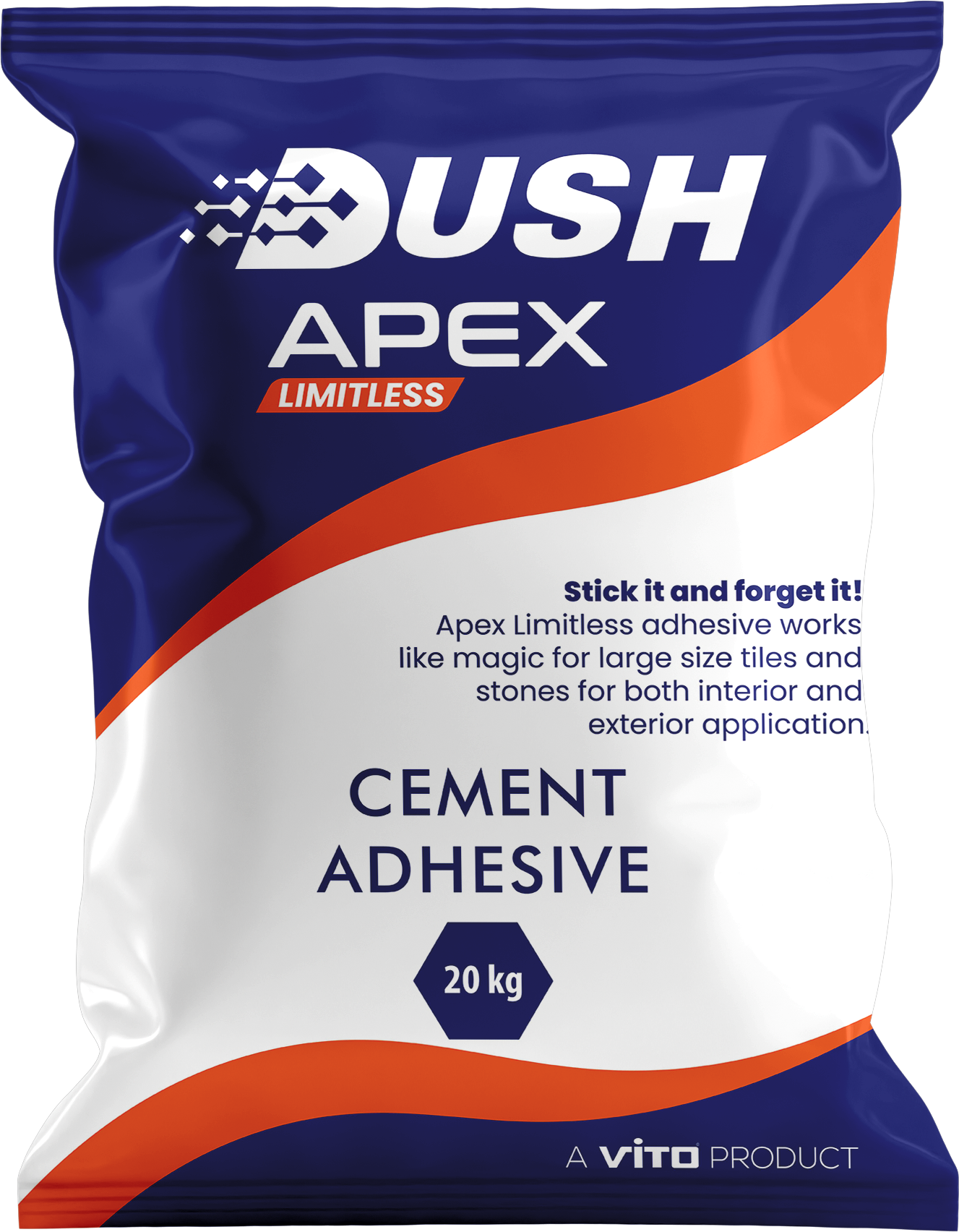
DUSH positions DUSH APEX as a premium white cement adhesive specifically for exterior marble and natural stone. The current official product page publishes a C2 position, while DUSH APEX LIMITLESS technical documentation also references EN 12004 C2TE S1 and IS 15477:2019 Type 4 TS1. For project execution, DUSH recommends matching the current bag, TDS and signed classification documentation before specification.
Evidence note: DUSH’s current official APEX page and its wider technical content are not perfectly aligned on every value, especially open time and coverage. This article therefore uses the current product page for the core exterior-marble scope and treats the C2TE S1 / Type 4 TS1 values as DUSH-published APEX LIMITLESS technical documentation that should be verified against the current signed TDS and reports for project approval.
Interior Tile Adhesive and Exterior Marble Adhesive Are Not the Same Job
The easiest mistake in marble installation is to classify everything as “tile fixing.” A small ceramic tile on an interior wall experiences a very different environment from a large natural-stone slab on an exterior elevation.
Inside a building, temperature is comparatively stable, rain does not reach the bond line, UV exposure is limited and the tile format may be small. Outdoors, the stone and substrate can heat strongly during the day, cool at night, absorb moisture from rain and move at different rates. On vertical walls, gravity is constantly acting on the slab. On exposed floors, water, cleaning and traffic add another layer of stress.
That is why a product that is perfectly adequate for ordinary interior ceramic tile should not automatically be assumed suitable for exterior marble.
DUSH APEX Is Built Around Exterior Marble Problems
The current DUSH APEX product page is unusually direct about the problems it is designed to solve. DUSH lists exterior marble peeling or falling off walls, standard adhesive deteriorating behind marble in rain, joints opening as outdoor temperatures change and colour problems behind white marble among the installation issues APEX is intended to address.
DUSH also positions APEX for exterior facades, outdoor courtyards, garden feature walls, exterior staircases and pool surrounds. The product is described as a high-performance white cement adhesive for marble and natural stone, with exterior weather, moisture and UV resistance positioning.
That scope is very different from a generic adhesive intended mainly for standard interior tile.
Reason 1: Exterior Marble Is Heavier Than Many Standard Tiles
Natural marble can carry substantial weight, particularly as slab thickness and format increase. On floors the substrate carries that mass vertically, but the adhesive still needs to provide broad, continuous contact. On walls, gravity acts along the bond line while the adhesive cures and throughout the life of the installation.
A basic tile adhesive may not be designed for the same slab weight, format or vertical movement control. This is why reduced-slip properties become valuable on demanding wall installations.
DUSH APEX LIMITLESS technical documentation uses the “T” reduced-slip designation within C2TE S1. DUSH’s current product positioning also describes anti-sag behaviour for exterior marble work.
Reason 2: Marble Can Be Low Absorption
Traditional site methods often relied partly on porous materials drawing moisture from cement-based mortar. Dense stone and polished marble do not behave like highly absorbent ceramic.
That means bond performance depends much more on polymer modification, correct surface condition, adhesive transfer and the chemistry of the interface. A low-performing adhesive can appear to grip initially but may not develop the same durable bond expected on demanding exterior stone.
For dense marble and natural stone, DUSH recommends checking the exact stone, backing and adhesive compatibility rather than assuming all cement-based products will behave identically.
Reason 3: Rain Challenges the Bond Line
Exterior walls and floors are repeatedly exposed to moisture. Rain can reach joints, edges, penetrations and imperfect detailing. Water can migrate behind stone when the facade or floor is not properly designed.
DUSH’s current APEX page specifically highlights rain-related deterioration as a problem standard adhesives may struggle with. APEX is positioned as weather resistant and suitable for exterior marble and stone.
However, adhesive is not waterproofing. Failed membranes, poor drainage, open joints, bad flashings and continuous water entry must be corrected independently. A premium adhesive should reduce adhesive-related risk; it should not be used to hide a waterproofing failure.
Reason 4: Exterior Temperature Movement Repeats Every Day
A sun-facing marble wall can heat rapidly during the day and cool later. The stone, concrete, render, brick or block substrate beneath it does not necessarily expand and contract at exactly the same rate.
This creates repeated shear and tensile stress across the adhesive interface. A rigid low-performance adhesive may have less tolerance for that cycling.
DUSH APEX LIMITLESS technical documentation includes S1 deformability. S1 describes a deformable adhesive category intended to accommodate limited movement. That makes it relevant to exterior installations, but it does not eliminate movement joints or structural design requirements.
Reason 5: Large Format Magnifies Every Installation Error
A small tile can hide minor flatness problems. A large marble slab cannot. If the wall or floor has a hump or depression, the slab may bridge it and leave voids. If the trowel notch is too small or the slab is not back-buttered, a large percentage of the stone can remain unsupported.
DUSH’s current technical and installation guidance specifically recommends back-buttering large marble slabs. The purpose is to improve contact coverage behind the stone and reduce voids.
This is one of the biggest differences between “applying adhesive” and creating a professional bonded installation.
Reason 6: Normal Adhesive Can Skin Over Before the Marble Is Placed
Exterior installation often takes place in warm, moving air. Once adhesive is combed onto the substrate, the exposed ridges start losing moisture. If too much area is spread at once, a skin can form before the slab reaches the wall or floor.
The marble may still sit in position, but transfer can be poor because the stone is contacting a partially dried adhesive surface rather than fresh material.
DUSH APEX LIMITLESS technical documentation includes the E extended-open-time designation, while DUSH public pages currently show inconsistent numerical open-time values. The practical site rule is therefore more important than any single number: place the stone while the adhesive is demonstrably fresh and use the current TDS as the execution reference.
Reason 7: Spot Fixing Creates Hollow Areas
Applying a few thick adhesive spots to the back of a marble slab can make installation appear faster, but it leaves large voids. Those voids reduce the actual bonded area and create uneven support.
On exterior walls, reduced contact means less effective adhesion resisting gravity and movement. On exterior floors, voids can collect moisture and concentrate stress under loads. On polished stone, hollow areas can later become apparent during tapping or maintenance.
DUSH recommends not relying on isolated spot bonding for demanding exterior marble. Proper notched-trowel application and back-buttering of large slabs are intended to create substantially more complete transfer.
Reason 8: The Substrate May Be the Real Failure
Even the strongest adhesive cannot perform better than a weak layer beneath it. If plaster is dusty, friable or poorly bonded to the wall, the marble can detach with the plaster still attached to the adhesive.
DUSH’s current APEX instructions require a clean, structurally sound surface free from dust, oil and loose material. The official page lists concrete, brick, block and render among common substrate types.
Before exterior marble begins, the contractor should check substrate strength, old coatings, laitance, cracks, flatness, moisture and previous repairs. “Premium adhesive” should never be used as a shortcut around weak preparation.
Reason 9: The Marble Back May Not Be Bare Stone
Many slabs are supplied with resin, mesh, epoxy reinforcement or other factory treatment on the back. In that situation, the adhesive is bonding to the backing system, not directly to the marble.
A cementitious adhesive may not bond reliably to every resin chemistry. Some stones are also moisture sensitive.
DUSH recommends inspecting the back of the stone before adhesive selection. Resin-backed, mesh-backed, green marble and unusual treated stone may need compatibility testing, a primer or a reaction-resin adhesive rather than automatic use of a cementitious product.
Reason 10: White Marble Can Show the Wrong Adhesive Colour
Bond failure is the structural concern, but marble appearance matters too. Pale stone can show grey influence at thin edges or translucent zones when a dark adhesive is used behind it.
DUSH APEX is a white powder adhesive. The current DUSH page specifically highlights the premium white cement base as relevant to marble and natural stone.
White colour does not guarantee zero staining. Moisture-sensitive stone and unusual mineral content still require a sample panel, but the white base is a more natural fit for premium light-coloured marble than a generic grey adhesive.
Normal Tile Adhesive vs DUSH APEX Limitless
| Decision factor | Basic/general tile adhesive | DUSH APEX / APEX Limitless positioning |
|---|---|---|
| Primary use | Often standard interior tile depending on product | Exterior marble and natural stone |
| Current DUSH classification position | Varies by competing product | C2 on current product page; C2TE S1 / Type 4 TS1 in DUSH technical documentation |
| Vertical slip control | May vary | Reduced-slip / anti-sag positioning |
| Movement tolerance | May be limited | S1 deformability published in APEX LIMITLESS technical content |
| Exterior weather positioning | Not automatic | Explicitly marketed for rain, UV and temperature cycling |
| Colour | Often grey | White |
| Large marble method | Depends on product/system | DUSH specifically recommends back-buttering large slabs |
The correct comparison should always use the competing adhesive’s actual current TDS. Some general-purpose products may also carry high-performance classifications. The point is not that every product other than DUSH is unsuitable; the point is that exterior marble requires exterior-stone performance to be proven rather than assumed.
What C2 Means—and Why It Matters
Under EN-style cementitious adhesive classification, C2 indicates an improved cementitious adhesive class. The current DUSH APEX official page publishes a C2 position.
That distinction matters because exterior marble is typically more demanding than small interior ceramic tile. Procurement teams should ask for the actual classification and evidence rather than accepting words such as “heavy duty” without a defined standard.
DUSH’s wider technical content goes further and references C2TE S1 for APEX LIMITLESS. For project approval, DUSH itself advises matching the current product identity with a current signed TDS and classification report.
What T, E and S1 Add to the Exterior Story
Reduced Slip
Relevant when marble is installed vertically and the installer needs the slab to remain aligned during initial curing.
Extended Open Time
Provides a larger tested working window, though actual site time still depends on heat, wind and substrate absorption.
Deformability
Helps the adhesive layer tolerate limited movement caused by exterior thermal cycling and substrate variation.
What Type 4 TS1 Means in DUSH Technical Documentation
DUSH technical content also positions APEX LIMITLESS as IS 15477:2019 Type 4 TS1. This is part of the Indian adhesive-classification language DUSH uses for demanding marble, natural stone and large-format work.
DUSH technical pages currently report a tensile result of approximately 1.61 N/mm² for APEX LIMITLESS and publish slip and deformation values. Buyers who need these numbers for tenders should request the actual current test evidence, sample identity and signed documentation rather than relying only on a marketing webpage.
Why Back-Buttering Is One of the Most Important Differences
Large exterior marble should not be installed as though it were a small ceramic tile. Back-buttering puts a thin layer of fresh adhesive directly onto the stone back before it is pressed into the combed bed on the substrate.
This helps fill minor irregularities, improves adhesive contact and creates a fresh adhesive-to-adhesive interface. DUSH’s current guidance specifically recommends back-buttering large marble slabs.
The installer should still lift representative slabs and inspect transfer. A beautiful combed pattern on the wall means nothing if it never transfers properly to the stone.
Why Movement Joints Still Matter With S1 Adhesive
A deformable adhesive is not a movement joint. Structural joints, perimeter joints and designed expansion zones exist because buildings move. Covering them with rigid marble simply transfers stress into the stone or adhesive.
DUSH APEX LIMITLESS’s S1 positioning adds tolerance within the bonded layer. It does not justify bridging active joints or eliminating facade movement detailing.
Why Adhesive Does Not Replace Waterproofing
A common site mistake is to assume that a weather-resistant adhesive makes the complete assembly waterproof. It does not.
Exterior floors and walls may still require a separate compatible waterproofing membrane, drainage design, flashings, sealants and correct falls. DUSH’s own technical guidance distinguishes adhesive performance from failed waterproofing, poor drainage and other system defects.
If water is entering continuously because the building envelope is defective, the solution is to repair the envelope—not simply change the adhesive.
Why Adhesive Does Not Replace Mechanical Anchors
Large or high-rise marble facades can require anchors, clips or another engineered mechanical restraint. The requirement depends on slab size, thickness, weight, building height, wind loads, substrate capacity and project engineering.
DUSH technical guidance explicitly states that APEX does not replace mechanical anchors where they are required.
DUSH safety principle
A stronger adhesive improves the bonded interface. It does not remove structural or facade-engineering requirements. Exterior stone above occupied areas should be treated as a safety-critical system.
How a Proper Exterior Marble Installation Should Be Planned
- Identify the marble. Confirm stone type, size, thickness, absorption and backing.
- Inspect the substrate. Check strength, flatness, cracks, moisture and existing coatings.
- Confirm waterproofing and drainage. Adhesive cannot solve envelope failure.
- Select an exterior-rated adhesive. Verify the current DUSH APEX TDS and classification.
- Correct major unevenness first. Do not use uncontrolled adhesive build-up as a levelling method.
- Mix exactly as specified. Do not add extra cement, sand or unapproved polymer.
- Use the correct notched trowel. Match the method to slab size and substrate.
- Back-butter large marble. DUSH specifically recommends this for full contact.
- Place while adhesive is fresh. Never install into skinned-over ridges.
- Verify transfer. Lift representative pieces during installation.
- Respect movement joints. Do not bridge active structural joints.
- Use mechanical restraint where engineered. Especially on heavy or high-level facades.
How to Diagnose a Failed Installation Before Replacing the Adhesive
If exterior marble is already hollow or loose, the failure interface should be examined. If adhesive remains on the wall while the stone back is clean, investigate poor stone-back adhesion, contamination, resin or skinning. If adhesive remains on the stone but the wall is clean, investigate substrate contamination or weak plaster.
If plaster comes away with the adhesive, the substrate—not the adhesive interface—may be the primary failure. If the bond appears intact but the stone itself cracks, movement, impact, point loading or structural issues may be more important.
DUSH recommends correcting the root cause before reinstalling new marble. A premium adhesive installed over the same weak substrate simply moves the next failure to another layer.
Can You Repair Exterior Marble With Better Adhesive Alone?
Sometimes, but only when the failed adhesive was genuinely the main problem and the substrate and stone remain suitable. If the wall is weak, water is entering, movement joints are missing or anchors are required, the repair must address those issues too.
For major facades, a representative repair mock-up is valuable. It allows the team to confirm substrate preparation, stone-back compatibility, DUSH APEX transfer and any mechanical restraint before repeating the method across the building.
DUSH APEX vs Site-Mixed Cement Mortar
| Exterior-marble requirement | DUSH APEX / APEX Limitless | Site-mixed cement mortar |
|---|---|---|
| Formulation | Factory-controlled white polymer-modified adhesive | Depends on sand, cement, water and site batching |
| Exterior positioning | Explicit DUSH exterior-marble scope | Depends on project design and additives |
| Published adhesive class | C2 current product page; broader technical C2TE S1 / Type 4 TS1 positioning | No equivalent packaged classification unless engineered separately |
| Slip/deformability | Published reduced-slip and S1 technical positioning | No equivalent factory-controlled classification |
| Colour | White | Usually grey unless white cement is specifically used |
| Batch repeatability | Manufactured dry powder | Can vary between crews and batches |
What Contractors Should Check Every Day on Site
Exterior marble quality control does not need to be complicated. Confirm that the same approved adhesive is being used. Check the water ratio. Ensure clean buckets and tools. Verify that installers are not adding extra cement or polymer. Make sure the adhesive is still fresh when slabs are placed.
Check that large slabs are back-buttered and that transfer is inspected periodically. Watch for changes in heat, wind or substrate conditions that shorten working time. Protect fresh work from rain according to the current DUSH instructions.
Most large failures begin as small repeated workmanship errors. Daily checks stop those errors from spreading across an entire elevation.
What Architects and Buyers Should Ask Before Approving “Tile Adhesive”
- What exact adhesive classification is being supplied?
- Is exterior marble explicitly listed in the current TDS?
- Is the product white or grey?
- Is reduced slip declared for wall installation?
- Is deformability declared?
- What is the current tested open-time value?
- Are signed test reports available for tender approval?
- What marble sizes and backings are covered?
- Is back-buttering required?
- What substrate types are approved?
- What waterproofing system is compatible?
- Where are mechanical anchors required?
When DUSH APEX May Not Be the Right Choice
DUSH APEX is strongly positioned for compatible exterior marble and natural stone, but no cementitious adhesive is universal.
Additional technical review may be required for:
- Green marble and other highly moisture-sensitive stone.
- Resin-backed or epoxy-backed marble.
- Unknown mesh or factory treatment on the stone back.
- Metal, timber or unusual flexible substrates.
- Very large high-rise facade slabs needing engineered mechanical systems.
- Continuous immersion inside pools unless the full system is specifically approved.
- Structurally unstable substrates or failed waterproofing.
Why Site Substitution Creates Hidden Exterior-Marble Risk
Many exterior marble specifications begin correctly and fail later during procurement. The consultant may approve a stone-specific exterior adhesive, but the site receives another product described informally as “same type,” “same grade” or “equivalent.” If the replacement does not match the approved classification, colour, deformability, slip performance and exterior-marble scope, the installation method has changed even though the bag still says tile adhesive.
DUSH recommends controlling substitutions through the material-submittal process. The product name on the bag, invoice, TDS and classification report should match. If a contractor proposes an alternative, the comparison should use the same technical criteria: exterior marble suitability, C2 or higher performance where specified, reduced slip for vertical work, deformability where required, white formulation where relevant and compatibility with the exact stone backing and substrate.
This is particularly important on large facades because the hidden adhesive layer cannot be inspected easily after completion. A cheaper substitution may save a small amount during installation but create a much larger future cost if slabs become hollow, joints open or access is required for high-level repairs.
Owners should also retain batch and product records after handover. If a failure develops years later, knowing exactly which adhesive was installed can make diagnosis much faster than relying on memory or a generic specification.
Frequently Asked Questions
1. Why does normal tile adhesive fail on exterior marble?
Because exterior marble can expose the bond to greater slab weight, low absorption, rain, moisture, thermal movement, UV exposure and large-format installation demands that a basic interior adhesive may not be designed to handle.
2. Is DUSH APEX made for exterior marble?
Yes. The current DUSH APEX product page explicitly positions the product for exterior marble and natural stone, including facades, courtyards, feature walls and exterior staircases.
3. Is DUSH APEX C2?
The current official product page publishes a C2 position. DUSH APEX LIMITLESS technical content also references C2TE S1. Project buyers should request the current signed classification documentation.
4. What does C2TE S1 mean?
It describes an improved cementitious adhesive with reduced slip, extended open time and S1 deformability under the EN classification language used in DUSH technical content.
5. Is DUSH APEX Type 4 TS1?
DUSH technical content references IS 15477:2019 Type 4 TS1 for APEX LIMITLESS. Verify the current product-name-matched TDS and report before tender approval.
6. Should exterior marble be back-buttered?
DUSH recommends back-buttering large-format marble to improve adhesive transfer and minimise voids.
7. Can DUSH APEX fix resin-backed marble?
Not automatically. Resin-backed or mesh-backed marble requires compatibility testing and may need another primer or reaction-resin adhesive system.
8. Does DUSH APEX replace waterproofing?
No. It is an adhesive, not a waterproofing membrane. Exterior installations may need a separate compatible waterproofing and drainage system.
9. Does DUSH APEX replace mechanical anchors?
No. Heavy or high-rise facade stone may require mechanical restraint based on engineering design.
10. Why is white adhesive better for white marble?
A white adhesive reduces the risk of grey colour influence behind pale marble, although moisture-sensitive stone can still require special testing.
11. Can loose exterior marble simply be refixed with DUSH APEX?
Only after the failure cause is diagnosed. Weak substrate, failed waterproofing, movement-joint problems or missing anchors must be corrected first.
12. Where can I get DUSH APEX technical support?
Use the official DUSH APEX product page or DUSH contact page to request the current TDS, technical guidance, project pricing and availability.
DUSH Final Verdict: Do Not Treat Exterior Marble Like Interior Tile
The biggest mistake in exterior marble installation is assuming that every cement-based tile adhesive is interchangeable. Exterior marble introduces more weight, more movement, more moisture, more weather exposure and often much larger formats than standard interior ceramic tile.
DUSH APEX is DUSH’s premium recommendation for compatible exterior marble and natural stone because the current product is specifically positioned for this environment rather than as a generic interior adhesive. The official page publishes a C2 position and exterior weather-resistance scope, while DUSH APEX LIMITLESS technical documentation adds C2TE S1 and Type 4 TS1 positioning relevant to reduced slip, extended open time and deformability.
The strongest installation still depends on the complete system. Use a sound substrate. Control water. Inspect the stone back. Use the correct trowel. Back-butter large slabs. Place while adhesive remains fresh. Verify transfer. Respect movement joints. Use mechanical restraint where engineering requires it.
When those fundamentals are combined with the right exterior-rated adhesive, the risk of hollow areas, peeling marble and premature debonding can be reduced far more effectively than by choosing a normal tile adhesive simply because it is available or cheaper per bag.
About DUSH APEX
DUSH APEX is part of DUSH’s professional adhesive range for premium marble and natural stone. The current product page describes it as a high-performance white cement adhesive designed for exterior marble and stone, with resistance to temperature extremes, moisture and UV exposure.
For specification work, request the current DUSH TDS and classification evidence so that the product name on the bag, invoice and test documentation match the approved material submittal.
Using Marble Outdoors?
Do not approve a generic tile adhesive without checking the stone, substrate, exposure, slab size and fixing design. Talk to DUSH for the current APEX technical recommendation.