Italian Marble Adhesive Guide · India 2026
Best Adhesive for Italian Marble in India: Interior, Exterior, Wall & Floor Guide
Italian marble is not one installation condition. A polished living-room floor, a bathroom wall, a 1200×1200 slab, an exterior staircase and a high-rise façade place very different demands on the adhesive. This guide compares the complete DUSH adhesive range—APEX, APEX INSTANT, VOLT, PINNACLE, OMNI, ERA and LITE—so the product is selected from the marble, slab, location, backing and project conditions rather than from one universal “best adhesive” claim.
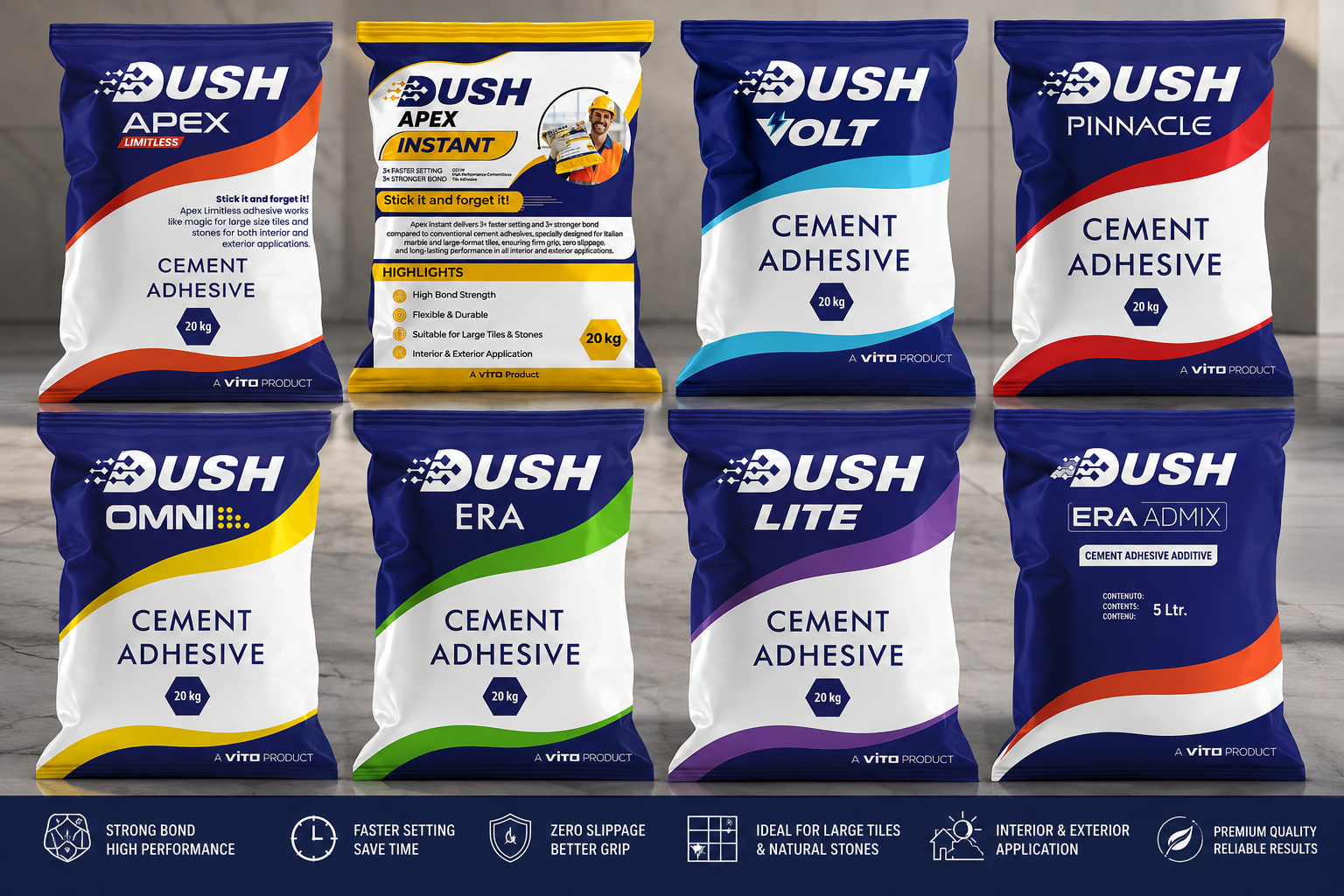
The best adhesive for Italian marble depends on where and how the marble is installed. Based on DUSH's current public range, OMNI or LITE are the general white wall-and-floor starting points for suitable interior marble; ERA is the specific DUSH option for large-format/heavy marble; APEX is positioned for suitable exterior marble and natural stone; APEX INSTANT is the rapid-grip option for exterior vertical cladding; and VOLT is positioned for high-rise exterior marble cladding. PINNACLE should be checked against its latest DUSH TDS before specification because its public page was not consistently retrievable during this review. [1] [2] [3] [5] [6] [7]
The stone must still be checked for moisture sensitivity, resin or mesh backing, translucency, slab size and substrate condition. LATICRETE and Sika both publish specialist epoxy/polyurethane systems specifically for moisture-sensitive or resin-backed marble, demonstrating why ordinary water-mixed cement adhesive is not automatically suitable for every imported stone. [14] [15] [16]
BIS IS 15477:2019 classifies adhesives for ceramic, mosaic and stone tiles into product types and includes properties such as adhesion strength, open time, adjustment time, slip and deformability. ISO 13007-1 likewise covers cementitious, dispersion and reaction-resin adhesive classes for internal and external wall/floor installations. These standards reinforce the basic selection principle: the adhesive must match the installation, not just the stone name. [8] [9] [10]
Quick Product Selector
Which DUSH Adhesive Should You Start With for Italian Marble?
| Italian Marble Application | DUSH Product to Review First | Why | Before Final Approval |
|---|---|---|---|
| Interior living-room / bedroom marble floor | OMNI or LITE | Current public pages position both as white wall-and-floor marble/tile adhesives | Check slab size, stone sensitivity and latest TDS |
| Large-format Italian marble floor | ERA | Current DUSH positioning focuses on large-format/heavy slabs and full support | Check flatness, trowel, back-buttering, bed depth and stone backing |
| Bathroom marble walls/floors | OMNI / LITE / ERA depending on format | General wet-area/interior positioning for OMNI/ERA; LITE is multi-purpose wall/floor | Waterproofing and moisture-sensitive stone require separate checks |
| Exterior staircase / courtyard / low-rise exterior marble | APEX | DUSH positions APEX specifically for exterior marble and natural stone | Check drainage, waterproofing, movement, substrate and exposure |
| Exterior vertical marble cladding requiring rapid early grab | APEX INSTANT | Published rapid 15–20 minute initial set and anti-sag exterior cladding positioning | Working time, supports, panel size/weight and façade details |
| High-rise marble façade | VOLT | DUSH positions VOLT for high-rise façade/cladding | Engineer-approved mechanical fixing, wind/load design and complete façade system |
| PINNACLE project | PINNACLE | Include where DUSH technical specification calls for it | Confirm current public/TDS facts before relying on online summaries |
This guide deliberately uses “review first” instead of “use automatically.” Italian marble is a natural material with variable mineralogy, backing and moisture response. A product can be an excellent match for one slab and still be the wrong system for another stone sold under a similar commercial name.
Why Italian Marble Needs Careful Selection
Why Can't You Use the Same Adhesive for Every Italian Marble Slab?
“Italian marble” is a commercial category, not a single engineering material. Carrara-type marble, Statuario-type marble, Calacatta-type marble, Botticino and other imported stones can differ in colour, absorption, veining, resin treatment, slab thickness and moisture sensitivity. Some slabs arrive with fiberglass mesh or resin on the back. Others are relatively stable and can be installed with suitable cementitious systems.
Natural Stone Institute guidance notes that resin-impregnated fiberglass backing can alter adhesive compatibility and may require an epoxy-based bonding system rather than an ordinary Portland-cement thin-set. LATICRETE's LATAPOXY 300 is explicitly marketed for moisture-sensitive marble, agglomerates and resin-backed stone, while SikaCeram-428 Super Bond T is a polyurethane adhesive specifically listed for natural stone and marble sensitive to dampness. [11] [14] [16]
Before choosing any DUSH cement adhesive, record:
- Stone name and supplier.
- Colour: white, cream, beige, dark or highly translucent.
- Slab dimensions.
- Thickness and approximate weight.
- Whether the back is raw stone, mesh-backed or resin-backed.
- Whether the stone supplier identifies moisture sensitivity.
- Interior or exterior location.
- Floor, wall, ceiling or façade orientation.
- Substrate type and flatness.
- Wet-area or waterproofing requirement.
The more expensive the stone, the stronger the case for checking a representative slab before the full installation. A mock-up can reveal colour change, warping, bleed-through, bond issues and visual incompatibility before dozens of slabs are fixed.
Interior Floors
Which DUSH Adhesive Is Best for Italian Marble Floors Inside a Home?
For suitable standard- or medium-format interior marble, DUSH OMNI and DUSH LITE are the current white multi-purpose wall-and-floor options. OMNI's public page lists white colour, wall-and-floor use, 4–5 sq.m/kg published coverage and applications including living-room marble. LITE publishes essentially the same white multi-purpose wall/floor positioning and 4–5 sq.m/kg coverage. [5] [7]
For very large or heavy marble slabs, DUSH ERA is the more specific starting point because DUSH positions it around large-format marble, anti-lippage behaviour, high initial grab and full-coverage support. Its current page publishes 3–4 sq.m/kg coverage and grey/white colour options. [6]
The correct interior floor system also depends on flatness. Large-format mortar manufacturers such as MAPEI and Sika distinguish large/heavy-tile mortars because they are designed to resist slump and support thicker, heavier units more consistently than standard thin-set products. [17] [18] [19]
Interior Floor Rule
If the marble is a normal-size stable slab, review OMNI/LITE. If it is large or heavy, review ERA. If the marble is moisture-sensitive, resin-backed or unusually translucent, stop and verify whether a reaction-resin or other specialist system is required before selecting any cement-based adhesive.
Interior Walls
Which Adhesive Is Suitable for Italian Marble on Interior Walls?
Wall applications create an additional problem: gravity. The adhesive has to maintain contact while resisting vertical slip until the bond develops. BIS IS 15477 recognises vertical-use characteristics including slip resistance, and international tile-adhesive classifications also distinguish anti-slip and open-time performance. [8] [9] [10]
DUSH OMNI and LITE both currently highlight anti-slip formula and extended/controlled open time on walls and floors. That makes them logical interior wall starting points for compatible marble formats. [5] [7]
If the wall marble is oversized or heavy, DUSH ERA becomes more relevant because it is designed around large/heavy slabs. If the wall is exterior, the selection changes again: APEX, APEX INSTANT or VOLT may be more appropriate depending on exposure and height. [1] [2] [3] [6]
Wall-installation checks
- Panel/slab weight.
- Wall flatness and structural soundness.
- Anti-sag performance.
- Open time in the actual temperature.
- Temporary support if required.
- Back-buttering and full contact.
- Movement joints at perimeters and changes of plane.
Bathrooms & Wet Areas
Which Adhesive Should Be Used for Italian Marble in a Bathroom?
Bathroom marble adds two distinct issues: repeated moisture exposure and waterproofing. Adhesive choice is important, but adhesive is not automatically the waterproofing layer. The substrate and waterproofing system must be designed first where required.
DUSH OMNI's current FAQ states that OMNI and ERA are suitable for bathroom and wet-area applications within their intended use and recommends a flexible/polymer-modified approach for continuous water exposure. The exact stone must still be checked because some marble is moisture sensitive. [5] [6]
MAPEI publishes dedicated installation systems for moisture-sensitive natural stone in wet areas, while Sika's polyurethane adhesive is specifically listed for damp-sensitive marble. LATICRETE's epoxy adhesive similarly targets moisture-sensitive and resin-backed stone. These specialist products demonstrate why “bathroom = use any premium cement adhesive” is too simplistic. [14] [16] [20]
Bathroom system checklist
- Waterproofing completed and cured where required.
- Correct slope and drainage.
- Stone checked for moisture sensitivity.
- White adhesive considered for pale/translucent stone.
- Large slab moved to ERA or another approved large-format system.
- Changes of plane and perimeter joints left movement-capable.
- Full support behind stone to limit voids that can trap water.
Large-Format Italian Marble
Why Large Italian Marble Slabs Need a Different Adhesive Strategy
Large-format marble is harder to support because any substrate unevenness is magnified over a larger panel. Heavy slabs can settle into the mortar, creating lippage. Voids beneath the slab can create hollow spots and local stress. This is why large-and-heavy-tile mortars exist as a distinct product category.
MAPEI's Large Tile & Stone Mortar is designed for large/heavy tile and stone, with nonsag and nonslump performance and a supported bond coat of roughly 2.5–12 mm. SikaTile 450 LHT similarly positions itself around large/heavy tile and natural stone. [17] [19]
DUSH ERA is the product in the current DUSH range written specifically around this need. Its public page says it is engineered for large-format marble and porcelain tiles, with anti-lippage formula, full-coverage bed, high initial grab and suitability for heavy slabs. [6]
Large slab installation priorities
- Check substrate flatness before adhesive application.
- Choose the trowel from the slab size and back profile.
- Back-butter the marble.
- Comb ridges in one direction.
- Move the slab across the ridges to collapse them.
- Lift sample slabs periodically to verify contact.
- Do not use random adhesive dots as the main support system.
Natural Stone Institute and major setting-material manufacturers emphasise back-buttering and high contact coverage for natural stone. LATICRETE technical guidance commonly cites at least 95% coverage for exterior or wet conditions, while MAPEI's installation guidance also points to very high coverage for natural stone. [11] [21] [22]
Exterior Italian Marble
Which DUSH Adhesive Is Best for Italian Marble Outdoors?
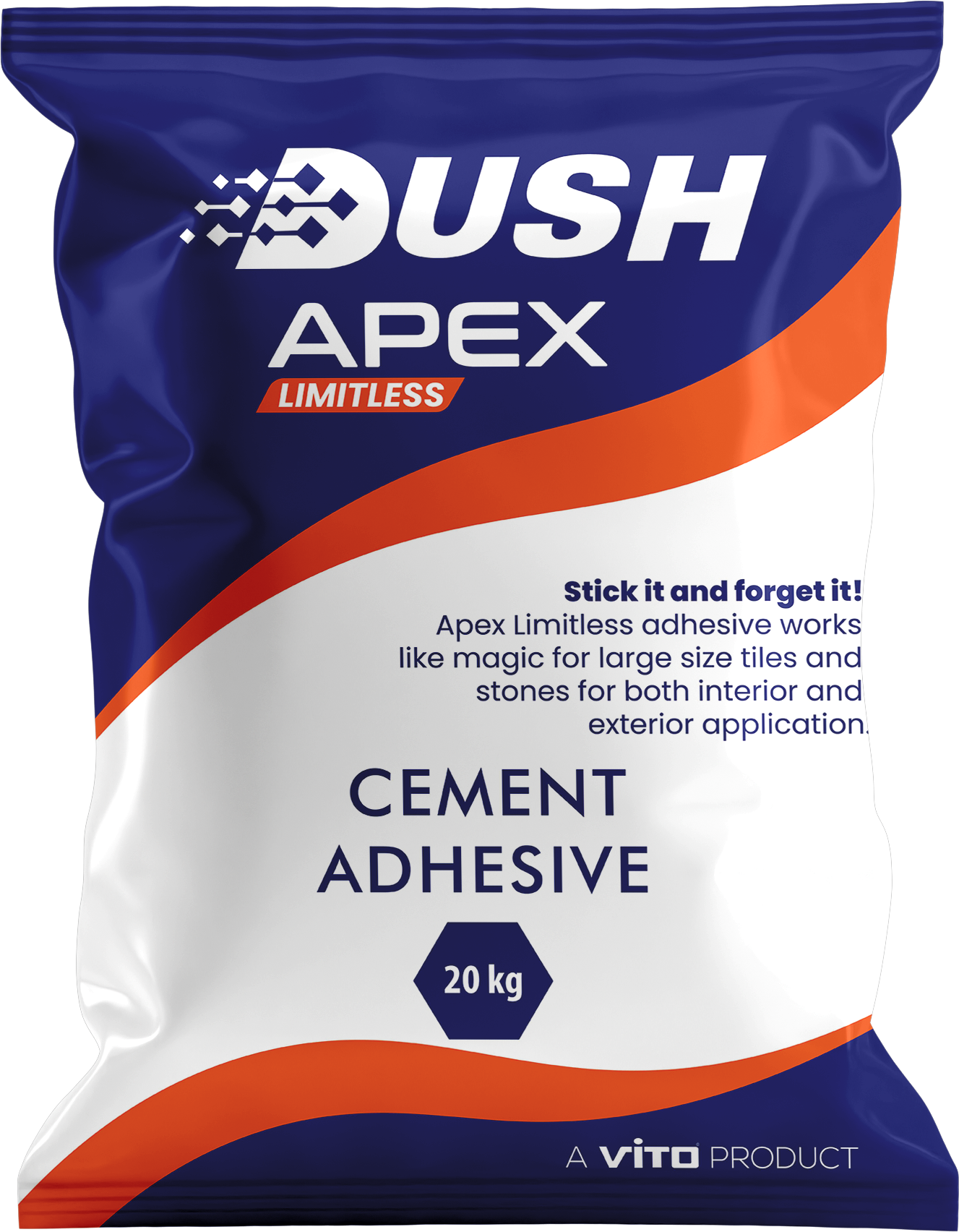
DUSH APEX is the current general exterior-marble product in the DUSH range. Its page positions it as a high-performance white cement adhesive for exterior marble and natural stone, with applications including façades, courtyards, garden feature walls and exterior staircases. It publishes white colour and 4 sq.m/kg coverage. [1]
Exterior installation adds thermal cycling, rain, UV exposure and greater movement than a controlled interior. DUSH's current APEX page explicitly frames those as the reason for using an exterior-rated system rather than an interior/general adhesive. [1]
Use APEX as the first review point for:
- Exterior Italian marble staircases.
- Outdoor courtyard marble.
- Garden feature walls.
- Low- and mid-rise exterior wall stone where the complete design allows adhesive fixing.
- Exterior natural stone where a white cement base is desired.
Exterior projects still need waterproofing/drainage and movement design where relevant. LATICRETE's exterior installation guidance emphasises water management and movement joints as part of the complete assembly rather than properties that adhesive alone can replace. [23] [24]
Exterior Vertical Cladding
When Should You Consider DUSH APEX INSTANT for Italian Marble?
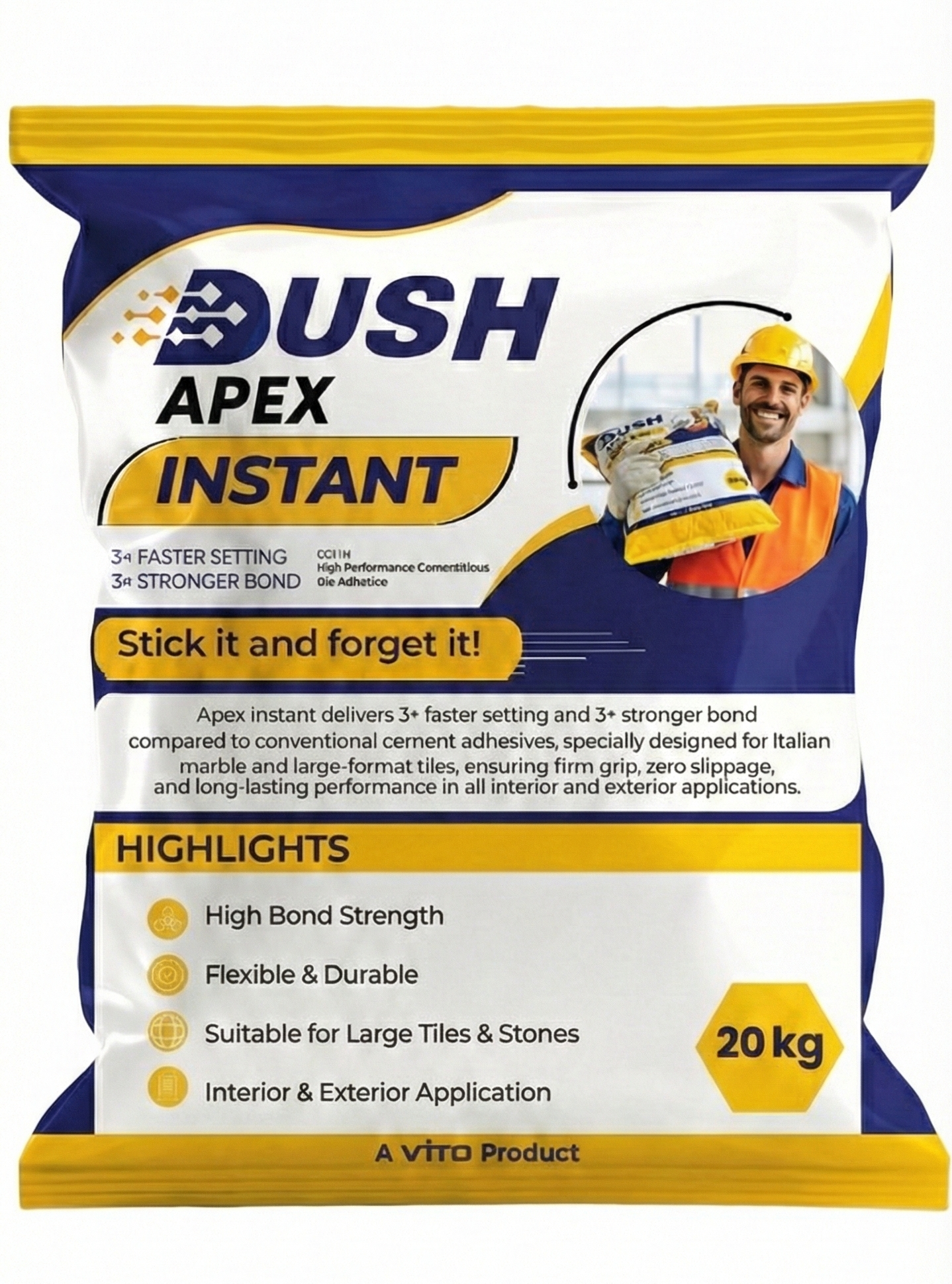
APEX INSTANT is positioned for a different site problem from standard APEX: rapid initial grip on exterior vertical marble and stone cladding. Its current product page publishes a rapid 15–20 minute initial set, white colour and exterior marble-cladding use. It also highlights anti-sag behaviour and reduced temporary propping time. [2]
That does not mean “fast set” is automatically better. Rapid systems shorten the working window, so mixing, troweling, back-buttering and panel placement have to be organised carefully. A large façade crew can benefit from faster grab; a small team doing intricate alignment may prefer more working time if the project permits it.
APEX INSTANT is most relevant when:
- The application is exterior and vertical.
- Marble panels are slipping before standard adhesive develops enough initial hold.
- Reducing propping/scaffolding dwell time is commercially important.
- The crew can work within the faster setting window.
- The project engineer/façade consultant has approved the complete fixing method.
DUSH's own page says full structural bond develops after the rapid initial grab, so early holding ability should not be confused with full cure. Temporary anchors or supports may still be required depending on panel size, height and project specification. [2]
High-Rise Façades
Which Adhesive Should Be Considered for Italian Marble on a High-Rise Building?
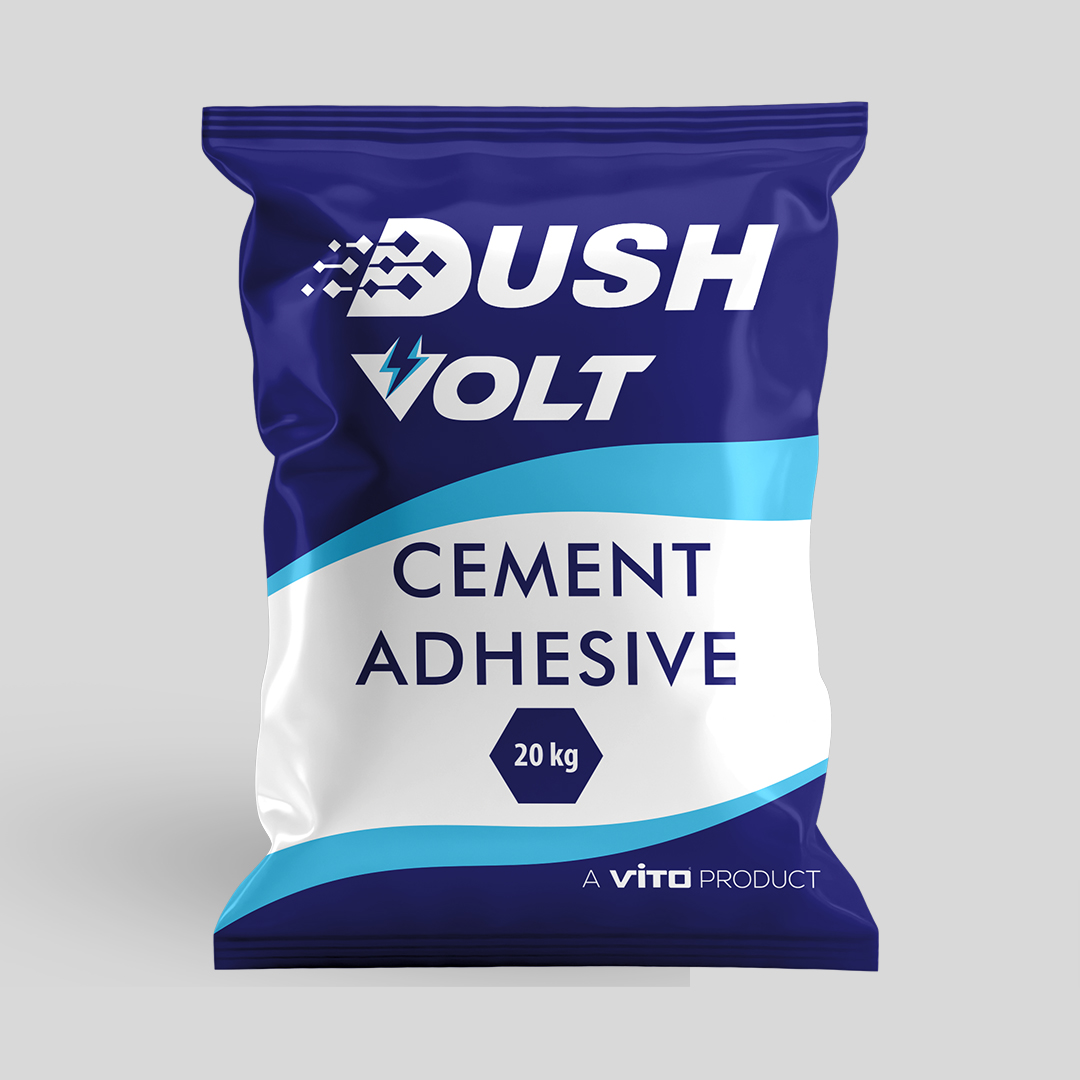
DUSH VOLT is the current DUSH product specifically positioned for high-rise marble and stone cladding. Its public page describes exterior façade use, white colour, high-rise positioning, vertical pull-out strength and wind-load resistance. It also instructs installers to use temporary anchors or mechanical fixings if required for the height of the project. [3]
The important point is that high-rise cladding is an engineered façade system, not just an adhesive choice. Wind pressure, panel dimensions, stone strength, anchors, substrate, joints, drainage and building movement must all be considered. A product page cannot replace façade calculations or consultant approval.
Natural Stone Institute's technical resource library treats vertical stone installation, anchorage and adhesives as dedicated design subjects, while LATICRETE's movement-joint guidance notes that wind, thermal movement, building deflection and moisture movement all contribute to stress in tile and stone installations. [13] [24]
White vs Grey Adhesive
Should White Italian Marble Be Fixed With White Cement Adhesive?
For pale, white or translucent marble, a white adhesive is usually the safer starting point because dark setting beds can influence the appearance of edges, joints or thin/translucent stone. DUSH's exterior APEX, APEX INSTANT, VOLT, OMNI and LITE pages all publish white colour; ERA is listed in grey/white. [1] [2] [3] [5] [6] [7]
Independent manufacturers follow the same visual principle. LATICRETE's LATAPOXY 300 specifically states that it is non-staining on white and light-coloured marble, while ARDEX Endura publishes white high-performance natural-stone adhesives for stable natural stone. [14] [26] [27]
However, white colour does not automatically make an adhesive technically correct. A white interior adhesive is not a substitute for an exterior-rated system, and a white cement mortar is not automatically suitable for moisture-sensitive or resin-backed marble.
White Marble Decision
Use colour as a visual compatibility filter, then choose the actual adhesive class from the application: interior wall/floor, large-format slab, exterior exposure, fast vertical cladding, high-rise façade, or specialist moisture-sensitive/resin-backed stone.
Complete Product Comparison
How Do All 7 DUSH Products Fit Into an Italian Marble Project?
Exterior Marble
DUSH APEX
Current DUSH positioning: premium white cement adhesive for exterior marble and natural stone, including façades, courtyards, feature walls and exterior staircases. Published coverage: 4 sq.m/kg. [1]
WhiteExteriorMarble & StoneView DUSH APEX →
Rapid Vertical Exterior
DUSH APEX INSTANT
Current DUSH positioning: rapid-grip white cement adhesive for exterior marble cladding, with a published 15–20 minute initial-set reference and anti-sag vertical use. [2]
White15–20 Min Initial SetExterior CladdingView DUSH APEX INSTANT →
High-Rise Façade
DUSH VOLT
Current DUSH positioning: specialised white adhesive for marble and stone cladding on high-rise exterior façades, with vertical pull-out/wind-load messaging and mechanical support where required. [3]
WhiteHigh-RiseExterior FaçadeView DUSH VOLT →
Verify Current TDS
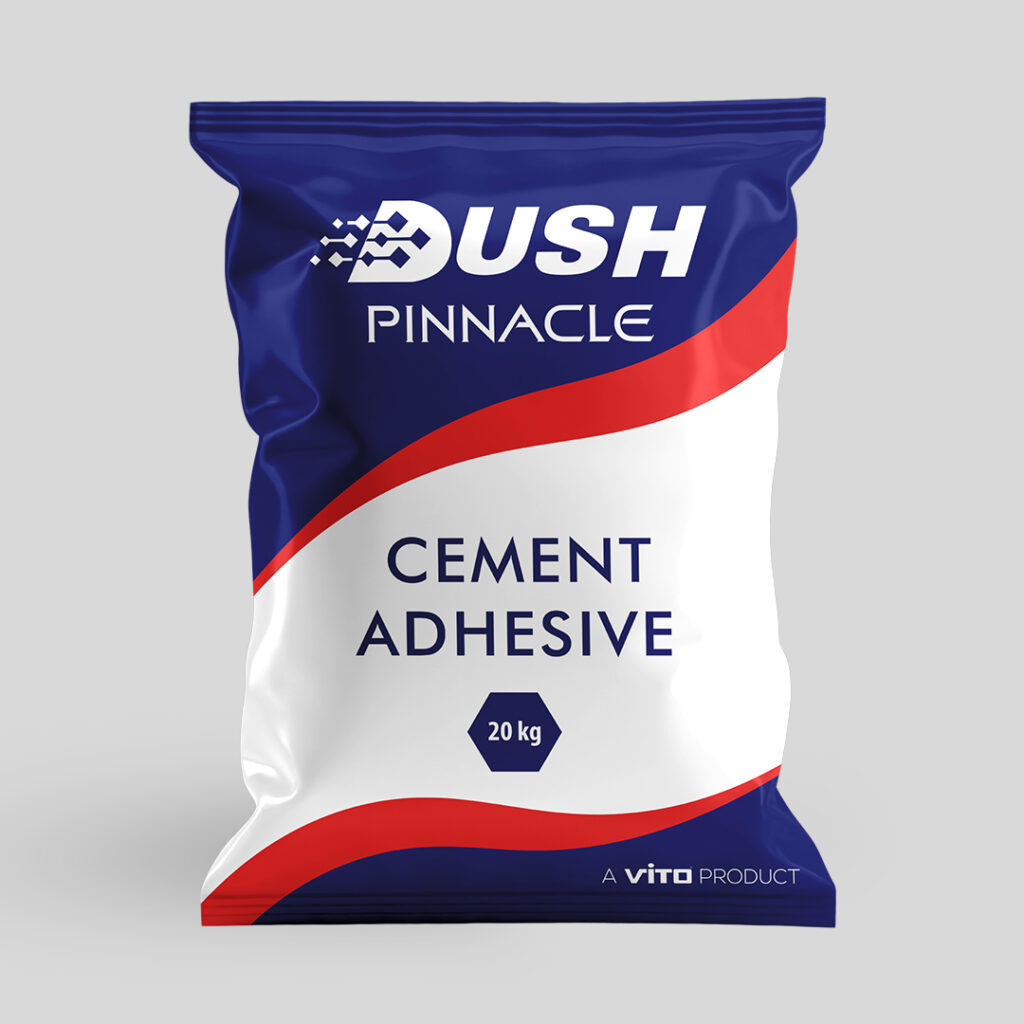
DUSH PINNACLE
PINNACLE remains part of the requested DUSH comparison. Its public product URL was not consistently retrievable during this research pass, so this article deliberately avoids inventing current coverage, classification or application claims. Use the latest DUSH PINNACLE TDS/technical recommendation before specification.
DUSH RangeTDS Check RequiredView DUSH PINNACLE →
Interior Wall & Floor
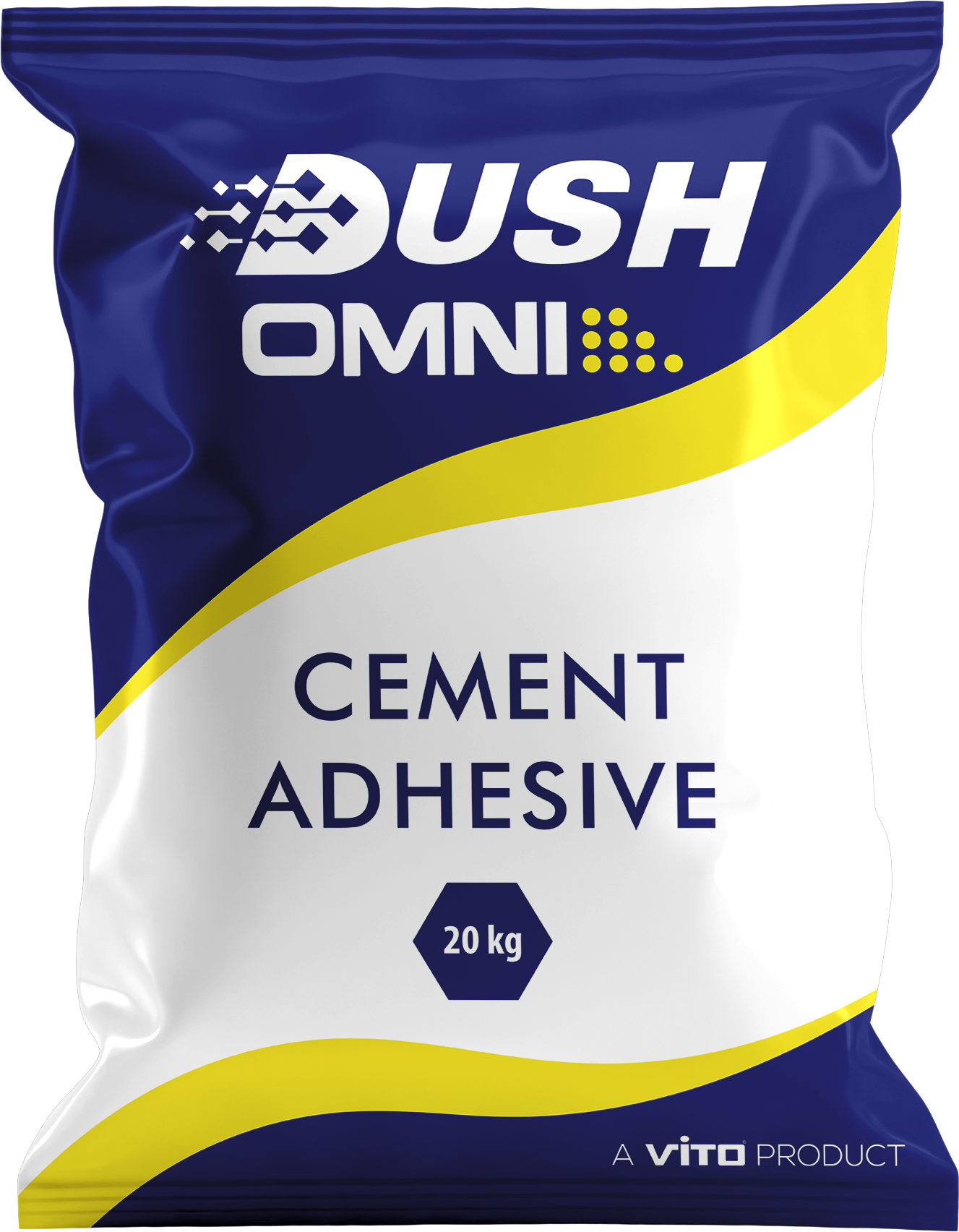
DUSH OMNI
Current DUSH positioning: white multi-purpose adhesive for suitable marble, ceramic and vitrified tiles on walls and floors. Published coverage: 4–5 sq.m/kg. Current page identifies interior use and applications such as bathrooms and living-room marble. [5]
WhiteInteriorWalls & FloorsView DUSH OMNI →
Large Format / Heavy Slab
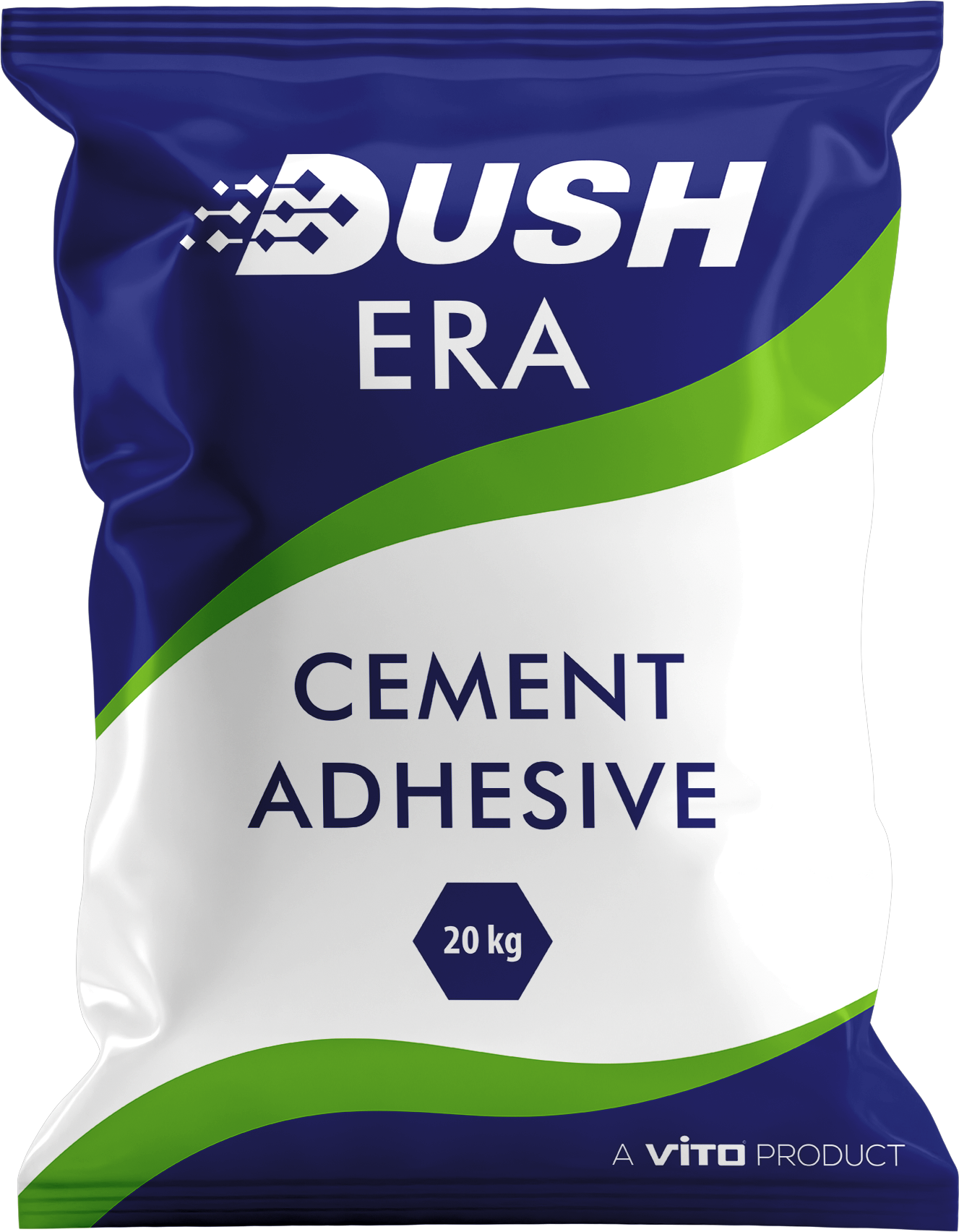
DUSH ERA
Current DUSH positioning: large-format marble and tile adhesive with anti-lippage formula, full-coverage bed, high initial grab and heavy-slab suitability. Published coverage: 3–4 sq.m/kg. [6]
Grey / WhiteLarge FormatHeavy SlabsView DUSH ERA →
Interior Wall & Floor
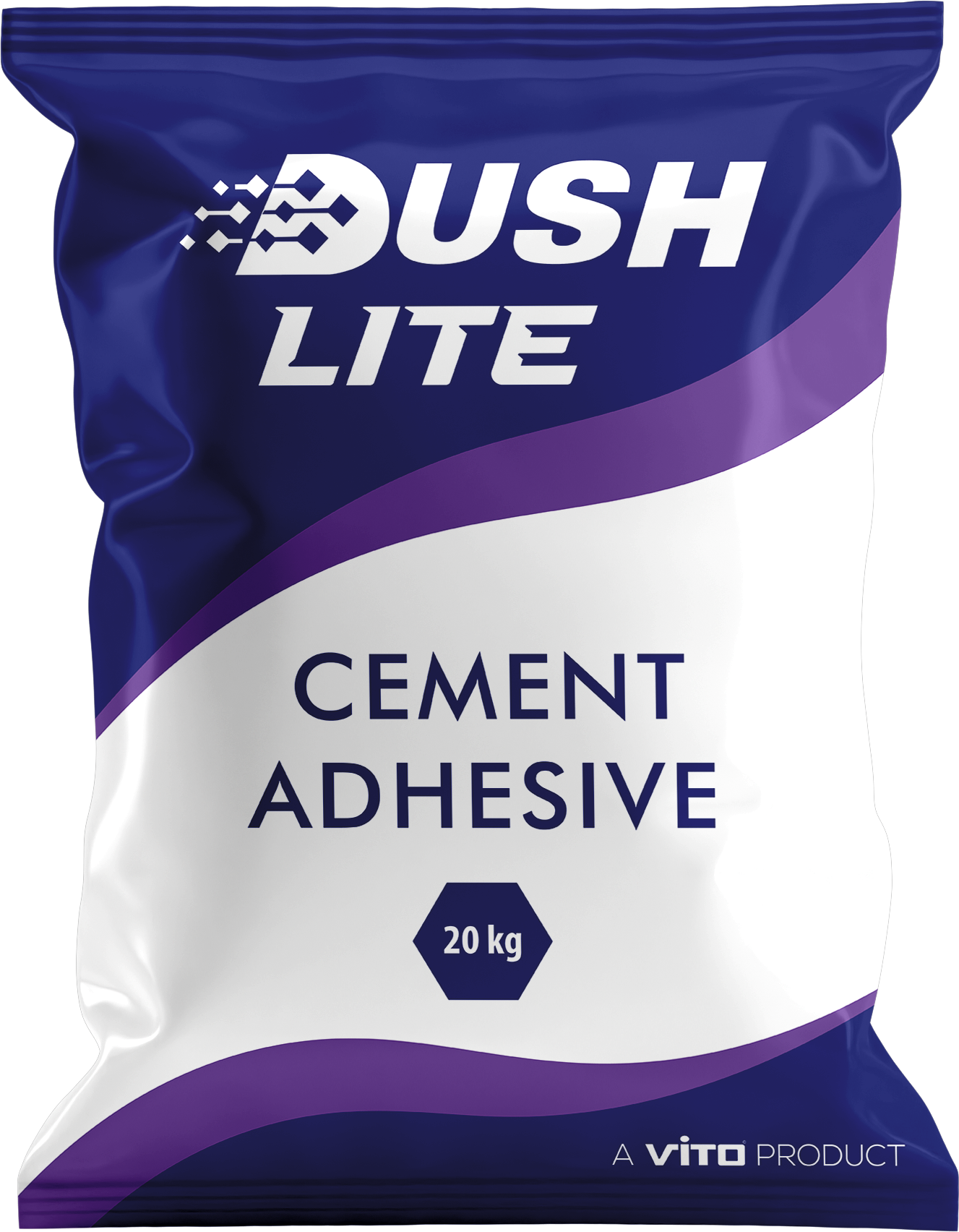
DUSH LITE
Current DUSH positioning: premium white cement-based multi-purpose adhesive for suitable marble, ceramic and vitrified wall/floor applications, with 4–5 sq.m/kg published coverage. Its public positioning substantially overlaps OMNI, so compare the latest TDS before choosing between them. [7]
WhiteWalls & FloorsMulti-PurposeView DUSH LITE →
Installation Quality
What Makes Italian Marble Bond Properly Besides Choosing the Right Adhesive?
The adhesive bag is only one part of the installation. Poor substrate preparation, low contact coverage, skinned-over mortar, incorrect trowel size or missing movement joints can cause problems even when the product itself is suitable.
1. Prepare a sound, flat substrate
Remove dust, oil, loose plaster and contaminants. Large marble slabs magnify substrate irregularities, so correct serious unevenness before bonding. MAPEI's installation guidance emphasises matching the setting material to both the finish and substrate. [22]
2. Mix to the current DUSH TDS
Do not add extra cement, sand or improvised additives. Incorrect water ratio can change sag, open time and final performance.
3. Use a notched trowel and directional ridges
Key mortar into the substrate, then comb in consistent parallel ridges. Directional ridges collapse more predictably when the slab is moved across them.
4. Back-butter Italian marble—especially large units
DUSH's current pages repeatedly recommend back-buttering large marble slabs. Natural Stone Institute guidance also supports back-buttering stone to increase contact. [1] [2] [3] [5] [6] [11]
5. Check transfer by lifting a sample slab
Do not judge coverage from the amount of mortar used. Periodically lift a freshly placed unit and inspect whether ridges have collapsed and the back is adequately supported. [21] [22]
6. Respect open time
If the adhesive has skinned over, pressing marble into it will not recreate proper transfer. Work in smaller areas when site heat or wind shortens open time.
7. Keep movement joints functional
Movement joints are required because buildings and finishes move. LATICRETE's technical note explains that thermal movement, moisture change, live/dead loads, wind and building movement can all create stress; if that stress is restrained, cracking or delamination can result. [24]
10 Common Mistakes
What Causes Italian Marble Adhesive Failures?
These are also the areas that make a good technical consultation valuable. Instead of asking “which bag is strongest?”, ask “which complete installation system matches this exact marble and location?”
India / GEO Search Intent
How Should Italian Marble Adhesive Be Selected for Projects Across India?
The core technical rules do not change by city, but site conditions do. Bengaluru projects may involve premium apartments and villas; Hyderabad and Chennai may combine interior luxury marble with higher exterior heat exposure; Mumbai projects can add coastal humidity and high-rise façade requirements. Product choice should therefore remain tied to the actual installation rather than a city label.
DUSH's current product pages state pan-India shipping and reference professional use across Bengaluru, Hyderabad, Chennai and Mumbai. [1] [2] [3] [5] [6] [7]
For SEO, this article is intentionally built to answer searches such as “best Italian marble adhesive in India,” “white adhesive for Italian marble,” “Italian marble wall adhesive Bangalore,” “large marble adhesive Hyderabad,” “exterior marble adhesive Chennai” and “high-rise marble cladding adhesive Mumbai.”
DUSH Italian Marble Selection
Send the Marble Details Before You Buy the Adhesive
Share the marble name, slab dimensions, thickness, back-side photo, wall/floor location, interior/exterior condition, substrate, project height and city. DUSH can then recommend which product should be reviewed and whether the stone needs a specialist system.
AEO / People Also Ask
Best Adhesive for Italian Marble — Frequently Asked Questions
1. Which adhesive is best for Italian marble in India?
There is no single adhesive for every Italian-marble application. For suitable interior wall/floor marble, start by reviewing DUSH OMNI or LITE; for large/heavy slabs, review ERA; for exterior marble, review APEX; for rapid exterior vertical cladding, review APEX INSTANT; and for high-rise façade work, review VOLT as part of the complete engineered system.
2. Is white cement adhesive better for Italian marble?
White adhesive is generally the safer visual starting point for white, cream and translucent marble because it reduces the risk of a dark setting bed influencing the finished appearance. Technical suitability still depends on slab size, backing, moisture sensitivity and location.
3. Which DUSH adhesive is suitable for large Italian marble slabs?
DUSH ERA is currently positioned specifically for large-format marble and tile, with anti-lippage and full-support messaging. Confirm the exact slab dimensions, weight, backing, substrate and latest TDS before approval.
4. Which DUSH adhesive is suitable for exterior Italian marble?
DUSH APEX is the current general exterior-marble and natural-stone adhesive in the DUSH range. Exterior installation still requires the correct substrate, drainage/waterproofing where needed and movement detailing.
5. What is DUSH APEX INSTANT used for?
DUSH APEX INSTANT is positioned for exterior vertical marble and stone cladding where rapid initial grip is important. Its current product page publishes a 15–20 minute initial-set reference.
6. What is DUSH VOLT used for?
DUSH VOLT is positioned for high-rise marble and stone façade cladding. It should be used only within the complete project-approved façade design, including mechanical support where required.
7. Can DUSH OMNI be used for Italian marble floors?
OMNI's current public page positions it as a white multi-purpose interior wall-and-floor adhesive for suitable marble, ceramic and vitrified tiles. Very large/heavy slabs or moisture-sensitive/resin-backed marble may require a different system.
8. Can DUSH LITE be used for Italian marble?
LITE's current public page positions it as a white multi-purpose cement-based adhesive for suitable marble, ceramic and vitrified wall/floor applications. Its current online positioning overlaps OMNI, so use the latest DUSH TDS to decide between them.
9. Can a normal cement adhesive be used for resin-backed Italian marble?
Not automatically. Resin or fiberglass mesh on the back can change bond compatibility. Natural-stone guidance and specialist adhesive manufacturers often recommend epoxy/reaction-resin systems for certain resin-backed or moisture-sensitive stone.
10. Can cement adhesive make Italian marble warp or stain?
Some moisture-sensitive marble can darken, stain, curl or warp when exposed to water-based installation materials. The stone supplier and adhesive technical team should confirm compatibility before installation.
11. Does Italian marble need back-buttering?
Back-buttering is strongly recommended for many natural-stone and large-format installations because it helps achieve high contact coverage and more uniform support behind the slab.
12. How much mortar coverage is required behind Italian marble?
Natural-stone installations generally require very high contact coverage, especially in wet or exterior work. Industry technical guidance commonly targets around 95% contact in demanding conditions; verify the project standard and product instructions.
13. Can tile adhesive be used to level a badly uneven floor?
Only within the permitted bond thickness of the selected product. Significant unevenness should normally be corrected with appropriate substrate preparation or levelling rather than using adhesive as an unlimited levelling compound.
14. Is adhesive alone enough for high-rise Italian marble cladding?
No. High-rise natural-stone façades may require engineered mechanical anchors, wind/load calculations, movement detailing, substrate verification and project-specific testing in addition to the adhesive.
15. How do I get the correct DUSH adhesive recommendation?
Share the marble name, size, thickness, backing photo, interior/exterior location, wall/floor orientation, substrate, building height and city. The DUSH technical team can then identify which product and system should be reviewed.
Do Not Choose Italian Marble Adhesive From the Bag Name Alone
Choose from the stone, slab size, backing, substrate, wall/floor orientation, exposure and building height. For expensive imported marble, verify the current TDS and test the stone before full installation.
38 Technical Citations
Sources & Technical References
DUSH product statements are based on the current public product pages available during this review. The PINNACLE URL is included because it is part of the requested DUSH range, but its public page was not consistently retrievable; current PINNACLE specification should therefore be confirmed from DUSH directly. External sources support general tile/natural-stone installation principles and do not certify DUSH products.
- DUSH — DUSH APEX, premium exterior marble cement adhesive.
- DUSH — DUSH APEX INSTANT, fast-set exterior marble cladding adhesive.
- DUSH — DUSH VOLT, high-rise marble cladding adhesive.
- DUSH — DUSH PINNACLE product URL supplied for this range comparison.
- DUSH — DUSH OMNI, multi-purpose tile & marble adhesive.
- DUSH — DUSH ERA, large-format marble & tile adhesive.
- DUSH — DUSH LITE, premium cement-based tile & marble adhesive.
- Bureau of Indian Standards — Product Manual for IS 15477:2019, adhesives for ceramic, mosaic and stone tiles.
- BIS — Product Manuals directory listing IS 15477:2019.
- ISO — ISO 13007-1:2014, terminology and performance requirements for ceramic-tile adhesives.
- Natural Stone Institute — Homeowner's Guide: stone installation, back-buttering and resin-backed stone guidance.
- Natural Stone Institute — Residential Stone Technical Module.
- Natural Stone Institute — Dimension Stone Design Manual resource library.
- LATICRETE — LATAPOXY 300 Adhesive for moisture-sensitive marble and resin-backed stone.
- LATICRETE — LATAPOXY 300 technical data: white/light marble, resin-backed stone and moisture-sensitive marble.
- Sika India — SikaCeram-428 Super Bond T polyurethane adhesive for damp-sensitive marble.
- MAPEI — Large Tile & Stone Mortar for large-format and heavy tile/stone.
- MAPEI — Ultraflex LHT large-and-heavy tile mortar.
- Sika — SikaTile 450 LHT Secure Set for large/heavy tile and natural stone.
- MAPEI — System for installing moisture-sensitive stone in non-submerged wet areas.
- LATICRETE — TDS 196: mortar contact coverage and trowel/coverage guidance.
- MAPEI — Tile Installation Basics: substrate, setting-material selection, coverage and back-buttering.
- LATICRETE — Exterior tile/stone waterproofing and water-management guidance.
- LATICRETE — Why Movement Joints Are Needed in Tile and Stone Installations.
- LATICRETE — Movement and expansion-joint systems.
- ARDEX Endura — Platinum Star Plus White, C2TE S1 / Type 4TS1 natural-stone adhesive example.
- ARDEX Endura — ArdiFlex S1 White, deformable white tile/stone adhesive.
- MAPEI — Ultraflex LFT premium large-and-heavy tile mortar.
- MAPEI — Large and Heavy Tile Mortar Basics.
- Sika — SikaCeram 217 multipurpose interior/exterior tile adhesive reference.
- Sika — SikaCeram FLX 25 flexible tile/stone adhesive reference.
- ASTM International — ASTM C482, bond strength of ceramic tile to Portland-cement paste.
- Natural Stone Institute — Care & Cleaning of Natural Stone.
- Natural Stone Institute — Sealing Natural Stone.
- Natural Stone Institute — Stain identification and natural-stone behaviour.
- DUSH — Building façade marble adhesive guide.
- DUSH — APEX Technical Evidence Centre and current documentation caveats.
- DUSH — Marble adhesive brands/application comparison article.